The all-reserved Limited Express Hokuto runs 11 times daily between Sapporo and Hakodate in as little as 3 hours 29 minutes for ¥9,770 one-way. Compare schedules, dynamic highway bus fares from ¥3,530 to ¥5,990, New Chitose Airport transfers, Shinkansen connections, and winter weather checks.
- Region & Focus
- Hakodate
- Reading Scope
- 15 min read · 7 chapters · 4 Q&As
- Official Verification
- 9 official sources checkedUpdated November 20, 2026
- Key Topics
- Rail travelItinerariesHokkaido
Chapter Route Map (tap any stop)
- Limited Express Hokuto: The All-Reserved Backbone
- Timetable Rhythm: Making the 11 Daily Trains Work
- From New Chitose Airport: The Minami-Chitose Transfer
- Kosoku Hakodate-go Highway Bus: Dynamic Fares and 4 Daily Runs
- Hakodate-Side Transfers: Shin-Hakodate-Hokuto and Hakodate Liner
- Budget Alternatives: All-Local Trains and Suzuran Combos
- Winter Operations: Day-Of Checks for Heavy Snow
- Quick Q&A
Sapporo and Hakodate sit roughly 319 kilometers apart, linked primarily by JR Hokkaido's all-reserved Limited Express Hokuto. Eleven trains run daily in 3 hours 29 minutes to 3 hours 59 minutes for ¥9,770 in standard reserved seating. Budget travelers can opt for the Kosoku Hakodate-go highway bus, which runs four round trips a day in roughly 5.5 to 6 hours with dynamic fares starting at ¥3,530. From New Chitose Airport, there is no direct train—you must ride three minutes to Minami-Chitose and transfer, taking just over four hours total. This guide lays out exact timetables, fare breakdowns, bus comparisons, Shinkansen connections at Shin-Hakodate-Hokuto, and day-of winter snowstorm checks so you can lock in the right departure and ticket with confidence.
Limited Express Hokuto: The All-Reserved Backbone
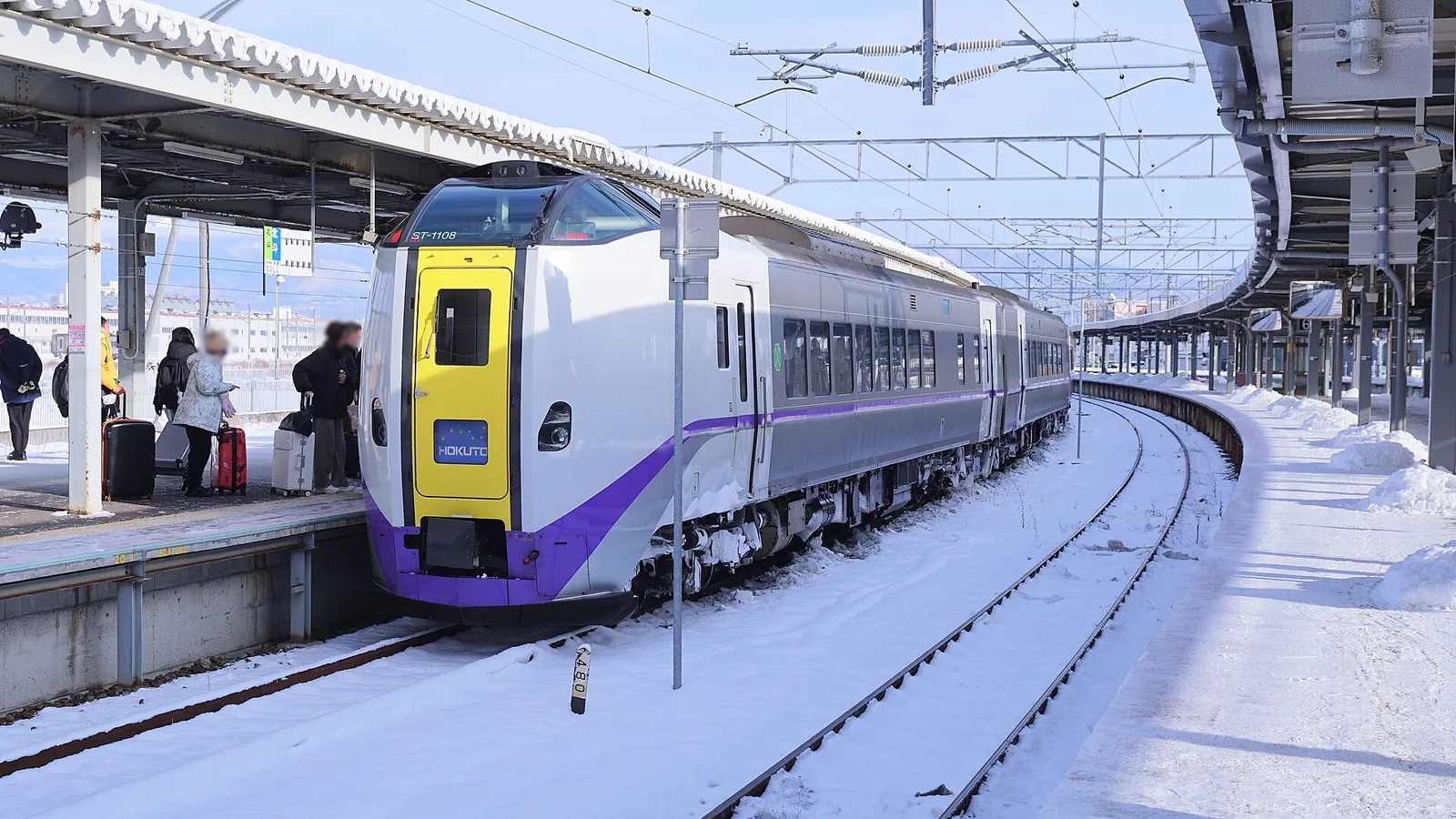
Operated by JR Hokkaido, the Limited Express Hokuto connects Sapporo and Hakodate while serving as Southern Hokkaido's main feeder for the Hokkaido Shinkansen. Every train uses KiHa 261-1000 series diesel railcars running via the Chitose, Muroran Main, and Hakodate Main lines through Tomakomai, Higashi-Muroran, Oshamambe, Shin-Hakodate-Hokuto, and Goryokaku. After leaving the plains around Chitose Airport, the route turns inland past the foothills of Mount Komagatake and hugs the Funka Bay coastline into Southern Hokkaido—a scenic stretch JR Hokkaido highlights directly on its train guide as showcasing magnificent views of Mount Komagatake and Funka Bay.
One rule governs the entire line: every car is reserved seating only. Standard cars carry zero unreserved seats, meaning you must hold a seat reservation before boarding regardless of departure time or season. Over the official 318.7-kilometer route between Sapporo and Hakodate, JR Hokkaido's fare calculator puts the one-way total at ¥9,770—made up of a ¥6,600 basic fare (identical whether paid by paper ticket or IC card) plus a ¥3,170 standard reserved-seat limited express surcharge. Upgrading to the Green Car raises the limited express surcharge to ¥6,830, bringing the one-way total to ¥13,430. Green Cars feature leather or woven fabric seats depending on the train set and include laptop power outlets, while standard reserved seats provide adjustable headrests, cup holders, and seat-back ticket clips that make a noticeable difference on a three-and-a-half-hour ride.
Because every ticket is tied to a specific train and seat, peak morning departures and evening returns on weekends or holidays frequently sell out. Booking as soon as your dates are set is the safest approach, using one of three channels: reserving online via Ekinet linked from JR Hokkaido's website to lock in round-trip seats ahead of departure, using JR Hokkaido's mobile Limited Express e-Pass to tap through ticket gates on your phone without paper tickets, or buying seats after arrival at station reserved-seat ticket machines, which support English and Traditional Chinese interfaces and operate much like JR East machines.
Whether to pay extra for the Green Car comes down to timing and recovery. Standard reserved seating with adjustable headrests and cup holders handles a 3.5-hour daytime trip easily. The Green Car premium buys extra legroom, leather seating, and quieter rest—worth considering if you arrive late and have an early start the next morning, whereas daytime travelers would rather put that ¥3,660 difference toward seafood at Hakodate Morning Market. In either class, the ¥6,600 basic fare remains fixed, so changing to another train only requires adjusting the seat reservation portion.
Onboard amenities noted in JR Hokkaido's official train guide include u-seat sections with configurable seating directions for either facing groups or quiet solo travel, an unreserved multi-purpose room for nursing or passengers feeling unwell, dedicated luggage storage rooms so bulky winter suitcases do not crowd your feet, and a strict nonsmoking policy throughout. JR Hokkaido also notes that standard train formations are subject to change, meaning the exact car layout on a given Hokuto departure can vary by date; reconfirm car details before boarding if you need specific seating or luggage space.
The all-reserved Limited Express Hokuto runs 11 times daily between Sapporo and Hakodate in as little as 3 hours 29 minutes for ¥9,770 one-way. Compare schedules, dynamic highway bus fares from ¥3,530 to ¥5,990, New Chitose Airport transfers, Shinkansen connections, and winter weather checks.
Timetable Rhythm: Making the 11 Daily Trains Work
According to JR Hokkaido's official timetable system (Friday, November 20, 2026 edition, matching the October 23 daily schedule), 11 southbound trains leave Sapporo for Hakodate each day at 6:00, 6:53, 8:43, 9:45, 10:56, 12:09, 13:26, 14:46, 15:45, 16:51, and 18:46, arriving in Hakodate at 9:29, 10:38, 12:33, 13:35, 14:40, 16:08, 17:13, 18:30, 19:29, 20:39, and 22:31. The fastest run is Hokuto 2 at 6:00 in 3 hours 29 minutes; most other departures take 3 hours 45 minutes to 3 hours 59 minutes, so plan on 3.5 to 4 hours plus transfer buffers.
Northbound service from Hakodate to Sapporo likewise runs 11 times daily, departing at 6:02, 7:37, 8:56, 10:05, 10:45, 12:14, 13:31, 15:01, 16:40, 17:55, and 18:43, reaching Sapporo at 9:47, 11:29, 12:41, 14:01, 14:41, 16:03, 17:30, 18:47, 20:36, 21:41, and 22:41. That final 18:43 departure arriving in Sapporo at 22:41 is a hard cutoff: miss it and you will need an extra night in Hakodate. In winter, calculate Mount Hakodate ropeway hours backward against that 18:43 last train.
Those departures support two distinct trip styles. A same-day round trip requires catching the 6:00 first train into Hakodate by 9:29, touring the morning market and downtown before noon, visiting Mount Hakodate or Motomachi in the afternoon, and catching the 18:43 last train back—an exhausting dawn-to-midnight push. Staying at least one night is far smoother: take the 10:56 or 12:09 train to reach Hakodate at 14:40 or 16:08 in time for dusk views and night scenery, then catch a morning train by 10:05 the next day to return to Sapporo around midday. Hakodate's spread-out sights naturally reward an overnight stay.
Several departures play specific tactical roles. The 6:00 train is the sole anchor for a full day trip; miss it and you do not arrive until 12:33. The 8:43 train is the classic post-breakfast departure arriving right around lunch. The 15:45 and 16:51 trains put you in Hakodate at 19:29 or 20:39 for late-evening Mount Hakodate views, while the 18:46 final departure arrives at 22:31 for travelers spending a full day in Sapporo first—just confirm late hotel check-in deadlines and taxi availability beforehand.
Calling patterns vary slightly by train—JR Hokkaido explicitly notes that stops vary by train—with primary intermediate stops at Shin-Sapporo, Chitose, Minami-Chitose, Tomakomai, Higashi-Muroran, Toya, Oshamambe, Shin-Hakodate-Hokuto, and Goryokaku. Because the line cuts across all of Southern Hokkaido, changing to a branch line at Higashi-Muroran reaches Noboribetsu Onsen, stepping off at Toya accesses Lake Toya Onsen, and transferring at Oshamambe leads onto the coastal Hakodate Main Line, allowing a clean one-way Sapporo-to-Hakodate routing with zero backtracking. Compare Lake Toya and Noboribetsu side by side in Southern Hokkaido Resort and Onsen Bases.
The same timetable also displays the Limited Express Suzuran running 6 daily round trips between Sapporo, Higashi-Muroran, and Muroran. It does not continue to Hakodate, but if Hokuto sells out and you are only headed as far as Noboribetsu or Higashi-Muroran, Suzuran doubles your options for breaking up the journey.
Watch for one quirk between JR Hokkaido's two online search tools: the route-search calculator occasionally displays total elapsed time as "258 minutes," whereas the official timetable lists the exact same train at 3 hours 50 minutes. Always build your itinerary from actual departure and arrival clock times in the timetable system rather than raw minute totals on the route finder.
From New Chitose Airport: The Minami-Chitose Transfer
Start with the basic constraint: there is no direct train between New Chitose Airport and Hakodate. Every rail itinerary begins with a 3-minute ride on the Rapid Airport train to Minami-Chitose Station, followed by a transfer to the southbound Limited Express Hokuto. According to JR Hokkaido's route search, the fastest connection takes about 4 hours 4 minutes and costs ¥8,910 total (¥5,960 basic fare plus ¥2,950 reserved-seat surcharge, or ¥6,610 extra for Green Car). The top five search results all price at ¥8,910; only when Hokuto sells out does the system suggest a two-transfer detour via Tomakomai at ¥10,070, so sticking to the single transfer at Minami-Chitose is both faster and cheaper.
On the ground, timing the connection is what matters most. Minami-Chitose is a compact junction station with short platform walks between Rapid Airport and Hokuto, but the two services are not clocked to match every arrival. Look up your exact Hokuto departure from Minami-Chitose while still inside the airport terminal, then board the matching Rapid Airport train so you do not end up waiting half an hour on the platform with heavy luggage. That 3-minute airport hop goes by quickly even standing, and boarding at Minami-Chitose avoids the hassle of transferring through crowded Sapporo Station.
Whether to head straight to Hakodate on arrival day depends entirely on your touchdown time. Flights landing before noon can transfer smoothly at Minami-Chitose in 4 hours 4 minutes, reach Hakodate by late afternoon, and catch the night view over dinner while resting on the train after the flight. Afternoon or evening arrivals risk missing the last southbound Hokuto connection; in that case, ride into Sapporo for the night and start fresh the next morning—see New Chitose Airport to Sapporo and Otaru Transfers for airport-to-city logistics. If you insist on zero transfers after landing, the Kosoku Hakodate-go highway bus stops directly at the airport and runs all the way to Hakodate.
Handle both tickets together at the airport. While an IC card works through the gates for the 3-minute Rapid Airport hop, boarding Hokuto at Minami-Chitose requires a reserved-seat limited express ticket. Buy the full through-ticket and seat reservation at the JR New Chitose Airport Station ticket office or machines so you can simply change platforms at Minami-Chitose without stopping to buy a second ticket. Since the top five itineraries cost the exact same ¥8,910, pick whichever gives the shortest layover.
The reverse connection works just as cleanly for departures out of New Chitose Airport. Catching the 6:02 first Hokuto north from Hakodate brings you through Minami-Chitose around 9:30 a.m. in plenty of time for midday flights, while the 8:56 or 10:05 trains comfortably cover afternoon departures. Next, look at the short shuttle link between downtown Hakodate and the Shinkansen terminal.
Kosoku Hakodate-go Highway Bus: Dynamic Fares and 4 Daily Runs
The main budget alternative to rail is Hakodate Bus's Kosoku Hakodate-go highway bus. It runs four round trips daily from Sapporo Ekimae via the Chuo Bus Sapporo Terminal and Oyachi, then stops at New Chitose Airport, Yakumo, the Mori area, and Shin-Hakodate-Hokuto Station before ending at Hakodate Ekimae Terminal and Yunokawa Onsen Higashi. Those stops solve two specific problems: travelers heading straight to Yunokawa's hot springs can stay on until Yunokawa Onsen Higashi and skip a local transfer in Hakodate, while Shinkansen passengers can get off directly at Shin-Hakodate-Hokuto without detouring through downtown Hakodate.
Travel time ranges from 5 hours 20 minutes to 6 hours—for example, departing Sapporo Ekimae at 6:45 and reaching Hakodate Ekimae at 12:05 (about 5 hours 20 minutes), or leaving Hakodate Ekimae at 7:18 and arriving in Sapporo at 13:20 (about 6 hours). In exchange for spending an extra 1.5 to 2 hours on the road, dynamic pricing cuts costs dramatically: online bookings run ¥3,530 to ¥5,990 depending on booking date and payment method, counter walk-ups cost a flat ¥5,990, and student fares run ¥3,180 to ¥5,390 online (¥5,390 at counters). Book early and you can pay under 60% of the Hokuto train fare; wait until departure day and the savings shrink fast.
Coaches feature 3-abreast independent seats, an onboard restroom, free Wi-Fi, power outlets or USB ports, and footrests (exact configurations vary by vehicle), turning a five-plus-hour ride into a comfortable stretch for sleeping or laptop work. Travelers prone to motion sickness should request front window seats. Tickets can be booked via Hassha Orai Net, Bus Plaza, Lawson convenience store kiosks, or by phone with Hakodate Ekimae Bus Terminal (0138-22-3265) and the Chuo Bus Sapporo Terminal reservation center (0570-200-600).
Check one schedule update before heading to the bus stop: Hakodate Bus announced that Sapporo-side boarding locations changed starting September 14, 2026 (including boarding bay changes inside Sapporo Terminal). Always verify the current bay on Hakodate Bus's official site rather than following outdated blog maps. Also remember that highway buses use the Do-O Expressway; heavy winter snowstorms can close the expressway and delay or cancel buses, and road recovery often lags behind rail restoration.
In practice, pairing the bus with the train works well. Students get strong value at ¥3,180 to ¥5,390, and budget-minded travelers often ride Hokuto one way in 3.5 hours to maximize sightseeing and take the bus the other way to put the savings toward dinner. Guests staying in eastern Sapporo can board at Oyachi to skip downtown traffic, while passengers boarding mid-route at New Chitose Airport should wait at the stop at least 20 minutes early—with only four departures a day, missing one means a two- to three-hour wait.
Hakodate-Side Transfers: Shin-Hakodate-Hokuto and Hakodate Liner
Hokkaido Shinkansen trains stop at Shin-Hakodate-Hokuto Station outside downtown, leaving three rail links into Hakodate Station. The standard choice is the Hakodate Liner shuttle on the Hakodate Main Line, taking roughly 22 minutes for ¥470 (same fare with an IC card) with departures synced directly to Shinkansen arrivals and departures (such as 9:32 and 10:00), making luggage transfers effortless with a single IC tap.
The second option is riding the Limited Express Hokuto for that single hop, which takes around 19 minutes—just three minutes faster—but adds an ¥850 reserved-seat surcharge. Paying ¥850 extra to save three minutes rarely makes sense unless you hold a rail pass covering limited express seats or hit an exact schedule gap where no Liner is running. The third option is the local train routed via Oshima-Sawara, which also costs ¥470 but takes 82 minutes; save it for rare missed connections when you want a slow rural-and-coastal loop.
Heading south on the Shinkansen, Hayabusa and Hayate trains connect Shin-Hakodate-Hokuto directly with Shin-Aomori and Tokyo. Using the Hakodate Liner plus the Shinkansen gives travelers a clean rail corridor to and from Tokyo without circling back to Sapporo for a flight. Once you reach downtown, plan your sightseeing and evening viewpoints with Hakodate City and Seasonal Night Views.
Transfer timing at the station is straightforward because Shin-Hakodate-Hokuto connects directly to the Shinkansen concourse—simply follow the station boards inside the building. When departing Hakodate Station to catch a Shinkansen, board the Hakodate Liner at least 40 minutes before your Shinkansen departure (allowing 22 minutes of ride time plus platform walking). Coming the other way into town, tap an IC card for ¥470 and follow posted evening shuttle times.
Factor those local fares into your full budget so nothing surprises you. Riding Hokuto straight from Sapporo to Hakodate Station costs ¥9,770 total; adding a standalone hop between Hakodate and Shin-Hakodate-Hokuto adds ¥470 on the Hakodate Liner (22 minutes) or ¥850 in reserved-seat surcharge on Hokuto (19 minutes). Meanwhile, the Kosoku Hakodate-go bus stops directly at Shin-Hakodate-Hokuto Station, letting you stow luggage under the coach and ride straight to the Shinkansen entrance without an extra downtown transfer.
Budget Alternatives: All-Local Trains and Suzuran Combos
If time is flexible and keeping fares low is your top priority, you can ride local trains all the way from Sapporo via Otaru, Oshamambe, and Mori to Hakodate. With two transfers, the journey takes about 7 hours 25 minutes and costs ¥6,270—saving ¥3,500 compared with Hokuto while more than doubling travel time. Its appeal lies in the unhurried scenery: hugging Ishikari Bay between Sapporo and Otaru, winding past orchards and mountain hamlets through Niki and Yoichi toward Oshamambe, running straight along the northern shore of Funka Bay to Mori, and skirting Mount Komagatake into Hakodate. It works best when the journey itself is part of the itinerary.
Splitting that 7.5-hour local ride across two days makes it far more enjoyable. Leave Sapporo in the morning, stow bags in Otaru for half a day around the canal and historic streets, ride the Hakodate Main Line south to Oshamambe in the afternoon, spend the night at Lake Toya or Oshamambe Onsen, and finish the final two to three hours into Hakodate the next morning. That single ¥6,270 itinerary effectively covers both Otaru and an onsen stop. Avoid grinding through all 7 hours 25 minutes in one sitting if you are short on time—arriving exhausted will eat straight into your first evening in Hakodate.
A middle-ground fallback pairs the Limited Express Suzuran with local trains: ride one of the six daily Suzuran departures from Sapporo to Higashi-Muroran, then switch to local trains via Oshamambe to Hakodate for roughly 8 hours total at ¥8,960. Since it is both slower and barely cheaper than Hokuto, treat it strictly as a backup when every Hokuto seat is sold out and you do not want to ride local trains the whole way. Another backup combines the Rapid Airport train with all-local connections for roughly 8 hours 33 minutes at ¥6,600.
Some travelers wonder whether flying domestically between Sapporo and Hakodate beats the train. In practice, ground transit wins on door-to-door simplicity: Hokuto puts you city-center to city-center in 3.5 hours, and even the highway bus takes 5 to 6 hours without airport security or terminal transfers at both ends, leaving domestic flights with little real-world advantage.
Your choice narrows cleanly to three paths: book the ¥9,770 all-reserved Limited Express Hokuto early if speed and heavy luggage matter; grab an early-bird Kosoku Hakodate-go bus ticket from ¥3,530 or split the ¥6,270 local rail route via Otaru and an onsen town if budget wins; and lock in Minami-Chitose or Shin-Hakodate-Hokuto transfer windows first if connecting from a flight or the Shinkansen. In winter, all three paths depend on the same final step: checking live operations on the morning you travel.
Winter Operations: Day-Of Checks for Heavy Snow
From December through March, Hokkaido's snow season brings recurring delays, cancellations, and rail-replacement buses on the Chitose, Muroran Main, and Hakodate Main lines. Rather than guessing reliability in advance, rely on JR Hokkaido's live train operations status pages—checking `webunkou` `area_donan` for Southern Hokkaido (including the Hakodate Main Line and Shinkansen shuttles) and `area_doo` for Central Hokkaido (covering the Chitose Line, Muroran Main Line, and Greater Sapporo). The status map flags suspended service, delays of 30 minutes or more, and bus substitutions in real time, and JR Hokkaido posts severe-weather banners on its homepage when low-pressure systems approach. Glance at the official legend PDF once beforehand so the status icons are immediately clear.
Run a simple three-check routine on travel day to stay ahead of disruptions. Check the forecast and homepage weather notices the night before to decide whether to leave on an earlier train; check live operations again from your hotel before heading out in the morning to confirm Hokuto is running or pivot immediately to the bus; and check once more before arriving at the station so you know whether your train is leaving on time or needs rebooking. Each check takes one or two minutes and beats discovering a cancellation board at the ticket gate.
If Hokuto is suspended or heavily delayed, the four-times-daily Kosoku Hakodate-go highway bus is your primary same-day backup—book immediately, as stranded rail passengers drive dynamic online fares up and sell out remaining seats within minutes during snowstorms. Your second option is flipping your itinerary order and pushing Hakodate later in the trip. When JR Hokkaido cancels a train, reserved-seat tickets can be refunded or rebooked free of charge onto a later departure the same day at station reserved-seat ticket machines or JR ticket counters, making advance reservations surprisingly protective in winter.
Do not blindly join the queue if station screens announce bus substitution. JR-arranged replacement buses run infrequently, often stop away from main station entrances, and crawl for hours over long gaps such as the Oshamambe stretch—feeling far slower than Hokuto. Check exactly which section is suspended first: if service is only disrupted between Sapporo and Minami-Chitose or Higashi-Muroran, routing around it via Suzuran or another open line may still work; if long-distance tracks into Hakodate are down, switching deliberately to the highway bus or shifting travel dates is usually smarter.
In winter, pad at least 30 to 60 minutes of buffer after Hokuto's scheduled arrival before fixed commitments like Mount Hakodate ropeway evenings or next-morning flights, and avoid same-day round trips during New Year or major snowstorms whenever possible. If a delay cuts into your daytime hours in Hakodate, apply the compression triage from Four Days in Sapporo and Otaru: protect the evening night view first and push the morning market and neighborhood walks to the following morning.
All-reserved Limited Express Hokuto service in 3.5 hours for ¥9,770 remains the backbone link between Sapporo and Hakodate, with highway buses trading time for lower fares and local trains turning the transit day into sightseeing. Across every option, locking in seats ahead of time and keeping JR Hokkaido's live status page open on your phone on travel morning is half the secret to smooth winter travel across Hokkaido.
A few useful answers
How long does the Limited Express Hokuto take from Sapporo to Hakodate, and what does it cost?
The fastest trip takes 3 hours 29 minutes on Hokuto 2 departing at 6:00 a.m., while standard departures run 3 hours 45 minutes to 3 hours 59 minutes across 11 daily all-reserved trains. A one-way ticket costs ¥9,770 total (¥6,600 basic fare—the same with an IC card—plus a ¥3,170 reserved-seat surcharge), and Green Car seating adds a ¥6,830 limited express surcharge. Because there are no unreserved cars, reserve ahead via Ekinet, Limited Express e-Pass, or station reserved-seat ticket machines.
Is it practical to travel directly from New Chitose Airport to Hakodate?
There is no direct train between New Chitose Airport and Hakodate. Take the Rapid Airport train 3 minutes to Minami-Chitose Station and transfer to the Limited Express Hokuto; the fastest connection takes about 4 hours 4 minutes for ¥8,910 total. Morning arrivals before noon can continue straight to Hakodate by evening, while late-afternoon or evening arrivals are usually better off staying overnight in Sapporo. The Kosoku Hakodate-go highway bus stops directly at the airport and continues to Yunokawa Onsen Higashi without a transfer.
How much cheaper is the highway bus than the Limited Express Hokuto?
The Kosoku Hakodate-go highway bus uses dynamic pricing: ¥3,530 to ¥5,990 online, a flat ¥5,990 at ticket counters, and ¥3,180 to ¥5,390 online for students (¥5,390 at counters). Early-bird fares can cut the cost to roughly 36% to 60% of Hokuto's ¥9,770 ticket, though travel time increases to 5 hours 20 minutes–6 hours with only 4 round trips per day. Buses feature 3-abreast seating, a restroom, Wi-Fi, and power outlets; Sapporo boarding bays changed on September 14, 2026, so verify the departure platform on Hakodate Bus's official site before riding.
Do trains between Sapporo and Hakodate get cancelled in winter, and how do I check?
Heavy snow between December and March can trigger delays, cancellations, or rail-replacement buses along the corridor. Check JR Hokkaido's live operations pages before leaving—specifically the webunkou area_donan page for Southern Hokkaido and area_doo for Central Hokkaido—checking the night before, the morning of departure, and again before boarding. If Hokuto is suspended, book the Kosoku Hakodate-go bus immediately before dynamic fares spike and sell out, and build a 30- to 60-minute buffer into winter schedules.
Official information and references
Sources used in this guide.
- JR Hokkaido | Limited Express Hokuto Train Guide (All-Reserved Seating, KiHa 261-1000 Series, u-Seat & Luggage Facilities)
- JR Hokkaido | Transfer, Fare & Timetable Search (11 Daily Sapporo–Hakodate Trains, Travel Times & Suzuran Schedule)
- JR Hokkaido | Route Search (Sapporo to Hakodate ¥6,600 Fare + ¥3,170 Reserved Seat, 318.7 km & New Chitose Airport Transfers)
- JR Hokkaido | Hokkaido Shinkansen (Hayabusa & Hayate: Shin-Hakodate-Hokuto to Shin-Aomori & Tokyo)
- JR Hokkaido | Live Train Operations Status: Southern Hokkaido (Hakodate Main Line & Shinkansen Connections)
- JR Hokkaido | Live Train Operations Status: Central Hokkaido (Chitose Line, Muroran Main Line & Sapporo Area)
- Hakodate Bus | Kosoku Hakodate-go Highway Bus (4 Daily Round Trips, Dynamic Fares ¥3,530–¥5,990, Timetable Revised July 1, 2026)
- JR Hokkaido | Mobile Ticket Limited Express e-Pass
- JR Hokkaido | Reserved-Seat Ticket Machine Guide