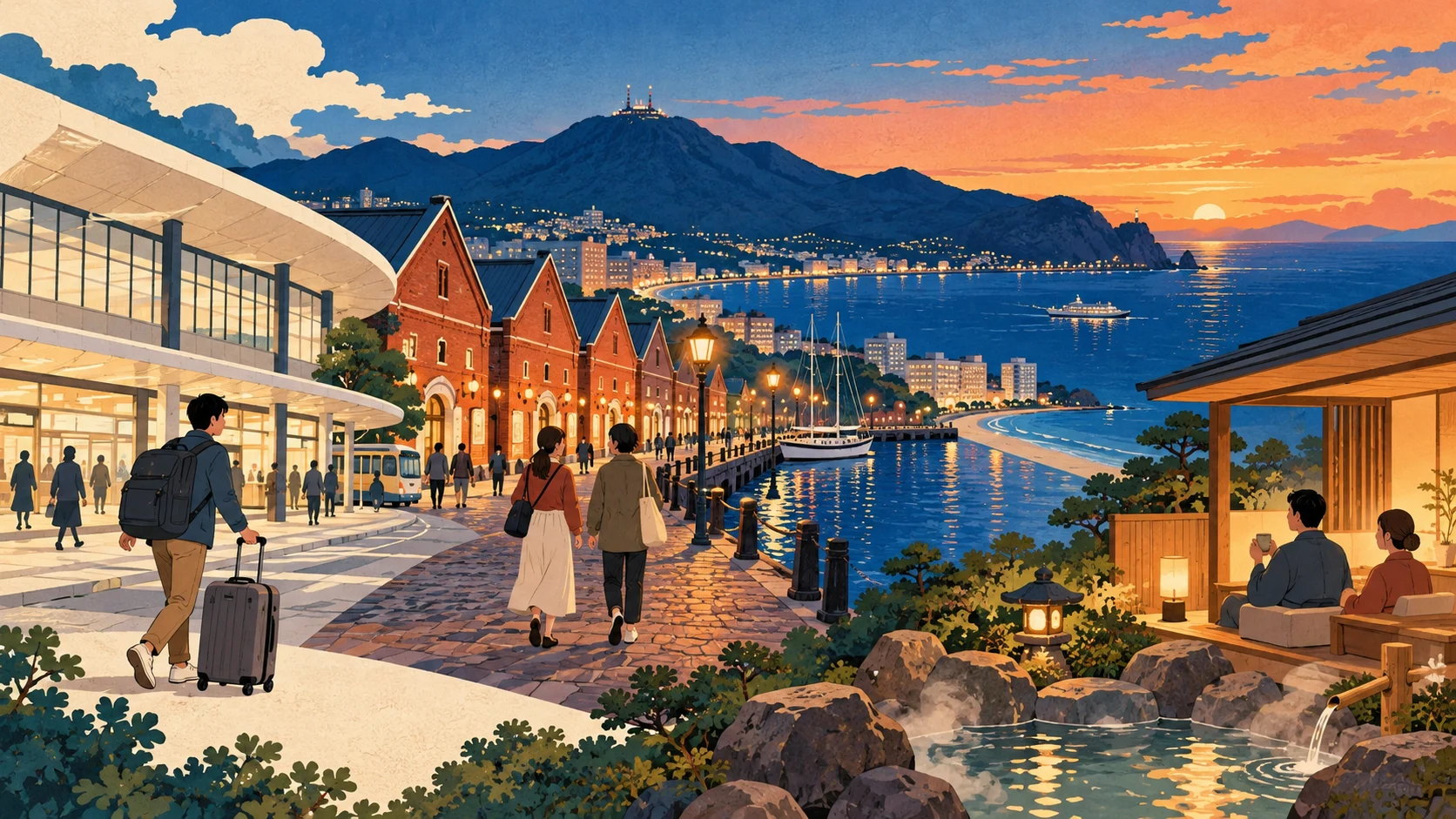
First choose an evening on the summit, by the bay or at an onsen inn. Then fit trams, the morning market, room categories and seasonal events into one Hakodate stay.
How many nights in Hakodate? Start with the evenings you want
If your trip includes the night view from Mount Hakodate, a ryokan dinner in Yunokawa and the Christmas tree by the bay, give them different evenings. Each has its own transport, weather or meal timetable; arrival day need not become a race between them. For a first visit, two nights are a useful starting point, allowing another chance to move the mountain outing. This is itinerary advice, not a promise that an extra night guarantees a clear view.
Think in four areas: the station and morning market, the bay and Motomachi, Goryokaku, and Yunokawa. Your base determines more than daytime convenience. It affects how far you want to walk at night, whether you can return for another layer and whether breakfast belongs in the hotel or market. Put arrival time, companions' energy and priorities beside the map. Those factors narrow the choice more usefully than a hotel ranking.
Ticket prices, room conditions and notices in this guide use official material readable on October 21, 2026; the botanical garden, Takuboku walk, costume experience, squid fishing and four Kanemori areas were checked separately on October 22. All amounts are in yen. Dynamic room prices are hypothetical examples, not offers available that day. If you are planning Japan independently for the first time, use this guide to choosing trip length and city order and give Hakodate a proper stay rather than treating it as a photo stop between Hokkaido transfers.
Distinguish Hakodate Station, Shin-Hakodate-Hokuto and the airport
The Shinkansen arrives at Shin-Hakodate-Hokuto, not Hakodate Station beside the market. JR Hokkaido's Hakodate Liner information gives 15–22 minutes between them, with the fastest service taking 15. That is train-running time only; add transferring, waiting and walking to the hotel. When booking a station hotel, establish which station the address is near. ‘Hakodate’ in the listing is not enough.
Different operators and stopping patterns link Hakodate Airport with the city. The airport's bus comparison lists a station shuttle at about 20 minutes, ¥700 for adults and ¥350 for children; express route 8 at about 25 minutes, ¥500/¥250; and route 96 at about 33 minutes, ¥340/¥170. These are reference times. Check the selected route's departures, stops and road conditions rather than assume the cheapest bus always reaches the same place.
For Yunokawa, you need not travel into central Hakodate just to pass the station and then carry bags back to the onsen area. Read the hotel's actual bus-stop name and walking directions first. At a station base, leave luggage and spend arrival afternoon nearby. If Sapporo comes before or after, calculate that long journey and check-out separately. The urban itinerary here is not a complete Hakodate–Sapporo transport guide.
Using the tram: direction, payment and the final walk all matter
Trams and walking make Hakodate manageable, but Goryokaku-koen-mae is not directly underneath the tower, and Yunokawa-Onsen is not every inn's front door. Add the walking leg after each ride, especially with a stroller, bags or slippery surfaces. Search the full destination name and visitor entrance. Directions to the opposite side of a park can leave you retracing the route.
The city's boarding instructions specify entry normally through the middle door and exit at the front; vehicles without a middle door use the front for boarding. Pay on exit. With an IC card, tap both on and off. For cash, take a numbered ticket when boarding, prepare the amount shown inside before your stop, then deposit ticket and fare after the vehicle stops. Do not push through a moving tram with a suitcase: steady yourself before moving.
The tram's accepted interoperable IC cards include Suica, PASMO and Kitaca; Suica is sometimes nicknamed the watermelon card by travelers. Acceptance for payment does not grant every transfer discount: specific discounts have card and stop conditions. Hakodate Teisan's airport bus has different payment rules too. Do not apply your tram experience automatically to every bus.
Tram fares in 2026 and the separate rules for children
The current tram fare table, revised on December 1, 2025, charges adults ¥250, ¥270, ¥290 or ¥300 by distance; children pay ¥130, ¥140, ¥150 or ¥150. Hakodate-ekimae to Jujigai is ¥250, to Goryokaku-koen-mae ¥270, and to Yunokawa-Onsen ¥290. If an attraction or hotel still shows a lower old fare, budget from the operator's current table. Do not mix versions.
The tram's adult category begins at Japanese lower-secondary school. The child range starts at age one and runs through Japanese primary school, with separate free accompaniment for preschoolers: each accompanying person can bring four preschool children free. This differs from hotel bed sharing, the ropeway's young-child allowance and the tower's school tickets. Check school stage, whether the child has entered primary school and seating needs instead of writing a universal ‘children half price’ in the budget.
For a day mostly walking the bay and Motomachi, the tram may only provide a return journey, making single fares simple and economical. If weather adds rides, reassess the passes. Do not make an extra post-dinner circuit just to recover the price. A route map should connect the areas you need and the return, not turn every stop into compulsory sightseeing.
One day, 24 hours or a two-day combination: calculate the right ticket
Hakodate's tram ticket page lists the day pass at ¥800 for adults and ¥400 for children, valid until the last tram that day rather than for 24 hours after activation. Paper tickets are sold on board and at listed outlets, with the date scratched off as instructed; mobile tickets follow their screen instructions. The separate mobile-only 24-hour pass costs ¥1,130/¥570 and requires a smartphone and credit card. The validity periods are different.
Start with the actual route: Hakodate-ekimae–Goryokaku-koen-mae ¥270, then Goryokaku-koen-mae–Jujigai ¥290, and Jujigai–Hakodate-ekimae ¥250. That is 270 + 290 + 250 = ¥810, so the ¥800 day pass saves just ¥10. A Jujigai return costs 250 × 2 = ¥500; buying the ¥800 pass costs ¥300 more. Also consider flexibility for extra rides, but do not describe ¥10 as a major saving.
The specified-zone tram and Hakodate Bus combination costs ¥1,600 for adults and ¥800 for children for one day, or ¥2,600/¥1,300 for two consecutive days. It is not simply a two-day tram ticket. Buy these on a mobile device with a credit card; read the bus coverage, especially without assuming every airport operator is included. For a JR pass, use a leg-by-leg comparison of fares and coverage, handling long-distance rail separately from city travel.
Station, bay or Yunokawa: choose a base around the journeys
The station suits early or late trains, luggage storage and the next morning's market. The bay suits repeated evening walks; Yunokawa suits dedicating an evening to baths and inn dining. All can support city sightseeing, with different costs of doubling back. A slow walk home after the Christmas tree and sitting down for a full ryokan dinner create different location priorities.
The named room categories below are comparison starting points, not a ranking of three hotels. Read area, occupancy, beds, bathroom and view separately. A communal bath does not establish an in-room onsen, and a marina-related hotel name does not give every room an ocean view. For groups, write down permanent and extra beds before comparing the nightly total. That avoids discovering a sofa bed only on arrival.
Two nights at one property reduce packing and bag storage. Consider moving one to Yunokawa when two meals or bathing in the room is itself the goal. Changing hotels uses parts of both morning and afternoon and adds clothing, damp-towel and luggage management. Picture the actual checkout-day journey with bags as well as the map distance. Accommodation advice then becomes relevant to your own stay.
| Property and base | Named room example | Check before booking |
|---|---|---|
| JR Inn Hakodate, beside the station | Twin 20 m² with shower; Premier Twin 34 m² with bathtub | Extra beds, preschool bed sharing and train- or mountain-side requests are not guarantees |
| Century Marina Hakodate, between station and bay | Standard-floor Twin, 24.0 m², with shower | The FAQ does not offer ocean-view rooms; distinguish breakfast type and plan |
| Hanabishi Hotel, Yunokawa | Specified Suehirotei open-air-bath room or Gagyutei contemporary Japanese suite | In-room bath depends on category; no shared-property reservable family bath |
JR Inn Hakodate: compare Twin and Premier Twin before booking
JR Inn Hakodate's current room page lists the ordinary Twin at 20 square meters for one or two, with 110 × 195 cm beds and a shower. The Single is 16 square meters with a 140 cm-wide bed and also a shower. Separate beds and saving floor space lead to different categories. Both being bookable for two does not make the stay identical.
For a room bathtub or a larger party, compare Large Twin and Premier Twin. Large Twin is 30 square meters for one to three with a bathtub; Premier Twin is 34 square meters for one to four, also with a bathtub. The website gives their main beds as 120 × 195 cm. A bathtub is a room facility, not proof of hot-spring water. A photograph of the top-floor communal bath does not depict your room's bathroom either.
At a station hotel, leaving bags on arrival, heading out to eat and collecting them after checkout can be the practical benefit. The hotel's luggage FAQ limits storage to arrival or departure day and excludes valuables, fragile items, refrigerated and frozen goods. Do not buy chilled seafood at the market assuming reception will refrigerate it. Buying before departure and checking packing and carriage with the shop may work better.
JR Inn: children's beds, late arrival and cancellation need separate checks
JR Inn's extra-bed and child conditions give the third guest an extra bed in Large Twin and Concept Room; four in Premier Twin use one extra bed and one sofa bed. Generally, each adult can share a bed with one preschool child. A child using a bed alone, or a primary-school pupil or older, pays the adult rate. Booking channels may set other conditions. The special railway-themed room has its own rules, so do not apply the general FAQ automatically.
Usual check-in starts at 15:00 and checkout ends at 10:00. Arrival is normally by 24:00; contact the hotel beforehand if later, and also when more than two hours behind your stated time. JR Inn Hakodate's accommodation terms separately address an unannounced no-show and priority of special agreements. Late check-in being possible does not remove the duty to notify. For a delayed flight, confirm the reservation is retained before arranging night transport.
The same terms' general table for up to nine rooms gives cancellation charges of 20% three days before, 50% the day before, 80% on the day and 100% for a no-show, based on the basic accommodation charge; specific penalty agreements take precedence. This is that hotel's example, not a shared refund policy across Hakodate or every promotion. Save your own deadline and cancellation route. A platform booking follows its procedure; removing an itinerary entry does not cancel the room.
Century Marina: separate a convenient bay location from an ocean-view expectation
Century Marina Hakodate's access page gives about five minutes on foot from the station, two from the morning market and ten from Kanemori's red-brick warehouses. That suits a market morning and bay evening, with walking times adjusted for luggage and surfaces. Check whether your breakfast and evening plans actually fall on either side of the hotel rather than judge the location solely by minutes from the station.
The standard-floor Twin is 24.0 square meters for one or two, with two 1,100 mm-wide beds and a shower. The standard Deluxe Twin is 30.4 square meters for one to three, listing two 1,200 mm beds and one 1,100 mm bed. The full room table includes different floors and newer categories. Similar names still require an occupancy check: do not transfer the standard-floor three-person arrangement to a same-named higher-floor version.
The hotel's ocean-view FAQ explicitly says it does not offer ocean-view rooms. Allocation is to the Mount Hakodate side or the city side toward the station. If you expect to see the sea from bed, that matters more than a promotional picture. There is also a 42.3-square-meter Universal room for one to three with a bathroom. For wheelchairs or transfer equipment, ask about entrances, bedside space, bathroom dimensions and assistance. A category name cannot establish the complete usable route.
Choosing a hotel breakfast: leave another morning for the market
When comparing Hakodate breakfasts, first decide how long you want to spend eating. Century Marina distinguishes its breakfast options: YUUYOO buffet is 6:30–11:00, last entry 10:30; Kita no Ro's irori set meal is 6:30–10:00, last entry 9:00, strictly by reservation with a daily limit. Any breakfast-inclusive plan does not automatically let you choose every venue.
Across two nights, separate the hotel breakfast from the market rather than eat a full buffet and then order seafood rice simply to check it off. Menus change with purchasing, so a temporary website dish is not a year-round promise. The hotel also has allergy limitations and shared preparation lines. Identify the ingredients you need to avoid before booking. A broad buffet selection does not by itself guarantee safe dining for every allergy.
This hotel's child and luggage FAQ says preschool bed sharing itself is free, but a set of hotel indoor clothing, slippers and amenities costs an additional ¥2,200. Free storage can include refrigerated and frozen goods, unlike JR Inn; confirm quantity and collection arrangements. Both are near the market, yet families and seafood shoppers may find different practical benefits worth adding to the total-cost and route comparison.
Yunokawa: Hanabishi private-bath rooms and the botanical garden's bathing monkeys
Yunokawa suits travelers making hot-spring bathing central to the stay. Hanabishi Hotel's room categories span the main building, Gagyutei and Suehirotei, with Japanese-style, mixed-style and open-air-bath rooms. Specified first-floor Suehirotei rooms have their own open-air bath; Gagyutei added contemporary Japanese suites with free-flowing source-water open-air baths in May 2026. These two features do not extend to every room in every building.
For family bathing in a separate space, verify which bath-equipped category appears on your booking. Hanabishi's FAQ says there is no shared-property private-hire bath or family bath. Booking an ordinary room and adding a family-bath session after arrival is therefore not an established fallback. Bath design, changes in floor level and help needed depend on the room. A beautiful bath photograph does not establish that an older relative can use it independently and safely.
The hotel separately lists a first-floor accessible room with its own open-air bath, sliding doors at the entrance and toilet and reduced level changes. Wheelchairs and simple folding beds, among other items, require reservations. This is a concrete starting point for questions, not a guarantee for every individual need. For a first ryokan, use booking questions about room baths, meals and Japanese bedding to state your requirements directly.
The Hakodate Tropical Botanical Garden is another Yunokawa stop before hotel check-in, but seeing monkeys is different from seeing them bathe, which is seasonal. When checked on October 22, 2026, the garden's home page said the monkey hot spring had finished and would resume in December 2026; Japanese macaques can still be seen outside the bathing season. The official FAQ gives a planned season from December 1 to around the following May's Golden Week, but explicitly says the pool is drained and the season ends early once a baby monkey is born; April is usually the peak birth month. Do not expect winter-photo bathing scenes in October or November, or treat Golden Week as a guaranteed spring closing date.
The garden's admission information lists 9:30–18:00 in April–October and 9:30–16:30 in November–March, with closure December 29–January 1. General admission is ¥300, elementary and junior-high pupils ¥100, and children not yet at elementary school free; payment on site is cash only. Discounts for Hakodate residents or pupils have separate conditions. Two adults, one elementary pupil and one preschool child, with no other exemptions, pay ¥700 in total. These are opening hours and admission prices, not a timed monkey performance or a promise that every monkey will bathe. If bathing is your main purpose, confirm that the seasonal hot-water supply is still operating before you go.
For a car-free visit, follow the garden's access page: take a tram from Hakodate-ekimae to the terminus Yunokawa, about 25 minutes, then walk about 15 minutes. This is a different stop from Yunokawa-Onsen near Hanabishi. Another option is Hakodate Bus route 96, about 20 minutes from the station to Nettai Shokubutsuen-mae; city information adds about two minutes on foot after alighting. These are reference travel times; waiting and winter road conditions are extra. Check services through the Hakodate Bus link on the garden's page. Arrange storage before bringing large luggage: the garden has no lockers or temporary baggage-holding service.
Hanabishi dinner times help decide which evening belongs to the night view
Hanabishi's dining and arrival FAQ gives dinner starts at 17:30–19:30, ending at 21:00, and breakfast at 7:00–9:00. Contact the hotel if you have dinner and expect to arrive after 19:30, or have no dinner and expect after 22:00. This is not a promise to delay dinner indefinitely. For the bay's 18:00 fireworks followed by Yunokawa, work backward through the complete return or reserve your two-meal ryokan night for another day.
Room dining does not automatically accompany every category. Relevant plans offer dinner in Gagyutei and Suehirotei open-air-bath rooms; breakfast is not served in the room. Specify room name, meals, location and dinner start on the order to compare the price difference. If the inn itself matters most, an afternoon check-in, bath and dinner fit better than repeated journeys into the center.
The hotel's current arrival directions give about two minutes on foot from Yunokawa-Onsen tram stop and three or eight from different airport bus stops, and state that there is no hotel shuttle. The access page directs you to operators for current fares. Its FAQ still contains an older tram amount; this guide uses the current operator fare of ¥290 for adults from Hakodate-ekimae to Yunokawa-Onsen. Knowing the stop is more useful than simply remembering the hotel is near the airport.
Accommodation and bathing taxes: check what the price already includes
Hakodate's accommodation tax applies to stays from April 1, 2026, including reservations made earlier for a later stay. The city's combined municipal and Hokkaido tax is based on taxable accommodation charges per person per night: below ¥20,000, tax ¥200; ¥20,000 to below ¥50,000, ¥400; ¥50,000 to below ¥100,000, ¥1,000; and ¥100,000 or more, ¥2,500. These figures already combine both levels. Do not add the ¥100 municipal component again to a combined ¥200.
Separately, the current bathing-tax explanation lists ¥100 for ordinary overnight or day-use bathers, with exemption below age fifteen. Do not retain the city's old ¥150 rate. The property should confirm whether the actual bathing product is taxable and already includes it. A communal bath does not mean another tax must automatically be added to every purchase. A child's bathing-tax exemption also does not imply an accommodation-tax exemption.
At payment, ask what is included, what is payable on arrival and which band applies to each guest. The budget below separates an assumed room rate, accommodation tax and any separately charged bathing tax so you can substitute your order. Compare the whole-room total rather than the search result's lowest per-person price. Two meals, shared-bed child amenities and cancellation flexibility change the product. Subtracting two headline figures alone cannot establish the better value.
Timing Mount Hakodate's night view: use sunset and visibility
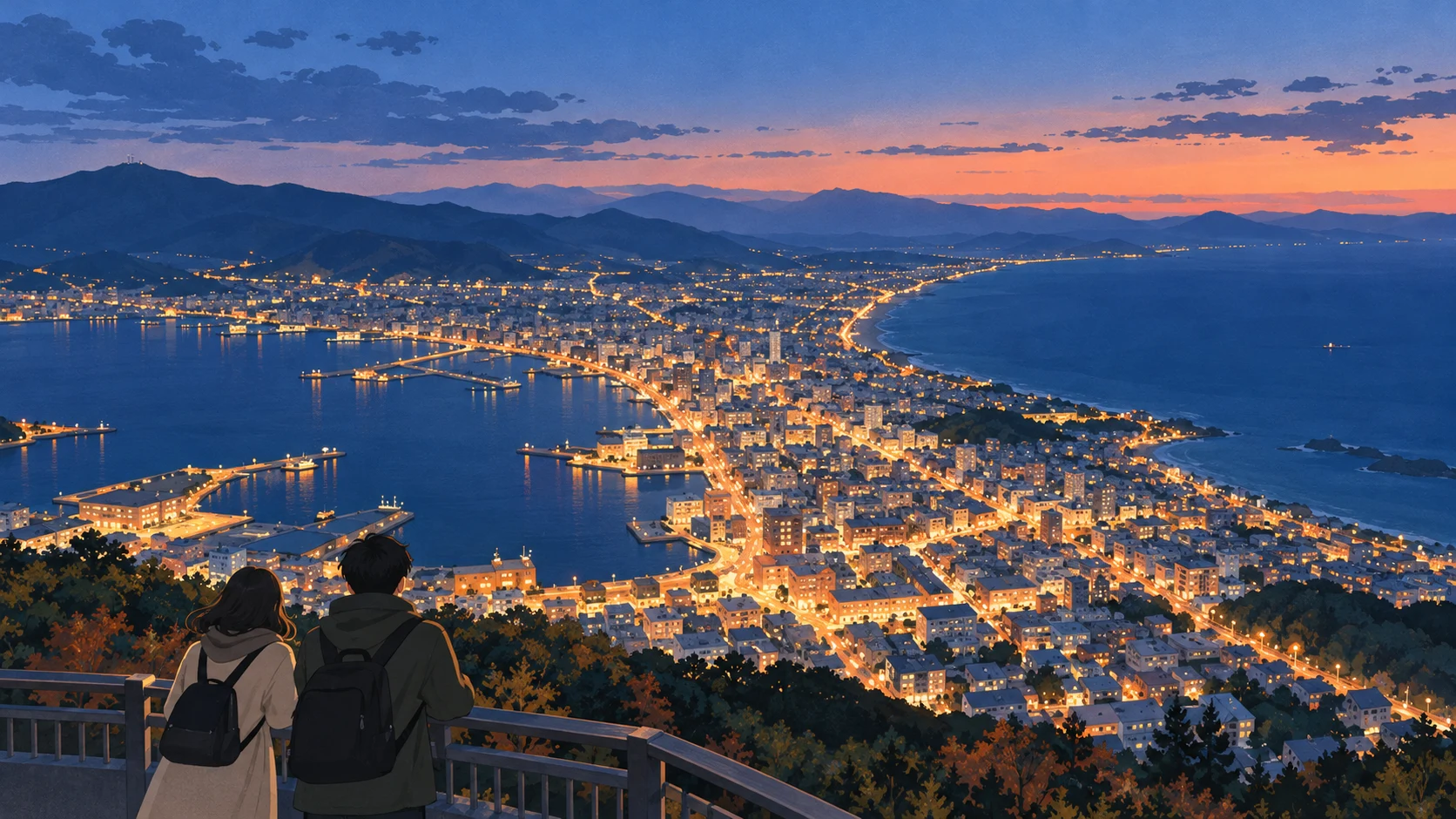
Allow flexibility for the changing light. Daylight reveals the geography; at dusk the city and sea separate, and after dark the dense bands of lights emerge. To watch that transition, do not plan to ascend on the last service. Pick a more promising evening and a dinner time with a generous window before or afterward. A photograph need not consume the night's entire energy and return plan.
Sunset changes by date, so ‘go up at five’ cannot be a year-round rule. The ropeway's operating and sunset information provides a lookup, but the displayed time only belongs to its displayed date. Check the day, last ascent and descent before assessing queues. The cabin ride is only about three minutes, excluding ticket purchase, waiting and reaching the lower station from your accommodation.
For companions who feel cold, struggle to stand or have only a moderate interest in the view, shorten outdoor waiting and choose a comfortable stay. The busiest photograph position is optional too. A night-view plan needs an ascent time, acceptable duration and descent method together. A single recommended clock time cannot account for the season and that evening's crowds.
Ropeway prices, seasonal last departures and young children
Mount Hakodate Ropeway's fares and hours list adults from Japanese lower-secondary school at ¥1,800 return or ¥1,200 one way, and children at ¥900/¥600. Ages zero–two travel free. From age three, one preschool child per adult is free; additional preschoolers pay the child fare. This is more restrictive than the tram's four preschoolers per accompanying person. Do not reuse the same family calculation.
Normally, April 20–September 30 has a 10:00 start, last ascent 21:30 and descent 22:00; October 1–April 19 starts at 10:00, with last ascent 20:30 and descent 21:00. Roads, weather and maintenance can alter this. The website also warns that ticket checks finish earlier and busy periods bring queues for both buying and boarding. Leave a real purchase and gate margin. Arriving at the station at the exact last departure is not a workable plan.
Only consider one way once the other direction is resolved. Especially in winter, a road drawn on the map does not mean you can walk down or summon a taxi at any time. The ropeway's accessibility FAQ lists elevators at the lower and upper stations, wheelchair boarding and access to the rooftop viewpoint. Ask the operator about extra assistance, weather protection or specific group needs, and calculate the slope before the lower station separately.
Autumn maintenance in 2026 and the winter road closure are different limits
The official tourism maintenance announcement suspends the ropeway for mandatory servicing on October 20–November 8, 2026. Other summit access exists then, but ropeway fares and ordinary frequencies do not become the alternative vehicles' conditions. The announced mountain bus is ¥700 per adult and ¥350 per child one way; an adult return is 700 × 2 = ¥1,400. This compares that temporary bus, not every form of mountain transport throughout the year.
Hakodate Bus's specific October 20–November 8 notice warns that road and boarding congestion may prevent catching the intended departure. From the station, intermediate stops are boarding-only; from the summit, alighting-only. The official tourism page lists station departures within 13:30–19:30 and summit returns within 14:20–20:10. Open the period's actual table for individual trips. The 20:10 final return is not the same deadline as the observation facilities closing at 21:00.
Winter is separate. The 2026-season mountain-road closure notice gives November 9, 2026 at 11:00 through April 12, 2027 at 11:00, with the end provisional and subject to road conditions. Cars, buses and taxis are all prohibited on that road during closure. Do not carry the autumn replacement bus into Christmas. Resumed ropeway operation still needs a daily check, while a winter trail being passable does not make an improvised night walk suitable for ordinary visitors.
Fog, strong winds or too many people: move the evening back into town
Check the operator's summit live-camera page, then the day's operating status. No rain at the base does not guarantee a clear summit; visible city lights do not mean a cloud layer is about to disperse. If the image and actual conditions show poor visibility, move the ascent to another evening. With only one night, accepting one fewer sight usually protects the trip better than spending it watching the queue.
Choose alternatives near where you are: open shops or indoor seats around the bay, the Public Hall in Motomachi during daylight, or an early return to your Yunokawa hotel. These do not guarantee a particular business will remain open in severe weather; check notices. If you abandon the mountain visit, establish whether a purchased ticket can be changed or refunded. An operational suspension does not mean that every third-party ticket will automatically be refunded.
Hakodate's official autumn–winter video introduces city light and neighborhood atmosphere before departure, without replacing current conditions. Its scenery belongs to the filming period, not a promise of roads, illuminations or snow on your date; December does not guarantee snow every day. Bring adjustable layers, suitable soles and time to return to your room. That works better than locking every evening to recreating the same shot.
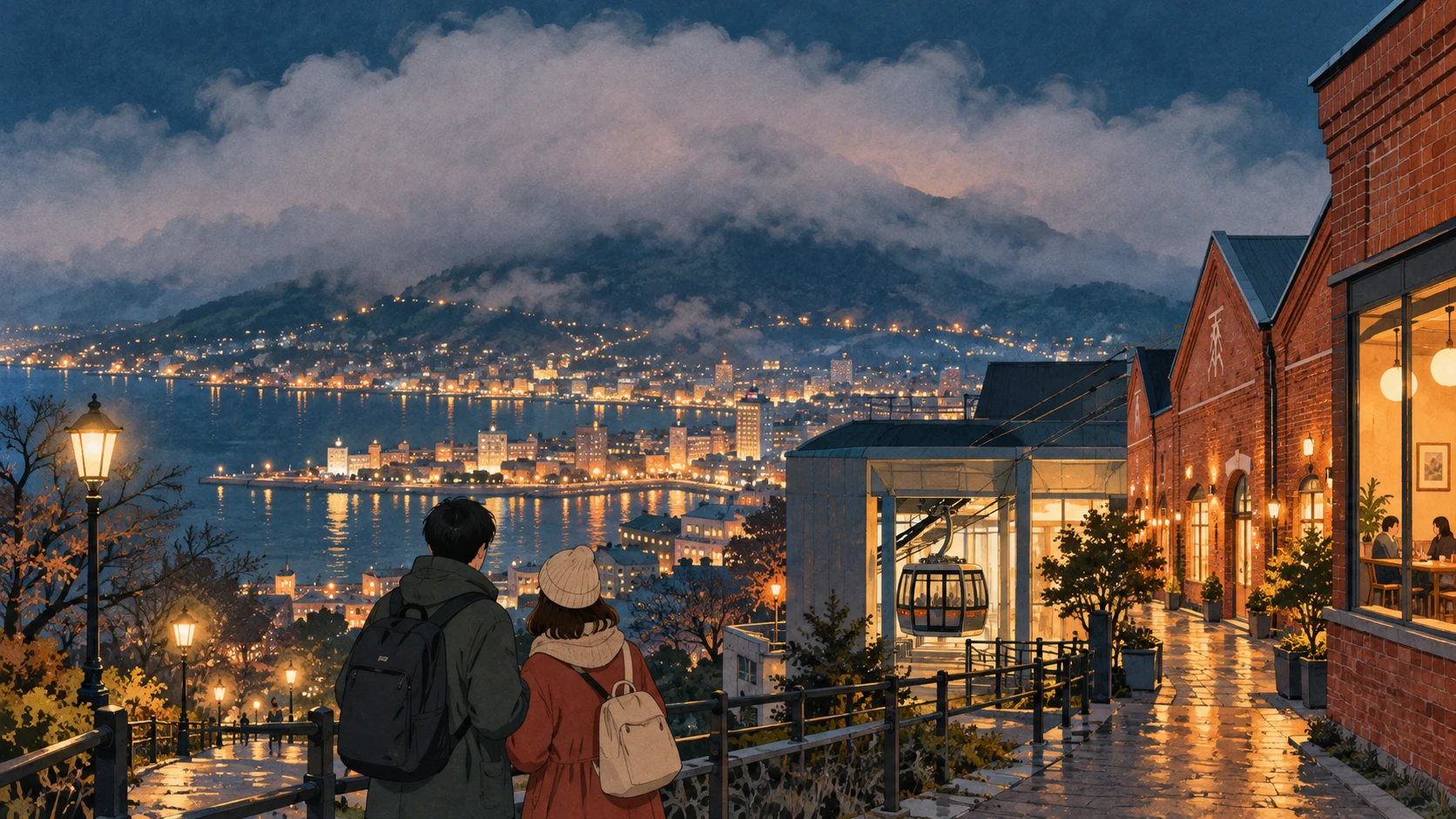
Motomachi, Hachimanzaka and the churches: one continuous daylight walk
Explore Motomachi as a connected walk rather than return to the tram after every building. The official Motomachi sample route gives about 1.5 km and two to three hours including visits, linking slopes, Western-style houses and churches. It is a reference duration, not a guarantee in snow, with a stroller or with entry to every building. Add lunch, photographs and breaks yourself.
Hachimanzaka's view follows the slope toward the harbor, but pedestrians and vehicles both use the street. Photograph from somewhere you may safely stand, without moving into the road to remove foreground cars. Link the Public Hall, Motomachi Park and churches in one direction, concentrating the uphill sections. If someone dislikes slopes, choose a few exteriors and one indoor stop rather than force the complete online checklist.
The evening streets have another atmosphere, but that does not open every building inside. Complete timed-entry visits first, then leave room for slopes and sea views. For a meal or coffee, look for open businesses along the walk. Check service hours, seating and return direction before detouring, and the day's menu and last order for a particular dish.
Old Public Hall: plan admission and the costume experience separately
The Old Public Hall of Hakodate's official visitor information lists ordinary individual entry at ¥300 and student/child entry at ¥150. April 1–October 31 is Tuesday–Friday 9:00–18:00 and Saturday–Monday 9:00–19:00; November 1–March 31 is 9:00–17:00. Entry ends thirty minutes before closing. Do not extend summer weekend hours into winter or assume the costume experience is included in ordinary admission.
The announced New Year closure is December 31, 2026–January 3, 2027, with additional maintenance closures on November 17, 2026 and January 26, 2027. Also note the partial visitor-route change from October 21, 2026: construction closes the video room and parts of the route, while other exhibits stay open and the related videos can be viewed elsewhere. Without an announced end date, do not invent a restoration date.
The official access references are about seven minutes on foot from Suehirocho tram stop and three from Kokaido-mae bus stop, still with a slope and the actual entrance to consider. A rainy-day alternative means indoor sightseeing, not an indoor route all the way from transport. For costumes or a full visit, leave time to choose, store belongings and return clothing. Last admission should not be your target arrival.
For costume photographs, look for Hakodate Haikara Ishokan inside the hall. The operator's current plans distinguish Western and Japanese dress. Western dresses or men's formalwear cost ¥3,500 for junior-high pupils and above, or ¥2,500 for elementary pupils and younger, for 30 minutes; hair ornaments and accessories add ¥1,000. Japanese yagasuri-pattern hakama or shosei student-style dress costs ¥4,500 for 30 minutes, the same for adults and children, including Japanese-style hair ornaments and small accessories. Children's patterned hakama starts at roughly age-three sizing; ask the shop which shosei sizes fit your child. Both plans are for indoor use and photographs with your own camera or phone, with hall admission extra. A general adult's ¥300 hall ticket plus basic Western dress totals ¥3,800. The usage process starts the experience clock after dressing is complete, so allow extra time for choosing, paying, changing and returning the costume.
An outdoor Japanese-dress plan is separate: 60 minutes for ¥8,000, the same for adults and children, available only May–October. Adult outdoor boots or setta sandals add ¥2,000; children must wear their own shoes for safety. Snow or poor weather may make the plan unavailable, with the decision made at the shop that day, so street photographs cannot be promised in advance. Families should first check the hall's published sizes: children's dresses 80–160 cm, Western formalwear 80–130 cm and patterned hakama 90–150 cm. These are style-size ranges; a favorite item may still not fit or may already be in use. The operator offers neither try-ons nor hair and makeup services. Prepare hair and confirm the child wants to dress up before joining the queue.
The costume counter closes earlier than the hall. April–October hours are 9:00–17:00, with last acceptance at 16:00; November–March is 10:00–16:00, last acceptance 15:00. The costume shop closes Tuesdays and Wednesdays in January and February, as well as when the hall is closed. Do not mistake the operator's office being closed Tuesdays and Wednesdays for a year-round costume-shop closure. Individuals need no reservation and are accepted in arrival order, with cash payment only; crowds or group bookings may end acceptance early. Groups of ten or more can use the group reservation form; school trips have another dedicated route, and a booking is confirmed only after the operator replies. If dressing up is the day's main activity, check its acceptance notices first rather than arriving at the hall's final admission time.
Church exteriors and interior visits: worship takes priority
Motomachi's Catholic, Hakodate Orthodox and St. John's churches are near one another but managed separately. The official tourism listing for Motomachi Catholic Church gives 10:00–16:00, excluding Sunday mornings and services. Visits stop December 30–January 5 and when the sanctuary is in use. This is neither a shared timetable for all three nor guaranteed entry upon arrival.
A walk can focus on exteriors and their relationship with the streets. Follow local rules when prayer, ceremonies or restriction signs are present. Another visitor's photo does not establish permission for interiors, portraits or tripods; ask staff if unsure. Churches are not photography sets cleared for tourists. Keeping voices low and entrances clear often makes a better shared stop than seeking a perfectly empty frame.
If a church is closed, use the time for Motomachi Park, open parts of the Public Hall or the bay rather than repeatedly wait to complete the group. In winter especially, separate daylight slope walking from evening dining. A sequence of steep streets after dark is not compulsory for the whole family. Seeing exteriors is still a complete travel experience; paid-attraction counts do not measure an afternoon's value.
Kanemori's four areas: shopping, canal walks and events
Kanemori's official homepage lists general retail at 9:30–19:00. Hakodate Beer Hall opens at 11:30 on weekdays and 11:00 on weekends and holidays, until 21:30 with last orders 21:00. Individual shops may adjust hours. Shops closing and waterfront lights remaining visible are different states. Schedule shopping before closing and check restaurant reception and queues separately. An illuminated warehouse exterior does not mean every counter is open.
Autumn 2026 also brings Kanemori Yobutsukan maintenance closure on November 9–12; the announcement says BAY Hakodate and Hakodate History Plaza operate normally. It affects part of the facilities, not the entire bay. If a particular shop draws you here, establish its building first. Shift affected shopping time to another open building or Motomachi.
The warehouse waterfront pairs naturally with dinner and seasonal events, leaving bags at your accommodation. In wind and rain, find a legitimately open place where you may sit rather than rely on a shop doorway for a long shelter. The website links its own social accounts for atmosphere and new updates. Use announcements for concrete hours and closures: a social photo does not prove a table is available at every business that evening.
With only one waterfront time slot, use Kanemori's official four-area layout to choose. Start at BAY Hakodate for canal-side warehouse views, desserts and crafts. Choose Kanemori Yobutsukan, linking two warehouses, for concentrated household goods, clothing and souvenir shopping. To sit down for a meal and see high ceilings and cypress pillars, focus on Hakodate History Plaza. Its name does not make it a history museum toured room by room: the current interior mainly houses Hakodate Beer Hall, shops and casual food outlets.
The fourth area, Kanemori Hall, is a multipurpose venue for concerts, theater, lectures, exhibitions and banquets. Without a confirmed public event on your date, do not make an indoor exhibition or performance a fixed stop. Tickets, start times and entry conditions follow that event's notice. The table distinguishes shopping and event functions; it does not mean every shop and the hall open together. With limited time, choose a canal walk plus one shopping building, or shopping plus a meal at History Plaza, instead of treating all four as attractions that must each be entered.
| Area | Actual function and named examples | How to plan |
|---|---|---|
| BAY Hakodate | Canal-side shopping, coffee, desserts and crafts, including Petit Merveille and Hakodate Music Box Hall | Choose it for canal views and a break; in poor weather, find an indoor shop that is actually open |
| Kanemori Yobutsukan | Goods, clothing and desserts across two warehouses, including Snaffles and handmade-bag specialist Mizubasho | Use retail hours for concentrated shopping; this building closes for maintenance November 9–12, 2026 |
| Hakodate History Plaza | High ceilings and cypress pillars, Hakodate Beer Hall, food outlets and shops | Allow time for a meal and warehouse structure; queues and last orders are extra |
| Kanemori Hall | Multipurpose music, theater, lecture and exhibition venue | Confirm a public event on your travel date, then follow its ticketing and entry arrangements |
Hakodate Morning Market: shop hours, live-squid fishing and a backup plan
The market cooperative's guidance gives general reference hours of 6:00 to after 14:00 in January–April and 5:00 to after 14:00 in May–December, repeatedly warning that shops differ. This describes overall activity, not a meal at any counter at five. For a particular seafood bowl, purchase or experience, open the actual shop notice. Use its last order, rather than the market's approximate end, as your deadline.
A morning visit fits station luggage storage and departure from the city. From Yunokawa, add the tram and walk without waking everyone excessively early simply to be first. With a substantial included hotel breakfast, put the market meal on another day or browse instead. There is no must-eat or must-buy list for everyone. Decide this meal's budget, willingness to eat raw food and ability to carry refrigerated goods.
Before buying seafood, ask whether the displayed price is per serving, item or weight and whether preparation, packing and delivery are separate. Then decide quantity. For flights or international borders, research destination and airline conditions separately; a seller offering packaging does not establish permission to import. Recommended-shop markings help identification, but confirm the total before paying. Asking first is preferable to buying an unsuitable item out of social pressure.
For a hands-on market stop, Ganso Live Squid Fishing Pond is inside Ekini Market at Wakamatsu-cho 9-19. Hook a squid by its fin in the tank, then have it prepared as sashimi by staff: the experience combines catching and eating on site. The market's official page explicitly lists market pricing and directs visitors to information posted on Facebook and other channels. Confirm that day's charge and included preparation at the counter before joining; an old article's price is no budget ceiling. Nor is another cooking method guaranteed. If you do not eat raw seafood, ask whether your needs can be met and choose an ordinary meal if there is no suitable arrangement.
The operating association currently lists the fishing pond at 7:00–14:00; the market opening at five does not mean squid fishing starts then. The city tourism site's details also give 7:00–14:00, ending when squid sell out, and list closures on the third Wednesday in January–June, October and November, December 31–January 4, and days when bad weather stops fishing. Ordinary visits need no reservation, but live squid are not available every day. If this is a priority, ask the Ekini Market office at 0138-22-5330 about the day's supply; telephone hours are 8:00–16:00. An indoor activity can still depend on sea conditions. If squid are unavailable, fishing is suspended or the queue threatens your train connection, skip the activity and browse the market or eat at Asaichi Shokudo Nibankan upstairs in the same building. Its official hours are 8:00–14:00, with food depending on the day's supply.
Budgeting a seafood bowl: compare tax-inclusive prices and branches
Kikuyo Shokudo's official morning-market menu lists Ganso Hakodate Tomoe-don at ¥2,980 before tax and ¥3,278 including it; benizake oyako-don at ¥2,280/¥2,508; and ikura-don at ¥3,058 including tax. These are different dishes. A pretax number is not the checkout total, and a branch-only dish is not available everywhere. Two adults each choosing Tomoe-don spend 3,278 × 2 = ¥6,556, a concrete meal-budget example.
The main and branch market shops currently list May–November 6:00–14:00, last orders 13:40, and December–April 6:00–13:30, last orders 13:10. The main shop does not reserve tables; the branch has a separate booking entry. Do not confuse them. If arriving late, check whether orders are still accepted before storing bags. General market activity into the afternoon does not mean every restaurant offers a leisurely late lunch.
For people avoiding raw food or particular ingredients, ask what preparations and seasonings are available that day. Plenty of seafood does not establish a suitable substitution. Another meal can be your favorite cooked food, ramen or an inn dinner instead of expensive seafood every time. The official food video introduces possibilities, but the actual dish and price should follow the shop's menu on your travel date.
Goryokaku Tower tickets: change the budget from April 2027
Goryokaku Tower's current ordinary admission is ¥1,200 for adults, ¥900 for lower- and upper-secondary students and ¥600 for primary-school pupils; preschoolers enter free. Usual hours are 9:00–18:00, with observation ticket sales ending 17:50. Walking the park and viewing its star from above are different experiences. Later park access does not extend tower operation. Check darkness and closing on your day if aiming for sunset.
The announced April 1, 2027 price change raises those amounts to ¥1,500, ¥1,130 and ¥750. Preschoolers remain free with a guardian; tickets are single-entry with no reentry. Two adults after the change pay 1,500 × 2 = ¥3,000, compared with the current 1,200 × 2 = ¥2,400: ¥600 more. This is an announced future price, so the budget can be updated before the last moment. The official page defines adults as 18 and older; if age and student status overlap, confirm the applicable ticket category with the seller.
There is still a walk from Goryokaku-koen-mae tram stop. The tower's directions from the tram use about ten minutes; other official descriptions for the park or another entrance may give a different duration for a different route. Some old transport prices on the tower site have not yet been updated; this guide uses the tram operator's table. Drivers should not assume a dedicated free ordinary-car lot. The site explicitly directs ordinary vehicles to nearby paid parking, with availability and charges checked separately.
| Category | Current price | Announced price from April 1, 2027 |
|---|---|---|
| Adult | 1,200 | 1,500 |
| lower-/upper-secondary student | 900 | 1,130 |
| primary-school pupil | 600 | 750 |
Goryo Hoshi no Yume: first check which winter the announcement covers
Goryo Hoshi no Yume lights the outline of Goryokaku's moat. The star from above and reflections along the perimeter give different perspectives. A search for ‘Goryo Hoshi no Yume 2026’ can mean early 2026 or the next winter at year-end. The tower's formal previous-season announcement is explicitly marked ended, covering December 1, 2025–February 28, 2026. It cannot establish that the event will run as usual from December 2026.
That season's announced lighting was sunset–19:00, while the tower remained 9:00–18:00, ticket sales until 17:50. Bridge repairs also changed light positions. This explains past viewing arrangements without promising a new season's area, time or snow. An older tourism event page retains an older tower price as well. Return to the current fare page for budgeting instead of copying the whole historical event notice.
For late 2026–early 2027, plan a daytime park and tower visit now, keeping the new illumination as unconfirmed. Decide whether to stay into the evening after the organizer announces dates, lighting and tower hours. Nonchangeable spending solely for an unconfirmed display concentrates uncertainty into one night. Keep the city attractions you already wanted and wait for the announcement.
Hakodate Christmas Fantasy 2026: what has been announced
The official 2026 Christmas Fantasy information lists a planned December 1–25, 2026 event, with the floating illuminated tree beside the red-brick waterfront. Ordinary lighting is 16:30–17:45 and 18:00–22:00; the first day starts at 18:00. The temporary 17:45 switch-off is part of the program, not evidence that the entire evening has been canceled. Confirm implementation against weather and the organizer's daily notices.
The official relighting and soup-stall program includes daily 18:00 fireworks and a red tree for fifteen minutes each at 18:30, 19:30 and 20:30. Soup stalls by the walkway run 16:30–20:00 at ¥700 a cup. Watching is free without reservations; food is extra. A cup each for two costs 700 × 2 = ¥1,400. These are currently published plans, not a guarantee of every presentation during strong wind or other disruption.
The event page also lists specially sponsored 18:00 fireworks on December 1, 19, 20, 24 and 25. You need not reorder all of Hokkaido to chase a larger show. Match the evening to an acceptable accommodation total, companions' warmth and return. Hokkaido has many winter events; this guide addresses this specific Hakodate program. Sapporo's dates and transport cannot be inferred from Hakodate's notice.
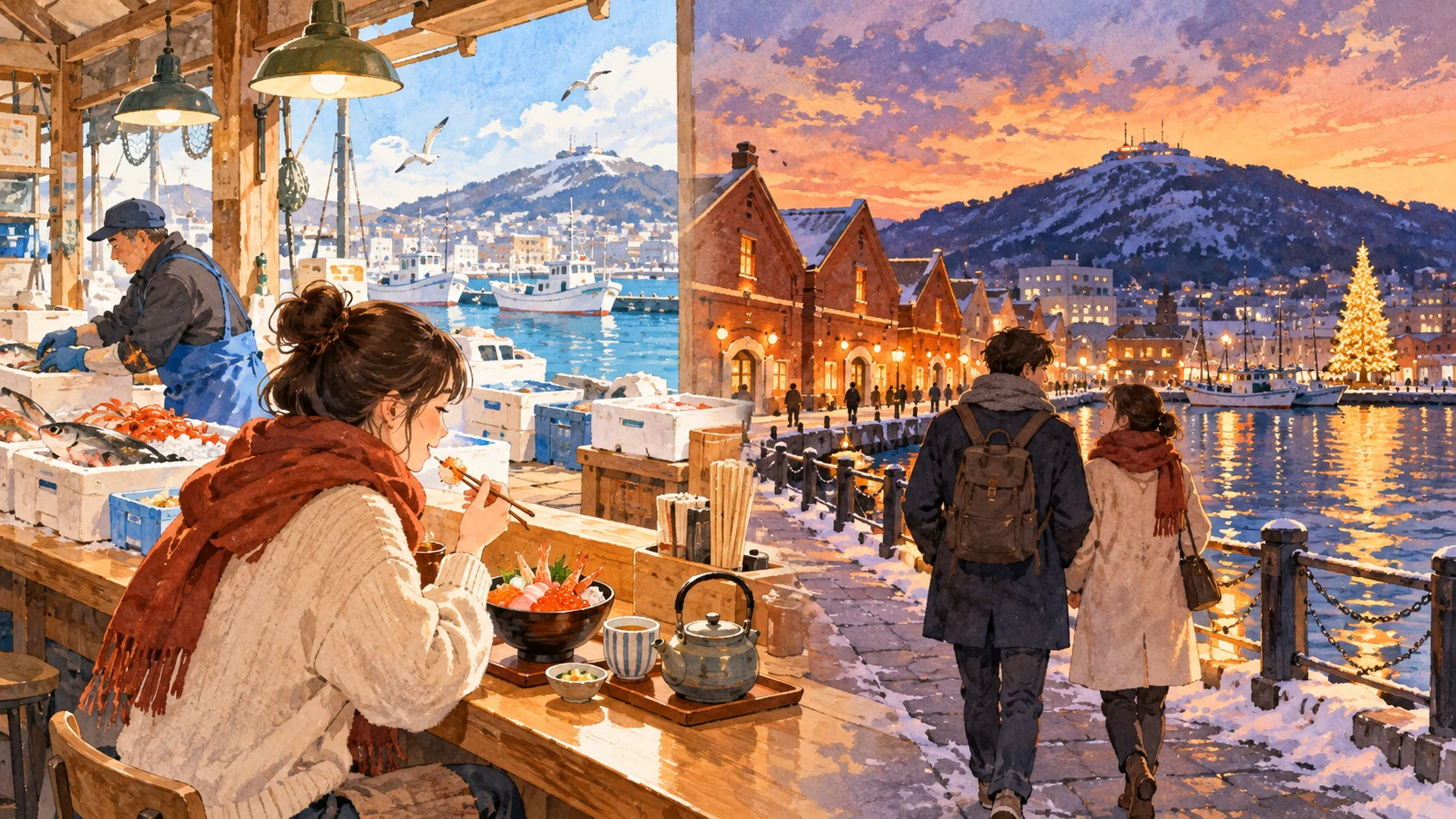
Do not put the Christmas bay, summit and ryokan dinner into one evening
For the full 18:00 waterfront program, stay nearby in late afternoon: visit Kanemori buildings still open, eat something, add layers and find a viewing place without blocking circulation. Official access gives about seven minutes on foot from Jujigai to the floating tree and five to the soup walkway in front of BAY. These are different locations; the shorter time does not apply everywhere. During traffic controls, the nearest intersection is not necessarily an available taxi drop-off.
With a Yunokawa dinner plan, put the waterfront night on another evening or confirm a no-dinner plan in advance. Do not rely on watching 18:00 fireworks, escaping the crowd, riding back and starting dinner punctually by 19:30. With children or older relatives, agree an indoor rest stop and a meeting point if separated. Leaving early is fine; waiting until the tree switches off is not required for a worthwhile visit.
Hakodate has separate summer fireworks, not the same event as daily Christmas relighting. The official Yunokawa fireworks page currently marks August 22, 2026 as ended, not a confirmed 2027 date. A coastal hotel also does not establish a room view of fireworks. For a view category, obtain answers on orientation, floor and that edition's launch site; otherwise plan to watch outside.
Cape Tachimachi and the Ishikawa Takuboku family grave: a daylight coastal walk
Cape Tachimachi's official listing gives about twenty minutes on foot from Yachigashira tram stop, explaining the cape's terrain and winter vehicle restrictions. It suits daylight sea views in stable weather, not a casual urban night-view replacement when the ropeway stops. The return includes slopes too: check companions' ability and remaining daylight. After a tiring Motomachi walk, deciding the next day is better than forcing the cape into the evening.
The 2026 road-opening notice lists March 24 at 10:00 through November 9 at 15:00, still adjustable for surface and weather. This Cape Tachimachi city road is not Mount Hakodate's road closing at 11:00. The times and sections are not interchangeable. General winter information allowing walking does not tell an unfamiliar visitor that any footwear or hour is suitable.
If wind makes the cape unsuitable, take a short bay walk closer to your hotel where access is safe, or rest indoors. Do not cross barriers for a photograph or use cemeteries along the route as portrait backgrounds. The cape suits people seeking open coastline and willing to walk farther. With only a brief gap, save it for adequate daylight instead of a rushed return after dark.
For a literary stop on the Cape Tachimachi walk, find the named Ishikawa Takuboku family grave. It is at Sumiyoshi-cho 16, on the uphill route toward the cape. Hakodate's official tourism page gives about 13 minutes on foot from Yachigashira tram stop and free access. Takuboku and seven family members are buried here, overlooking the Omori shore he loved. Reading the tanka on the monument before looking across the coast gives the walk a specific literary stop beyond a cape photograph.
A possible route is Yachigashira tram stop → Takuboku family grave → Cape Tachimachi → back to the stop. Add roughly 10–15 minutes at the grave to the original cape round-trip allowance; this is this guide's suggested buffer, not an official tour duration. The official roughly 20-minute tram-stop-to-cape walk and 13-minute stop-to-grave walk refer to two destinations, not consecutive legs to add together. The seated seaside Takuboku statue is at Takuboku Small Park, Hinode-cho 25, a different place from this family grave. Do not navigate to the grave using a statue photograph. In winter, strong winds or fading daylight, shorten or cancel the cape walk; keep quiet at the grave and give mourners space.
Two nights and three days: mountain first, bay or ryokan on the second evening
You can swap days in this editorial two-night, three-day sequence according to arrival and weather. On day one, leave luggage or check in, walk around the market and bay, then assess the mountain toward evening. With a late flight, simply eat and rest. Do not begin with distant Cape Tachimachi. Learning your local tram stop, restaurants and route back leaves room for a delayed flight or train.
On day two, use the morning for Goryokaku and afternoon for Motomachi and the Public Hall, reversing if daylight and energy favor it. The evening has two versions: a city base supports bay lights and dinner; changing to a meal-inclusive Yunokawa room means shortening the walk and arriving for a bath. If poor weather on the first night moves the mountain to the second, remove another evening activity rather than compress everything else.
On day three, align market breakfast, checkout, bag collection and departure in one direction. Only add Tachimachi with spare daylight and suitable surfaces. For a flight or long train ride, leave the cape for another visit. Write which station to return to, where bags wait and the latest time to leave a sight. One fewer distant stop can buy an unhurried meal and a smoother connection.
With only one night, choose one evening priority
Make either the summit or waterfront event the main focus. In an ordinary season, try afternoon Motomachi, a dusk mountain visit and the next morning's market. At Christmas, if 18:00 fireworks matter most, spend the afternoon at Kanemori and the bay, then fit Goryokaku or the Public Hall the next day by opening times. Removing stops does not make the trip incomplete. It allows a real pause instead of leaving only memories of waiting for transport.
Choose accommodation around departure: early rail favors the station; a bay evening needs the actual walk home checked; two ryokan meals call for returning to Yunokawa in the afternoon. When reading reviews, compare the writer's room, companions and season with yours. Still verify room name, dinner deadline and children's beds. A large price gap deserves a check of whether date, party size, meals and cancellation terms match.
With poor weather all day, use confirmed-open interiors and short neighborhood routes. A taxi can reduce cold, wet movement, with its actual day's estimate added separately. Do not tour every corner just because you bought a pass. Preserve the experience that matters most and enough energy for your companions to want to return to Hakodate.
One-night budget for two adults: an assumed room rate and checked fares
The table models two adults for one city night: an assumed ¥24,000 double room including consumption tax but excluding meals and accommodation tax, with the hotel confirming taxable accommodation below ¥20,000 per person. Accommodation tax is 200 × 2 = ¥400. A ¥700 airport shuttle both ways costs 700 × 2 people × 2 legs = ¥2,800. Tram day passes for both on two days cost 800 × 2 × 2 = ¥3,200. The room price is hypothetical; ticket inputs follow this guide's checked version.
Add two ropeway returns at 1,800 × 2 = ¥3,600; current tower admission 1,200 × 2 = ¥2,400; Public Hall 300 × 2 = ¥600; Tomoe-don 3,278 × 2 = ¥6,556; and an assumed ¥6,000 for other food and drinks. The total is 24,000 + 400 + 2,800 + 3,200 + 3,600 + 2,400 + 600 + 6,556 + 6,000 = ¥49,556. This is not a promotional package and excludes flights to Hokkaido, long-distance rail, shopping, insurance and unplanned taxis.
From April 1, 2027, changing only the tower to its announced price adds ¥600 and makes ¥50,156; other items still need updating at the time. If both days only need a Hakodate-ekimae–Jujigai return, two adults over two days spend 500 × 2 × 2 = ¥2,000 on trams, ¥1,200 less than the example's passes. At an onsen inn with ordinary bathing tax charged separately, two liable adults can add 100 × 2 = ¥200, without duplicating an included charge. Changed rooms and meals require a fresh calculation of the whole table.
| Item | Total for two | Nature and scope |
|---|---|---|
| Double room and accommodation tax | 24,000 + 400 | Assumed room price; taxable accommodation below ¥20,000 per person |
| Airport return and two days of trams | 2,800 + 3,200 | A day pass each day, without combination or individual-route discounts |
| Ropeway, tower and Public Hall | 3,600 + 2,400 + 600 | Ordinary adult tower price before April 2027 |
| Tomoe-don and other food | 6,556 + 6,000 | Bowl at current tax-inclusive price; other food assumed |
| Total | 49,556 | Flights, long-distance rail, shopping and other costs excluded; recalculate your own route |
Before booking, save beds, dinner, cancellation and a weather alternative
Read the complete order: hotel building and room, number of adults and children's Japanese school stages, permanent and extra beds, room bath or communal bath, included breakfast and dinner, and actual taxes due on arrival. Ask each hotel about the same conditions to make answers comparable. An unconfirmed view or bed is not a hotel promise merely because you wrote it in your own request box.
Then save cancellation deadlines, late-arrival contacts, arrival station and luggage arrangements. For Christmas 2026, retain an ordinary city alternative after checking dates. For a new Goryo Hoshi no Yume season, wait for the formal announcement before committing nonchangeable spending. Seasonal expectations are fine, but dates, light positions, roads and fares need to belong to your departure year.
To extend Hakodate into a longer Japan trip, organize totals with a budget separating accommodation, transport and food, then check bags and connections against winter travel and alternative-plan principles. Settle the most important evening first and keep daytime blocks exchangeable. Markets, slopes, coast and hot springs can then each have their own time.
A few useful answers
How many nights suit a first Hakodate visit?
Start with two, allowing a mountain-weather swap and separate bay and Yunokawa-dinner evenings. With one, choose a single nighttime priority. An extra night does not guarantee a clear view.
Should I stay by the station or in Yunokawa?
Early or late trains, bags and the market favor the station. For a night of bathing and two meals, compare specified Yunokawa rooms. Include return travel, beds and cancellation; neither area is universally better.
Does Hakodate's tram day pass last 24 hours?
No. The ¥800 adult/¥400 child day pass ends with that day's last service. The separate mobile 24-hour ticket costs ¥1,130/¥570, with different validity and purchase methods.
Can I use Suica on the tram?
Yes. Interoperable IC cards include Suica and PASMO, normally tapped on and off. Specific transfer discounts limit eligible cards. Do not apply tram IC rules automatically to Hakodate Teisan airport buses.
What does the Mount Hakodate Ropeway cost?
When checked for this guide, adults from Japanese lower-secondary school pay ¥1,800 return or ¥1,200 one way; children ¥900/¥600. Check the separate young-child allowance, daily suspensions and seasonal last departures.
Can I reach the summit during autumn 2026 ropeway maintenance?
During the October 20–November 8, 2026 suspension, temporary mountain buses and other options have their own schedules and crowd warnings. Once the road closes for winter on November 9, do not extend that autumn bus into your plan.
Will Goryokaku Tower prices change in 2027?
From April 1, 2027, announced ordinary prices are ¥1,500 adult (the official page defines adults as 18 and older), ¥1,130 lower-/upper-secondary student and ¥750 primary pupil. Before then, the current prices here are ¥1,200/¥900/¥600. Check visit date and category.
Is Goryo Hoshi no Yume confirmed for late 2026?
The cited tower announcement only confirms the ended December 1, 2025–February 28, 2026 season. It does not guarantee late 2026–early 2027. Plan daytime Goryokaku and await the organizer's new lighting announcement.
When is Hakodate Christmas Fantasy 2026?
Official tourism lists a planned December 1–25, 2026 event. Usual tree lighting is 16:30–17:45 and 18:00–22:00, first day from 18:00. Weather and daily notices govern the program. Viewing is free; soup is extra.
Does Hanabishi have a family bath I can add to the booking?
The FAQ says no shared-property private-hire or family bath. For a separate space, choose specified Suehirotei open-air-bath rooms or the named Gagyutei suites. Ordinary rooms do not all acquire a private onsen.
How late can I eat seafood rice at the morning market?
Market-wide reference hours differ from individual shops. Kikuyo Shokudo's market branches currently take last orders at 13:40 in May–November and 13:10 in December–April. Check other shops individually, without extending their orders to the market's approximate end.
Can I drive to Cape Tachimachi or Mount Hakodate in winter?
The roads have different notices. Tachimachi's 2026 open period ends November 9 at 15:00; the mountain road closes that day at 11:00, provisionally until April 12, 2027 at 11:00. Surface conditions can change this; pedestrian access is not advice for an ordinary winter night walk.
Check with the source
Schedules, availability and rules can change. These official sources are the place to confirm details before you book.
- JR Hokkaido: Shin-Hakodate-Hokuto and Hakodate Liner
- Hakodate Airport: bus routes, times and fares
- Hakodate city: tram/bus boarding and payment
- Hakodate tram: current distance fares and child rules
- Hakodate tram: day, 24-hour and bus combination tickets
- JR Inn Hakodate: current named rooms and bathrooms
- JR Inn Hakodate: arrival, bed sharing, luggage and meals
- JR Inn Hakodate: accommodation terms and general cancellation
- Century Marina Hakodate: access and location
- Century Marina Hakodate: floors, rooms and occupancy
- Century Marina Hakodate: views, child amenities and luggage
- Century Marina Hakodate: breakfasts, hours and dietary limits
- Hanabishi Hotel: rooms, specified open-air baths and accessibility
- Hanabishi Hotel: dining, private baths and shuttle FAQ
- Hanabishi Hotel: bus stops, tram and arrival route
- Hakodate city: combined city and Hokkaido accommodation tax in 2026
- Hakodate city: current bathing tax and age exemption
- Mount Hakodate Ropeway: daily operation and sunset
- Mount Hakodate Ropeway: seasonal hours, fares and young children
- Mount Hakodate Ropeway: accessibility and facilities
- Official Hakodate tourism: 2026 ropeway servicing and temporary summit transport
- Hakodate Bus: mountain service October 20–November 8, 2026
- Official Hakodate tourism: 2026-season mountain-road winter closure
- Mount Hakodate Ropeway: summit live-camera entry
- Official Hakodate tourism: Motomachi sample walking route
- Old Public Hall: seasonal hours, admission and closures
- Old Public Hall: partial visitor-route change from October 21, 2026
- Official Hakodate tourism: Motomachi Catholic Church visitor conditions
- Kanemori warehouses: retail hours and official social accounts
- Kanemori warehouses: partial November 2026 maintenance
- Morning Market cooperative: general hours and shop differences
- Kikuyo Shokudo: tax-inclusive menu and market-branch hours
- Goryokaku Tower: current ordinary fares, hours and parking
- Goryokaku Tower: announced prices from April 1, 2027
- Goryokaku Tower: walk from the tram and access
- Goryokaku Tower: ended Goryo Hoshi no Yume season 2025–2026
- Official Hakodate tourism: planned Christmas 2026 and soup stalls
- Official Hakodate tourism: ended Yunokawa fireworks 2026
- Official Hakodate tourism: Cape Tachimachi walk, terrain and winter limits
- Official Hakodate tourism: Tachimachi road-open period in 2026
- Official Hakodate tourism: official video library and channel links
- Hakodate Tropical Botanical Garden: current monkey hot-spring and opening notices
- Hakodate Tropical Botanical Garden: hours, admission and payment
- Hakodate Tropical Botanical Garden: early end to monkey bathing and luggage rules
- Hakodate Tropical Botanical Garden: station trams and route 96 buses
- Hakodate City: botanical garden facilities, fares and access
- Official Hakodate tourism: Takuboku family grave, Sumiyoshi location and Yachigashira walk
- Official Hakodate tourism: Takuboku Small Park statue and Hinode location
- Hakodate Haikara Ishokan: current plans and acceptance rules
- Old Public Hall: costume sizes and shop-specific closures
- Hakodate Haikara Ishokan: experience process
- Hakodate Haikara Ishokan: reservation form for groups of ten or more
- Ekini Market: live-squid fishing market prices and seasons
- Ekini Market association: fishing-pond hours and office
- Hakodate City tourism: Ganso Live Squid Fishing Pond
- Ekini Market: Asaichi Shokudo Nibankan
- Kanemori Red Brick Warehouse: four areas and building functions
- Kanemori: current BAY Hakodate shops
- Kanemori: current Yobutsukan shops
- Kanemori Hall: functions and event information
- Kanemori: current History Plaza shops