Choose southwest Hokkaido by how you want to spend the time: Niseko or Rusutsu for consecutive ski days or one booked outdoor activity, Lake Toya for the shore, cruises and announced fireworks dates, or Noboribetsu for valley walks, bathing and a separate aquarium visit below the onsen town. Pick a main base, then check the room, transfers and cancellation terms so that one to three nights after Sapporo or New Chitose produce usable activity days.
After New Chitose or Sapporo, decide which night belongs at a resort
With just one extra night and dinner followed by bathing in mind, start with Lake Toya or Noboribetsu. For repeated lessons and days in ski boots, use Niseko or Rusutsu as a consecutive-night base. The four names belong on one comparison table, not a one-day checklist. Changing hotels includes packing equipment, collecting bags, waiting and checking in again; apparent map proximity removes none of those steps.
After a Sapporo and Otaru city itinerary, keep one main resort base. Two to three nights make a full ski day easier; a lake or onsen-town visit can work with one. These are itinerary suggestions, not hotel minimum-stay rules or guaranteed bus connections. Align arrival, activity and departure days before booking. An early flight means no resort activity that departure day.
The information below uses official material checkable on October 22, 2026. Winter focuses on announced 2026–27 products. Ballooning, rafting and amusement parks are labeled as the already-ended 2026 green season, useful for choosing a future base, without relabeling unannounced 2027 dates or prices. Decide together whether you want skiing, a cruise or bathing before booking, rather than taking the cheapest room and adding costly cross-area travel later.
| Base | Main use | Travel and time allowance |
|---|---|---|
| Niseko | Four ski areas, named lessons or booked green-season activities | Choose a foot-of-mountain area such as Hirafu or Hanazono and match the meeting point first |
| Rusutsu | Three mountains in winter; separate green-season park admission | Allow time for the building, school, rentals and bus separately |
| Lake Toya | Lake-view rooms, cruises, Mount Usu and announced fireworks dates | A bus follows Toya Station; evening activities suit an overnight |
| Noboribetsu | Onsen town, Jigokudani, Bear Park or Nixe | Separate the hilltop onsen town from the station and aquarium below |
Niseko’s four areas share a mountain, not the same daily routine
Niseko United includes Grand Hirafu, Hanazono, Niseko Village and Annupuri. Hirafu suits comparing accommodation, apartment kitchens and daily ski transfers together. Hanazono suits matching the hotel with activity meetings at HANAZONO308. Village and Annupuri have their own base entrances: a room there does not put you outside Hirafu’s lesson desk.
The all-mountain website’s planned 2026–27 seasons start November 28, 2026 in all four areas, with different finishes: Village on April 4, 2027, Hanazono April 11, and Hirafu and Annupuri May 5. Opening dates can still change. Planned night skiing is December 12–March 22, not a promise that every lift and trail operates simultaneously every day.
Before changing areas, check the day’s upper-mountain links, whether you can ski the chosen route, and alternative transport back to your original base. Beginners crossing the mountain to justify an all-mountain pass can spend practice time finding routes and rushing for last lifts. With one full ski day, staying where the lesson and rentals are often works better than touching all four areas. Use a second full activity day for exploring elsewhere.
All four have beginner-rated runs, but green markings do not give identical gradients or lengths. Use the official 2026–27 trail map to locate lower-mountain practice areas, then compare Hirafu, Hanazono, Village and Annupuri trail data below. Read maximum and average gradients together: Hirafu Family averages only 7° but reaches 17°. Family in a name does not mean flat throughout. First-time skiers should stay in basic teaching areas, then repeat suitable beginner runs once they can control speed, stop and turn.
Hanazono–Hirafu connections are not equally difficult in both directions. Hanazono’s trail description has a short uphill section after the Hanazono No.2 chair exit before the Connecting Course leading to Hirafu Holiday; the current map marks both green. In reverse, the official access guide describes King Gondola, Swinging Monkey chair, Parallel and Silver Dream, yet still calls Silver Dream beginner. The current map and dedicated trail page rate it intermediate, with a maximum 20°. Plan this crossing as requiring intermediate terrain, not an all-green route. If you are not ready for intermediate runs, change areas by a base shuttle whose departures you have confirmed.
Links onward to Village and Annupuri are higher on the current map, not a level traverse through all four beginner base areas. Annupuri’s Family and Junior are lower down; routes from the summit encounter intermediate or advanced terrain. Crossing all four suits skiers who can independently handle the chosen intermediate routes, read junctions and manage the return time. First-timers can give one area a whole day. Check each connecting lift and trail, and the latest return to your own area; base night-skiing hours do not establish last cross-area connections. Before relying on a downhill lift ride to exit, ask that station whether it carries descending passengers that day and the last time. For the United Shuttle, check the season, stops and ticket eligibility too: some material seen still says 2025–26 and does not guarantee the new season’s final bus.
| Area | Named practice area or beginner run | How to use the comparison |
|---|---|---|
| Grand Hirafu | Lower-mountain Family: 17°/7°, 750 m | For skiers who control speed and turns and want repeated lower-Hirafu practice. A beginner run is not a completely flat first-time standing area. |
| Hanazono | Beginner area near HANAZONO308; Juicy Fruit from Symphony Gondola’s middle station: 12°/7°, 800 m | After lessons at Hanazono, keep gentler beginner practice below the middle station. Do not ride to the top by default: Colly’s Folly from there is intermediate, maximum 22°. |
| Niseko Village | Official Beginner Areas 1 and 2; lower Shakey Knees: 9°/4°, 650 m | Compare this area for basic teaching and subsequent lower-mountain practice. Teaching-area eligibility depends on school and ticket; the upper Niseko Gondola is not automatically the next step. |
| Annupuri | Family: 11°/6°, 580 m; Junior: 13°/9°, 960 m; both beginner | Start with shorter gentle repeats, then compare Junior for more length in the same area. These lower green runs do not establish an equally easy descent from the summit. |
From the airport to Niseko: the station is not the final leg
Niseko United’s access guide lists the rail approach through New Chitose, Sapporo and Otaru toward Kutchan and Niseko, warning of limited local trains. The endpoint to research is not simply Niseko Station: identify the station your hotel uses and the bus or taxi afterward. Hanazono and Hirafu stays do not have equal door-to-door costs just because the station name is the same.
Direct winter ski buses normally need reservations. Although the same official page previews 2026–27 booking information, some timetables explicitly remain 2025–26. Check the year, boarding/drop-off hotels, large-bag and ski-bag acceptance before giving booking details to the transfer desk. Do not work backward to flights from last season’s departure, or assume a station makes every arrival connect seamlessly.
If considering a rail pass, use route and cost checks for rail tickets for the actual sections. Pass eligibility, a separate ski-bus charge and a successfully reserved hotel transfer are separate questions. Use the arrival evening to check in and try equipment. Do not commit to a paid lesson with late-arrival restrictions immediately after landing before road conditions are established.
All mountain or Hanazono–Hirafu: buy for the area you will use
The current Hanazono–Hirafu two-area prices list peak season December 24, 2026–February 28, 2027: an adult day pass is ¥12,500 at the window or ¥11,800 online. The all-mountain adult window day pass for the same period is ¥13,500, a ¥1,000 window-price difference. This buys a wider area, not a compulsory beginner upgrade. For lessons limited to Hanazono and Hirafu, check the school’s recommended ticket first.
The two-area pass classes ages 4–12 as children, 13–15 and 65-plus in another price column. Ages three and under can collect a free ticket at the window, with the child present and a guardian accompanying lift rides. Adult lesson ages can differ again; adult ticket is not a universal age category. An afternoon four-hour pass starts after noon on its purchase day and runs continuously from first gate entry, not four freely chosen clock-hour slots.
The online all-mountain instructions also list a ¥500 card charge for a first purchase and no direct cancellation/refund after buying. Riding the United Shuttle with the card can activate its days or deduct usage time. One early bus ride can unintentionally consume a day intended for tomorrow’s skiing. Multi-day tickets use consecutive days; include rests and potential non-ski days before purchasing.
NISS lessons have their own ages, language and April date limits
NISS’s current small-group lessons divide into Tic Tac for ages 3–6, Yuki for 7–14 and adults from 15, with at most four per group. Tic Tac is skiing: children must be three on the start date and independently toilet-trained. The advertised 10:00–15:30, or 5.5 hours, includes a lunch break, not 5.5 continuous hours of individual instruction. Group teaching is generally in English, requiring understanding of simple directions.
January 10, 2027 falls in the school’s regular season, when all three full-day group categories list ¥32,000 per person; peak season is ¥37,000. The listed lunch is included, lift passes and rentals are not. Adult groups mainly take levels 1–4; higher levels should compare private lessons. The header gives planned group operation December 8, 2026–April 4, 2027, while season notes below extend to April 11. Ask the school about bookable April dates rather than treating the price table as proof of classes throughout.
Check in at HANAZONO308. Yuki and adult meetings are 09:45–10:00, Tic Tac 09:15–09:45, with child collection at 15:30. These affect whether to stay in Hanazono or transfer early from Hirafu. If adults also have lessons, arrange who handles the child and rental boots. The lesson start is not the time to leave the hotel, and do not expect to switch to Chinese instruction on arrival.
Rental and lesson cancellations belong to different products
NISEKO SPORTS’s current adult Sports rentals cost ¥6,500 for one-day equipment alone or ¥8,500 with boots; skis also include poles. Check clothing, helmets and other items separately. Online reservations are accepted until four days before use; from three days before through the day, arrange in store. The page offers collection from 15:00 the previous afternoon, but confirm branch, size and pickup time. Convenient collection does not mean every item is in the package.
The winter terms distinguish NISS and rental changes. NISS takes a nonrefundable 20% deposit within seven days of confirmation, with final payment due 30 days before arrival. After full payment, cancellation generally refunds 80% at 30 days before the start and is generally nonrefundable within 30 days. The wording is close at the 30-day boundary: get written confirmation if it falls exactly there. Late arrival does not entitle you to extra time, a different lesson or a refund; weather and lift changes do not automatically cancel the entire lesson.
Rental terms separately allow a full refund for cancellation by the previous day. On the day, before use begins, contact the shop directly about cancellation or changes; the stated compensation may be shop credit usable during the trip. This differs from NISS’s nonrefundable deposit. Record payment and cancellation dates separately for lessons, equipment/boots, clothing, passes and transfers. A hotel arranging them does not make the hotel cancellation table apply to everything.
Setsu in Hirafu: start with Studio family occupancy
Setsu’s Studio page lists the basic Studio as 41 square meters, with a King or two single beds, for at most two adults and one young child. Village Studio with Tatami is 66 square meters, for three adults and one young child or two adults and two children, with Japanese bedding for extra sleeping places. These combinations tell you more than a maximum occupancy of four. Two adults and two elementary-school children should not book a basic Studio expecting to squeeze in later.
The hotel FAQ’s child categories are adults from 13, children 7–12 and young children six and under, using age at check-in; all ages count toward total room occupancy. Kitchens and washer-dryers help with breakfast, wet clothing and children’s meals over several nights. Only some Studios have tubs, and ordinary bathroom equipment does not establish in-room onsen. Choose an explicitly private-onsen suite category if natural hot-spring water in the room is essential.
The property suits apartment stays with daily Hirafu trips, but its FAQ expressly says it is not ski-in/ski-out. Compare kitchen, laundry and ski-locker convenience with the morning transfer time. Rates vary with dates, people, ages and plans; an undated minimum display cannot guarantee a whole-season price. Request the bed type when booking too.
Setsu’s new-season shuttle and lodging cancellations
Setsu’s published 2026–27 ski shuttle runs December 1, 2026–April 15, 2027 from the hotel ski lockers, circulating 08:00–10:00 and then listing 20-minute intervals through 17:00. Departures from 17:20 onward operate only in the listed December 12–March 22 night-skiing period, subject to date changes. The hotel shuttle’s season does not make every ski area, lesson and night session finish on the same day.
Setsu’s accommodation terms define December 1–March 31 as winter bookings: cancellation 60 days or more before arrival forfeits the paid deposit; fewer than 60 days incurs the full stay charge. Ordinary one-to-fourteen-night bookings April–November list 100% for cancellation within two days, with separate tables for long stays or five-plus rooms. These are contractual baselines; check any terms on your actual confirmation. Do not carry summer flexibility assumptions into winter.
Normal check-in is 15:00 and checkout 11:00. Contact the hotel before sending ski equipment, labeling the booking name, number and arrival date. The FAQ lists delivery no earlier than two days before arrival. Do not put all equipment, medication and first-night clothing in one last delivery: you still need to check in and manage tomorrow if it has not arrived. Separate connections, check-in and equipment collection rather than filling a timetable with minimum journey times.
Park Hyatt Hanazono: distinguish 65-square-meter rooms and residences
Park Hyatt Niseko Hanazono’s room descriptions give both 1 King Bed and 2 Twin Beds as 65 square meters for up to four, with a living-room sofa converting to a double bed. Studio Residences of 35–40 square meters hold up to two. The King description lists a kitchenette and washer-dryer; Twin equipment is described differently. Residence does not establish identical kitchens, and four-person capacity does not mean four separate beds.
For natural onsen in the room, choose a category explicitly named Private Onsen, such as the 73-square-meter King Studio Residence Private Onsen for up to two, or the 98-square-meter King private-onsen suite for up to four. An ordinary 65-square-meter room’s soaking tub is not a private onsen. Direct slope access and ski lockers suit Hanazono-focused stays, still subject to trail opening and ability, not a guarantee of skiing to your room door at any time.
Park Hyatt’s booking policy for children differs from Setsu: ages 0–5 sharing with adults stay free within total room capacity, with the listed free breakfast only on breakfast-inclusive plans. Ages six and above use applicable adult rates. Children still count toward occupancy. Two adults with a six-year-old comparing the hotels need to consider child charges, beds and breakfast together, not merely similarly named double rooms.
Airport travel to Hanazono: a transfer request needs confirmation
Park Hyatt’s transport FAQ lists Kutchan as the nearest station and options including roughly two to 2.5 hours’ airport driving, reserved hotel cars in green season and winter airport buses to the resort area. This helps choose transport; it does not confirm your departure or seat. Peak-time taxis can also be difficult to arrange on the spot. For dinner in Hirafu, reserve the return to Hanazono first. A daytime ski shuttle is not a late-night ride home.
Send luggage using the hotel address, guest name and reservation number; the hotel can also help with domestic and airport delivery on departure. Confirm cutoff and actual delivery date before use. Do not send away boots needed tomorrow. Peak lodging cancellations depend on date and plan; the FAQ directs you to reservations, without a fixed-day table for every booking. Another Niseko hotel’s 60-day winter rule does not transfer here.
The four-area pass, school meeting point, hotel car and airport bus each have their own coverage. Keep confirmations offline showing at least date, party size, meeting point and payment status. With two nights, make only one day require an early meeting, keeping another half-day for weather and equipment. For several days of advanced skiing, add nights in the same base rather than changing rooms daily for another ski-area name.
Summer ballooning is tethered; Hanazono may be outside the transfer area
Hokkaido Lion Adventure’s 2026 balloon page says the venue has moved near Pure in Niseko Village. The balloon is tethered, rises and returns to the same spot, with about five minutes per ride plus queuing. It is not a long free flight over Mount Yotei. The 2026 season was weekends and national holidays June 6–September 23, with daily bookings July 18–August 31. Do not use those as 2027 operating dates.
Listed regular prices are ¥3,170 for adults, ¥2,200 for elementary-school children and ¥660 for young children, free for ages two and under, with at least two participants. Normal meeting is 06:30, moving to 06:00 on specified busy dates or with large numbers. The pilot judges conditions that morning, and rain or wind may cancel the activity. Stay somewhere that supports the early meeting the night before, rather than trying to connect a fresh airport arrival. Children being eligible does not remove basket-entry ability or clothing requirements.
Free transfers on the activity page require reservation and cover only specified Niseko/Hirafu areas, excluding Kutchan Station surroundings and Hanazono. The operator’s participation rules list traveler cancellation at 50% the previous day and 100% on the day, with no cancellation fee when the operator cancels for weather. From Hanazono, establish how to reach the venue rather than assuming Niseko means free collection everywhere.
Shiribetsu rafting: age three eligibility does not include spring rapids
HANAZONO’s 2026 rafting ran April 29–October 12 and has now ended. Regular prices were ¥6,500 for adults from junior-high age and ¥4,500 from age three through elementary school, taking about three hours. Morning starts 09:00 with an 08:45 meeting; afternoon starts 13:30 with a 13:15 meeting. Meet at HANAZONO308, with about 20 minutes’ bus travel included. It is not a turn-up river activity to improvise after checkout.
Spring snowmelt rapids separately require junior-high age and above, listed April 29–May 5, 2026 subject to water levels. Children ages 3–5 are also not accepted during periods of high water in May. Bring underwear, a change and a small towel, wear practical movement-friendly clothes and avoid jeans and skirts. Helmets, life jackets, wetsuits and river shoes are among provided equipment, but a wetsuit does not guarantee staying dry. Consider age, water and the child’s actual stamina together.
The green-season terms generally allow free cancellation at least two days before, 50% the previous day and 100% on the day, with restrictions for early-booking or sale products. Operator cancellation for impossible weather has no cancellation fee. Water activities such as rafting prohibit cameras and electronics for safety; a waterproof pouch is not automatic permission. Changing and collecting bags follow the activity. For another base that afternoon, confirm the actual finish point and transport.
Summer gondola and hiking are separate: do not reuse green-season hours in late autumn
Hanazono’s 2026 summer-gondola information lists July 1–October 12 and already marks the season ended. Return fares are ¥2,000 from junior-high age, ¥1,000 for elementary students and free for preschool children. One way takes about six minutes, from elevation 308 m to 658 m. This is summer sightseeing, not part of a winter all-mountain pass. Wait for next year’s details; the October price table does not establish operation in late October.
That season’s daytime hours were 09:00–16:30, last boarding 16:00, with tickets at HANAZONO308’s activity counter on the day. Near the upper station the surface is unpaved and awkward for strollers, there is no summit restaurant and cabins have no air-conditioning. Mount Yotei views depend on weather. Seated gondola sightseeing and a mountain walk have different equipment and time needs.
The Kagaminuma trail page separately gives about 70–80 minutes return, requiring hiking footwear/clothing, water and bear/insect preparations. A six-minute gondola ride does not replace trail time. For children or older people wanting only views, a short upper-station stop and return is easier to adjust. Use seasonal itinerary choices in Japan to separate seasonal facilities from year-round indoor rest options.

Rusutsu’s three mountains: match lessons and the route back to your room
Rusutsu’s official winter introduction places West, East and Isola within one resort system. Staying near the hotel does not make every lesson meeting an immediate step outside; children, strollers and ski boots add indoor travel too. On a first visit, choose terrain for your level and let the instructor decide about other mountains. Three mountains are not a beginner’s target for one day.
The international school’s guide says instructors choose suitable terrain across the three mountains according to ability, while desks, rentals and ticket counters occupy different locations. Allow extra time when coming from the Westin by monorail. If only half the party has lessons, agree breakfast, accompanied check-in and a lunch meeting first. Do not make the whole family cross buildings for one person’s lesson without their own rest plan.
These lift passes, lessons and rentals are outside Niseko’s all-mountain product. Two to three nights practicing in one system make meeting times easier to control than changing bases and schools. For a first experience, plan one lesson and a gentle-slope activity day. Experienced skiers exploring elsewhere still need to respond to the day’s lifts, wind and open return routes, not choose the final run from mountain names alone.
The table uses official trail ratings and gradients. Break an East–Isola outward journey into recognizable sections too. The official map’s Isola access box shows East Quad to East Tignes, Fuboru, Joint and Furikozawa, then Isola No.2 Quad on the Isola side. It specifically tells beginners to choose East Quad rather than East No.2 Gondola to higher terrain. Across A and B are steep ungroomed shortcuts, not substitutes for Joint because they are shorter. The map connects the West hotel side and East Center Station by East No.1 Gondola and Tower Pair; check usable directions and passenger rules that day.
From the top of Isola No.2 Quad, the return can follow Isola Grand and its Isola Grand Bypass, then Isola D and Isola D Bypass to Furikozawa, Across No.2 Pair back to East, and the open lower East Tignes to East Center Station. This connection still contains officially intermediate sections. If you cannot yet turn, control speed and use chairs consistently, remain on Family or Easy Trail that day. From a West-side hotel, establish the East-to-hotel link, its direction and final ride before leaving. Reaching East and reaching the hotel are separate plans.
Before crossing, confirm last rides on Across No.2 Pair and the equipment used East–West, rather than continuing deep into Isola because hotel-side night skiing remains open. The official ticket information warns that closing times vary with period and conditions. As of October 22, 2026, this guide has not established the 2026–27 last rides on each connection. Check live lift and trail status and local notices on the day, ask staff about the return, and leave connection margin. Narrow the area for wind, closures or approaching last rides. Map connectivity is not proof of an available round trip today.
| Mountain | Named gentle run or link | Ability and practical choice |
|---|---|---|
| West | Family: 650 m, maximum 12°; White Lover: 650 m, maximum 11°; both beginner | Compare these short runs for repeats near the hotel. Beginner Rainbow is 2,000 m, for extending distance after speed control; a shared rating does not make a long summit run a first-lesson starting point. |
| East | Easy Trail: 750 m, maximum 8°, beginner, reached by East No.1 Pair | Start with short repeats here. East Tignes is in the same mountain area but intermediate, 2,500 m and maximum 19°. Reaching Easy Trail does not establish ability to descend from East’s summit. |
| Isola | Furikozawa: 2,100 m, maximum 10°, beginner connector; Isola Grand: 3,500 m, maximum 20°, intermediate | Add long runs when you can link turns, control speed and preserve return time. Furikozawa links East and Isola; it is not a self-contained novice practice circuit. Some green terrain does not make the whole mountain crossing easy. |
Rusutsu day, continuous five-hour and 25-hour passes: different clocks
Rusutsu’s 2026–27 tickets define regular season as December 19, 2026–March 14, 2027. Ages 19–64 pay ¥16,700 at the window or ¥13,200 online for a day, and ¥14,500 or ¥11,600 for five hours. Children 4–12, teenagers 13–18 and seniors 65-plus have separate columns, unlike Niseko’s groups. Early December and dates after mid-March have other rates; regular season is not the entire winter.
The five-hour pass runs continuously from first gate entry, without splitting across days. The 25-hour product uses one-hour units and costs adults ¥39,000 at the window or ¥36,000 online. Five-hour top-ups are only for existing 25-hour holders; a new card cannot simply buy the top-up price. Two regular-season online day passes at ¥13,200 total ¥26,400, or ¥9,600 below ¥36,000. For two days, a flexible-sounding hourly product is not automatically better value.
Passes cannot be shared or carried with unused credit into the next winter. The page lists unused current-season five-hour and point tickets valid until March 31, 2027; check other products individually. Count actual lift days rather than buying three days because you stay three nights. If day one is arrival, boot collection and dinner, start the pass on the day you actually ski.
English private lessons are priced per instructor; inventory rental clothing too
Rusutsu international private ski lessons take one to five people, from age four, generally in English without other-language versions. November 28–December 13, 2026 and the January–February 2027 regular season list 14:00–16:00, two hours at ¥51,000 per instructor. With five suitably matched participants, that averages ¥10,200 each; it is not a ¥10,200 individual place sold by the school. Peak December 14–31 and March spring lessons have other prices.
Lessons exclude passes and rentals. First-timers and level 1 must check in at least 30 minutes early. Ask the school whether the exception of no lift pass in a level-1 lesson’s first two hours applies; do not remove everyone’s full-day pass beforehand. The standard ski-rental page lists adult skis, boots and poles at ¥10,800 per day. Check whether clothing, helmets, gloves and goggles require the Full Set option. Package does not mean a three-piece rental covers you head to toe.
International-school terms generally charge at least 10% for cancellation after payment, however far ahead: 10% from 30 to seven days before, 30% from seven days to 72 hours, and 100% within 72 hours. Ask the desk at exact boundaries. Personally deciding the weather is poor does not remove fees. With two or more lifts operating, lessons may continue or change terrain. Read the full conditions before payment rather than treating weather as an automatic refund afterward.
Rusutsu’s standard Twin: a third guest uses an extra bed
Rusutsu Resort Hotel & Convention’s Twin is 33 square meters for up to three. Two people use two singles; a third uses an extra bed. The room has a tub and toilet, and guests can use the public hot-spring baths, without making the room tub natural onsen. For a cot, wheelchair or several ski bags, ask about space after the extra bed and an appropriate room arrangement.
Ordinary Twins, family rooms, suites and other resort hotels are not one product simply because they appear together on a page. Compare real dates, adults, children and two-meal inclusion; an undated starting rate is not bookable availability. Confirm breakfast/dinner locations, extra child meals and early luggage storage with the selected plan to know whether arrival day can support a paid activity.
Allow indoor travel even within the same resort. On a first morning, do not compress bus arrival, stored bags, changing, boot rental and lesson check-in into the preceding half-hour. Use day two as a full ski day, then choose day-three activities around checkout and the return bus. That makes the room’s convenience clearer and avoids missing a booked bus to justify another pass.
New Chitose–Rusutsu and Sapporo–Rusutsu buses have different fares
The BIGRUNS airport bus lists resort-bound winter operation November 28, 2026–March 30, 2027 and airport-bound November 29–March 31, about 120 minutes. Online one-way fares are ¥5,000 per seat, ¥5,500 otherwise, equal for adults and children. From age four a paid seat is required; ages three and under are free only on an adult’s lap. Reserve and pay online by 24:00 seven days before travel. The advance price does not guarantee boarding after an unbooked airport arrival.
The winter RUSUTSU EXPRESS from Sapporo lists November 28, 2026–March 31, 2027, ¥3,000 per seat one way online, with a 15:00 previous-day cutoff. Reservations separately open in early November: follow that notice and complete the booking. Sapporo 08:00 reaches Hotel & Convention about 09:45; the hotel return is 17:00, reaching Sapporo 18:45. Other resort hotels have different stop times, and Sapporo construction can change the meeting point.
Airport-bus cancellation is 40% the previous day, 50% before departure on the day, and 100% after departure or for a no-show. Sapporo-bus self-cancellation completed before departure is listed at 0%, then 100% after departure or no-show. Do not exchange the rules. Some extra winter airport services start only in December. Confirm large cases, ski bags, flight connections and hotel stop before booking. Two hours’ driving does not remove immigration, meeting and winter-road margins.
Rusutsu’s summer park ended October 18; winter lift tickets do not apply
Rusutsu’s 2026 amusement-park calendar lists April 29–October 18, with regular Monday closures except national holidays, Golden Week, July and August. For a future green-season visit, decide whether to stay in the resort while awaiting 2027 dates and prices. A winter three-mountain lift ticket does not become amusement-park admission. A winter stay in the same hotel does not keep the Ferris wheel and outdoor rides running.
For the listed ordinary 2026 weekday, adult park-only day admission is ¥6,300 at the window or ¥5,400 online. Resort day admission is ¥7,700 or ¥6,300, adding the specified Yotei Gondola, indoor pool and other facilities. Comparing like-for-like online weekday prices gives ¥900 extra. Value depends on actual use and opening dates. Do not extend that weekday table to summer holidays or weekends, or infer every ride suits a small child.
Individual rides retain height, age and accompaniment restrictions despite paid entry. The summer introduction used on the official resort site helps with the atmosphere of the choices; confirm the calendar, purchasable tickets and each ride separately. In rain, establish actual indoor opening and ticket inclusion rather than improvising unresearched rafting or another outdoor activity as a reservation-free alternative.
Lake Toya’s station is not on the shore
The tourism association’s access guide names JR Toya as the nearest station, followed by Donan Bus or taxi, about 20 minutes to Toyako Onsen. From New Chitose by rail, first change at Minami-Chitose for a limited express. Reaching Toya Station is not reaching a lake-view room. With older travelers, children and bags, the final leg can need more advance work than the train.
For lakeside onsen-town hotels, ask how easily you can reach the pier, dinner and your room after leaving luggage. Hillside or more distant lake-view properties need separate evening-return and hotel-transfer checks. The label Lake Toya accommodation does not establish equal walkability. Lake view describes a sightline, not proximity to one pier or a complete view of moving fireworks launches.
Without a car, keep the first afternoon for arrival and the shore, choose either the cruise or Mount Usu as the next day’s main activity, then plan your departure around station-bound buses. From Noboribetsu, check buses at both ends and actual rail connections, treating the hotel change as the main work of half a day. A morning carrying bags through transfers cannot simultaneously be an easy mountain visit, cruise and punctual lunch.
Nonokaze’s lake-view rooms: the 36.8-square-meter Twin has no private onsen
Nonokaze’s English room page lists the Spa-resort standard lake-view Twin for two, 36.8 square meters, with a shower. The standard Japanese-Western room has the same area: the English page gives three to four people, while the Japanese overview gives two to four. Confirm the actually bookable combination rather than exchanging their capacities. The 68-square-meter Japanese-Western suite has a unit bathroom explicitly without onsen water, unlike the 56-square-meter Executive Twin with a view-facing private hot spring.
Decide whether you need room bathing before beds and party size. For lake views from the public bath, a shower-only room may be enough. To avoid shared bathing, choose a category expressly providing a private onsen bathroom. Lake view, suite or a tub photograph cannot establish the water source. Ask about lake and fireworks sightlines too: no arbitrary lake-view room is a fixed front-row seat to that evening’s display.
Nonokaze’s FAQ lists under-threes free and ages three through preschool at a ¥3,850 tax-inclusive facility fee without bedding, sharing with parents. Bedding costs depend on the plan. Day-use bathing is not accepted, unlike guests’ reservable 50-minute private bath at ¥4,400 per room. Include young children, bedding and private-bath needs in the room search together.
Nonokaze transfers depend on the accommodation booking channel
Nonokaze’s access page lists Sapporo 13:30–16:00 outward and 10:00–12:30 return. Normal one-way fare is ¥1,000 each, waived for accommodation booked by hotel phone or official website. New Chitose is 14:00–16:20 outward and 10:15–13:00 return, normally ¥1,500 one way or ¥1,000 for direct official accommodation bookings. Adults and children pay equally; the two routes do not have the same discount.
Reserve transfers separately. Online requests run until three days before, ending when full; groups of eight or more cannot use them. Reconfirm the bus after modifying or rebooking accommodation rather than assuming the room change preserves seats. Sapporo and airport meeting points and reception times differ; both directions require confirmation. A date with no reservations may not operate, and pets are outside this transfer service.
Normal check-in is 15:00 and checkout 11:00. The FAQ cancellation table is 20% six to four days before, 50% three to two days before, 80% the previous day and 100% on the day/no-show; ask separately for groups. A transfer does not remove cancellation charges, and transport and lodging remain separate contracts. For the 14:00 airport bus, check flight, immigration and meeting time, not simply whether arriving by the lake at 16:20 suits you.
Lake Toya cruises: daytime Nakajima and fireworks boats are separate
Toya Kisen’s operations and fares distinguish daytime Nakajima and fireworks cruises. Regular daytime admission is ¥1,800 for adults and ¥900 for elementary students. From late April through October, sailings are 08:30–16:30 every 30 minutes, about 50 minutes without landing or 80 with a landing and the next boat. Use the Ekimae pier behind Hotel Grand Toya, not any pier you happen to see.
The winter route November–early April does not land on Nakajima: 09:00–16:00 hourly, about 45 minutes, with the final sailing potentially adjusted for sunset. Plan winter sightseeing around views from the water, not summer island walks and cafes. Electronic tickets also need paper exchange at the counter, required ten minutes before sailing. Include that step in pier arrival time.
The fireworks boat is separately 20:35–about 21:20, ¥1,900 for adults or ¥950 for elementary students, from the head-office pier between Manseikaku and Nonokaze. It does not sail when bad weather cancels the fireworks. Both pier and price differ from daytime. For a quiet lakeside evening, consider watching ashore first. Cold, seasickness or an early bedtime are good reasons not to add a night boat just because you bought a daytime ticket.
Mount Usu’s ropeway: consider visibility and allow more than ride time
Mount Usu’s official operations and fares list returns at ¥2,000 from junior-high age and ¥1,000 for elementary students, about six minutes one way. Official visit estimates are about 40 minutes for ropeway plus Lake Toya observatory, or 60 with the crater-basin observatory. These exclude travel from the lake, waiting, tickets and rests. Six minutes is not the length of the whole morning activity.
Hours vary by date. On October 22, 2026, the page displayed first ascent 08:15 and last descent 16:30, while its weather panel still showed the previous day’s observation. Before leaving, distinguish today’s operating notice, older weather data and general year-round descriptions. Do not reuse October’s final ride for winter or other dates. Clouds can justify lakeside rest rather than buying a view you cannot see.
The departure point is below Showa Shinzan, separate from Toyako Onsen. With public transport, check that day’s Showa Shinzan service and return to the lake; drop the mountain and keep the cruise if connections fail. Drivers also need parking, the walk to the station and the final descent. Use only open routes in the volcanic area, with local controls taking precedence. Give view-dependent activities suitable weather rather than filling everyone’s day with both water and mountain.
Use the 2026 Lake Toya fireworks notice, not a promise for next year
The 45th Lake Toya Long-Run Fireworks announcement specifies April 28–October 31, 2026, nightly 20:45–21:05, about 20 minutes. Rain normally does not stop it, but unstable wind direction or speed can. Neither the claim that rain always cancels the display nor the claim that a nightly launch is guaranteed is accurate. This answers the 2026 long-run event only, not 2027 dates or another winter display.
The boat company says launch locations move along the water and the fireworks boat follows, another reason to ask about room angle, floor and obstructions. Decide whether you want to stay in the room all evening or go to the shore after dinner. Facing the lake cannot guarantee the full display remains centered in the window. Do not pay for an unnecessary high-end private-onsen upgrade for an unconfirmed viewing effect.
Fireworks finish around 21:05 and the boat returns about 21:20, followed by the walk back to the hotel. This is not a daytime activity after which you can simply return to Sapporo. An overnight makes dinner, fireworks and bathing easier to enjoy together. If canceled, lake views and baths remain, and missing the fireworks does not automatically make hotel cancellation free. Decide before payment whether the stay still meets expectations without the show.
Noboribetsu’s onsen town is uphill; the station and Nixe are below
Dai-ichi Takimotokan’s public-transport guide treats Donan Bus after Noboribetsu Station as a separate leg, alighting at the onsen bus terminal or a stop near the hotel. Rail from New Chitose normally goes via Minami-Chitose first. Direct highway buses to the onsen town have their own reservation and operation conditions. The hotel FAQ lists its direct shuttle suspended and public transport required; convenient access on a booking site does not establish a free hotel vehicle waiting.
Nixe’s official access page gives about five minutes on foot from JR Noboribetsu Station. It is not the same walking circuit as Jigokudani and the onsen hotels uphill. Visit the aquarium after arriving at the station before going uphill, or after checkout on the way down before a train. Either is clearer than carrying bags repeatedly between the two ends. Distinguish a highway Noboribetsu stop from Noboribetsu Onsen too; the shared name alone is not a reason to alight.
When changing hotels, ask about baggage-storage limits and collection location first, then decide sightseeing order. From Lake Toya that morning, finish transfers and arrival, then choose Jigokudani or the Bear Park in the afternoon. Give Nixe another half-day for a fuller visit. The usable-day planning for a first Japan trip helps separate transfer and activity days instead of putting every landmark into an idealized single day.
Start with a short Jigokudani walk; add the footbath only on open paths
The tourism association’s short Jigokudani course gives about 30 minutes overall, including around 20 at the valley. View steam and the valley from open lookouts, extending according to the group’s walking ability. This is not the time for every Oyunuma path and natural footbath together. Wear practical shoes so you can return comfortably from even a short walk before dinner or dark.
Oyunuma and the Oyunuma River natural footbath are optional extensions. Check roads, paths, snow and local signs before deciding. Hot water and steam do not permit approaching any water edge or putting feet in it. In winter, prioritize main sights with easy retreat. For a closure, return to the onsen town or inn rather than bypass controls to complete a list. The natural footbath is not a guaranteed year-round indoor bath.
Gokuraku-dori fits a short walk around check-in, with food and shops kept within actual meal and return times. Onihanabi has separate event dates; Jigokudani’s name does not establish nightly shows. With only an hour, finish a route you can comfortably return from instead of rushing for a footbath, statues and shops together.
The tourism association’s walking map places the natural footbath beside the stream, separate from Oyunuma Pond. From Noboribetsu Onsen Bus Terminal, follow Gokuraku-dori past Enmado to Sengen Park, then take the road toward Ryotei Hanayura, Oyado Kiyomizuya and Noboribetsu Sekisuitei. On the Sekisuitei side near the welcoming parent-and-child oni statues, follow currently open signs into the Oyunuma River exploration path and along the river to the footbath. Identify entrance landmarks with the official brochure’s onsen-town map on pages 6–7. Return to the same entrance and terminal afterward for easier control of the journey; there is no need to detour through the forest paths behind Jigokudani first.
Bourou NOGUCHI Noboribetsu’s official local guide gives about 30 minutes on foot from the terminal to the footbath. Using that one-way figure gives about 60 minutes’ return walking; this guide suggests another 15–30 for soaking, taking shoes/socks off and putting them back on, and resting, totaling 75–90 terminal-to-terminal. That is an editorial allowance for open, normally walkable paths, not an official total-time guarantee or a schedule to force through snow and ice. The map’s 388 m/15 minutes refers only to the exploration-path segment from the Oyunuma side, not the full onsen-town return.
In winter, identify the day’s open entrances and sections first. If only the Sekisuitei side is open, enter and return there without continuing to Oyunuma or Jigokudani forest links. If the footbath entrance is closed, retreat by the same road to Sengen Park. Only if the road and main Jigokudani viewpoints remain open should you continue via Noboribetsu Park Service Center, then return the same way to Sengen Park, Enmado and Gokuraku-dori for an indoor stop. If snow or ice makes even the main area unsuitable, stay in the onsen town or consider indoor bathing under the Takimotokan day-use conditions below.
Three named short stops near Gokuraku-dori make this concrete. Sengen Park offers free geyser viewing; with limited time, look as you pass rather than waiting for another eruption. Enmado has free mechanical shows, officially including 15:00 and 17:00, with possible weather closure. For a seated meal, KONKON opposite the Enma statue, formerly Dosanko Pudding, serves soup curry and pudding. Its site lists 10:00–19:00, last food orders 18:20; recheck before departure.
Bear Park admission includes the ropeway: check spring inspection and winter cutoffs
Noboribetsu Bear Park admission is ¥3,200 for adults, ¥1,600 from age four through sixth grade and free through age three, including return ropeway. There is no ropeway-only or non-ropeway admission ticket. October 21–April 20 hours are 09:30 opening, 15:50 last admission and 16:30 close; April 21–October 20 are 09:00, 16:20 and 17:00. The April 5–23, 2027 statutory-inspection closure, reopening April 24, takes priority over the ordinary date bands.
The ropeway normally takes about seven minutes each way, slowing or stopping in strong winds. The FAQ suggests about 60 minutes for a quick park visit or 90 at leisure, with activities and crowds affecting time. The Human Cage viewing area has stairs and is not fully wheelchair-accessible. Wheelchair ropeway travel also involves changing to a park wheelchair and at least one companion. Follow the park’s rules on feed and feeding methods, never feed your own food, and do not assume cub areas always allow feeding.
Collection for the lower ropeway station currently covers only the weekday onsen town, excluding Noboribetsu Station and the natural footbath. It does not run on weekends, holidays or specified busy dates and needs contact via a hotel or similar desk. It is not a free sightseeing vehicle for all Noboribetsu. For weekends, establish the hotel-to-lower-ropeway-station walk. In strong-wind suspension, replace the visit; a bought admission ticket does not prove ropeway operation.
The official cub video supplements observation, not current visit promises
The cub video used on the Bear Park’s official site is titled “Cub Bedroom Live Camera 2025 Highlights” and published by the official Noboribetsu Bear Park YouTube channel. Its context is highlights of a 2025 livestream, useful for introducing children to cubs’ lives. The word Live in the title does not make this a current feed or guarantee this visit’s cub numbers, feeding or display times.
For children’s animal visits, consider outdoor exposure, stairs, ropeway and toilets first. The park distinguishes personal family filming from live broadcasts, which require prior permission. Other visitors holding phones do not authorize every filming method. Check signs and other guests’ privacy before deciding how to record the visit.
Noboribetsu Bear Park and Showa Shinzan Bear Park are separate attractions. The ¥3,200 admission, included ropeway and spring inspection here belong only to Noboribetsu, not the park near Mount Usu. If both entries on your list simply say bear park, remove duplication or decide whether you actually want both, rather than adding another animal attraction because a shortened name is the same.
Nixe admission and penguin parade: match the date
Nixe’s current visitor guide lists ¥3,200 from junior-high age, ¥1,600 from age four through elementary school and free for ages three and under. Hours are 09:00–17:00, with admission sales ending 16:30. The listed current-year maintenance was April 13–17, 2026; those past five days are not a 2027 closure schedule with the year replaced. Give this aquarium with multiple displays and shows a half-day for your interests rather than photographing only the castle exterior before the next bus.
The annual schedule’s September 24–November 3 period lists penguin parades 11:00–11:15 and 14:15–14:30. Match your date first, then check animal and weather changes on site. A tight rail connection built around this one show leaves little margin for changes. Winter also needs its own date band; an October screenshot is not a permanent annual program.
The aquarium FAQ allows same-day re-entry after arranging it at entrance Information before leaving. Restaurants, shops and the attached amusement area also require admission first. Complete re-entry formalities for a meal outside and return. Ask about that day’s luggage storage rather than guaranteeing large-case dimensions or spare lockers. Do not miss a booked train by going back uphill to retrieve a case.
Dai-ichi Takimotokan’s East Twin: compare the room and bath distance
Dai-ichi Takimotokan’s East Building Superior Twin is 32 square meters for two with a garden view, shower and washlet, not a private-onsen room. Compare these basics if two beds and the public bath meet your needs. For bathing in-room with a Jigokudani view, choose a West Building premium category explicitly providing open-air onsen. Writing a bathtub preference in notes does not establish an upgrade.
The hotel’s building guide gives about 40 m from West to the main bath, 150 m from Main/East and 210 m from South. These are indoor distances, not walking times from JR Noboribetsu Station. Frequent bathing or limited mobility can make route, elevators and the actually assignable room more relevant than photographs. Compare those before paying for a shorter distance.
Normal check-in is 14:00, checkout 10:00, with Premium checkout at 11:00. Staying guests can ask reception about free main-bath and pool use before check-in or after checkout, while room-use hours remain unchanged. For another bath on departure day, plan storage, changing, bag collection and the station journey. The practical ryokan and shared-bath process helps settle clothing and use questions before reaching the bath.
| Named room | Area, beds and occupancy | Bathroom and use |
|---|---|---|
| Setsu basic Studio | 41 m²; King or Twin; two adults plus one young child | Kitchen and laundry; tubs in some rooms only, not ordinary in-room private onsen |
| Park Hyatt 2 Twin Beds | 65 m²; two beds plus convertible sofa; up to four | Ordinary tub; choose an explicit private-onsen category for room onsen |
| Rusutsu standard Twin | 33 m²; two singles plus extra bed for third guest; up to three | Room tub and shared hot springs are separate |
| Nonokaze standard lake-view Twin | 36.8 m²; Twin for two | Shower, not room onsen |
| Takimotokan East Superior Twin | 32 m²; Twin for two | Shower; about 150 m from East to main bath |
Noboribetsu day bathing: the rest room is not a private family bath
Takimotokan’s day-spa page lists ¥2,500 for adults, ¥1,500 from age three through elementary school and free for under-threes, including towel rental and the specified taxes. Admissions are 09:00–18:00, with day guests leaving by 21:00. Annual maintenance closure is April 5–15, 2027, different from the Bear Park’s closure through April 23. A shared start date does not make the two reopen together.
The day-use rest room is 09:00–16:00, ¥5,500 per room for one to eight, explicitly without a private tub. Private room must not be interpreted as private onsen or a reservable bath. Confirm how rest-room and bathing charges combine, actual times and party size before buying. Space for several people to rest does not give each a private bath inside.
For bathing without an overnight, combine an onsen-town walk with day-use hours and preserve return transport. Parking may prioritize staying guests when busy; follow directions to nearby parking rather than transferring free overnight parking to day use. An overnight helps with dinner or next-morning Jigokudani. For privacy, first identify a qualifying room or inn with genuine reservable baths, then compare costs.
Meal-inclusive stays: dinner cutoffs, children’s restaurants and cancellation terms
Takimotokan’s meal FAQ gives Yunosato and in-room dinner starts at 18:00–19:30, with arrivals after 19:30 to inquire at booking. Buffet dinner is generally 18:00–20:00, adjusted to occupancy. Not every guest must dine at one time, but arrival matters for included meals. For a late bus, confirm dinner availability; an uneaten dinner is not necessarily refundable cash.
Nonokaze’s FAQ says its French and Japanese kaiseki restaurants do not accept elementary-school children and younger. Children being allowed to stay does not make every meal plan available to them. Contact the hotel early at booking for food allergies and confirm available meals and limits. Allergen labeling or willingness to adjust does not establish completely segregated preparation. Choose a restaurant every companion can use rather than seeking a meal change after arrival.
For fewer than five rooms, Takimotokan’s contractual cancellation thresholds list 20% seven days before, 50% three days before, 80% the previous day and 100% on the day/no-show. Check actual intervals, earlier cancellation and special plans against your confirmation. Nonokaze generally begins 20% six to four days before; record the hotels separately. Transport, lodging, lessons and activities each retain their own cancellation rules. Save each confirmation.
Add two to three winter nights: use one ski base fully
For learning to ski after Sapporo, add two Niseko nights: travel, check in, collect equipment and locate the desk on afternoon one; use day two fully for lessons or skiing; on the morning of day three, fit short activities or departure around checkout and return travel. This is an independently assembled example, not a package for sale. With one full day, the Hanazono–Hirafu lesson area can suffice without adding mountain crossings to justify a pass.
For three nights, leave the extra full day for practice at the same base or weather adjustments, then return to the city or airport on the final day. Rusutsu supports the same rhythm with its own three-mountain ticket, school and BIGRUNS, not Niseko buses. Rushing from Hanazono to another early Rusutsu lesson stacks late-arrival terms onto unknown road conditions, undermining a short stay’s full practice day.
Return rentals and collect stored bags before boarding the reserved bus. Have a bag for damp clothing rather than repacking a case at the door. Before an important flight next day, consider a final Sapporo or airport-area night as a planning tradeoff, not an assertion that transport is unreliable. Decide buffer time by how much lost activity and accommodation changes you can accept, rather than separately booking the latest descent and earliest takeoff.
Two green-season nights: one booked activity and an adjustable afternoon
For green-season Niseko, consider two nights: transport and dinner on arrival, a balloon the next morning, then a gondola or rest depending on energy and weather. Arrange venue transport first if collection excludes your hotel. This is a framework for a future summer; dates must fall inside each announced season. The 2026 balloon ended September 23 and cannot be combined arbitrarily with an October rafting date.
Rafting takes about three hours plus check-in, changing and travel, so give it half a day and keep the other half for meals and rest rather than another base’s fixed departure. Ability, age, water and weather must all suit the paid activity. If the operator cancels, adjust according to your separate accommodation/transport terms rather than assuming those become refundable too.
For Rusutsu’s amusement park, staying in the resort and giving rides a full day is simpler; check whether to add Yotei Gondola or the pool. Both winter and summer use hotels but need different clothing and tickets. Read activity confirmation, cancellation deadlines and room conditions together to distinguish a flexible rest stay from a timed outdoor product. Hokkaido geography does not merge the rules.
One to three lakeside/onsen nights: a second base needs a real travel day
For one Lake Toya night, arrive in the afternoon, walk the shore, and add dinner and fireworks during the announced period; cruise or rest next morning before leaving. In Noboribetsu, leave bags, take the short Jigokudani walk, dine and bathe, then visit Nixe downhill before JR next day. Both put overnight value in dinner, baths and morning, rather than a few hours’ sleep after a midnight arrival.
With three nights, two at Lake Toya and one at Noboribetsu give a full day for weather-dependent lake/mountain choices, a straightforward transfer and a short afternoon walk. Reverse the two-night emphasis for both Bear Park and Nixe. Establish buses, rail connections, both hotels’ luggage handling and final departure station before adding a second base, rather than doing so because two bookmarked hotels both look appealing.
One night in each is possible but does not create two complete days. Dinner cutoffs, a fireworks boat and checkout shuttles determine usable hours. Drop sights for naps or slower walking. Keep indoor baths and rest, changing order for wind-stopped ropeways, restricted paths or show changes. Every backup is not another required stop on the same day.
Compare budgets on the same basis before choosing skiing or onsen
For a 35-year-old adult taking a regular-season NISS group on January 10, 2027, add a ¥12,500 two-area window day pass, ¥8,500 Sports skis/boots/poles and ¥32,000 lesson with its listed lunch: ¥53,000. With the same day’s ¥13,500 all-mountain window pass it is ¥54,000, an extra ¥1,000. Clothing, helmet, accommodation and access transport are excluded. This recalculates named products; it is not a ¥53,000 package sold by an operator.
Two similarly skilled adults sharing one instructor’s regular-season Rusutsu two-hour private lesson for one to five pay ¥51,000 plus two online day passes at ¥13,200 and standard skis/boots/poles at ¥10,800 each: ¥99,000 total, ¥49,500 average. This differs from Hanazono’s 5.5-hour group with lunch; an average alone cannot establish which service is cheaper. Choose teaching style and language before completing rental, transport and food budgets.
For two non-skiing adults and one elementary-school child, Lake Toya daytime cruising is ¥4,500 and Mount Usu returns ¥5,000, totaling ¥9,500. Noboribetsu Bear Park and Nixe each cost ¥8,000, or ¥16,000 together. These are only listed regular admissions, excluding accommodation, travel, parking and food, without squeezing different itineraries into one day. Use Japan daily-budget categories to separate essential and removable activities. Dropping an unwanted item helps more than searching for an unconfirmed discount.
| Assumption/date | Calculation | Listed subtotal |
|---|---|---|
| January 10, 2027: one adult, regular-season NISS group | Two-area window pass ¥12,500 + equipment ¥8,500 + lesson ¥32,000 | ¥53,000; listed lunch included in lesson |
| Same day: two adults sharing one Rusutsu instructor for two hours | 2 × (online pass ¥13,200 + equipment ¥10,800) + lesson ¥51,000 | ¥99,000; average ¥49,500 |
| Two adults and one elementary student: Lake Toya daytime cruise and Mount Usu | Cruise ¥4,500 + ropeway ¥5,000 | ¥9,500 |
| Two adults and one elementary student: Bear Park and Nixe | Bear Park ¥8,000 + Nixe ¥8,000 | ¥16,000; schedule separate visits |
Accommodation tax and changing room prices: check the municipality and taxable base
Kutchan’s explanation from April 2026 sets a combined town/prefecture accommodation tax at 3% of accommodation charges, already allocating the Hokkaido share. For Hirafu or Hanazono, do not add the same prefectural component again. If the hotel confirms a taxable accommodation amount of ¥30,000, 3% is ¥900. This example does not treat a whole bill including meals, other services and consumption tax as taxable accommodation.
Lake Toya, Noboribetsu, Rusutsu and Niseko Town do not all use Kutchan’s 3%. Check the property’s municipality and whether the quote includes accommodation tax, bathing tax, child facility fees and parking. Room rates vary with date, plan, category and party size. Without actual dates and an available room, this guide does not give a precise-looking guaranteed nightly price. Compare matching dates, meals and cancellation conditions rather than a strict prepaid rate against a refundable plan.
Transport discounts may depend on accommodation booking channel: Nonokaze’s direct-booked Sapporo bus is free, but its airport bus is only discounted. Add up the accommodation quote and transport costs that actually apply to you before comparing booking channels. For extra beds, transfers or dietary needs, obtain a specific reply and complete tax-inclusive payable amount. A starting rate or free-facility label alone cannot establish the family’s final bill.
Confirm your own reservations, not the number of sights on the map
Before paying, write down four answers: which area and room, when and where to meet, whether each child meets the activity conditions, and the cost of canceling or changing. This is not a demand for a large travel manual; it helps you locate departure-critical details in confirmations. If only accommodation is booked and transfers remain inquiries, finish transfers rather than adding another early-meeting activity.
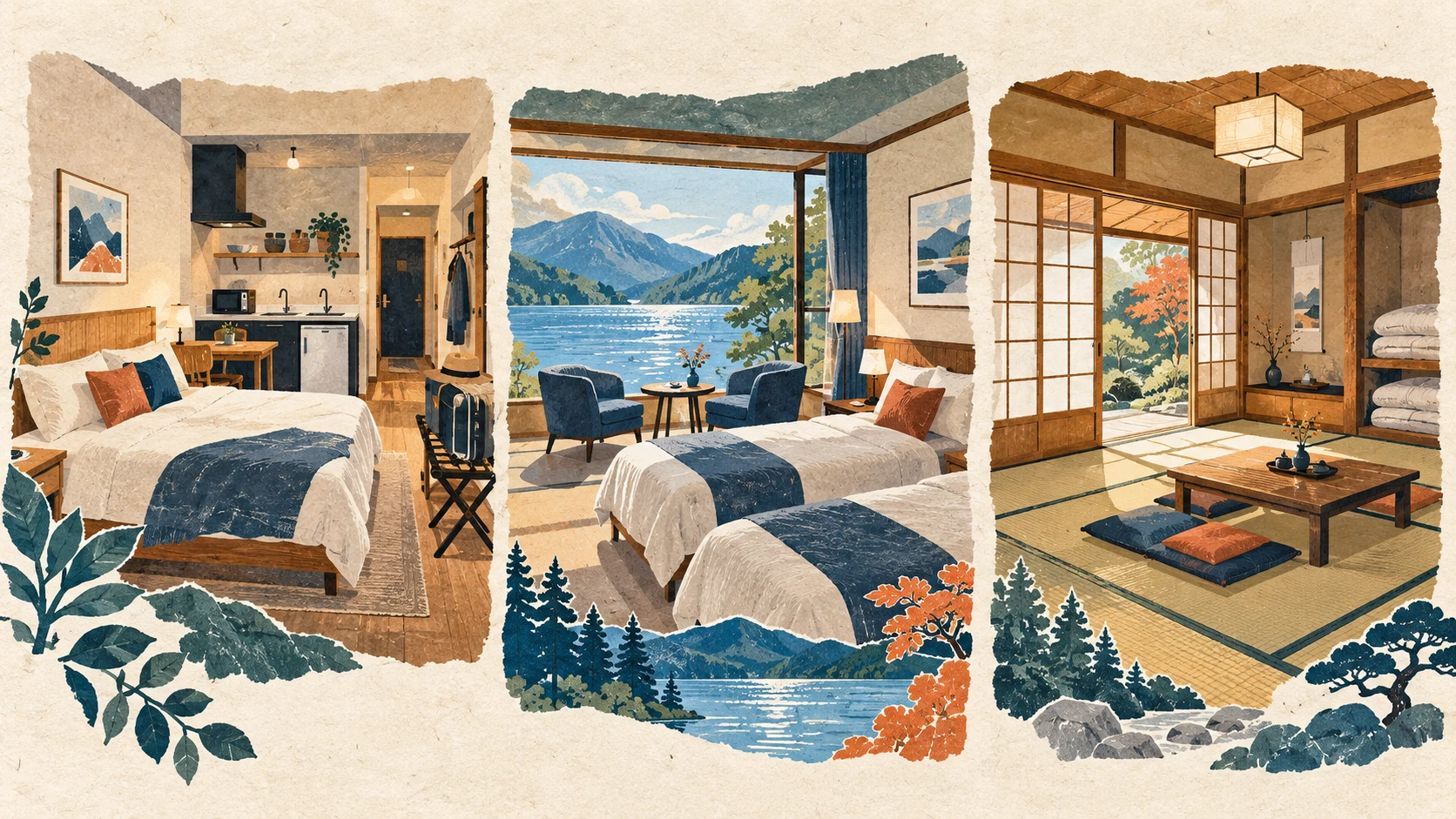
Before travel, recheck seasonal dates and actual daily operation, especially upper-mountain links, wind-stopped lifts, summer closures, April inspections and fireworks. Published dates can inform choices; unannounced years remain unannounced. Concept illustrations compare lodging and travel rhythms. Actual room layouts, views, bus meetings and activity sites depend on your selected official products.
The easiest one-to-three-night addition in southwest Hokkaido often uses one main base, one complete activity day and some changeable time. Skiing, lakes and onsen need not all appear together. The night works when companions can eat, rest and arrive punctually within their own stamina. Confirm return travel and space for luggage, then add the next activity you actually want.
A few useful answers
Should I stay in all four southwest Hokkaido bases with only one to three extra nights?
No. Choose Niseko or Rusutsu for consecutive skiing nights, or Lake Toya or Noboribetsu for bathing and lake scenery. With three nights and two bases, allow real time to change hotels rather than putting four place names into one day.
Does staying in Niseko mean I must buy the all-mountain pass?
No. For Hanazono and Hirafu only, check whether the two-area pass is enough. Peak-season 2026–27 adult one-day window prices are ¥12,500 for those areas and ¥13,500 for all mountain. Ability, connecting lifts and transport back to your base also constrain area changes.
Can a three-year-old join a NISS group lesson?
Tic Tac skiing accepts children who are at least three on the start date, up to age six, and can use the toilet independently. Instruction is generally in English. Ages 7–14 and 15-plus have separate groups; lift passes and rentals are extra and meeting times differ.
Is Setsu Niseko ski-in/ski-out?
Its FAQ says it is not; use a shuttle or another way to the slopes. The basic 41-square-meter Studio holds at most two adults and one young child, with that child included in total occupancy. It is not a four-person room for adding two elementary-school children.
Do all ordinary Park Hyatt Hanazono rooms have private onsen?
No. The 65-square-meter King or Twin rooms differ from residences and suites explicitly named Private Onsen. A soaking tub is not automatically natural hot-spring water. Children aged six and above follow the hotel’s applicable adult room-rate rules.
Does the balloon’s free transfer collect from Hanazono?
The Lion Adventure balloon transfer checked here excludes Hanazono and the Kutchan Station area. Arrange transport to the Niseko Village venue first. The 2026 activity ended September 23; check a new announcement for 2027 dates and vehicles.
Can I split Rusutsu’s five-hour pass across two days?
No. It runs continuously from the first gate entry. The separate 25-hour product can be used in one-hour units and cannot be shared. Summer amusement-park admission is another ticket again.
Does Nonokaze’s standard Lake Toya Twin have an in-room onsen?
The standard lake-view Twin is 36.8 square meters for two with a shower. The 68-square-meter Japanese-Western suite also explicitly says its unit bathroom does not use onsen water. For private room onsen, choose a category expressly providing it.
Can I use the 2026 Lake Toya fireworks dates to book for 2027?
Do not carry them forward. The formal announcement used here is April 28–October 31, 2026, 20:45–21:05, with cancellation possible for unstable wind direction or speed. A separate announcement is needed for 2027 or winter fireworks. A lake-view room does not guarantee a show.
Does Noboribetsu Bear Park admission include the ropeway?
Yes, the return ropeway is included. Regular admission is ¥3,200 for adults, ¥1,600 from age four through sixth grade, and free for ages three and under. The park closes for inspection April 5–23, 2027; strong winds can also stop operations.
When is Nixe’s penguin parade, and can I walk from there to Jigokudani?
The annual schedule’s September 24–November 3 period lists 11:00 and 14:15. Match other dates to their own period and on-site changes. Nixe is about five minutes on foot from JR Noboribetsu Station; Jigokudani is up in the onsen town, not the same short walking circuit.
Is Dai-ichi Takimotokan’s day-use Private room a private family bath?
No. The ¥5,500 rest room is for one to eight people, 09:00–16:00, without a private bathtub. Regular bathing costs ¥2,500 for adults and ¥1,500 for ages three through elementary school. Confirm the combined charges and usable times when reserving.
Check with the source
Schedules, availability and rules can change. These official sources are the place to confirm details before you book.
- Niseko United | 2026–27 all-mountain tickets and four-area seasons
- Niseko United | Stations, United Shuttle and airport access
- HANAZONO | Hanazono–Hirafu ticket prices and eligibility
- Niseko United | Online cards, activation and refund conditions
- NISS | 2026–27 group ages, prices and check-in
- NISEKO SPORTS | 2026–27 rentals, collection and return
- HANAZONO | Winter activity and rental terms
- Setsu Niseko | Studio area, beds and occupancy
- Setsu Niseko | Children, facilities, luggage and arrival FAQ
- Setsu Niseko | 2026–27 ski shuttle timetable
- Setsu Niseko | Lodging and additional-service terms
- Park Hyatt Niseko Hanazono | Room areas, beds and private-onsen categories
- Park Hyatt Niseko Hanazono | Child rates and total occupancy
- Park Hyatt Niseko Hanazono | Transport, luggage and reservation FAQ
- Hokkaido Lion Adventure | 2026 tethered balloon and transfers
- Hokkaido Lion Adventure | Participation, cancellation and weather
- HANAZONO | 2026 rafting, meetings and spring restrictions
- HANAZONO | Green-season cancellations and participation terms
- HANAZONO | 2026 summer-gondola prices and path conditions
- Rusutsu Resort | 2026–27 English private ski lessons
- Rusutsu Resort | 2026–27 lift tickets and restrictions
- Rusutsu Resort | Ski-rental items and prices
- Rusutsu Hotel & Convention | 33-square-meter Twin
- Rusutsu Resort | BIGRUNS New Chitose airport bus
- Rusutsu Resort | 2026–27 Sapporo winter bus
- Rusutsu Resort | 2026 amusement-park calendar and tickets
- Rusutsu Resort | Official homepage and featured summer video
- Lake Toya Tourism Association | Rail, Donan Bus and access
- Nonokaze | English room categories and bathroom descriptions
- Nonokaze | Children, cancellations, dining and bathing FAQ
- Nonokaze | Sapporo and New Chitose transfer conditions
- Toya Kisen | Daytime Nakajima and fireworks cruises: times and fares
- Mount Usu Ropeway | Fares, date-specific operation and visit times
- Lake Toya Tourism Association | Official 2026 long-run fireworks notice
- Dai-ichi Takimotokan | Public transport and arrival
- Noboribetsu Nixe | JR station and regional access
- Noboribetsu Tourism Association | Thirty-minute Jigokudani walk
- Noboribetsu Bear Park | Admission, ropeway, inspection and visit FAQ
- Noboribetsu Bear Park | Lower station and weekday onsen-town transfers
- Noboribetsu Bear Park | Official homepage and 2025 cub highlights
- Noboribetsu Nixe | Admission, annual maintenance and tickets
- Noboribetsu Nixe | Annual segmented show schedule
- Noboribetsu Nixe | Same-day re-entry and visitor FAQ
- Dai-ichi Takimotokan | East Superior Twin facilities and occupancy
- Dai-ichi Takimotokan | Building distances and private-onsen categories
- Dai-ichi Takimotokan | Day bathing and rest rooms without private baths
- Dai-ichi Takimotokan | Arrival, luggage, meals and cancellation FAQ
- Kutchan Town | Combined town/prefecture accommodation tax from April 2026
- Rusutsu Resort | Three winter mountains
- Nonokaze | Japanese room categories and standard Japanese-Western room
- Dai-ichi Takimotokan | Accommodation terms and cancellation thresholds
- HANAZONO | Inter-area skiing, shuttles and boarding conditions
- HANAZONO | Trail ratings, lengths and gradients
- Annupuri | Beginner runs and gradients
- Niseko United | Official 2026–27 trail map
- Niseko United | Grand Hirafu trail data
- Niseko United | Village trail data
- Rusutsu | Named runs, distances and official ratings
- Rusutsu | Winter trail map currently supplied on the official site
- Rusutsu | Daily lift and trail status
- Noboribetsu Tourism Association | August 2025 walking map
- Bourou NOGUCHI Noboribetsu | Footbath and local access
- Noboribetsu Tourism Association | Sengen Park
- Noboribetsu Tourism Association | Enmado
- KONKON | Food, location and opening information
- Noboribetsu Tourism Association | Yunokuni Noboribetsu brochure and town map, pages 6–7
- Noboribetsu Tourism Association | Oyunuma River natural footbath