Where should you stay in Kyoto's Karasuma district? Compare Shijo-Karasuma, Karasuma Oike, Karasuma Sanjo and Nijojo-mae by subway lift exits, links to Kyoto Station and Osaka, and city accommodation tax.
- Region & Focus
- Kyoto
- Reading Scope
- 22 min read · 7 chapters · 6 Q&As
- Official Verification
- 31 official sources checkedUpdated 22 November 2026
- Key Topics
- Where to stayNeighbourhoodsBooking
Chapter Route Map (tap any stop)
- Start with the street outside your hotel door
- Arriving from Kyoto Station: lift exits matter more than station names
- Choosing routes for Osaka, Higashiyama and Arashiyama
- Compare beds for two; check floor plans for three generations
- How Kyoto's accommodation tax works per person, per night
- Half-day walks straight from your hotel
- When to book Kyoto Station or Kawaramachi instead
- Quick Q&A
Base yourself in Shijo-Karasuma if you are arriving from Osaka-Umeda on the Hankyu Line or want Nishiki Market and Shijo-dori dinner spots within easy walking distance. Pick Karasuma Oike if you are travelling via Kyoto Station and splitting your days between Nijo Castle and Higashiyama. To sit neatly between the two, look at the streets from Karasuma Sanjo over to Shinmachi-dori. If your hotel is already tucked near Horikawa-dori and Nijo Castle's main gate, plan your routes around Nijojo-mae Station on the Tozai Line instead. When travelling with large suitcases or a pushchair, match each hotel address to the nearest subway lift exit first -- walking distance alone will quickly narrow your shortlist by half.
Start with the street outside your hotel door
Shijo-Karasuma and Karasuma Oike refer to two major junctions. Karasuma-dori runs north to south, crossed by Shijo-dori and Oike-dori, with Sanjo-dori sitting in between. Municipal Subway Shijo Station sits along the southern side of Shijo-dori, while the entrances for Hankyu Karasuma Station stretch out along Shijo-dori itself. The two stations are connected underground, so simply follow the signage for whichever operator you are riding. One stop west of Karasuma Oike lies Nijojo-mae, which has its own exits and platform.
Shijo-Karasuma suits travellers who like to wander after dinner. Heading east from the crossroads brings you to Daimaru Kyoto, Nishiki Market and Shijo-Kawaramachi, while heading west along Shijo-dori leads towards Omiya. If your hotel sits on Bukkoji-dori or Ayanokoji-dori, exiting from the southern side of Subway Shijo Station makes for a smoother walk back at night. Properties on Muromachi-dori require crossing Karasuma-dori when walking back from Daimaru; if nightly rates are similar, save that crossing for daytime and dine on your hotel's side of the avenue in the evening.
Karasuma Oike stacks two subway lines directly beneath the junction: the Karasuma Line on basement level B2 and the Tozai Line on B3. The main advantage of staying nearby is being able to pick either line right outside your door. You can visit Nijo Castle in the morning, drop off shopping back in your room during the afternoon, and ride the Karasuma Line straight to Kyoto Station the next day, all from the same corner. Hotels on opposite sides of Oike-dori look neighbours on a map, though anyone wheeling luggage should factor in the time spent waiting at pedestrian crossings.
Karasuma Sanjo puts both main stations within walking reach, making it a natural fit if your days revolve around cafés, lunches and small side streets along Sanjo-dori. When checking an address, read the cross street alongside the main road. "Shinmachi-Sanjo" places a property west of Karasuma-dori, whereas "Karasuma-dori Sanjo-sagaru" means heading south towards Shijo. Relying solely on "Sanjo" in a listing title can easily land you near the Kamo River instead. Pin the exact entrance on a map before deciding whether to use Oike day to day and which lift exit to aim for with luggage.
Accommodation around Nijojo-mae works best when Nijo Castle or the western half of the Tozai Line anchors your itinerary. To judge the walk to the castle entrance, measure from Higashi-Otemon Gate on Horikawa-dori. If a property sits closer to Senbon-dori and JR Nijo Station, you can rely directly on JR trains on travel days, and the neighbourhood feels more like the JR Nijo area. By contrast, if you are commuting through Kyoto Station every day, staying at Nijojo-mae adds an extra change at Karasuma Oike on every trip -- a difference you will notice most when carrying bags.
| Area | Primary stations | Best-suited itineraries |
|---|---|---|
| Shijo-Karasuma | Subway Shijo (K09), Hankyu Karasuma (HK85) | Day trips to and from Osaka-Umeda, Nishiki Market, Shijo-dori shopping |
| Karasuma Oike | Karasuma Oike (K08 / T13) | Easy access to Kyoto Station, Nijo Castle, Okazaki and both subway lines |
| Karasuma Sanjo | Either Shijo or Karasuma Oike depending on block | Strolling Sanjo-dori with daytime walks towards both northern and southern hubs |
| Nijojo-mae | Nijojo-mae (T14) | Early entry at Nijo Castle, Tozai Line sights and trips towards Uzumasa Tenjingawa |
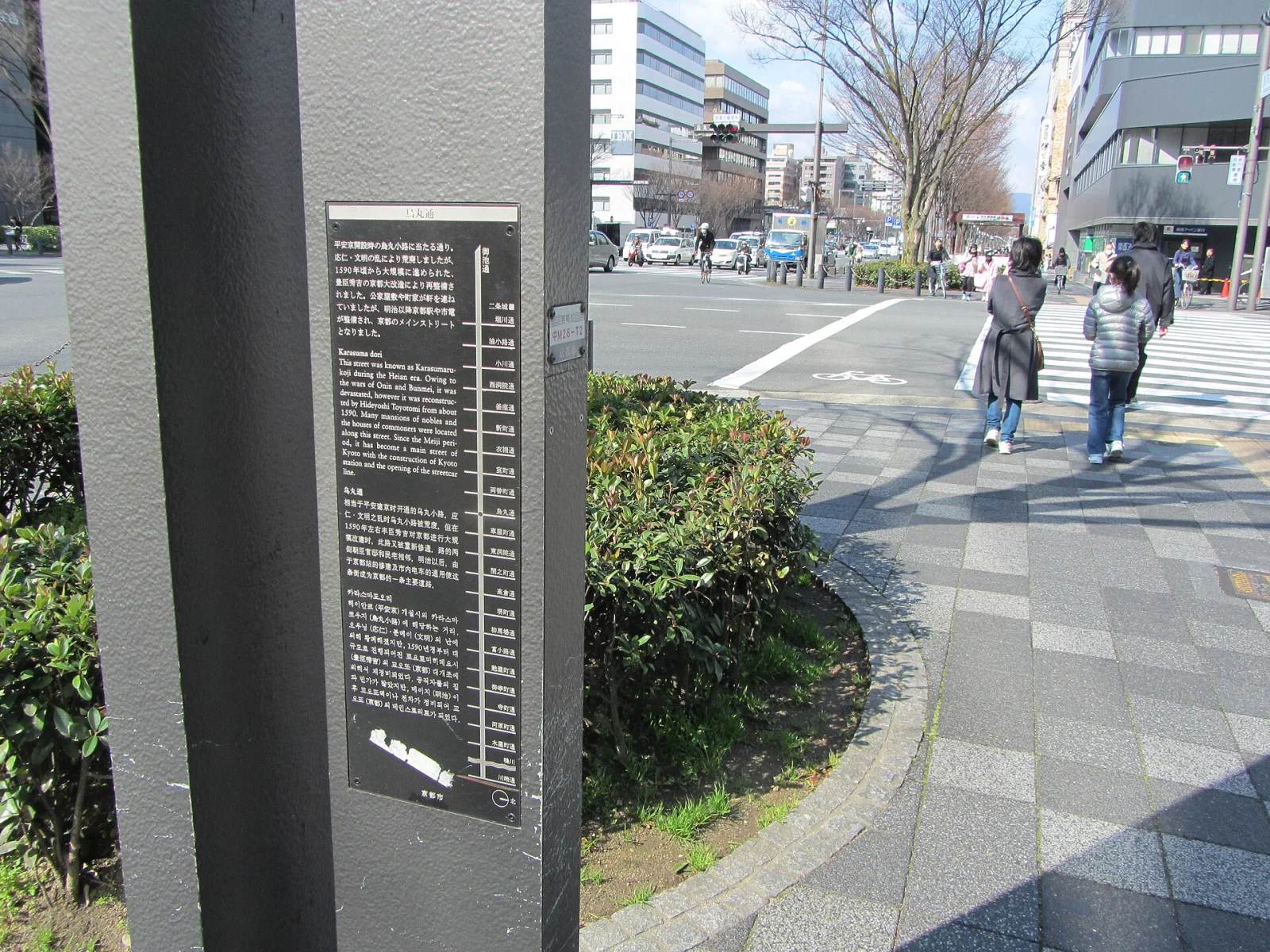
Where should you stay in Kyoto's Karasuma district? Compare Shijo-Karasuma, Karasuma Oike, Karasuma Sanjo and Nijojo-mae by subway lift exits, links to Kyoto Station and Osaka, and city accommodation tax.
Arriving from Kyoto Station: lift exits matter more than station names
From Municipal Subway Kyoto Station (K11), take the Karasuma Line bound for Kokusaikaikan through Gojo to Shijo, and one stop further to Karasuma Oike. Travellers heading to Nijojo-mae change onto the Tozai Line at Karasuma Oike and ride one stop towards Uzumasa Tenjingawa. Stepping off a Shinkansen or JR train, follow the "Subway" signs first so you measure the subway leg from the platform itself. Beyond the listed riding minutes, leaving the JR concourse, waiting for a train and ascending to street level all add their own buffer.
The step-free route at Shijo Station starts with the lift at the southern end of the platform, leading up through the South Ticket Gate to street level. The Kyoto City Transport Bureau station map marks lifts at Exit 1 on the east side and Exit 4 on the west side near Ayanokoji-dori. If your phone's map app tries to funnel you up the nearest underground staircase, search specifically for "Shijo Station Exit 1" or "Shijo Station Exit 4" instead. Placing the two lifts on opposite sides of Karasuma-dori means choosing the one on your hotel's side saves waiting through a wide traffic junction.
At Karasuma Oike Station, the street-level lift is Exit 3-2, which surfaces at the south-eastern corner of the Karasuma-dori and Oike-dori intersection. Coming off the Tozai Line platform, take the lifts via the Karasuma Line level to the North Ticket Gate and then up to the street. Save a screenshot of the station diagram on your phone for your first transfer, especially if your group splits up for the toilets or rides in different carriages. Follow either the Tozai Line or Karasuma Line signs during the changeover and agree on a visible meeting point on the destination platform rather than looping around at street level.
For the lift to street level at Nijojo-mae Station, ride the lift from the centre of the platform through the ticket gates and take the street lift at Exit 1, which opens onto the south side of Oshikoji-dori. Even if a hotel website advertises "a few minutes' walk from Nijojo-mae Exit 2", recalculate your route via Exit 1 when wheeling suitcases. Wheelchair users and families with pushchairs should also check the final few metres to the hotel door for steps, raised thresholds, driveway slopes or abruptly narrowing pavements.
The Shijo-dori underground passage keeps you dry all the way from Hankyu Karasuma towards Shijo-Kawaramachi. If you plan to duck into a department store or emerge inside a specific building, match the exit numbers to the store's floor guide before returning to street level outside your hotel. Moving between Hankyu and the municipal subway means clearing two separate sets of ticket gates; pushchair users can check the Shijo Station map for stairlifts or stick to each operator's own street-level lift. Large groups with big bags do best meeting outside a street-level exit so stairwells stay clear for passing commuters.
When Japanese listings quote a walking time from the station, use it as a rough benchmark for the final street stretch rather than the entire transit. To estimate door-to-door time from your train carriage, trace four separate segments on the map: platform, ticket gate, exit corridor and pavement. If two people are returning from different parts of town at night, agree to meet at whichever hotel door opens directly onto the street. Some properties share a building with offices or shops, so a Street View screenshot showing the building number and hotel sign helps taxi drivers and companions far more than a pin on the nearest junction.
Choosing routes for Osaka, Higashiyama and Arashiyama
From Osaka-Umeda on the Hankyu Kyoto Main Line, search for "Karasuma (HK85)" as your stop. It sits one stop before Kyoto-Kawaramachi and puts you right onto Shijo-dori. If your Osaka base is near Hankyu Osaka-Umeda Station or your mornings start around Umeda, this direct link is a major practical advantage of Shijo-Karasuma. If you are already arriving at Kyoto Station by Shinkansen or JR, staying on the municipal subway from there is just as straightforward. On Hankyu platforms, check both the destination and stopping pattern, and bookmark "Karasuma" alongside "Subway Shijo" for transfers.
Heading east from Karasuma Oike on the Tozai Line brings you to Kyoto Shiyakusho-mae for the Teramachi area, Sanjo Keihan for transfers to the Keihan Main Line or a walk across the Kamo River along Sanjo-dori, and Higashiyama Station for Heian Shrine and the museums in Okazaki. By contrast, if your evening plans stay around Shijo-Kawaramachi, Shijo Ohashi Bridge or southern Gion, walking east along Shijo-dori or hopping one stop on the Hankyu Line to Kyoto-Kawaramachi from Shijo-Karasuma is far simpler than going north to Karasuma Oike to switch to the subway.
Arashiyama can be reached several ways, each dropping you in a slightly different spot. From Shijo-Karasuma, you can walk to Shijo-Omiya for the Randen tram, or ride a Hankyu train stopping at Omiya and walk up to street level for Randen Shijo-Omiya Station; Keifuku Electric Railroad lists the tram ride to Arashiyama at roughly 24 minutes, excluding transfer and waiting times. From Karasuma Oike, ride the Tozai Line to the Uzumasa Tenjingawa terminus and step outside to transfer to Randen-Tenjingawa. Save the shops you want to visit along with Togetsukyo Bridge on your map so you can return via whichever line sits closest to your final stop.
Another option is taking the Hankyu Line from Karasuma to Katsura and changing onto the Hankyu Arashiyama Line, which ends at Hankyu Arashiyama Station on the southern bank of the Katsura River. That drop-off makes sense if you want to start at the south end of Togetsukyo Bridge or have lunch booked south of the river. If your main stops are in Sagano and you are already staying near JR Nijo or Kyoto Station, compare the walk from Saga-Arashiyama on the JR Sagano Line. When planning the return leg, pin all three stations named Arashiyama or Saga-Arashiyama alongside whichever side of Shijo you have booked for dinner.
To reach Fushimi Inari from Shijo or Karasuma Oike, ride the Karasuma Line south to Kyoto Station and switch to a JR Nara Line train that stops at Inari. Inari Station stands directly opposite Fushimi Inari Taisha, while the shrine's access page notes that Keihan Fushimi-Inari Station is around a five-minute walk away. If you start in Karasuma in the morning and want to spend the afternoon in Gion, take JR out and return via Keihan to Gion-Shijo, then stroll across the Kamo River for dinner in Kawaramachi. Guests staying at Nijojo-mae should avoid backtracking towards their hotel for the outbound leg and simply route from whichever station they are near when setting off.
The Karasuma Line also links directly to Kyoto Imperial Park and Kyoto Botanical Gardens. For the botanical gardens' Kitayama Gate, Kyoto Prefecture notes that Exit 3 of Kitayama Station puts you right at the entrance; if you prefer the main gate, walk east from Kitaoji Station. If you have two or more stops lined up around Kitayama and Kitaoji during the day, our Kitayama accommodation guide shows how that neighbourhood lays out. When part of your group still wants Shijo's shops in the evening, devote a morning to Kitayama and keep your base in Karasuma to avoid moving bags.
Standard adult fares on the Kyoto Municipal Subway range from ¥220 to ¥360 depending on distance. A one-day subway pass costs ¥800 for adults (¥400 for children), while the combined Subway & Bus 1-Day Pass is ¥1,100 for adults (¥550 for children). Jot down your planned subway journeys for the day before buying: two minimum-fare rides total ¥440, which pairs easily with walking via an IC travel card. You only come out ahead on the ¥800 subway day pass once you hit four ¥220 rides (¥880) in a single day.
Staying in Shijo-Karasuma often means mixing in Hankyu and Randen rides, neither of which is covered by municipal day passes. Tally only the municipal subway and eligible bus trips you are certain to take, and budget JR, Hankyu, Keihan and Randen separately. On days centred on Shijo-dori and Nishiki Market, walking straight through often beats going up and down stairs for a one-stop ride. For broader pass rules and sightseeing lines, see our guide to Kyoto subway and bus day passes and sightseeing express routes.
Compare beds for two; check floor plans for three generations
Two adults staying one or two nights should start by checking for a genuinely wide double bed or booking two singles. On Via Inn Kyoto Shijo Muromachi's official room page, the 140 cm bed in Single A is listed for one guest, whereas the Double with the same 140 cm width sleeps two. Its Economy Twin uses 97 cm beds, while Twin A offers 122 cm beds. If you need clear floor space to open suitcases flat, compare overall square footage and where the desk and chairs sit.
For families with school-age children or groups of four adults, aparthotels keep dining, laundry and sleeping under one roof. Count which bed each person actually gets first, then check dining seating and any doors separating sleeping areas. A four-person unit might offer four single beds or combine bunk beds with singles; if younger children or older relatives would struggle with a top bunk, filter for all-ground-level beds when booking. Look at the bathroom and toilet layout on the floor plan too: when four people are getting ready at once, a separate washbasin outside the bathroom cuts queues far more effectively than extra floor area.
At MIMARU Kyoto Shinmachi Sanjo, for instance, the hotel lists a roughly five-minute walk from Karasuma Oike Station, in-room kitchens and washer-dryers, with exact bed configurations and washbasin counts detailed on each room page. Larger units sleep six or more, making it easy for multi-generational trips to compare one apartment side by side against two twin rooms. Choose layouts with sliding or solid partitions if early risers and night owls need separation, or book two separate rooms. If young children will return for daytime naps, check for blackout curtains and see how many street turns lie between the main avenue and reception.
Housekeeping policies inside the same aparthotel also shape longer stays. At MIMARU Kyoto Shinmachi Sanjo, daily service covers towel and bathmat changes for selected items plus vacuuming, while bathroom and wash-area cleaning (outside the kitchen) and bed-making begin from the third night on a once-every-two-days cycle, with extra cleaning available for a fee on request. Travellers staying several nights who plan to cook and wash clothes should also check drying racks or space and how rubbish is collected. For a two-night stay where every meal is eaten out, spending the savings on wider beds or breakfast often makes more sense.
Families often fixate on whether a room has a kitchen, even though most end up using far less than expected. For simple breakfasts, a fridge, microwave, cutlery and a proper table with chairs are usually plenty. Only if you intend to cook full dinners should you check the equipment list for hobs, pans, knives and tableware counts. On week-long trips, verify whether the microwave fits convenience-store bento boxes and whether the fridge includes a freezer compartment. Crossing unused appliances off your must-have list makes comparing properties across areas much easier.
When travelling with primary-school-aged children or younger, enter their exact ages before evaluating which bed combinations appear in the quote. Cots, bed guards and extra bedding depend on specific room types, so put all adults and children on the same reservation from the outset. Place older relatives who wake during the night in the room nearest the toilet, and keep the living space free for family members staying up to chat. For accessibility needs, ask separately about doorway widths, bathroom thresholds and shower chairs rather than simply asking whether a hotel is accessible.
Buildings along Shijo-dori and Karasuma-dori offer straightforward taxi pick-ups and clear street frontages, whereas side-street addresses call for checking road width and whether cars can pull up briefly outside. Light sleepers should screen room orientation, window details and floor levels on the booking page; if one side faces a busy arterial road, note a quiet-side preference. When natural light in the lounge or a specific bed set-up matters most, select a room category whose photos and specifications confirm what you get -- that reliability usually outweighs floor height.
Your arrival and departure timings can also sway which room type works best. MIMARU's official site notes complimentary luggage storage from 07:00 to 22:00 on both check-in and check-out days. A family arriving in Karasuma early in the morning can drop bags at reception and hop one stop to Marutamachi or grab breakfast first; if you are sending bags ahead for evening delivery, keep a spare change of clothes in your daypack. Conversely, if a late flight or evening train from Osaka brings you in late, stick to the property's check-in window and log your estimated arrival time in the booking so nobody is left hunting for the entrance from different stations.
How Kyoto's accommodation tax works per person, per night
From 1 March 2026, Kyoto City's updated accommodation tax applies by stay date and the nightly room-only charge per guest. Under the municipal definition, the taxable amount covers the base room charge and service fees, excluding meals and consumption tax. Some booking platforms collect the tax upfront, while others leave it to be settled at the hotel desk. When comparing room-only and breakfast-included plans at the same property, open the tax and service breakdown to see whether any balance remains payable on site.
Take two adults staying three nights in a twin room at a room-only rate of ¥18,000 per night: that comes to ¥9,000 per person, per night, placing each guest in the ¥400 tier for a combined total of ¥2,400 across the three nights. Switch to a rate where each guest pays ¥20,000 per night and the tax jumps to ¥6,000 for two people over three nights. Larger groups weighing one apartment against two twin rooms should run the maths separately for each headcount and stay length.
Entering the accurate guest headcount when booking and budgeting the accommodation tax for the whole group go hand in hand. Plans priced for different group sizes often split charges differently, so run your search with every traveller's details included from the start. If a booking includes children sharing existing beds free of charge or bundled meal plans, ask the property to confirm the taxable room rate per guest. Note any pay-at-hotel taxes on your itinerary so settling up between companions stays separate from prepaid card charges.
Where travel dates might shift, favour rates with clear cancellation deadlines. Read the exact cut-off time and time zone -- noting that Japanese hotels quote deadlines in Japan Standard Time (JST) -- and put the final free-cancellation cut-off in your calendar. If you book two rooms separately, track check-in rules and cancellation terms for each reservation individually. Whenever promo codes, prepayments or split multi-night bookings are involved, record what has already been paid and the refund rules per booking. Comparing a continuous stay against switching hotels mid-trip should factor in luggage storage fees, delivery charges and the time spent returning to your room.
| Taxable room rate per person, per night | Tax per person, per night |
|---|---|
| Under ¥6,000 | ¥200 |
| ¥6,000 to under ¥20,000 | ¥400 |
| ¥20,000 to under ¥50,000 | ¥1,000 |
| ¥50,000 to under ¥100,000 | ¥4,000 |
| ¥100,000 or more | ¥10,000 |
Half-day walks straight from your hotel
Staying at Shijo-Karasuma makes Nishiki Market an effortless morning opener. The market association puts the walk from both Subway Shijo and Hankyu Karasuma at around three minutes. If you are shopping for pickles or snacks, pick one or two stalls open that day, walk east along Nishikikoji-dori, and leave anything needing refrigeration for the return walk back to your hotel. Individual shop hours vary, so if you want a proper sit-down breakfast early, pick a café beforehand and browse the market afterwards. Nishiki Market asks visitors not to eat while walking, and instead to finish food inside or directly outside the stall where it was bought. Families with pushchairs can consolidate sit-down tastings at one shop to avoid navigating narrow lanes carrying food.
Daimaru Kyoto's official access page shows direct underground connections from both Subway Shijo and Hankyu Karasuma, while Takashimaya Kyoto in Shijo-Kawaramachi connects straight to Hankyu Kyoto-Kawaramachi Station. If you are bringing prepared food back to an aparthotel, loop from Nishiki Market into Daimaru and pick up chilled dishes right before walking back to your room. On evenings when you are dining east of the Kamo River, save glass jars and refrigerated sweets for another day rather than carrying bags across the bridge and back.
Early risers staying around Karasuma Sanjo can stroll down Sanjo-dori to Sakaimachi-dori for coffee. Inoda Coffee Main Shop sits just south of Sanjo on Sakaimachi-dori; its official site lists a 07:00 opening and roughly a five-minute walk from Karasuma Oike Station. Before an opening-hour visit to Nijo Castle, you can walk back to Karasuma Oike to catch the Tozai Line, or head straight down Sakaimachi-dori to Nishikikoji-dori for Nishiki Market. If you are staying west on Shinmachi-dori and catching the first train out, grabbing breakfast the evening before saves an early-morning detour.
From Karasuma Oike, Nijo Castle makes a tidy morning outing: ride the Tozai Line one stop to Nijojo-mae and walk to Higashi-Otemon Gate. Castle grounds open at 08:45, with last admission generally at 16:00 and closing at 17:00. General castle entry and the Ninomaru Palace do not require advance booking, whereas Honmaru Palace operates by timed-entry e-ticket purchased ahead of time. Staying close by lets you lock in one fixed timed slot, stroll whichever garden areas fit around it, and pop back to the hotel for a break whenever needed.
Travellers visiting over the 2026–2027 New Year period should note that Nijo Castle closes completely from 29 to 31 December, and both Ninomaru Palace and Honmaru Palace have additional interior closure dates on 26–28 December and 1–3 January. Ninomaru Palace also closes on Tuesdays in January, July, August and December (shifting to the following day if a public holiday falls on Tuesday). If anyone in your group is set on seeing the palace screen paintings, mark open palace days on your calendar during the same week you book your room and set aside a morning. For full ticket details and choosing between the two palaces, see our Nijo Castle tickets and palace guide.
Wheelchair users should plan both station exits and palace access. Nijo Castle states that wheelchairs are permitted inside both Ninomaru Palace and Honmaru Palace, provided visitors transfer to the castle's indoor viewing wheelchairs on entry; complimentary power-assisted wheelchairs are also available at the General Information Centre on a first-come, first-served basis. If you have a timed slot for Honmaru Palace, leave extra margin before your entry window to borrow a wheelchair, transfer and travel from the main gate to the palace.
For a walk north along Karasuma-dori, get off at Imadegawa or Marutamachi to enter Kyoto Imperial Park from the north or south. To enter the Kyoto Imperial Palace itself, head for Seishomon Gate on the western side. The Imperial Household Agency runs year-round public entry free of charge without prior reservation, subject to a bag check at the gate; last admission is 15:50 in March and September, 16:20 from April to August, and 15:20 from October to February. Decide whether you want a park stroll or palace entry, and if you want both, check Seishomon Gate's closing cut-off first before wandering the wider grounds.
Keep in mind that the park paths are surfaced with gravel. If anyone in your group prefers to avoid long gravel stretches, picking a western entrance close to the palace is easier than walking all the way from south to north. Afterwards, you can ride the Karasuma Line straight back to Karasuma Oike from Imadegawa or Marutamachi, leaving time for older travellers to rest before dinner. Suitcases and large bags are prohibited inside the Imperial Palace, so leave them at your hotel before heading out. If members of your party want to apply for the Kyoto Sento Imperial Palace, see our guide to visiting the Kyoto Imperial Palace, Sento Imperial Palace and Imperial Villas.
If rain sets in while you are staying near Karasuma Oike, the Kyoto International Manga Museum is an easy indoor fallback. The museum's access page directs visitors north up Karasuma-dori from Exit 2, while lift users should surface via Exit 3-2 and cross back at the junction. If you plan to go on a Wednesday, check the museum's opening calendar for that specific date first. When only half your group wants to visit, splitting up and meeting back at the hotel or on Sanjo-dori for a meal avoids dragging everyone back to Kyoto Station to regroup.
When the rain is heavy enough to avoid street level altogether, both main stations have covered hubs where you can sit and eat first. ShinPuhKan connects directly to the South Ticket Gate of Karasuma Oike Station, while COCON Karasuma links to Exit 2 of Subway Shijo Station as well as Exits 23 and 25 of Hankyu Karasuma. Guests staying on the western side of Shijo can eat at COCON Karasuma before heading back to their room and save Kawaramachi for a dry day; guests east of Karasuma Oike can step straight into ShinPuhKan from the station concourse and cross Karasuma-dori towards the museum or the north once the downpour eases. Where entrances have level changes, follow each complex's step-free route if travelling with a pushchair.
When to book Kyoto Station or Kawaramachi instead
Kyoto Station makes the most sense for very late arrivals, early-morning Shinkansen departures, or itineraries built around daily JR trains. When scanning hotel maps, separate the Karasuma Exit side from the Hachijo Exit side: both advertise "right by Kyoto Station", yet having to cross the station's free-passage concourse and change floors after checkout takes the shine off rolling luggage to your gate. If your train gets in just before the last subway, staying beside Kyoto Station wraps up the evening fast; if only your final morning train is early on a three-night trip, compare the cost and time of taking a taxi from Karasuma instead.
If your evenings revolve around the Kamo River, Pontocho, Kiyamachi and dinners in Kawaramachi or across the river, staying further east shortens the walk home. Pin Hankyu Kyoto-Kawaramachi and Keihan Gion-Shijo on opposite ends of the bridge: guests near Kyoto-Kawaramachi can hop on the Hankyu Line back to Osaka, while Keihan riders simply step across the Kamo River. Shijo-Karasuma sits at a walkable middle ground -- handy when one companion pops over to Nishiki Market regularly while another rides the subway to Kyoto Station. When picking late-night restaurants, remember to count the major crossings and the final walk back.
When one half of a group heads to Nijo Castle while the other goes straight to Okazaki, Karasuma Oike lets everyone set off from the same station in opposite directions. Conversely, if your trip involves returning to Kyoto Station every morning for the JR Kyoto, Nara or Sagano lines, the number of train days quickly outweighs Kyoto Station's quieter nightlife. Travellers making only one Osaka day trip and one afternoon run to Arashiyama will find Shijo-Karasuma an easy all-round base. Whenever listings cluster within the same pocket, favour a hotel entrance that is unmistakable every time you come and go.
During Gion Matsuri, booking along Shijo-dori requires matching your arrival route to the junction outside your hotel. The Kyoto City Tourism Association's 2026 Yoiyama guide advises travellers heading towards Kyoto Station to enter the subway at Karasuma Oike to sidestep the heaviest crowds at Shijo Station. If you are staying along Shijo during Yoiyama or the Yamahoko Junko float procession in 2027, wait for that year's traffic restriction map and locate your walking approach by your hotel's exact block. Arrange taxis to drop outside the cordoned zone and check when the hotel can accept luggage deliveries so your bags arrive smoothly.
If you reach Kyoto Station in the morning and want to start sightseeing straight away, check Kyoto City's HANDS FREE KYOTO portal for storage and same-day luggage delivery. Some services deliver from Kyoto Station to partner hotels on the same day if bags are dropped off before 14:00 -- ideal when you want to see Nijo Castle or Nishiki Market before checking in. On departure day, check whether your hotel can forward suitcases to a Kyoto Station pickup desk before your afternoon Shinkansen. Before booking, align three times across both your hotel and the courier: drop-off cut-off, estimated arrival and collection hours.
Splitting a stay between two hotels is only worthwhile when hard train or city-transfer schedules demand it -- for example, three nights in Karasuma followed by a final night on the departing side of Kyoto Station. Otherwise, keep one Karasuma booking and leave bags at reception after checkout until you collect them for the train. Keeping a single base also gives anyone in the group who moves at a gentler pace easy access to rest, spare layers or medication nearby. On any hotel-switch day, keep passports, valuables and half a day's essentials in a daypack so a late bag delivery never holds up lunch or check-in.
On checkout day, if you are not doubling back to your hotel, work backwards from your final sightseeing stop to choose a luggage pickup point. For instance, before an afternoon Shinkansen after a morning in Kyoto Imperial Park, forward your suitcases to a Kyoto Station counter open for afternoon collection and ride south from Marutamachi Station. If your last stop is around Shijo before taking the Hankyu Line back to Osaka, leaving bags at your hotel until departure is far smoother. Whenever a station offers both stairs and a street-level lift, note the exact lift exit and collection hours beside your luggage leg on the itinerary.
A few useful answers
Are Hankyu Karasuma Station and Subway Shijo Station the same place?
They are two separate stations at the same intersection, linked by an underground passageway outside the ticket gates. Hankyu Karasuma serves the Kyoto Main Line, while Municipal Subway Shijo serves the Karasuma Line, so transferring requires passing through both operators' ticket barriers.
Which subway exits have lifts when staying in Karasuma with heavy luggage?
At Shijo Station, use the South Ticket Gate and take Exit 1 (east side of Karasuma-dori) or Exit 4 (west side). At Karasuma Oike Station, the street-level lift is at Exit 3-2 on the south-eastern corner of the intersection. At Nijojo-mae Station, take the lift via Exit 1.
Do you need to change trains between Karasuma Oike and Nijo Castle?
No. From Karasuma Oike, board the Tozai Line towards Uzumasa Tenjingawa and ride one stop to Nijojo-mae. If you are coming from Kyoto Station, take the Karasuma Line to Karasuma Oike first and change lines there.
What should a family of four check before booking an aparthotel?
Enter the exact number of adults and children with their ages first, then check the bed layout and whether the bedrooms have dividing doors. For longer stays, in-room laundry, dining seating, separate basin space and housekeeping schedules are often more helpful for comparing options than room category names alone.
How is the accommodation tax calculated for hotels in Karasuma, Kyoto?
From 1 March 2026, Kyoto City's revised accommodation tax applies in five tiers ranging from ¥200 to ¥10,000 per person, per night, based on the room-only rate excluding meals and consumption tax. For example, a taxable rate of ¥6,000 to under ¥20,000 incurs ¥400 per person, per night. Check your booking breakdown to see whether it is collected at the property.
Is Shijo Station or Kyoto-Kawaramachi Station closer to Nishiki Market from Karasuma?
According to the market association's access page, Municipal Subway Shijo Station and Hankyu Karasuma Station are around a three-minute walk away, compared with about four minutes from Hankyu Kyoto-Kawaramachi Station. If you want to enter from the western end near Daimaru, Shijo or Hankyu Karasuma is closer.
Official information and references
Sources used in this guide.
- Kyoto City Transport Bureau | Shijo Station timetable, layout and lifts
- Kyoto City Transport Bureau | Karasuma Oike Station layout and transfers
- Kyoto City Transport Bureau | Nijojo-mae Station layout and lifts
- Kyoto City Transport Bureau | Subway station maps
- Hankyu Railway | Karasuma Station layout and transfers
- Hankyu Railway | Kyoto Line route map
- Keifuku Electric Railroad | Randen route map and timetables
- Kyoto City Transport Bureau | Standard subway fares
- Kyoto City Transport Bureau | One-day passes and fare FAQs
- City of Kyoto | Revised accommodation tax rates
- City of Kyoto Support | Definition of taxable accommodation charges
- MIMARU Kyoto Shinmachi Sanjo | Rooms, kitchens and housekeeping policy
- Via Inn Kyoto Shijo Muromachi | Room amenities and bed widths
- Kyoto Nishiki Market Shopping District Association | Access
- Nijo Castle | Opening hours, closures and palace non-viewing days
- Nijo Castle | FAQs and visit reservations
- Imperial Household Agency | Kyoto Imperial Palace year-round entry guide
- Ministry of the Environment | Kyoto Imperial Park access and gates
- Kyoto Prefecture | Kyoto Botanical Gardens access
- Kyoto International Manga Museum | Access map
- Kyoto International Manga Museum | Opening calendar
- Kyoto City Tourism Association | 2026 Gion Matsuri Yoiyama guide
- HANDS FREE KYOTO | Luggage storage and delivery options
- Kyoto Nishiki Market Shopping District Association | Dining and walking etiquette
- Daimaru Kyoto | Underground access from Shijo and Karasuma stations
- Takashimaya Kyoto | Access and Shijo-Kawaramachi location
- Inoda Coffee Main Shop | Opening hours and access
- ShinPuhKan | Access from Karasuma Oike Station South Ticket Gate
- COCON Karasuma | Connections from Subway Shijo and Hankyu Karasuma stations
- Fushimi Inari Taisha | Access from Inari and Keihan Fushimi-Inari stations
- Nijo Castle | Entrance location and access