Compare Ninomaru’s waiting rooms, audience halls and wall paintings with Honmaru’s former Katsura residence and rotating originals. Choose a 90-minute visit or half a day for both palaces, gardens, gallery and tea.
- Region & Focus
- KyotoAttractions
- Reading Scope
- 29 min read · 16 chapters · 4 Q&As
- Official Verification
- 14 official sources checkedUpdated 26 October 2026
- Key Topics
- ItinerariesKyoto, Osaka & Kansai
Chapter Route Map (tap any stop)
- For a first visit, see Ninomaru and its garden properly
- Higashi Ote-mon, the guardhouse and Kara-mon introduce the castle’s hierarchy
- Ninomaru’s staggered plan: put each room’s purpose in place
- From Tozamurai to Ohiroma: waiting, conveying business and formal audiences
- From Kuroshoin to Shiroshoin, the paintings grow quieter
- Ninomaru Garden: change position by the pond to see the palaces around it
- Honmaru Palace: a princely residence moved from beside the Imperial Palace
- Honmaru’s Goshoin: a room that could become a Noh stage
- Otsune-goten originals rotate: choose dates for particular rooms
- Honmaru Garden and the keep base: level paths or a climb
- Seiryu-en and tea fit towards the end of a longer route
- Add the original-painting gallery: see the setting first, then the brushwork
- The 90-minute version: Ninomaru, the pond and back east
- The two-palace version: let Honmaru’s slot set the order
- Mobility needs, socks and storage: connect the indoor and outdoor routes
- Choose tickets last: match prices and opening days to what you want to see
- Quick Q&A
For a first visit to Nijo Castle, keep Ninomaru Palace and its garden. Add Honmaru Palace for a princely residence, late-Edo bird-and-flower paintings and life at a modern imperial villa, allowing two and a half to three hours. The palaces differ greatly in room use, age and paintings. Choose the content first, then book Honmaru’s slot to connect gates, interiors, pond garden, tea and the original-painting gallery into an unhurried half-day.
For a first visit, see Ninomaru and its garden properly
With only an hour and a half, choose Ninomaru Palace and Ninomaru Garden. With half a day, add Honmaru Palace. Honmaru offers the rooms and paintings of a princely residence and traces of life at a modern imperial villa. Ninomaru links waiting, conveying business, formal audiences and living quarters, making the workings of a shogun’s palace easier to grasp.
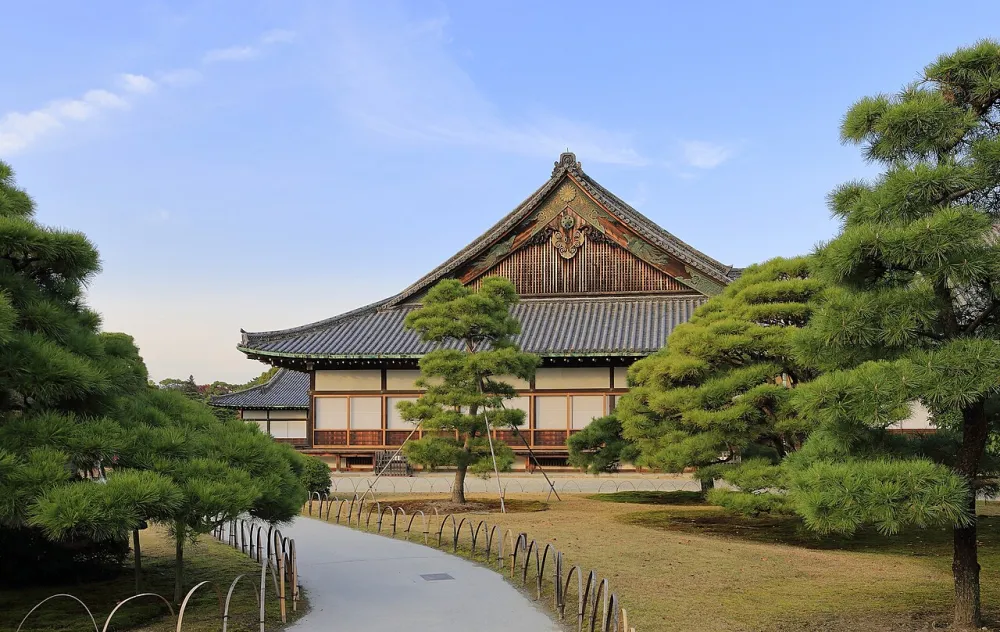
The castle’s visit-duration FAQ estimates one to one and a half hours for Ninomaru Palace and garden, or two and a half to three hours with Honmaru Palace and garden. These times include movement around the grounds and help you choose a morning or afternoon visit. Allow half a day to study the wall paintings or sit for tea. If companions have less interest in interiors, make Ninomaru the main paid visit and leave after the garden.
For both palaces, find an available Honmaru slot first, then place Ninomaru before or after it. An early-morning Honmaru booking suits going straight there and seeing Ninomaru on the way back. A later pre-noon Honmaru slot allows Ninomaru first. This leaves time to stop at rooms and rest along the paths.
Compare Ninomaru’s waiting rooms, audience halls and wall paintings with Honmaru’s former Katsura residence and rotating originals. Choose a 90-minute visit or half a day for both palaces, gardens, gallery and tea.
Higashi Ote-mon, the guardhouse and Kara-mon introduce the castle’s hierarchy
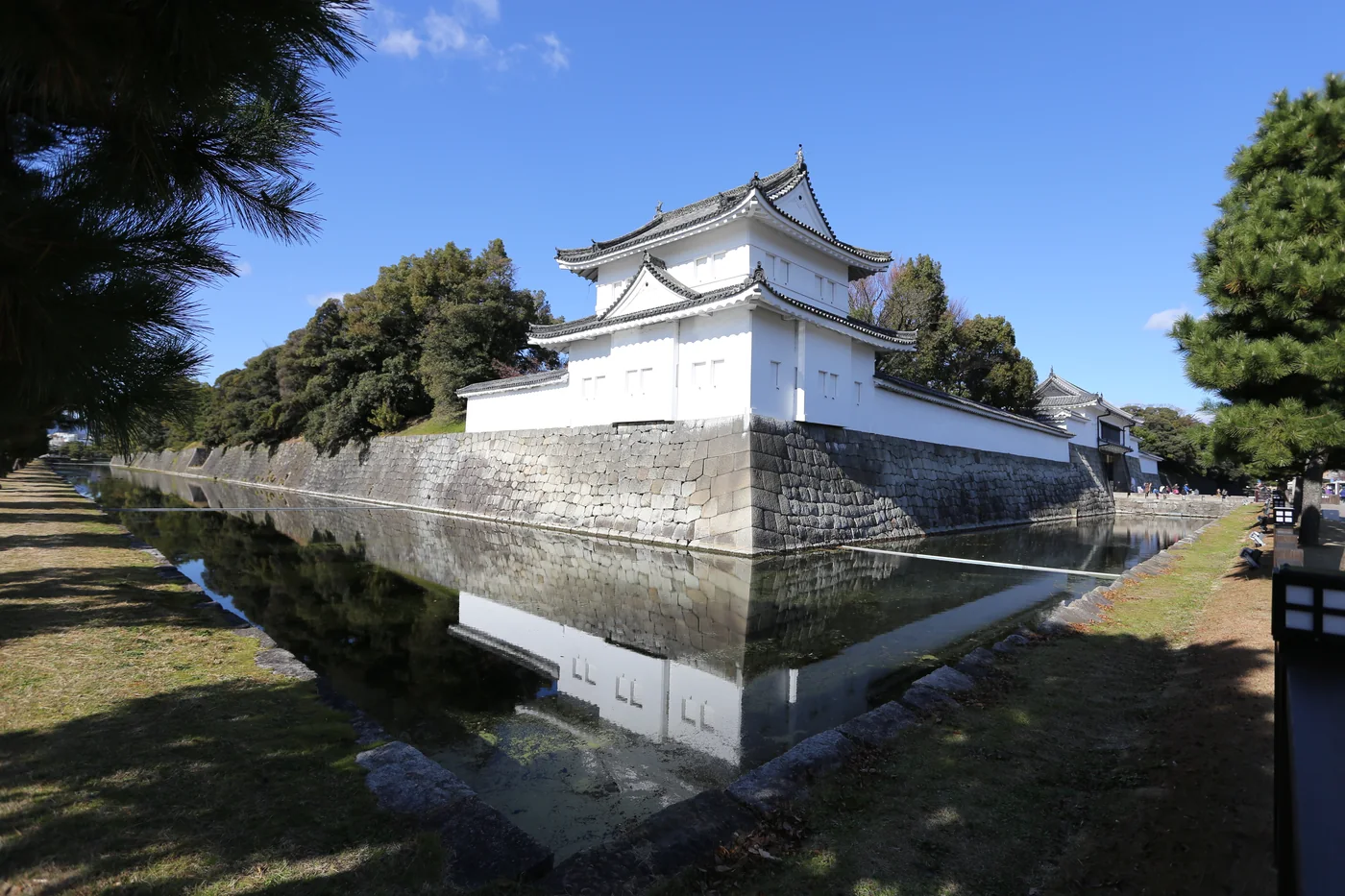
Enter through Higashi Ote-mon, notice the height of the gatehouse, then head towards Kara-mon. The castle’s cultural-property guide suggests Higashi Ote-mon was made a single-storey gate for Emperor Go-Mizunoo’s 1626 visit so nobody looked down on him. The present gatehouse dates from 1662. This relationship between upper and lower levels connects with the raised and lower audience areas inside the palace, giving the detail a practical purpose.
The nearby guardhouse was a duty station. During the Edo period, guards sent by the shogunate took turns serving at Nijo Castle. Of several guardhouses once within the grounds, this one remains. On a first visit, note its position relative to the main gate: guarding and surveillance came before the formalities of entering the palace. If your Honmaru booking is near, return later rather than delaying entry to photograph every building.
Kara-mon is Ninomaru Palace’s main gate. Its four-legged structure has curved karahafu gables front and back, with coloured carvings beneath a cypress-bark roof. Pine, bamboo, plum and cranes carry wishes for longevity, while guardian lions protect the space. View the whole from outside the flow of visitors, then choose a carving to examine. Inside, decoration continues through transoms and metal fittings.
Ninomaru’s staggered plan: put each room’s purpose in place
The Ninomaru Palace plan runs southeast to northwest through Tozamurai, Shikidai, Ohiroma, Sotetsu no Ma, Kuroshoin and Shiroshoin. Corridors connect six buildings staggered like geese in flight. The official figures are 33 rooms and more than 800 tatami mats. Rather than memorising each name, follow the functions: waiting at the entrance, conveying business, formal audiences, closer audiences and daily life. The decoration and painting subjects then fit their settings.
Outside Ninomaru Palace, overlapping roofs show the separate buildings. Inside, follow the viewing corridors past the rooms. Paintings, columns, doorframes and floor levels form each room together. Seeing them as a group explains the space better than treating each painting as a gallery picture. Your corridor position also changes how far you can see through openings.
For a first visit, give Tozamurai, Ohiroma, Kuroshoin and Shiroshoin one focus each: find tigers, find the raised platform, then compare colour with ink. Those interested in painting can add the senior councillors’ rooms in Shikidai and Ohiroma’s fourth room. Follow the open route rather than walking against the flow to revisit a painting.
From Tozamurai to Ohiroma: waiting, conveying business and formal audiences
The first, second and third Tozamurai rooms were waiting rooms for visitors, also called the Tiger Rooms for their bamboo-and-tiger paintings. Find the tigers across walls and sliding doors, then look at the room sizes. Visitors were already placed within a display of Tokugawa power before a formal audience. Children can start by finding tigers and leopards rather than hearing a full history of the shogunate.
Also in Tozamurai, the Imperial Messenger’s Room received court envoys, with paintings of cypress and green maple. The Willow Room and nearby rooms also use plants. Notice how decoration changes with the visitor’s rank and the room’s purpose: the tiger imagery does not fill every corner. Recall the Tiger Rooms when you reach the plant paintings to compare the two forms of reception.
At Shikidai, the focus changes to conveying visitors’ business and gifts and greetings between senior councillors and daimyo. Pines in the Shikidai room signify lasting prosperity. The councillors’ rooms behind use subjects such as reeds and geese or willows and egrets, with white walls above the nageshi rails. The official account explains the duties here. Compare the decoration front and back and consider the intermediaries who handled affairs before an audience.
Ohiroma’s first and second rooms hosted the shogun’s formal audiences with daimyo and court nobles. The castle’s Ohiroma explanation identifies the first as the upper level and the second as the lower; the shogun sat facing south on the upper level. The alcove, staggered shelves, attached study alcove and ceremonial doorway cluster in the main room. Follow the floor change up to these wall features to place historical audience scenes in an actual room.
The famous restoration-of-imperial-rule scene is associated with this space, but there is more to see than one event. The alcove behind the shogun and the shelves and study features framing his seat shaped how visitors looked towards him. Look at the room before reading the event to get more from the setting.
The third room’s transoms are carved through both sides of cypress boards 35 cm thick. Floral noshi-shaped metal fittings on the rails are another detail in Ohiroma and Kuroshoin. Look up at the depth and openwork, then back at the pines, separating carved material from painted surface. The fourth room’s pines and hawks form another scene. The official interpretation identifies it as a weapons-storage space during the shogun’s visits to Kyoto, unlike the main audience rooms.
From Kuroshoin to Shiroshoin, the paintings grow quieter
Called the Small Hall in the Edo period, Kuroshoin was the most formal space after Ohiroma, receiving daimyo close to the Tokugawa family and high-ranking court nobles. The Cherry Blossom Rooms show flowers blooming and falling, plum blossom, lingering snow and pine. Through an opening, find the seasonal details and consider how they surround the audience position. The sliding-door paintings are by Kano Naonobu, younger brother of Kano Tanyu.
Shiroshoin’s ink landscapes differ markedly from the richly coloured earlier rooms. Based on its former name, Goza no Ma, the castle interprets it as the shogun’s living and sleeping quarters. The first and second rooms use West Lake subjects; the third shows Chinese legendary and historical figures. Following Kuroshoin with this space reveals the difference between formal and domestic rooms within one indoor route, and why the six buildings reward seeing in order.
The corridor also has its nightingale-floor sound. The castle’s construction diagram attributes it to friction between clamps and nails. Listen to the timber structure and people’s footsteps. Focus your indoor visit on one raised platform, a set of transoms and an ink landscape, leaving with clear observations rather than a phone full of room names.
Ninomaru Garden: change position by the pond to see the palaces around it
After leaving the palace, treat Ninomaru Garden as an extension of the interiors. The pond garden west of Ohiroma was remodelled for the imperial visit in 1626, with works commissioners including Kobori Enshu. Ohiroma, Kuroshoin and the now-lost imperial-visit palace once surrounded it from different directions. The design had to serve several viewpoints. This relationship makes the garden worth keeping even on a one-palace visit.
Choose two stops on the public paths: one with the islands and bank stones in the foreground, another looking back at the palace roofs. The official garden introduction describes the central island, waterfall and substantial stone banks. Moving changes the relationship between water, stone and buildings, offering more than repeated photographs from one point.
At the sign for the lost imperial-visit palace, picture its former position and look again at the open garden. Audience rooms, the vanished building and pond reconnect here. If Honmaru is next, finish the views near your main route and save a longer stop for Seiryu-en afterwards. Visitors seeing only Ninomaru can linger by the pond.
Honmaru Palace: a princely residence moved from beside the Imperial Palace
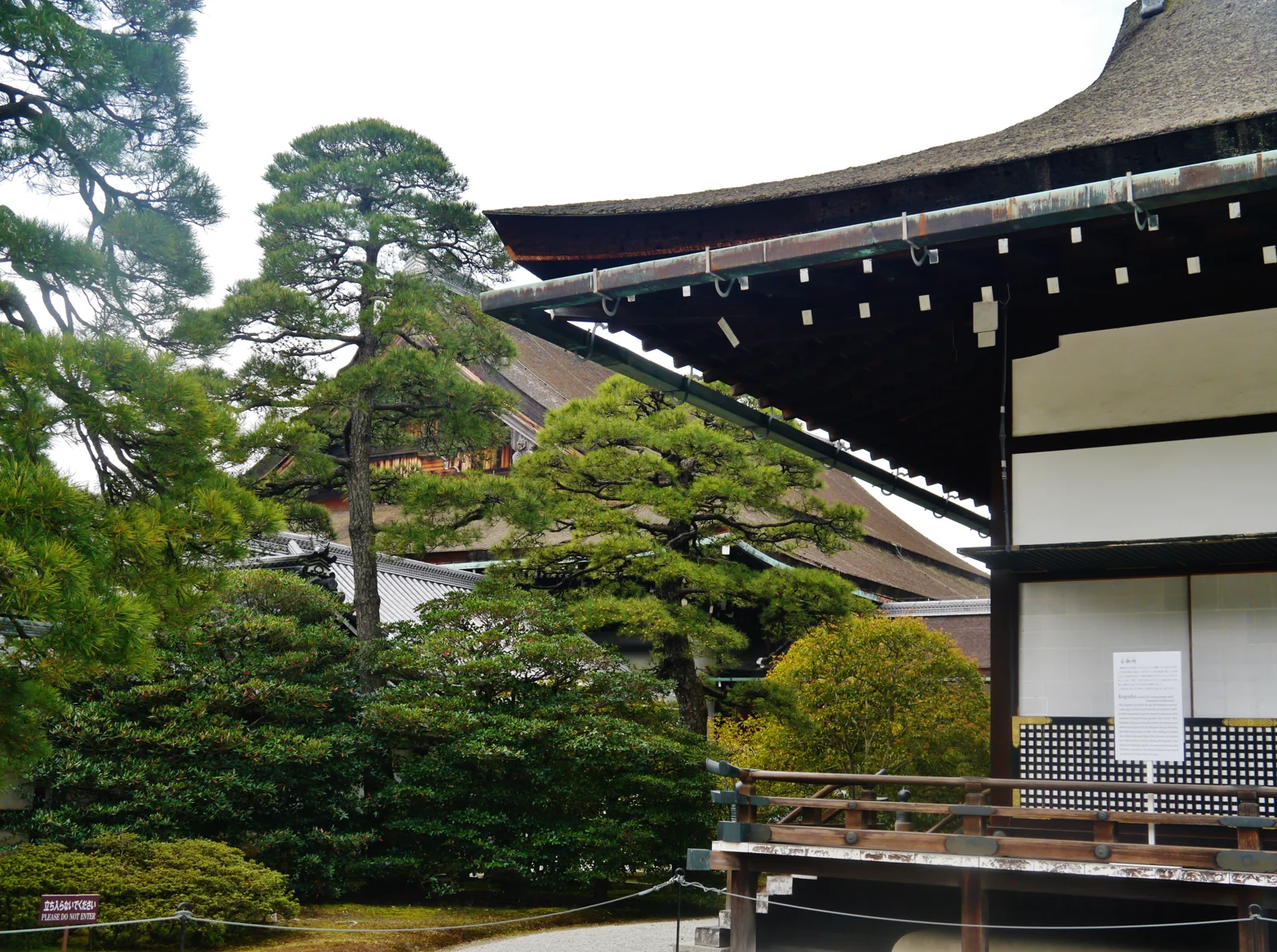
Inside the inner moat, the buildings have a different identity. The history of the present Honmaru Palace records that the earlier palace burnt down in 1788 and the temporary late-Edo palace was removed in the early Meiji period. Today’s complex was formed in 1893–1894 by moving part of the Katsura princely palace from north of the Kyoto Imperial Palace. It served the imperial family during the Nijo Detached Palace period, retaining the context of a princely home and modern imperial villa.
Major repairs finished at the end of March 2024. Public visits resumed on 1 September after 18 years. The repaired interior has a restricted route to protect original paintings and decorated karakami paper. Batch entry also reflects the narrow passages of a residence.
The entrance, Goshoin, Otsune-goten, kitchen and Goose Rooms of Honmaru Palace originally occupied separate positions at the Katsura residence. During relocation, Otsune-goten was rotated 90 degrees and attached south of Goshoin. The kitchen and Goose Rooms, previously separate, were placed beside each other. Knowing the buildings were reassembled helps explain corridors and room orientations shaped in the Meiji period.
This gives visitors who have seen Ninomaru a reason to add Honmaru. Ninomaru focuses on the hierarchy between shogun and visitor; Honmaru shows princely daily life, late-Edo painting and a relocated residence becoming an imperial villa. For grand gilded audience halls, Ninomaru is enough. Add Honmaru to spend time on finer paper patterns, flowers, birds and domestic fittings.
The kitchen and Goose Rooms add the service side of the house. Counters and a sink line the kitchen’s north side. The two Goose Rooms served retainers and attendants, with flying geese echoing their name. The kitchen is normally closed, so use the official plan to understand it. On the open route, trace the rooms from the owner’s daily life and reception to attendants’ activities.
Honmaru’s Goshoin: a room that could become a Noh stage
The entrance room and intermediary room together cover about 60 m², with nearby waiting rooms for messengers, court attendants and nobles. Reception remains a function, but on a different scale from Ninomaru. In Goshoin’s first to third rooms, the owner occupied the raised first room and visitors the second and third. The alcove and shelves framed the principal seat. Ninomaru’s upper and lower levels provide a direct comparison.
The Goshoin explanation says the third room could become a Noh stage when its tatami were removed. The corridor adjoining its southwest corner became the bridgeway. Use the plan to see how an everyday room could become a performance space. Follow the present viewing route to inspect the structure and connections, with diagrams explaining stage use.
The Four Seasons Rooms form a two-by-two group, with wall paintings of spring, summer, autumn and winter. The interlocking manji-pattern transom between the spring and summer rooms links to the design tradition of the Katsura family’s separate villa, today’s Katsura Imperial Villa. The Cloud and Crane Rooms take their name from karakami patterns. Their first three rooms stand in a row; the small sliding panels above and below the shelves in the first room show coastal spring and autumn scenes. Such subjects and patterns explain Honmaru’s emphasis on residential detail.
Otsune-goten originals rotate: choose dates for particular rooms
Otsune-goten housed the princely owner’s daily living and sleeping spaces. Living rooms have alcoves and shelves; sleeping rooms and other spaces retain chrysanthemum-shaped mosquito-net hooks. These small fittings reveal practical use. The Honmaru painting guide lists Kano Eigaku’s pines and cranes, with detailed feathers and sprinkled gold, and Nakajima Raisho’s seasonal flowers across different surfaces. Some plants have no painted outlines, giving a very different character from Ninomaru’s giant pines and tigers.
To protect originals, different Otsune-goten rooms open in rotation. The 2026 fiscal-year schedule lists the Pine and Crane Room, Pheasant Room and Storage Room for 19 September–15 November 2026. From 18 November 2026 to 14 March 2027, the Four Seasons Flowers, Farming, Bush Clover and Dressing Rooms replace them. For pines and cranes or seasonal flowers, these dates matter before morning or afternoon light.
Cedar-door paintings also rotate. Fourteen sets are normally stored, with roughly one set shown each half-year. The Honmaru cedar-door schedule lists the Tsurusawa school’s Pines and Cranes from 21 October 2026 to 14 March 2027. Made in 1800, it originally stood on the south side of Goshoin’s west corridor. Paint on cedar differs from paper sliding-door paintings: look at how wood grain and image meet.
Nijo Castle’s film on conserving and repairing Honmaru Palace wall paintings, showing original works and restoration processes.
Honmaru Garden and the keep base: level paths or a climb
Honmaru Garden, south of the palace, was created after the Katsura buildings moved here. It was remodelled following Emperor Meiji’s 1895 visit, leaving curved paths, lawns, ornamental stones and a moon-viewing platform. After the interior, see the main house and modern garden together. Ninomaru’s pond stones and multiple viewpoints give way here to lawns, curves and buildings. Seeing both makes the differences clearer than a single garden photograph.
The former keep site is in Honmaru’s southwest corner. Lightning destroyed the keep in 1750. The stone base and elevated views are the main features now. The castle’s keep-site introduction lists views over Honmaru Palace, its garden and Kyoto. From above, connect the roofs and paths you have walked.
Leave the climb for those with enough energy and time. Wheelchair users or companions tired after both palaces can continue through the garden towards the exit and meet others at an agreed rest point. The climb changes the viewpoint; level routes already give a full view of buildings and gardens, so it need not be a whole-group task.
Seiryu-en and tea fit towards the end of a longer route
Seiryu-en was created in 1965. A Japanese garden with Koun-tei and Waraku-an lies west; a Western-style lawn lies east. The official account records the use of building materials, garden stones and trees from the former Suminokura residence. Shift your attention from palace rooms to water, building exteriors and lawn edges. The three gardens preserve designs from different periods within one visit.
For seated tea, choose Waraku-an. The official service page lists matcha and sencha sets, normally 09:30–16:30 with last orders at 16:00. On a two-palace route, tea after Honmaru avoids rushing a booking halfway through. Ninomaru-only visitors can also rest here after the garden. Orders cost extra; use the main rest area for food you bring.
On ordinary days, view Koun-tei from its south side. Limited-period dining and special use have separate arrangements. The open garden paths give a good view of its setting. Accessible toilets near the Seiryu-en rest area also make this a meeting zone after separate photo walks. Before returning to Higashi Ote-mon, decide whether to enter the painting gallery.
Add the original-painting gallery: see the setting first, then the brushwork
Ninomaru Palace contains painted copies installed to preserve originals. To see original works, visit the Nijo Castle Painting Gallery. The gallery introduction explains that originals are held on movable panels in their original room arrangement and selected by room or theme for exhibitions. Copies use traditional materials and methods to study early-Edo colours and forms. The palace shows how paintings surrounded people; the gallery lets you inspect the surviving works closely.
The autumn 2026 exhibition “Wall Paintings That Adorned the Seat of Power” displays Ohiroma’s first and second rooms from 10 September to 8 November. The winter “A Magnificent Setting for Banquets” follows with Kuroshoin’s first and second rooms from 19 November 2026 to 17 January 2027, closed 29–31 December. In autumn, carry your memory of the raised audience position from Ohiroma to the gallery; in winter, study Kuroshoin more closely. Between exhibitions, keep the palaces and gardens in your plan.
The gallery costs an additional ¥100, with castle admission separate. Entry is 09:00–16:30 and closing at 16:45. The official FAQ permits photography inside but prohibits flash, monopods, tripods and extended selfie sticks. Both palace interiors prohibit photography. Save photographs of favourite paintings for the gallery and focus on rooms and explanations inside the palaces.
The 90-minute version: Ninomaru, the pond and back east
Enter through Higashi Ote-mon, pass Kara-mon to Ninomaru Palace, see Ninomaru Garden afterwards and return east via Seiryu-en. This keeps a complete palace, a garden stretch and exterior gates. The castle’s short route links key points in an hour. Allow an hour and a half to stop for paintings, manage shoes and see the pond.
Use the toilets and organise your belongings before entering. Inside, focus on Tozamurai’s tigers, Ohiroma’s upper level and the colour change from Kuroshoin to Shiroshoin. Outside, see two pond viewpoints. If the current gallery exhibition matches the rooms, add it; for seated rest, choose the main rest area or Waraku-an. One optional final stop gives more flexibility than two fixed bookings.
If Ninomaru is closed, the formal power setting you want is unavailable. Visit another day or make that day a Honmaru residence-and-gardens visit. Castle-only admission allows gardens and open paths; each palace interior has its own admission entitlement. If rooms are your purpose, read palace calendars before fitting other Kyoto plans around the date.
The two-palace version: let Honmaru’s slot set the order
For an early Honmaru booking, go there first after entering the castle. Follow reception, storage and the roughly eight-minute introduction film, then enter. After the palace, see Honmaru Garden and continue to Ninomaru. The castle estimates about 40 minutes inside Honmaru, with possible waits for batch entry. Putting the fixed slot first lets you omit the keep base or tea later if tired and see Ninomaru at your own pace.
For a later Honmaru slot, see Ninomaru first. The Honmaru visit procedure gives about 850 metres from Higashi Ote-mon to the entrance, a minimum 15–20-minute walk. The castle requires entry to the grounds at least 20 minutes before your Honmaru booking. Add Ninomaru’s roughly 30-minute interior visit, plus tickets, shoes, garden stops and possible waiting. For a half-day plan, see Ninomaru and the pond first, go straight to Honmaru, then leave tea, the gallery and Seiryu-en until afterwards.
The official recommended direction runs from Honmaru towards the west bridge and then north to Seiryu-en. In flower season, the longer version loops south for the plum grove or cherry garden. For buildings, the northern return connects more easily with tea and the gallery. If you have an afternoon restaurant booking, allow time to leave and take the subway, making the gallery or climb optional. Three hours can retain the main content of both palaces.
Mobility needs, socks and storage: connect the indoor and outdoor routes
Main paths include gravel. The official wheelchair service lends a limited number of power-assisted wheelchairs from the information office without reservations; the assist function needs a carer’s help. With your own mobility aid, collect the service map after entry. Mark the Honmaru detour, west-bridge and Seiryu-en rest areas, and accessible toilets east of Midori no Sono before choosing your outdoor distance.
Both palaces provide viewing wheelchairs, but you must transfer into them. The official FAQ says entry may be impossible if transfer is difficult. Discuss this with the castle before booking Honmaru and arrange the transfer help you need. Access along grounds paths and entry into interiors require separate preparation.
Pushchairs and other large items can be stored at the main rest area. The castle lists ¥500 storage for large items such as pushchairs and suitcases. If companions take turns seeing a palace, agree a meeting place and time. Neither castle re-entry nor repeat palace entry is allowed. The main rest area has feeding and nappy-changing facilities, useful between indoor visits.
For Honmaru, remove shoes and wear socks. Put shoes and hand luggage in the palace lockers. Items measuring 35 cm wide × 35 cm deep × 50 cm high or larger go to the main rest area’s luggage storage. Narrow corridors use batch entry, so storing a large camera bag makes movement easier. Include collection before leaving: Honmaru is still some distance from the east side.
Photography and filming are prohibited inside both palaces. Outdoors, photograph from viewing routes without obstructing others. Monopods and tripods are prohibited throughout the castle. The visitor rules restrict food and drink to designated areas. Eat packed lunches at the main rest area and stop at a designated rest place to drink water. In summer, make hydration a proper break between the palaces.
For a drink or simple rest, the main rest area normally opens 08:45–16:45, with a café corner, shop, storage and nursing facilities. Waraku-an suits those wanting a longer tea stop.
Choose tickets last: match prices and opening days to what you want to see
As of October 2026, the official fee page lists adult castle admission at ¥800, castle plus Ninomaru at ¥1,300, and Honmaru at an extra ¥1,000. Both palaces total ¥2,300; the painting gallery adds ¥100. A Honmaru ticket excludes castle admission. Use castle admission for gardens and open outdoor routes, adding the relevant tickets for palace interiors or gallery.
On ordinary days, castle entry starts at 08:45 and ends at 16:00; the grounds close at 17:00. Ninomaru reception ends at 16:10; Honmaru reception runs 09:30–16:00. The whole castle closes 29–31 December. Ninomaru closes on Tuesdays in January, July, August and December, plus 26–28 December and 1–3 January. A Tuesday public holiday moves that closure to the next day. Honmaru closures are the third Monday of each month and the following day, 26–28 December and 1–3 January. The third Monday and the following day remain open when they fall on a public holiday. For both palaces, choose a date when their opening calendars overlap.
Honmaru online tickets go on sale 30 days ahead. Purchases cannot be changed, cancelled or refunded. Read the Otsune-goten and cedar-door schedules before booking. A small number of same-day Honmaru tickets are sold at the information office inside the grounds, not the general ticket office beside Higashi Ote-mon. For a short gap in central Kyoto, unreserved Ninomaru is easier to fit in. For a planned Honmaru residence visit, build the half-day around the booking.
For explanation, choose an official Nijo Castle guided tour. Japanese tours start at 09:30 and 11:30, costing ¥1,500 per person from primary-school age. English tours start at 10:00 and 12:00, costing ¥2,500 from age 7. Each lasts about 60 minutes. Castle and Ninomaru admission are extra; Honmaru is excluded. Check in beside the information office inside the grounds 20 minutes before the start. An audio guide is another option for slower independent viewing. To see both palaces, connect Honmaru after the tour, leaving grounds-walking time between fixed starts.
A few useful answers
Is Ninomaru alone enough for a first Nijo Castle visit?
Ninomaru Palace and garden offer about one to one and a half hours, suitable for a first visit or limited time. Add Honmaru to compare a princely residence with the shogun’s audience spaces.
Does a Honmaru ticket include Ninomaru?
Honmaru admission excludes both castle entry and Ninomaru. Adult daytime admission for both palaces is ¥1,300 for the castle and Ninomaru plus ¥1,000 for Honmaru, totalling ¥2,300.
Can I see all Otsune-goten paintings on the same day?
Rooms open in rotation to protect original paintings. The Pine and Crane Room and Four Seasons Flowers Room belong to different periods. Read the official schedule before buying a Honmaru slot.
Are photography rules the same in both palaces and the gallery?
Photography and filming are prohibited inside Ninomaru and Honmaru. The gallery permits photography but prohibits flash, tripods, monopods and extended selfie sticks.
Official information and references
Sources used in this guide.
- Ninomaru Palace and Garden | Nijo Castle
- Honmaru Palace and Garden | Nijo Castle
- Cultural properties and facilities | Nijo Castle
- Visiting Honmaru Palace | Nijo Castle
- Frequently asked questions | Nijo Castle
- Nijo Castle Painting Gallery
- Suggested visitor routes | Nijo Castle
- Visitor services | Nijo Castle
- Admission fees | Nijo Castle
- Opening hours and closing days | Nijo Castle
- Visitor rules | Nijo Castle
- Official Nijo Castle guided tours
- 2026 fiscal-year Otsune-goten opening schedule
- Honmaru Palace cedar-door painting display schedule