Explore Kyoto's Okazaki district from Higashiyama or Keage Station. Practical guide to the Okazaki Canal Jikkokubune cruise, choosing between the Kyocera and Hosomi museums, Heian Shrine Garden admission, and rainy-day alternatives during MOMAK's early 2027 closure.
- Region & Focus
- KyotoNeighbourhoods and shopping
- Reading Scope
- 21 min read · 8 chapters · 5 Q&As
- Official Verification
- 39 official sources checkedUpdated 22 November 2026
- Key Topics
- ItinerariesNeighbourhoodsFirst trip
Chapter Route Map (tap any stop)
- Choose Higashiyama or Keage First, Then Decide Which Way to Walk
- How to Ride the Okazaki Canal Jikkokubune, and Where to Walk Without a Boat
- Choosing Between the Kyocera, Hosomi, and National Museum of Modern Art
- Heian Shrine Grounds vs the Paid Garden: Separate Entrances and Closing Times
- Visiting Kyoto City Zoo with Children: Choose Your Gate Before Picking Zones
- Three Ways to Pace Okazaki: Exhibitions, Autumn Strolls, and Spring Boats
- Rainy-Day, Monday, and Closure-Season Alternatives
- When to Eat and Which Side of Town to Stay On
- Quick Q&A
For a first visit to Kyoto's Okazaki district, set aside a full day for one art museum, the Heian Shrine gardens, and a walk along the canal. Start from Higashiyama Underground Station in the morning for the Kyocera Museum, pass beneath the giant torii gate to the shrine after lunch, and finish with a waterside stroll to Keage Station at dusk. Travelling with children? Swap the morning museum for Kyoto City Zoo. If you want to ride the spring Jikkokubune canal boat, start from Keage and lock in your sailing time first. Note that the National Museum of Modern Art, Kyoto (MOMAK) is closed for maintenance from 18 January to late March 2027, making the Kyocera Museum and the Kyoto Museum of Crafts and Design (Fureaikan) your best late-winter indoor pairing.
Choose Higashiyama or Keage First, Then Decide Which Way to Walk
Okazaki sits east of the Kamo River and north-west of Nanzenji. Open your map and locate the giant vermilion torii gate on Jingu-michi Street first. Two major art museums flank either side of the road; Heian Shrine lies straight ahead to the north, while walking east along the canal leads to Kyoto City Zoo, the Lake Biwa Canal Museum, and Nanzenji Funadamari (boat landing). Begin at Higashiyama Station if you want art or the shrine first, or start from Keage Station if you plan to board a canal boat, photograph the Suirokaku aqueduct, or enter the zoo via its east gate. Using the underground stations at opposite ends means you can simply exit via whichever station is nearest once your legs tire.
From Kyoto Station, take the Karasuma Underground Line to Karasuma-Oike and change to the Tozai Line towards Rokujizo or Misasagi. For the museum cluster first, alight at Higashiyama Station (T10), take Exit 1 onto the north side of Sanjo-dori, walk east to Jingu-michi, and turn left towards the giant torii gate. The Kyocera Museum estimates an eight-minute walk from Higashiyama Station, with a little further beyond the torii gate to reach Heian Shrine's Otenmon Gate. Visitors with pushchairs, wheelchairs, or mobility needs should use the lift at Higashiyama Station Exit 2 to reach the south side of Sanjo-dori, then cross at the pedestrian crossing onto Jingu-michi. Leave a few extra minutes to cross the road if you are carrying shopping on the way back.
At Keage Station (T09), Kyoto City Transport lists Nanzenji, the Lake Biwa Canal Museum, and Kyoto City Zoo under the Exit 1 area guide. For street-level lift access, use Exit 2 and follow Sanjo-dori along flat pavement towards your destination. Both the Canal Museum and the Jikkokubune operators estimate a seven-minute walk from Keage. To reach the boat dock directly, set your navigation to 'Nanzenji Funadamari Boarding Point' or 'Lake Biwa Canal Museum' so it does not route you into Nanzenji's main temple gate first. Coming from Keihan Sanjo Station, transfer underground to Sanjo-Keihan Station for direct Tozai Line trains to Higashiyama and Keage. If you are staying around Jingu-Marutamachi, Heian Shrine lists Jingu-Marutamachi Station as roughly a 15-minute walk, which also pairs nicely with a stroll back towards the Kamo River for dinner.
To avoid a rail transfer, board Kyoto City Bus No. 5 from Stand A1 outside Kyoto Station: alight at 'Okazaki Koen Bijutsukan / Heian Jingu-mae' for the museums and giant torii gate, or 'Okazaki Koen Dobutsuen-mae' for the zoo's main gate. This route falls within the standard flat-fare zone at ¥230 for adults and ¥120 for children. For the return journey, check the bus front display for 'Kyoto Station', as opposite stops serve Ginkakuji and Iwakura. If you are simply making a return trip to Okazaki and exploring on foot, tapping a transit IC card per ride is enough. On major exhibition opening days, cherry blossom weekends, or Jidai Matsuri, switch to the underground for timed-entry tickets so road traffic only affects the final short walk.
On the afternoons of 22, 23, 28, and 29 November 2026, buses heading back to Kyoto Station from the Nanzenji area are subject to autumn traffic diversions. Between 15:00 and 19:00 on those dates, Route 5 and Route 5 via Gojo-dori detour around 'Nanzenji / Eikando-michi' and 'Okazaki Hosshoji-cho', though they continue to stop in front of the zoo. Between 15:45 and 19:20 on the same days, passengers already aboard Kyoto Station-bound Buses 5, 105, or 206 may pay the bus fare upon alighting at 'Higashiyama-Sanjo' and collect a transfer ticket to exchange at the dedicated window in Higashiyama Underground Station for a ride back to Kyoto Station. If you have already walked as far as the Keage underground entrance, simply take the train straight back.
If you are arriving after lunch in Shijo-Kawaramachi or Gion, start with whichever museum or garden has the strictest last-entry cut-off. On your way back towards Higashiyama Station, you can continue west along Sanjo-dori towards the Kamo River for shops and cafés. Travellers transferring to the Shinkansen at Kyoto Station should leave large suitcases in lockers or luggage storage before heading to Okazaki with a daypack: narrow cherry-blossom canal paths, gravel walkways inside Heian Shrine Garden, and compact museum cloakrooms will quickly slow down anyone pulling wheeled luggage.
Explore Kyoto's Okazaki district from Higashiyama or Keage Station. Practical guide to the Okazaki Canal Jikkokubune cruise, choosing between the Kyocera and Hosomi museums, Heian Shrine Garden admission, and rainy-day alternatives during MOMAK's early 2027 closure.
How to Ride the Okazaki Canal Jikkokubune, and Where to Walk Without a Boat
Okazaki's spring Jikkokubune canal boats depart from Nanzenji Funadamari in front of the Lake Biwa Canal Museum, cruising along the canal to turn back at the Ebisugawa Dam—a roughly 3 km, 25-minute round trip with no mid-route stops. If anyone in your group wants to split up and explore on foot, arrange to meet back at the boarding dock. Note that Fushimi also runs Jikkokubune boats, and the Lake Biwa Canal operates a separate long-distance 'Biwako Sosui Cruise' between Otsu and Kyoto, so double-check the departure and arrival points before buying tickets. For cherry blossoms along the Okazaki banks alone, pick the round-trip marked 'Okazaki Sakura Corridor'. The long-distance cruise's 'Keage Boat Landing' and the Okazaki Jikkokubune's 'Nanzenji Funadamari' sit at opposite ends of the Keage Incline—if you see queues heading towards Otsu or Yamashina at the top end, walk down along Sanjo-dori towards the Canal Museum to reach the Jikkokubune ticket desk.
The most recent Okazaki Jikkokubune season ran from 20 March to 15 April 2026, with standard departures every 15 minutes from 09:30 to 16:30. Fares for that season were ¥2,000 for junior high school students and adults, ¥1,000 for primary school children, and ¥500 for pre-school children aged three and above. Children under three travel free on a guardian's lap, though a ticket is required if they occupy a seat. Online bookings carried an additional ¥110 fee per person. Sailing dates and fares for 2027 have not yet been announced; when booking spring accommodation for next year, reserve a day for Okazaki with a walking-only backup itinerary just in case.
For the 2026 season, advance tickets for selected sailings went on sale on the official website from 10:00 JST on 25 February, closing at noon the day before sailing or earlier once sold out. Bookings were capped at eight seats per transaction, payable by Visa or Mastercard, with online buyers exchanging their confirmation email for boarding passes 15 minutes prior to departure. Same-day tickets went on sale on-site from 08:30, capped at five seats per person; once purchased, you can stroll nearby as long as you return to the dock 10 minutes before departure. If you want your whole family on the same boat, allow generous buffer time for gathering rather than scheduling your next timed ticket right after the 25-minute cruise.
Under the last season's rules, tickets could not be rescheduled or refunded by the buyer once purchased. If sailings are cancelled due to weather or mechanical issues, the operator refunds the boat fare, though the online booking fee is non-refundable. Life jackets must be worn throughout the trip, and eating or drinking is prohibited both on board and at the pier. If you want to visit during peak cherry-blossom hours with a toddler who needs an afternoon nap, send one early riser to queue for same-day tickets while the rest of the group joins once the sailing slot is confirmed. If your lunch or museum visits are already fixed to specific times, put the boat ride in your earliest open slot so you can switch to a canal walk if needed.
Walking from Keage towards the giant torii gate brings you past the Lake Biwa Canal Museum and Nanzenji Funadamari first, before following the waterway towards the zoo and art museums. If you only want photographs of the water, bridges, and torii gate, the views around the Jingu-michi bridge over the canal are more than enough—there is no need to walk all the way down to the Ebisugawa Dam. To understand why the water level drops so steeply at Keage, detour up to the Keage Incline tracks. The upper and lower boat basins sit roughly 36 metres apart in elevation, and boats once rode wheeled cradles up and down the rails between them. On crowded spring days, inspect the scale models inside the museum first, then glance at the outdoor tracks at the lower end to see how the cradle system worked.
Admission to the Lake Biwa Canal Museum is free; it opens 09:00–17:00 (last entry 16:30), while viewing of the incline winding-house machinery closes at 16:00. The museum closes on Mondays (or the following weekday if Monday is a public holiday) and over the New Year period from 29 December to 3 January. Put the Canal Museum first on your route from Keage to learn about the hydro-engineering and boat models before heading towards the art museums at 10:00. In light drizzle, admire the canal from the street-level bridge and duck inside. Because wet railway sleepers, gravel, and slopes slow everyone down, families with pushchairs will have an easier time keeping to schedule by taking the paved streets straight to the zoo.
Inside the Nanzenji grounds, the brick-arched Suirokaku aqueduct carries the first branch of the Lake Biwa Canal. From Keage, you can pass through the spiral-brick 'Nejirimanpo' pedestrian tunnel towards Nanzenji and continue up to the aqueduct. Because that detour leads deeper into the temple complex, loop back to Nanzenji Funadamari afterwards if you are continuing through Okazaki. Alternatively, if you plan to visit Eikan-do and follow the Philosopher's Path to Ginkakuji after leaving the Canal Museum, head straight north and save the Okazaki museums and Heian Shrine for another half-day—check our Ginkakuji and Philosopher's Path half-day route to time the connection.
Choosing Between the Kyocera, Hosomi, and National Museum of Modern Art
If you are picking just one museum in Okazaki on a first visit and want modern Kyoto Nihonga paintings, striking museum architecture, or blockbuster special exhibitions, start with the Kyoto City KYOCERA Museum of Art. Across Jingu-michi, the National Museum of Modern Art, Kyoto (MOMAK) suits visitors keen on modern Japanese art, crafts, or its current featured programme. Just west of the road leading north from the torii gate to Heian Shrine sits the Hosomi Museum—check what is currently on before you go if you are hoping for traditional Japanese art and crafts, as collecting focus and temporary exhibitions differ; for instance, Hosomi's headline show at the end of 2026 features German Meissen porcelain.
The Kyocera Museum generally opens 10:00–18:00 and closes on Mondays (staying open when a Monday falls on a public holiday) and from 28 December to 2 January. Overseas visitors and non-residents pay the standard out-of-city rate for the Collection Room: ¥730 for adults, ¥300 for primary to senior high school students, and free for pre-schoolers. Special exhibitions set their own prices and last-entry times, and some require dated or timed-entry tickets. If there is a special exhibition you cannot miss, book that ticket via the exhibition page first and treat the Collection Room as an optional add-on so you are not queueing at the ticket desk twice inside the same building. Note that official last entry to the Collection Room is 17:30, leaving just 30 minutes if you arrive at the cut-off.
From Jingu-michi, the 1933 main building of the Kyocera Museum retains its historic facade, while entry is via the sunken glass entrance beneath Kyocera Square—home also to the café ENFUSE and the museum shop. Exhibitions take place across the main building's North and South Wings as well as the newer Higashiyama Cube wing, so check the gallery name on your ticket once inside and pick an obvious landmark—such as outside the shop on the main entrance floor—to regroup if anyone in your party separates with a pushchair. Lifts connect every level, pushchairs are allowed inside the galleries, and a nursing room is located in the first-floor East Hall. Visitors requiring step-free assistance can use the museum intercom at the north-west entrance or the south-west side of Kyocera Square, and wheelchairs can be borrowed free of charge.
The Collection Room rotates its displays between seasons: the autumn term runs until 13 December 2026, followed by a winter term from 15 January to 14 March 2027 showcasing modern Kyoto lacquerware in the South Wing first-floor gallery. Between 17 December 2026 and 11 January 2027, the Higashiyama Cube also hosts a Studio Ghibli-curated exhibition of Hakuin Zen paintings. If you hope to visit the Hosomi Museum or Heian Shrine Garden on the same day, budget 90 minutes for a main exhibition at the Kyocera Museum. If you end up lingering longer, skip the second paid museum ticket and head out for a canal walk before lunch or dinner.
For contemporary sculpture in late winter, Raphael Zarka's solo exhibition runs in the Kyocera Museum's Higashiyama Cube from 6 February to 5 May 2027, open 10:00–18:00 with last admission at 17:30. Tickets are ¥1,800 for adults, ¥1,300 for high school, university, and vocational students with valid student ID, and free for junior high school students and younger. Online sales open at 10:00 JST on 1 December 2026 with no separate early-bird discount. Because the museum opens on the substitute holiday Monday of 22 March and the public holiday Monday of 3 May, spring-holiday visitors can easily slot Okazaki into either of those Mondays.
The Hosomi Museum generally opens 10:00–17:00, opening on public-holiday Mondays and closing the following day, as well as during exhibition changeovers. Its Heinz Werner Meissen Porcelain exhibition runs from 21 November 2026 to 31 January 2027 (closed 25 December to 4 January), with admission at ¥2,000 for adults and ¥1,500 for junior high to university students with student ID. Give yourself extra time here in the afternoon if you want to study the glazes and fine decorative details. Inside, JAKUCHU CAFÉ opens 10:30–17:00 (last order 16:30); as the Kokoan tea room is currently closed for general service, plan on using the café if you want a sit-down break.
If you plan to visit two museums in one day, keep your ticket stubs and the Hosomi Museum's same-day admission sticker. Visiting Hosomi first gives you ¥100 off a Collection Room ticket bought at the Kyocera Museum's on-site counter when you show your same-day sticker. Going in reverse, presenting a same-day Kyocera ticket stub before paying at Hosomi lowers the Meissen Porcelain exhibition to ¥1,900 for adults and ¥1,400 for students. When timed tickets at the Kyocera Museum are tight, book your essential timed slot first and save the discount for the museum where you can buy at the door. Same-day reciprocal discounts also apply between MOMAK and the Kyocera Museum, so present your earlier ticket at the desk before buying your second admission.
The National Museum of Modern Art, Kyoto (MOMAK) keeps standard hours of 10:00–18:00 (last entry 17:30), usually extending until 20:00 (last entry 19:30) on Fridays during special exhibitions. Its jewellery exhibition running from 24 October 2026 to 17 January 2027 charges ¥2,000 for adults on the day, including admission to the concurrent Collection Gallery. For the Collection Gallery alone during that run, daytime tickets are ¥1,000 for adults and ¥500 for university students, while high school students, visitors under 18, and those aged 65 and over enter free; check current exhibition pricing rather than relying on older Collection rates. MOMAK closes from 28 December 2026 to 4 January 2027, and then closes again for facility maintenance from 18 January until the end of March 2027.
If members of your group want to visit different exhibitions, arrange to meet on the same side of Jingu-michi near the giant torii gate, or pick a specific museum name for lunch—typing simply 'Kyoto art museum' into a maps app often sends people to the wrong side of the street. Use exact meeting points such as 'Kyocera Museum sunken glass entrance' or 'MOMAK main entrance'. After lunch, you can walk past the torii gate across the canal bridge towards the zoo together without everyone having to sit through the same two exhibitions.
Heian Shrine Grounds vs the Paid Garden: Separate Entrances and Closing Times
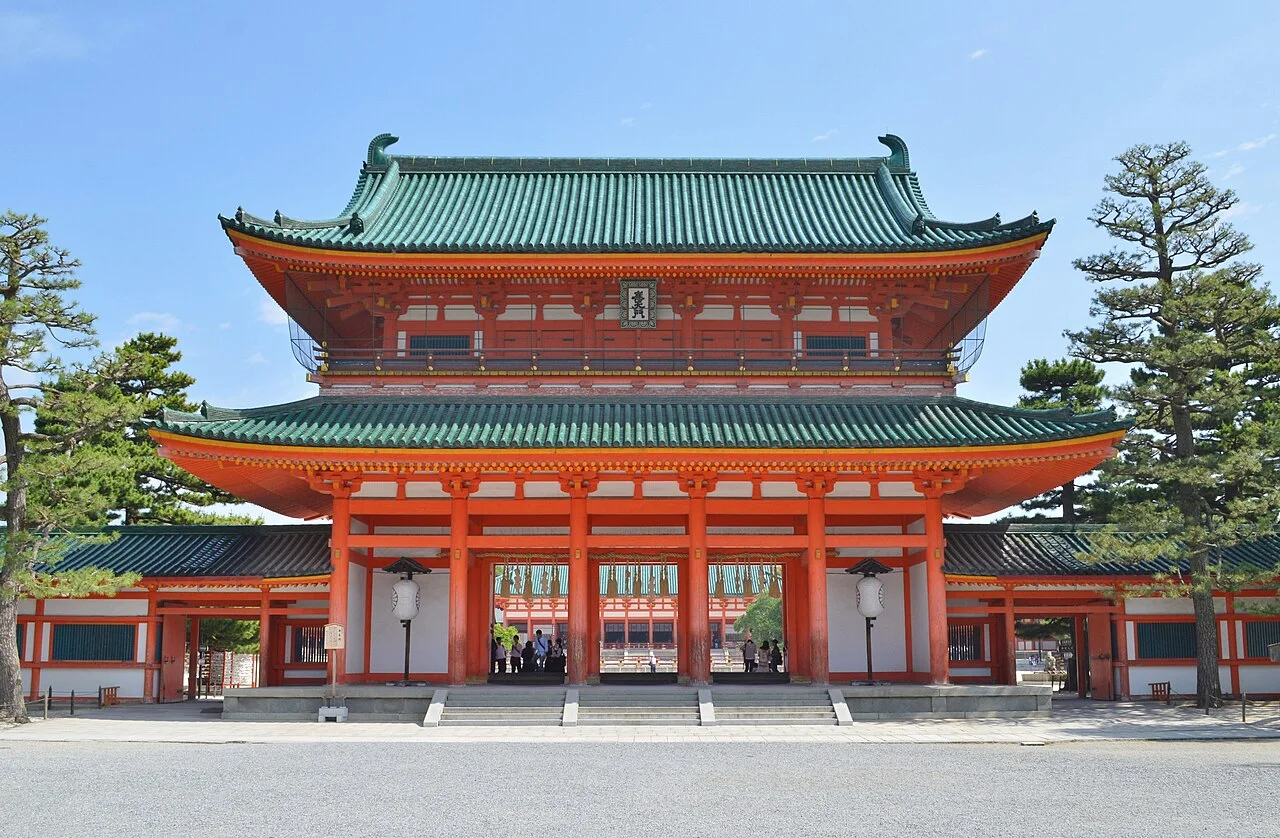
Standing on Jingu-michi, the giant torii gate leads north to Otenmon Gate. Stepping through Otenmon brings you face to face with the Daigokuden—Heian Shrine's outer worship hall—at the end of the central axis. Built in 1895 to mark the 1,100th anniversary of the capital's move to Heian-kyo, the complex reproduces the layout of the ancient imperial Chodoin audience hall. After photographing the torii, pause on the approach outside Otenmon to frame the courtyard, then look back from inside at the gatehouse and flanking corridors. To enter the strolling pond garden, follow the 'Shinen Garden' signs inside the precinct to the separate ticket booth.
The main shrine precinct opens daily from 06:00 for worship, whereas the Shinen Garden admits visitors from 08:30 at ¥600 for adults and ¥300 for children. From March to September the garden closes at 18:00 (last entry 17:30); in October it usually closes at 17:30 (last entry 17:00); and from November to the end of February it closes at 17:00 (last entry 16:30). In winter, schedule the garden straight after lunch and before a second museum so you have time for a full circuit around the ponds. If you only wish to visit the free outer courtyard, arrive in the morning before the museums open at 10:00.
Four distinct garden zones—South, West, Middle, and East—wrap around the main shrine buildings. Spring brings weeping red cherry blossoms in the South Garden, while the East Garden leads across the covered Taiheikaku bridge overlooking Seiho Pond. Early summer highlights irises and water lilies along the water's edge, and late autumn draws reflections across the ponds. Because the garden paths mix crushed gravel with steps and uneven stone, take care after rain. Wheelchairs and pushchairs are permitted in the main shrine precinct, though moving further in involves steps and raised thresholds. Older travellers who tire easily can focus on Otenmon Gate and the main courtyard, saving seated rest stops for a museum café. Tripods and monopods are banned in the Shinen Garden during cherry blossom season and on free-admission days, and carry a fee on ordinary weekdays.
Kyoto's Jidai Matsuri (Festival of the Ages) takes place each year on 22 October, when a historical procession leaves Kyoto Imperial Park's Kenreimon Gate and marches across the city to Heian Shrine in costumes moving backwards through the eras from Meiji to Heian. Alongside the Aoi Matsuri and Gion Matsuri, it is one of Kyoto's three great festivals. If you want to catch the final stretch in Okazaki, stake out a spot along Jingu-michi beforehand; the Kyoto City Tourism Association publishes reserved seating details for Kyoto Imperial Park, Oike-dori, and Heian Jingu-michi. Anyone crossing from the museum side towards the shrine needs to factor in parade road closures and agree on which side of the route to meet companions. The shrine's visitor page also lists shortened hours for the Shinen Garden on festival day—admitting visitors from 09:30 to 11:30 and closing at noon on 22 October—so save the garden for a normal day and keep festival day free for the parade.
If Heian Shrine is your New Year morning stop, bear in mind that neighbouring cultural venues reopen on different dates. Kyoto City Zoo closes until New Year's Day 2027, making 2 January the earliest day for animals. For the Hosomi Museum and MOMAK, wait until 5 January, when both reopen. On New Year's Day itself, pair a morning visit to the Heian Shrine courtyard with a short walk along Jingu-michi and the canal, checking the shrine's New Year notice for extended worship hours.
| Venue | Usual Opening Hours | New Year Closures & Seasonal Changes |
|---|---|---|
| Kyoto City KYOCERA Museum of Art | 10:00–18:00 | Closed 28 Dec–2 Jan. Collection Room last entry 17:30; special exhibitions vary |
| Hosomi Museum | 10:00–17:00 | Closed 25 Dec 2026–4 Jan 2027 |
| National Museum of Modern Art, Kyoto (MOMAK) | 10:00–18:00 (last entry 17:30) | Closed 28 Dec 2026–4 Jan 2027; closed for maintenance 18 Jan–late Mar 2027 |
| Heian Shrine Shinen Garden | Opens 08:30 | Nov–late Feb last entry usually 16:30 |
| Kyoto City Zoo | Opens 09:00 | Closed 28 Dec–1 Jan; Dec–Feb last entry 16:00 |
| Lake Biwa Canal Museum | 09:00–17:00 (last entry 16:30) | Closed 29 Dec–3 Jan |
Visiting Kyoto City Zoo with Children: Choose Your Gate Before Picking Zones
General admission to Kyoto City Zoo is ¥750, with free entry for junior high school students and younger. From March to November it opens 09:00–17:00, shifting to 09:00–16:30 from December to February, with last admission 30 minutes before closing in both seasons. The zoo closes on Mondays (or the following weekday if Monday is a public holiday) and annually from 28 December to 1 January. Prioritise your children's favourite big animals early: the zoo notes that Asian elephants, Grevy's zebras, and giraffes begin returning to their indoor enclosures from 15:30.
To start with the zoo, walk roughly seven minutes from Keage Station to the East Gate, work your way west through the grounds, and exit via the West Main Gate straight towards the giant torii, Heian Shrine, and the museums. Coming from Higashiyama Station or the 'Okazaki Koen Dobutsuen-mae' bus stop, enter by the West Main Gate instead—and if the Lake Biwa Canal Museum is next, leave through the East Gate. Wheelchairs and pushchairs can be borrowed free of charge at either entrance, though pushchairs are limited and cannot be reserved. Both gates and the children's zone provide nursing rooms or baby-care facilities, so whichever end you enter from, you can sort out feeding or nappy changes before the rest of your group heads deeper into the park.
If you plan to step out for lunch and return, ask staff at the gate to stamp your same-day ticket for re-entry, noting that re-entry also cuts off 30 minutes before closing. When morning time is tight and you only want to see the elephants and giraffes, circle their enclosures on the park map beforehand. Keep the indoor Tropical Animal House or Ape House in mind as rain shelters, though you will still walk outdoors between buildings. If heavy rain sets in all morning, switch to the nearby Canal Museum to see the boat and incline models—or let half your group visit the zoo while the rest tour an exhibition, regrouping near the Kyocera Museum entrance for lunch.
Three Ways to Pace Okazaki: Exhibitions, Autumn Strolls, and Spring Boats
For an art-focused weekday, enter the Kyocera Museum at 10:00, have lunch in Okazaki, and walk through Heian Shrine's Shinen Garden in the afternoon. If you still have energy and time afterwards, add an exhibition at the nearby Hosomi Museum. On a half-day visit, pick just one paid ticket—either a museum or the Shinen Garden—and spend the rest of your time walking from the giant torii gate along the canal. Entering and leaving via Higashiyama Station works smoothly here, letting you stop for canal photographs from the Jingu-michi bridge on the return walk.
On a bright spring day during cherry blossom season, start at Keage for the incline tracks or a pre-booked Jikkokubune sailing, then follow the canal west into Okazaki. Treat the canal banks and Heian Shrine's weeping red cherry trees as two separate highlights: in the Shinen Garden the blossoms trail close to paths and ponds, whereas from the canal bridges you can frame long rows of trees lining both banks. If the main bridge gets crowded, keep walking towards the zoo and Canal Museum for quieter vantage points out of the pedestrian flow. Should you miss a boat slot, find the blossoms slower than expected, or hit wind and rain, slip into the Canal Museum before continuing to an afternoon art exhibition. If you are combining the Shinen Garden and the canal bank, tackle the pond garden first while afternoon light is still bright.
In autumn when foliage is the priority, start early from Keage with Nanzenji or Eikan-do before walking down to the canal for lunch. At Nanzenji's Suirokaku, red-brick arches cut across the wooded temple hillside; at Heian Shrine, autumn colour reflects in still ponds—visit one in the morning and the other after lunch if you want both. If an art museum is also on your list, dropping Eikan-do keeps the day at a comfortable pace. Coming down from the foothills around 16:30 in late autumn often leaves you too late for Shinen Garden admission, in which case an hour in the Kyocera Collection Room or an early dinner along Sanjo-dori makes a better close.
In peak summer heat and glare, keep your canal walk brief before stepping into air-conditioned galleries, or arrive at the zoo's 09:00 opening while animals are active. Turning up at 15:00 or 16:00 leaves little time in winter and can coincide with animals moving indoors in warmer months. When a family has a must-see exhibition, eat before your timed slot and save the outdoor shrine grounds for cooler hours. Walking into Okazaki from Nanzenji around midday puts you right by the canal bridges, where you can decide whether to buy a museum ticket or hop straight onto transport without trekking to the far north end first.
If you are staying in Kyoto and heading to Gion for dinner, end your Okazaki route near the giant torii gate or Higashiyama Station, then walk south down Jingu-michi onto Sanjo-dori. Continuing on foot to Yasaka Shrine, Hanamikoji, and Kenninji adds a substantial walk south, so take a bus or taxi from Okazaki if you have young children or a restaurant reservation to make. Heading back towards Sanjo or Kyoto Shiyakusho-mae, ride the Tozai Line straight into town and enjoy a post-dinner stroll along the Kamo River instead of rushing between closing times.
Rainy-Day, Monday, and Closure-Season Alternatives
When steady rain sets in, walk from Higashiyama Station to the giant torii gate, anchor half your day with one headline exhibition, and use the nearby Kyoto Museum of Crafts and Design (Fureaikan) as your second indoor stop. Located in the basement (B1) of Miyako Messe, it opens 10:00–18:00 (last entry 17:30) at ¥500 for adults and university students, ¥400 for primary to senior high and technical college students, and free for pre-schoolers. Its permanent gallery introduces 74 traditional Kyoto crafts: trace how fabric is made from Nishijin-ori weaving looms through to Kyo-Yuzen dyeing techniques, and check the artisan demonstration calendar if you want to time your visit for a live craft demo. Pairing the Kyocera Museum's winter lacquerware showcase with the finished pieces and tool displays at Fureaikan feels far more cohesive than buying a random second art ticket just to stay dry.
Because Fureaikan closes on irregular dates rather than every Monday, it fills the gap when Okazaki's major venues close together. For instance, on Monday 30 November 2026 the Kyocera Museum, Hosomi Museum, Kyoto City Zoo, and MOMAK all take their regular Monday closure, while Fureaikan remains open according to its 2026 schedule. On Monday 7 December, when Fureaikan is also closed, a sunny day still works for Heian Shrine and the canal—whereas in heavy rain it is smarter to swap Okazaki with another district. Note that Fureaikan is also scheduled to close on 21 February 2027 (Kyoto Marathon day), 22 February, and 8 March, overlapping with MOMAK's maintenance closure.
When pairing Fureaikan with a neighbouring Okazaki attraction on the same day, keep your same-day ticket from the Kyocera Museum, Hosomi Museum, MOMAK, or Kyoto City Zoo to receive ¥100 off admission at Fureaikan. The discount also works in reverse—presenting a Fureaikan ticket gets you group or concession rates at partner venues, though certain special exhibitions at Kyocera and MOMAK are excluded. Only commit to two venues if both genuinely interest you; in driving rain and wind, head to whichever museum is closest first, have lunch on that same side of the road, and decide over coffee whether you have time for a second.
During MOMAK's closure from 18 January to late March 2027, your two-museum pairing in Okazaki is the Kyocera Museum plus Hosomi Museum—with Hosomi's Meissen porcelain show running until the end of January, and its subsequent exhibition dates taking over from February. For guaranteed winter programming, combine the Kyocera Museum's Kyoto lacquerware exhibition (from 15 January) with Fureaikan on a compact route that avoids detouring out to Keage. If you are already staying on the east side of Okazaki, walk in from Keage via the Lake Biwa Canal Museum to see the models first, then follow the outer edge of the zoo straight to the giant torii gate.
When to Eat and Which Side of Town to Stay On
Having lunch right by the museums lets you walk straight into Heian Shrine Garden afterwards. Inside the Kyocera Museum's main entrance level, ENFUSE opens 10:30–19:00 (last order 18:00) and follows the museum's closing days—giving you two extra hours for a post-exhibition sit-down compared with Hosomi's café, which closes at 17:00. At weekends, avoid eating just as a major gallery session finishes: either take an early lunch after a morning museum, or browse restaurants along Sanjo-dori near Higashiyama Station before visiting the shrine in the afternoon. If you prefer an unhurried meal, schedule an outdoor stop such as the canal or shrine courtyard immediately after lunch so a slow table does not throw off a timed entry.
If you are only visiting Okazaki for a single day, any hotel along the Tozai Underground Line works well. If you plan to return to Keage early the next morning for cherry blossoms or Nanzenji, staying near Keage saves that first cross-town leg—for example, The Westin Miyako Kyoto stands roughly two minutes from Keage Station Exit 2 and runs a guest luggage counter at Kyoto Station. From here, you step straight out at the eastern edge of the district for the Suirokaku aqueduct or morning Jikkokubune boats, and you can hop back on the Tozai Line to Sanjo-Keihan for dinner around Sanjo and Kiyamachi.
If your two- or three-day Kyoto trip centres on Kawaramachi, Nishiki Market, and the Kamo River, staying near Kyoto Shiyakusho-mae makes evening dining in town effortless. Hotel Okura Kyoto connects directly to Kyoto Shiyakusho-mae Station, placing you two Tozai Line stops from Higashiyama and three from Keage, with easy access east or north-south via Karasuma-Oike depending on each morning's plan. Staying near Kyoto Station requires one change at Karasuma-Oike to reach Okazaki, yet saves an extra cross-city haul on Shinkansen arrival and departure days. If you prefer Shijo-Karasuma, ride one stop north from Shijo to Karasuma-Oike for the Tozai Line, keeping walkable evening shopping between Karasuma and Kawaramachi.
A few useful answers
How should I plan a half-day itinerary in Kyoto Okazaki?
If you want art, take the underground to Higashiyama Station for the Kyoto City KYOCERA Museum of Art, then walk past the giant torii gate and the canal bridges. If you prefer waterways, start from Keage Station for the Lake Biwa Canal Museum and Nanzenji Funadamari before continuing towards Heian Shrine.
When do 2027 Kyoto Okazaki Jikkokubune canal boat tickets go on sale?
As of 22 November 2026, sailing dates and ticket release times for 2027 have not yet been announced. For reference, the 2026 season ran from 20 March to 15 April, with advance tickets opening at 10:00 JST on 25 February.
Do I need to pay to enter Heian Shrine and its Shinen Garden?
The Shinen Garden costs ¥600 for adults and ¥300 for children; from November to late February last admission is usually 16:30 and closing time is 17:00. Visiting the outer shrine courtyard to worship is free and requires no ticket.
Where can I go in Okazaki on a rainy day?
Pair either the Kyocera Museum or Hosomi Museum with the nearby Kyoto Museum of Crafts and Design (Fureaikan). If you arrive via Keage Station, start with the free Lake Biwa Canal Museum. Note that the National Museum of Modern Art, Kyoto (MOMAK) is closed for maintenance from 18 January to late March 2027.
Should I enter Kyoto City Zoo through the West Main Gate or the East Gate?
If you arrive by underground at Keage Station, enter via the East Gate and walk west through the zoo to exit at the West Main Gate towards Heian Shrine. Coming from Higashiyama Station or the 'Okazaki Koen Dobutsuen-mae' bus stop, the West Main Gate is the most direct entrance.
Official information and references
Sources used in this guide.
- Kyoto City Transport Bureau: Higashiyama Station (Exits and Step-Free Access)
- Kyoto City Transport Bureau: Keage Station (Exits and Step-Free Access)
- Kyoto City Bus Route 5: Stops and Timetable
- Kyoto City Transport Bureau: City Bus Fares
- Kyoto City KYOCERA Museum of Art: Access
- Kyoto City KYOCERA Museum of Art: Visitor Information & Admission
- Kyoto City KYOCERA Museum of Art: Exhibition Schedule
- Kyoto City KYOCERA Museum of Art: Winter Kyoto Lacquerware Exhibition
- Reciprocal Same-Day Admission Discounts: Kyocera, Hosomi, and MOMAK
- Hosomi Museum: Visitor Information, New Year Closures, and Café Hours
- Hosomi Museum: 2026–27 Meissen Porcelain Exhibition
- National Museum of Modern Art, Kyoto (MOMAK): Hours and Admission
- National Museum of Modern Art, Kyoto (MOMAK): Jan–Mar 2027 Maintenance Closure Notice
- National Museum of Modern Art, Kyoto (MOMAK): Closure Calendar
- Kyoto Prefecture Travel Agents Association: 2026 Okazaki Jikkokubune Route, Fares & Policy
- City of Kyoto: 2026 Okazaki Jikkokubune Canal Cruise Notice
- Lake Biwa Canal Museum: Hours, Closures, and Access
- Lake Biwa Canal Museum: Okazaki & Keage Walking Map
- Heian Shrine: Shinen Garden Guide, Admission, and Seasonal Hours
- Heian Shrine: Architecture, Otenmon Gate, and Giant Torii Guide
- Heian Shrine: Access and Accessibility FAQ
- Kyoto City Tourism Association: Jidai Matsuri Procession Route
- Kyoto City Tourism Association: Kyoto's Three Great Festivals and Gozan Okuribi
- Kyoto City Zoo: Opening Hours, Closures, and Animal Viewing Times
- Kyoto City Zoo: Admission Fares
- Kyoto City Zoo: Accessibility and Family Facilities
- Kyoto City Zoo: Access and Main vs East Gate
- Kyoto Museum of Crafts and Design (Fureaikan): Hours, Admission & Partner Discounts
- Kyoto Museum of Crafts and Design (Fureaikan): 2026–27 Closure Calendar
- The Westin Miyako Kyoto: Underground Access and Kyoto Station Guest Luggage Service
- Hotel Okura Kyoto: Direct Underground Station Access
- Kyoto City Transport Bureau: Autumn 2026 City Bus Diversions and Transfers
- Biwako Sosui Cruise: Official Boarding and Alighting Piers
- Hosomi Museum: Meissen Porcelain Exhibition Discounts and Fares
- Kyoto City KYOCERA Museum of Art: 2027 Raphael Zarka Exhibition Tickets
- Kyoto Museum of Crafts and Design (Fureaikan): Permanent Exhibition and Craft Tools
- Kyoto Museum of Crafts and Design (Fureaikan): Artisan Demonstration Calendar
- Kyoto City KYOCERA Museum of Art: ENFUSE Café
- Kyoto City KYOCERA Museum of Art: Main Entrance and the Glass Ribbon