Plan a day in Kyoto's Okazaki district via Higashiyama or Keage Station: how to ride the spring canal Jikkokubune boats, choose between Kyocera and Hosomi museums, check Heian Shrine garden fares, and handle rainy days during MoMAK's early-2027 closure.
- Region & Focus
- KyotoNeighborhoods and shopping
- Reading Scope
- 21 min read · 8 chapters · 5 Q&As
- Official Verification
- 39 official sources checkedUpdated November 22, 2026
- Key Topics
- ItinerariesNeighborhoodsFirst trip
Chapter Route Map (tap any stop)
- Start at Higashiyama or Keage, Then Choose Your Direction
- How to Ride the Okazaki Canal Jikkokubune—and What to Walk Instead
- Choosing Between the KYOCERA Museum, Hosomi Museum, and MoMAK
- Heian Shrine Grounds vs. Shinen Garden: Separate Entrances and Closing Times
- Kyoto City Zoo with Kids: Pick Your Gate Before Planning Exhibits
- Three Ways to Pace Okazaki: Gallery Day, Autumn Walk, or Spring Boat
- Rainy Days, Mondays, and Early-2027 Closure Backups
- Where to Eat Lunch and Which Side to Stay On
- Quick Q&A
For a first visit to Kyoto's Okazaki district, set aside a full day to pair one major museum with Heian Shrine's Shinen Garden and a walk along the canal. Start from Higashiyama Subway Station in the morning for the KYOCERA Museum of Art, pass beneath the giant torii gate to the shrine after lunch, and follow the water east to Keage Station by dusk. Traveling with kids? Swap the morning museum for Kyoto City Zoo. If you want to catch the spring Jikkokubune canal boats, start at Keage and lock in your boarding time first. Note that the National Museum of Modern Art, Kyoto (MoMAK) will close for maintenance from January 18 through late March 2027, making the KYOCERA Museum and the Kyoto Museum of Crafts and Design the go-to indoor backups in late winter.
Start at Higashiyama or Keage, Then Choose Your Direction
Okazaki sits east of the Kamo River and northwest of Nanzen-ji. Open a map and look first for the giant vermilion torii gate straddling Jingu-michi Street. Two major art museums face each other on opposite sides of that avenue, Heian Shrine anchors the north end, and the canal leads east past Kyoto City Zoo, the Lake Biwa Canal Museum of Kyoto, and the Nanzen-ji Funadamari boat basin. Start at Higashiyama Station if you want art or the shrine first; start at Keage Station if you are heading straight for the canal cruise, the brick Suirokaku aqueduct, or the zoo's East Entrance. Entering at one subway station and exiting at the other lets you end your day wherever your legs run out.
From Kyoto Station, take the Karasuma Subway Line to Karasuma Oike and transfer to the Tozai Line bound for Rokujizo or Misasagi. For the museums first, get off at Higashiyama Station (T10), take Exit 1 onto the north side of Sanjo-dori, walk east to Jingu-michi, and turn left toward the giant torii. The KYOCERA Museum estimates an 8-minute walk from Higashiyama Station, with the walk to Heian Shrine's Otenmon Gate continuing past the torii. If you have a stroller, wheelchair, or prefer avoiding stairs, take the Exit 2 elevator to the south side of Sanjo-dori and cross at the pedestrian crosswalk to reach Jingu-michi; leave a few extra minutes for the crossing on the way back if you are carrying shopping bags.
At Keage Station (T09), Kyoto Municipal Transportation signage directs visitors for Nanzen-ji, the Canal Museum, and the zoo out Exit 1. Take the Exit 2 street-level elevator if you need step-free access and follow Sanjo-dori at ground level. Both the Lake Biwa Canal Museum and the Jikkokubune operator estimate a 7-minute walk from Keage. To reach the canal boat dock, set your GPS to "Nanzenji Funadamari" or "Lake Biwa Canal Museum of Kyoto" rather than routing into Nanzen-ji's main temple gate. Coming from Keihan Sanjo Station, transfer underground to Sanjo Keihan Subway Station for Higashiyama or Keage. If you are staying near Jingu-Marutamachi, Heian Shrine lists Jingu-Marutamachi Station as roughly a 15-minute walk—an easy stroll back toward the Kamo River for dinner.
To skip the subway transfer, board City Bus No. 5 from stop A1 outside Kyoto Station. Get off at "Okazaki Koen Bijutsukan / Heian Jingu-mae" for the museums and giant torii, or "Okazaki Koen Dobutsuen-mae" for the zoo's Main Entrance. The flat city bus fare is ¥230 for adults and ¥120 for children. For the return trip, confirm the bus headsign reads "Kyoto Station" (Kyoto-eki), as opposite stops along the same corridor serve Ginkaku-ji and Iwakura. If you are just riding to and from Okazaki and walking inside the district, paying per ride with an IC transit card is plenty. On major exhibition opening days, cherry blossom weekends, or Jidai Matsuri, switch to the subway for timed-entry tickets so road traffic only affects the final short walk.
On the afternoons of November 22, 23, 28, and 29, 2026, buses returning from the Nanzen-ji area toward Kyoto Station follow autumn detours. Between 15:00 and 19:00 JST, Kyoto Station-bound Bus No. 5 and the Gojo-dori variation of Bus No. 5 reroute around "Nanzenji / Eikando-michi" and "Okazaki Hosshoji-cho," though they still stop in front of the zoo. During 15:45–19:20 on those dates, passengers already aboard Kyoto Station-bound buses 5, 105, or 206 can pay their fare at "Higashiyama Sanjo," collect a transfer ticket, and exchange it at the dedicated subway counter in Higashiyama Station for a ride to Kyoto Station. Visitors already near Keage should simply take the subway from there.
If you are arriving after lunch in Shijo Kawaramachi or Gion, pick one museum or the Shinen Garden with a strict last-entry cutoff and tackle that first. Ending back near Higashiyama Station leaves you well placed to stroll Sanjo-dori toward the Kamo River for shops and dinner. Travelers connecting to a Shinkansen at Kyoto Station should store large suitcases there first and bring only a daypack into Okazaki—narrow sakura-season canal paths, gravel walkways inside the shrine garden, and compact museum lockers all slow down rolling luggage.
Plan a day in Kyoto's Okazaki district via Higashiyama or Keage Station: how to ride the spring canal Jikkokubune boats, choose between Kyocera and Hosomi museums, check Heian Shrine garden fares, and handle rainy days during MoMAK's early-2027 closure.
How to Ride the Okazaki Canal Jikkokubune—and What to Walk Instead
Okazaki's spring Jikkokubune boats depart from Nanzen-ji Funadamari right in front of the Lake Biwa Canal Museum, cruise down to the Ebisugawa Dam, and loop back on a roughly 3 km, 25-minute round trip with no mid-route stops. If anyone in your group wants to walk separately, agree to meet back at the boarding dock. Note that Fushimi also runs Jikkokubune boats, and the Lake Biwa Canal operates a separate long-distance "Biwako Sosui Cruise" between Otsu and Kyoto, so double-check your origin and destination before buying tickets. For cherry blossoms solely within Okazaki, book the round-trip labeled "Okazaki Sakura Corridor." The long-distance cruise uses the "Keage" pier at the top of the incline, while Okazaki's Jikkokubune docks at "Nanzen-ji Funadamari" at the bottom—if you see lines of travelers bound for Otsu or Yamashina at the upper pier, keep walking along Sanjo-dori toward the Canal Museum to find the Jikkokubune ticket booth.
In the most recent 2026 season, Okazaki Jikkokubune ran from March 20 to April 15, with regular departures every 15 minutes from 9:30 to 16:30 JST. Published fares for that season were ¥2,000 for junior high school students and adults, ¥1,000 for elementary school students, and ¥500 for preschool children aged 3 and older; children under 3 rode free on an adult's lap (or required a ticket if occupying a seat), with an additional ¥110 per-person fee for online bookings. Dates and fares for the 2027 season have not been announced yet. When booking spring accommodations for next year, earmark one day for Okazaki with a walking backup plan that still works without a boat slot.
For 2026, advance online sales for select departures opened at 10:00 JST on February 25 and stayed open until noon the day before boarding, closing earlier if a sailing sold out. Bookings were capped at 8 seats per order and accepted Visa and Mastercard; online buyers exchanged their confirmation email for paper tickets 15 minutes before departure. Same-day tickets went on sale at the dock from 8:30 JST (generally capped at 5 seats per person), letting early birds buy tickets, stroll the neighborhood, and return 10 minutes before boarding. If you want your whole family on the same boat, pad your meetup time rather than trying to squeeze a timed ticket right after the 25-minute cruise.
Under last season's rules, tickets could not be rescheduled or voluntarily refunded after purchase. If operations were canceled due to weather or mechanical issues, the operator refunded the boat fare, while online handling fees remained non-refundable. Life jackets are mandatory for the entire ride, and eating or drinking is prohibited both onboard and on the dock. If you want a peak-hour canal cruise while a toddler naps after lunch, send one early riser for same-day tickets and have everyone else join once the departure slot is locked in. If your lunch or museum entry is already timed, aim for the earliest open sailing so you can pivot to walking the banks if seats sell out.
Walking from Keage toward the giant torii brings you past the Canal Museum and Nanzen-ji Funadamari first, then along the water past the zoo and museums. If you only want photos of the water, bridges, and torii gate, the bridge where Jingu-michi crosses the canal gives you the classic view without walking all the way to Ebisugawa Dam. To understand why the water drops so sharply at Keage, walk up to the Keage Incline tracks. The upper and lower basins sit roughly 36 meters apart in elevation, and boats were once hauled up and down on wheeled cradles along the rails. When spring crowds pack the upper incline, study the scale model inside the museum first, then take a quick look at the outdoor tracks at the bottom to see how the cradles worked.
Admission to the Lake Biwa Canal Museum is free, open 9:00–17:00 (last entry 16:30), with the Incline Winch Room accessible until 16:00. The museum closes on Mondays (or the following weekday if Monday is a national holiday) and over New Year from December 29 to January 3. Put it first when entering from Keage to inspect the hydraulic models before the art museums open at 10:00. In light rain, pause on the canal bridge for a look at the water before ducking inside—wet wooden ties, gravel, and slopes slow footing down, so stroller groups bound for the zoo will keep better time along the paved streets.
The brick-arched Suirokaku Aqueduct inside Nanzen-ji belongs to a branch of the First Lake Biwa Canal. From Keage, walk through the spiral-brick "Nejiri Manpo" pedestrian tunnel toward Nanzen-ji to reach the aqueduct, then loop back to Nanzen-ji Funadamari if you are continuing into Okazaki. If instead you plan to follow up with Eikan-do and walk the Philosopher's Path north to Ginkaku-ji, keep heading north from Nanzen-ji and save Okazaki's museums and shrine for another half day; the Ginkaku-ji and Philosopher's Path half-day route helps gauge how those two walks connect.
Choosing Between the KYOCERA Museum, Hosomi Museum, and MoMAK
If you only pick one museum in Okazaki on a first trip, start with the Kyoto City KYOCERA Museum of Art for modern Kyoto Nihonga painting, historic architecture, or blockbuster special exhibitions. Across Jingu-michi sits the National Museum of Modern Art, Kyoto (MoMAK), best for modern Japanese art, crafts, and focused curatorial shows. Head north past the torii and slightly west for the Hosomi Museum—ideal for classic Japanese art and crafts, though always check the current exhibition title first, as exhibition themes can diverge from the permanent collection (for instance, Hosomi's late-2026 headline show focuses on German Meissen porcelain).
The KYOCERA Museum generally opens 10:00–18:00, closing Mondays (except national holidays) and from December 28 to January 2. Out-of-town visitors pay the non-resident rate for the Collection Room: ¥730 for adults, ¥300 for elementary through high school students, and free for preschoolers. Special exhibitions carry separate admission fees and last-entry rules, and some require date- and time-specific tickets. If there is a special exhibition you refuse to miss, buy that ticket directly via the exhibition page and treat the Collection Room as an optional add-on, rather than bouncing between ticket counters in the same building. Last entry to the Collection Room is 17:30, leaving only 30 minutes if you arrive right at cutoff.
Approaching from Jingu-michi, the KYOCERA Museum's 1933 Main Building preserves its historic facade, while visitors enter through the sunken glass entrance beneath Kyocera Square—where the cafe ENFUSE and museum shop are also located. Exhibitions rotate across the Main Building's North and South Wings and the newer Higashiyama Cube wing. Check which wing is printed on your ticket upon entry and pick a clear meetup spot with stroller companions, such as near the shop on the main entrance level. Elevators reach all floors, strollers are welcome in galleries, and a nursing room sits off the 1F East Hall; visitors needing mobility assistance can use the intercoms at the northwest entrance or the southwest side of Kyocera Square, and free wheelchairs are available to borrow.
The Collection Room refreshes its lineup between seasonal terms: the Autumn 2026 display runs through December 13, followed by the Winter term from January 15 to March 14, 2027 featuring modern Kyoto lacquerware in the 1F South Wing. If you visit between December 17, 2026 and January 11, 2027, Higashiyama Cube hosts a Studio Ghibli-organized exhibition of Zen paintings by Hakuin. If you hope to cover Hosomi or Heian Shrine's garden the same day, budget 90 minutes for your main KYOCERA show; if you linger longer, skip buying a second museum ticket and take a canal walk before eating.
For contemporary sculpture in late winter, Raphaël Zarka's solo exhibition runs at Higashiyama Cube from February 6 to May 5, 2027 (10:00–18:00, last entry 17:30). Tickets are ¥1,800 for general admission, ¥1,300 for high school, university, and vocational students with ID, and free for junior high students and younger. Online sales open at 10:00 JST on December 1, 2026, with no early-bird discount. Note that the museum stays open on the Monday holidays of March 22 (observed Vernal Equinox Day) and May 3, 2027, giving spring-break travelers two rare Monday options in Okazaki.
The Hosomi Museum generally opens 10:00–17:00, staying open on holiday Mondays and closing the following day instead, as well as during exhibition changeovers. Its Heinz Werner Meissen porcelain exhibition runs from November 21, 2026 to January 31, 2027 (¥2,000 adults; ¥1,500 junior high through university students with ID), with a New Year closure from December 25 to January 4. Plan extra afternoon time here if you want to linger over glazes and fine brushwork. Inside, JAKUCHU CAFÉ serves 10:30–17:00 (last order 16:30); the traditional tea room Kokoan is currently closed to general visitors, so count on the cafe for a seated break.
If you plan to hit two museums in one day, hold onto your ticket stubs and Hosomi's same-day admission sticker. Visiting Hosomi first and showing that day's sticker at the KYOCERA ticket window takes ¥100 off the Collection Room ticket. In reverse, presenting a same-day KYOCERA ticket stub at Hosomi before paying lowers the Meissen exhibition to ¥1,900 for adults and ¥1,400 for students. When KYOCERA requires hard-to-get timed slots, secure that ticket first and apply the reciprocal discount at whichever museum lets you buy on the spot. Same-day reciprocal discounts also apply between MoMAK and KYOCERA—bring your first ticket to the counter and ask which current shows qualify.
MoMAK normally opens 10:00–18:00 (last entry 17:30), extending Friday nights during special exhibitions until 20:00 (last entry 19:30). Its jewelry exhibition runs from October 24, 2026 to January 17, 2027 with same-day adult tickets at ¥2,000, including access to the concurrent collection gallery. Visiting only the collection gallery during that period costs ¥1,000 for adults and ¥500 for university students, while high school students, visitors under 18, and seniors 65 and older enter free (check current-term rates rather than relying on older listings). MoMAK closes December 28, 2026 to January 4, 2027, and then closes again for facility maintenance from January 18 through late March 2027.
If members of your group split up for different exhibitions, pick a meetup point on the same side of the giant torii or meet at a specific restaurant rather than typing "Kyoto Art Museum" into maps, which often drops pins across the street. Use exact labels like "KYOCERA Museum underground entrance" or "MoMAK main entrance" when coordinating. Afterward, you can cross the bridge beside the torii toward the zoo together without anyone having to double back past both museums.
Heian Shrine Grounds vs. Shinen Garden: Separate Entrances and Closing Times
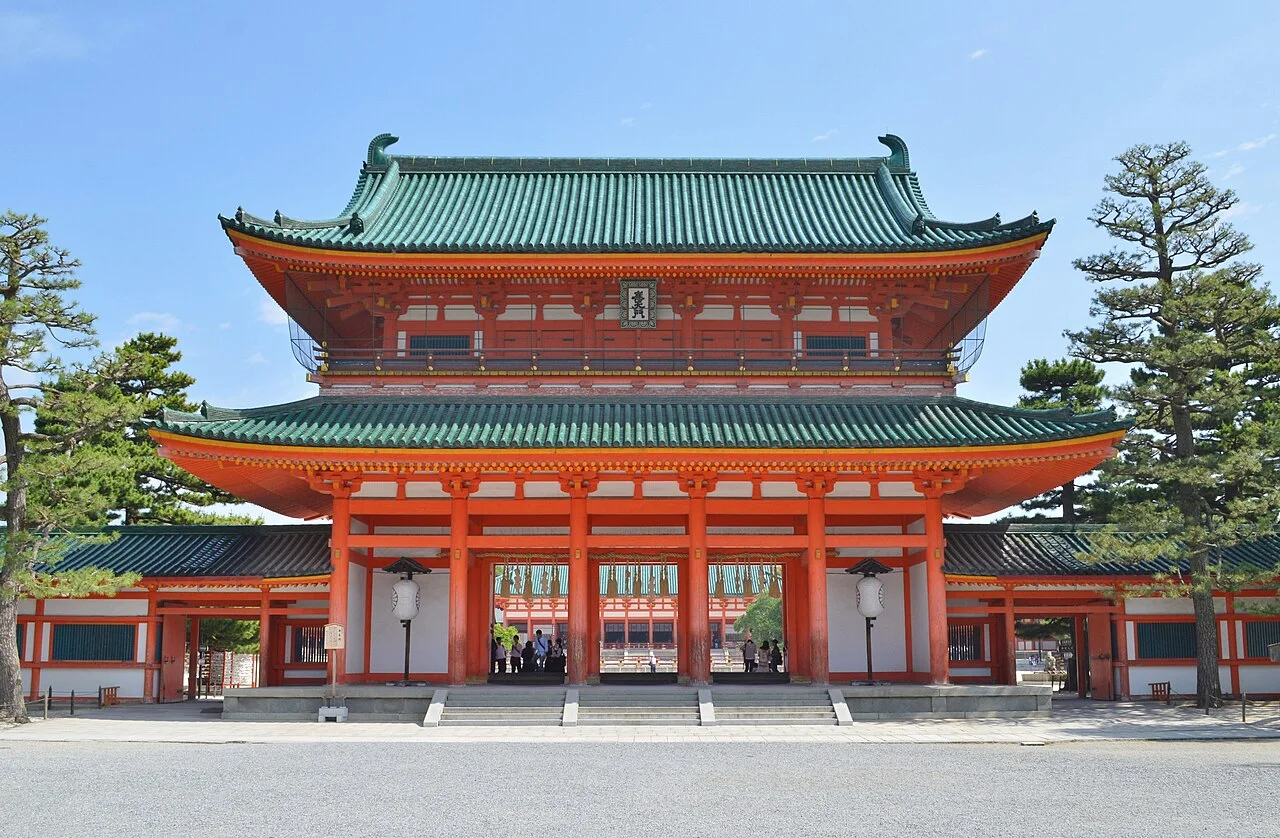
The giant torii stands over Jingu-michi, with Otenmon Gate sitting to the north beyond it. Walk straight through the gate toward Daigokuden, Heian Shrine's outer worship hall at the end of the central axis. Built in 1895 to mark the 1,100th anniversary of Kyoto's founding as the imperial capital, the complex reproduces the layout of the Heian Palace's Chodo-in state hall at reduced scale. Pause before stepping under Otenmon Gate to frame the gravel courtyard from the street, then turn back inside to photograph the two-tiered gatehouse and side corridors. To enter the strolling pond gardens, follow the "Shinen" signs inside the courtyard to the garden ticket booth.
The main shrine courtyard opens daily at 6:00 for worship, while Shinen Garden begins admitting visitors at 8:30. Garden admission is ¥600 for adults and ¥300 for children. Hours run until 18:00 (last entry 17:30) from March through September, 17:30 (last entry 17:00) in October, and 17:00 (last entry 16:30) from November through the end of February. In winter, visit the garden right after lunch before entering a second museum so you have daylight for the full loop. Early risers visiting only the main courtyard can arrive before breakfast and wait for the 10:00 museum openings.
Shinen Garden wraps around the shrine halls in four linked zones: South, West, Middle, and East. Spring brings weeping crimson cherry trees in the South Garden, leading across to the covered Taiheikaku Bridge over Seiho Pond in the East Garden; early summer highlights irises and water lilies, while late autumn draws visitors for pond reflections. The garden paths mix gravel with uneven stepping stones, so slow down after rain. Wheelchairs and strollers are allowed inside the shrine grounds, though deeper sections involve steps and raised thresholds—if older companions prefer flat ground, stick to Otenmon Gate and the main courtyard, then rest at a museum cafe. Tripods and monopods are banned in Shinen Garden during cherry blossom season and free-admission days, and carry a fee on regular weekdays.
Kyoto's annual Jidai Matsuri procession falls on October 22, marching from Kenreimon Gate at Kyoto Imperial Palace across the city to Heian Shrine in historical costumes progressing backward from the Meiji to the Heian era—making it one of Kyoto's Big Three festivals alongside Aoi Matsuri and Gion Matsuri. If you want to watch the final stretch in Okazaki, stake out a spot along Heian Jingu-michi in advance; the Kyoto City Tourism Association posts paid seating details for Kyoto Imperial Park, Oike-dori, and Heian Jingu-michi. Anyone heading from the museums to Shinen Garden should plan around procession crossings, and groups should meet on the same side of the avenue. Note that Shinen Garden runs shortened hours on festival day—admitting 9:30–11:30 and closing at noon on October 22—so save the garden for a non-festival day if you want time to watch the parade.
If you choose Heian Shrine for a New Year's morning visit, check neighboring holiday closures carefully. Kyoto City Zoo stays closed through January 1, 2027, making January 2 the first option for animals, while art-focused travelers will find both Hosomi and MoMAK reopening on January 5. On New Year's Day itself, pair a morning shrine visit in the main courtyard with a stroll back along Jingu-michi and the canal; check Heian Shrine's New Year notice for exact Hatsumode gate hours.
| Venue | Standard Opening Hours | New Year Closures & Seasonal Hours |
|---|---|---|
| Kyoto City KYOCERA Museum of Art | 10:00–18:00 | Closed Dec 28–Jan 2. Collection Room last entry 17:30; special exhibitions vary |
| Hosomi Museum | 10:00–17:00 | Closed Dec 25, 2026–Jan 4, 2027 |
| National Museum of Modern Art, Kyoto (MoMAK) | 10:00–18:00 (last entry 17:30) | Closed Dec 28, 2026–Jan 4, 2027; closed Jan 18–late Mar 2027 for maintenance |
| Heian Shrine Shinen Garden | Entry opens 8:30 | Nov–end of Feb last entry typically 16:30 |
| Kyoto City Zoo | Opens 9:00 | Closed Dec 28–Jan 1; Dec–Feb last entry 16:00 |
| Lake Biwa Canal Museum of Kyoto | 9:00–17:00 (last entry 16:30) | Closed Dec 29–Jan 3 |
Kyoto City Zoo with Kids: Pick Your Gate Before Planning Exhibits
General admission to Kyoto City Zoo is ¥750, with junior high school students and younger admitted free. Hours run 9:00–17:00 from March through November and 9:00–16:30 from December through February, with last entry 30 minutes before closing in both seasons. The zoo closes Mondays (shifting to the next weekday if Monday is a holiday) plus December 28 through January 1. See priority animals early—the zoo notes that Asian elephants, Grevy's zebras, and giraffes begin returning to their indoor shelters from 15:30.
Starting at the zoo is easiest from Keage Station, a roughly 7-minute walk to the East Entrance, letting you cross the park from east to west and exit toward the giant torii, Heian Shrine, and the museums. Coming from Higashiyama Station or the "Okazaki Koen Dobutsuen-mae" bus stop puts you at the Main Entrance on the west side; if your next stop is the Canal Museum, exit via the East Entrance. Free wheelchairs and strollers are available at both gates (strollers are limited and cannot be reserved). Nursing rooms and baby-care spaces are located near the Main Entrance, East Entrance, and Children's Zoo area, so whichever gate you enter, you can handle feeding or diaper changes before the rest of your group heads in.
To leave for lunch and return, ask staff at the gate to stamp your same-day ticket; re-entry follows the same cutoff 30 minutes before closing. If you only want elephants and giraffes in the morning, circle those enclosures on the park map first. Keep the Tropical Animal House and Great Ape House in mind as brief indoor rain shelters, though you still cross open paths between buildings. In steady downpours, swap the zoo for the boat and incline models inside the Canal Museum, or split up outside the Main Entrance—kids with one adult in the zoo, art lovers in a gallery—and regroup near the KYOCERA Museum entrance for lunch.
Three Ways to Pace Okazaki: Gallery Day, Autumn Walk, or Spring Boat
For a relaxed weekday art itinerary, enter the KYOCERA Museum right at 10:00, have lunch in Okazaki, and walk Heian Shrine's Shinen Garden in the afternoon, adding the Hosomi Museum afterward if time remains. For a half-day visit, pay for either one museum or Shinen Garden and spend the rest of your time walking between the giant torii and the canal. Entering and exiting via Higashiyama Station works smoothly—just pause on the canal bridge along Jingu-michi for a photo on your way back.
On a sunny cherry blossom day, start at Keage to walk the incline or catch a pre-booked Jikkokubune boat, then follow the canal into Okazaki. Splitting your flower viewing between the canal banks and Shinen Garden gives two distinct perspectives: weeping branches dipping low over paths and ponds inside the shrine versus unbroken rows of trees framing the water from the canal bridges. If a bridge gets crowded, keep walking toward the zoo and Canal Museum for clearer vantage points out of pedestrian traffic. If boats sell out, blooms run late, or wind and rain roll in, step inside the Canal Museum before moving on to your afternoon art museum. Always prioritize the pond garden before daylight fades, when reflections still hold.
When autumn foliage is the priority, start early from Keage at Nanzen-ji or Eikan-do and walk back down to the canal for lunch. Nanzen-ji's Suirokaku pairs red brick arches with maple-draped hillside grounds, while Shinen Garden offers quiet pond views—splitting morning and afternoon between them gives plenty of variety. If you also want an art museum, skipping Eikan-do keeps the day from feeling rushed. Walking down from the foothills around 16:30 in late autumn means Shinen Garden may already be past last entry; in that case, use the final hour for the KYOCERA Collection Room or head back toward Sanjo-dori for an early dinner.
In summer's midday glare, keep the canal walk short before ducking into an air-conditioned museum, or hit the zoo right at 9:00 before heat drives animals indoors. Showing up at 15:00 or 16:00 leaves little margin—short winter hours cut your time, and summer afternoons mean several animals have already moved inside. If your group has one must-see exhibition, schedule lunch before it and save the shrine courtyard for cooler light. Arriving in Okazaki from Nanzen-ji around noon lets you decide right at the canal bridges whether to buy a museum ticket or catch a train out, without hiking to the far north end first.
If you are dining in Gion later that evening, wrap up Okazaki near the giant torii or Higashiyama Station and walk south along Jingu-michi to Sanjo-dori. Continuing on foot to Yasaka Shrine, Hanamikoji, and Kennin-ji adds another stretch south, so with small children or a tight dinner reservation it is faster to grab a taxi or transit from Okazaki. Heading back toward Sanjo or Kyoto Shiyakusho-mae? Ride the Tozai Subway Line back into town and enjoy a post-dinner stroll along the Kamo River instead of racing attraction closing bells.
Rainy Days, Mondays, and Early-2027 Closure Backups
In steady rain, walk from Higashiyama Station to the giant torii, spend the morning in one headline exhibition, and pair it with the nearby Kyoto Museum of Crafts and Design (Fureaikan), located on floor B1 of Miyako Messe. It opens 10:00–18:00 (last entry 17:30) with admission at ¥500 for adults and university students, ¥400 for elementary through technical college students, and free for preschoolers. The permanent gallery covers 74 Kyoto traditional crafts—look for Nishijin-ori weaving looms and Kyo-Yuzen dyeing steps if you are curious how textiles are made, or check their artisan demonstration calendar ahead of time to catch live craftwork. After seeing KYOCERA's winter lacquerware display, comparing finished works with the tools and process exhibits here makes a sharper second stop than buying another full-priced special exhibition ticket.
Because the Crafts Museum uses irregular closure dates rather than a blanket Monday shutdown, it fills gaps when most Okazaki venues close. On Monday, November 30, 2026, for example, KYOCERA, Hosomi, the zoo, and MoMAK are all closed, whereas the Crafts Museum does not list that date on its 2026 closure calendar. On Monday, December 7, 2026, however, the Crafts Museum is also closed—save that day for Heian Shrine and the canal in good weather, or swap Okazaki with another neighborhood in heavy rain. Keep in mind that the Crafts Museum closes on February 21, 2027 (Kyoto Marathon Day), February 22, and March 8, overlapping with MoMAK's maintenance closure.
When visiting the Crafts Museum and another Okazaki attraction on the same day, keep your same-day ticket from KYOCERA, Hosomi, MoMAK, or Kyoto City Zoo to get ¥100 off admission at the Crafts Museum. The discount works in reverse too—showing a same-day Crafts Museum ticket grants group or discounted rates at partner venues, though select special exhibitions at KYOCERA and MoMAK are excluded. Only double up if you genuinely want both stops; if wind and rain slow you down, head into whichever museum is closer, eat on that same side of the street, and decide after lunch whether you have time for a second gallery.
During MoMAK's maintenance closure from January 18 through late March 2027, pair KYOCERA and Hosomi for an all-art day—Hosomi's Meissen show runs through January 31, with later winter dates following its changeover schedule. For a guaranteed late-winter pairing that avoids extra walking toward Keage, combine KYOCERA's lacquerware exhibition (opening January 15) with the Kyoto Museum of Crafts and Design right next door. Staying on the east side of Okazaki? Start from Keage with the free Lake Biwa Canal Museum models before walking outside the zoo toward the giant torii.
Where to Eat Lunch and Which Side to Stay On
Eating lunch near the museums sets up an easy afternoon walk into Heian Shrine's Shinen Garden. ENFUSE, at the KYOCERA Museum's main entrance, operates 10:30–19:00 (last order 18:00) on museum open days—staying open two hours later than Hosomi's cafe (which closes at 17:00) if you want an unhurried post-gallery coffee. On weekends, eat slightly ahead of exhibition rushes: finish one morning gallery and grab an early lunch, or walk to Sanjo-dori near Higashiyama Station for more dining choices before touring the shrine after midday. Putting an open-entry outdoor walk right after lunch keeps your schedule flexible if a restaurant table runs late.
If Okazaki is a single day trip, anywhere along the Tozai Subway Line keeps transit simple. If you also plan early-morning cherry blossom photos at Keage Incline or a morning walk at Nanzen-ji, staying near Keage cuts out the first commute—for instance, The Westin Miyako Kyoto sits about 2 minutes from Keage Station Exit 2 and offers a guest luggage service counter at Kyoto Station. Stepping out puts you right at the east end for the aqueduct or Jikkokubune dock, and you can ride the Tozai Line straight back to Sanjo Keihan for dinner in Sanjo or Kiyamachi.
To tie Kawaramachi, Nishiki Market, and the Kamo River into a two- or three-day Kyoto stay, the Kyoto Shiyakusho-mae area makes evening dining effortless. Hotel Okura Kyoto connects directly to Kyoto Shiyakusho-mae Station, putting Higashiyama Station two stops east and Keage three stops east on the Tozai Line while offering quick north-south connections via Karasuma Oike. Staying right around Kyoto Station adds one transfer at Karasuma Oike on your Okazaki day, but eliminates a cross-town trip when arriving or departing by Shinkansen with heavy bags. Prefer Shijo Karasuma? Ride one stop to Karasuma Oike for the Tozai Line and walk home from Karasuma or Kawaramachi shops at night.
A few useful answers
How should I plan a half day in Kyoto's Okazaki district?
For art first, take the subway to Higashiyama Station, visit the KYOCERA Museum of Art, and walk out past the giant torii and canal bridge. For canal scenery first, start at Keage Station, stop by the Lake Biwa Canal Museum and Nanzen-ji Funadamari dock, and continue toward Heian Shrine.
When do 2027 Okazaki Canal Jikkokubune tickets go on sale?
As of November 22, 2026, 2027 sailing dates and ticket launch times have not been announced. For the most recent 2026 season, boats ran March 20 to April 15, with advance online tickets opening on February 25 at 10:00 JST.
Do you need a ticket for Heian Shrine's Shinen Garden?
Yes—Shinen Garden admission is ¥600 for adults and ¥300 for children, with last entry typically at 16:30 and closing at 17:00 from November through the end of February. Visiting only the main shrine courtyard for worship is free.
What are the best rainy-day options in Okazaki?
Pair either the KYOCERA Museum of Art or the Hosomi Museum with the Kyoto Museum of Crafts and Design (Fureaikan). If arriving from Keage, you can also start at the free Lake Biwa Canal Museum. Note that the National Museum of Modern Art, Kyoto is closed for maintenance from January 18 through late March 2027.
Should I use the Main Entrance or East Entrance at Kyoto City Zoo?
If you arrive at Keage Subway Station, enter via the East Entrance and walk west toward Heian Shrine via the Main Entrance. If you arrive from Higashiyama Station or the "Okazaki Koen Dobutsuen-mae" bus stop, the Main Entrance on the west side is closer.
Official information and references
Sources used in this guide.
- Kyoto Municipal Transportation Bureau: Higashiyama Station Exits & Accessibility
- Kyoto Municipal Transportation Bureau: Keage Station Exits & Accessibility
- Kyoto City Bus Route 5 Stop List
- Kyoto Municipal Transportation Bureau: City Bus Fares
- Kyoto City KYOCERA Museum of Art: Access Information
- Kyoto City KYOCERA Museum of Art: Visitor Guide & Admission
- Kyoto City KYOCERA Museum of Art: Exhibition Schedule
- Kyoto City KYOCERA Museum of Art: Winter Kyoto Lacquerware Feature
- Reciprocal Same-Day Admission Discounts: KYOCERA, Hosomi & MoMAK
- Hosomi Museum: Visitor Info, New Year Closures & Cafe Hours
- Hosomi Museum: 2026–2027 Meissen Porcelain Exhibition Details
- The National Museum of Modern Art, Kyoto (MoMAK): Hours & Admission
- The National Museum of Modern Art, Kyoto (MoMAK): Jan–Mar 2027 Maintenance Closure Notice
- The National Museum of Modern Art, Kyoto (MoMAK): Closed Days Calendar
- Kyoto Prefecture Travel Agency Association: 2026 Okazaki Jikkokubune Route, Fares & Refund Policy
- City of Kyoto: 2026 Okazaki Jikkokubune Event Announcement
- Lake Biwa Canal Museum of Kyoto: Hours, Closures & Access
- Lake Biwa Canal Museum of Kyoto: Okazaki & Keage Walking Map
- Heian Shrine: Shinen Garden Overview, Fares & Seasonal Hours
- Heian Shrine: Architecture, Otenmon Gate & Giant Torii Guide
- Heian Shrine: Visitor Access & Accessibility FAQ
- Kyoto City Tourism Association: Jidai Matsuri Procession Route
- Kyoto City Tourism Association: Kyoto's Three Major Festivals & Gozan Okuribi
- Kyoto City Zoo: Hours, Closures & Animal Viewing Schedule
- Kyoto City Zoo: Admission Fees
- Kyoto City Zoo: Accessibility & Family Facilities
- Kyoto City Zoo: Access & Both Entrances
- Kyoto Museum of Crafts and Design (Fureaikan): Hours, Fares & Partner Discounts
- Kyoto Museum of Crafts and Design (Fureaikan): 2026–2027 Closure Calendar
- The Westin Miyako Kyoto: Subway Exit & Kyoto Station Guest Luggage Service
- Hotel Okura Kyoto: Direct Subway Access Information
- Kyoto Municipal Transportation Bureau: Autumn 2026 City Bus Detours & Transfers
- Biwako Sosui Cruise: Official Boarding & Disembarkation Piers
- Hosomi Museum: Meissen Exhibition Discount Eligibility & Fares
- Kyoto City KYOCERA Museum of Art: 2027 Raphaël Zarka Exhibition Tickets
- Kyoto Museum of Crafts and Design (Fureaikan): Permanent Exhibition & Craft Tools
- Kyoto Museum of Crafts and Design (Fureaikan): Artisan Demonstration Calendar
- Kyoto City KYOCERA Museum of Art: ENFUSE Cafe
- Kyoto City KYOCERA Museum of Art: Main Entrance & Glass Ribbon