View the Ginkaku-ji garden along the Ginshadan, Kōgetsudai, Kyōko-chi pond, and the hillside stone groupings, and tell apart the regular ticket from the 2026 autumn special opening of the Tōgudō. Includes same-day registration, the no-translation-app rule on Japanese-language tours, the Sengetsusen detour, a half-day sample plan, and the southbound return along the Philosopher's Path.
- Region & Focus
- KyotoShrines and temples
- Reading Scope
- 30 min read · 14 chapters · 4 Q&As
- Official Verification
- 10 official sources checkedUpdated November 22, 2026
- Key Topics
- ItinerariesBookingKyoto, Osaka & Kansai
Chapter Route Map (tap any stop)
- First decide whether to give half a day to the garden, or add an interior guided tour
- The two buildings left from the Higashiyama-dono are the real starting point for reading the history
- From the Somon to the Chumon, first walk about 50 meters of the Ginkaku-ji-gaki bamboo fence
- At the Ginshadan, look at the edges and sand ripples; keep the moonlight story as a folk saying
- The Kogetsudai sand mound and the Kannonden (Kannon Hall): look at the sand outlines and the pavilion's upper and lower levels separately
- Around Kinkyochi Pond: putting the Ginkaku and the Togudo back into the same garden
- Sengetsusen is the water connection — and the turning point for the fewer-stairs version
- The Hojo and the Togudo: recognize the exteriors first, then decide which interiors to see
- Dōjinsai and Rōseitei: the shoin and the Gokō zashiki each have their own points to watch
- 2026 autumn special opening: how to work with the same-day form, the meeting point, and the Japanese-only rule
- South along the Path of Philosophy: it connects toward Keage only after Wakaoji-jinja
- Two half-day examples that genuinely leave room for waiting and lunch
- From Kyoto Station take the subway to Imadegawa and transfer to route 203; for the return trip, let your last position decide
- Tickets, December hours, and goshuin: budget each separately and the trade-offs become clear
- Quick Q&A
Regular worship at Ginkaku-ji centers on the garden; to step inside the Tōgudō's Dōjinsai, you must join the special opening. The 2026 autumn round is scheduled for November 1 through December 5, using same-day on-site registration and Japanese-language tours, with translation apps not permitted along the way. First choose the spaces you want to see, then plan your half day: viewing only the garden can be paired with a short stretch of the Philosopher's Path; adding the indoor guided tour means putting registration and assembly in the morning; and if you want to walk the full route south to Nyakuoji Shrine, treat that roughly 2 km as its own walking theme.
First decide whether to give half a day to the garden, or add an interior guided tour
If what you care about most is the relationship between the white sand, the pond water, and the wooden pavilion, the standard garden ticket alone makes for a complete focus of a visit. A workable route starts with the bamboo-fence approach from the Somon (main gate); once inside, identify the Ginshadan (white-sand mound), the Kogetsudai (moon-viewing platform), and the Kannonden (Kannon hall), then follow Kinkyochi Pond toward the hillside. Climb to the lookout only if your legs are up to it; if you want fewer steps, the lower garden already offers sand, water, stones, and buildings to see. The temple suggests about 30 minutes for a standard visit; for visitors who like to stop and study the garden, the editorial recommendation is 60 to 90 minutes, with the walking and rest before and after the entrance counted separately.
To see the shoin-style interior spaces and the painted fusuma panels, the 2026 autumn special opening covers the Hondo (main hall), the Togudo, and the Roseitei, led by a guide and lasting about 30 minutes. It adds 2,000 yen per person and also adds a fixed assembly point in front of the Hondo (main hall) that you must return to on time during the morning. This arrangement suits visitors with a clear interest in building interiors who can accept a Japanese-language commentary; if you mainly wanted to photograph the garden scenery, it is better to save that time and budget for the garden and lunch.
First separate the temple and the Philosopher's Path on your map. Ginkaku-ji has an admission ticket and opening hours, while the Philosopher's Path is a public walking route along the canal (water channel); after finishing the garden, you can take just a short stroll around the Ginkaku-ji Bridge (bridge) area, or continue all the way south to Nyakuoji Shrine. Either length can serve as a formal itinerary. If you join the interior guided tour in the morning and also plan the complete southern walk in the afternoon, keep lunch in this area — do not squeeze another temple's fixed admission slot in between.
View the Ginkaku-ji garden along the Ginshadan, Kōgetsudai, Kyōko-chi pond, and the hillside stone groupings, and tell apart the regular ticket from the 2026 autumn special opening of the Tōgudō. Includes same-day registration, the no-translation-app rule on Japanese-language tours, the Sengetsusen detour, a half-day sample plan, and the southbound return along the Philosopher's Path.
The two buildings left from the Higashiyama-dono are the real starting point for reading the history
Ginkaku-ji's formal name is Jisho-ji. The shogun Ashikaga Yoshimasa began building the Higashiyama mountain villa, also called the Higashiyama-dono, in 1482; the Togudo, constructed as a private Buddha hall, was completed in 1486, and the Kannonden had its ridgepole raised in 1489. After Yoshimasa died in 1490, the villa was converted into a Zen temple in accordance with his will. These few dates can be kept in one short timeline and checked against the two surviving buildings during your visit — far easier to follow than memorizing the whole shogunal family history at the entrance.
The temple's precinct guide lists both the Togudo and the Kannonden as structures surviving from the Higashiyama-dono's construction period. The Kannonden is what is popularly called the Ginkaku (Silver Pavilion), while the Togudo originally enshrined Amida Nyorai (Amida Buddha). They served different purposes and look different; placing the two back into the original villa makes it clear why the site holds a Buddha hall, a shoin study, and a garden together, rather than every building serving the same activity.
The garden you see today has gone through later restoration and change. For the sand mounds of the Ginshadan and the Kogetsudai, the temple considers them a conception of the early-modern period or later, so the entire landscape in front of you cannot be taken directly as its 1482 original form. When looking at the old buildings, identify the surviving structures; when looking at the sand scenery, observe the practices that formed later — the two can be appreciated at the same time. If you want to help children grasp the chronology, just remember that the Higashiyama mountain villa came first and was later converted into a temple; when you reach the Togudo and the Ginkaku and find the right buildings, you already have a clear thread to follow.
From the Somon to the Chumon, first walk about 50 meters of the Ginkaku-ji-gaki bamboo fence
Between the Somon (main gate) and the Chumon (middle gate) runs a slender approach about 50 meters long, enclosed by a bamboo fence known as the Ginkaku-ji-gaki bamboo fence. Your viewing can start here: first notice how the two sides restrict the sightlines, then observe how the white sand and the buildings unfold once you enter the garden. The editorial advice is not to hurry in front of the Somon searching for a full view of the Ginkaku; this deliberately narrowed path is itself part of understanding the change of scale before and within the garden.
The official precinct map labels the Somon (main gate), the Ginkaku-ji-gaki bamboo fence, and the Chumon (middle gate) as 01, 02, and 03 in order, and the Chumon is also where reception takes place. Getting familiar with these three names first makes the later 'registration in front of the Hondo (main hall)' less likely to be mistaken for a ticket office outside the temple grounds. Visitors joining the special opening should, after completing the standard admission, go to the front of the Hondo (main hall) to find the application form; factor this movement into your arrival time — reaching the Somon does not count as having arrived at the assembly point.
The 05 shoin on the map is marked as not open to the public; what the temple presents is the new shoin completed in 1993. It is a different space from the Togudo's Dojinsai, which the special opening covers. If you see the word 'shoin' on the map, do not detour in search of a door you can enter; follow the normal garden route in order, and let the current guided tour handle the interior portions. Sorting out the routes and building names first leaves your attention free for the sand, instead of repeatedly asking directions among several halls.
At the Ginshadan, look at the edges and sand ripples; keep the moonlight story as a folk saying
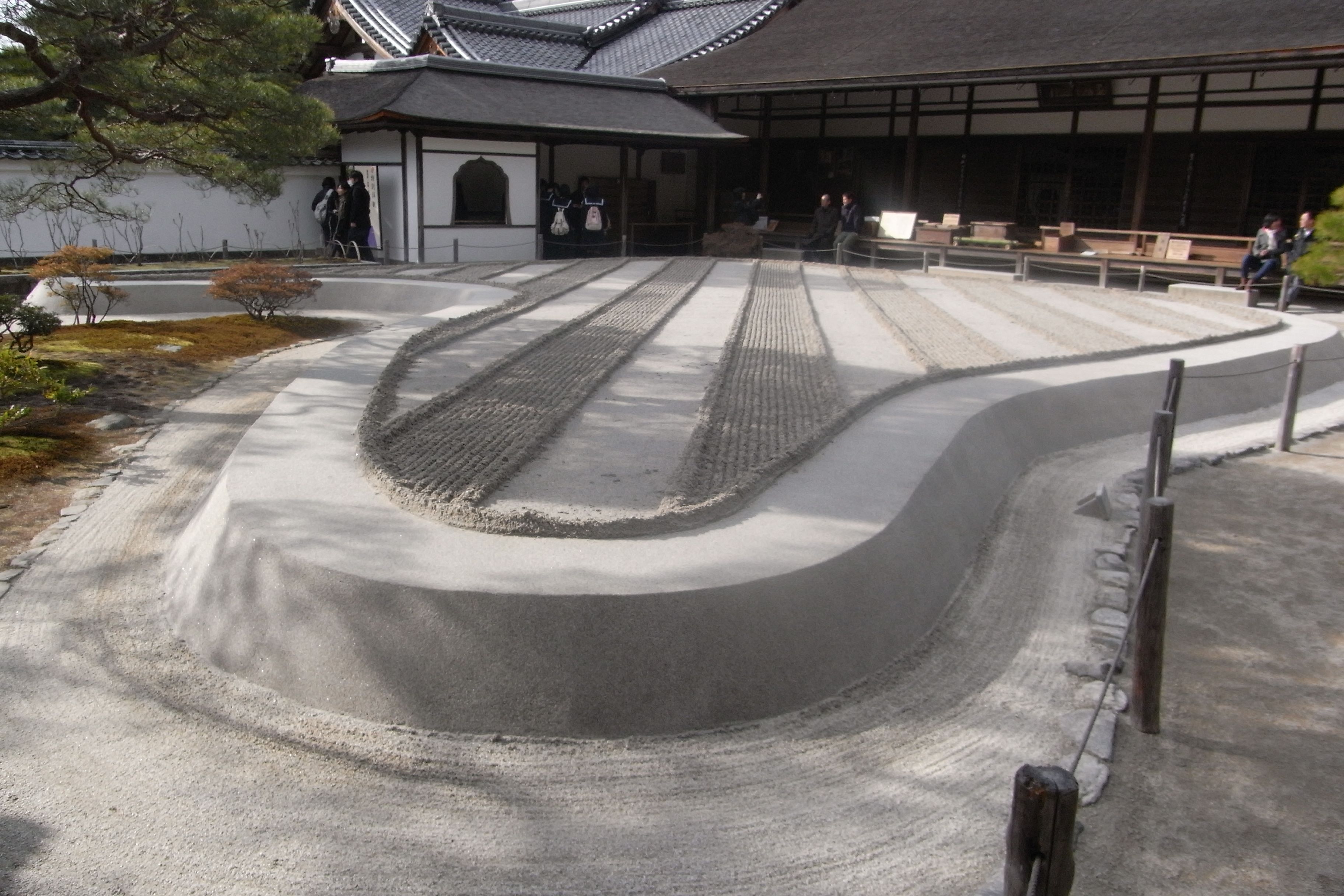
The Ginshadan in front of the Hojo (abbot's hall) is built of white sand in stepped undulations, its surface ripples evoking waves. When observing, first find the height of the outer edge, then look inward along the parallel ripples, distinguishing the hollowed areas from the raised ones. Keeping your eyes only on the distant Ginkaku makes it easy to overlook this man-made landform close by; stop where you do not block passage and let your gaze follow one set of ripples to its turning point — that brings you closer to the material in front of you than rushing to decide which mountain it 'resembles'.
In a photograph of the Ginshadan taken in March 2011, the foreground shows the curved edge of the mound, its low hill, and row upon row of ripples, with buildings visible behind. This angle suits comparing the highs and lows of the sand surface and the rake lines; the Kogetsudai and the Kannonden are best identified separately on site. The side of the sand feature is also worth a look: from the low side edge up to the higher surface, shadow and pattern offer different clues — the three-dimensional thickness is easier to grasp than the flat pattern.
That the Ginshadan reflects moonlight and that the Kogetsudai served for sitting to await the moon are common claims. The temple's explanation of the two sand mounds explicitly calls them folk sayings and holds that their formation cannot be traced back to the Muromachi period. Treat these accounts as imagination prompted by the names, and keep the historical narrative to the well-grounded parts. Visiting in daylight, the ripples, the forms, and the arrangement of the neighboring halls are things you can observe directly — there is no need for a moon-viewing legend to understand what makes them interesting.
The Kogetsudai sand mound and the Kannonden (Kannon Hall): look at the sand outlines and the pavilion's upper and lower levels separately
The Kogetsudai is a mound of sand in a truncated-cone (frustum) form, an outline distinct from the tiered, ripple-patterned Ginshadan (silver sand stretch) beside it. The editors suggest viewing each one on its own first, then finding a spot where you can compare the two at once: one is mainly about the concentration and height of its form, the other mainly about its surface texture and horizontal spread. Both are made of sand, but they do not have to be seen the same way, and there is no need to rush to interpret them as any one fixed set of symbols.
The Kannonden is a two-story pavilion: its lower floor is named Shinkuden and its upper floor Choonkaku. The Kyoto City Tourism Association's architecture introduction (Kyoto City Tourism Association architecture introduction) characterizes the upper floor as in the style of a Zen Buddhist hall and the lower floor as residential in style. When viewing the exterior from the garden, you can split your attention between the two levels, noting how the openings of each floor and the roof come together as a whole. Read it first as a building that combines two kinds of floors, then look back at the sand mounds, and the scene is no longer just a temple name.
The city tourism association lists the Kannonden's upper floor, Choonkaku, as housing a wooden statue of Kanzeon Bodhisattva (Kannon Bosatsu), and the lower floor, Shinkuden, as housing one thousand Jizo statues (a thousand Jizo statues); the Togudo is the Buddha memorial hall mentioned above, dedicated to Amida Nyorai (Amida Nyorai).
The interior of the Kannonden is not open to the public, and the 2026 autumn three-hall special opening does not include it among the interiors open to visitors. The reason to buy the special ticket should be the main hall, the Togudo, and Roseitei. Those who want to see the Ginkaku can spend their time at exterior viewpoints in the garden; those who want to see the Dojinsai can then schedule that indoor guided tour. Keep the two expectations separate from the start, so that you do not pay the extra fee on site and still end up waiting for an entrance to the Ginkaku's second floor.
Around Kinkyochi Pond: putting the Ginkaku and the Togudo back into the same garden
Kinkyochi Pond stretches east–west in the lower garden, with the Ginkaku on the west side and the Togudo on the northeast side. This positional relationship comes from the city tourism association's garden introduction (City tourism association garden introduction); when visiting, you can use it to check against the map, first identifying the two ends of the pond water, then moving on to the next stretch. Buildings do not have to be a standalone destination every time; the distances between pond bank, water surface, and halls can themselves be a reason to stop and look.
Kinkyochi Pond also offers a specific spot for finding a stone feature: the city tourism association (Kyoto City Tourism Association) lists the Muso Soseki's zazen meditation stone — the zazen stone associated with the monk Muso Soseki — in front and to the west of Hakukakuto (White Crane Island) island. You can first identify the island in the pond, then follow this bearing to find the stone, and see how the island, the stone, and the water surface connect front to back. This stone feature lies by the lower Kinkyochi Pond, while the stone group near the Sosen-tei site in the upper section can be viewed as a separate stretch — one pond-side, one mountain-side.
The editors suggest that as you move along the open path, first notice how much of the buildings you can see from where you stand, then note what gets hidden by trees or the bank after each turn. In a pond-stroll garden, what you see changes with your position; treating the same Ginkaku as a landmark to identify again and again along the way shows you these changes better than stopping for a long time at the first spot and then rushing all the way to the exit. When it is crowded, split your pauses into several shorter stops, find spots where you can step aside to let others pass, and look from there — there is no need to guard one angle while waiting for people to leave.
If your companions can only manage the lower ground, you can make Kinkyochi Pond the main area and link the sand features, the exterior of the Kannonden, and the exterior of the Togudo into one route. Those interested in architecture can watch how the buildings sit relative to one another; those who prefer the garden can watch the combinations of water and bank — both can walk the same path with their own focus. Deciding at the pond's southeast side whether to extend up to the mountain-side upper section is easier to match to the group's pace that day than setting the lookout as a finish line everyone must complete right at entry.
QUICK GLANCE KYOTO photographs the Ginkaku-ji white-sand garden, Kyōko-chi pond, and the Kannon Hall, useful for comparing the relative positions of the Ginshadan, Kōgetsudai, and the pond edge.
Sengetsusen is the water connection — and the turning point for the fewer-stairs version
Sengetsusen sits at the southeast end of Kinkyochi Pond, channeling water that flows down from the mountain side into the lower garden where the Ginkaku and the Togudo stand. Here you can reconnect the pond and the mountain you viewed separately before: the lower section holds the halls and pond water, while up the eastern hillside are the upper garden and a spring. When the route reaches this point, first watch how the water falls, then decide whether to climb for the view or stay at the lower level to finish the visit.
Wheelchair and stroller users should, following the temple's access and detour instructions (the temple's traffic and detour instructions), turn right just before station 14, Sengetsusen. Stations 15 the lookout, 16 Benzaiten, 17 the Sosen-tei site, and 18 Ocha-no-i (the tea well) all have steps, and wheelchairs and strollers cannot go up. Before setting out, save these five numbers together; at the fork, use Sengetsusen to orient yourself, and you can choose your direction before starting to climb. There is one multi-function toilet next to the shop, so you can plan toilet stops together with the timing of entering and leaving the garden.
The city tourism association calls the upper section the Ocha-no-i (the tea well) garden and introduces the group of rocks excavated in 1931 as a dry landscape garden. This thread helps fill in the difference you feel moving from the pond side up to the mountain side: the lower section centers on the pond-stroll garden, while the upper section has stone groups to see. If your interest in garden-making is greater than in distant views, you can list the upper-section stone groups as a priority when planning, and set aside energy for the steps up and down.
What is worth seeing in the upper section also differs from spot to spot. The lookout offers a higher viewing position; near the Sosen-tei site there is a distinctive stone group the temple describes as appearing to have crumbled down, viewable from the garden path; Ocha-no-i (the tea well) is a spring found by following the eastern hillside upward. Those who like stone groups can save their attention for the Sosen-tei site; those interested in the water routes can understand Sengetsusen and the spring together — there is no need to treat all four spots as the same kind of 'mountain photo checkpoint.'
On rainy days, or when knees and legs are bothering you, the editors suggest cutting the upper section and concentrating your stay on the sand features, the pond-side, and the building exteriors, then shortening the Philosopher's Path after leaving the temple. This trims two burdens at once — steps and long distances — while lunch can stay fully intact. If the group walks at different paces, decide before entering the mountain side to stay together on the lower route, so that no one ends up pushing a stroller right up to the steps and only then improvising who carries the stroller and who carries the child.
The Hojo and the Togudo: recognize the exteriors first, then decide which interiors to see
The Hojo — that is, the main hall — is a mid-Edo period building, from a different era than the Togudo that survives from the Higashiyama-dono period. Its principal image is Shakyamuni Buddha; the 2026 autumn special opening additionally lists sliding-door paintings by Yosa Buson and Ike no Taiga, with the works on display that season being reproductions. Those who want to see the paintings can note this first, then enjoy how the fusuma paintings sit within the hall's interior space, without treating this viewing as a chance to come face to face with ancient originals.
The Togudo is the private Buddha hall (Buddha memorial hall) of Ashikaga Yoshimasa; the temple introduces its Amida faith alongside the surrounding Zen-style garden. An ordinary visit shows its exterior from the garden; during special openings you can enter with a guide to see the Amida Nyorai statue, the statue of Ashikaga Yoshimasa in clerical form, and the Dojinsai. First understand the memorial hall as a space enshrining the Buddha image its patron worshipped, then look at the other room inside, the study — and the building's purpose will not be entirely eclipsed by the single phrase 'four and a half tatami mats.'
Dōjinsai and Rōseitei: the shoin and the Gokō zashiki each have their own points to watch
Dōjinsai sits inside the Tōgudō hall, and the temple's 2026 autumn highlights page describes it as the oldest surviving four-and-a-half-mat shoin. Here "four and a half mats" is a clue to the room's scale, while "shoin" points to how the space was used; when visiting, first take in the room itself, then its relationship to the Buddhist hall portion. The Tōgudō also holds an Amida Nyorai statue and a statue of Yoshimasa, so if you file this small hall away as merely a tea room, you will miss its original function as a space for keeping a personal Buddha image.
The city tourism association likewise introduces Dōjinsai as the prototype of the four-and-a-half-mat tea room.
At Rōseitei, the focus is the Gokō zashiki room and the sliding-door paintings by Okuda Genso. These are different objects of viewing from the reproduced sliding-door paintings by Yosa Buson and Ike no Taiga listed for the main hall. If you memorize the painters paired with the hall names, you are less likely to leave and blur the three halls into a single "house with old paintings." At Dōjinsai, note the layout of the small space; at Rōseitei, look at the relationship between the Gokō zashiki and the sliding-door paintings — even a short guided tour can then have a concrete order of observation.
What has been announced this time is a guided tour. If you are expecting tea drinking or offering incense yourself, leave that kind of experience for activities that explicitly list such services; judge this ballot by the three halls' architecture, Buddhist statues, shoin, and sliding-door paintings. During the special opening you may not take notes or sketch, and no photography is allowed. The editors suggest that before entering you memorize only a few hall names and the things you want to see, and after following the tour, organize your memories only once the tour ends and you have retrieved your belongings. Reading the names in advance is to spend less effort on identification — there is no need to turn 30 minutes into a dictation test.
2026 autumn special opening: how to work with the same-day form, the meeting point, and the Japanese-only rule
This autumn special opening is scheduled to run from Sunday, November 1 to Saturday, December 5, 2026. As of the October 28 announcement, the event has not yet begun; each day starts at 10:00, 11:00, 12:00, 13:30, 14:30, and 15:30, with each session about 30 minutes and a capacity of about 20 people. The 10:00, 11:00, and 12:00 sessions on Sunday, November 15 are suspended, so anyone wanting to join that day should put their choices in the afternoon. Temple events may cause session changes, so on your departure day check the suspended-session column on the current events page directly.
The application form is set up in front of the main hall about an hour before each session begins, and applications are accepted in same-day order. After writing your name on the form, you must also return to gather in front of the main hall 10 minutes before the start. For example, if you want to join the 10:00 session, the editors suggest arriving at the main hall around 9:00 to check the form; after registering, view only the nearby garden sections you can return from in time, and come back to assemble at 9:50. "About an hour before" is the form set-up time announced by the temple; arriving early serves to handle on-site registration, and there is no online reservation before departure that can hold a place.
The fee is an additional 2,000 yen per person, which includes a special commemorative item, and a regular admission ticket is still required. Preschool children are not accepted, and groups or parties of 7 or more are also not accepted; parties of six or fewer register the same way, subject to same-day remaining capacity. Families with preschool-age children should choose the garden-only version for the whole family, or settle in advance who stays with the children and who joins the indoor tour. If the whole party must stay together, simply drop the indoor tour from this plan — the timing of lunch and the stroll becomes easier to manage.
The tour is conducted in Japanese only, with no interpreting allowed during it — even apps and translation devices are included. Whether you can accept this language condition is more worth deciding than which session to book first; if you need a companion to translate sentence by sentence, choosing the regular garden visit is more practical. During the special opening, photography, audio recording, video recording, note-taking, and sketching are all prohibited, and phones and tablets must be checked in with your belongings. Anyone who wants to consult background text and images while viewing the interior should finish reading the material before the tour and let the half-hour visit focus on what is in front of you.
The regular garden visit has no on-site guide, and no Wi-Fi is provided anywhere on the temple grounds; only the interior is the special-opening guided tour. The editors suggest preparing your background reading and maps before departure, and saving the names of the main hall, the Tōgudō, and Rōseitei plus your return direction. Anyone who needs to look things up can do so before the special opening; once your phone is checked in, simply follow the staff — no need to download the whole set of material at assembly time.
Dress and luggage also have clear thresholds: you must wear socks, and bare feet or stockings alone will not be admitted; large luggage such as suitcases, as well as pets, cannot be checked in on site. The editors suggest leaving suitcases at your accommodation or at a storage arrangement already made, and putting on socks before heading out. The November 1 announcement that the "talk and zazen" event is full refers to a different activity; the three-hall tour still runs on the same-day form basis described above. Distinguish news items by activity name, and you will not misread that sold-out notice as the entire autumn being fully booked.
South along the Path of Philosophy: it connects toward Keage only after Wakaoji-jinja
The Path of Philosophy introduced by the Kyoto City Tourism Association is about 2 kilometers, linking the Ginkaku-ji side with Wakaoji-jinja. Travel write-ups often summarize it as Ginkaku-ji to Nanzen-ji, but when actually planning your walk you should mark the southern end at Wakaoji; reaching Nanzen-ji or Keage involves further sections. Those walking the full southern route leave the temple, descend toward the Ginkaku-ji bridge area, then follow the Path of Philosophy south, and finally continue according to their return station.
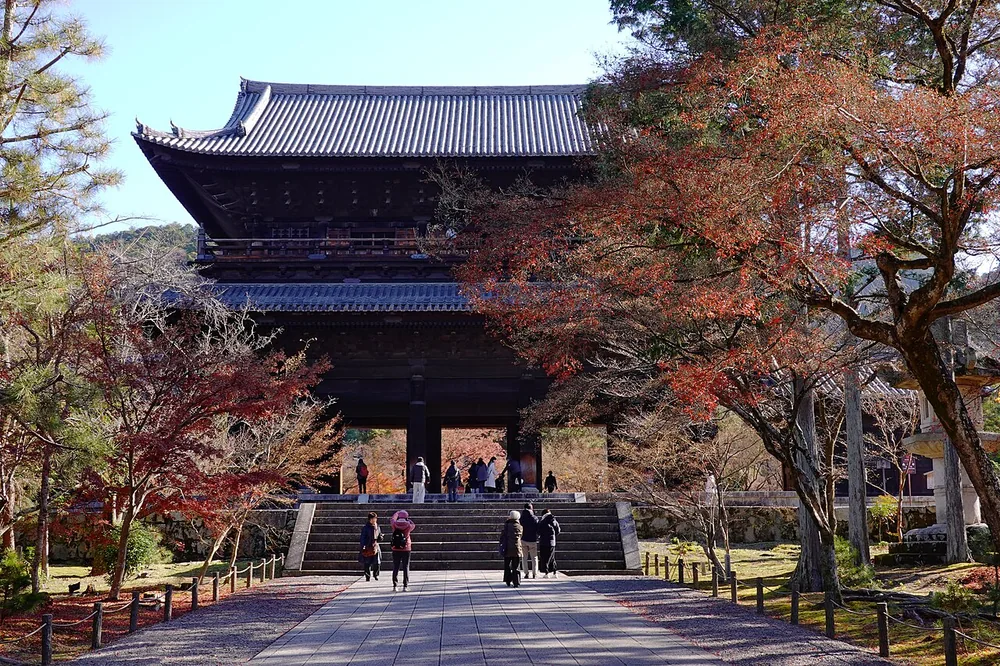
The Lake Biwa Canal alongside the path draws water from Lake Biwa and flows south to north; the nearby Shirakawa stream follows the terrain from north to south. This difference is a clue you can carry on your stroll: as you walk south, the canal beside you flows the opposite way. Keep the two waterways' names and directions separate, and you can understand that this area holds more than "one small river flowing downhill." The route is named for the philosopher Nishida Kitaro, who walked and thought here; along it are also the Sekisetsu-zakura cherry trees donated by Hashimoto Kansetsu. Visiting in autumn, you can likewise come to know it through the waterways and the geography — no need to treat the spring blossoms as the expectation for the day.
The editors suggest allowing 60 to 90 minutes for the full Path of Philosophy, including slow walking and brief stops, plus separate time for lunch and the walk from the southern end to the station. The official listing puts the approach from Keage to near the southern end at about 20 minutes, usable as a geographic scale reference; after reaching Wakaoji you still need to reserve that segment for returning to the station. If you also want to enter Nanzen-ji's paid area, add visiting and ticketing time on top — either stretch the walking day, or cut one item between Ginkaku-ji and the indoor tour.
Those wanting only a short walk can stroll along the canal from the Ginkaku-ji bridge area, setting in advance a time you are willing to turn back, then head toward the Ginkakuji-michi stop. This version suits a morning when the garden has already taken long, the weather turns rainy, or companions still want to sit and rest. The full-length walk should be decided by the day's legs; choose the turnaround version first, and when you reach a waterside spot worth lingering at, you can stay a while longer instead of constantly prodding companions with remaining kilometers.
Two half-day examples that genuinely leave room for waiting and lunch
Below are editor-suggested timings: entry and tours follow the official slots, with stop lengths distributed according to a slow pace. For the regular garden version, enter around 9:00 and allow until about 10:00–10:30 to cover the dry-landscape garden, the pond side, and whichever hillside segment suits you; rest after descending from the temple, then have lunch. If you want a waterside walk in the afternoon, choose a short segment of the Path of Philosophy and return to Ginkakuji-michi to catch transport out. Those who prefer a long walk should give the whole post-lunch stretch to heading south, reaching Wakaoji and connecting to Keage, without squeezing in another temple ticket on a tight schedule.
The special-opening version puts same-day registration first. In November, if you target the 10:00 session, arrive at the main hall around 9:00 to check the form; after securing a place in that session, sightsee nearby and return to assemble at 9:50; follow the tour from 10:00 to about 10:30, retrieve your belongings, and then catch up on the garden. This way you have one indoor and one outdoor stretch before lunch, and the afternoon can hold just a short Path of Philosophy walk. If no suitable slot is available that day, switch to the regular garden version; do not use up the time you could have spent sitting down to eat just to wait for the next session.
If you choose the 13:30 session, the application form is set up only around 12:30, with assembly at 13:20. Lunch must sit where it fits these two times; the editors suggest eating before entering the temple to handle afternoon registration, or touring the garden first and leaving the meal until after the tour — pick whichever matches the meal timing you can accept. Do not default to exiting for lunch and coming back. By December, the temple opens only at 9:00, and the gap between the first 10:00 session and opening is also shorter than in November; if you want the first session, go straight to the form in front of the main hall first, then see the garden.
From Kyoto Station take the subway to Imadegawa and transfer to route 203; for the return trip, let your last position decide
From Kyoto Station, the official City of Kyoto traffic advice is to take the Karasuma subway line to Imadegawa, then board city bus route 203 toward Ginkaku-ji from the Karasuma Imadegawa stop at street level. The ride from Kyoto Station to Imadegawa takes about 9 minutes as a reference, and the transfer stop is located on Imadegawa-dori, on the side of the Doshisha University campus. When you reach the surface, first check the direction toward Ginkaku-ji before boarding; on weekends and holidays route 102 is also an option, while for weekday planning check timetables for the 203.
After getting off the 203 at Ginkakuji-michi, head east from the Shirakawa-dori and Imadegawa intersection, walking along the Sosui (canal) direction, pass the Ginkaku-ji Bridge and the entrance to the Philosopher's Path, then continue up the sandō slope to the temple. The city tourism association's temple listing gives about 10 minutes on foot from Ginkakuji-michi and about 5 minutes from Ginkakuji-mae, the two stop names corresponding to different alighting points. When planning your registration, keep the walk from the bus stop to the front of the main hall at the front of your schedule — in particular, do not judge your arrival against the 10:00 opening using only the time you reach Ginkakuji-michi.
If you are staying along the Keihan line, you can go to Demachiyanagi and transfer there to city bus 7 or 203 toward Ginkakuji-michi, without detouring through Kyoto Station first. For leaving, it depends on where you end up: if you only walk a short stretch of the Philosopher's Path, return via Ginkakuji-michi; if you walk the full route south to Nyakuoji shrine, you connect toward Keage Station and take the Tozai subway line, and those returning to Kyoto Station transfer to the Karasuma line at Karasuma Oike Station. Save these two exit directions in your map in advance, and in the afternoon you can choose based on your remaining energy, without walking back to the northern end just to catch a return bus from the same stop.
Tickets, December hours, and goshuin: budget each separately and the trade-offs become clear
From April 1, 2026, the regular admission fee is 1,000 yen for high school students and above, 500 yen for elementary and junior high school students, free for preschoolers, with no group discount. Adults adding the special opening pay 3,000 yen per person; two adults viewing only the garden pay 2,000 yen in total, or 6,000 yen with the special opening added. One adult plus one elementary school student on regular tickets totals 1,500 yen, and if both add the special opening the total is 5,500 yen. These figures cover admission only; listing transport and meals separately shows how much an indoor guided visit actually adds.
Reduced-price tickets carry eligibility limits: the temple's FAQ lists holders of applicable disability handbooks (shinshōgaisha techō), care handbooks (ryōiku techō), and similar, shown at the payment counter on the day of the visit, at 100 yen for both adults and elementary/junior high students; similar handbooks issued abroad are not covered. When overseas travelers calculate a family budget, budget at general prices rather than applying Japan's domestic handbook discount to foreign documentation. This regular admission reduction should also be read separately from the special opening, which costs an additional 2,000 yen per person.
Regular admission and the on-site shop accept cash and "O-mairi Pay," while special interior visits and goshuin are not covered by that service. According to the temple's FAQ, from March to November the gates open at 8:30, last entry is 17:00, and the site closes for descent at 17:20; from December to February this changes to a 9:00 opening, 16:30 last entry, and 16:50 descent. The shop closes at 16:30 in the summer season and 16:00 in winter, so if you want to buy something, schedule it before your walk's end time; those arriving only shortly before last entry will also need to shorten their visit to fit the descent time.
The special opening runs through December 5, but once December begins the regular opening has already switched to winter hours; the tours still follow their designated time slots. Goshuin issued after 16:00 are pre-written (kakioki), and in autumn 2026 there are additional full-day kakioki dates: October 31 to November 3, November 7–8, 14–15, and 21–29. The current goshuin announcement also lists an autumn-limited pre-written goshuin available from November 1, at 500 yen each with 2,000 copies in total, ending when the supply runs out. If you want one for a collection, place it before or after your visit and leave the temple for the Philosopher's Path once you have received it.
A few useful answers
How do I get to Ginkakuji from Kyoto Station?
Take the Karasuma subway line to Imadegawa (about 9 minutes), then catch bus 203 at the Karasuma Imadegawa stop on the Doshisha University side of Imadegawa Street. Get off at Ginkakuji-michi, cross Ginkakuji Bridge to the east, and follow the uphill approach. It's about a 10-minute walk from the stop.
How much does Ginkakuji cost, including the fall special tour?
As of April 1, 2026, regular admission is ¥1,000 for high school students and adults, ¥500 for elementary and middle school students, and free for preschoolers. The fall special tour adds ¥2,000 per person, bringing the adult total to ¥3,000.
How do I sign up for Ginkakuji's fall 2026 special tour?
Sign up in person on the day between November 1 and December 5, 2026. The first-come, first-served sign-up sheet goes out in front of the main hall about an hour before each tour, and you’ll need to return there 10 minutes before it starts. Tours are in Japanese only, with no interpreting or translation tools.
Can I visit Ginkakuji with a stroller or wheelchair?
Yes, you can visit the lower garden. Turn right before the spring marked 14 on the map. The path to the hillside lookout has steps, and there's an accessible restroom next to the shop.
Official information and references
Sources used in this guide.
- Ginkaku-ji: official homepage and autumn opening announcement
- Ginkaku-ji: regular admission, transport, and the Sengetsusen detour
- Ginkaku-ji: garden, halls, and upper/lower precinct maps
- Ginkaku-ji: entry, descent, interior opening, and services FAQ
- Ginkaku-ji: the Higashiyama villa and its two surviving buildings
- Ginkaku-ji: 2026 price change, goshuin, and zazen announcements
- Ginkaku-ji: 2026 autumn three-hall special opening and same-day registration
- Kyoto City Tourism Association: the Philosopher's Path, canal flow, and southern end
- Kyoto City Tourism Association: rail-and-bus connections for Ginkaku-ji and the Philosopher's Path
- Kyoto City Tourism Association: Jishō-ji architecture, garden, and walks from the bus stops