Walk from Gion-Shijo Station to Yasaka Shrine for a 30-minute visit or pair it with Maruyama Park. Covers the West Romon Gate, Main Hall, evening lanterns, Utsukushi Gozensha beauty water, goshuin hours, and festivals.
- Region & Focus
- KyotoShrines and temples
- Reading Scope
- 19 min read · 7 chapters · 6 Q&As
- Official Verification
- 26 official sources checkedUpdated November 22, 2026 at 08:00 AM GMT+8
- Key Topics
- First tripItinerariesNeighborhoods
Chapter Route Map (tap any stop)
- Walk Shijo-dori to the End, Enter Through the West Romon Gate
- Reading the Two Gates, the National Treasure Main Hall, and the Dance Stage
- Purifying at the Temizuya, Then Visiting Utsukushi Gozensha and Eki Shrine
- Where to Get Goshuin, Omamori, and Formal Prayers
- With Half a Day Left, Head North or South from Maruyama Park
- Morning Roofline Views, Nighttime Lanterns
- Portable Shrines at Gion Matsuri, Sacred Fire on New Year's Eve
- Quick Q&A
Yasaka Shrine is open 24 hours a day for general worship with free admission. For a first visit from Gion-Shijo Station, walk east along Shijo-dori for about 5 minutes to reach the West Romon Gate, and budget 30 to 45 minutes to see the Main Hall, Dance Stage, and Utsukushi Gozensha. Plan your visit after dark if you want to see the lanterns lit on the Dance Stage. If you want a goshuin written directly into your stamp book, reach the amulet counter before 4:00 PM. With two or three hours free during the day, cut through the grounds into Maruyama Park and continue toward Chion-in Temple or Kodai-ji Temple at an easy pace.
Walk Shijo-dori to the End, Enter Through the West Romon Gate
If you are wrapping up a stroll in Kawaramachi and heading to Gion, exit Hankyu Kyoto-Kawaramachi Station and walk east along Shijo-dori across Shijo-ohashi Bridge, which the shrine estimates at about 8 minutes. Exiting Keihan Gion-Shijo Station puts you on the east bank of the Kamo River, about 5 minutes east along the same street. Shops line the route all the way to Higashioji-dori, where the raised vermilion West Romon Gate stands across the intersection. In good weather, walking this stretch from Kawaramachi beats waiting for a single-stop bus at Shijo-Kawaramachi. Between the bridge and the storefronts, people naturally pause along the way, so factor in station exit time and traffic lights when setting a meetup time.
First-time visitors coming straight from JR Kyoto Station can take City Bus 206 or 106 to Gion. Route 206 runs in a loop: take the direction bound for Kiyomizu-dera and Gion on the way out, and board from the stop labeled for Kiyomizu-dera and Kyoto Station on the return. During peak sightseeing seasons, buses may run extra departures or temporary detours, so check Kyoto City Transportation Bureau's Gion bus stop page for both route numbers and travel directions. If anyone in your group has large luggage, drop it at your hotel first—the stone steps in front of the West Romon Gate are much easier without heavy bags.
To skip the traffic along Higashioji-dori, take the Karasuma Subway Line from Kyoto Station to Karasuma Oike and transfer to the Tozai Line for Higashiyama Station. Kyoto's official tourism site lists the subway ride at around 15 minutes; from Higashiyama Station, walk down Sanjo Jingumichi and head south past Shoren-in Temple and Chion-in Temple to enter the east side of the shrine via Maruyama Park. If those temples are already on your day's itinerary, visiting Chion-in first and exiting Yasaka Shrine through the West Romon Gate brings you closer to Gion-Shijo Station or Kawaramachi for your return ride.
Visitors using wheelchairs can use the shrine's designated accessible route, entering from the Tokiwa Shinden parking area through the shrine office passageway. The shrine office generally operates from 9:00 AM to 5:00 PM, so plan this route during daytime hours and call the office at 075-561-6155 in advance to confirm same-day access. Travelers with strollers should also check the precinct map beforehand, since the stone steps at the West Romon Gate require lifting the stroller. If members of your group enter from different sides, meet in the open space beside the Dance Stage rather than blocking the gate steps or the front of the Main Hall.
Approaching from the south side of Higashiyama, search your map directly for Yasaka Shrine South Romon Gate. Coming from Nene-no-Michi, look first for the South Approach marked by a stone torii gate. The five-story pagoda signed as Yasaka Pagoda belongs to Hokan-ji Temple to the southwest of the shrine. When meeting friends at an entrance, share the exact gate name or a pin on the map rather than simply saying to meet at Yasaka.
On weekends and holidays, if you already plan to ride several Kyoto City buses and subways, the city lists the sightseeing express bus EX100 as an option for reaching Gion, covered by the Subway & Bus 1-Day Pass, with single adult fares at ¥500. If your day only involves riding from Kyoto Station to Gion and walking toward Kiyomizu-dera, your return line depends on where your hotel or dinner spot is. Hankyu sits at the west end of Shijo-ohashi Bridge and Keihan at the east end, making it easy to reconnect with whichever line serves your stay. If you are also heading north to Okazaki or Ginkaku-ji later in the day, a day pass makes far clearer sense.
Walk from Gion-Shijo Station to Yasaka Shrine for a 30-minute visit or pair it with Maruyama Park. Covers the West Romon Gate, Main Hall, evening lanterns, Utsukushi Gozensha beauty water, goshuin hours, and festivals.
Reading the Two Gates, the National Treasure Main Hall, and the Dance Stage
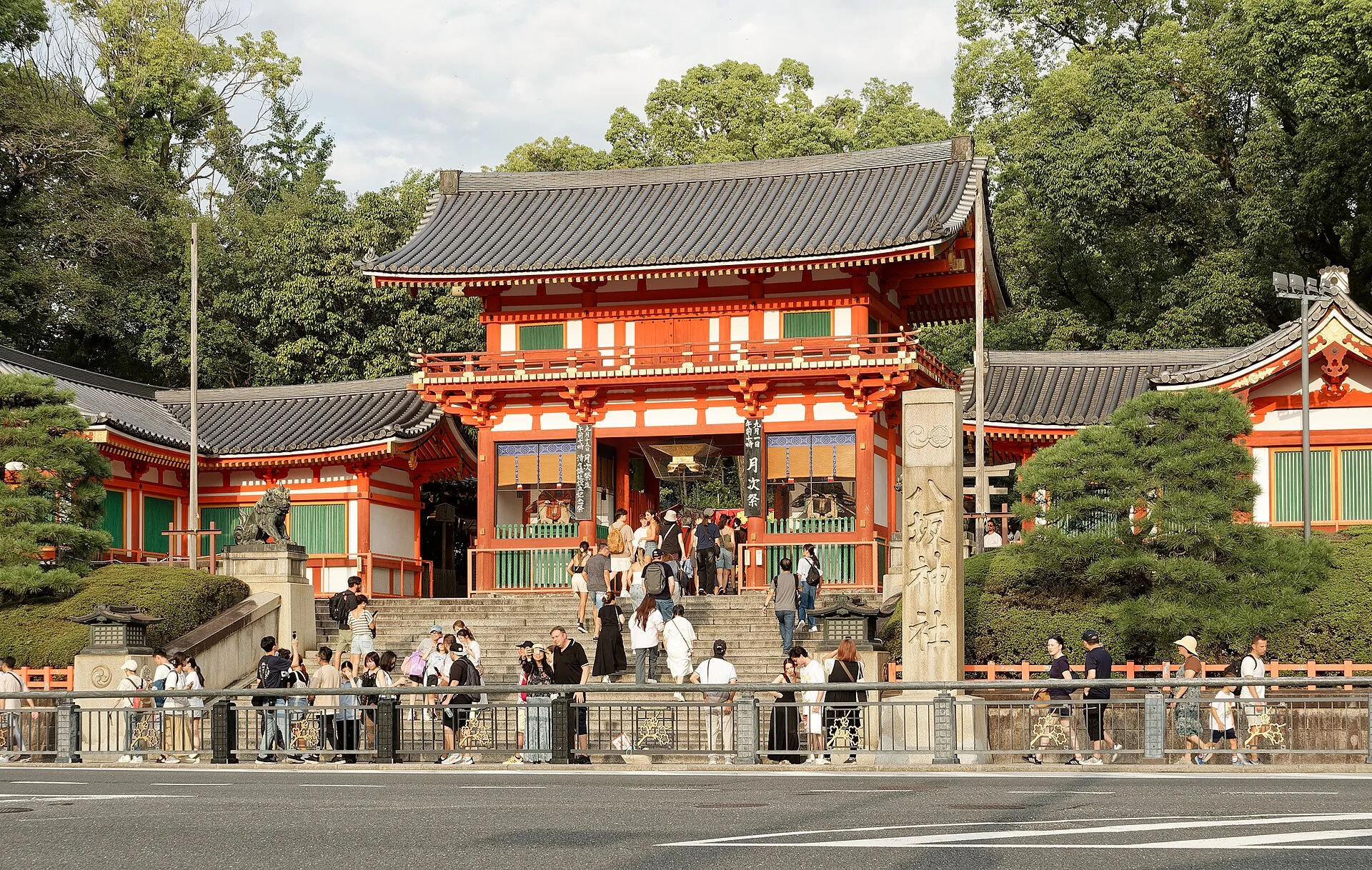
Rebuilt in 1497, the West Romon Gate is the oldest structure listed by the shrine on its grounds. It has shifted position alongside city road changes: when Shijo-dori was widened in 1913, the gate was moved northeast, and the lower flanking wings on either side were added in 1925. From across the street, you can take in the tiled roof, main gate, and stepped-down wings in a single view. Pause on the opposite sidewalk to look up before crossing, and keep the stone steps clear for people moving up and down once you cross over.
Inside the grounds, look first for the central Dance Stage (Maiden) hung with rows of lanterns; the Main Hall sits just north of it. Walk around the side of the Dance Stage to the South Romon Gate and look back to see that the gate, Dance Stage, and Main Hall sit along a single north-south axis. Entering from the West Romon Gate shows you the side of the Dance Stage first, so walking around to the south side makes the overall layout click. The 1331 Illustrated Map of Gion Shrine cited by the shrine already shows this alignment; while the middle gate and corridors in the painting no longer stand, the front-to-back relationship of the main structures remains clear on site.
The South Romon Gate is what the shrine designates as its main gate; the current gate dates to 1879, while the stone torii outside it is older, erected in 1646. Casual visitors arriving from Gion often overlook this side, yet the portable shrines pass through the South Romon Gate and stone torii when departing for the Gion Matsuri. Looking back from outside the gate lets you trace the approach straight through the Dance Stage toward the Main Hall. Watch your step on the stone stairs inside the gate, as foot traffic moves both up from the south and down toward Nene-no-Michi.
Rebuilt in 1654 under the Edo shogunate, the Main Hall (Honden) was designated a National Treasure in 2020. Seen from the front worship area, its facade is remarkably broad. While most shrines separate the inner sanctuary and the outer worship hall, both are enclosed here under one sweeping roof with an extra lower eave extending around the outside—the hallmark of Yasaka Shrine's Gion-zukuri architectural style. You can also view the roofline at an angle from the east side of the Dance Stage; noticing the rear and side eaves as you walk toward Utsukushi Gozensha gives a much better sense of the building's depth than viewing it head-on alone.
The Main Hall enshrines Susanoo-no-Mikoto, Kushinadahime-no-Mikoto, and their eight offspring deities (Yahashira-no-Mikogami). The shrine links Gion worship closely to warding off illness and misfortune, a thread that continues at Eki Shrine along the west approach and throughout the July festival. Yasaka Shrine was historically known as Gion-sha or Kanshin-in before adopting its current name in the Meiji era, so references to Gion-sha in historical texts or old maps refer to this exact site.
The Dance Stage hosts ritual dances and Shinto weddings, and during the Gion Matsuri it holds the portable shrines. The lanterns hanging beneath its eaves are mostly donated by nearby teahouses and traditional restaurants. By day you can examine the timber framing and raised stage structure; after dark, the calligraphy on each lantern lights up row by row, best viewed by stepping back a few paces to the side. When a ceremony or wedding is underway, follow the routes marked by shrine staff and leave the space around the stage and the central path to the Main Hall unobstructed.
For a smaller architectural detail, walk to the latticed wooden fence (suki-bei) on the east side of the Main Hall. According to the shrine, this fence dates to roughly the mid-Meiji period and features karakusa arabesque carvings, separating the side of the Main Hall from the space where sacred food offerings are prepared. Nearby stands the Tadamori Lantern, tied to an episode in The Tale of the Heike in which Taira no Tadamori was ordered to capture a seemingly monstrous figure, only to discover a monk lighting lamps. If you spot the stone lantern, pause to read the explanatory plaque—this quiet corner preserves a story older than the evening lanterns.
Just west of the South Romon Gate stands the mikoshi storehouse, housing the three portable shrines used in the Gion Matsuri. Built in 1928, it resembles wood from the outside, though the shrine's architectural notes state that aside from the roof tiles and sliding doors, it is constructed largely of concrete. On ordinary days when the portable shrines are inside, head instead to the Emado (votive plaque hall) on the north side inside the West Romon Gate. Shrine records date it to around 1744; originally west of the Main Hall before moving to the north approach, it displays large votive paintings of the float procession alongside sangaku mathematical tablets. Visitors interested in traditional Japanese architecture or festivals will find these two outbuildings helpful for connecting the quiet grounds to July's celebrations.
Just inside the West Romon Gate, look down at the stone bases beneath the komainu guardian figures. The shrine notes that the pedestals are carved with the Four Symbols protecting Kyoto, with the Azure Dragon visible beneath the lion statue, representing Kyoto's east. Shrine lore also speaks of an Azure Dragon dwelling in a pond beneath the Main Hall. If you are only visiting Yasaka today, look for the dragon carving near the west gate; if your itinerary includes Kyoto Gyoen or Matsunoo Taisha to the west, the Kyoto Five-Shrine Pilgrimage places Yasaka as the eastern stop, anchoring the legend in the city's geography.
Purifying at the Temizuya, Then Visiting Utsukushi Gozensha and Eki Shrine
Entering through the West Romon Gate, stop at the west temizuya pavilion to purify your hands. Hold the ladle in your right hand to rinse your left hand, then switch hands to rinse your right. To rinse your mouth, pour water into your cupped left palm, finish by rinsing your left hand once more, and tilt the ladle upright so the remaining water runs down the handle. If the pavilion uses running spouts or modified fixtures, simply follow the setup and posted signs on site. Large groups should step up a few at a time so others can pass along the path.
Queue up neatly in front of the Main Hall. The shrine's worship etiquette is to toss an offering coin, ring the bell, bow twice, clap twice, offer a silent prayer, and bow once more. The Main Hall's bell ropes are tied away from about 5:00 PM to 6:00 AM the next morning, though all other steps remain the same. Since offertory coins are personal offerings, keeping a coin somewhere easy to reach before you step up lets you pray calmly without digging through your bag at the front.
East of the Main Hall sits Utsukushi Gozensha, whose present hall dates to 1591 and is designated an Important Cultural Property. Enshrining three goddesses, it features clear spring water—called beauty water (biyosui)—welling up beside the hall. According to the shrine, dabbing two or three drops onto your skin is a traditional prayer custom. Space around the basin is tight, so if someone in your group is taking photos or holding bags, step aside onto the main path once you finish praying. Take a moment here to notice the extending eaves of Utsukushi Gozensha as well, which echo the construction style of the Main Hall.
On the west side stands Eki Shrine, dedicated to Somin Shorai. In legend, he offered hospitality to a traveling Susanoo-no-Mikoto, who taught him in return how to ward off plague using a woven reed ring (chinowa). If you see the phrase "Descendant of Somin Shorai" (Somin Shorai Shison Nari) on charms during July's Gion Matsuri, visiting this small shrine puts that name in context. Since the adjacent west approach connects down to Shijo-dori, visitors walking one-way toward Maruyama Park should stop by the west side for Eki Shrine right after climbing the West Romon Gate stairs, before heading toward the Main Hall and Utsukushi Gozensha on the east.
Use the shrine's precinct map to locate Okuninushi Shrine as well. Dedicated to Okuninushi-no-Kami, who healed an injured hare in the White Hare of Inaba myth, the shrine features a stone statue depicting that scene and is introduced by the shrine as a sub-shrine for matchmaking and personal ties. Walking slowly, you can also spot the signs for Kitamuki Ebisu Shrine, associated with business prosperity, and Akuoji Shrine, which enshrines the fierce spirit of Susanoo-no-Mikoto and is listed under protection from misfortune and calamity. If visiting with children, the white hare statue is far easier to spot than memorizing deity names—just be sure to yield space when others are praying right in front of a sub-shrine.
If you only have time for one or two sub-shrines, match your route to what you want to see. Entering and exiting through the West Romon Gate along Shijo-dori lets you stop at Eki Shrine on either leg. If you are continuing into Maruyama Park, finish near Utsukushi Gozensha on the east side of the Main Hall and walk straight east—it saves backtracking around the west side of the Dance Stage.
Visitors interested in exploring more sub-shrines can loop around the north side from the east flank of the Main Hall past the northeast gate to find Hiyoshi Shrine and Hamono Shrine, and continue along the north approach to Itsukushima Shrine. The shrine lists Hiyoshi Shrine for directional protection and connects Hamono Shrine to rites honoring bladed tools. Since Maruyama Park borders the east side, take an eastern path out if you are heading to Chion-in Temple, or circle back by the Emado if you want the shortest path back down the West Romon Gate to Shijo-dori. Checking the shrine's downloadable precinct map helps keep your bearings—especially where both major gates appear on the map—by orienting yourself first to Shijo-dori and Maruyama Park.
Where to Get Goshuin, Omamori, and Formal Prayers
Save goshuin (shrine stamps) for after you pray. Yasaka Shrine's offerings page notes that the main Yasaka Shrine goshuin can be written directly into a goshuincho stamp book from 9:00 AM to 4:00 PM; after 4:00 PM, pre-written paper slips are issued instead. The shrine office generally remains open until 5:00 PM. If you want calligraphy written directly into your book, have your stamp book and desired stamp names ready, and leave enough buffer time for afternoon queues. Anyone visiting mainly to see the lit Dance Stage after dinner will find it easiest to pick up goshuin on a separate daytime stop.
Look for the counter marked "Juyosho" beside the Dance Stage. The shrine map places it on the west side of the Dance Stage next to the shrine office, whereas the reception for formal prayers sits on the west side of the Main Hall—the two windows handle separate services. If you brought a stamp book, open it to the blank page where you want the stamp placed. When someone in your group wants to browse nearby sub-shrines, agree to meet in the wider open area outside the counter so everyone does not need to wait in line together; during busy periods, this wait often determines your total stop time.
Some visitors also collect stamps for Utsukushi Gozensha or Eki Shrine. Because the shrine's offerings catalog lists the main Yasaka Shrine goshuin separately from individual sub-shrine stamps, note the shrine names on your phone and ask at the counter after praying. If people in your group want different items, regroup first and decide before stepping into line. Paper goshuin slips can simply be tucked into a document folder or inside your stamp book and sorted once you sit down in Maruyama Park.
Choose omamori charms according to what you wish to pray for. The shrine's catalog includes series for warding off misfortune ("yakuyoke"), love and matchmaking ("enmusubi"), and traffic safety ("kotsu anzen"). Since the same counter often has lines for paper talismans (ofuda) and goshuin, check the online catalog in advance if you want to compare colors and designs with travel companions, and allow a few minutes at the window. Note that the shrine's photography rules prohibit photographing items at the offerings counter.
Formal prayers (gokito) are registered through the reception desk on the west side of the Main Hall between 9:00 AM and 4:00 PM. The shrine lists initial offering fees (hatsuhoryo) starting at ¥8,000, and ¥10,000 for hatsumiyamairi (a newborn's first shrine visit). At the desk, state your prayer intention and fill out your name and address, along with the pronunciation of your name for the priest's chanting, then submit the offering and wait in the lounge area. Wishes such as good health, exam success, and travel safety are listed in the shrine catalog; if you plan to book a formal prayer, anchor your afternoon schedule around this counter while companions relax in Maruyama Park.
Because formal prayers are official ceremonies, the shrine asks visitors to dress neatly. If you have just walked over from the slopes around Kiyomizu-dera wearing rain gear or carrying bulky bags, tidy up before entering the prayer reception area. Casual worshippers only need to pray in front of the Main Hall; families visiting together can each bow and pray side by side outside, then step clear for the next visitors.
With Half a Day Left, Head North or South from Maruyama Park
Yasaka Shrine sits right against the west edge of Maruyama Park. Walk out the east side of the shrine grounds to see the Gion weeping cherry tree and Hyotan Pond, then loop back along another path toward your next direction. Opened in 1886, the park was later landscaped by master gardener Jihei Ogawa VII into a strolling garden with ponds and winding paths. Outside cherry blossom season, walking to the far side of the pond and looking back highlights the drop from the Higashiyama foothills down to the water. Families with young kids or anyone wanting a breather can treat Maruyama Park as a full stop in itself without paying another temple admission or climbing extra stairs.
If historic architecture is your priority, head north from the park to Chion-in Temple's Sanmon Gate and continue up to the National Treasure Mieido Hall. Chion-in typically opens its gates from 6:00 AM to 4:00 PM, with most reception counters opening at 9:00 AM. Yuzen-en Garden admits until 4:00 PM and Hojo Garden until 3:50 PM, while combined tickets for both gardens stop selling at 3:20 PM. Single-garden admission for high school students and adults is ¥300 and ¥400 respectively, or ¥500 for the combined ticket. Arriving near last entry, pick whichever single stop—Yuzen-en Garden beside the gate or Mieido Hall—you can finish comfortably; to cover Mieido Hall and both gardens, go straight to Chion-in after lunch and save the park and shrine for the return walk.
You can also admire the Sanmon Gate as part of a simple park stroll. Built in 1621 and designated a National Treasure, it stands 24 meters tall and 50 meters wide, letting you appreciate its massive rows of pillars and double-tiered roof right from the plaza in front (the upper level is normally closed to the public). If your legs still feel fresh, continue up to the mid-level terrace to see the Mieido Hall, rebuilt in 1639 with a listed frontage of about 45 meters; note the noticeable elevation gain between the two buildings. If you are saving your energy for Kodai-ji Temple to the south, take in the Sanmon Gate and double back through Maruyama Park onto the southern route.
Chion-in runs a free shuttle between the Sanmon Gate and Mieido Hall, listed by the temple from 9:00 AM to 4:00 PM with a break from 1:00 PM to 2:00 PM. If you plan to ride it, enter at the boarding area in front of the Sanmon Gate so you do not get separated from companions climbing the stone steps. For the subway ride back, exit Chion-in and follow Jingumichi north to Higashiyama Station, then ride west to Karasuma Oike to transfer for Kyoto Station. If part of your group came via Gion-Shijo, everyone can easily split up from the temple gate toward their respective lines.
To reach Kodai-ji Temple and Hokan-ji Temple, take the south exit of Maruyama Park onto Nene-no-Michi. Visitors touring Kodai-ji's gardens can head into the temple first, while those looking to photograph the five-story pagoda and historic lanes can continue to Yasaka Pagoda and decide from there whether to climb Ninenzaka and Sannenzaka toward Kiyomizu-dera. If you are pushing a stroller or avoiding steep descents on your knees, keep it to a short out-and-back walk along Nene-no-Michi and save the stair-heavy Kiyomizu-dera stretch for another day. The reverse route works just as well: start at Kiyomizu-dera in the morning, finish at Yasaka Shrine in the afternoon, and walk down Shijo-dori toward the Kamo River for dinner.
If you leave Kawaramachi around noon, a relaxed half-day split gives about 40 minutes to Yasaka Shrine and 30 minutes to Maruyama Park, leaving the rest for one temple and walking between sights. Stopping for snacks or browsing shops easily adds half an hour, so use Chion-in or Kiyomizu-dera's closing time as your turnaround cue. If you want to cover both areas thoroughly, plan the southern stretch separately using our Kiyomizu-dera and Higashiyama Walking Guide, and pair Yasaka Shrine with Maruyama Park on another swing through Gion.
When your group wants both cherry blossoms and temples, decide first which stretch needs daylight most. If crowds around the weeping cherry tree get thick, walk around to the far side of the pond—the return path gives you easy connections back toward Yasaka Shrine or north to Chion-in. Because Maruyama Park has multiple cherry varieties, you can still spot later-blooming trees along the paths even when the weeping cherry is past peak. For a sit-down meal, plan a teahouse in Maruyama Park or a restaurant along Shijo-dori ahead of time so lunch does not eat into temple closing hours.
Morning Roofline Views, Nighttime Lanterns
Walking across Shijo-ohashi Bridge from Kawaramachi in the early morning lets you study the Main Hall rooflines and sub-shrines before daytime tour groups gather at the gate. If you want a goshuin stamp, loop through Maruyama Park first and return to the shrine at 9:00 AM. If some companions arriving from Kyoto Station want to sleep in, arrange to meet for breakfast near Gion-Shijo Station so early risers can tour the grounds first. Morning light from the Utsukushi Gozensha side works especially well for seeing the eaves of both the sub-shrine and the Main Hall.
To catch both daytime architecture and evening illumination in one visit during autumn or winter, arrive shortly before dusk. Walk around the east side to view the sub-shrines while there is still daylight, then circle back outside the Dance Stage as the lanterns come on before heading to Shijo-dori for dinner. In summer when sunset is late, eat dinner first if you already have a reservation, then walk back after dark. At night, you can also walk along the north approach to see the mantoro—rows of lanterns engraved with donors' names—easily spotted on the way from the Dance Stage toward the north gate.
In light rain, trace a compact loop through the West Romon Gate, around the Dance Stage, and past the Main Hall, saving the east side of Maruyama Park and Nene-no-Michi for drier weather. Stone steps at the gate and stone paving inside get slick when wet, so keep your phone put away on stairs and leave one hand free for railings. Since prayers, weddings, and ritual dances take place on the Dance Stage, meeting at a seated cafe along Shijo-dori works far better during steady rain than waiting under the stage eaves. In narrow passages, lower your umbrella or step aside to let others pass before opening it back up on the street.
If dinner is booked in Pontocho or Kiyamachi, exit the West Romon Gate and walk northwest along public streets toward Shirakawa Minami-dori and Tatsumi Bridge before looping back to the Kamo River and Shijo-ohashi Bridge. Late at night or if anyone prefers well-lit main roads, return straight along Shijo-dori to catch Keihan or Hankyu right at the bridge. Private alleys and storefront spaces in Gion post restrictions on entry and photography, so stick strictly to public roads. When geiko or maiko are walking by, give them clear space to pass—book a public performance separately rather than waiting on the curb, which disrupts local residents and businesses.
Casual handheld photography is permitted on the shrine grounds. Keep tripods and selfie sticks packed away, avoid shooting inside the Main Hall or directly down the central axis of any shrine hall, and never block foot traffic at the gates, offertory box, or main paths. To photograph the Dance Stage lanterns with a phone, shoot from the side and wait for passersby to walk through naturally. Put your phone down when a wedding procession or shrine priest passes; the shrine prohibits photographing priests, shrine maidens, or other visitors without permission. Commercial kimono photo shoots inside the grounds are restricted to partner studios authorized by the shrine.
If you plan to combine an autumn 2026 visit with Chion-in Temple's evening special illumination, the temple lists dates from November 17 to December 6, running from 5:30 PM to 9:30 PM with last admission at 9:00 PM. General evening admission is ¥800 for adults and ¥400 for elementary and junior high school students. Walk up from the park to see Chion-in's Sanmon Gate, Yuzen-en Garden, and Mieido Hall area before returning to Yasaka Shrine's Dance Stage, putting the timed-entry stop first in your evening. If you only care about photographing the Dance Stage lanterns, stay at the shrine and head back to Shijo-dori through the West Romon Gate.
Portable Shrines at Gion Matsuri, Sacred Fire on New Year's Eve
Gion Matsuri is Yasaka Shrine's signature festival, whose origins the shrine traces back to an 869 Goryo-e ritual held to quell epidemics. Today, neighborhood and shrine events run throughout July, starting on July 1 and ending with the Nagoshisai summer purification festival at Eki Shrine. If you want to see the decorative floats being assembled or paraded, focus on the Yamahoko neighborhoods and parade route west of the Kamo River. To follow Yasaka Shrine's own role in the festival, map out the Main Hall, Dance Stage, and the routes traveled by the portable shrines.
Per the shrine's published festival schedule, during Shinkosai on the evening of July 17, three portable shrines depart Yasaka Shrine and arrive at the Shijo Otabisho resting hall in Shijo-Teramachi that night. During Kankosai on July 24, they return from Shijo Otabisho to the shrine in the evening. Both days also feature morning Yamahoko float processions, so anyone watching from morning into night can step off the main avenues for a meal between events. Groups with children or older travelers do best picking one segment to watch from a spot near a planned train station. On July 31, Nagoshisai brings the season back to Eki Shrine on the shrine's west side, where the festival page lists chinowa reed-ring charms for distribution.
Even if your trip only catches early July, you can still witness events tied to the portable shrines. The festival calendar includes the Mikoshi Arai washing ritual on July 10, when the central Nakagoza portable shrine is carried onto Shijo-ohashi Bridge for purification over the Kamo River. On July 15, Yoimiyasai takes place after the shrine lights are extinguished, transferring the deities into the portable shrines on the Dance Stage. Travelers hoping to see the regular shrine buildings and evening lanterns should visit during daytime on these dates and wait in public street areas if festival crowd controls are in place. Because Mikoshi Arai and the main portable shrine processions are separate events, double-check both the date and location when planning.
Outside festival weeks, you can still walk past Shijo Otabisho. Located in Shijo-Teramachi on the west side of the Kamo River near the Shijo-Teramachi exit of Kyoto-Kawaramachi Station, it houses the portable shrines during the mid-July interval. On an ordinary day, walking from here back across Shijo-ohashi Bridge to Yasaka Shrine links the two anchor points of the procession. Since each portable shrine takes a distinct route during the formal festival, once you have both endpoints marked on your map, pick your viewing spot based on that year's official schedule and on-site traffic controls.
At year-end, the shrine's New Year schedule separates the 7:00 PM Joyasai purification service on December 31 from Okera Mairi, which begins around 7:30 PM. Sacred fire from Okera Mairi lights the shrine lanterns and burns alongside consecrated okera wood until New Year's morning. Visit on the evening of December 31 for Okera Mairi, or come during the daytime for hatsumode if you prefer milder weather and easier walking. Neighboring Chion-in Temple runs its own New Year's Eve bell-ringing schedule, so allow ample queue and transfer time if visiting both in one night. For New Year's lodging, transit, and early-morning shrine visits, see our Kyoto Hatsumode Route Guide.
Events continue past New Year's Day. According to the New Year calendar, January 3 features a morning Hatsuno Noh dedication and an afternoon Karuta-hajime poetry card ceremony at the Noh stage. Arriving a few days later, you can catch Gion no Ebessan at Kitamuki Ebisu Shrine on January 9 and 10, following the three-shrine route of the Main Hall, Okuninushi Shrine, and Kitamuki Ebisu Shrine, or picking up a lucky fukuzasa bamboo branch in front of Ebisu Shrine. Because both sub-shrines sit near the west approach, expect brisk worship and charm lines; walk west from the Main Hall past Okuninushi Shrine and look just west of the shrine office for Kitamuki Ebisu Shrine.
February's Setsubun Festival takes place on the Dance Stage with traditional dances by Kyoto's geiko districts and ritual bean-throwing. To watch a performance, check the Setsubun program for each district's stage time, choose one slot, and finish your Main Hall prayer beforehand. Crowds gather around the Dance Stage waiting for the beans, so stick to the outer walkways when passing through and designate Maruyama Park as a regrouping spot if your party separates near the gates. In November, Utsukushi Gozensha holds its annual festival and the Barber and Beauty Appreciation Festival; space in front of the small shrine is limited, so check the shrine's monthly calendar for exact dates if its connection to beauty trades interests you.
Kyoto City lists Maruyama Park's typical cherry blossom season from late March to early April. During the day, stop by Utsukushi Gozensha before entering the park to take in the silhouette of the weeping cherry tree. If you are coming mainly for night blossoms, check Kyoto City's seasonal blooming and illumination notices, as flower timing and evening park events follow separate schedules. In autumn, if your visit overlaps with Chion-in's evening special viewing, build your timeline around the temple's ticket and entry cutoffs first and stop by Yasaka Shrine's Dance Stage on your way back into Gion, keeping dinner reservations on whichever side leaves enough margin to finish the walk unhurried.
A few useful answers
Does Yasaka Shrine charge admission, and how long does a visit take?
The grounds are free to enter and open 24 hours a day for general worship. Plan 30 to 45 minutes to see the West Romon Gate, Main Hall, Dance Stage, and Utsukushi Gozensha. Leave extra time if you want a goshuin stamp or a formal prayer.
Can I get a goshuin written directly in my stamp book at Yasaka Shrine?
According to the shrine's offerings page, goshuin are written directly into your goshuincho stamp book from 9:00 AM to 4:00 PM; after 4:00 PM, pre-written paper slips are issued instead. The shrine office generally handles requests until 5:00 PM.
How do you use the beauty water at Utsukushi Gozensha?
Beauty water (biyosui) wells up beside Utsukushi Gozensha. As the shrine explains, the custom is to dab two or three drops onto your skin as a gesture of prayer.
Can I ring the bell when visiting Yasaka Shrine at night?
The bell ropes at the Main Hall are tied up from around 5:00 PM until 6:00 AM the next morning, though you can still pray at the hall as usual and see the illuminated votive lanterns around the Dance Stage.
Can I visit Yasaka Shrine and Maruyama Park together?
Yes. Exiting the east side of the shrine leads straight into Maruyama Park; add about half an hour to stroll around the pond and weeping cherry tree. From there, Chion-in Temple lies to the north, and Kodai-ji Temple and Yasaka Pagoda lie to the south.
Which train station is closest to Yasaka Shrine?
From Keihan Gion-Shijo Station, it is about a 5-minute walk east along Shijo-dori. From Hankyu Kyoto-Kawaramachi Station, cross the Kamo River and walk along the same street for about 8 minutes. By city bus, get off at the Gion stop.
Official information and references
Sources used in this guide.
- Yasaka Shrine | Precinct Map and Access
- Yasaka Shrine | Worship, Formal Prayers, and Tokiwa Shinden Access
- Yasaka Shrine | Shrine History and Gion Faith
- Yasaka Shrine | Main Hall, West Romon Gate, and Precinct Architecture
- Yasaka Shrine | Precinct Highlights, Dance Stage, and Beauty Water
- Yasaka Shrine | Sub-shrines and Enshrined Deities
- Yasaka Shrine | Utsukushi Gozensha
- Yasaka Shrine | Offerings, Charms, and Goshuin
- Yasaka Shrine | Notice on Main Hall Bell Ropes
- Yasaka Shrine | Notice on Photography Within the Grounds
- Yasaka Shrine | Origins of Gion Matsuri and Portable Shrine Processions
- Yasaka Shrine | New Year Ceremonies and Okera Mairi
- Yasaka Shrine | Setsubun Festival
- Kyoto City Transportation Bureau | Gion Bus Stop and Route Timetables
- Kyoto City Official Travel Guide | Access to Gion and Yasaka Shrine
- Kyoto City Official Travel Guide | Maruyama Park and Weeping Cherry Tree
- Kyoto Prefecture Tourism Guide | Maruyama Park Gardens and Hyotan Pond
- Chion-in Temple | Gate Hours, Garden Admission, and Shuttle Bus
- Kyoto City Official Travel Guide | Walking Route from Higashiyama Station to Kiyomizu-dera
- Kyoto City Official Travel Guide | Notice on the Gion South District
- Kyoto City Official Travel Guide | Walking from Kiyomizu-dera to Yasaka Shrine, Gion, and Chion-in
- Chion-in Temple | National Treasure Sanmon Gate
- Chion-in Temple | National Treasure Mieido Hall
- Chion-in Temple | 2026 Autumn Evening Special Viewing
- Yasaka Shrine | Monthly Rituals and Event Calendar
- Yasaka Shrine | Gion Ebisu Festival and Three-Shrine Pilgrimage