Plan a half-day walk through Kyoto's Nishijin district from the Nishijin Textile Center to Kamishichiken and Kitano Tenmangu, with handweaving and kimono booking fees, workshop comparisons, machiya cafe hours, and tips on reading certification seals.
- Region & Focus
- KyotoNeighborhoods and shopping
- Reading Scope
- 18 min read · 9 chapters · 5 Q&As
- Official Verification
- 30 official sources checkedUpdated November 22, 2026
Chapter Route Map (tap any stop)
- Half-Day Walk from Horikawa-Imadegawa to Kitano
- What to See for Free at the Nishijin Textile Center
- Booking Handweaving, Kaleidoscopes, and Kimono Experiences
- Reading Nishijin Textiles Before Stepping Inside a Workshop
- Choosing Between Two Workshops: Orinasukan and Tatetoyoko
- Sitting Down Inside a Weaver's Townhouse at Sozen Cafe
- Walking Through Kamishichiken to Kitano Tenmangu
- Choosing Nishijin Textiles by Purpose and Checking the Seal
- Choosing Your Entry Bus and Exit Route
- Quick Q&A
For a first walk through Kyoto's Nishijin district, start at the Nishijin Textile Center at Horikawa-Imadegawa to see looms and obi sashes, head toward Daikoku-cho to find weaver townhouses with preserved workrooms, and finish via Kamishichiken at Kitano Tenmangu. Set aside four to five hours to tour one workshop, sit down for sweets, and still have time for the shrine. If you want to weave your own cloth, book the Center's 40-minute tabletop loom session or a guided workshop slot ahead of time; if renting a kimono to stroll outside, keep your route shorter so you can return it before afternoon cutoff.
Half-Day Walk from Horikawa-Imadegawa to Kitano
Start at 10:00 AM at the Nishijin Textile Center, budgeting 45 minutes to an hour for the Historical Exhibition Hall and artisan demonstration area. Leaving the building, head west along Imadegawa-dori toward Omiya-dori to see the exterior of the former Nishijin Textile Museum. Turn north onto Jofukuji-dori at Imadegawa-Jofukuji to reach Daikoku-cho. After viewing the exhibits at Orinasukan, loop back toward Imadegawa-dori around Senbon-dori and walk on to Kamishichiken and Kitano Tenmangu. Because the route involves several turns, pin the Textile Center, Orinasukan, Kamishichiken-dori, and the shrine's East Gate in sequence on your map app, opening the final leg once you cross Senbon-dori.
Anchor one fixed time before you set out. If you are only touring exhibits, stroll at your own pace and pause 40 minutes for lunch. With a 1:30 PM workshop booking, tour the Textile Center first, eat lunch, and check in afterward. If your workshop is at 3:30 PM, flip the route: start at Kitano in the morning, walk east, stop by the Textile Center midday, and wrap up at the Teranouchi studio in the afternoon before catching a bus from nearby Kenryuko-mae to avoid doubling back to Kitano.
If you only have two hours, stay on Nishijin's eastern side. Walk from the Textile Center to the former Nishijin Textile Museum, then decide between Daikoku-cho's townhouses or spending more time in the Center's third-floor exhibits. If you are staying near Kitano, trim the walk to a tight loop of Kamishichiken, the East Gate, and the main shrine hall. When you have a weaving reservation, young children, or slower walkers in your group, taking a city bus between the workshop and the shrine feels far better than rushing three stops on foot.
Monday is the easiest scheduling trap. The Nishijin Textile Center is normally closed on Mondays, though it opens on Japanese national holidays and closes the following Tuesday instead. Orinasukan closes every Monday, even on national holidays. Tuesday through Sunday is the simplest window for seeing both; on holiday weekends, compare closure calendars and reservation slots side by side. If a regular Monday is your only available day, spend your half-day on Kamishichiken's public streets and inside Kitano Tenmangu, entering and exiting near the shrine.
Plan a half-day walk through Kyoto's Nishijin district from the Nishijin Textile Center to Kamishichiken and Kitano Tenmangu, with handweaving and kimono booking fees, workshop comparisons, machiya cafe hours, and tips on reading certification seals.
What to See for Free at the Nishijin Textile Center
The Nishijin Textile Center stands at 414 Tatemonzen-cho, Kamigyo-ku, on the south side of the Horikawa-dori and Imadegawa-dori intersection. Admission is free. Hours run 10:00 AM to 4:00 PM from October through March and until 5:00 PM from April through September, with year-end closures from December 29 to January 3. If you arrive on a November afternoon, head straight to the third-floor Historical Exhibition Hall and save second-floor shopping for before you leave. The Nishijin Textile Industrial Association's visitor page currently lists no scheduled live kimono shows, so cross showtimes from older travel blogs off your plan.
Models and videos on the first floor trace sericulture, silk reeling, and weaving, making this an easy starting point with kids. Up on the second-floor demonstration floor, watch for nukinishiki (weft brocade) and tsumekaki hon-tsuzureori (fingernail tapestry weaving). The former uses handlooms fitted with punched Jacquard pattern cards, while the latter requires weavers to pack weft threads with notched fingernails over an under-warp design drawing. When crowds block your view of the hands, step to the side to see where each thread enters the fabric. The Center also introduces zaguri, the hand-reeling process that draws silk from cocoons onto bobbins—if a demonstration is running, you can watch raw filaments become workable yarn.
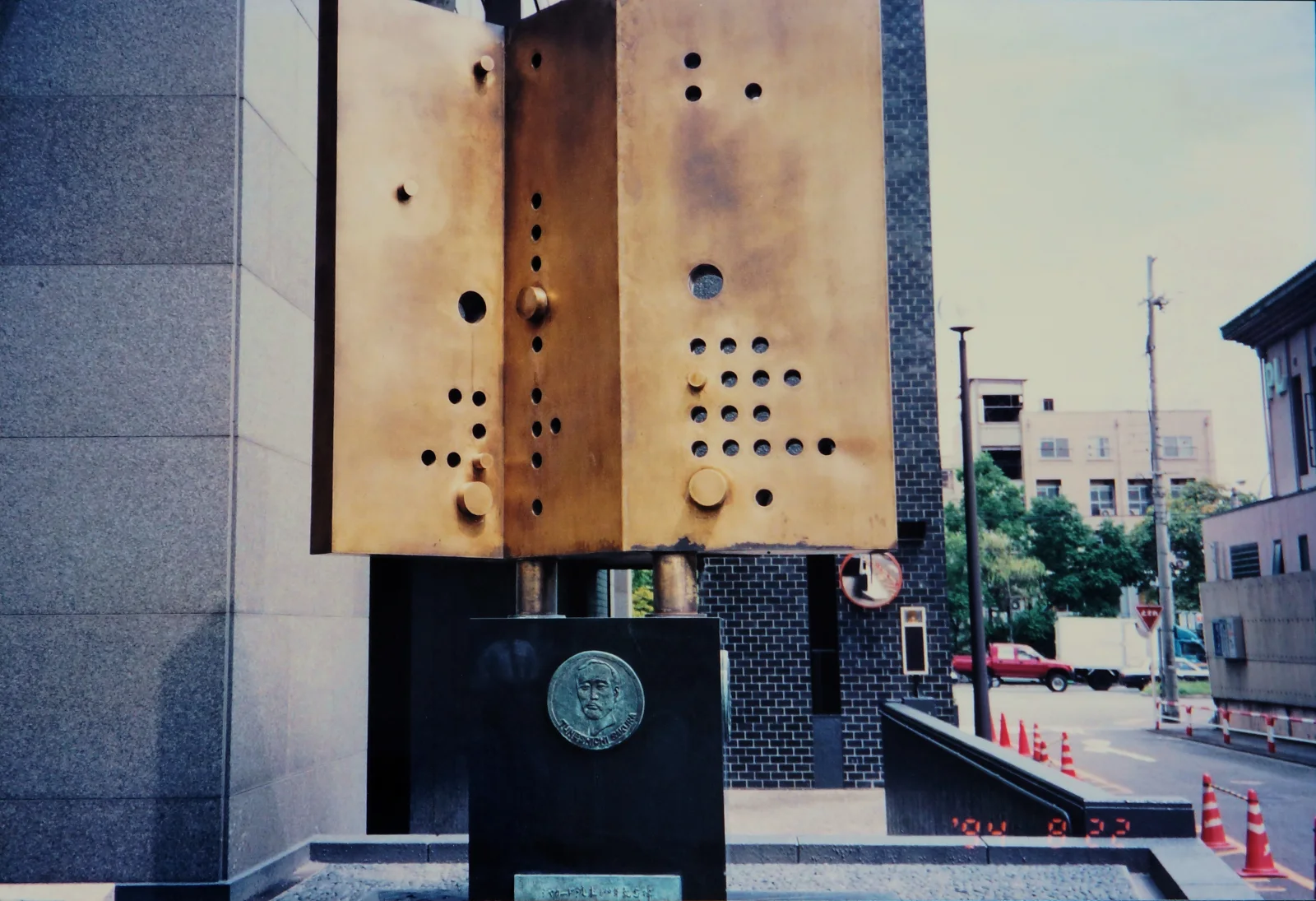
The third-floor permanent gallery houses Japan's first wooden Jacquard mechanism, a Kyoto City Designated Cultural Property. Punched pattern cards are linked in a long chain, each row of holes controlling which warp threads lift. Think of them as a sequence of instructions fed into the loom; looking back at finished brocades, every repeating petal and border breaks down into individual passes of yarn. Modern equipment can also drive warp lifts digitally, and seeing these punched cards before visiting the direct-controlled power looms at Tomiya Orimono makes the shared logic immediately clear.
Outside the building stands a monument modeled after punched Jacquard pattern cards. Kyoto City records note that in the early Meiji era, Nishijin weavers traveled to Lyon, France, bringing Jacquard and flying-shuttle mechanisms back to Kyoto—pair the oversized outdoor sculpture with the wooden mechanism inside. When navigating by map, keep the Nishijin Textile Center and the Kyoto City Archaeological Museum as two separate stops: the old Nishijin Textile Museum refers to the archaeological museum building, while active weaving exhibits and workshop check-in take place at Horikawa-Imadegawa.
For a closer look at finished textiles, tour both the permanent and special displays in the Historical Exhibition Hall. Obi sashes show how a single motif repeats across a long band, while folding screens and interior panels demonstrate how the same yarns scale up for larger viewing distances. From November 3, 2026 to March 28, 2027, the third-floor gallery hosts a free collection exhibition themed around the 400th anniversary of the Kan'ei Imperial Visit. If you plan to visit both craft museums in one day, focus on the Jacquard mechanism and this special show here, saving handwoven garments for Orinasukan.
Booking Handweaving, Kaleidoscopes, and Kimono Experiences
The Center's compact tabletop handlooms are built for first-timers. You weave a table runner measuring about 20 x 30 cm in roughly 40 minutes and take it home. Participants must be in fifth grade or older. Starting October 2026, individual fees are ¥2,750 for adults and ¥2,530 for students. That 40-minute block covers seated weaving, so allow at least an hour and a half if you also want to browse the gallery and shop. You will learn to alternate warp sheds, pass the shuttle, and beat each weft row snug—even if neighbors finish faster, take your time keeping the edges even.
If children in your group are too young for the handloom, book the kaleidoscope craft decorated with Nishijin fabric scraps. Listed start times are 10:30 AM, 1:30 PM, and 2:30 PM JST, capped at four participants per session, lasting about 30 minutes at ¥1,980 per person. Children in second grade and younger must be accompanied by a parent or guardian. If splitting your group across both activities, note both requests in the reservation remarks and wait for staff to confirm your assigned times before deciding whether part of the group browses exhibits first. The Center's reservation page offers English and Simplified Chinese forms; your booking is confirmed only after you receive a reply, and next-day bookings are accepted solely by phone between 10:00 AM and 4:00 PM JST.
To walk the neighborhood in kimono, reserve the komon outdoor plan for ¥8,800 (the indoor-only option is ¥5,500). Dressing takes about 20 minutes for both plans and excludes hair and makeup. Outdoor rentals must be returned 30 minutes before closing—3:30 PM or 4:30 PM depending on the season. The easiest pacing is dressing first, strolling around Imadegawa-Omiya, returning after lunch, and switching back into walking shoes for Kitano. If you plan to wear the kimono to Kamishichiken, factor a taxi or return bus into your schedule so you leave Kitano with margin to spare.
Trying on junihitoe court robes or men's sokutai attire calls for a separate time block. The Center lists roughly 80 minutes at ¥48,400 each, including hair, makeup, and one commemorative photo, with a minimum height of 145 cm (junihitoe is for women, sokutai for men). Children's indoor-only kimono dressing is a separate option for heights from 110 to 128 cm at ¥11,000. Treat these photo-driven sessions as their own dedicated stop, leaving buffer before and after to tour the exhibits.
Reading Nishijin Textiles Before Stepping Inside a Workshop
The Nishijin Textile Industrial Association defines Nishijin-ori as yarn-dyed figured textiles woven in Kyoto's Nishijin district, encompassing 12 nationally designated traditional craft categories. Across a single piece of cloth, lengthwise warp threads and widthwise weft threads interlace to build patterns gradually. When you spot a gold motif in a display case, check whether it emerges pass by pass along the weft, then read nearby swatches and material or process cards. Once that structure clicks, comparing two similar-looking obi along their surface weave becomes intuitive.
A textile goes through several stages before reaching the loom. After an orimoto weaving house sets a design, the motif must be charted onto grid paper for every warp and weft intersection. Yarn colors, dye lots, and weights are finalized, and warp threads are beamed in order. At the demonstration floor, spend a few extra seconds looking above the loom to watch the mechanism lift selected warp threads, then look down at the fell of the cloth where each newly thrown weft is beaten tight. Watching both together reveals what a loom coordinates simultaneously far better than tracking the shuttle alone.
This division of labor explains why the textile trade spans multiple blocks. Nishijin relies on specialized pattern designers, yarn dyers, and beaming workshops that align thousands of parallel warp threads. The Association still describes the district through this network of weaving houses (oriya), material dealers, and wholesalers (tonya). Walking around Imadegawa-Omiya, picture bolts of cloth and raw silk moving between shops—Kyoto cultural heritage records preserve the old junction name Senryo-ga-Tsuji, recalling when silk merchants, wholesalers, and financiers clustered here.
The name "Nishijin" comes from the Western Army's encampment during the Onin War. Kyoto City records note that silk weaving already had roots here in the Heian period; once displaced artisans returned after the fighting to resume work, Nishijin gradually took hold as the district's name. Walking from the Textile Center toward Imadegawa-Omiya, pass the Kyoto City Archaeological Museum. Built in the Taisho era as the original Nishijin Textile Museum, it displays the Nishijin Monument stone outside recounting the district's origins—even though the museum itself exhibits excavated Kyoto artifacts, the historic facade and stele make a worthwhile brief stop.
If an early train puts you in the neighborhood before the Textile Center opens, stop into the Archaeological Museum first. It opens at 9:00 AM with free admission, closes at 5:00 PM, and accepts last entry at 4:30 PM. Galleries present excavated artifacts chronologically alongside maps and photos of Kyoto sites, giving you far more context than waiting outside the Center's doors. Keep in mind that year-end closures start one day earlier here, running from December 28 through January 3.
Weaver townhouses and private homes interweave along the same streets. Street-facing wooden lattices, shop entrances, and narrow corridors leading toward the rear illustrate how client meetings, family life, and production fit onto one narrow lot. Workrooms built to house looms (oriya-date) typically feature tall ceilings and dedicated daylighting. Stick to workshops with posted visitor entrances and public hours if you want to see rear loom rooms; for closed small workshops, appreciate their lattices and eaves from the public street.
Choosing Between Two Workshops: Orinasukan and Tatetoyoko
Pick Orinasukan for handwoven garments and an intact weaver's townhouse. Operated by the Foundation for the Promotion of Handweaving Techniques, it sits at 693 Daikoku-cho along Jofukuji-dori north of Kamidachiuri, about a five-minute walk from the Imadegawa-Jofukuji bus stop. Hours are Tuesday through Sunday, 10:00 AM to 4:00 PM; admission is ¥1,000 for adults and ¥700 for high school students. Once both a textile merchant shop and family home, the building exhibits reconstructed Noh costumes, historical attire, and regional handwoven fabrics—seeing how boldly Noh motifs sit across full sleeves and shoulders conveys stage scale in a way flat cloth cannot.
Orinasukan also introduces Watabun's Daikoku-cho handweaving workshop, where commercial obi are woven to order. If watching master weavers at the loom is your top priority, write to the museum with your preferred date and group size to ask whether a workshop viewing can be paired with your visit. Orinasukan also runs a roughly three-hour handweaving class (solo participants welcome) for ¥11,000 including museum admission. Spend a morning practicing there and keep lunch and the shrine unscheduled afterward, or stick to the exhibits for a leisurely walk from Daikoku-cho toward Kitano.
Pick Tomiya Orimono's Teranouchi studio, Nishijin Kobo Tatetoyoko, to see working power looms. The studio runs a 15-minute guided tour of its loom floor and showroom for ¥300, with photography prohibited on the loom floor; inquire via the email address listed on their studio page. Because Tomiya Orimono's head office also appears on maps, save the Teranouchi studio specifically—take City Bus 6 or 206 to Kenryuko-mae and walk about three minutes.
You can also book a 90-minute tour-and-handweaving package through the Kyoto City Tourism Association booking page, offered on select dates at 10:00 AM, 1:30 PM, and 3:30 PM JST with advance reservation and prepayment. Fees are ¥4,250 for adults and ¥3,920 for students, open to fifth grade and up. You choose one weft color, alternate two warp sets using foot pedals, throw the shuttle by hand, and beat each row tight to take home a roughly 30 cm table runner. Companions who prefer not to weave can browse Nishijin wagashi sweet shops or Kamishichiken and rejoin you at the next stop.
If you want to see both handweaving and machine weaving in one day, start with the Textile Center's wooden Jacquard mechanism before touring live production at one workshop. Seeing real looms and demos up close leads to sharper questions—such as how a motif is charted or how weavers keep cloth edges straight. When visiting both venues, anchor the middle of your schedule with whichever session is booked and keep the other to exhibits or a short tour; weaving even a small swatch yourself makes complex museum textiles much easier to decipher afterward.
Sitting Down Inside a Weaver's Townhouse at Sozen Cafe
For a machiya cafe that preserves a weaver townhouse layout, visit Kyomachiya Sabo Sozen at the corner of Teranouchi-dori and Jofukuji-dori. Built roughly a century ago as an oriya-date, its high-ceilinged rear hall once held looms—walking from the lower front room into the back and looking up toward the roof beams shows the architecture far better than photographing the front lattice. The menu features arare rice crackers, chilled warabimochi, and Nishijin parfaits; if you want to roast bite-sized rice crackers yourself, check their arare-yaki experience details and treat it as a dedicated afternoon stop.
Sozen separates its cafe hours from its retail shop hours. Current notices list the cafe as open Saturdays, Sundays, and national holidays from 11:30 AM to 6:00 PM (last order 5:30 PM). The retail shop generally operates 10:30 AM to 6:00 PM and closes Mondays and Tuesdays except on national holidays. On weekdays, drop in for a bag of rice crackers and plan lunch or coffee along Imadegawa-dori instead of arriving at a closed tea room—eating where seating is straightforward also makes it easier to leave on time for your workshop.
Walking north from Orinasukan, schedule Sozen after your handweaving session. If your workshop sits closer to Senbon-dori, lock in check-in time first and choose which end of the route makes more sense for a break. On rainy days, keep one primary museum and a nearby lunch spot, then ride the bus to Kitano. In bright summer sun, follow wide Imadegawa-dori to the next clear cross street before turning into side lanes for townhouses. Delivery vans, couriers, and cyclists share these narrow streets, so step aside where vehicles and residents can pass whenever checking a map or waiting for friends.
If you hold off on sweets until Kitano, look for Awamochisho Sawa-ya across Imadegawa-dori from the south main torii gate. Highlighted on Kyoto City's walking guides, this long-standing shop serves soft millet mochi coated in toasted soybean flour or filled with smooth red bean paste. Entering through the East Gate from Kamishichiken, visit the shrine first and exit south for seating and buses. For charcoal-grilled aburi-mochi, head farther north outside Imamiya Shrine—a natural alternate finish if you continue toward Murasakino after your workshop.
Walking Through Kamishichiken to Kitano Tenmangu
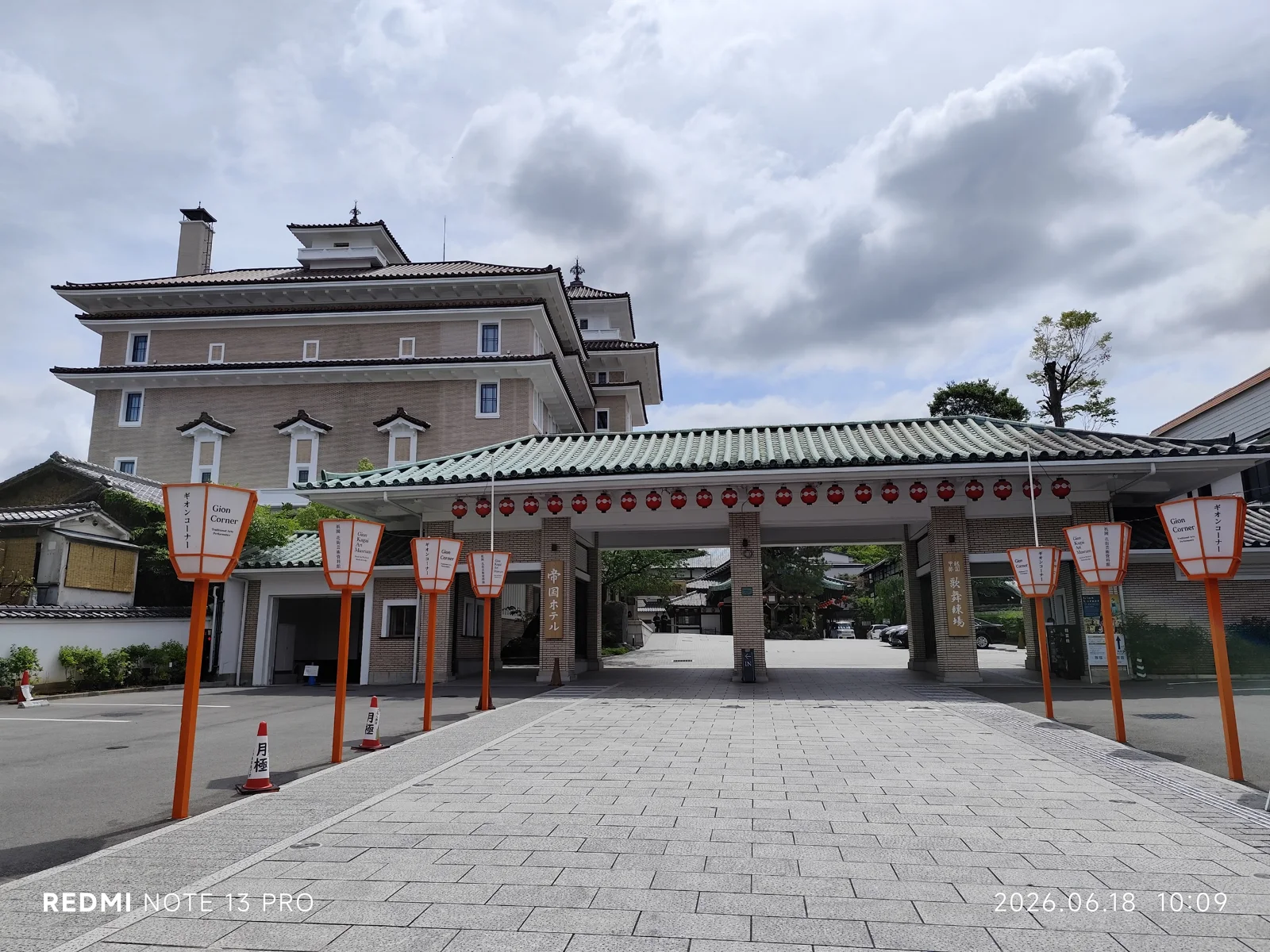
Growing outside Kitano Tenmangu's East Gate, Kamishichiken is one of Kyoto's five geisha districts (hanamachi). City archives recount that leftover timber from shrine renovations was used to build seven teahouses, and as Nishijin's textile trade boomed, local merchants and weaving masters became frequent patrons. Walking the public street, you pass uninterrupted rows of wooden lattices, deep eaves, and glowing entrance lanterns. Leave plenty of room for working or hurrying geiko and maiko, always ask permission before photographing people, and respect property lines—shop interiors, private courtyards, and alleys marked private belong to businesses and residents.
If you have 40 minutes to spare between a workshop and Kitano, detour down Itsutsuji-dori to Daihoon-ji. Better known as Senbon Shakado, its main hall survived the Onin War and is designated by Kyoto City as the oldest surviving temple building in central Kyoto (Rakuchu). Grounds open from 9:00 AM to 5:00 PM free of charge, while the main hall and Reiho-kan treasure hall require paid entry (enter the Reiho-kan by 4:00 PM). Heading back toward Kamishichiken brings you to the shrine's east side, grounding the morning's Onin War history in a building still standing today.
The East Gate brings you straight into Kitano Tenmangu without steps, making it wheelchair-accessible from Kamishichiken; arriving from the main southern torii, a ramp runs beside the Romon gate. General shrine grounds are free to enter—see the National Treasure main sanctuary dedicated to Sugawara no Michizane, the Sanko-mon gate, and the Ema Hall hung with votive plaques and Nishijin weaves. Same-day registration for private prayers closes at 4:00 PM at the amulet office (large groups must contact the shrine in advance). Because Sanko-mon closes 30 minutes ahead of the shrine itself, plan late arrivals using the shrine's daily opening hours.
The 25th of every month is the Tenjin-ichi flea market. If shopping is your goal, browse the stalls in the morning and walk back along Kamishichiken-dori toward the Textile Center, which is far calmer than hurrying back to the market after an afternoon class. In severe weather, check the shrine's official announcements for cancellations, and expect stall counts to vary with conditions. Shrine parking closes on market days, so ride City Bus 50 from Kyoto Station to Kitano Tenmangu-mae or walk from Randen Kitano-Hakubaicho Station. If carrying new pottery or vintage textiles through crowded streets, pause near the East Gate to pack large bags securely against your side.
Plum blossom and autumn foliage seasons pull shrine visits earlier in the day. With early-, mid-, and late-blooming plum cultivars, the shrine lists late February through early March as the best overall window. In autumn, the Momijien maple garden along the Kamiya River and Odoi earthen embankment charges separate admission. Built by Toyotomi Hideyoshi to ring Kyoto, the Odoi lets you look down over tree canopies from the ridge as well as follow streamside paths below—finish textile shopping earlier if you want bright daylight for foliage photos and time to walk the full garden.
In 2026, Momijien opens from October 31 to December 6, with evening illuminations running from November 13 through the final day. Regular daytime hours end at 4:00 PM (last entry 3:40 PM), while illumination nights stay open until 8:00 PM (last entry 7:40 PM). Admission is ¥1,500 for junior high students and older, ¥700 for children, and free for preschoolers. Pairing an afternoon workshop in autumn with dinner afterward lets you return comfortably for the night lighting; to trace the branches and earthen embankment clearly, budget an hour before dusk and save evening for the trip back.
Choosing Nishijin Textiles by Purpose and Checking the Seal
For a first purchase, start with a glasses case, small pouch, necktie, or table runner. When shopping for gifts, think about how the recipient will use the item—choose practical pockets, openings, or dimensions first, then pick the pattern. Because intricate brocades cut into small goods only show a fragment of the full design, compare two pieces of the same style to choose the motif placement you like best. Note that the Textile Center's second-floor shop also stocks crafts from other regions; to be sure you are buying Nishijin-ori, check the origin and maker labels or ask staff to point out which panel uses Nishijin fabric.
When shopping for an obi, ask to see the eyeglass-shaped certification seal issued by the Nishijin Textile Industrial Association, and read the weaver's registration number and weave category printed on it. You can look up the weaver's name in the Association's member directory. Ask specifically about warp and weft materials, whether the piece is handwoven, and which occasions suit the weave. On vintage obi missing original hangtags or seals, have the shop record any known weaver details, fiber content, and stains or wear on the item tag so you can weigh price against condition.
Checking tags pays off on practical accessories too. Some Tatetoyoko goods combine silk warps with polyester wefts finished with water- and stain-repellent coatings—useful for pouches tossed into bags or caught in rain. For delicate sheer silks, ask how to clean them and smooth out creases; for table runners, measure your table width and think about water rings or hot mugs. If a shop provides care notes, snap a photo of them alongside the item label.
When you see "haku" or "tsumugi" on a label, evaluate how the texture reads when worn. As the Association explains, haku weaving applies gold or silver leaf to washi paper, slices it into ultra-fine strips, and weaves them into the cloth strand by strand—ask staff to hold a piece under shop lighting so you can inspect it straight-on and at an angle, watching the motifs catch at the folds. Tsumugi uses yarn spun from silk floss for a slubbed, tactile surface; running your hand lightly across the weave shows why it excels in casual wear. For cloth marked "futsu" (double weave), ask to turn it over to see how the exact same motif reverses its color palette on the back.
If you only have room for one compact souvenir, Nishijin-fabric book covers and card cases preserve classic motifs while fitting easily in carry-on luggage. For book covers, check height and spine thickness—Japanese bunko paperback sizes may not fit larger international paperbacks. On card cases, inspect the stitched edges and corners to ensure card slots do not sit awkwardly across raised brocade threads. If you fall for a particular weaver's design, note the series name if printed on the packaging or card so you can look up matching pieces later.
Buying your first kimono obi? Bring outfit photos or exact colors and measurements of your kimono, since formal ceremonies and casual outings call for different obi types and knots. Ask whether separate tailoring (shitate) is required and what it costs; if picking up before leaving Japan, state your departure date upfront. If you want an order shipped overseas, ask the shop to write down the destination, total cost, estimated delivery date, and return or exchange policy before you pay, and keep your receipt and order form. Even if buying an obi purely for wall display, ask about decorative tapestry sizes first, as a full obi's length and width can be awkward to mount cleanly.
Choosing Your Entry Bus and Exit Route
To begin at the Textile Center from Kyoto Station, take the Karasuma Subway Line to Imadegawa Station and walk west along Imadegawa-dori for about 10 minutes. For a shorter walk, take City Bus 9 from Kyoto Station to Horikawa-Imadegawa and walk one or two minutes. Take Bus 12 from Shijo-Karasuma or Shijo-Kawaramachi, Bus 59 from Sanjo-Keihan, or Bus 201 or 203 from Keihan Demachiyanagi. Because Horikawa-Imadegawa stops sit on different corners depending on direction, verify stop locations and destinations on Kyoto City Bus maps before boarding—to head toward Kitano Tenmangu from near the Center, catch westbound Bus 203 or 51.
When finishing at Kitano, take Bus 50 to Kyoto Station, Bus 55 to Nijo Station or Hankyu Omiya, or eastbound Bus 203 back to Demachiyanagi. Continuing to Arashiyama or Omuro? Walk from the shrine to Randen Kitano-Hakubaicho Station and ride the Kitano Line, transferring at Katabiranotsuji if needed. Let hotel logistics pick your walking direction: if you are staying along the Karasuma Line and want the subway back, start at Kitano in the morning and walk east to Imadegawa; if staying near Nijo or Hankyu Omiya, walk west from the Center and board near the shrine.
Stamina and weather shape this walk more than map distance. Treat Imadegawa-dori as your east-west transit spine; walking west from Daikoku-cho, decide at Senbon-dori whether to keep going on foot or catch a bus. With umbrellas or strollers in rain, stick to wide avenues until the final turn rather than threading small backstreets. If visiting inside an oriya townhouse with a walker, ask in Japanese when booking—"Iriguchi to kengaku keiro ni dansa wa arimasu ka" ("Are there any steps at the entrance or along the tour route?")—and mention whether you will need a chair, locking the workshop into your itinerary only after confirming clear access.
If Tatetoyoko is your second stop, you can also walk north from Teranouchi to Imamiya Shrine. Recognized by Kyoto City as Nishijin's guardian shrine, its grounds hold Orihime Shrine dedicated to the weaving arts—look for stone lanterns shaped like weaving shuttles. Spend the rest of the day eating aburi-mochi, paying your respects, and catching a nearby bus. Both Kitano and Imamiya add extra walking, so on a half-day with a longer workshop visit, choose just one shrine to anchor the end of your route.
When meeting companions at Kitano Tenmangu, specify either the East Gate (Higashimon) or the First Torii (Ichi-no-Torii), as the two entrances stand on opposite sides. Walking from the workshops links naturally to the East Gate via Kamishichiken, whereas city bus riders arrive along the southern approach by the great torii. On flea market days or autumn illumination nights, gathering outside at an agreed gate before stepping into the grounds makes it much easier to stay together.
A few useful answers
How much is admission to the Nishijin Textile Center, and do I need a reservation?
Entry to the building and the Historical Exhibition Hall is free, and general visits do not require a reservation. Handweaving, kaleidoscope crafting, and kimono experiences require paid advance bookings.
Are kimono shows still running in 2026?
As of November 22, 2026, the Center's visitor page lists no scheduled live kimono shows. Plan your visit around the Historical Exhibition Hall, artisan demonstration area, or paid hands-on workshops instead.
What is the difference between handweaving at the Nishijin Textile Center and at Tatetoyoko?
The Textile Center session takes about 40 minutes on a tabletop handloom to weave a table runner. Tatetoyoko's 90-minute plan pairs a guided power-loom floor tour with handweaving on select dates and requires prepayment. Both accept participants from fifth grade and up.
Can I do the Nishijin half-day walk on a Monday?
On regular Mondays, both the Nishijin Textile Center and Orinasukan are closed, so focus on Kamishichiken's public streets and Kitano Tenmangu. On Monday national holidays, the Textile Center opens and closes Tuesday instead, while Orinasukan remains closed.
Which day of the month is the Tenjin-ichi flea market?
Kitano Tenmangu holds its monthly Tenjin-ichi flea market on the 25th. If browsing stalls is your priority, visit the shrine in the morning and walk along Kamishichiken toward the Textile Center afterward. Check the shrine's official website for weather-related cancellation notices.
Official information and references
Sources used in this guide.
- Nishijin Textile Industrial Association | Nishijin Textile Center Hours & Access
- Nishijin Textile Industrial Association | Historical Exhibition Hall & Kimono Show Notice
- Nishijin Textile Industrial Association | Sericulture, Silk Reeling & Artisan Demonstrations
- Nishijin Textile Industrial Association | Handweaving & Kaleidoscope Experiences
- Nishijin Textile Industrial Association | Kimono Experiences, Pricing & Return Deadlines
- Nishijin Textile Industrial Association | Nishijin Textile Center Reservations
- Nishijin Textile Industrial Association | Weaving Production Process
- Nishijin Textile Industrial Association | District Division of Labor
- Nishijin Textile Industrial Association | Nishijin Textile Varieties
- Nishijin Textile Industrial Association | Obi Weaving Techniques & Gold/Silver Foil
- Nishijin Textile Industrial Association | Definition, Varieties & Certification Seal
- Nishijin Textile Industrial Association | Member Weaver Directory
- Nishijin Textile Industrial Association | Orihaku & Current Exhibition Hall Collection Show
- Orinasukan Handweaving Museum | Exhibits, Admission & Access
- Orinasukan Handweaving Museum | Watabun Handweaving Workshop
- Orinasukan Handweaving Museum | Handweaving Experience
- Tomiya Orimono | Teranouchi Studio, Loom Tours & Fabrics
- Kyoto City Travel Guide | Tomiya Orimono Studio Tour & Handweaving Booking
- Sozen | Machiya Cafe & Operating Days
- City of Kyoto | Nishijin Textiles & Lyon Jacquard Technology
- Kyoto City Cultural Properties Protection Division | Kitano, Nishijin & Kamishichiken
- Kyoto City Travel Guide | Kyoto City Archaeological Museum
- Kyoto City Travel Guide | Kamishichiken Walk & Awamochisho
- Daihoon-ji | Senbon Shakado Hours & Visitor Information
- Kyoto Media Support Center | Aburi-mochi Outside Imamiya Shrine
- Kitano Tenmangu | Worship & Access
- Kitano Tenmangu | Plum Blossoms, Tenjin-ichi Market & Step-Free Access
- Kyoto City Travel Guide | 2026 Kitano Momijien Special Opening & Illuminations
- Kyoto City Transportation Bureau | Horikawa-Imadegawa Bus Stops & Timetables
- Kyoto City Travel Guide | Kyoto Street Walking Etiquette