A half-day walk through Kyoto's Nishijin district from the Nishijin Textile Centre to Kamishichiken and Kitano Tenmangu Shrine. Covers handweaving and kimono booking fees, choosing a workshop, machiya café hours and reading the Nishijin seal.
- Region & Focus
- KyotoNeighbourhoods and shopping
- Reading Scope
- 18 min read · 9 chapters · 5 Q&As
- Official Verification
- 30 official sources checkedUpdated 22 November 2026
Chapter Route Map (tap any stop)
- A Half-Day Walk from Horikawa-Imadegawa to Kitano
- What to See for Free at the Nishijin Textile Centre
- How to Book Handweaving, Kaleidoscopes and Kimono
- Understanding Nishijin Weaving Before Visiting a Workshop
- Choosing a Workshop: Orinasukan vs Tatetoyoko
- A Break at Souzen Café Inside a Weaver's Townhouse
- Through Kamishichiken to Kitano Tenmangu Shrine
- Buying Nishijin Textiles: Purpose First, Then the Seal
- Transport: Which End to Start From and How to Leave
- Quick Q&A
On a first visit to Kyoto's Nishijin district, start at the Nishijin Textile Centre at Horikawa-Imadegawa to see looms and obi sashes, head towards Daikoku-cho to find weaver's townhouses with preserved workrooms, and finish via Kamishichiken at Kitano Tenmangu Shrine. Allow four to five hours so you have time for one workshop, a seated break for refreshments and a shrine visit. If you want to weave fabric yourself, book the Centre's 40-minute handweaving session or pick a guided workshop slot. If renting a kimono to wear outdoors, plan a shorter loop since garments must be returned to the Centre in the afternoon.
A Half-Day Walk from Horikawa-Imadegawa to Kitano
Start at 10:00 at the Nishijin Textile Centre, allowing 45 minutes to an hour for the archive exhibition room and artisan demonstration area. Leave the building and head west along Imadegawa-dori; around Omiya-dori you can view the exterior of the former Nishijin Textile Museum. Turn north at Imadegawa-Jofukuji onto Jofukuji-dori towards Daikoku-cho. After seeing the exhibitions at Orinasukan, loop back to Imadegawa-dori near Senbon-dori and continue towards Kamishichiken and Kitano Tenmangu Shrine. Because the route involves several turns, pin the Centre, Orinasukan, Kamishichiken-dori and the shrine's East Gate in order on your map app, then load the final leg once you cross Senbon-dori.
Anchor your departure around one fixed booking time. If you are only visiting exhibitions, wander at your own pace and stop for 40 minutes around lunchtime. With a 13:30 workshop slot, finish the Centre in the morning and check in after lunch. If your workshop is at 15:30, flip the route: start at Kitano in the morning, walk east, pause at the Centre around midday and finish at the Teranouchi workshop in the afternoon. From there, catch a bus from Kenryu-ko-mae instead of doubling back to Kitano.
If you only have two hours, stay in eastern Nishijin. Walk from the Centre to the former Nishijin Textile Museum, then decide between exploring the townhouses of Daikoku-cho or spending longer with the third-floor exhibits at the Centre. Visitors staying near Kitano can trim the outing to a compact loop around Kamishichiken, the East Gate and the main shrine hall. When you have handweaving booked, children in tow or someone in your party who walks slowly, taking a bus between the workshop and the shrine is far more comfortable than rushing three stops on foot.
Mondays are the easiest scheduling trap to fall into. The Nishijin Textile Centre normally closes on Mondays, though it opens on Japanese public holidays and closes the following Tuesday instead. Orinasukan closes on Mondays even when they fall on a public holiday. Ordinary Tuesdays through Sundays are the simplest days to pair both venues; over holiday weekends, check closing days alongside your booking slots before locking in a date. If your itinerary only leaves an ordinary Monday free, spend your half-day on the public streets of Kamishichiken and inside Kitano Tenmangu's grounds, arriving and leaving via the shrine.
A half-day walk through Kyoto's Nishijin district from the Nishijin Textile Centre to Kamishichiken and Kitano Tenmangu Shrine. Covers handweaving and kimono booking fees, choosing a workshop, machiya café hours and reading the Nishijin seal.
What to See for Free at the Nishijin Textile Centre
The Nishijin Textile Centre sits at 414 Tate-monzen-cho in Kamigyo Ward, on the south side of the Horikawa-dori and Imadegawa-dori junction. Admission is free. Opening hours are 10:00 to 16:00 from October to March and 10:00 to 17:00 from April to September, with New Year closures from 29 December to 3 January. If you arrive on a November afternoon, head straight to the third-floor archive exhibition room first and leave second-floor shopping until just before you leave. The Nishijin Textile Industrial Association's visitor page currently lists no scheduled live kimono shows, so cross old guidebook showtimes off your plan.
Models and videos on the ground floor explain sericulture, reeling silk from cocoons and weaving cloth, making it an easy starting point with children. Up in the second-floor artisan demonstration area, look out for nukinishiki weft brocade and tsumekaki hon-tsuzure-ori fingernail tapestry weaving. The first uses a handloom fitted with a punch-card Jacquard mechanism; the second involves following a design placed beneath the warp and using notched fingernails to pack down sections of weft thread. If crowds block your view of the weaver's hands, step to the side to trace where each thread enters the cloth. The Centre also introduces zaguri, the technique of drawing silk from cocoons onto bobbins, so when a demonstration is running you can watch raw fibre become workable yarn.
The third-floor permanent exhibition displays Japan's first wooden Jacquard mechanism, a Kyoto City Designated Cultural Property. Punch cards are a long linked strip of perforated cards in which the hole positions on each card dictate which warp threads lift. Picture them as a stack of instructions read sequentially by the loom; looking back at a finished textile, every repeating petal and continuous border had to be broken down into individual picks. Modern equipment can drive warp threads with digital patterns, so after inspecting the punch cards here, it is easy to spot the shared logic on the direct-controlled power looms at Tomiya Orimono.
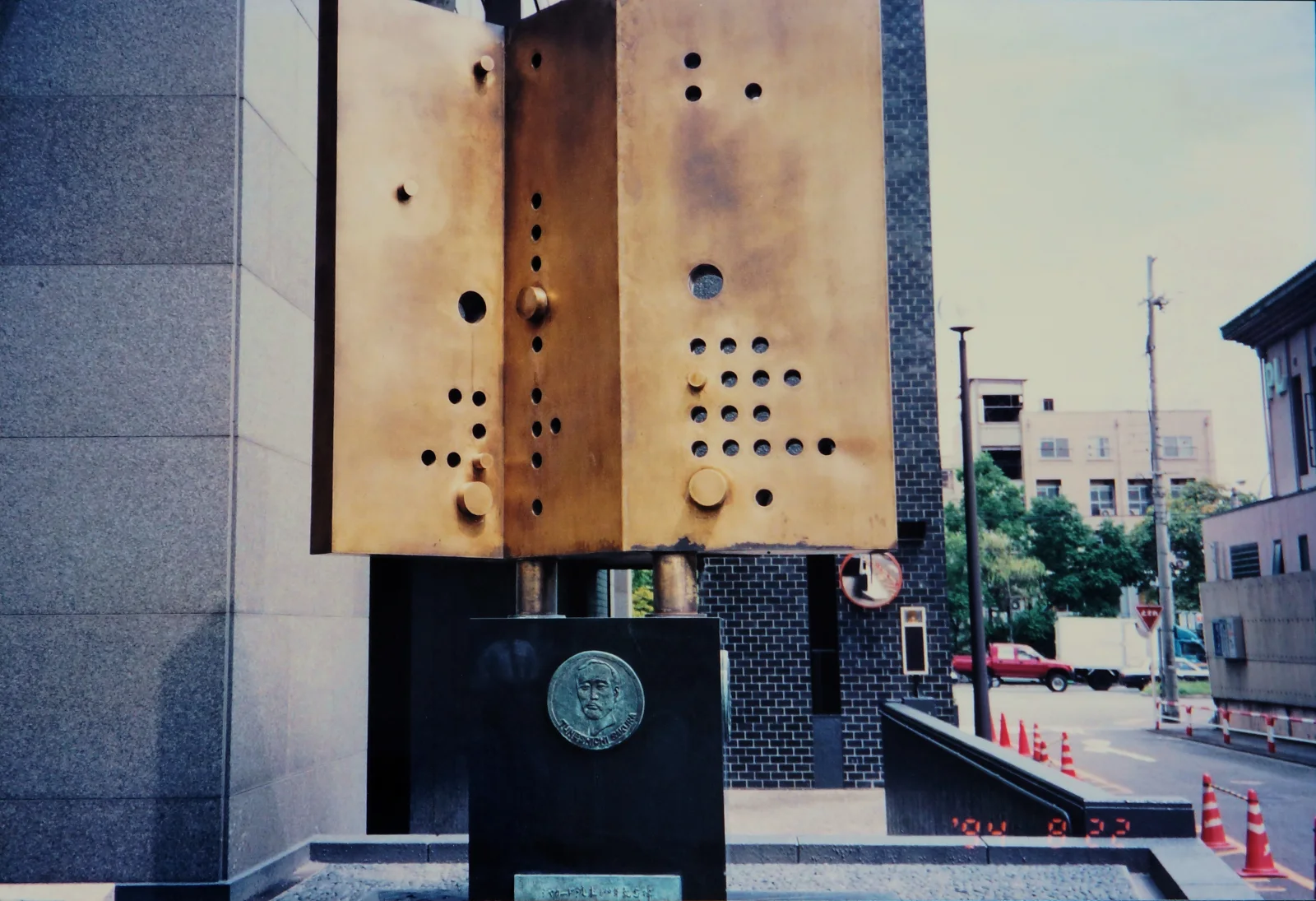
Outside the building stands a Jacquard loom monument shaped like a giant perforated punch card. Kyoto City historical records note that in the early Meiji era, Nishijin weavers travelled to Lyon in France and brought both Jacquard and flying-shuttle mechanisms back to Kyoto, so the outdoor sculpture pairs neatly with the wooden mechanism upstairs. When setting up satnav or map pins, keep the Nishijin Textile Centre and the Kyoto City Archaeological Museum as two separate stops: the "former Nishijin Textile Museum" refers to the Archaeological Museum building, whereas active textile displays and handweaving check-in are at Horikawa-Imadegawa.
To see more finished work, combine the permanent gallery with the special exhibition in the archive room. Obi sashes show how a single motif repeats along a narrow length of cloth, while fabric folding screens and interior furnishings illustrate how the same techniques adapt to larger dimensions and longer viewing distances. From 3 November 2026 to 28 March 2027, the third-floor archive room hosts a free collection exhibition marking the 400th anniversary of the Kan'ei Imperial Visit. If you plan to visit both textile museums in one day, focus on the Jacquard mechanisms and this special exhibition at the Centre, saving handwoven garments for Orinasukan.
How to Book Handweaving, Kaleidoscopes and Kimono
The Centre's small handlooms suit complete beginners. You weave a table runner measuring roughly 20 by 30 centimetres in about 40 minutes and take it home afterwards. Participants must be in primary Year 5 (roughly age 10) or older. From October 2026, individual admission is ¥2,750 for adults and ¥2,530 for students. Since that slot covers time seated at the loom, allow at least an hour and a half at the Centre if you also want to browse the archive room and shop. You learn to raise alternating warp threads, pass the shuttle and beat the weft tight; even if neighbours finish faster, take your time keeping the selvedges even.
If children in your group are too young for the loom, book a kaleidoscope session decorated with Nishijin fabric offcuts. Listed start times are 10:30, 13:30 and 14:30 for up to four people per slot, taking around 30 minutes at ¥1,980 per person. Children in primary Year 2 or below must be accompanied by a parent or guardian. If your party wants to split across both activities, note both on the booking page, which offers English and Simplified Chinese forms. A reservation is only confirmed once the Centre replies; next-day bookings are accepted by phone only between 10:00 and 16:00 JST.
To walk the surrounding streets in kimono, book the komon outdoor plan at ¥8,800; the indoor-only plan is ¥5,500. Dressing takes roughly 20 minutes and excludes hair and makeup. Outdoor rentals must be returned 30 minutes before closing, meaning 15:30 or 16:30 depending on the season. The most relaxed plan is to stroll around Imadegawa-Omiya after dressing, return the kimono after lunch and change back into your own shoes before continuing to Kitano. If you want to visit Kamishichiken in kimono, build in a taxi or return bus so you get back comfortably before the deadline.
The junihitoe court robe for women and sokutai attire for men require a much longer slot. The Centre lists each at around 80 minutes and ¥48,400, including hair, makeup and one commemorative photograph, with a minimum height of 145 centimetres. For children aged roughly five to eight, there is a separate indoor-only children's kimono plan for heights between 110 and 128 centimetres at ¥11,000. Treat these elaborate dress-up sessions as a dedicated activity and leave breathing room before or after to see the galleries.
Understanding Nishijin Weaving Before Visiting a Workshop
The Nishijin Textile Industrial Association defines Nishijin-ori as yarn-dyed patterned textiles produced in Kyoto's Nishijin district, spanning 12 nationally designated traditional crafts. On any piece of cloth, the warp runs lengthwise and the weft crosses horizontally, building motifs where the two intersect. When you spot a band of gold patterning in a display case, look closely to see whether it appears segment by segment along the weft and check nearby labels for fabric swatches, fibres or process notes. Once you grasp that basic structure, it becomes far easier to compare two seemingly similar obi sashes side by side.
Before a single thread goes onto a loom, a textile has already passed through multiple hands. After the orimoto weaving house finalises a design, the motif must be translated into a weave chart dictating every warp and weft intersection. Yarn colours, dyeing and thickness are set next, and the warp threads are wound onto the beam in sequence. At the demonstration looms, spend a few extra seconds watching the overhead mechanism lifting selected warp threads while the newly passed weft is beaten snug at the fell line below; watching both points together explains far more than simply following the shuttle back and forth.
That multi-stage workflow explains why the textile trade spread across several neighbouring streets. Nishijin developed specialist pattern designers, yarn dyers and warp winders alongside the weavers themselves. Because the Association still organises the district around this division of labour, weaving workshops, raw-material dealers and tonya wholesalers sit side by side. Walking near Imadegawa-Omiya, picture bolts of cloth and raw silk changing hands between shops: Kyoto City heritage records note the junction's old nickname, Senryo-ga-tsuji, recalling when silk dealers, textile wholesalers and financiers clustered here.
The name Nishijin comes from the Western Army's encampment during the Onin War. Kyoto City records trace local weaving back to the Heian period, noting that artisans who fled during the fighting later returned and rebuilt their trade, gradually giving the district the name Nishijin. Walking from the Centre towards Imadegawa-Omiya, pause outside the Kyoto City Archaeological Museum. This Taisho-era building originally served as the Nishijin Textile Museum and has a stone Nishijin Monument stele out front; although the galleries focus on excavated artefacts from across Kyoto, the building and stele alone warrant a brief stop.
If an early train gets you to the area before the Centre opens, step inside the Archaeological Museum first. It opens at 09:00 with free admission, closes at 17:00 and admits its last visitors at 16:30. Displays arrange excavated pieces chronologically and use maps and photographs to locate historic sites across the city, making the walk back along Imadegawa-dori to the Centre much richer than waiting outside locked doors. Note that its New Year closure begins a day earlier than the Centre's, running from 28 December to 3 January.
Weaving workshops and private homes alternate along the same narrow streets. Looking at timber street lattices, shop doorways and deep passages running towards the rear, you can trace how client meetings, family life and production fitted onto a single narrow plot. Oriya-date weaver's townhouses usually feature higher ceilings and tailored lighting in the rear room built to house the looms. When seeking out working interiors, stick strictly to workshops displaying a public entrance and open signage; for closed small workshops, admire the latticework and eaves from the public street.
Choosing a Workshop: Orinasukan vs Tatetoyoko
For handwoven garments and an intact weaver's townhouse, choose Orinasukan. Operated by the Foundation for the Promotion of Handweaving Techniques, this museum sits at 693 Daikoku-cho on Jofukuji-dori just north of Kamitachiuri, roughly five minutes on foot from the Imadegawa-Jofukuji bus stop. Opening hours are Tuesday to Sunday from 10:00 to 16:00, with admission at ¥1,000 for adults and ¥700 for senior high school students. The former textile merchant's machiya displays reconstructed Noh costumes, period garments and handwoven cloths from various regions; seeing how Noh motifs wrap across sleeves and shoulders conveys scale far better than looking at flat yardage.
Orinasukan also introduces visitors to Watabun's nearby Daikoku-cho handweaving mill, where commissioned obi sashes are woven. If watching master weavers at work is your main goal, email or write to the museum in advance with your preferred date and party size to ask whether a mill visit can be added to your tour. Orinasukan also runs a roughly three-hour handweaving session that accepts solo bookings at ¥11,000 including museum admission. Dedicate a morning to weaving and leave lunch and the shrine loose for the afternoon, or stick to a shorter exhibition visit if you prefer an unhurried walk from Daikoku-cho to Kitano.
To see working power looms in action, pick Nishijin Kobo Tatetoyoko, the Teranouchi Workshop run by Tomiya Orimono. It offers a ¥300 guided tour of the loom floor and showroom lasting about 15 minutes, with no photography permitted on the loom floor; enquire via the email address on the workshop webpage to arrange a short tour. Note that Tomiya Orimono's head office appears separately on maps, so make sure you save the Teranouchi Workshop pin. Take City Bus 6 or 206 to Kenryu-ko-mae and walk about three minutes.
You can also book Tatetoyoko's 90-minute tour and handweaving package. The Kyoto City Tourism Association registration page lists selected dates with slots at 10:00, 13:30 and 15:30 JST, requiring advance booking and prepayment. Fees are ¥4,250 for adults and ¥3,920 for students, open to primary Year 5 (roughly age 10) and above. You pick one weft colour, work foot pedals to raise two alternating sets of warp threads, pass the shuttle by hand and beat each pick tight to take home a roughly 30-centimetre table runner. Companions who prefer not to weave can browse Nishijin wagashi sweet shops or Kamishichiken and rejoin you at the next stop.
If you want to understand both handweaving and mechanised weaving, start with the Centre's wooden Jacquard loom and then pick one workshop for live production. Seeing real looms alongside an explanation lets you ask concrete questions, such as how a motif is broken down on a weave chart or how weavers keep the cloth edges straight. Should you visit both workshops, place your booked session in the middle of the day and keep the second stop to an exhibition or quick tour. Making even a small handwoven piece yourself makes the far more intricate museum weaves much easier to read afterwards.
A Break at Souzen Café Inside a Weaver's Townhouse
For a machiya café that preserves its weaver's townhouse architecture, stop at Kyomachiya Sabo Souzen on the corner of Teranouchi-dori and Jofukuji-dori. The shop describes the building as a roughly century-old oriya-date townhouse whose high-ceilinged rear section once housed looms. Walk through from the lower street-front rooms and look up at the beams and roof height to see the shift in volume far more clearly than you can from a doorway photo. The menu features arare rice crackers, chilled warabimochi and a Nishijin parfait, or you can look up their arare-yaki rice-cracker grilling experience as an afternoon stop in its own right.
Souzen runs separate schedules for its café and retail shop. Current listings open the café on Saturdays, Sundays and public holidays from 11:30 to 18:00, with last orders at 17:30. The retail shop generally opens from 10:30 to 18:00 and closes on Mondays and Tuesdays unless a public holiday falls on those days. On weekdays, pop in for a packet of rice crackers and plan lunch or coffee along Imadegawa-dori so you are not hunting for a seat at the last minute and can time your departure for a workshop accurately.
Walking north from Orinasukan, Souzen slots neatly right after a morning weaving session. If your workshop is near Senbon-dori, lock in your check-in time before deciding which end of the route gets your rest stop. In wet weather, commit to one major indoor venue with a nearby café or restaurant and take a bus for the Kitano leg. On bright sunny days, follow broad Imadegawa-dori to a clear junction before dipping into quiet backstreets for machiya architecture. Bear in mind that deliveries, couriers and cyclists still use these narrow lanes, so step clear of entrances and traffic whenever checking your map or waiting for companions.
If you save sweets until you reach Kitano, look for Awamochi-dokoro Sawaya on Imadegawa-dori directly opposite the southern Great Torii gate. Featured in Kyoto City walking routes, this long-standing shop serves soft millet rice cakes rolled in roasted soybean kinako flour or filled with smooth red bean paste. Entering Kitano Tenmangu through the East Gate from Kamishichiken lets you pay your respects first and exit south for a seat or a bus stop. Charcoal-grilled aburi-mochi lies further north outside Imamiya Shrine, offering an alternative northward finish towards Murasakino after your workshop.
Through Kamishichiken to Kitano Tenmangu Shrine
Developed outside Kitano Tenmangu Shrine's East Gate, Kamishichiken is the oldest of Kyoto's five geisha districts. Kyoto City records recount that timber left over from shrine repairs was used to build seven teahouses, later frequented by prosperous Nishijin merchants and weaving house owners. Walking along the public street reveals continuous wooden latticework, low eaves and softly lit doorway lanterns. Give way to geiko and maiko heading to or from appointments, always ask before photographing people, and watch property boundaries so you do not step into shop interiors, private courtyards or marked private alleys.
If you have 40 minutes spare between a workshop and Kitano, detour along Itsutsuji-dori to Daihoon-ji, better known as Senbon Shakado. Its main hall survived the Onin War and is recognised by Kyoto City as the oldest surviving temple building in central Kyoto. The grounds open from 09:00 to 17:00 free of charge, while the main hall and Reihokan treasure hall require paid admission with last entry to the treasure hall at 16:00. Heading back towards Kamishichiken brings you neatly onto the shrine's eastern side, anchoring the morning's tales of medieval conflict in a building you can see for yourself.
The East Gate leads straight into Kitano Tenmangu's grounds with a step-free approach suitable for wheelchair users arriving from Kamishichiken; visitors coming up from the main southern Great Torii find a ramp beside the Romon gate. Entering the main grounds is free, taking you past the National Treasure shrine buildings dedicated to Sugawara no Michizane, the ornate Sanko-mon gate and the Ema-do hall hung with votive wooden plaques and Nishijin textiles. For formal indoor prayers, individuals register on the day at the Juyosho office until 16:00, while large groups should contact the shrine beforehand. Note that Sanko-mon closes 30 minutes before overall closing time, so check the shrine's daily opening hours if arriving late in the day.
The 25th of every month brings the Tenjin-ichi market. If browsing antiques and stalls is your goal, visit the shrine first thing in the morning and walk back along Kamishichiken towards the Textile Centre rather than rushing back after a workshop. The shrine announces weather cancellations on its official website, and stall numbers vary on the day. Note that the shrine car park closes on market days: take City Bus 50 from Kyoto Station to Kitano Tenmangu-mae or walk from Randen Kitano-Hakubaicho Station. If you pick up ceramics or vintage textiles, pause near the East Gate to pack bulky bags securely so you do not knock into passers-by.
Plum blossom and autumn foliage seasons both reward an earlier start at the shrine. With early, mid- and late-blooming plum varieties across the grounds, the shrine cites late February to early March as peak overall bloom. In autumn, the Momiji-en maple garden along the Kamiya River and Odoi earthworks on the shrine's western edge charges separate admission. Built by Toyotomi Hideyoshi as Kyoto's defensive rampart, the Odoi lets you look down over the treetops before walking the valley paths below; move textile shopping earlier in the day so you have daylight to walk the full garden trail.
In 2026, Momiji-en opens from 31 October to 6 December, with evening illuminations from 13 November until the final day. Standard daytime hours run until 16:00 with last admission at 15:40, extending to 20:00 with last admission at 19:40 during illuminations. Admission is ¥1,500 for junior high students and adults, ¥700 for younger children and free for pre-schoolers. If you book an afternoon workshop in autumn, stop for dinner after class and return to Kitano for the night illuminations; to see the foliage and ramparts clearly in daylight, ring-fence an hour before dusk and leave the evening commute until afterwards.
Buying Nishijin Textiles: Purpose First, Then the Seal
A glasses case, small pouch, tie or table runner makes an approachable first purchase. When choosing a gift, think first about how the recipient will use it — pockets, clasp style or length — before settling on a pattern. Intricate woven motifs cropped down to small accessories only show a corner of the full design, so compare two pieces of the same item to pick the placement you prefer. Because the Textile Centre's second-floor shop also stocks crafts from other Japanese regions, check the origin and maker labels or ask staff which parts use genuine Nishijin cloth.
When buying an obi sash, ask to see the spectacles-shaped certification seal issued by the Nishijin Textile Industrial Association and check the weaver registration number and weave category printed on it. You can look up the weaver number via the Association's member directory. Ask which fibres form the warp and weft, whether the piece is handwoven or power-loomed and which occasions it suits. On secondhand obi lacking original tags or seals, ask the shop to write down the known weaver, fibre content and any wear or staining before weighing it against your budget.
Checking fabric labels is particularly worthwhile for practical accessories. Some small goods at Tatetoyoko combine a silk warp with a polyester weft and add water- and stain-repellent finishes, a sensible choice for pouches tossed onto café tables or caught in rain. For fine pure silk pieces, ask about cleaning and smoothing creases after packing. Before buying a table runner, measure your table width and consider splashes or hot mugs; if a care card is included, photograph it alongside the product label.
When you see haku or tsumugi on shop labels, picture how each looks when worn. The Association explains haku as washi paper gilded with gold or silver foil, sliced into fine strips and woven line by line into the fabric; ask staff to hold it under light and view it both straight on and at an angle to see the foil glint along the folds. Tsumugi is spun from silk floss for a slubbier, matte texture favoured for casual everyday wear. If you spot futsu double-cloth weave, ask to turn it over to see how the same motif swaps colourways cleanly on the reverse.
For a single lightweight souvenir, a Nishijin cloth book cover or cardholder preserves rich patterning while fitting easily into hand luggage. Check book cover height and spine capacity carefully, as Japanese bunko paperback covers rarely fit standard international paperbacks. On cardholders, inspect the seams and corners to confirm card slots do not cut awkwardly across raised weave textures. If you fall for a particular weaving house's motif, check whether the packaging or card lists a collection name so you can track down matching sizes later.
If buying your first kimono obi, bring photographs of your outfits or exact pattern and measurement notes for your existing kimono, since formal versus casual wear dictates both weave and tying style. Ask whether tailoring is charged separately and what it covers, and give your departure date straight away if collecting before leaving Japan. Should you wish to have a piece shipped home overseas, ask the shop to put the delivery destination, total fee, estimated dispatch date and return or exchange conditions in writing before paying, and keep both the receipt and order copy. If buying an obi purely for display, check hanging measurements first, as full sash proportions can be tricky to mount on an ordinary wall.
Transport: Which End to Start From and How to Leave
Starting at the Nishijin Textile Centre, take the Karasuma Line underground from Kyoto Station to Imadegawa Station and walk west along Imadegawa-dori for about 10 minutes. For a shorter walk, take City Bus 9 from Kyoto Station straight to Horikawa-Imadegawa, leaving just a one- or two-minute stroll. Bus 12 connects from Shijo-Karasuma and Shijo-Kawaramachi, Bus 59 serves Sanjo-Keihan and Buses 201 and 203 run from Keihan Demachiyanagi. Because Horikawa-Imadegawa bus stops sit on different corners depending on direction, check Kyoto City Transport Bureau bay maps before boarding — westbound Buses 203 and 51 marked for Kitano Tenmangu-mae connect straight from the Centre to the shrine.
Finishing at Kitano Tenmangu, catch Bus 50 back to Kyoto Station, Bus 55 to Nijo Station or Hankyu Omiya, or eastbound Bus 203 back towards Demachiyanagi. Travellers continuing to Arashiyama or Omuro can walk to Randen Kitano-Hakubaicho Station for the Kitano Line, changing at Katabiranotsuji if required. If you need to pick up luggage from your hotel before leaving Kyoto, let your train line set your direction: visitors staying along the Karasuma Line can start at Kitano in the morning and walk back to Imadegawa Station in the afternoon, whereas those near Nijo or Hankyu Omiya can start at the Centre and board near the shrine at the end.
Energy levels and weather affect this walk far more than map distances suggest. Treat Imadegawa-dori as your central bus spine: heading west from Daikoku-cho, decide at Senbon-dori whether to keep walking or hop on a bus. In rain with umbrellas or pushchairs, stick to main avenues until the nearest turning rather than threading through every narrow lane. If anyone in your party uses a walking frame and plans to tour inside a workshop, ask in Japanese when booking — "Iriguchi to kengaku keiro ni dansa wa arimasu ka?" ("Are there steps at the entrance or along the tour route?") — and note if a chair is needed before locking the visit into your schedule.
If Tatetoyoko is your second stop, you can also head north from Teranouchi to Imamiya Shrine. Kyoto City recognises Imamiya as Nishijin's tutelary shrine, and its subsidiary Orihime Shrine honours weaving arts with stone lanterns carved in the shape of shuttles. Finish there with charcoal-grilled aburi-mochi, pay your respects and catch a bus nearby. Since both Kitano and Imamiya add extra walking, stick to whichever shrine matches your finish on a half-day that already includes a lengthy workshop.
When meeting companions at Kitano Tenmangu, specify either the East Gate or the First Torii, as they sit on different sides of the grounds. Those walking from the workshops via Kamishichiken arrive seamlessly at the East Gate, whereas City Bus passengers usually alight near the southern Great Torii approach. Picking an exact gate beforehand saves plenty of hunting around during busy monthly markets or autumn evening illuminations.
A few useful answers
How much is admission to the Nishijin Textile Centre, and do I need to book?
Entry to the building and the archive exhibition room is free, and general visits require no booking. Handweaving, kaleidoscope and kimono experiences cost extra and must be booked in advance.
Are there still kimono shows in 2026?
As checked on 22 November 2026, the Centre's visitor page lists no scheduled live kimono shows. Plan around the archive exhibition room, artisan demonstrations or paid workshops instead.
What is the difference between handweaving at the Nishijin Textile Centre and at Tatetoyoko?
The Centre's session lasts about 40 minutes and uses a small handloom to weave a table runner. Tatetoyoko's 90-minute package combines a guided tour of the working power-loom floor with handweaving, running on selected dates with advance prepayment. Both accept participants from primary Year 5 (around age 10) upwards.
Can I do the Nishijin half-day walk on a Monday?
On an ordinary Monday, both the Nishijin Textile Centre and Orinasukan are closed, so focus on the streets of Kamishichiken and Kitano Tenmangu Shrine. On a Monday public holiday, the Centre opens and closes on the Tuesday instead, while Orinasukan remains closed on Mondays even on public holidays.
Which day of the month is the Tenjin-ichi market held?
Kitano Tenmangu Shrine holds its Tenjin-ichi market on the 25th of every month. If browsing stalls is your priority, start at the shrine in the morning and walk along Kamishichiken towards the Nishijin Textile Centre afterwards. Any weather cancellations are posted on the shrine's official website.
Official information and references
Sources used in this guide.
- Nishijin Textile Industrial Association - Nishijin Textile Centre Opening Hours and Access
- Nishijin Textile Industrial Association - Archive Exhibition Room and Kimono Show Notice
- Nishijin Textile Industrial Association - Sericulture, Reeling and Artisan Demonstrations
- Nishijin Textile Industrial Association - Handweaving and Kaleidoscope Experiences
- Nishijin Textile Industrial Association - Kimono Dressing Plans, Prices and Return Times
- Nishijin Textile Industrial Association - Nishijin Textile Centre Activity Bookings
- Nishijin Textile Industrial Association - Production Process
- Nishijin Textile Industrial Association - District Division of Labour
- Nishijin Textile Industrial Association - Categories of Nishijin Textiles
- Nishijin Textile Industrial Association - Obi Weaving Techniques and Foil Threads
- Nishijin Textile Industrial Association - Definition, Craft Varieties and Certification Seal
- Nishijin Textile Industrial Association - Member Weaver Directory
- Nishijin Textile Industrial Association - Orihaku and Current Archive Collection Exhibition
- Handweaving Museum Orinasukan - Exhibitions, Admission and Access
- Handweaving Museum Orinasukan - Watabun Handweaving Mill Visits
- Handweaving Museum Orinasukan - Handweaving Experience
- Tomiya Orimono - Teranouchi Workshop, Loom Tours and Fabrics
- Kyoto City Official Travel Guide - Tomiya Orimono Workshop Tour and Handweaving Booking
- Souzen - Machiya Café and Opening Days
- City of Kyoto - Nishijin Weaving and the Lyon Jacquard Mechanism
- Kyoto City Cultural Properties Protection Division - Kitano, Nishijin and Kamishichiken
- Kyoto City Official Travel Guide - Kyoto City Archaeological Museum
- Kyoto City Official Travel Guide - Kamishichiken Walk and Awamochi-dokoro Sawaya
- Daihoon-ji Temple - Senbon Shakado Opening Hours and Visitor Information
- Kyoto Film Office - Aburi-mochi Outside Imamiya Shrine
- Kitano Tenmangu Shrine - Worship Hours and Access
- Kitano Tenmangu Shrine - Plum Blossoms, Tenjin-ichi Market and Step-Free Access
- Kyoto City Official Travel Guide - 2026 Kitano Momiji-en Special Opening and Illuminations
- Kyoto City Transport Bureau - Horikawa-Imadegawa Bus Stops and Timetables
- Kyoto City Official Travel Guide - Kyoto Neighbourhood Walking Etiquette