Walk Ginkaku-ji's garden past the Ginshadan (silver sand garden), the Kogetsudai mound, Kinkyochi Pond and hillside rock groupings, and keep the standard ticket and the 2026 autumn special viewing of the Togudo hall clearly apart. Includes same-day registration, the Japanese-only (no translation) rule, the Sengetsusen detour, a half-day example and a southern Philosopher's Path return.
- Region & Focus
- KyotoShrines and temples
- Reading Scope
- 30 min read · 14 chapters · 4 Q&As
- Official Verification
- 10 official sources checkedUpdated 22 November 2026
- Key Topics
- ItinerariesBookingKyoto, Osaka & Kansai
Chapter Route Map (tap any stop)
- First decide whether to give half a day to the garden, or to add an interior tour
- The two buildings left from the Higashiyama dono are the real starting point for reading the history
- From the main gate to the middle gate: first walk the roughly 50-metre Ginkaku-ji fence
- At the Silver Sand Beach, look at the edges and the raked patterns; the moonlight story is kept as folklore
- Kogetsudai and Kannonden: looking at the sand silhouette and the pavilion's two storeys separately
- Around Kinkyochi Pond: putting Ginkaku and Togudo back into the same garden
- Sengetsusen: where the water connects, and the turning point of the fewer-stairs version
- Hojo and Togudo: recognise the exteriors first, then decide which interiors to see
- Dōjin-sai and Rōsei-tei: distinct things to look for in the shoin and the oki-no-zashiki
- The 2026 autumn special opening: how the same-day form, assembly and Japanese-language conditions fit together
- South along the Philosopher's Path, joining the route to Keage only after Nyakuōji
- Two half-day examples that genuinely preserve the waiting time and lunch
- From Kyoto Station via Imadegawa and bus 203: on the way back, your last stop decides the route
- Tickets, December timings and goshuin seals: budgeting them separately makes the trade-offs easier
- Quick Q&A
A standard visit to Ginkaku-ji centres on the garden; to enter the Dojinsai study inside the Togudo hall, you must join the special viewing separately. The 2026 autumn round is scheduled for 1 November to 5 December, with same-day on-site registration and Japanese-language guiding, and no translation apps may be used during the tour. Choose the spaces you want to see first, then plan the half day: gardens only, and you can add a short stretch of the Philosopher's Path; with the indoor tour, keep registration and the meeting point in the morning; if you want the full southern walk to Nyakuōji Shrine, set that roughly 2 kilometres aside as a separate walking theme.
First decide whether to give half a day to the garden, or to add an interior tour
If what matters most to you is the relationship between the white sand, the pond and the wooden pavilions, the standard garden ticket can support a complete visit in its own right. A good way to walk it is to start at the bamboo-fenced approach by the main gate, then, once inside, identify the Silver Sand Beach, the Moon-Viewing Platform and the Kannon Hall, before following the Kinkyōchi Pond towards the hillside. Climb up to the viewpoint only if your legs are up to it; if you would rather avoid stairs, the lower garden already offers sand, water, stone and buildings to look at. The temple uses roughly 30 minutes as its reference time for a standard visit, but for anyone who likes to stop and study the garden, the editors suggest allowing 60 to 90 minutes, with the walking and rest either side of the entrance counted separately.
If you want to see the shoin rooms and the sliding-door paintings, the autumn 2026 special opening gives access to the main hall (hondō), Tōgudō and Rōseitei, on a guided tour of about 30 minutes. It adds ¥2,000 per person, and it also introduces a morning commitment: a meeting point in front of the main hall that you must return to on time. This arrangement suits visitors with a definite interest in architectural interiors who are comfortable with explanations given in Japanese. If you were only planning to photograph the garden views, it makes more sense to keep this time and budget for the garden and lunch instead.
Begin by separating the temple and the Philosopher's Path on the map. Ginkaku-ji has entry tickets and opening hours, whereas the Philosopher's Path is a public walking route alongside the canal. After finishing the garden, you can either take a short stroll around the Ginkaku-ji Bridge area or continue south all the way to Nyakuōji Shrine. Either length works as a proper itinerary item. If you join the interior tour in the morning and then want to walk the full southern route in the afternoon, keep lunch in this area, and avoid squeezing a fixed entry slot at another temple in between.
Walk Ginkaku-ji's garden past the Ginshadan (silver sand garden), the Kogetsudai mound, Kinkyochi Pond and hillside rock groupings, and keep the standard ticket and the 2026 autumn special viewing of the Togudo hall clearly apart. Includes same-day registration, the Japanese-only (no translation) rule, the Sengetsusen detour, a half-day example and a southern Philosopher's Path return.
The two buildings left from the Higashiyama dono are the real starting point for reading the history
Ginkaku-ji's formal name is Jishō-ji. Ashikaga Yoshimasa began building his Higashiyama retreat — also known as the Higashiyama dono — in 1482; Tōgudō, which served as his private Buddha hall, was completed in 1486, and the frame of the Kannon Hall was raised in 1489. After Yoshimasa's death in 1490, the retreat was converted into a Zen temple in accordance with his wishes. These few dates can be kept together as one short chronology, and matched against the two surviving buildings during your visit — far easier to follow than memorising a whole history of the shogun's family at the entrance.
The temple's guide to the grounds lists both Tōgudō and the Kannon Hall as surviving structures from the Higashiyama dono construction period. The Kannon Hall is the building popularly known as the Silver Pavilion, while Tōgudō originally enshrined Amida Buddha. They served different purposes and look different from one another; placing both back into the original retreat makes it clear why this site holds a Buddha hall, a shoin and a garden at once, rather than every building serving the same kind of activity.
The garden you see today has been restored and altered in later centuries. The temple regards the sand mounds of the Silver Sand Beach and the Moon-Viewing Platform as concepts dating from the early modern period or later, so the entire landscape before you should not be taken as the original appearance of 1482. You can identify the surviving historic structures when looking at the old buildings, and observe the later practices when looking at the sand features — the two can be appreciated at the same time. If you want to introduce children to the idea of periods, it is enough to remember one thing first: 'the retreat came before the temple', then look for the right building when you reach Tōgudō and the Silver Pavilion, and you will already have a clear thread to follow.
From the main gate to the middle gate: first walk the roughly 50-metre Ginkaku-ji fence
Between the main gate and the middle gate runs a narrow approach of roughly 50 metres, enclosed by a bamboo fence known as the Ginkaku-ji fence. Looking can start right here: first notice how the fence on both sides restricts the view, then observe how the white sand and the buildings unfold once you step into the garden. The editors suggest not rushing to find the full view of the Silver Pavilion in front of the main gate; this constrained stretch of path is itself part of understanding the garden's sense of scale, front and back.
The official grounds map marks the main gate, the Ginkaku-ji fence and the middle gate in sequence as 01, 02 and 03, and the middle gate is also where reception takes place. Familiarising yourself with these three names first makes the later step of 'registering in front of the main hall' less likely to be mistaken for a ticket office outside the temple. Those joining the special opening should note that after completing the standard entry, they still need to go to the front of the main hall to find the application form; factor this movement into your arrival time, and do not treat reaching the main gate as having arrived at the meeting point.
On the map, item 05, the shoin, is marked as not open to the public; what the temple introduces is the new shoin completed in 1993. This is a different space from Tōgudō's Dōjinsai, which is what the special opening lets you see. If you come across the word 'shoin' on the map, do not set off in search of a door you can enter; follow the standard garden route as laid out, and leave the interior parts to the current tour. Keep the route and the building names straight first, and you can then devote your attention to the sand, rather than repeatedly asking the way between the halls.
At the Silver Sand Beach, look at the edges and the raked patterns; the moonlight story is kept as folklore
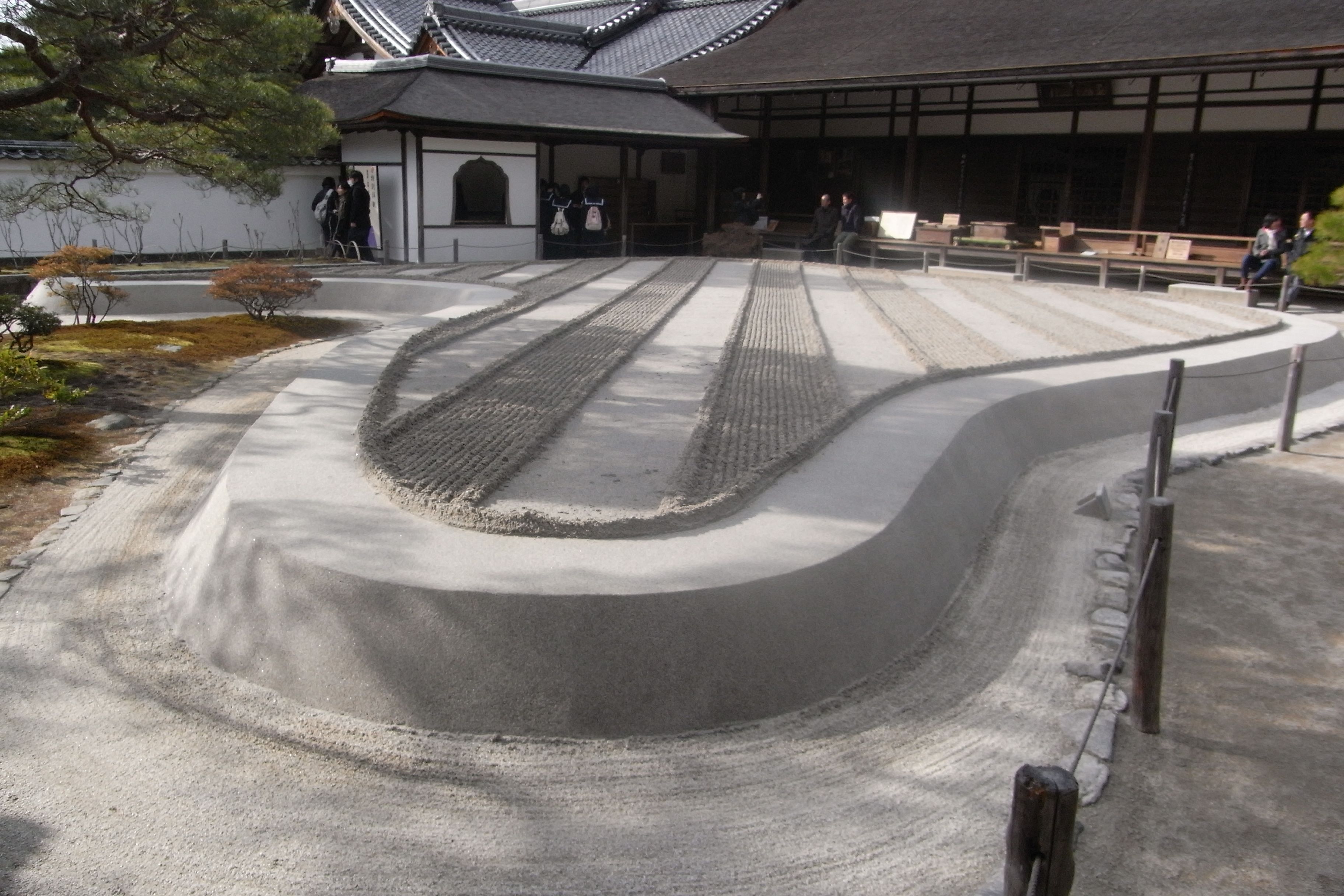
In front of the hōjō, the Silver Sand Beach is built up from white sand into segmented undulations, its surface raked into patterns suggesting ripples. A good way to observe it is to look first for the height of the outer edge, then follow the parallel lines inwards, distinguishing the sunken areas from the raised ones. Keeping your eyes only on the Silver Pavilion in the distance makes it easy to overlook this artificial terrain at your feet. Stopping somewhere that does not block the path, and letting your gaze travel along one set of raked lines to where it turns, brings you closer to the material in front of you than hurrying to decide which mountain it is supposed to resemble.
In a photograph of the Silver Sand Beach taken in March 2011, the foreground shows the beach's rounded edge, its low mounds and its rows of raked lines, with buildings visible behind. This angle lends itself well to comparing the height of the sand surface with the raking patterns, while identifying the Moon-Viewing Platform and the Kannon Hall is best left for when you are on site. The sides of the sand formations are also worth a look: from the near edge up to the higher surface, the shadows and the lines offer different clues, and the three-dimensional thickness is easier to grasp than a flat pattern.
The ideas that the Silver Sand Beach reflects moonlight, and that the Moon-Viewing Platform was a spot for sitting and waiting for the moon, are commonly repeated. The temple's own explanation of the two sand mounds explicitly calls these accounts folklore, and holds that their creation cannot be traced back to the Muromachi period. It is fine to treat such stories as imaginings prompted by the names, while keeping the historical narrative to what is actually supported. When you visit in daylight, the raked patterns, the forms and the arrangement of the neighbouring halls are already there to be seen directly; you do not need a moon-viewing legend to make sense of what makes them interesting.
Kogetsudai and Kannonden: looking at the sand silhouette and the pavilion's two storeys separately
Kogetsudai is a truncated cone of sand, forming a different silhouette from the stepped, ripple-rippled Ginshadan beside it. The editorial suggestion is to look at each once first, then find a position where you can compare the two at the same time: one is mainly about the concentration and height of its shape, the other mainly about its surface patterning and horizontal spread. Both are made of sand, but they do not have to be viewed the same way, and there is no need to rush them into any single fixed symbolism.
Kannonden, by contrast, is a two-storey pavilion, with the lower storey called Shinkuden and the upper storey called Choonkaku. the Kyoto City Tourism Association's introduction to the building summarises the upper storey as in the style of a Zen Buddhist hall and the lower storey as in the style of a residence; when you look at the exterior from the garden, you can divide your attention between the two storeys, noticing how the openings of each floor and the roofs combine into a whole. Read it first as a building that joins two kinds of storey, then look back at the sand mounds, and the scene is no longer just a temple name.
The city tourism association lists the upper storey of Kannonden, Choonkaku, as housing a wooden statue of Kannon Bosatsu, and the lower storey, Shinkuden, as housing a thousand statues of Jizō (a thousand Jizo statues); Togudo, mentioned earlier, is the private Buddha hall that enshrines Amida Buddha.
The interior of Kannonden is not open to the public, and the three-hall special opening in autumn 2026 does not list it among the buildings you can enter either. The reason to buy a special ticket should be the main hall (Hondo (main hall)), Togudo and Roseitei. Those who want to see Ginkaku can spend their time on the exterior viewpoints around the garden; those who want to see Dojinsai should plan for that indoor guided tour instead. Keep the two expectations separate at the outset, so that you do not find yourself at the site, having paid extra, still waiting for an entrance that leads to the second floor of Ginkaku.
Around Kinkyochi Pond: putting Ginkaku and Togudo back into the same garden
Kinkyochi Pond stretches east to west across the lower garden, with Ginkaku on its western side and Togudo to the north-east. This is the spatial relationship given in the city tourism association's introduction to the garden; you can use it to check your map as you walk, first identifying the two ends of the pond before moving on to the next stretch. The buildings do not have to be treated as separate destinations every time; the distance between the pond's banks, the water and the halls can itself be a reason to stop and look.
Kinkyochi Pond also has one specific spot for finding a stone feature: the city tourism association lists the 'Muso Soseki's zazen meditation stone' (the meditation stone of Musō Soseki) at the front of the western side of Hakukakuto (White Crane Island). You can first identify the island in the pond, then look for the stone along this bearing, watching how island, stone and water connect in sequence. This stone feature lies in the lower Kinkyochi Pond, and together with the stone group near the Sosen-tei site in the upper garden can be viewed as two stretches, one at the pond's edge and one on the hillside.
The editorial suggestion, as you move along the open paths, is to first note how many buildings you can see from your current position, then watch what disappears behind trees or a bank after the next bend. Viewing in a pond-strolling circuit garden changes with position; using the same Ginkaku as a repeated point of reference along the way shows this change far better than lingering a long time at the first viewpoint and then hurrying straight to the exit. When it is crowded, split your stops into several shorter ones, find a spot where you can step aside to look, and there is no need to hold one angle while waiting for people to move on.
If others in your group can only manage the lower ground, you can make Kinkyochi Pond your main area, linking the sand features, the exterior of Kannonden and the exterior of Togudo into one stretch. Those interested in the buildings can look at their positions relative to one another, while those who prefer gardens can look at the combination of water and banks; the two can walk the same route with their own focus. Deciding at the south-east side of the pond whether to extend up to the upper garden on the hillside is easier to fit to the day's pace than making the viewpoint a must-complete goal for everyone the moment you enter.
QUICK GLANCE KYOTO films Ginkaku-ji's white sand garden, Kinkyochi Pond and Kannon hall, useful for comparing the relative positions of the Ginshadan (silver sand garden), the Kogetsudai mound and the pondside.
Sengetsusen: where the water connects, and the turning point of the fewer-stairs version
Sengetsusen lies at the south-eastern end of Kinkyochi Pond, channelling the water flowing down from the hillside towards the lower garden where Ginkaku and Togudo stand. This is where you can reconnect the pond and the hill you have been looking at separately: the lower garden has halls and pond water, while further up the eastern slope are the upper garden and its spring water. When your route reaches this point, first watch how the water falls, then decide whether to climb up for the viewpoint or stay on the lower ground to finish your visit.
Wheelchair and pushchair users should, according to the temple's transport and diversion instructions, turn right in front of number 14, Sengetsusen. Numbers 15 (the viewpoint), 16 (Benzaiten), 17 (the Sosen-tei site) and 18 (Ocha-no-i (the tea well)) all have steps, and wheelchairs and pushchairs cannot go up. Before setting out, you can save all these numbered points together; when you reach the fork, use Sengetsusen to orient yourself, and you can choose your direction before the climbing begins. The multi-purpose toilet is beside the shop, so you can plan toilet breaks together with the times you enter and leave the garden.
The city tourism association calls the upper garden the Ocha-no-i (the tea well) garden, introducing the cluster of rocks excavated in 1931 as a dry landscape garden (karesansui dry landscape garden). This clue helps to explain the difference you feel as you climb from the pond's edge to the hillside: the lower garden is mainly a pond-strolling circuit, while the upper garden offers stone groups to look at. If your interest in garden design outweighs the distant views, you can make the upper garden's stone groups a priority when planning, and set aside energy for climbing up and down the steps.
What the upper garden offers is varied too. The viewpoint provides a higher vantage; near the Sosen-tei site there is an unusual stone group the temple describes as looking like a collapse, which you can see from the garden path while looking over the upper garden; and Ocha-no-i (the tea well) is a spring you find by climbing along the eastern hillside. Those who like stone groups can save their attention for the Sosen-tei site, while those interested in water channels can read Sengetsusen and the spring together — there is no need to treat all four as the same kind of 'hilltop tick-box spot'.
On a rainy day, or if knees or legs are uncomfortable, the editorial suggestion is to drop the upper garden, concentrate your stops on the sand features, the pond's edge and the building exteriors, and shorten the Philosopher's Path (the Philosopher's Path) after leaving the temple. That way a single decision removes two burdens, climbing steps and covering long distances, and lunch can be kept fully intact. If others in your group walk at different paces, decide before entering the hillside to stay on the lower ground together, rather than someone pushing a chair reaching the steps and only then improvising who carries the chair and who carries the child.
Hojo and Togudo: recognise the exteriors first, then decide which interiors to see
Hojo is the main hall (Hondo (main hall)), a building of the mid-Edo period, and therefore of a different date from Togudo, which survives from the Higashiyama-dono era. Its principal image is Shakyamuni Buddha; the autumn 2026 special opening separately lists the sliding-door paintings of Yosa Buson and Ike no Taiga, and the works shown this season are reproductions. Those coming for the paintings can bear this in mind first, and then enjoy how the sliding-door paintings are placed within the hall's interior space — there is no need to think of this visit as a chance to come face to face with ancient originals.
Togudo is Yoshimasa's private Buddha hall, and the temple presents its Amida devotion side by side with the Zen-style garden around it. On a standard visit you see its exterior from the garden; on the special opening you can enter on the guided tour and see the Amida Buddha statue, the statue of Ashikaga Yoshimasa in the form of a Buddhist deity (monastic form), and Dojinsai. Understand the Buddha hall first as a space housing the statues a faith worships, and then look at the other shoin room inside, and the building's purpose will not be entirely swamped by the single phrase 'four-and-a-half mats'.
Dōjin-sai and Rōsei-tei: distinct things to look for in the shoin and the oki-no-zashiki
Dōjin-sai lies within Tōgudō, and in its 2026 autumn highlights the temple describes it as the oldest surviving shoin of four-and-a-half tatami mats. Here the 'four-and-a-half mats' is a clue to the room's scale, while 'shoin' hints at the space's purpose; when visiting, you can first take note of the room itself, then consider its relationship to the Buddhist hall section. Tōgudō also holds a statue of Amida Nyorai (Amitābha) together with a statue of Yoshimasa, so if you file away this small hall merely as a tea room, you will miss its original function as a jibutsu-dō (a hall holding a Buddha image for devotion).
The city tourism association also introduces Dōjin-sai as the prototype of the four-and-a-half-mat tea room.
The focus at Rōsei-tei is the Oki-no-zashiki, together with the fusuma paintings by Okada Gensō. These are a different set of works from the copies of fusuma paintings after Buson and Ike no Taiga listed for the Hōjō (main hall). Pairing each painter with the hall's name makes it much harder, once you have left, to blur the three halls into a single 'house with old paintings'. At Dōjin-sai you can pay attention to the arrangement of a small space, while at Rōsei-tei you can look at how the Oki-no-zashiki relates to the fusuma paintings — even a short guided tour then yields a concrete order of observation.
This round of announcements covers a guided tour. If what you were hoping for was drinking tea or burning incense yourself, you can leave that kind of experience to events that explicitly list such services; this ticket should be judged on the three halls' architecture, Buddhist statues, shoin and fusuma paintings. Note-taking and sketching are not permitted during the special opening, and neither is photography; the editorial advice is to note down only a few hall names and the things you want to see before entering, follow the guide through, and then organise your memories after the tour ends and your belongings are returned. Reading the names beforehand is meant to save effort on identification — there is no need to turn 30 minutes into a dictation test.
The 2026 autumn special opening: how the same-day form, assembly and Japanese-language conditions fit together
This autumn special opening is scheduled to run from Sunday 1 November to Saturday 5 December 2026. As of the announcement dated 28 October, the event had not yet begun; sessions start daily at 10:00, 11:00, 12:00, 13:30, 14:30 and 15:30, each lasting about 30 minutes with a capacity of roughly 20 people. The 10:00, 11:00 and 12:00 sessions are suspended on Sunday 15 November, so anyone hoping to take part that day should favour an afternoon slot. Temple events can cause sessions to change, and on your departure date you can check the suspension column on the current events page directly.
The application form is placed in front of the Hōjō roughly one hour before each session, and applications are taken in the order received that day. After writing your name on the form, you must also return to the front of the Hōjō to assemble 10 minutes before the start. For example, if you want to join the 10:00 session, the editorial advice is to arrive at the front of the Hōjō around 9:00 to check the form, and after registering look only at nearby parts of the gardens that you have time to return from, coming back at 9:50 to assemble. The one-hour mark is the time the temple announces for setting out the form; arriving early serves to handle the on-site registration, since there is no online booking to hold a place beforehand.
The fee is an additional 2,000 yen per person and includes a special souvenir; the ordinary admission ticket is still required. Preschool-age children are not accepted, and groups or parties of seven or more are likewise not accepted; those travelling as six or fewer register as usual for whatever places remain that day. Families with preschool children should choose the garden-only version for the whole family, or agree in advance who stays with the children and who joins the indoor visit. If everyone must stay together, simply take the indoor tour out of this itinerary — it actually becomes easier to keep control of lunch and walking time.
The tour is conducted in Japanese only, and no interpretation is permitted while it is under way, including apps and translation devices. Deciding whether you can accept this language condition matters more than first choosing which session to attend; if you would need a companion to translate sentence by sentence, the ordinary garden visit is the more practical choice. Photography, sound recording, filming, note-taking and sketching are all forbidden during the special opening, and mobile phones and tablets must be left with your other baggage. Anyone who wants to consult background material while viewing the interior should finish reading it before the tour, and let the half-hour visit concentrate on what is in front of them.
The ordinary garden visit has no guide on hand to give commentary, and there is no Wi-Fi anywhere on the precincts; the indoor portion is what the special opening tour covers. The editorial advice is to prepare background reading material and maps before setting out, saving the names of the Hōjō, Tōgudō and Rōsei-tei, along with the direction back to the station. Those who need to look things up can do so before the special opening; after handing over their phone they simply follow the staff, rather than downloading an entire set of content only at the assembly point.
Clothing and luggage also have clear thresholds: socks must be worn, and bare feet or stockings alone are not sufficient for the tour. Large luggage such as suitcases, as well as pets, cannot be left at the venue. The editorial advice is to leave the case at your accommodation or an arranged luggage store, and put on socks before heading out. The announcement that the 1 November 'talk and zazen' session is fully booked refers to a separate event; the tour of the three halls still proceeds as described above via the same-day form, and if you distinguish by event name when checking news, you will not misread that fully booked notice as the whole autumn programme being filled.
South along the Philosopher's Path, joining the route to Keage only after Nyakuōji
The Philosopher's Path as introduced by the Kyoto City Tourism Association is about 2 kilometres long, linking the Ginkaku-ji end with Nyakuōji Shrine. Travel write-ups often summarise it as running from Ginkaku-ji to Nanzen-ji, but when actually planning the walk you should mark the southern end at Nyakuōji; further sections remain before Nanzen-ji or Keage. Those walking the full route southwards should, after leaving the temple, first go downhill to the area of Ginkaku-ji Bridge, then follow the Philosopher's Path south, and finally continue on according to their return station.
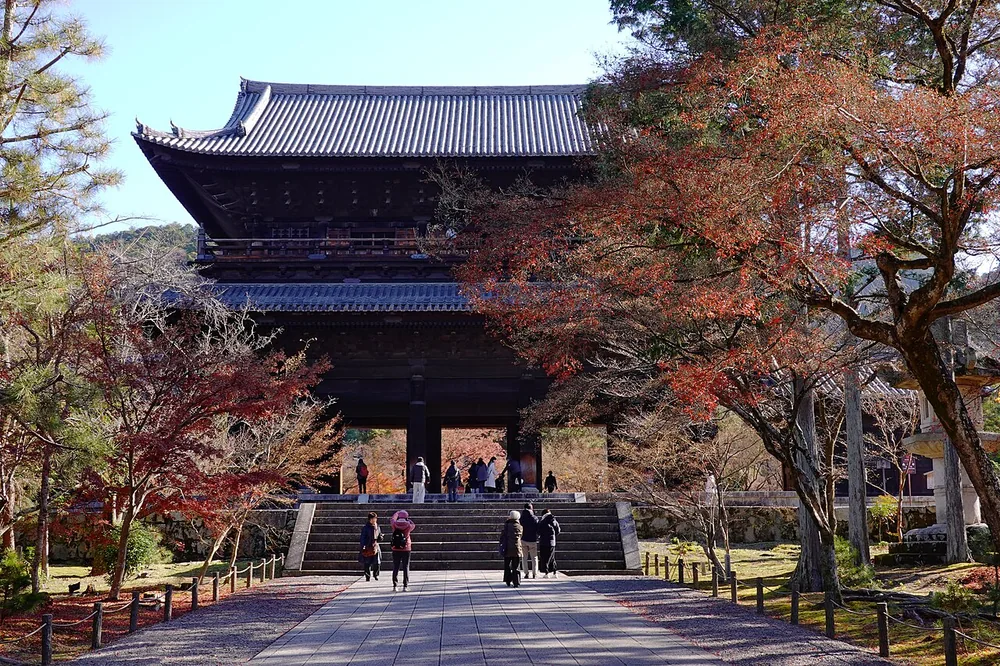
The waterway alongside the path draws from Lake Biwa, and its water flows from south to north; the nearby Shirakawa, meanwhile, follows the terrain from north to south. This difference is a clue you can carry with you while walking: as you head south, the waterway beside you flows in the opposite direction. Keeping the two waterways' names and directions separate from the outset, you can grasp that this area has more than just 'one little stream flowing downhill'. The route takes its name from the philosopher Nishida Kitarō, who walked and pondered here, and along it there are also the Sekisetsu cherry trees donated by Hashimoto Kansetsu; in autumn you can still come to know it through the waterway and the geography, without treating the spring blossom as something to expect on the day.
The editorial advice is to allow 60 to 90 minutes for the full Philosopher's Path, including slow walking and brief pauses, and to set aside additional time for lunch and the walk from the southern end to the station. The official figure of around 20 minutes from Keage to near the southern end serves as a useful reference for the geographic scale; even after reaching Nyakuōji you must still keep this stretch in reserve for returning to the station. If you also intend to enter Nanzen-ji's paid areas, add separate time for the visit and buying tickets — extend the walking day accordingly, or drop one item between Ginkaku-ji and the indoor tour.
Those wanting only a short walk can stroll alongside the waterway from the area of Ginkaku-ji Bridge, setting in advance the time at which they are willing to turn back, and then return towards the Ginkaku-ji-michi bus stop. This version suits a morning when the garden has already taken longer than expected, the weather has turned rainy, or a companion would like to sit down and rest. The full-length walk should be decided by your pace on the day; by choosing the turn-back version first, you can linger a while longer at any waterside spot that catches your eye, rather than forever urging companions on with the kilometres remaining.
Two half-day examples that genuinely preserve the waiting time and lunch
The following are editorial timings; entry and the tour follow the official time slots, with lengths of stay allocated to suit slow walking. On the ordinary garden version you can enter around 9:00, staying until around 10:00 to 10:30 to take in the sand garden, the pond-side areas and whichever hillside section suits you; after leaving the temple and walking downhill, take a rest, then have lunch. If you want a waterside walk in the afternoon, choose a short section of the Philosopher's Path and leave from Ginkaku-ji-michi. Those who prefer a long walk should give the entire post-lunch stretch to the southward route, joining the path to Keage at Nyakuōji, without squeezing in another temple ticket that would force a rush.
The special opening version puts the same-day registration first. If you are aiming for the 10:00 session in November, reach the front of the Hōjō around 9:00 to check the form, secure a place for that session, look around nearby and return to assemble at 9:50; from 10:00 to about 10:30 follow the guide, then revisit the gardens after collecting your belongings. By this point you have had one indoor stretch and one outdoor one before lunch, and the afternoon can be given over to just a short walk on the Philosopher's Path. If no suitable places remain that day, switch to the ordinary garden version; do not spend the whole time you could have used sitting down to a meal waiting for the next session.
If you choose the 13:30 session, the application form is set out at around 12:30, with assembly at 13:20. Lunch needs to be placed where it fits around those two times; the editorial advice is either to eat first and then enter the temple to handle the afternoon registration, or to view the gardens first and keep the meal until after the tour — pick whichever suits the dining time you can accept. Do not treat returning after lunch outside the temple as the default sequence. In December the temple does not open until 9:00, and the gap between the 10:00 first session and opening is shorter than in November; if you want the first session, go straight to the form in front of the Hōjō, then see the gardens.
From Kyoto Station via Imadegawa and bus 203: on the way back, your last stop decides the route
From Kyoto Station, the Kyoto City official transport advice is to take the Karasuma subway line to Imadegawa, then board bus 203 towards Ginkaku-ji from the Karasuma-Imadegawa stop at street level. The ride from Kyoto Station to Imadegawa takes roughly 9 minutes for reference, and the bus stop is on Imadegawa-dori on the Doshisha University side of the road. Check the Ginkaku-ji direction at street level before boarding; on weekends and holidays bus 102 is also an option, while on weekdays plan around the 203 timetable.
After getting off bus 203 at Ginkakujimichi, head east from the Imadegawa intersection on Shirakawa-dori, walk along the canal, cross Ginkaku-ji Bridge and the entrance to the Philosopher's Path, then climb the temple approach up to the temple. The city tourism association's temple information lists about 10 minutes on foot from Ginkakujimichi and about 5 minutes from Ginkakuji-mae — the two stop names correspond to different drop-off points. When planning your registration slot, keep the walk from the bus stop to in front of the main hall at the front of your schedule; in particular, do not match only the arrival time at Ginkakujimichi against the 10:00 opening.
If you are staying along the Keihan line, you can go to Demachiyanagi and transfer to city bus 7 or 203 to Ginkakujimichi, without doubling back through Kyoto Station first. When leaving, it depends on where you finish: if you only walk a short stretch of the Philosopher's Path, head back to Ginkakujimichi; if you walk the full southern route to Nyakuōji, continue towards Keage Station and take the Tōzai subway line — those returning to Kyoto Station change again to the Karasuma line at Karasuma-Oike. Save these two exit directions on a map in advance, and in the afternoon you can choose according to how much energy you have left, without having to walk back to the northern end just to catch a return bus from the same stop.
Tickets, December timings and goshuin seals: budgeting them separately makes the trade-offs easier
From 1 April 2026, the standard admission fee is 1,000 yen for senior high school students and above, 500 yen for primary and junior high school pupils, free for pre-school children, with no group discount. An adult combining the special viewing pays 3,000 yen each; two adults viewing only the gardens pay 2,000 in total, or 6,000 with the special viewing. One adult plus one primary school pupil on standard tickets comes to 1,500 in total, or 5,500 if both add the special viewing. Since these figures cover the visit only, with transport and meals listed separately, you can see exactly how much an indoor guided tour actually adds.
The reduced fee has separate eligibility conditions: the temple's FAQ lists holders of the Physical Disability Certificate (shintaishōgaisha techo), the Rehabilitation Welfare Notebook (ryōiku techo) and similar documents as eligible, on presentation at the reception on the day of the visit, at 100 yen for both adults and primary/junior high pupils; certificates of the same kind issued abroad are not covered. Overseas travellers budgeting for a family should calculate at the standard prices, rather than applying the Japanese domestic certificate discount to foreign documents. This standard-admission reduction should also be read separately from the special viewing, which costs an additional 2,000 yen per person.
Payment at standard admission and in the precinct shop is by cash or 「おまいりPay」; the special viewing and goshuin seals are not covered by that service. According to the temple's FAQ, from March to November the gates open at 8:30, with last entry at 17:00 and the descent from the hillside by 17:20; from December to February this changes to a 9:00 opening, last entry at 16:30 and descent by 16:50. The shop closes at 16:30 in summer and 16:00 in winter, so if you want to buy anything, plan it before the end of your stroll; those arriving close to last entry also need to shorten their visit in line with the descent time.
The special viewing runs until 5 December, but once December begins the standard opening has already switched to the winter schedule; guided tours still depend on the designated session. After 16:00, goshuin seals are provided pre-written; in autumn 2026 there are further pre-written-only days: 31 October to 3 November, 7–8 November, 14–15 November and 21–29 November. The current goshuin announcement also lists an autumn-limited pre-written goshuin issued from 1 November, at 500 yen each with a run of 2,000, ending once the quantity is exhausted. If you collect seals, you can slot this in before or after your visit, collecting yours and then leaving the temple to walk the Philosopher's Path.
A few useful answers
How do I get to Ginkakuji from Kyoto Station?
Take the Karasuma underground line to Imadegawa (about 9 minutes), then catch the 203 at the Karasuma Imadegawa stop on the Doshisha University side of Imadegawa Street. Get off at Ginkakuji-michi and head east across Ginkakuji Bridge. It's about a 10-minute uphill walk from the stop to the temple.
How much is admission to Ginkakuji and its autumn special tour?
From 1 April 2026, standard admission is ¥1,000 for upper secondary pupils and adults, ¥500 for primary and lower secondary pupils, and free for pre-school children. The autumn special tour costs an extra ¥2,000 per person, so adults pay ¥3,000 in total.
How do I book a place on Ginkakuji’s autumn 2026 special tour?
Sign up in person on the day between 1 November and 5 December 2026. Places are allocated in sign-up order on a sheet outside the main hall about an hour before each tour, and you’ll need to return there 10 minutes before it starts. Tours are in Japanese only, with no interpreting or translation tools.
Can I visit Ginkakuji with a pushchair or wheelchair?
Yes, you can visit the lower garden. Turn right before the spring marked 14 on the map. The path up to the hillside viewpoint has steps, and there's an accessible toilet next to the shop.
Official information and references
Sources used in this guide.
- Ginkaku-ji: official homepage and autumn viewing announcement
- Ginkaku-ji: standard admission, access and the Sengetsusen detour
- Ginkaku-ji: garden, halls and precinct map of upper and lower sections
- Ginkaku-ji: entry, descent, indoor viewing and service Q&A
- Ginkaku-ji: the history of the Higashiyama villa and the two surviving structures
- Ginkaku-ji: 2026 price change, goshuin seals and zazen announcement
- Ginkaku-ji: 2026 autumn special viewing of three halls and same-day registration
- Kyoto City Tourism Association: the Philosopher's Path, the canal's course and its southern end
- Kyoto City Tourism Association: rail and bus connections for Ginkaku-ji and the Philosopher's Path
- Kyoto City Tourism Association: Jishō-ji architecture, garden and walk from the bus stops