Read the Kondo’s triad, seven emanation Buddhas and Twelve Heavenly Generals, then the Kodo’s 21 figures. Compare the autumn 2026 north-side 360-degree circuit, pagoda first story, treasure exhibition and Kanchi-in, with Kobo market rituals, seasonal prices and a half-day route.
- Region & Focus
- KyotoShrines and temples
- Reading Scope
- 31 min read · 14 chapters · 4 Q&As
- Official Verification
- 15 official sources checkedUpdated November 22, 2026
- Key Topics
- ItinerariesSeasonsTravel budget
Chapter Route Map (tap any stop)
- Leave time for the two halls, then choose the pagoda, exhibition or market
- Kondo, Kodo and Jikido on the south–north axis
- Look at the Kondo roof first: the main hall rebuilt in 1603
- Read the Yakushi triad from center to sides, halo and pedestal
- Why the Kodo was rebuilt before the Kondo
- Divide the 21 figures into five groups before learning their names
- Autumn Kodo opening: view the mandala from the north
- Inside the pagoda’s first story: central pillar, figures and painted imagery
- The autumn treasure exhibition connects rebuilding with dedication and documents
- Kanchi-in shifts from large sculpture groups to residential rooms and five Kokuzo figures
- Free worship at Miedo and Jikido has its own focus
- Kobo market on the 21st: browse around eight and leave ten for Mieku
- Split prices by date and calculate only what you want to see
- A half-day route: finish the halls, then choose one extra place
- Quick Q&A
Give most of your time at To-ji to two different ways of looking at Buddhist sculpture. In the Kondo, start with the Yakushi triad and look closely at the halo and pedestal. In the Kodo, identify groups within the spatial arrangement of 21 figures. From October 31, 2026, a north-side circuit opens in the Kodo and the pagoda’s first story opens too. Then choose the treasure museum, Kanchi-in or the Kobo market on the 21st of each month to give the half day a clear focus.
Leave time for the two halls, then choose the pagoda, exhibition or market
On a first visit, start with the Kondo’s Yakushi triad, then see the Kodo’s three-dimensional mandala of 21 figures. The halls stand next to each other but need different approaches. In the Kondo, follow the central deity and flanking bodhisattvas down to the pedestal. In the Kodo, identify central, side and outer groups first. Even without a first-story pagoda opening, the two halls are reason enough for a dedicated visit.
With one morning, focus on the two halls plus Miedo and Jikido. For esoteric Buddhist art, add the pagoda interior and treasure museum in autumn. For residential architecture and gardens, add Kanchi-in. Allow separate browsing time for the Kobo market on the 21st: its pace differs from a sculpture-focused half day. Choose what you want to see rather than buying every ticket.
As announced on October 28, 2026, the autumn treasure exhibition was already running, while the pagoda first story and Kodo north side were due to open October 31. If your dates are flexible and you most want the tower interior and rear views of the figures, choose that opening period. On other dates, focus on the year-round Kondo and Kodo.
Read the Kondo’s triad, seven emanation Buddhas and Twelve Heavenly Generals, then the Kodo’s 21 figures. Compare the autumn 2026 north-side 360-degree circuit, pagoda first story, treasure exhibition and Kanchi-in, with Kobo market rituals, seasonal prices and a half-day route.
Kondo, Kodo and Jikido on the south–north axis
Use the temple grounds guide to identify the three halls, from south to north: Kondo, Kodo and Jikido. The temple explains the sequence as Buddha, teaching and community. The Kondo houses the principal deity, the Kodo expresses esoteric teaching, and the Jikido connects with monks’ daily practice. Following this order gives each building a clear subject and helps you keep your bearings.
To-ji was founded in 796 as a state-built temple, paired with Sai-ji on the two sides of Heian-kyo’s Rajomon gate. Kukai later took charge, and the Kodo became central to transmitting esoteric Buddhism. Today’s temple continued through repeated fires and rebuilding. The Kondo, Kodo and pagoda have different construction dates; one image of an ancient Heian-period temple does not describe every building.
Miedo lies northwest of the main compound. Find Kanchi-in along Kushige-koji on the north side. Choose these directions after the two halls without repeatedly returning to the pagoda to start again. Use the grounds map for orientation and enter paid areas through their gates. Complete the area covered by one ticket before moving to another to reduce searches for ticket counters.
Look at the Kondo roof first: the main hall rebuilt in 1603
As you approach, look for the roof’s raised central section. The official Kondo explanation identifies the present National Treasure as a Momoyama-period building from 1603, with a tiled hip-and-gable roof combining Tenjikuyo and Japanese styles. The unusual central roof is easier to find than a string of architectural terms. Identify it, then look at the double doors below the small roof.
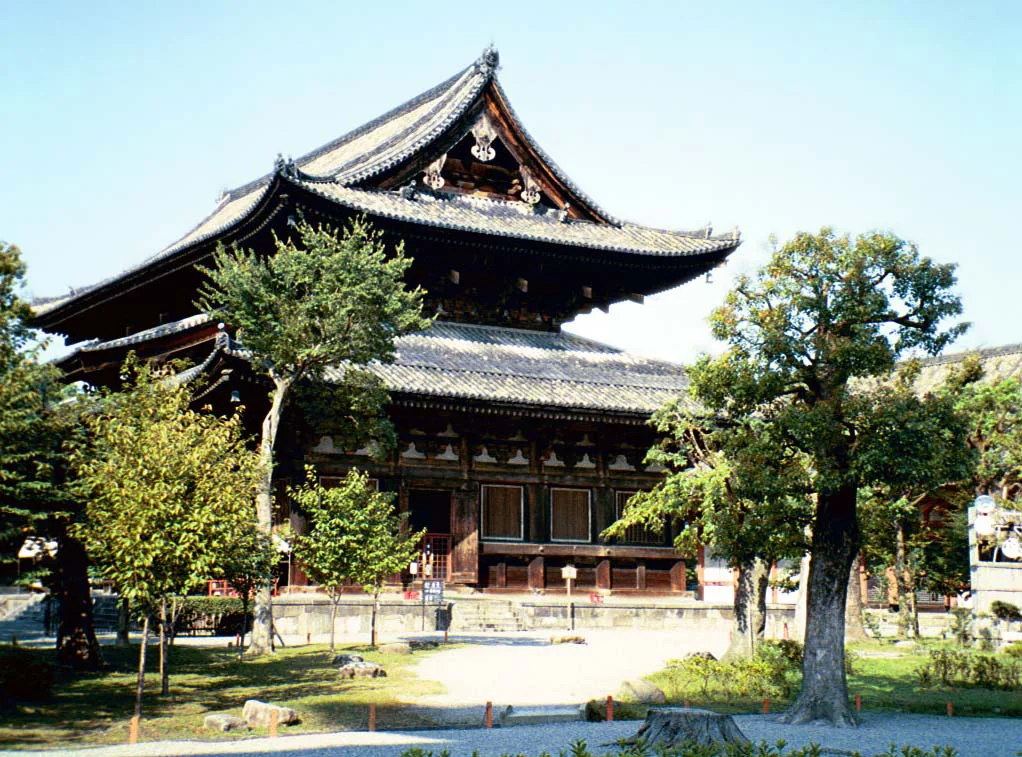
The Kondo is To-ji’s main hall and was the first building begun at the temple’s foundation in 796. It burned in 1486 and was not rebuilt until after the Battle of Sekigahara. That recovery after more than a century explains the present Momoyama form. Look for continuity in the hall’s purpose and how later builders restored its dignity.
The temple records an account of the doors below the small roof opening for flower scattering during ceremonies. This offers a clue to the building’s use. Look outside before entering to connect roof, doors and the space housing the principal deity. If architecture is not your main interest, keep this stop short and give more time to the Yakushi triad inside.
Read the Yakushi triad from center to sides, halo and pedestal
Yakushi Nyorai stands at the center. Facing the principal image, Nikko Bosatsu is on your right and Gakko Bosatsu on your left. These directions are from the visitor’s viewpoint. See how the three form a group before identifying individual names. Together the central deity and two flanking bodhisattvas are the Yakushi triad.
One memorable feature is that Yakushi holds no medicine jar. The temple explains this as an older form of representation. If you normally identify Yakushi by a jar, look further here. Seven emanation Buddhas appear on the halo behind him, forming the imagery of the Seven Medicine Buddhas. After the whole triad, move your gaze to the halo for a second focus beyond the main image.
Then look down. The Twelve Heavenly Generals stand around the pedestal. The temple explains their role as protecting Yakushi and fulfilling his vows. The numbers refer to different locations: three figures at center and sides, seven on the halo and twelve around the base. Remembering positions is more useful than forcing yourself to memorize every name on site.
The present triad is also a post-fire restoration, recreated by the Momoyama sculptor Kosho. The temple lists it as dated 1603, wood with lacquer and gold leaf, and an Important Cultural Property. Both building and sculptures were lost and rebuilt. From the roof outside to the pedestal inside, you see two results of the same recovery in architecture and sculpture.
Adjust the depth to your interests. First-time visitors can identify the triad and pedestal; sculpture enthusiasts can return to the relationship between halo and principal image. With children, ask where the seven and twelve figures are. This gives them a concrete question about position without a continuous lesson in dates.
Why the Kodo was rebuilt before the Kondo
The present Kodo was completed in 1491, more than a century before the current Kondo. Both burned in 1486, but the Kodo was rebuilt first, five years later. The official explanation connects that priority with the role Kukai gave it as the central building for transmitting esoteric Buddhism.
The original Kodo was begun in 823 and completed in 839. The temple records corridors linking the areas around it and the Kondo. The Kodo stood at the center of a main compound about 255 meters square. Establish that position outside, then look at the central Dainichi Nyorai inside to connect the plan and the sculpture arrangement.
During repairs to the figures in 2000, traces of burned thin wood were found below the altar. The temple suggests they may relate to Kukai performing a goma fire ritual after the foundations were completed to consecrate the altar. This helps explain the altar as a ritual place. The main visible guide remains how the figures form a whole through center, sides and surroundings.
Divide the 21 figures into five groups before learning their names
Before entering, open the temple’s mandala arrangement guide. At the center are the Five Wisdom Buddhas led by Dainichi Nyorai. Facing Dainichi, the five great bodhisattvas centered on Kongoharamitta Bosatsu are to your right. The five great Wisdom Kings centered on Fudo Myoo are to your left. The Four Heavenly Kings, Bonten and Taishakuten surround them, making 21 figures.
The count is five, five, five, then four and two. Each of the first three groups has a center; the final groups occupy the altar’s perimeter. This reduces 21 names to spatial groups you can identify. Find the three main groups first, then the outer figures, so you do not lose direction at the first row.
The temple calls this a karma mandala, commonly known as a three-dimensional mandala. Two-dimensional Womb and Diamond Realm mandalas communicate esoteric Buddhism through images. Here Buddhas, bodhisattvas, Wisdom Kings and heavenly beings become physical sculpture groups. Look at their relationships as well as individual figures, with central Dainichi as the reference for the whole altar.
Start where you can see the overall arrangement and identify Dainichi and the two side groups. Follow the visitor route group by group. Keep the neighboring group’s position in mind, then return to the outer Four Heavenly Kings, Bonten and Taishakuten. This is an editorial suggestion for visitors wondering where to begin among so many figures.
Compare the halls here. In the Kondo, identify the triad and extend your view to halo and pedestal. In the Kodo, identify several groups before individual figures. Alternating these scales gives more than remembering only each hall’s principal deity. With limited time, allow a little more for the Kodo because reading the arrangement requires stopping.
Do not treat the 21 figures as a checklist. If Fudo interests you, focus on the Five Wisdom Kings. To understand the mandala, focus on the relationship between center and sides. Looking with one question, then rereading the diagram, often leaves a clearer memory than looking up every figure inside.
Autumn Kodo opening: view the mandala from the north
From October 31 to December 13, 2026, the north side of the altar opens for a circuit around the mandala. The autumn special opening notice lists daytime hours of 8:00–17:00, with reception ending at 16:30. The north side also opens during special evening visits. Choose this period to compare front and rear arrangements.
The added value is the viewpoint. Establish the center, sides and outer figures from the front, then follow the open route north to see the same group from another direction. Use Dainichi as your reference to identify which side you face. Simply completing a 360-degree circuit can miss the differences between front and rear positions.
Plan ordinary viewing and the north-side opening differently. The former follows the usual route; the latter needs extra circuit time. For a dedicated visit, drop one extra exhibition space to give the Kodo enough time. An evening circuit is possible, but the daytime pagoda interior, treasure museum and Kanchi-in need separate scheduling.
Inside the pagoda’s first story: central pillar, figures and painted imagery
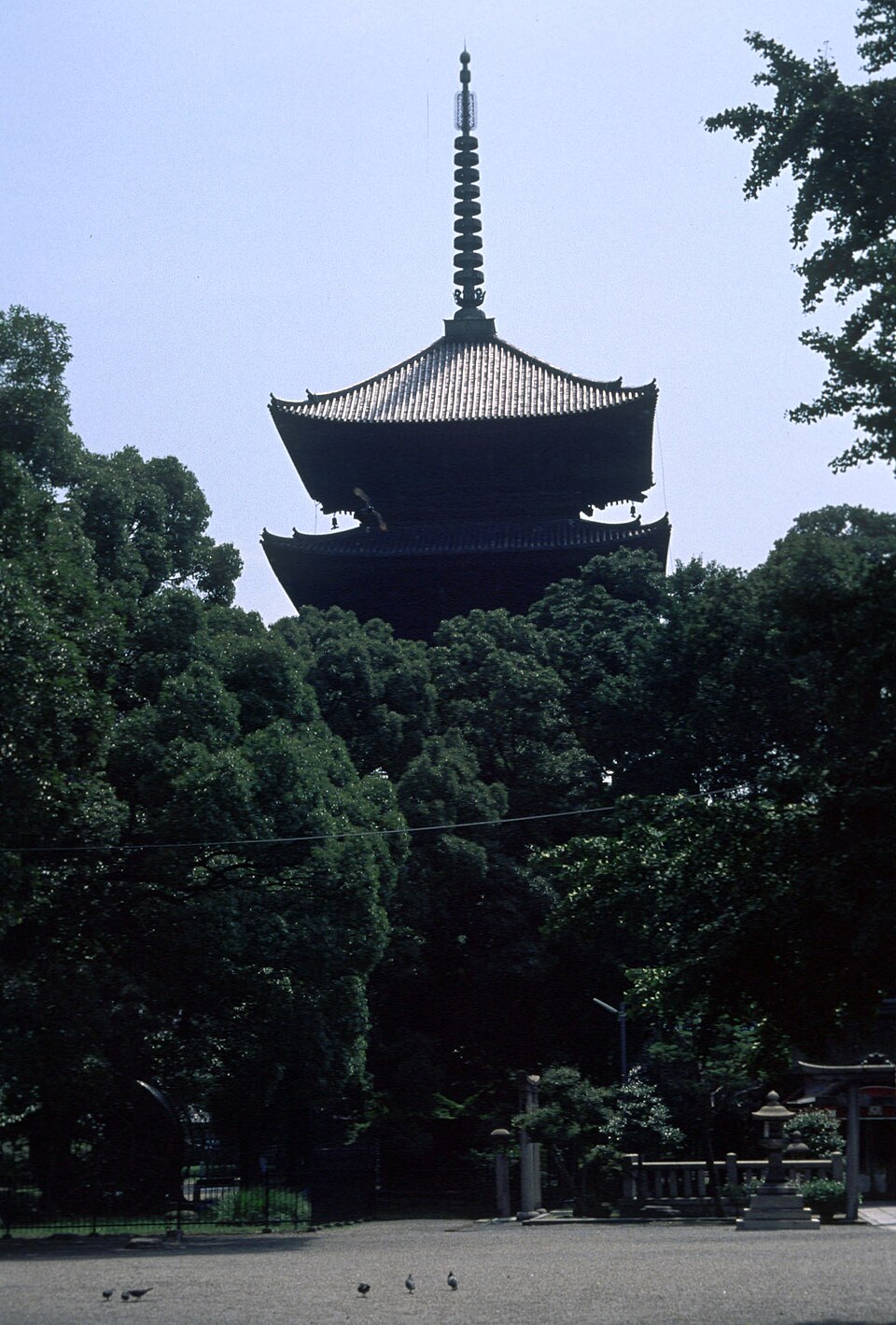
To-ji’s pagoda is about 55 meters high. The present fifth version was rebuilt in 1644. The official introduction records four fires from lightning and other causes, with labor and materials raised again each time. Remember that the present exterior is an Edo-period rebuilding before turning to esoteric imagery inside.
The autumn 2026 first-story opening also runs October 31–December 13. First story means the lowest interior level, with sculptures and paintings to see. The ticket does not include climbing the tower. For a high view over Kyoto, choose another observation facility rather than assuming the five exterior stories are accessible by stairs.
The central pillar running through the stories symbolizes Dainichi Nyorai, with four Buddhas and eight bodhisattvas around it. Compare this with the Kodo, where a Dainichi sculpture occupies the center. Here the pillar has a similarly important religious position. Seeing the Kodo first makes the temple’s joint explanation of structure and figures easier to follow.
Look next at columns and walls. The four main columns carry Diamond Realm mandalas, the side columns on four sides show the Eight Great Dragon Kings, and walls depict the eight Shingon patriarchs and the transmission of teaching to Kukai. Divide your attention into center, surrounding figures, columns and walls rather than following one figure alone. Knowing what to look for helps in this image-dense interior.
In 826, Kukai petitioned for help transporting tower timber, showing the difficulty of supplying construction materials. Between exterior and interior, that record connects engineering and faith: the tower required real materials and labor, while pillar and figures formed an esoteric space. Choose the current treasure exhibition if you want to pursue later rebuilding.
Views of the pagoda’s eaves and finial through trees in the temple grounds.
The autumn treasure exhibition connects rebuilding with dedication and documents
The treasure museum presents Art and History of To-ji’s Five-Story Pagoda: 1,200 Years of Rise and Fall from September 20 to November 25, 2026. Its dates differ from the pagoda opening. To see both, choose October 31–November 25. The first rotation ends October 22; the second runs October 23–November 25, with some works changed. Read object lists with the rotation dates.
The notice includes a gilt-bronze reliquary pagoda, a repaired dragon head and Emperor Go-Daigo’s pagoda dedication prayer among its materials. Rebuilding was followed by dedication ceremonies. The temple lists records from 1086, 1334 and 1594, with particularly many prayers and ritual implements surviving from 1334. These materials go beyond the tower’s appearance to who supported rebuilding and how rituals expressed its completion.
Choose between two possible threads. For craft, read faith and repair through the reliquary and dragon head. For history, look at how prayers and documents record rebuilding and dedication. Use the works actually displayed that day. Rotation changes bring different materials to the same subject; the announcement is not a fixed all-season display list.
The museum also connects with Jikido. Its former Thousand-Armed Kannon was damaged in the 1930 fire, restored and moved here. See the exhibition, then Jikido’s current principal image and burned Heavenly Kings to connect results of the same fire in two places. If only the pagoda imagery interests you, keep just that interior. Add the museum to continue reading objects and documents.
Kanchi-in shifts from large sculpture groups to residential rooms and five Kokuzo figures
Kanchi-in stands east of Kushige-koji between the north main gate and north outer gate. The official introduction says Goho founded it around 1359 and his disciple Kenpo installed five Kokuzo Bosatsu as its principal images. Large numbers of esoteric texts were compiled and collected here. The temple describes its role as a Shingon study institution. After the Kodo’s teaching imagery, the subject shifts to scholar-monks’ study and life.
The scale is concrete: the temple records more than 15,000 esoteric texts collected by Goho and Kenpo. Read the reception hall and main hall within that environment of organizing documents and transmitting knowledge. The five Kokuzo figures are traditionally said to have been brought by Eun of Ansho-ji and later moved here by Kenpo. That temple account of transmission has a separate context from the reception hall’s 1605 rebuilding.
The National Treasure reception hall rebuilt in 1605 has residential spaces and a wood-shingle roof, unlike the tiled Kondo and Kodo. The temple points to a carriage porch with a curved gable and an oshiita-style alcove as medieval residential features, while column spacing follows tatami dimensions. These show a transition toward early-modern shoin architecture. Such differences reward architectural attention beyond the National Treasure label.
Rooms include the Jodan, Tsugi, Rajo, Kurai and Shisha rooms. In the Jodan room, the temple attributes Eagle and Bamboo Grove paintings to Miyamoto Musashi. After the two great halls, shift attention to partitions, alcoves and painting positions rather than using only a central principal image to read the whole space.
The main hall east of the reception hall houses the five Kokuzo Bosatsu. Each sits on a lotus supported respectively by a lion, elephant, horse, peacock or garuda. These mounts offer a concrete starting point. Look at the animals supporting the lotuses, then the five as a group, before chasing five names. The temple calls them Buddhas of wisdom, matching Kanchi-in’s scholarly role.
North of the main hall is the Fusenkan tea room. The temple introduces its sliding-door paintings, garden lanterns, water basin and planting. Follow the open route to view rooms, figures and garden in stages. After a long study of the Kodo, save Kanchi-in for another visit. If residential-scale buildings and gardens interest you, let it replace the treasure museum for a clearer change of space within the half day.
Free worship at Miedo and Jikido has its own focus
Miedo lies within earthen walls northwest of the compound, on the site of Kukai’s residence. The Miedo guide identifies rear hall, front hall and middle gate, with cypress-bark roofs, lattice shutters, plank doors and railed verandas. Compared with the Kondo’s great roof, look closely here at residential forms and how parts connect.
Worship at Miedo and Jikido is free. The daily Shojinku offering begins at 6:00. According to the temple FAQ, arrive around 5:50 at Miedo’s Karamon or west gate and enter with the assembled worshippers. There is no offering fee to attend. Kukai’s seated image is revealed during Shojinku and throughout the monthly Mieku on the 21st. An ordinary afternoon and morning worship offer different arrangements.
Jikido takes its name from a place where monks practiced through daily life. It now has a pilgrimage seal office and an Eleven-Headed Kannon; it is not a lunch restaurant. The current building was completed in 1933 after three years of work following the 1930 fire. Continuing north from Kondo and Kodo brings monastic life and pilgrimage into a concrete place.
Facing Jikido’s principal image, burned Four Heavenly Kings are visible on the left. They originally protected the Thousand-Armed Kannon and were badly damaged in the fire. The Kannon was restored and moved to the treasure museum, while the kings remained here and the principal image became Eleven-Headed Kannon. Compared with remaking the Kondo images, the burned figures show a different preservation outcome.
Jikido also serves as a seal office for pilgrimages including the Shikoku 88 temples and Rakuyo 33 Kannon sites. On the 21st it holds an osunafumi practice recreating the Shikoku pilgrimage. Alongside market browsing and Miedo worship, this offers another way to understand pilgrimage and why worshippers gather.
For longer participation, choose sutra copying at Jikido. The sutra-copying information lists walk-in registration from 9:00 to 15:00 and a ¥1,000 offering for the Heart Sutra. The FAQ says ink, brush and paper are provided. Events and rituals during special openings may change time or location. Replace another exhibition with copying to leave an uninterrupted writing period.
Kobo market on the 21st: browse around eight and leave ten for Mieku
Kobo market connects with the Mieku ritual held on the 21st each month. The temple’s account traces worshippers gathering, tea shops opening and daily-goods stalls growing into a market. Nearly a thousand stalls is the temple’s overview of its scale. This background explains why stalls and Miedo rituals occur on the same day.
Miedo’s seated Kukai was carved in 1233 by Kosho, son of Unkei. His name and that of the sculptor who recreated the Kondo Yakushi triad have the same Japanese reading, Kosho, but are written differently: 康勝 and 康正. Their works belong to different periods. Remembering only one name can mix Momoyama rebuilding with Kamakura-period devotion to Kobo Daishi. Keep work, name and date together.
Preparation begins after the 5:00 gate opening. The FAQ says most stalls are open around 8:00 and begin packing away around 16:00; some close earlier in rain. Arrive in the morning for browsing rather than very late afternoon. Five o’clock suits early worship or seeing preparations, not an assumption that all stalls are trading.
At 10:00 on the 21st, Miedo holds Mieku in gratitude to Kukai. If the ritual interests you, browse first, leave time around ten for Miedo, then visit the two halls. The temple records Mieku beginning at Kanjō-in in 910 and also taking place at Miedo from 1240. The relationship between ritual and market most clearly distinguishes this day from an ordinary shopping trip.
You can choose only the market and free worship on the 21st, saving the paid halls for another day. For concentrated sculpture viewing, enter the halls first and browse later. Each order has its own focus. The temple car park is unavailable that day, so use rail and walking rather than the ordinary-day parking plan.
Split prices by date and calculate only what you want to see
These are individual prices from To-ji’s official 2026 table, in yen per person. September 20–October 30: Kondo and Kodo cost ¥800 for adults, ¥400 for high school students and ¥300 for junior high school children and younger. Kanchi-in and the treasure museum each cost ¥600 for adults and high school students, ¥300 for younger visitors. A combined ticket for the halls, Kanchi-in and museum costs ¥1,500 for adults and high school students, ¥500 for younger visitors.
October 31–November 25: the pagoda first story plus Kondo and Kodo costs ¥1,200 for adults, ¥700 for high school students and ¥500 for junior high school children and younger. Kanchi-in and the museum remain ¥600 each for adults and high school students, ¥300 for younger visitors. The three-area combined ticket is ¥2,000 for adults and high school students, ¥800 for younger visitors. High school pricing differs between the halls-and-pagoda ticket and the combined ticket, so calculate by product.
November 26–December 13: the museum exhibition has ended. Halls and pagoda remain ¥1,200 for adults, ¥700 for high school students and ¥500 for younger visitors. Kanchi-in is ¥600 for adults and high school students, ¥300 for younger visitors. A combined halls, pagoda and Kanchi-in ticket is ¥1,500 for adults and high school students, ¥600 for younger visitors. December 14–31 returns to halls at ¥800, ¥400 and ¥300; a combined ticket with Kanchi-in is ¥1,200 for adults and high school students, ¥500 for younger visitors.
For two adults between October 31 and November 25, halls and pagoda alone total ¥2,400. Adding either Kanchi-in or the museum for each person totals ¥3,600. All three areas with combined tickets total ¥4,000, saving ¥800 against ¥4,800 separately. For only two areas, separate tickets are ¥400 cheaper than combined tickets. Choose content before price differences so a saving does not add an unwanted exhibition.
Grounds normally open 5:00–17:00. Kondo and Kodo open at 8:00; Kanchi-in and the museum during its exhibition open at 9:00. All close at 17:00, with reception ending 16:30. Combined halls-and-Kanchi-in tickets stop selling at 16:00; three-area tickets stop at 15:30. Afternoon arrivals should enter their priority area first rather than treating last reception as a good start for a complete visit.
Special evening visits are separate: October 31–December 13, 2026, 18:00–21:30, last reception 21:00. Admission is ¥1,000 for adults including high school students and ¥500 for younger visitors, with no combined ticket or group discount. It covers illuminated grounds, Kondo and Kodo, including the seasonal north-side opening. Visit by day for the pagoda interior, and before November 25 by day for the treasure exhibition. Choose the evening separately for its content.
A half-day route: finish the halls, then choose one extra place
For an ordinary morning, an editorial plan is to start Kondo and Kodo around 8:30, allow about one to one and a half hours together, then visit Miedo and Jikido before leaving for lunch. This is longer than the FAQ’s usual estimate of 30 minutes to an hour, to allow time for identifying groups and looking outside. Extend the morning for Kanchi-in. For less walking, keep the two halls and one free worship stop.
For a fuller autumn visit, see the halls and pagoda first, then either the museum or Kanchi-in. To see both, allow a longer half day without a distant temple immediately afterward. On market day, decide the priority between morning stalls, 10:00 Mieku and paid areas. Rain still means outdoor movement between buildings. Drop an extra exhibition and return to the station area to rest after the core visit.
The official access guide lists about 15 minutes, 1.1 km, from Kyoto Station’s Hachijo exit and about ten minutes, 0.6 km, from Kintetsu Toji Station. From Kyoto Station, head to the southern Hachijo exit first. If already on Kintetsu, calculate from Toji Station. Choose your return station by the next train or meal rather than circling back for another pagoda photograph.
For 6:00 Shojinku, work backward from the 5:50 gathering to your accommodation departure, then wait until 8:00 for the halls. For an evening visit, eat first and enter after 18:00 before returning to your accommodation. Treat daytime, early morning and evening as separate complete plans so attention stays on the figures, buildings or ritual you came for.
A few useful answers
When can I enter To-ji’s five-story pagoda in fall 2026, and how much is admission?
The pagoda’s first-floor interior is open from October 31 to December 13, 2026. The ticket covers the pagoda interior, Kondo Hall, and Kodo Hall and costs ¥1,200 for adults, ¥700 for high school students, and ¥500 for middle school students and younger children.
When is To-ji’s Kobo Market, and what time should I go?
Kobo Market takes place on the 21st of every month. Most stalls are open by about 8 a.m. and start closing around 4 p.m. A service honoring Kukai takes place in Mieido Hall at 10 a.m.
How long does it take to walk to To-ji from Kyoto Station or Kintetsu Toji Station?
From the Hachijo Exit on the south side of Kyoto Station, it’s about a 15-minute walk (1.1 km). From Kintetsu Toji Station, it’s about 10 minutes (600 meters).
What should I see on my first visit to To-ji if I have half a day?
Start with the Yakushi Triad in Kondo Hall, then see the 21 statues of the three-dimensional mandala in Kodo Hall. Allow about an hour to an hour and a half for the two halls, then visit Mieido Hall and Jikido Hall, both free to enter.
Official information and references
Sources used in this guide.
- To-ji: Hours and 2026 admission prices
- To-ji: Autumn 2026 special opening
- To-ji: Access
- To-ji: FAQ
- To-ji: Mieku and Kobo market
- To-ji: Grounds guide
- To-ji: Kondo
- To-ji: Kodo
- To-ji: Jikido
- To-ji: Miedo
- To-ji: Kanchi-in
- To-ji: Five-story pagoda
- To-ji: Three-dimensional mandala
- To-ji: History
- TokyoStreetView: To-ji Temple, Kyoto (video published in 2020)