Kawaramachi and Gion sit on opposite banks of the Kamo River. Choose your base by the railway line you will ride daily and your walk back after dinner. Compare Shijo, Kiyamachi, Pontocho and Gion Shirakawa, plus machiya stairs, room orientation, Gion Matsuri access and Kyoto's accommodation tax.
- Region & Focus
- Kyoto
- Reading Scope
- 18 min read · 7 chapters · 5 Q&As
- Official Verification
- 27 official sources checkedUpdated 22 November 2026
- Key Topics
- Where to stayNeighbourhoodsBooking
Chapter Route Map (tap any stop)
- Start Your Hotel Map at Shijo-Ohashi Bridge
- Save Two Addresses Before You Arrive
- Check Room Orientation Before Paying Extra for Quietness
- In a Machiya, Check What Sits at Both Ends of the Stairs
- For the Gion Matsuri, Pick Your Festival Dates First, Then Book Flexibly
- Leave Breathing Room Between the Kamo River and Pontocho at Dusk
- Split Two Days Between Higashiyama and the Shopping Arcades, with a Midday Break
- Quick Q&A
If this is your first trip to Kyoto and your plans centre on shopping, dinner reservations and day trips to Osaka-Umeda, start on the west bank of the Kamo River around Shijo-Kawaramachi. If you want early morning walks to Yasaka Shrine, evening strolls along Shirakawa or direct Keihan trains to Fushimi Inari, look on the east bank in Gion. Kiyamachi and Pontocho suit travellers who prefer to stay out late for dinner and drinks. Light sleepers and families with children should check which street a room faces and whether there is lift access to the entrance, and anyone visiting during the Gion Matsuri should consult that year's traffic restriction map before booking.
Start Your Hotel Map at Shijo-Ohashi Bridge
Start by locating Shijo-Ohashi Bridge. Immediately west lies Hankyu Kyoto-Kawaramachi Station, with Shijo-dori running west to the Shijo-Kawaramachi junction near Nishiki Market and the Teramachi and Shinkyogoku covered arcades. Immediately east sits Keihan Gion-Shijo Station, from where Shijo-dori continues east at street level to Yasaka Shrine. To compare hotels across both banks on one shortlist, anchor your map at the bridgehead and trace two lines for each candidate: arriving from the train with bags and walking back after dinner. Whenever search results mix both sides of the river, those two routes quickly cross off awkward locations.
On the Kawaramachi side, start around the Shijo-Kawaramachi junction. If you plan to ride Hankyu to and from Osaka or drop shopping bags at Takashimaya before heading back out, staying near this crossroads saves the most hassle. If your dinners are booked beside the Kamo River, edge slightly east towards Kiyamachi. Light sleepers can keep the same station and arcade access while booking an inward courtyard room or one set back from restaurant frontages. Use GOOD NATURE HOTEL KYOTO, just south of Takashimaya, as a map benchmark: it lists roughly 2 minutes on foot from Hankyu Exit 4 and 5 minutes from Keihan Gion-Shijo Exit 3, starting from opposite sides of the bridge.
For Gion Shirakawa, check the pin before assuming its location. Tatsumi Bridge and Shinbashi-dori sit north of Shijo-dori beside the Shirakawa canal and teahouse streets, while the main promenade of Hanamikoji runs south from Shijo-dori down to Kennin-ji Temple. Look near Tatsumi Bridge or Shinbashi-dori if you want to step straight out along Shirakawa at dawn, or shift south and east if your days centre on Kennin-ji, Hanamikoji and Yasaka Shrine. Several properties labelled Gion Shirakawa actually sit closer to Sanjo-dori and Higashiyama underground station—Tsumugi Gion Shirakawa, for example, lists around 5 minutes on foot from Higashiyama Station and 7 minutes from Sanjo-Keihan Station. Two listings can share the same neighbourhood label yet rely on completely different morning lines.
Pontocho runs along the west bank from Sanjo down towards Shijo-dori, with Kiyamachi just to its west beside the Takase River and cross-lanes linking back to Kawaramachi-dori. The clear upside of staying in Kiyamachi or Pontocho is a short stroll home after dinner and easy bar-hopping if you fancy a second stop. The trade-off comes in the final few dozen metres, where dragging wheeled cases past evening queues and diners gathered outside restaurants is far harder than strolling empty-handed. Late arrivals should check whether a hotel can be entered from main thoroughfares such as Kawaramachi-dori or Shijo-dori, leaving the narrow lanes for after your bags are dropped.
There is also a handy pocket further north on the west bank. If you plan to take the Tozai underground line to Okazaki the next morning or walk back across Sanjo-Ohashi Bridge after dinner, look around Kawaramachi-Sanjo instead of measuring every listing from Kyoto-Kawaramachi Station. Cross Hotel Kyoto, just south of Kawaramachi-Sanjo, gives a clear comparison: its official access guide lists roughly 7 minutes on foot from Kyoto-Kawaramachi Exit 1A, 4 minutes via underground passage Exit 2 from Kyoto Shiyakusho-mae Station, and 4 minutes across the bridge from Exit 6 shared by Sanjo and Sanjo-Keihan stations. For hotels between the two bridges, measure from the line you will actually use.
If you want to explore both banks, one base is plenty. River crossings only become tedious if you dine on the opposite bank every night and return to your room repeatedly during the day. This layout also helps split groups agree on one hotel: shoppers can head back to Kawaramachi to drop bags while architecture and heritage walkers linger in Gion, meeting later at the bridgehead or outside a restaurant rather than forcing everyone along the same street.
Kawaramachi and Gion sit on opposite banks of the Kamo River. Choose your base by the railway line you will ride daily and your walk back after dinner. Compare Shijo, Kiyamachi, Pontocho and Gion Shirakawa, plus machiya stairs, room orientation, Gion Matsuri access and Kyoto's accommodation tax.
Save Two Addresses Before You Arrive
For the west bank from Osaka-Umeda, take the Hankyu Kyoto Line straight to the Kyoto-Kawaramachi terminus. Arriving from Kansai Airport on JR or by Shinkansen at JR Kyoto Station, take the Karasuma Municipal Underground Line to Shijo Station, walk through the connecting underground passage to Hankyu Karasuma Station, and ride one stop to Kyoto-Kawaramachi—ideal with luggage if your hotel sits near the bridgehead. If your hotel is on the Teramachi or Shinkyogoku side, compare walking directly from Shijo underground station against changing trains; set your navigation app to the hotel entrance rather than the street name so waiting times, stairs and turns are all counted.
To reach the east bank from JR Kyoto Station, take a JR Nara Line train that stops at Tofukuji, change to the Keihan Line bound for Sanjo or Demachiyanagi, and get off at Gion-Shijo. If your stay is at the northern end of Shirakawa, check the walking route from Keihan Sanjo or Higashiyama underground station instead, as staying near Sanjo-Keihan also lets you cross Sanjo-Ohashi Bridge from the west. Travelling from central Osaka, you can board Keihan directly at Yodoyabashi or Kyobashi on a service calling at your stop, avoiding a transfer through Osaka-Umeda to Hankyu.
Properties at the northern end of the east bank are also easy to reach entirely by municipal underground from Kyoto Station: ride the Karasuma Line to Karasuma Oike and change to the Tozai Line for Sanjo-Keihan or Higashiyama. If you arrive via JR at Yamashina and are only visiting Higashiyama that day, transfer directly to the Tozai Line at Yamashina rather than heading into Kyoto Station. When your first sightseeing stop is right near the hotel, send one person ahead with the bags while others start lunch nearby. Anyone using a wheelchair or a large pushchair should check official station maps for lifts up to street level so the hotel's quoted walking time matches the exit you will actually take.
Kyoto-Kawaramachi (Hankyu) and Gion-Shijo (Keihan) are separate stations: changing between them means exiting the ticket gates and crossing Shijo-Ohashi Bridge at street level, so do not mistake two nearby pins for a single interchange. When travelling with a pushchair or wheelchair, mark street-level lifts on your map and check whether a main junction crossing sits opposite your exit. Hankyu's official station plan separates the East and Central ticket gates and notes that certain underground exits have restricted opening hours; at Keihan Gion-Shijo, a lift near Exit 7 links street level with the ticket concourse alongside internal platform lifts, meaning step-free routes can add a little distance to a hotel's stated walking time.
If you prefer to avoid train transfers and are travelling light, check direct city buses from Kyoto Station to Shijo-Kawaramachi and compare the stops closest to your hotel. On weekend and holiday afternoons, queues at Kyoto Station bus stops grow quickly, so factor waiting time into your schedule, especially with children. Save the exact Japanese stop names in large text on your phone beforehand, as Shijo-Kawaramachi, Shijo-Keihan and Gion each use separate stops. Take the train when time is tight, or book a taxi from Kyoto Station in heavy rain or if relatives cannot stand for long, keeping the property's recommended drop-off point saved.
For taxis, save both the property's Japanese name and street address, plus separate pick-up and drop-off pins. When a machiya sits tucked down a narrow lane, ask the host in advance for a nearby corner where a larger cab can pull over, along with the walking turns from there. Arriving in pouring rain or with two heavy suitcases is far smoother when you already have a reachable drop-off spot rather than hunting on arrival. For rail and coach options between Kansai Airport and the city, see our Kansai Airport transfers guide.
Your second essential address is the check-in point. Whole-house machiya may greet guests at the house itself or hand over keys at an off-site reception desk. Shirakawa-an states clearly on its website that check-in starts at 3:00pm at its sister wagashi confectionery shop, Mochitora, with check-out at 11:00am. Save the reception address and the accommodation address separately so everyone in your group has both. If you are arriving in separate parties, agree who will collect the keys and where the others will wait, and message via your booking channel ahead of time if you are running late.
Travellers arriving early to explore Higashiyama before check-in can leave large suitcases at the station or use Kyoto City's HANDS FREE KYOTO delivery service to participating hotels. Check same-day cut-off times, luggage size limits and the list of eligible properties beforehand, taking extra care to enter the correct receiving address if reception sits off-site. Take out daytime medication, rain gear and charging cables before handing bags over. On departure day, reverse delivery back to Kyoto Station lets you tour the city hands-free before catching an evening Shinkansen.
Check Room Orientation Before Paying Extra for Quietness
Once a west-bank hotel catches your eye, check Street View and the hotel's entrance photos to see what sits directly outside the windows. For rooms facing Shijo-dori or Kawaramachi-dori, ask about glazing and floor height. Along Kiyamachi's bar and restaurant strip, noise often picks up late at night as kitchens close and diners head out. Across the water on the east bank, Kawabata-dori runs alongside the riverfront. A room marketed as a "river view" can still overlook a busy road, footpath or restaurants opposite, so separate river-facing categories from courtyard rooms—and keep the waterways straight: Kiyamachi borders the Takase River, the main river between the districts is the Kamo River, and Gion Shirakawa sits along the Shirakawa canal.
Rather than sending a vague "quiet room please" message, write specifically: "I would prefer an inward-facing room away from Shijo-dori and the lifts; please let me know if this room category has different orientations." If you can pick your room location at booking, keep a record of those conditions, and distinguish guaranteed views or layouts from unconfirmed requests. Upper floors soften immediate street chatter, though window sealing, air-handling units and corridor traffic still matter. Light sleepers sensitive to sudden noise should also ask about connecting doors, lift lobbies and floor ice machines.
Many travellers choose Shirakawa for its canal-side windows, so check which floor the listing photograph was taken from and whether it shows a bedroom or a shared lounge, then confirm which specific room each image depicts. Ask yourself whether you want to sit indoors watching the canal, open the window to hear the water, or simply walk past Tatsumi Bridge each morning—only the first two justify paying extra for a canal-facing window. Otherwise, a well-planned room nearby lets you stroll Shirakawa at dawn and return via Hanamikoji at dusk; weigh the nightly rate difference against the hours you will actually spend in the room.
Guest reviews are reliable for pinpointing noise hotspots. Search reviews for the exact room type using terms like "Shijo-dori", "near lift", "bar" or "air conditioning", noting whether reviewers mention floor numbers or weekend stays. If several guests flag the same street-facing stack, you have concrete grounds to ask the hotel for a different orientation in a similar price bracket. Where Kiyamachi or Pontocho only offers street-facing rooms and you have early departures, moving across a main avenue or west towards Karasuma is far more practical than expecting everyone to finish dinner early. Add Shijo-Karasuma stays to your shortlist—you can still walk back from Kawaramachi after dinner.
Families with young children or older relatives who return for a midday rest should also consider daytime noise. If a hotel sits above a shopping complex, check whether the hotel lobby has a separate entrance from the retail floors, how many lift changes are required to reach your room, and which street door stays open at night. Being next to a department store is convenient for snacks and supplies, and arranging to meet in the hotel lobby is much easier than searching for each other across busy shop floors. For a single-night stay, a direct, simple route from pavement to front desk usually matters more than a prettier window.
In a Machiya, Check What Sits at Both Ends of the Stairs
Renting a whole machiya townhouse makes the most sense when you plan to spend at least an evening indoors—buying ingredients for breakfast, running two days' laundry or sharing takeaway supper in a living room. If you are out sightseeing from morning until bedtime, a standard hotel removes off-site check-in steps and multi-level navigation. When comparing prices for three or four guests, count actual beds and bathrooms: one townhouse gives you a shared lounge, whereas two hotel rooms often provide two bathrooms, which cuts morning queues if everyone has an early train.
Trace the machiya floor plan from the entrance hall to the toilet, bathroom and every sleeping space. If the beds are upstairs while the only toilet is on the ground floor, night-time trips up and down steep stairs quickly add up. Anyone with knee trouble should choose a property with a ground-floor bed and same-level toilet, or switch to a hotel with a lift. For crawling toddlers, stair openings, handrails and whether the stairwell can be gated tell you far more than living-room photos. Sleeping on ground-floor tatami also warrants a check on how easy it is to stand up and whether there is a seat by the entrance for putting on shoes.
You do not need to carry every suitcase upstairs. If large cases can stay safely on the ground floor, pack a small overnight bag with what you need for bedtime and the next morning. Where the bathroom has a deep soaking tub, check grab rails, raised thresholds and shower space separately. Apply the exact same street-to-shower check to accessible hotel rooms: if a bathroom has grab rails yet still requires stepping over a sill at the doorway, ask the property for real photographs before confirming.
Kyoto City's accessible accommodation directory ("Hito ni Yasashii Oyado Joho") is a helpful starting point when comparing hotel specifications. Its municipal entry for Cross Hotel Kyoto notes wheelchair-accessible guest rooms and accessible lifts in common areas, while specifying a 60cm bathroom doorway width in standard rooms. If you travel with your own wheelchair, send its width alongside the room floor plan and ask from which side of the bed you can transfer. When booking two rooms, check that the accessible room and companion room can be placed on the same floor so nobody has to take a lift across the building in the middle of the night.
In renovated machiya during winter, ask how both bedrooms and bathrooms are heated and whether heating can be switched on prior to arrival. In summer, check whether each bedroom has its own air-conditioning unit and where units sit across both storeys. Confirm where the third and fourth guests sleep—proper bed or tatami futon—as one floor can mix both, allowing anyone needing a raised bed to claim their room early. Shirakawa-an's specification page is a model of clarity, listing one air-conditioning unit on the ground floor and two upstairs, while Tsumugi Gion Shirakawa itemises its hob and cookware; before buying groceries, confirm condiments, rubbish sorting rules and kitchen hours.
When booking hotels with children, enter exact ages and inspect every bed arrangement: a twin room and a triple-occupancy room are configured differently. Co-sleeping (bed-sharing) works for younger children, while older children accustomed to their own bed need a genuine third sleeping space. A bathroom with a separate vanity sink lets one person shower while another brushes their teeth and packs bags. If you plan to return for afternoon naps, check housekeeping windows and door access, and keep a nearby child-friendly restaurant with seated waiting in reserve in case little ones run out of steam.
Because many whole-house listings feature "Gion" or "Shirakawa" in their name, note down the official Japanese facility name and street number. Kyoto City publishes both its licensed Hotel Business (Ryokan-gyo) register and its registered Private Lodging (Minpaku) list: verify hotels and guesthouses against the Hotel Business register by address, and minpaku properties against the municipal registered facilities list. When comparing options with travel companions, share the official name and street address rather than just pasting a booking platform link.
For the Gion Matsuri, Pick Your Festival Dates First, Then Book Flexibly
To see the Yamaboko floats, focus your map on the Yamaboko-cho blocks around Shijo-Karasuma; shift to the east bank only if your priority is rituals around Yasaka Shrine. Kyoto City Tourism lists the Saki Matsuri Yoiyama evenings on 14–16 July with the procession on 17 July, and the Ato Matsuri Yoiyama on 21–23 July with its procession on 24 July. A west-bank stay makes it easier to drop back to your room before the lanterns are lit at dusk, whereas the east bank saves a river crossing after shrine events and dinner in Gion. Restrictions do not stay uniform across all of July—pick your exact festival dates first and overlay that year's official traffic and festival map onto your regular routes.
On procession days passing the Shijo-Kawaramachi junction, plot a backup walking route between your hotel and station on the map beforehand. Hankyu's 2026 festival notice warns that station entry may be restricted and exits converted to one-way up or down flow, meaning your closest everyday exit may be closed to you. Time your arrival with wheeled luggage outside peak parade hours, or leave bags at Kyoto Station until the procession clears. Keep both Shijo-Ohashi and Sanjo-Ohashi bridges saved and follow stewards' instructions when road closures are in force.
Decide which night deserves the location budget by separating where you watch Yoiyama from where you need to depart the next morning. Arriving early in the day suits staying on the edge of Yamaboko-cho, dropping suitcases by afternoon and walking in at dusk. Groups arriving late with an early Shinkansen the next morning may prefer Kyoto Station hotels, riding up hands-free for the evening festivities and returning near the platforms to sleep. With young children or older relatives, pick one short, close-up viewing window and let anyone wanting to stay out longer rejoin you later rather than pushing through crowds until the end.
During cherry blossom, autumn foliage or festival peaks, lock in a cancellable booking for the exact number of guests as soon as your transport works. Note the free-cancellation deadline, the time zone the property uses (Japan Standard Time, JST), and whether trimming one night alters the rate for remaining nights. Then check a second hotel for identical dates and occupancy—when a deal looks cheaper, verify room category, cleaning fees, breakfast and whether keys are collected off-site. Compare total prices in Japanese yen (¥) across properties first before letting card currency conversion cloud the comparison, and choose a cancellation window close to arrival if your dates depend on blossom or autumn colour forecasts.
Whole-house machiya often apply stricter amendment and cancellation terms: Shirakawa-an's policy lists a 30% fee from 21 days prior to check-in, 50% from 7 days prior, and 100% on the day or for no-shows. Confirm everyone's arrival dates before committing to fixed-date townhouse bookings, check whether your first night belongs on the same reservation as subsequent nights, and note the final free-cancellation date in your calendar straight away. If shifting dates crosses into a different rate plan, ask the operator whether your existing booking can be amended before cancelling and rebooking.
Kyoto City's accommodation tax was revised from 1 March 2026 and is charged per person per night. Taxable room rates under ¥6,000 incur ¥200; ¥6,000 to under ¥20,000 incur ¥400; ¥20,000 to under ¥50,000 incur ¥1,000; ¥50,000 to under ¥100,000 incur ¥4,000; and ¥100,000 or more incur ¥10,000. The city's taxable rate includes service charges but excludes meals and consumption tax—so two guests sharing a room with a ¥15,000 taxable share per person per night pay ¥1,600 in total over two nights. Check at checkout whether the bill states accommodation tax is included or payable at the property, particularly on multi-night stays with fluctuating rates or whole-house totals.
Leave Breathing Room Between the Kamo River and Pontocho at Dusk
Kamogawa Noryo-yuka are the open-air riverside dining decks built beside the water by west-bank restaurants. For 2026, the Kamogawa Noryo-yuka Cooperative lists the season as 1 May to 15 October, though some restaurants finish at the end of September and daytime deck openings vary by venue. Browse the cooperative's restaurant list and area map first, then select "noryo-yuka" or "yuka seating" on the venue's booking page. Check wet-weather rules—whether diners move indoors, lose outdoor seats or have to rebook—and line up an acceptable indoor backup if that evening is your only two-hour slot.
Yuka dining works at lunchtime too: the cooperative's search filters include "hiruyuka" (daytime deck), table seating and tatami rooms. Dining outdoors at lunch lets Kawaramachi guests slip back to their hotel during the brightest heat before heading over to Shirakawa later. For evening reservations, check both seating start and finish times so you are not hanging around in a tight alley ahead of opening. If booking a set course, confirm dietary requirements and children's options beforehand, and send everyone the restaurant address and booking surname in case people arrive separately.
Guests staying on the east bank can easily book dinner in Pontocho: save a pin showing which street the restaurant entrance actually opens onto, cross Shijo-Ohashi or Sanjo-Ohashi Bridge, and turn into the lane from the nearest end. If you want to stroll beside the water after dinner, look for the closest steps down to the embankment when leaving—and stick to street-level bridges and pavements in heavy rain or when closure signs are displayed. Kyoto Prefecture warns that sudden downpours can make Kamo River levels rise rapidly; leave the lower banks immediately if the current quickens or turns muddy. If anyone wants to head back early, say goodnight at a main junction outside Pontocho rather than debating in the narrow lane.
Because Pontocho is narrow, drop large umbrellas, shopping bags and bulky backpacks at your hotel first and take a compact folding umbrella or waterproof layer instead. To help older relatives sit comfortably sooner, ask when booking whether seating uses chairs or tatami and whether stairs lead up from the street. Crossing the river, queuing for a table and finding a loo often take longer than expected. You can also arrive early to watch dusk over the river before entering the lane from the Sanjo or Shijo end—or treat the riverside walk as your outdoor highlight if your table is indoors.
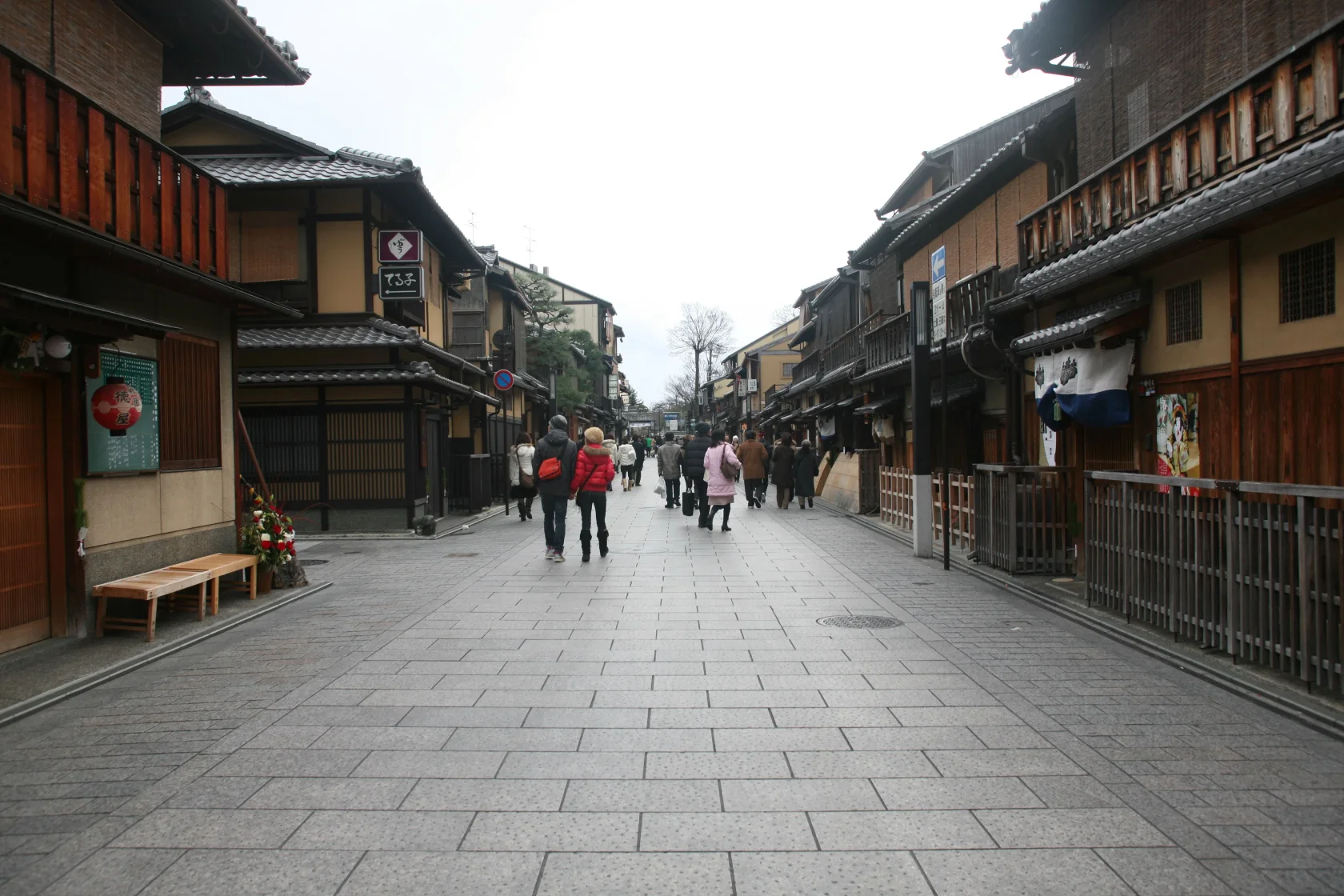
On the walk back to Gion, remember that vehicles use Hanamikoji Street: stay on public lanes as shown on entrance signs and avoid lining up outside teahouse doors. Respect all private-lane "no entry" and "no photography" notices, leave generous room for geiko and maiko to pass, and never follow or photograph them without permission. Save conversation until you are indoors, dispose of rubbish at the time and place specified by your machiya host, and step clear of traffic when stopping for street photos. Full route notes and local etiquette are covered in our Gion Hanamikoji walking guide.
Split Two Days Between Higashiyama and the Shopping Arcades, with a Midday Break
Waking up in Gion, devote the morning to Shirakawa, Yasaka Shrine and Maruyama Park, starting with whichever lies closest to your doorstep. Time your walk through Hanamikoji around Kennin-ji Temple's opening hours if you plan to view the Abbot's Hall (Hojo) and Dharma Hall (Hatto). Continuing up towards Kodai-ji, Ninenzaka, Sannenzaka and Kiyomizu-dera involves sustained uphill streets—confirm everyone is happy with the gradient and decide whether to return via a main road or a closer station. With older relatives, keep Yasaka Shrine and Maruyama Park as a gentle half-day and head back after lunch; anyone continuing uphill can follow our Kiyomizu-dera and Higashiyama walking route and meet back on Shijo-dori in the evening.
During cherry blossom or autumn colour seasons, picking your departure time trims queues considerably. Kyoto City's Tourism Comfort Map forecasts crowd levels by date, time and weather for Hanamikoji, Kiyomizu-zaka and Nishiki Market. If Hanamikoji is forecast to be busy in the morning, stroll Shirakawa first and walk Hanamikoji after leaving Kennin-ji. Spend your single early start on the hillside walk you care about most, keeping easy, flat streets near your hotel for the afternoon. If walking all the way from Shijo-Kawaramachi to Kiyomizu-dera feels too demanding, Kyoto City Tourism notes City Bus 207 to Kiyomizu-michi—bearing in mind there is still a steep climb from the bus stop.
Save Kawaramachi for your second half-day: target specific stalls in Nishiki Market, eat wherever there is seated space, and continue through Teramachi, Shinkyogoku or Takashimaya. When showers come and go, pairing Nishiki Market with the covered arcades and department store dining keeps the afternoon dry. Crossing from Gion still requires walking over the Kamo River before ducking into underground passages or malls, though wet shoes and socks are easy to swap back at your hotel. With spare time after Shijo, walk north along Teramachi towards Sanjo while others wait by Sanjo-Ohashi Bridge, linking naturally into our Kyoto Sanjo-dori walking guide.
For out-of-town day trips, west-bank guests can ride Hankyu from Kyoto-Kawaramachi to Katsura and change to the Hankyu Arashiyama Line for Arashiyama. Heading to Fushimi Inari from Gion-Shijo, board a Keihan service that calls at Fushimi-Inari Station, as Limited Express trains skip it. For Kurama and Kibune, ride Keihan to Demachiyanagi and transfer to the Eizan Electric Railway. If your stay sits on the west bank and requires crossing the bridge to catch trains, weigh one morning crossing and one evening return against the rest of your itinerary; for a single out-of-town excursion, choose your hotel based on your regular evening route. If you have two consecutive early starts on the Shinkansen or JR lines, staying near Kyoto Station eliminates daily feeder journeys.
The stretch between Shijo-Ohashi and Sanjo-Ohashi bridges is well suited to splitting by energy levels. Parents with small children wanting only a brief spell outdoors can stay on their own bank, while shoppers head into Kawaramachi and machiya fans cross over to Shirakawa, setting a named shop or specific bridge end as the rendezvous. If anyone in your party is unsteady on riverside steps or slick paving stones, keep the whole outing at street level, book dinner somewhere directly off a main avenue and avoid doubling back solely to meet up.
On your final evening, line up the next morning's train departure, left-luggage collection deadlines and check-out instructions together. Check street-level station entrances for early trains, and follow your host's key-return arrangement if reception or the machiya check-in desk is off-site. For late-afternoon departures, keep your final hours on the same side of the river so you can collect bags and leave straight from your nearest station. If you want one last morning walk along Shirakawa before checking out, fit breakfast and the stroll in before clearing the room so you only need to pick up your bags on the way out.
A few useful answers
For a first trip to Kyoto, is Kawaramachi or Gion more convenient?
Choose around Kyoto-Kawaramachi Station if shopping, varied dinner options or Hankyu trains to Osaka-Umeda are priorities. Stay between Gion-Shijo Station and your key sights if you want early morning walks to Shirakawa and Yasaka Shrine or frequent Keihan rides. If most of your journeys use JR lines, compare Kyoto Station as well.
How should I request a quiet room in Kawaramachi?
After booking, ask for an inward-facing room away from the lifts. If quietness matters, avoid categories facing the Shijo-Kawaramachi junction or directly overlooking Kiyamachi restaurant doors, and clarify whether the orientation is guaranteed or only noted as a request for check-in.
Which station should I use for a Gion Shirakawa machiya?
Check the exact address of both the machiya and its check-in desk first. Near Tatsumi Bridge and Shinbashi-dori, compare Gion-Shijo and Keihan Sanjo; towards Sanjo-dori on the east side, also check Higashiyama and Sanjo-Keihan underground stations. With heavy suitcases, recalculate the walk using lift exits.
Is staying near Yasaka Shrine good for the Gion Matsuri Saki Matsuri Yoiyama?
If your main goal is viewing the Yamaboko floats on Yoiyama evenings, look on the west bank between Shijo-Karasuma and Shijo-Kawaramachi and check hotel access against that year's traffic map. If you are focusing on rituals at Yasaka Shrine, stay on the east side in Gion within walking distance.
Can I stay in Gion and dine on a Pontocho noryo-yuka riverside deck at night?
Yes. Pontocho sits on the Kamo River's west bank, so cross via Shijo-Ohashi or Sanjo-Ohashi Bridge depending on the restaurant's location. Request yuka seating when booking and confirm the wet-weather indoor policy; the 2026 cooperative season runs until 15 October, though some venues close at the end of September.
Official information and references
Sources used in this guide.
- Kyoto City Tourism Association — Choosing Accommodation: Key Features of Each Area
- Kyoto City Tourism Association — Central Kyoto Sightseeing Map
- Kyoto City Tourism Association — City Railways and Transfers
- Kyoto City Tourism Association — Kyoto Station Transfer Guide
- Hankyu Railway — Kyoto-Kawaramachi Station Map
- Keihan Electric Railway — Gion-Shijo Station Information and Map
- City of Kyoto — HANDS FREE KYOTO Luggage Delivery Service
- Kyoto City Tourism Association — Gion Matsuri Schedule and Procession Route
- Hankyu Railway — Gion Matsuri Station Maps and Extra Services
- City of Kyoto — Accommodation Tax Scope and 2026 Revised Rates
- Kyoto Kamogawa Noryo-yuka Cooperative — 2026 Season Dates and Restaurant Directory
- Kyoto City Tourism Association — Pontocho-dori
- Kyoto Prefecture — Kamo River Water Levels and Safety Guidance
- Kyoto City Tourism Association — Gion-machi Minamigawa Visitor Etiquette
- City of Kyoto — Private Lane and Photography Notices around Hanamikoji, Gion
- Kyoto Prefecture Tourism Federation — Gion District and Shinbashi Preservation Area
- GOOD NATURE HOTEL KYOTO — Access and Entrances
- Kyomachiya Shirakawa-an — Facilities and Check-In Information
- Tsumugi Gion Shirakawa — Facility Details and Walking Routes
- Kennin-ji Temple — Visiting and Access
- Cross Hotel Kyoto — Walking Access from Shijo and Sanjo
- City of Kyoto — Cross Hotel Kyoto Accessibility Information
- City of Kyoto — Licensed Hotel Business Facilities and Off-Site Reception Data
- City of Kyoto — Registered Private Lodging (Minpaku) Facilities List
- Kyomachiya Shirakawa-an — Cancellation and Payment Terms
- Kyoto City Tourism Association — Access to Kiyomizu-dera and Higashiyama
- Kyoto City Tourism Association — Kyoto Tourism Comfort Map