Dates for the 2027 Yodogawa Fireworks have not yet been announced. Based on the 2026 (38th) edition, compare paid and free zones at the Juso venue, Umeda-side closures, ticket pickup rules, and return routes on Hankyu, JR, and Osaka Metro.
- Region & Focus
- OsakaFestivals and fireworks
- Reading Scope
- 15 min read · 10 chapters · 6 Q&As
- Official Verification
- 19 official sources checkedUpdated November 22, 2026 at 08:00 AM GMT+8
- Key Topics
- SeasonsBookingRail travel
Chapter Route Map (tap any stop)
- Which Bookings to Keep Flexible Until 2027 Dates Drop
- Finding the Right Bank, Bridges, and Entrances on the Juso Map
- Choosing Paid Sponsor Seats: Compare Chairs and Assigned Seating First
- Buying Tickets Online and Picking Up Paper Tickets in Japan
- What You Can See From the Free Zones—and When Spot-Saving Starts
- Juso, Tsukamoto, Minamikata, or Nishinakajima-Minamigata: Which Station to Use
- Wait in Your Seat After the Finale—or Leave Early
- Picking Entrances for Kids, Seniors, and Wheelchair Users
- Watching the Water Fireworks: Camera Zones vs. Smartphone Shooting
- Fireworks-Night Lodging: Umeda, Shin-Osaka, or Shifting Your Osaka Days
- Quick Q&A
Dates for the 2027 Naniwa Yodogawa Fireworks Festival have not yet been announced. The most recent edition took place on October 17, 2026, from 7:00 PM to 8:00 PM along Osaka's Yodo River. Spectators had to enter from the north (right) bank on the Juso side, as the Umeda-side riverbanks were closed for construction. For a first visit, start by picking a seating tier that comfortably fits your whole group, then choose your arrival station based on your ticket zone. Even if you are staying in Umeda, you can cross the river by Hankyu or JR before the show and ride back afterward.
Which Bookings to Keep Flexible Until 2027 Dates Drop
As of November 22, 2026, the organizer's official announcements still cover only the completed 38th edition. When searching Japanese sources, use the official name "Naniwa Yodogawa Hanabi Taikai." The 37th edition in 2025 took place on October 18, a shift the organizers noted was made to align with Expo 2025 Osaka, Kansai. The 38th edition stayed in October: the date was announced on January 13, online ticket sale details followed on June 1, and official web sales opened on August 1 at 10:00 AM JST. Use those milestones as planning reminders, and leave fireworks night open on your calendar until the next date is confirmed.
If your entire trip to Japan revolves around the Yodogawa Fireworks, wait for the official date announcement before locking in nonrefundable flights and hotels. If you already have a broader Kansai itinerary planned, keep two Osaka nights flexible with a room rate that states a clear free-cancellation deadline. Save your booking confirmation email rather than relying on the search listing, and log both the cutoff date and its Japan Standard Time (JST) deadline in your calendar. That way, if the room turns nonrefundable later, you only need to decide whether to keep the stay rather than scrambling to rebook accommodations on the morning tickets go on sale.
Lock in your logistics in three stages. Once the festival date is announced, decide where you will sleep that night. When ticketing details are released, pick a seating tier based on your group's ages and budget, and check how easy the assigned entrance is to reach. Wait until the traffic restriction map is published to finalize your station exit, approach route, and final leg home. In 2026, the traffic control page was updated on September 16—more than a month after tickets went on sale. Once you have tickets in hand, look up the walking route for your specific zone, and verify any shortcut a friend recommends against that year's official map.
Under the 38th edition rules, the show goes on in light rain and is canceled—not postponed—in severe weather. According to the official FAQ, the cancellation call is made at 11:00 AM JST the day before and posted on the festival website, though lightning or sudden river-level spikes on show day can still force a suspension or mid-show halt. Check the official site before heading out so you know whether to pack rain ponchos. If the event is canceled, switch that evening to dinner near your hotel or an indoor shopping complex, and keep the rest of your trip unchanged.
| Announcement or Milestone | Date / Time | Action for Travelers |
|---|---|---|
| Scheduled date announced | January 13, 2026 | Plan lodging and intercity travel dates |
| Official online ticket sales open | August 1, 2026, 10:00 AM | Choose seating by zone and note pickup method |
| Traffic restrictions updated | September 16, 2026 | Map exact entrance route and return transit |
| Event held | October 17, 2026, 7:00 PM–8:00 PM | 38th edition completed |
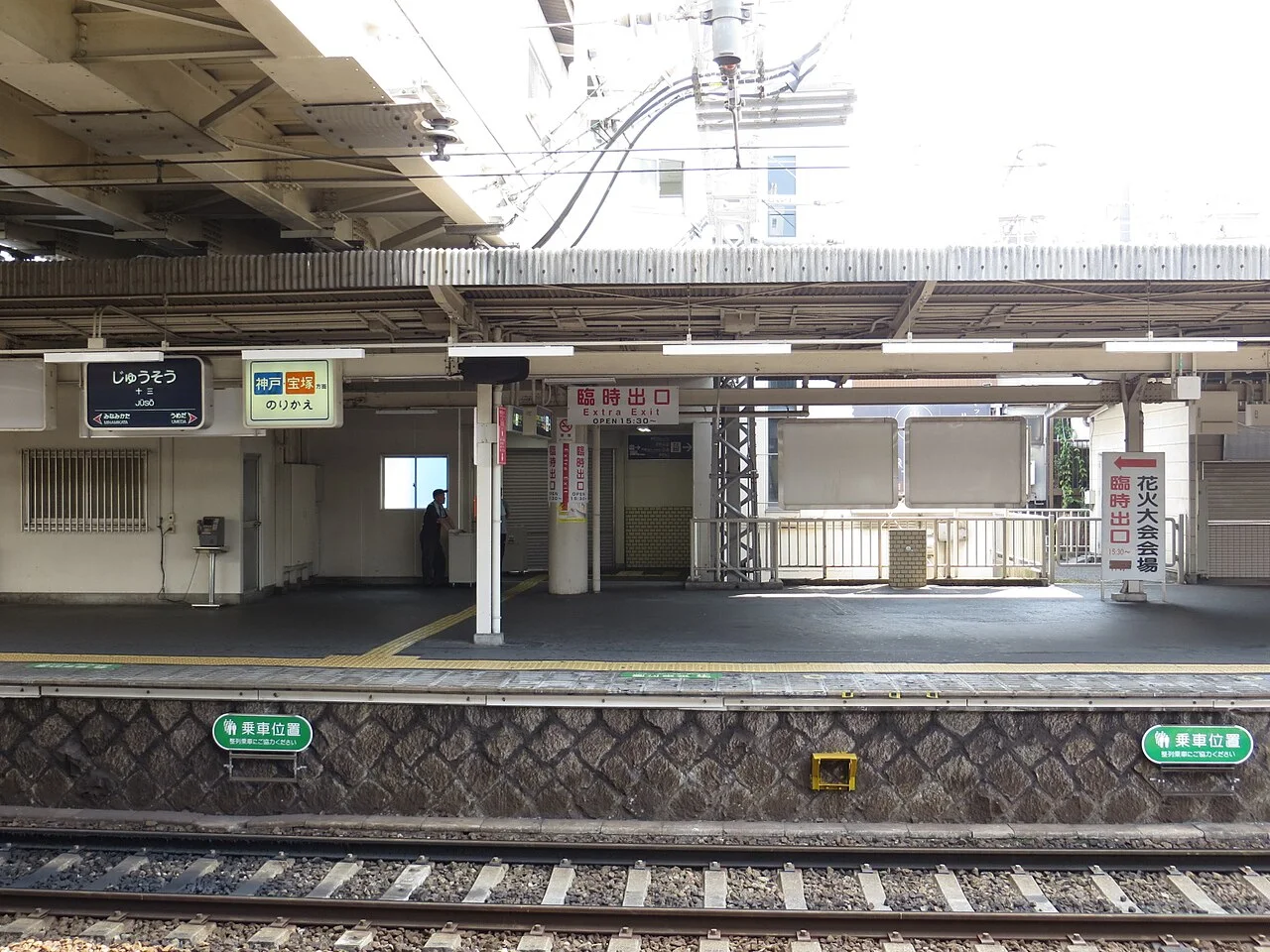
Dates for the 2027 Yodogawa Fireworks have not yet been announced. Based on the 2026 (38th) edition, compare paid and free zones at the Juso venue, Umeda-side closures, ticket pickup rules, and return routes on Hankyu, JR, and Osaka Metro.
Finding the Right Bank, Bridges, and Entrances on the Juso Map
The Yodo River flows southwest through central Osaka toward Osaka Bay, and the open spectator grounds for the 38th edition sat on the north (right) bank—the Juso and Tsukamoto side. Official boundaries stretched from around the Shin-Yodogawa Ohashi Bridge on the Shin-Midosuji road upstream down to the Yodogawa Ohashi Bridge on National Route 2 downstream. According to the organizer's FAQ, fireworks are launched roughly between the Juso Ohashi Bridge (National Route 176) and the JR Kobe Line viaduct. When reading the map, locate both ends of the venue, the launch zone, and your ticketed section separately so your riverbank target lines up with the direction you exit the station.
Due to expressway construction in 2026, the Umeda-side left bank from around Nakatsu to Noda was closed to the general public. Walking toward the river at street level from Umeda or booking a hotel in Nakatsu for riverfront access led straight to a fenced-off bank. You can still stay in Umeda for the rest of your itinerary and simply take the train across to the Juso side on fireworks night. If you plan to cross a bridge on foot, verify which walkways remain open on that year's traffic restriction map. Follow separate rules for bridge crossings and embankment viewing—do not stop on a bridge or the top of the levee to watch the fireworks.
Save both the official venue map and the traffic restriction map offline before you go. On the 38th edition venue map, orange zones mark paid sponsor seating and green zones mark free areas; red arrows from train stations guide ticket holders, while blue arrows lead to the free viewing areas. The traffic map shows closed intersections, open bridge sidewalks, and restriction hours. Make sure your screenshots keep the legend and station names visible. Searching your phone's maps app for the festival name usually drops a single generic event pin—navigating by riverbank side and your ticket block's assigned entrance is far more reliable than following a generic pin toward the water.
Bridge names look deceptively similar in map searches: Juso Ohashi Bridge, Shin-Juso Ohashi Bridge (on the Juso Bypass), and Shin-Yodogawa Ohashi Bridge (on Shin-Midosuji). Match "Juso Ohashi" to National Route 176, and match the JR viaduct to the JR Kobe Line. When reading upstream versus downstream labels, treat "toward Shin-Midosuji" as upstream and "toward Route 2" as downstream. Use these landmarks to tell companions where you are rather than trying to share a drifting blue GPS dot.
On the 38th edition map, the Central Stairs, East Stairs, and Tsukamoto Slope were restricted from 2:00 PM onward as dedicated entrances for paid sponsor seating. Ticket holders show their paper ticket at the embankment approach, then have staff tear the stub at the gate for their specific block. Spectators without tickets must use the general public entrances marked for the free zones. If friends hold different ticket types, eat together in the shopping arcade beforehand, split up for your respective levee entrances, and meet back at the train station near your hotel afterward. The foot of the Central Stairs must stay clear for foot traffic during the event, and organizers advise against waiting for companions at the gates.
Choosing Paid Sponsor Seats: Compare Chairs and Assigned Seating First
If you are traveling with older relatives or young kids, evaluate the seating format before looking at price. In the 38th edition, Stage Seats and Premier Seats provided tables, chairs, and organizer-assigned seat numbers. Pick the same block when ordering and follow the seat numbers printed on your tickets. Organizers warn that separate purchases may result in split seating, so families and friends wanting to share a table should buy in one transaction within the same block. Stage Seats also feature pre-show performances, making it worthwhile to arrive early since your seat is already waiting.
Exciting Seats sit near the center launch zone and include a table, chair, bento box, and tea. Although the 38th edition advance adult price matched the Stage Seat at ¥14,000, Exciting Seat tickets only grant admission to the zone, where seating is first-come, first-served. If part of your group arrives late, remaining open seats may be scattered. If you want a close central view while guaranteeing a family sits together, compare the identically priced Stage Seat or step up to the Premier Seat.
For budget-conscious travelers, Panorama Seats cost ¥5,000 for adults and ¥2,500 for children in the 38th edition. Tickets are sold across several Left and Right blocks, with open cushion seating along the sloped embankment. Check the color-coded zone chart before buying, and do not confuse the block names "Left" and "Right" with the left or right banks of the Yodo River. Anyone with back pain or difficulty getting up off the ground will feel an evening on cushions—for those travelers, a real chair in the Stage Seat section matters far more than a slightly shorter walk.
Noryosen (Viewing Boat) tickets cost ¥28,000 per adult in the 38th edition and include assigned seating with tables and chairs aboard a boat moored permanently along the bank. This option suits viewers who want a water-level angle on low-altitude river bursts—note that the boat stays docked and does not cruise the river during the show. Boat tickets also carry specific weather terms. Save the boat section's cancellation policy before booking, and compare its boarding, cruising, and refund rules side by side if you are also considering third-party tour-agency dinner cruises.
For the 2026 organizer-sold sections listed above, child fares applied to children aged 3 through elementary school. Children under 3 enter free on an adult's lap, though they need a child ticket if they require their own seat. Junior high school students require adult tickets, so factor that into your budget. Panorama Seats come with a seat cushion, whereas chaired tiers like Stage Seats also include a bento meal and tea. Confirm meal inclusions, chair type, and entrance gates before checkout so the ticket price matches what you actually need on show night.
Using 38th edition official web pricing, Panorama Seats for two adults and one elementary-school child total ¥12,500 in face value, or ¥13,490 including online system and convenience-store printing fees for all three tickets. Putting the same trio in Stage Seats totals ¥35,990. That price difference buys reserved seat numbers, tables, chairs, and meals—and guarantees everyone keeps their seat even if family members arrive separately. If your group is fine sitting on cushions for the duration, the savings from Panorama Seats easily cover a hotel upgrade or transit.
| Seating Tier | Adult / Child (JPY) | Seating Format |
|---|---|---|
| Panorama Seat | ¥5,000 / ¥2,500 | Block-specific; open cushion seating within block |
| Exciting Seat | ¥14,000 / ¥7,000 | Zone-specific; unreserved chairs within zone |
| Stage Seat | ¥14,000 / ¥7,000 | Tables and chairs; organizer-assigned seat numbers |
| Premier Seat | ¥20,000 / ¥10,000 | Tables and chairs; organizer-assigned seat numbers |
| Noryosen (Viewing Boat) | ¥28,000 / ¥14,000 | Assigned seating aboard a docked vessel |
Buying Tickets Online and Picking Up Paper Tickets in Japan
Start from the organizer's "Purchase Sponsor Viewing Seats" link to access the official ticketing portal. In 2026, buying official online tickets required member registration, though previously registered accounts could be reused. Test your login, review the payment screen, and confirm that notification emails reach your inbox beforehand. The organizer's ticket guide lists both credit card and convenience-store payment options; check the current order page for accepted cards and payment deadlines. If you intend to pay at a convenience store after landing in Japan, make sure the payment window does not expire before your arrival date. Paying online by card leaves only paper-ticket pickup for your trip.
For the 38th edition, official web tickets were redeemed at multimedia kiosks inside FamilyMart stores in Japan using an exchange number (pickup code). Save your confirmation email's pickup instructions, redemption start date, and exchange number offline. Print your paper tickets at a FamilyMart near the airport or your hotel after landing so you aren't standing in kiosk lines near Juso Station right before the show. In 2026, official online orders added a ¥220 system fee and a ¥110 convenience-store issuing fee per ticket—for larger family orders, compare total checkout cost against other tiers before paying.
The official festival portal, Ticket Pia, e+, and Lawson Ticket (L-tike) each manage separate pages, so your seating blocks and ticket-pickup steps depend on the vendor you buy from. If the official portal sells out, check the other authorized outlets listed on the main ticket page. In the 38th edition, additional Exciting Seats near the center were released later, though organizers announced a complete sellout on October 16. Rank your preferred sections ahead of time so you can pivot immediately to a backup block or the free viewing zones if seats sell out; unauthorized paid resale is strictly prohibited.
Confirm your final headcount before purchasing, especially if members of your party arrive in Osaka on different days or enter separately. Once you print the paper tickets, hand each person their own ticket and share photos showing the block code. Having one person hold all the tickets forces latecomers to wait at the stairs—right where staff require walkways to stay clear. In the 38th edition, re-entry to paid areas was allowed only if you obtained a re-entry pass on exit and presented both your torn ticket stub and the re-entry pass on return. Anyone stepping out to buy food or drinks needs to carry their own stub.
Official ticket terms state that if the show goes ahead, no refunds are issued for personal conflicts or late arrivals. Refunds apply only if the entire event is canceled, processed through the original ticketing vendor. If a temporary suspension or cancellation is announced, keep your intact paper ticket, torn stub, and payment receipt until the organizer publishes refund instructions. Handle hotel cancellations separately under your room's own deadline. The 38th edition had fixed refund windows and procedures, so save the current terms when you buy for the next edition.
What You Can See From the Free Zones—and When Spot-Saving Starts
If you are traveling solo or as a pair, mainly want to see the high-altitude aerial shells, and don't mind a long walk back to the train, the free viewing zones are a solid option. For the 38th edition, saving spots outside paid seating was prohibited until noon (12:00 PM) on event day—mats laid down early were removed even with someone sitting on them. Even after noon, unmanned mats are not allowed, and space is capped at 1 square meter per person actually present. On the 38th edition map, free areas were split between the right bank upstream toward Juso and Nishinakajima and downstream near National Route 2, with warnings that sections close early once full. Sitting on levee tops, stairs, walkways, or restricted zones is forbidden. Arrive early for closer spots, and bring a tarp you can fold down to fit your exact headcount.
Pay attention to bridge clearance, bank slope, and distance when scouting a spot. High-altitude bursts climb high above the river and remain visible from farther back, but low-level water effects require an unobstructed sightline to the river surface. If sitting down leaves you staring at the levee slope, trees, or standing crowds, standing up to shoot photos will only block spectators behind you. Judge a family spot from seated eye level, and walk the route from your tarp to the nearest restrooms while it is still daylight.
If your group is arriving at staggered times, agree on three map points beforehand: bridge, bank, and entrance. Areas near Juso Ohashi Bridge and the JR Kobe Line viaduct are both on the right bank, yet they sit a long walk apart along the levee. Searching the riverbank after dark for a specific tarp color is far harder than meeting at an obvious landmark before entering the venue. If someone is commuting in last-minute from Kyoto or Kobe, send them to an accessible spot where standing or sitting is permitted rather than having them push into an already packed central riverbank.
According to the 38th edition FAQ, food stalls were split into two zones: upstream from Juso between the Juso Bypass, Nishinakajima, and Shin-Midosuji; and downstream on the Tsukamoto side between the JR Kobe Line viaduct and National Route 2, alongside concessions inside paid seating areas. Buy food on the same side as your viewing spot so you don't have to fight crowds across the grounds beforehand. Organizers allow outside food and alcoholic drinks inside sponsor seating, though open flames and cooking equipment are banned—stick to ready-to-eat items.
In rain, wear a poncho or raincoat that keeps your hands free—organizers ask spectators to avoid using umbrellas. Riverbanks get breezy after sunset, so pack a dry cushion and a light jacket for the wait. Drink water and use the restroom before the show starts, and if staff ask crowds to pack up and shift, fold your tarp promptly. For the 38th edition, organizers instructed spectators to leave event-generated trash at designated riverbank disposal points following staff directions before exiting.
Juso, Tsukamoto, Minamikata, or Nishinakajima-Minamigata: Which Station to Use
Taking Hankyu from Umeda to Juso lines up best with the entrances near Juso Ohashi Bridge on the official map. Note that Hankyu "Osaka-Umeda" and JR "Osaka" are separate stations—decide which one you are using before leaving your hotel, as switching between them requires cutting through underground malls or crossing busy streets. If a friend texts "meet in Umeda," pin down an exact hotel lobby or a named railway company ticket gate rather than trying to find each other inside a massive terminal complex.
JR Tsukamoto Station connects directly to Osaka and Shin-Osaka, making it the first line to check if your seats sit toward the downstream end of the venue. JR West's station layout separates platforms bound for Osaka and Shin-Osaka from those heading toward Amagasaki and Sannomiya. If you are returning to JR Osaka Station, look for platform signs reading "For Osaka, Shin-Osaka, and Kyoto" once inside the gates. At Juso Station, verify which Hankyu line and direction queue you are joining—especially if you plan to transfer at Osaka-Umeda.
If you are staying near Shin-Osaka or along the Midosuji Line and have upstream seats, check Osaka Metro's Nishinakajima-Minamigata Station. Travelers arriving on the Hankyu Kyoto Line should look at Hankyu's Minamikata Station on the venue map. Despite nearly identical names, they are run by different operators—save the exact Japanese station names on your phone to show staff if you need directions on the way back. Because both stations sit side by side in the same neighborhood, crowds bottleneck at the same intersections, so do not treat them as completely separate bypass routes.
The 38th edition official guide also listed Mitejima Station on the JR Tozai Line and Himejima Station on the Hanshin Main Line. Match these against the traffic restriction map if your seats sit far downstream or your hotel connects directly to either line. Conversely, detouring to a distant station when your block sits at the opposite end of the right bank only forces you to wade through denser crowds and backtrack. Pick one primary station aligned with your return direction and one backup station reachable from your section's exit in case crowd control diverts foot traffic.
In 2026, organizers urged sponsor-seat holders to reach their nearest train station by 5:30 PM and arrive at the riverbank by 6:00 PM. Official guidance notes that walking from the station to the riverbank takes about 15 to 30 minutes under event crowds, so finish convenience-store ticket pickup, family meetups, and early dinner before hitting the destination station. Gate opening times are also staggered: in the 38th edition summary, the Central Stairs opened at 2:30 PM, Panorama Seat gates at 3:00 PM, and other organizer-sold sections at 4:00 PM. Plan around your block's gate time if you want to settle in early. Late arrivals arriving after launch began were still guided to their seats in the 38th edition, though progress from gate to seat moves much slower once the show starts.
| Venue Zone to Check First | Station | Return Connections |
|---|---|---|
| Around Juso Ohashi Bridge | Hankyu Juso | Hankyu Osaka-Umeda / all Hankyu lines |
| Downstream right bank | JR Tsukamoto | JR Osaka, Shin-Osaka, or Amagasaki |
| Upstream near Shin-Midosuji | Hankyu Minamikata / Metro Nishinakajima-Minamigata | Hankyu Kyoto Line / Osaka Metro Midosuji Line |
| Farther downstream | JR Mitejima / Hanshin Himejima | JR Tozai Line / Hanshin Railway |
Wait in Your Seat After the Finale—or Leave Early
Once the finale wraps up, pack your ticket stubs, rain ponchos, and cushions before listening for which block is cleared to exit. In the 38th edition, paid sections exited in staggered waves with gates opening and closing to meter crowd flow, and the official guide urged spectators to avoid the initial rush and wait roughly an hour before moving. Stay inside your assigned block if you can wait it out. Climbing onto the stairs or loitering by the gates to wait for friends clogs the outflow—follow staff instructions out to an open holding area before checking a companion's location.
If older relatives or young kids are running out of steam, leaving early works—as long as you beat the exit lockdown. The 38th edition FAQ states that exits switch to restricted crowd-control status roughly 15 minutes before the fireworks end. With the 2026 show scheduled to end at 8:00 PM, anyone exiting early needed to clear their block gate before restrictions kicked in around 7:45 PM, factoring in the walk from seat to gate. Once staff start directing outbound lanes, follow the flow and do not push forward through narrowed exits.
Your arrival and departure rail lines do not have to match. For example, if you walk in from Hankyu Juso to seats downstream near the JR viaduct, staff may route your exit toward Tsukamoto, where catching a JR train back to Osaka is far easier. Just remember that single-operator rail passes do not cover a different railway company, so you will pay a separate fare. Check exit routes and one-way pedestrian arrows on the restriction map before committing to a long walk—returning to your original station often means fighting against outbound crowd control. Taking a longer walk to an alternate line only makes sense if the path is open and your group has the energy.
In the 38th edition, the east sidewalk of Shin-Juso Ohashi Bridge closed at 1:00 PM. Both sidewalks of Juso Ohashi Bridge closed at 5:30 PM, with northbound traffic lanes converted to pedestrian use and stopping on the bridge strictly prohibited. Even if two hotel options look equally walkable across a bridge on Google Maps, compare actual rail connections against that year's open pedestrian corridors. Organizers mandate public transit and provide no official car or bicycle parking at the venue. Travelers with luggage, strollers, or plans to call a taxi should set their pickup point well outside the traffic restriction perimeter—areas around Juso Station exits and bridge approaches must remain clear.
If you are catching a late Shinkansen or heading to Kansai International Airport after the show, count backward from your train departure and build in heavy buffers for station queues, packed cars, and transfer walks. During the 38th edition, Hankyu issued special show-day rules for its PRiVACE reserved-seat service at Juso Station: suspending onboard ticket sales for passengers boarding at Juso after 7:30 PM, and advising wheelchair users to transfer at Osaka-Umeda instead after 3:00 PM. While specific to that reserved-seat car, the notice underscores how risky tight transfers at Juso are on fireworks night. Whenever possible, book an extra night in Osaka and travel with luggage the next morning.
Picking Entrances for Kids, Seniors, and Wheelchair Users
The 38th edition FAQ listed two wheelchair-accessible ramps into the Juso venue: one on the Tsukamoto Station side near the JR Kobe Line, and another along National Route 176. Before finalizing tickets, contact the organizer with your specific block name to confirm whether those ramps connect directly to your section's open gate. Organizers identified Stage Seats and the Noryosen Viewing Boat as the tiers closest to accessible restrooms, with staff available to guide guests as needed—for the Noryosen boat, inquire in advance about boarding and disembarking between the bank and vessel. If someone in your party has limited walking stamina, verify whether the same ramp stays open for outbound exits afterward.
With a stroller, two paths that appear connected on a flat map often hide a staircase climbing up the levee. Decide among the adults beforehand who will carry the child and who will fold the stroller at stairs before picking your entrance. If you swap the stroller for a baby carrier, consider how many hours you will wear it, and pack a foldable seat cushion so adults can take turns resting inside the seating zone. If you have already spent half the afternoon sightseeing, don't force tired family members to stand in an entrance queue by the river just for a front-row spot.
On a child's first visit, locate the nearest restrooms as soon as you enter, and point out staff in event vests so kids know who to approach if separated. Bring kid-sized ear protection, start from a slightly farther back spot with a clear exit path, and—if you are in an unreserved block—aim for spaces beside an aisle without encroaching on it. If staying for the water-level finale matters, paying for chairs so everyone can rest through the wait is far easier than trying to hold out on crowded grass.
When splitting up for drinks or restroom trips, designate a meetup landmark inside an open holding area and keep at least one adult with anyone needing assistance. Cell service often degrades inside the crowd, so save your ticket block code, meetup time, and hotel address in Japanese offline. If a child gets lost, alert event staff immediately rather than sending another child to look. If anyone feels unwell, notify nearby staff right away to reach a safe resting area instead of pushing the whole group backward against stair traffic.
If anyone in your group needs frequent restroom breaks, lock down two options before entering: one at the station or restaurant beforehand, and one inside your seating block. Official guidance warns of queues at riverbank toilets, so an easy walking path from your seat matters more than simply seeing a toilet icon on the map. Where queues and walking distances add up, book a reserved-seat block, arrive early, and handle restroom visits before showtime. Near the water, watch the wind direction too: organizers caution that spent shell debris can drift down onto the bank, and if you spot anything resembling an unexploded firework shell, do not touch it—alert staff immediately.
Watching the Water Fireworks: Camera Zones vs. Smartphone Shooting
The festival grew out of local Juso community groups—launching in 1989 as the Heisei Yodogawa Fireworks Festival before adopting its current name—and continues to rely on neighborhood volunteers. When picking seats, check the program for low-level water segments. The 38th edition ran in five acts, opening with music-synchronized choreography and closing with a finale featuring water-skimming bursts across the river surface. To see those low bursts open across the water, you need an unobstructed view down to the river surface directly in front of the launch barges from a seated position.
If you plan to set up a tripod, start with the organizer FAQ's list of designated photography zones for that year. In 2026, Ticket Pia, e+, and Lawson Ticket offered specific photo areas, whereas tripods and selfie sticks were banned in Exciting, Group, Stage, Panorama, and Noryosen boat sections. Entry rules for camera areas follow the issuing vendor's terms. With a standard seat ticket, shoot handheld from your own seat—keep cameras clear of aisles and stairs, and pack your gear away before your block exits.
For phone photography, test a horizontal frame that includes a slice of the riverbank silhouette before waiting for the low bursts to enter the shot. Zooming tight on a single aerial shell cuts off wide dual-side bursts opening across the river. Lower your screen brightness between acts and limit filming to a few clips so neighbors keep an unblocked view of the water. If wind pushes smoke across your lens, stay in your seat and wait for the next act rather than moving into walkways or stairs.
Unauthorized drone flying over or along the venue riverbanks was strictly prohibited in the 38th edition—even for sub-100g drones. If you want to capture both the river surface and high aerial shells, dial in your main lens settings before arrival and pack a lens cloth. If drizzle starts, put your phone away rather than opening an umbrella that blocks views behind you.
If you want reference photos afterward, check the official festival website's gallery or save original links from news outlets. Riverbank angles, distant bridges, and sightlines shift dramatically depending on where a shot was taken. While social feeds often circulate views from nearby apartments or hotel windows, ask your hotel directly about the exact room category, floor level, and window orientation before booking—and verify whether you can actually see the launch site while seated from a river-facing window.
Fireworks-Night Lodging: Umeda, Shin-Osaka, or Shifting Your Osaka Days
Staying in Umeda means stepping off the return train right inside your hotel district—provided you already picked between Hankyu back to Osaka-Umeda or JR back to Osaka Station. Each terminal requires a walk to your hotel, so if you are with kids, save a street-level walking route beforehand instead of hunting for underground exits late at night. If you are still comparing hotels, check our Umeda neighborhood stay guide to weigh walking distances across Hankyu, JR, and Metro stops. Pad plenty of time if you are meeting friends for a late-night meal, and check kitchen last-order times in advance.
Staying near Shin-Osaka simplifies next-morning Shinkansen departures and luggage transfers, while on fireworks night you can choose between Osaka Metro Nishinakajima-Minamigata or JR Tsukamoto depending on your ticket zone. Guests staying in Namba get a direct Midosuji Line connection to upstream zones; if you book Stage Seats near Juso, ride Hankyu back to Osaka-Umeda and transfer from there. If your group is heading back to different hotels afterward, have everyone save their own return route during the day and meet only at one landmark clearly outside the traffic-control perimeter.
Keep daytime sightseeing light on fireworks day so your afternoon stays free for ticket pickup, an early meal, and getting into the venue. Pick one short stop near your hotel—such as Osaka Castle, Umeda shopping, or Tennoji—because trying to tour from morning until dusk before heading to Juso will eat straight into your buffer for station and gate queues. Dedicate a separate full day to Universal Studios Japan rather than rushing from the theme park to the riverbank at sunset. If you are planning around a future edition, map two swappable sightseeing days using our three-day Osaka itinerary and adjust once the festival date is set.
If you are planning around Osaka's traditional festival calendar, research Yodogawa separately from the Tenjin Matsuri at Osaka Tenmangu Shrine. Tenjin Matsuri runs on a fixed schedule with Yomiya eve festivities on July 24 and the Honmiya land procession, river boat procession, and dedication fireworks along the Okawa River on July 25. For late-July trips, plan around the Okawa River area using our Osaka summer festivals guide; if you are adding fireworks stops in other cities, see our Japan fireworks seating and transit guide.
A few useful answers
When is the 2027 Yodogawa Fireworks Festival?
As of November 22, 2026, the organizer has not yet announced the 2027 date. The 38th edition took place on October 17, 2026.
Can you watch the Yodogawa Fireworks for free from the Umeda-side riverbank?
In the 2026 (38th) edition, entry to the Umeda-side left bank was prohibited. Free viewing zones were located on the Juso-side right bank, accessible via the general public entrances marked on the official venue map.
Are Panorama Seats assigned by seat number?
In the 38th edition, Panorama Seat tickets granted access to a designated block printed on your ticket, with open cushion seating inside that block. For individually numbered seats, look at Stage Seats or Premier Seats.
Can I enter using the online order confirmation screen on my phone?
In the 38th edition, official online tickets had to be printed as paper tickets at a FamilyMart store in Japan. For tickets bought through other authorized outlets, follow the issuing instructions on your order.
If it rains, is the show postponed to the next day?
In the 38th edition, the event ran in rain and canceled—with no makeup date—in severe weather. Any cancellation or suspension updates are posted on the official website.
Which ticket should I buy if I want to use a tripod?
For the 38th edition, designated photography areas were sold through Ticket Pia, e+, and Lawson Ticket (L-tike). Check the "photography area" (Shashin Satsuei Area) listing on those outlets for the edition you attend.
Official information and references
Sources used in this guide.
- Yodogawa Fireworks Festival Official News and 38th Edition Closing Notice
- 38th Edition Date, Launch Schedule, and Venue Overview
- 38th Edition Date Announcement
- 37th Edition Date Announcement
- 38th Edition Official Ticket Sale Launch Notice
- Venue Map, Free Spot-Saving Rules, and Entry Safety
- 38th Edition Traffic Restrictions and Spot-Saving Hours
- 38th Edition Joint Osaka Prefectural Police and Organizer Traffic Restriction Map
- Official FAQ (Cancellations, Entry, Accessibility, Photography, and Exit)
- 38th Edition Paid Sponsor Seating, Ticketing Outlets, and Advance Prices
- Paid Sponsor Seating Entry, Seating, and Refund Rules
- Official Ticketing Guide and FamilyMart Ticket Issuing
- 38th Edition Program and Water Fireworks
- History of the Naniwa Yodogawa Fireworks Festival
- Hankyu Juso Station Map and Platform Directions
- Hankyu 38th Edition Fireworks Day PRiVACE Reserved-Seat Operations
- JR West Tsukamoto Station Map
- Osaka Metro Nishinakajima-Minamigata Station Map
- Osaka Tenmangu Shrine Tenjin Matsuri Schedule and River Boat Procession