Ring in 2027 at Shitennoji's New Year's Eve bell or visit Sumiyoshi Taisha for New Year's Day hatsumode. Includes JR Osaka Loop Line overnight trains, Nankai and Hankai Tramway routes, plus Shitennoji's 2027 rituals and exhibition dates.
- Region & Focus
- Osaka
- Reading Scope
- 19 min read · 11 chapters · 6 Q&As
- Official Verification
- 22 official sources checkedUpdated November 22, 2026
- Key Topics
- SeasonsRail travelItineraries
Chapter Route Map (tap any stop)
- Where to Go on December 31 Starts With How You Get Back
- Where JR's Extra New Year's Eve 2026 Trains Run
- Which Sumiyoshi Taisha Schedules to Check for Gates, Rituals & Parking
- Sumiyoshitaisha, Sumiyoshihigashi & Sumiyoshitoriimae Are Three Different Stations
- Getting From Sumiyoshitoriimae to Shitennoji Toward Tennoji-ekimae
- Shitennoji's New Year's Eve Bells & January 1 Hall Hours
- Shitennoji's Announced 2027 Offerings, Prayer Services & Special Exhibition
- Walking From the Soribashi Bridge to the Four Main Halls
- Handling Rain, Strollers & Mobility Breaks
- Budgeting Time for Lines, Crowds & New Year Meals
- Doing a Half-Day on January 1—or Moving Events to Early January
- Quick Q&A
If you are staying up until midnight in Osaka on New Year's Eve, booking near Tennoji lets you walk to Shitennoji Temple for the midnight bell. Anyone staying along the JR Osaka Loop Line can also catch extra overnight JR West trains. Sumiyoshi Taisha sits farther south and works far better as a daytime trip on the Nankai Main Line or Hankai Tramway, when you can clearly see the Soribashi Bridge and the four National Treasure main halls. If you only have half a day on January 1, pick the side of town that gives you the easiest round trip from your hotel so worship, meals, and your ride back stay in one neighborhood.
Where to Go on December 31 Starts With How You Get Back
Shitennoji Temple is the simpler pick if you want to hear temple bells at midnight on New Year's Eve. The temple sits just north of Tennoji Station, making a late-night round trip on foot realistic, and JR West is running extra Osaka Loop Line trains for New Year's Eve 2026. Save crossing the Soribashi Bridge and paying respects at the four main sanctuaries of Sumiyoshi Taisha for a separate outing. Sumiyoshi Taisha lies on Osaka's southern edge and requires the Nankai Railway or the Hankai Tramway. Getting there in the evening and getting back in the early hours are two different logistics problems—a train that takes you out does not guarantee one will take you home.
Hatsumode—the year's first shrine or temple visit—officially begins at midnight on January 1 (JST). If you are based in Namba, Umeda, or Kyoto, the easiest way to skip messy midnight transfers is to stay near your hotel on New Year's Eve and visit Sumiyoshi Taisha in daylight. Traveling with kids or older relatives who tire easily? Pick one site first and eat lunch in the same neighborhood. If you go to Shitennoji for the midnight bells, push Sumiyoshi Taisha to January 1 or early January so neither visit feels rushed.
When scanning hotel maps, pin the exact station you plan to return to rather than filtering vaguely for "central Osaka." Staying near Tennoji turns the post-bell exit into a simple walk back to bed. From Umeda, you can link JR Osaka Station onto the Loop Line, though you still have the walk from Osaka Station to your hotel. Namba gives you the cleanest daytime ride south to Sumiyoshi on the Nankai Main Line, though if you head back from Tennoji late at night you need a clear route first. Because Namba's Nankai, Kintetsu, and subway lines occupy separate station wings, check our Namba station-zone hotel guide when booking.
| Goal | Where to Go | Transit & Timing |
|---|---|---|
| Hear the New Year's Eve bell at midnight | Shitennoji Temple | Walk back to Tennoji at night or ride JR Osaka Loop Line extra trains |
| See the National Treasure halls and Soribashi Bridge | Sumiyoshi Taisha | Daytime Nankai Main Line Local train or Hankai Tramway |
| Pray for exam success on January 3, 2027 | Shitennoji Ganzandaishi-do Hall | Check-in from 8:30 AM; prayer service 10:00 AM to 3:30 PM |
| Watch the Hoe-kago procession on January 9, 2027 | Imamiya Ebisu Shrine | Ride Nankai to Imamiyaebisu, or walk from Ebisucho or Daikokucho |
Ring in 2027 at Shitennoji's New Year's Eve bell or visit Sumiyoshi Taisha for New Year's Day hatsumode. Includes JR Osaka Loop Line overnight trains, Nankai and Hankai Tramway routes, plus Shitennoji's 2027 rituals and exhibition dates.
Where JR's Extra New Year's Eve 2026 Trains Run
According to JR West's October 30 announcement, regular trains on December 31 run on a weekend/holiday timetable, followed by extra service on both the inner and outer Osaka Loop Line into 2027 from roughly midnight to 3:00 AM at about 10-minute intervals. The JR Yumesaki Line between Nishikujo and Sakurajima runs roughly every 10 minutes from around 11:30 PM to 3:00 AM, with some through-trains continuing onto the Loop Line. Note that 3:00 AM marks the end of the overall operating window, so check the exact last train for your station and direction. JR West expects to publish timetables on JR Odekake Net and WESTER around December 21. See JR West's New Year's Eve extra train notice.
Once you leave Shitennoji, if your hotel sits near a Loop Line stop such as Osaka, Fukushima, Kyobashi, or Tsuruhashi, follow the temple's walking route back to JR Tennoji Station and confirm your platform by destination station. Visitors staying in Kyoto or Kobe should note that this extra service covers only the Osaka Loop Line and Yumesaki Line—JR lines out toward Kyoto and Kobe still end on their regular schedule. If you plan to stay past midnight and leave Osaka city that same night, look up that final intercity leg first. Even if an extra train gets you to JR Osaka Station in the small hours, you may still have to wait until first train to continue toward Kyoto.
JR Tennoji, Kintetsu Osaka-Abenobashi, Hankai Tennoji-ekimae, and Subway Tennoji are four separate stations. Seeing the same neighborhood name on a route app makes it easy to assume JR's late-night trains apply to the whole complex. Follow JR signs for the Loop Line; if you need Nankai from JR Tennoji, you can transfer at Shin-Imamiya, though your cutoff that night is still Nankai's last train. When the crowd disperses from Shitennoji after midnight, head straight toward a line you know is running—or within walking distance of your hotel.
If you plan to ride Nankai or the Hankai Tramway back into central Osaka from Sumiyoshi Taisha, check each operator's New Year's Eve schedule separately. Last season, Nankai ran neither extended hours nor overnight trains on New Year's Eve, and while Hankai ran holiday frequencies, its last tram did not run later than usual. If you keep Sumiyoshi Taisha for midnight, lock in a confirmed ride back first. When anyone in your group needs a subway connection, work backward from the final leg to your hotel before picking your departure time from Sumiyoshi. See Nankai's previous holiday service notice.
When checking trains past midnight, switch your search date to January 1, 2027—unless an operator lists post-midnight service at the end of its December 31 service day, in which case follow that operator's date format. Screenshot your boarding station, train direction, transfer buffer, and the entrance to use on the way back. After the bells finish, walking through the crowd to the main street and reaching the right platform eats up time, so step out of line in time to catch one train earlier than the absolute last connection home.
Which Sumiyoshi Taisha Schedules to Check for Gates, Rituals & Parking
Sumiyoshi Taisha's special New Year page lists gate hours separately from amulet counter hours. Last season (December 2025 to January 2026), gates opened at 10:00 PM on December 31 and stayed open until 8:00 PM on January 1, then ran 6:00 AM to 7:00 PM on January 2 and 3—posted under the "Reiwa 8" heading. Standard winter hours on the access page show gates opening at 6:30 AM from October through March (6:00 AM on the 1st of each month and on Hatsutatsu days), with the outer perimeter gates and inner sanctuary enclosure closing at 4:00 PM and 5:00 PM respectively. For 2027 planning, look for the "Reiwa 9" gate schedule on Sumiyoshi Taisha's New Year page.
Even before midnight, Sumiyoshi Taisha holds a year-end farewell ritual. The shrine's annual calendar lists the Shiwasu Oharai purification ceremony at 4:00 PM on December 31, followed by the Joya-sai New Year's Eve service thanking the deities for the passing year. If you want to watch these rites and still eat dinner back in Namba, schedule Sumiyoshi in the late afternoon with a confirmed ride back to your hotel. Since those rites close out the old year, returning the next day in daylight cleanly separates your year-end visit from your actual hatsumode wait. See Sumiyoshi Taisha's December events calendar.
For New Year's Day rituals, the shrine's annual calendar lists the Wakamizu-no-gi (First Water ceremony) at 5:00 AM and Saitan-sai (New Year's Day festival) at 6:00 AM on January 1. The head priest draws sacred well water as an offering, then leads prayers across the main halls and sub-shrines for peace and an abundant harvest. Ceremony start times, which halls are open to approach, and general visitor queue routing are managed separately on-site. If your goal is simply paying New Year respects, arriving later in the day still gives you access to all four main halls without racing down from northern Osaka before dawn. See Sumiyoshi Taisha's January events calendar.
Standard New Year road closures listed on the shrine's access page run from 11:00 PM on December 31 until around 7:00 PM on January 1, and from 10:00 AM to roughly 7:00 PM on January 2 and 3. Last season's notice also closed on-site shrine parking from December 31 through January 3. Pedestrian approaches from Sumiyoshitaisha Station matter far more than parking spots during this window—if you have a rental car for Kansai, leave it at your hotel and take the train. If someone in your party needs a car drop-off or pickup, check the current season's restriction map on the New Year page for vehicle-free zones and pickup hours. See Sumiyoshi Taisha's access guide.
Last season, Sumiyoshi Taisha announced no food or festival stalls inside the grounds from December 31 through January 5, and suspended both Godairiki stone amulets and fishing-style fortune draws from December 31 through January 4. If you visit at night, eat dinner before setting out—or check which nearby spots are open—so your time on-site goes to the grounds themselves. On regular days at the Goshogozen enclosure, visitors search the pebbles for three stones marked with the characters "Go," "Dai," and "Riki" (Five, Great, Power) and get a pouch at the amulet counter. If your first New Year trip sticks to the four main halls, save the sub-shrines and special charms for another day.
Sumiyoshitaisha, Sumiyoshihigashi & Sumiyoshitoriimae Are Three Different Stations
Take a Local (Futsu) train on the Nankai Main Line from Nankai Namba to Sumiyoshitaisha Station (NK08), then walk east about 3 minutes per the shrine's site. On the Nankai Koya Line, take an All-Stops Local (Kakutei) to Sumiyoshihigashi Station (NK52) and walk west about 5 minutes. Even though both belong to Nankai, they depart from different platforms with different train labels—enter "Nankai Namba" as your origin and match your destination station to the exact line you board. On the platform, verify the line name, destination sign, and whether Local (Futsu) or Kakutei stops there before stepping on. See the Nankai Main Line Sumiyoshitaisha Station timetable & map and Nankai Koya Line Sumiyoshihigashi Station page.
Normally, only Local trains stop at Nankai Sumiyoshitaisha Station; last season, select Airport Express and Sub Express trains made temporary stops only from January 1 to 4. Coming straight from Kansai Airport, ride a Namba-bound Airport Express to Sakai Station (NK11) and transfer to a Nankai Main Line Local heading in the same direction—Sakai is south of Sumiyoshi Taisha, so both legs move toward central Osaka. If you take the Rapi:t Limited Express, pick a Rapi:t Beta service that stops at Sakai, and search "Nankai Sakai" so you do not confuse it with Sakaishi Station on the JR Hanwa Line. If you arrive midday with big suitcases, drop your bags at your hotel first and save hatsumode for the next day. See our Kansai Airport to central Osaka transfer guide.
From Tennoji or Abeno, board the Hankai Tramway Uemachi Line at Tennoji-ekimae and catch a tram bound for Abikomichi or Hamadera-ekimae that stops at Sumiyoshitoriimae (HN12). Sumiyoshi (HN10) is a separate junction stop where the Hankai and Uemachi lines meet; when the display shows Sumiyoshitoriimae as the next stop after Sumiyoshi, you are heading toward the main shrine entrance. From the Shinsekai area, catch a southbound tram at Ebisucho or Shin-Imamiya-ekimae bound for Sumiyoshitoriimae without backtracking to Tennoji. See the Hankai Tramway route map.
On the Hankai Tramway, board through the rear door and exit at the front. It charges a flat fare per ride anywhere on the line—¥240 for adults and ¥120 for children—and takes Japanese yen cash or transit IC cards. Tap your IC card at the rear reader on boarding, then tap again when getting off: next to the driver's farebox at Sumiyoshitoriimae, or at the fare collection booth after stepping off at Tennoji-ekimae. Press the stop button when you hear Sumiyoshitoriimae announced. Carry coins or ¥1,000 bills if paying cash, and load enough IC balance for the round trip beforehand. See Hankai Tramway boarding & fare rules.
Each paying passenger aged 6 or older can bring up to two preschool children free on Hankai trams, with any third preschooler charged the child fare; 12-year-olds still in elementary school pay child fare, while 6-year-olds not yet in elementary school ride as preschoolers. Transfers to other rail operators are billed separately. If riding straight to Sumiyoshi, parents should decide at the tram stop which card or cash to use so the whole family is not rummaging for change at the front door.
Getting From Sumiyoshitoriimae to Shitennoji Toward Tennoji-ekimae
Between the two sites in daylight, the most direct connection is a tram bound for Tennoji-ekimae from Sumiyoshitoriimae, riding to the last stop and walking to Shitennoji. Because the same stop posts trams bound for both Ebisucho and Tennoji, let any Ebisucho-bound tram pass and wait for the Tennoji-ekimae car. Shukuin Station lies south in Sakai, so head north for Shitennoji. Shitennoji estimates about a 12-minute walk from Tennoji Station, and from the Hankai terminus you also need to factor in street crossings and navigating past the station complex. Since trams stop frequently along the street, picking the right terminus matters more than memorizing an exact ride duration. See the Sumiyoshitoriimae direction timetables.
To go the other way—starting at Shitennoji—walk south from the Nandaimon gate area to Tennoji-ekimae and catch a tram to Sumiyoshitoriimae. Tennoji and Abeno make a natural lunch break between the two stops, and an easy point for groups to split up afterward. If you only have half a day, set a hard cutoff time for each site: visit whichever one has a scheduled ritual or exhibition first, and leave ample daylight for the second. If the first stop stretches into the afternoon, push the second to another day rather than rushing through the halls or museum.
Hankai's station timetables flag select low-floor streetcars, though equipment swaps can happen. If you are using a wheelchair or stroller, check both the streetcar platform layout and street crossings at each stop. Prefer to skip unfamiliar tram steps? During the day, ride the Osaka Metro Midosuji Line from Tennoji to Namba and switch to the Nankai Main Line. It adds one paid transfer, but keeps both ends on major stations—and anyone staying in Namba can easily split Shitennoji and Sumiyoshi across two separate mornings.
Shitennoji's New Year's Eve Bells & January 1 Hall Hours
Shitennoji's December calendar lists three spots for the Joya no Kane New Year's Eve bell: the North Bell Hall, Drum Tower, and South Bell Hall. Numbered tickets are distributed starting at 11:00 PM, with bell-ringing starting at 11:30 PM on a first-come, ticketed basis. Afterward, the Kaiun Bell (North Bell Hall) and Shofuku Bell (Drum Tower) open sequentially from roughly midnight to 3:00 AM. Pick one bell pavilion if you want to strike the bell yourself and follow on-site signs; if you just want to listen or pray from outside, stick to the main paths and leave space for moving queues. Note that the temple does not serve amazake or toshikoshi soba at this event. See Shitennoji's December events page.
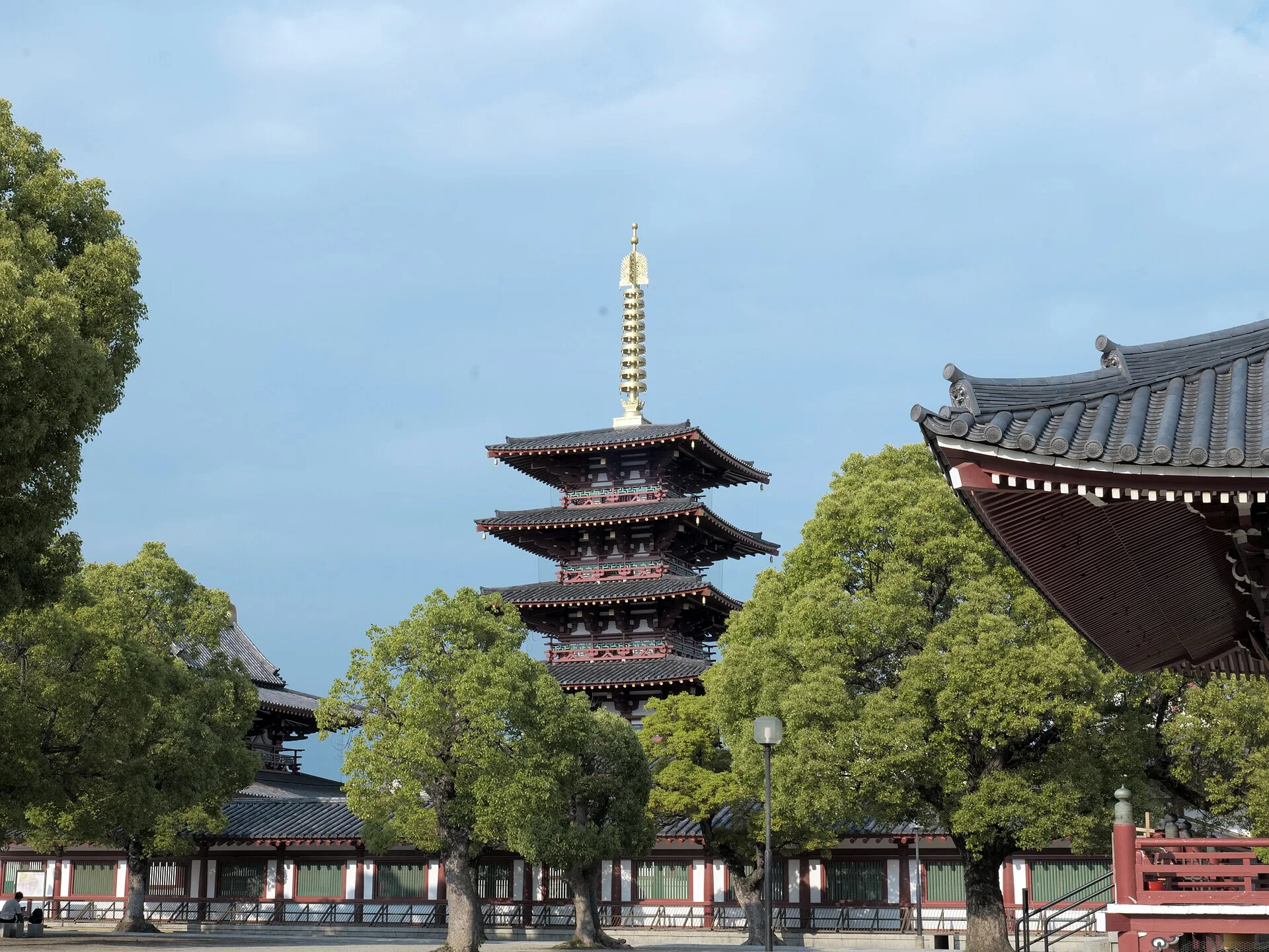
Outer temple gates, inner halls, and ticketed zones run on separate schedules. Shitennoji's main precincts stay open 24 hours for outdoor worship, while temple halls open at 8:30 AM on January 1. For the midnight bells, stay in the open courtyard paths; to step inside the Chushingaran (Central Precinct) for the Kondo Main Hall and Five-Story Pagoda, visit during winter hours from October through March (8:30 AM to 4:00 PM). Standard Chushingaran admission is ¥500 for adults (including university students), ¥300 for high school students, and free for elementary, junior high, and preschool children. The garden and Treasure House charge separate admission. See Shitennoji admission & hours.
Your walking approach depends on which direction you come from. Shitennoji-mae Yuhigaoka Station on the Osaka Metro Tanimachi Line is about a 5-minute walk south, handy if coming from Higashi-Umeda or elsewhere along the Tanimachi Line. From JR or Subway Tennoji Station, the walk north takes about 12 minutes per temple estimates. If staying near Tennoji, walk your late-night return path in daylight first and pick a clear meeting point. For gates, gardens, and a standard walking order, check our year-round Shitennoji Temple visit guide, along with Shitennoji's official access page.
Shitennoji's Announced 2027 Offerings, Prayer Services & Special Exhibition
In October 2026, Shitennoji announced its 2027 New Year offerings, with rice cakes (mochi) and sake placed before the temple altars from January 1 to 5. To sponsor an offering, register in person at the halls by December 22, 2026 for mochi (¥3,000) or by December 24 for sake (¥3,500), giving staff your name and quantity. If you are only arriving in Osaka right before New Year's Eve, simply visit the halls on January 1 without building in a separate trip just to register. See Shitennoji's 2026 announcements.
If you are praying for a student facing entrance exams, Shitennoji will hold its exam-success prayer service at Ganzandaishi-do Hall on January 3, 2027, with check-in starting at 8:30 AM and the ceremony running from 10:00 AM to 3:30 PM. Wooden goma prayer sticks cost ¥300, while full prayer packages run ¥3,000, ¥5,000, or ¥10,000 depending on the keepsake set posted on-site. Companions just sightseeing can pay respects outside the hall, buy tickets for the Central Precinct, and regroup at an agreed temple gate. The temple also runs its Shusho-e New Year repentance rites through January 14; visitors seeking other blessings can check Rokuji-do Hall's special New Year prayers during those dates before deciding which halls to enter. See Shitennoji's January events & Ganzandaishi-do service page.
The Treasure House runs its New Year Special Treasures Exhibition from January 1 to February 7, 2027, focusing on Shitennoji and women's devotion, with National Treasure Illustrated Fan-Shaped Lotus Sutra (Senmen Hokekyo Sasshi), Volume 6 on display from January 1 to 14. Regular hours are 8:30 AM to 4:00 PM (last entry 20 minutes before closing), extending to 8:00 AM to 5:00 PM on January 21. Exhibition tickets are ¥500 for adults, ¥300 for high school students, and free for junior high school students and younger. If it rains on New Year's morning and you want to spend half a day in Tennoji, swap your outdoor stroll for this indoor show.
Walking From the Soribashi Bridge to the Four Main Halls
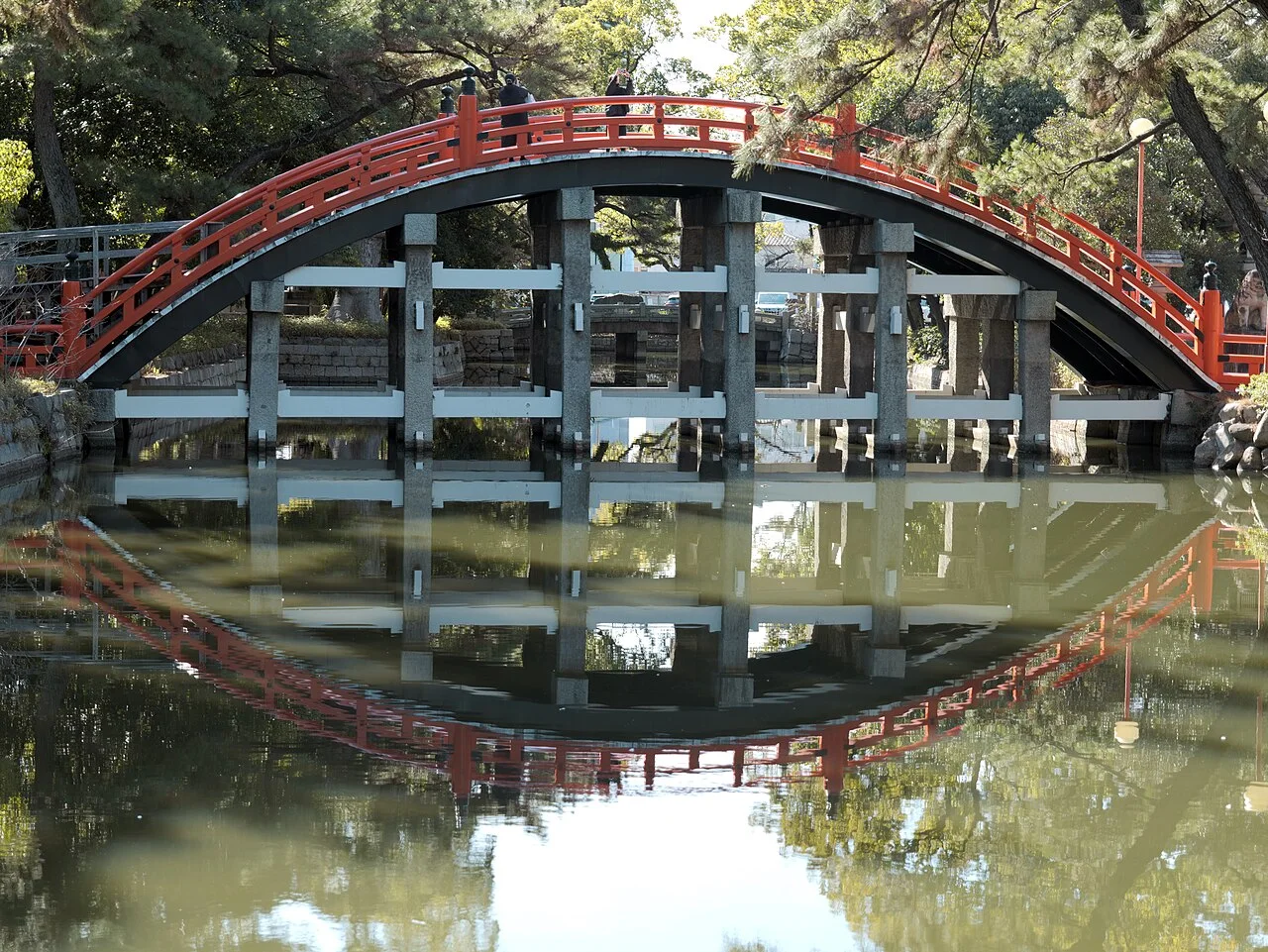
Approaching from Nankai Sumiyoshitaisha Station or Hankai Sumiyoshitoriimae, the usual front route brings you through the West Otorii Gate first. Over the sacred pond rises the vermilion Soribashi arched bridge—also known as the Taikobashi drum bridge—cresting roughly 3.6 meters high with a maximum incline around 48 degrees according to the shrine. On clear days, the arch and pond reflection look sharpest from the bank; in wet weather, ask staff for the day's flat bypass route. Anyone crossing the bridge is asked to hold the handrails and keep moving at the crest rather than stopping for group photos. Visitors with strollers, wheelchairs, or balance needs should tell attendants before entering crowded queue lanes so they can point you toward the open accessible route. See Sumiyoshi Taisha's Soribashi Bridge & grounds highlights.
On regular days, the shrine maps out a roughly 20-minute route past the Soribashi Bridge and the temizuya purification basin to the four main sanctuaries (Hongu), though hatsumode calls for extra queue time. The First through Third Main Halls stand in a straight row front to back, while the Third and Fourth Main Halls sit side by side—the shrine notes you may visit them in any order. The first three enshrine the three Sumiyoshi deities and the fourth honors Empress Jingu; all four main halls are National Treasures showcasing the classic Sumiyoshi-zukuri style. From the worship area, look for the straight two-sloped roofs, gable-end doorways, and vermilion pillars against whitewashed walls. When holiday crowd barriers route visitors in from the side, pray at the first open hall you reach and follow staff directions from there. See Sumiyoshi Taisha's worship route and the four National Treasure main halls.
Stop by the temizuya purification basin to rinse your hands before approaching the worship hall. At Sumiyoshi Taisha, drop your offering coin, bow deeply twice, clap twice, and bow once more; at Buddhist temples like Shitennoji, simply press your palms together quietly without clapping. Follow posted signs for omamori (amulets), goshuin (shrine/temple stamps), and prayer reception. Travel-safety charms are a staple at Sumiyoshi Taisha, while academic and exam charms cluster around Ganzandaishi-do Hall at Shitennoji. Save the Japanese names of the items you want—such as "goshuin" or "omamori"—as a quick screen note before arriving so you can point and ask staff without digging through a translation app in the crowd. See Sumiyoshi Taisha's worship etiquette.
Entering Sumiyoshi Taisha just to pray costs nothing—walk up to the worship area and pay your respects. Requesting a formal family blessing from a Shinto priest is a separate paid service, with New Year procedures differing from regular days. Last New Year season, the National Treasure main halls handled oazukari kito (drop-off proxy prayers), meaning applicants submitted forms for priests to pray on their behalf without sitting inside the sanctuary. If you only want an amulet after praying, skip the prayer desk and head straight to the amulet counter. The shrine's Traditional Chinese FAQ notes that gift shops and the Nankunsha sub-shrine take Japanese yen cash, so pack both a loaded transit IC card and cash before leaving your hotel. See Sumiyoshi Taisha's visitor FAQ.
Handling Rain, Strollers & Mobility Breaks
Before stepping onto Sumiyoshi Taisha's outdoor approach, pick a meetup spot outside the main queue—such as the Nankai station entrance you walked past on arrival. If two adults split up so one can line up for amulets while the other waits with the family, specify the exact station and exit rather than saying "by the torii," or one person may wait at the West Otorii Gate while the other waits at the tram stop. When folding a stroller for crowded lanes, make sure a second adult handles your child and bags; if you are visiting solo with a toddler, shorten the route to one worship stop and wait until you reach an open plaza before repacking.
Rain jackets, hats, and grippy shoes move far better through dense shrine crowds than wide umbrellas. Slow down on wet stone steps and bridges, and step aside to the pond bank or an uncrowded edge of the path to photograph the Soribashi Bridge without blocking queues. At Shitennoji, adjust to bad weather by walking the shorter approach from Shitennoji-mae Yuhigaoka Station, viewing one outdoor hall, and ducking straight into the Treasure House; save the full central axis and neighborhood stroll for dry skies. If the indoor exhibit has a wait, resting at an open cafe near Tennoji Station and circling back takes far less energy than pushing on to a second shrine.
If anyone in your group uses a wheelchair, map out station elevators, accessible temple gates, museum floor access, and restrooms in advance. Both Nankai's station pages and Shitennoji's official site provide station layouts and precinct maps—save them to your phone so you can point to them when asking attendants at fork points. Ask Sumiyoshi Taisha's information desk for accessible restrooms and baby-changing areas, and note that eating and drinking are prohibited inside the shrine grounds. If older travelers need water or a seat, step outside the grounds to a designated break spot before deciding whether to rejoin.
Budgeting Time for Lines, Crowds & New Year Meals
When traveling as a family, agree upfront on a maximum wait time before someone steps out to rest, and make sure everyone knows where to reunite. Daylight makes it much easier to photograph the four National Treasure halls and judge the steepness of the Soribashi Bridge, so save photos until after you clear the worship area. If lines spill out to the street intersection, ask uniformed staff whether a queue is for the main halls, amulet counters, or tram boarding—when multiple lines overlap on one road, getting into the right lane matters more than guessing how fast it moves.
Right next to Tennoji Station, Tennoji MIO's Main Building and Plaza Building are closed on December 31, 2026 and January 1, 2027, with only select tenants operating independently; regular hours generally resume on January 2 from 10:30 AM, though individual shop hours still vary. If you are staying nearby, eat dinner near your hotel before walking to the temple on New Year's Eve, and plan breakfast at your hotel on New Year's morning. Even when a mall sits right above a station, check each restaurant's specific New Year holiday hours so your lunch detour stays on the same side of town as your visit. See Tennoji MIO's New Year holiday hours notice.
Travel light at night with compact cash, your phone, and warm layers—leave bags at your hotel after confirming luggage storage and any late-night entrance curfew policies. If you are based along the Nankai line, get a full night's sleep and head out in daylight on January 1. Keep small yen coins handy in a pocket before midnight so you are not digging through a backpack in front of the offering box.
Doing a Half-Day on January 1—or Moving Events to Early January
If you only have half a morning on January 1 and are staying in Abeno or Tennoji, focus on Shitennoji: pray, visit either the Central Precinct or the Treasure House, and head back toward the station for lunch. From Namba, if Sumiyoshi-zukuri architecture is your priority, take a Nankai Main Line Local to Sumiyoshi Taisha, stick to the Soribashi Bridge area and four main halls, and pick just one item at the amulet counter. Trying to fit both in one day? Ride up from Sumiyoshi Taisha to Tennoji for lunch first, then check whether you have time before Shitennoji's paid zones close. Even if indoor halls are closed, Shitennoji's courtyard remains open for outdoor prayer, whereas Sumiyoshi Taisha requires factoring in its seasonal gate closing times.
Sumiyoshi Taisha's fixed January schedule includes Genshi-sai (Festival of the Origin) on January 3 at 8:00 AM, the Toka Shinji song-and-dance ritual on January 4 at 1:00 PM, and Aouma Shinji (the White Horse Ritual) on January 7 at 11:00 AM. During Aouma Shinji, a sacred horse visits each main hall in turn to ward off bad fortune for the year; last season, the shrine also posted special instructions for same-day limited goshuin stamps and Takekoma amulets. If your dates line up with January 7, make the White Horse Ritual your main stop and treat any special stamp or charm as a bonus. If you prefer an unhurried architecture walk, pick a quiet daytime slot between festivals so you can explore the four main halls, Goshogozen, and minor sub-shrines at your own pace.
Sumiyoshi Taisha's Ichi-Ebisu Daikokusha Annual Festival falls on January 9 and 10, while central Osaka's separate Imamiya Ebisu Shrine hosts its larger Toka Ebisu festival from January 9 to 11—Yoi-Ebisu (Eve), Hon-Ebisu (Main Day), and Nokori-Ebisu (Final Day). Head to Imamiya Ebisu if you want to receive lucky bamboo branches (fukuzasa) from Fukumusume shrine maidens or see the 2027 Hoe-kago palanquin parade, already confirmed for January 9. The closest rail stop is Imamiyaebisu on the Nankai Koya Line, with subway access via Ebisucho or Daikokucho. Anyone staying in Namba can walk straight there or hop one short train without meeting at Sumiyoshi Taisha first. See Imamiya Ebisu Shrine's 2027 Toka Ebisu announcement.
Imamiya Ebisu Shrine posts separate service windows for January 9 to 11, 2027. Lucky bamboo branches (fukuzasa) are distributed daily from 7:00 AM to 1:00 AM the next morning, though Fukumusume maidens hand them out specifically between 9:00 AM and 9:00 PM; standard amulets and goshuin stamps run 9:00 AM to 10:00 PM daily. Prayer access stays open overnight until the festival closes at 1:00 AM on January 12. If you only want the Hoe-kago parade or a lucky bamboo branch, target the exact day and window rather than trying to cover all three days. Afterward, stay on the Shinsekai or Namba side of town for food, which links right into the same side of town covered in our three-day Osaka itinerary. See Imamiya Ebisu Toka Ebisu service hours.
Still in Osaka in mid-January? On January 15, Sumiyoshi Taisha holds the Kofuda Shono-shiki ceremonial fire to burn old talismans, amulets, and New Year shimenawa straw ropes, followed the same day by the New Year Poetry Offering Festival (Ken'ei-sai), where priests chant selected classical waka poems—a completely different atmosphere from New Year's Eve crowds. The shrine's annual calendar lists the fire ceremony at 9:00 AM and the poetry festival at 10:00 AM, making that morning ideal if you want both traditional rites and the main halls. On any ordinary day, pick a quiet sub-shrine from our Sumiyoshi Taisha visitor guide when you have time to linger.
A few useful answers
Do JR trains run after midnight on New Year's Eve in Osaka?
Ringing in 2027, JR West is adding extra trains in both directions on the Osaka Loop Line from roughly midnight to 3:00 AM at about 10-minute intervals. The JR Yumesaki Line between Sakurajima and Nishikujo also gets extra service, while other JR routes end on their regular schedules.
How do you get from Shitennoji Temple to Sumiyoshi Taisha?
Walk to Hankai Tramway's Tennoji-ekimae stop and take a tram bound for Abikomichi or Hamadera-ekimae that stops at Sumiyoshitoriimae. For the return trip, wait at Sumiyoshitoriimae for a tram signed for Tennoji-ekimae.
Does the Nankai Airport Express stop at Sumiyoshitaisha Station?
Normally, only Local trains stop at Sumiyoshitaisha Station. Riding the Airport Express from Kansai Airport, transfer at Sakai Station to a Namba-bound Local train.
Can you register mochi or sake offerings at Shitennoji for New Year's Day 2027?
New Year offerings are placed before the temple altars from January 1 to 5, 2027. You must register in person with hall staff by December 22, 2026 for mochi or December 24, 2026 for sake.
Do you need a Central Precinct ticket to ring the New Year's Eve bell at Shitennoji?
No—the New Year's Eve bell uses numbered admission tickets distributed from 11:00 PM per the temple's December schedule. Central Precinct tickets are for daytime entry to the Kondo Main Hall and Five-Story Pagoda.
Do you have to climb the Soribashi Bridge to reach Sumiyoshi Taisha's main halls?
No—flat side routes are available. When New Year crowd lanes are in place, show staff a shrine grounds map at the entrance so they can direct strollers or wheelchairs to the open level path.
Official information and references
Sources used in this guide.
- JR West | 2026 New Year's Eve Extra Train Service
- Sumiyoshi Taisha | Gate Hours, Access & Standard New Year Traffic Restrictions
- Sumiyoshi Taisha | Previous Season (Reiwa 8) Hatsumode Page
- Sumiyoshi Taisha | December Oharai Purification & New Year's Eve Service
- Sumiyoshi Taisha | January Annual Shinto Rituals
- Sumiyoshi Taisha | Soribashi Bridge & Grounds Highlights
- Sumiyoshi Taisha | Visitor FAQ, Admission & Precinct Facilities
- Sumiyoshi Taisha | Worship Route for the Four Main Halls
- Nankai Electric Railway | Sumiyoshitaisha Station
- Nankai Electric Railway | Trains Stopping at Sakai Station
- Nankai Electric Railway | Previous Year-End & New Year Service Notice
- Hankai Tramway | Sumiyoshitoriimae Stop Timetables
- Hankai Tramway | Boarding Guide, Fares & Payment
- Hankai Tramway | Previous Year-End & New Year Service Notice
- Shitennoji Temple | December Annual Events & New Year's Eve Bell
- Shitennoji Temple | Access & Walking Times
- Shitennoji Temple | Admission, Hours & 2027 New Year Special Treasures Exhibition
- Shitennoji Temple | 2027 New Year Mochi & Sake Offering Registration
- Shitennoji Temple | 2027 Ganzandaishi-do Exam-Success Prayer Service
- Imamiya Ebisu Shrine | Reiwa 9 (2027) Toka Ebisu & Hoe-kago Procession
- Imamiya Ebisu Shrine | Toka Ebisu Reception & Service Hours
- JR West WESPO | Tennoji MIO New Year Holiday Hours