Hear the New Year's Eve bell at Shitennoji or visit Sumiyoshi Taisha for hatsumode on New Year's Day in Osaka. A practical guide to JR Osaka Loop Line special trains, Nankai and Hankai tram routes, plus Shitennoji's 2027 services and exhibition dates.
- Region & Focus
- Osaka
- Reading Scope
- 19 min read · 11 chapters · 6 Q&As
- Official Verification
- 22 official sources checkedUpdated 22 November 2026
- Key Topics
- SeasonsRail travelItineraries
Chapter Route Map (tap any stop)
- Where to Go on 31 December: Check Your Journey Back First
- Where JR's Special Trains Run on New Year's Eve 2026
- Sumiyoshi Taisha Opening Hours, Rituals and Parking
- Sumiyoshi-taisha, Sumiyoshi-higashi and Sumiyoshi-toriimae Are Three Different Stations
- From Sumiyoshi-toriimae to Shitennoji: Take the Tennoji-ekimae Tram
- Shitennoji's New Year's Eve Bell and New Year Opening Hours
- Shitennoji's 2027 Offerings, Ceremonies and Special Exhibition
- From the Sorihashi Bridge to the Four Main Shrines: Key Landmarks
- Rainy Weather, Toddlers and Step-Free Rest Stops
- Planning Around Queues, Crowds and Meals
- Fitting It Into Half a Day on New Year's Day, or Shifting to Early January
- Quick Q&A
If you are staying up for midnight on New Year's Eve in Osaka, basing yourself near Tennoji lets you walk to Shitennoji Temple for the Joya-no-Kane bell. Anywhere along the Loop Line is also served by JR West's extra late-night trains. Sumiyoshi Taisha lies further south, so it is far easier to visit by day on the Nankai Main Line or the Hankai tram, when you can clearly see the Sorihashi Bridge and the four National Treasure main halls. If you only have half a day on New Year's Day, pick whichever side is simplest to reach from your hotel so your visit, lunch and journey back stay in the same area.
Where to Go on 31 December: Check Your Journey Back First
If you want to hear the temple bell ring in the New Year in Osaka, Shitennoji is the simpler option to plan around. The temple sits just north of Tennoji Station, so you can walk both ways after dark, and JR West is running extra Osaka Loop Line trains on New Year's Eve 2026. Treat Sumiyoshi Taisha as a separate trip if you want to cross the arched Sorihashi Bridge and pay your respects at its four main shrines. Sumiyoshi Taisha lies in southern Osaka and requires either the Nankai Railway or the Hankai tram. Getting there in the evening and leaving in the small hours are two entirely separate journeys: a train that gets you out there will not necessarily get you back.
Hatsumode is the first shrine or temple visit of the year, and it only counts once the clock hits 1 January in Japan Standard Time (JST). If you are staying in Namba, Umeda or Kyoto, the easiest plan with the fewest changes is to stay near your hotel on New Year's Eve and save Sumiyoshi Taisha for daylight. If you are travelling with children or older relatives who tire easily on foot, stick to one site first and eat lunch in the same neighbourhood. For Shitennoji's New Year's Eve bell, push Sumiyoshi Taisha to the following day or early January so you can take each visit at its own pace.
When scanning the hotel map, pin the exact station you intend to return to rather than searching vaguely for 'central Osaka'. Staying around Tennoji turns the post-midnight trip back into a straightforward walk after leaving the temple. Basing yourself in Umeda gives you the Loop Line from JR Osaka Station, though you still have the walk from the station to your hotel at the end of the night. Namba is the easiest hub for catching the Nankai Main Line to Sumiyoshi Taisha by day, though getting back from Tennoji late at night needs a clear route. Because Namba's Nankai, Kintetsu and underground stations sit in separate zones, check our Namba station-by-station stay guide before booking.
| What to do | Location | Transport and timing |
|---|---|---|
| Hear the New Year's Eve bell | Shitennoji Temple | Walk back to Tennoji at night, or take a special JR Osaka Loop Line train |
| See the National Treasure halls and Sorihashi Bridge | Sumiyoshi Taisha | Take a Nankai Main Line Local train or Hankai tram by day |
| Pray for exam success (3 January 2027) | Shitennoji Ganzan Daishido Hall | Registration from 08:30; service 10:00 to 15:30 |
| Watch the Hoekago palanquin parade (9 January 2027) | Imamiya Ebisu Shrine | Take the Nankai line to Imamiyaebisu, or walk from Ebisucho or Daikokucho |
Hear the New Year's Eve bell at Shitennoji or visit Sumiyoshi Taisha for hatsumode on New Year's Day in Osaka. A practical guide to JR Osaka Loop Line special trains, Nankai and Hankai tram routes, plus Shitennoji's 2027 services and exhibition dates.
Where JR's Special Trains Run on New Year's Eve 2026
According to JR West's 30 October announcement, services on 31 December will follow the weekend and public holiday timetable, with extra trains added in both inner and outer directions on the Osaka Loop Line after midnight into 2027, running roughly every 10 minutes from around 00:00 to 03:00. The JR Yumesaki Line between Nishikujo and Sakurajima will also run roughly every 10 minutes from around 23:30 until 03:00, with some through-services onto the Loop Line. Note that 03:00 is the end of the overall operating window, so check the last train for your specific station and direction. JR West plans to publish exact timetables on JR Odekake Net and WESTER around 21 December. JR West's New Year's Eve special train announcement
Leaving Shitennoji, if your hotel is near a Loop Line station such as Osaka, Fukushima, Kyobashi or Tsuruhashi, follow the temple's walking route back to JR Tennoji Station and check the platform boards for your destination stop. Travellers staying in Kyoto or Kobe should note that these extra trains cover only the Osaka Loop and Yumesaki lines; JR lines towards Kyoto and Kobe still stop running at normal last-train times. If you plan to stay past midnight and leave Osaka city the same night, look up that final intercity leg first. Even if a late train gets you to JR Osaka Station in the early hours, you may have to wait for the first morning service to continue towards Kyoto.
JR Tennoji, Kintetsu Osaka-Abenobashi, Hankai Tennoji-ekimae and Tennoji underground station are four distinct stations. Because the same place name pops up in route planners, it is easy to assume JR's late-night trains apply across the whole interchange. Follow the JR signs for the Loop Line; if you want to connect from JR Tennoji to the Nankai line, change at Shin-Imamiya, keeping in mind that Nankai's own last-train cutoff still applies. When the crowd disperses from Shitennoji in the early hours, head straight towards whichever line is still running or within walking distance of your bed.
To return to the city centre from Sumiyoshi Taisha by Nankai or Hankai, check each operator's New Year's Eve timetable separately. Last season, Nankai did not extend hours or run overnight on New Year's Eve, and while Hankai ran holiday timings, its last tram was not pushed later. If you are set on a midnight visit to Sumiyoshi Taisha, lock in a guaranteed return train first. If anyone in your group also needs an underground connection, work backwards from the last train to their hotel to determine when you must leave Sumiyoshi. Nankai's previous New Year service notice
When searching for trains after midnight, switch the departure date to 1 January 2027—unless the timetable site tucks early-morning services at the tail end of the 31 December service day, in which case follow that operator's convention. Screenshot your boarding station, train direction and transfer buffer for the last train, and note which station entrance you need on the way back. Walking from the temple through crowds to the street crossing and down to the right platform takes time, so pick the penultimate train that gets you home as your cut-off to leave the queue.
Sumiyoshi Taisha Opening Hours, Rituals and Parking
Sumiyoshi Taisha's special New Year page lists gate opening hours and amulet counter times separately. Last season (December 2025 to January 2026), the gates opened at 22:00 on 31 December, closed at 20:00 on 1 January, and ran 06:00 to 19:00 on 2 and 3 January; that notice was titled 'Reiwa 8' (2026). Standard winter hours appear on the access page: from October to March the shrine usually opens at 06:30 (or 06:00 on the 1st of each month and on Hattatsubi, the First Dragon Day), with the outer perimeter gate and inner sanctuary closing at 16:00 and 17:00 respectively. When planning for New Year 2027, look for the 'Reiwa 9' (2027) gate schedule on the Sumiyoshi Taisha New Year page.
Before the midnight countdown, Sumiyoshi Taisha also holds a year-end farewell ritual. Its annual calendar schedules the Shiwasu Oharai-shiki (year-end purification) at 16:00 on 31 December, followed by the Joyasai (New Year's Eve service) to give thanks for the passing year. If you want to watch this ceremony and still make dinner back in Namba, visit Sumiyoshi in the late afternoon, take a train back and stay overnight near your hotel. Because that ritual closes out the old year, returning by daylight the next day lets you split your New Year's hatsumode visit and its queues into two calmer trips. Sumiyoshi Taisha December annual events
For fixed New Year's Day rituals, the shrine's official calendar lists the Wakamizu-no-Gi at 05:00 and the Saitansai at 06:00 on 1 January. During the Wakamizu-no-Gi, the chief priest draws fresh water from the sacred well as an offering, while the Saitansai invokes peace and a good harvest across the main halls and auxiliary shrines. How far into the main halls you can walk and when public queues are routed through are managed separately on the ground while ceremonies are under way. If you simply want to pay your New Year's respects, arriving later in daylight still lets you visit all four main halls without racing down from northern Osaka before dawn. Sumiyoshi Taisha January annual events
The shrine's access page notes standard New Year road restrictions from 23:00 on 31 December until roughly 19:00 on 1 January, and from 10:00 to roughly 19:00 on 2 and 3 January. Last season's notice also closed the shrine car park from 31 December to 3 January. Pedestrian access from Sumiyoshi-taisha Station matters far more than parking over New Year: anyone touring Kansai by hire car should leave it parked near their accommodation and take the train in the morning. If someone in your party requires a car drop-off or pick-up, check the current season's traffic restriction map on the New Year page for vehicle-free zones and permitted hours. Sumiyoshi Taisha access guide
Last season, Sumiyoshi Taisha announced no food stalls inside the grounds from 31 December to 5 January, and suspended both the Go-Dai-Riki stone amulets and fishing-rod fortune slips from 31 December to 4 January. For a night-time visit, eat dinner before setting out or confirm an open restaurant along the way so your time on the grounds goes towards what you actually came to see. On ordinary days at the Goshogozen enclosure, visitors search for three pebbles marked 'Go', 'Dai' and 'Riki' (representing five great strengths) and buy a pouch for them at the charm counter. If your first trip only covers the main shrines, save those side shrines and special charms for another day.
Sumiyoshi-taisha, Sumiyoshi-higashi and Sumiyoshi-toriimae Are Three Different Stations
From Nankai Namba, take a Local ('Futsu') train on the Nankai Main Line to Sumiyoshi-taisha Station (NK08) and walk east for around 3 minutes. If you prefer the Koya Line, take an All-Stops ('Kakutei') train to Sumiyoshi-higashi Station (NK52) and walk west for around 5 minutes. Even though both belong to Nankai Railway, each line uses its own platforms and train types: set your origin to 'Nankai Namba' in your route planner and make sure the line matches the destination station you picked. On the platform, double-check the line name, destination sign and station stops before boarding. Nankai Main Line Sumiyoshi-taisha Station timetable and map, Nankai Koya Line Sumiyoshi-higashi Station
Under normal timetables, only Local trains stop at Nankai Sumiyoshi-taisha Station; last season, select Airport Express and Sub-Express services made temporary stops there only from 1 to 4 January. Coming straight from Kansai International Airport, catch a Namba-bound Airport Express to Sakai Station (NK11) and transfer to a Main Line Local train going in the same direction, as Sakai lies south of Sumiyoshi Taisha and both legs head towards central Osaka. If you take the Limited Express Rapi:t, choose a Rapi:t beta service that calls at Sakai. Search for 'Nankai Sakai' so you do not confuse it with JR Sakaishi Station on the Hanwa Line. If you arrive around midday with heavy luggage, drop your bags in the city first and save hatsumode for the next day: see our Kansai Airport to Osaka transfer guide.
From Tennoji or Abeno, board the Hankai Tramway Uemachi Line at Tennoji-ekimae and take a tram bound for Abikomichi or Hamadera-ekimae that stops at Sumiyoshi-toriimae (HN12). Sumiyoshi (HN10) is a separate stop where the Hankai and Uemachi lines converge; once you pass Sumiyoshi and see Sumiyoshi-toriimae next, you are heading straight for the shrine's front gate. From Shinsekai, you can board a southbound tram directly at Ebisucho or Shin-Imamiya-ekimae and watch for Sumiyoshi-toriimae without detouring via Tennoji. Hankai Tramway route map
On Hankai trams, you board through the rear doors and alight at the front, paying a flat single fare of ¥240 for adults and ¥120 for children in cash or with a transport IC card. Tap your IC card on the reader as you board at the rear, then tap again when alighting: at Sumiyoshi-toriimae you tap next to the driver's fare box, whereas at Tennoji-ekimae you step off and pay or tap at the staffed fare barrier. For Sumiyoshi-toriimae, press the stop button as soon as you hear the announcement. Carry coins or ¥1,000 notes for easy change if paying cash, or top up your IC card enough for the full trip before boarding. Hankai Tramway boarding and fares
For young children on Hankai trams, each passenger aged 6 or over may bring up to two infants (aged 1 to 5, or 6-year-olds not yet in primary school) free of charge, with any additional infants charged at the child fare; 12-year-olds still in primary school also pay the child fare. Separate railway operators charge their own fares if you transfer onwards. If you are riding the Hankai tram straight to Sumiyoshi, sort out which cards or cash you are using while waiting at the stop so the whole family is not rummaging for change at the front door.
From Sumiyoshi-toriimae to Shitennoji: Take the Tennoji-ekimae Tram
By day, the most straightforward link between the two sites is a tram bound for Tennoji-ekimae from Sumiyoshi-toriimae, followed by a walk to Shitennoji from the terminus. The stop serves both Ebisucho-bound and Tennoji-bound trams, so if a tram signed for Ebisucho pulls up, wait for the next Tennoji service. Shukuin is in Sakai to the south, whereas for Shitennoji you need to travel north. Shitennoji's official guide estimates a 12-minute walk from Tennoji Station, and from the Hankai terminus you should factor in street crossings and walking around the station complex. Because the tram stops frequently along the road, picking the right terminus sign matters far more than memorising an exact ride time. Sumiyoshi-toriimae tram timetable
Doing the route in reverse from Shitennoji, walk south from the Nandaimon gate area to Tennoji-ekimae and catch a tram to Sumiyoshi-toriimae. If you want lunch between the two visits, use Tennoji or Abeno as your midpoint stop—it is also an easy place for a group to split up afterwards. When you only have half a day, work backwards from the latest time you need to be on site: visit whichever temple or shrine has a scheduled ritual or exhibition first, leaving daylight for the second stop. If the first visit runs into the afternoon, move the second to another day rather than rushing the main halls or museum.
Hankai timetables mark certain departures as low-floor trams, though vehicles can be swapped at short notice for operational reasons. For wheelchair or pushchair users, platform widths and street crossings at each stop matter as much as the tram itself. If you would rather avoid navigating an unfamiliar tramway, take the Osaka Metro Midosuji Line from Tennoji to Namba by day and change there onto the Nankai Main Line. It adds one paid transfer, but keeps both your outward and return journeys on major station corridors—and anyone staying in Namba can easily visit Shitennoji and Sumiyoshi Taisha on two separate days straight from their hotel.
Shitennoji's New Year's Eve Bell and New Year Opening Hours
Shitennoji's December calendar lists three bell-ringing spots for New Year's Eve: the North Bell Hall (Kita-Shodo), the Drum Tower (Koro) and the South Bell Hall (Minami-Shodo). Numbered tickets are handed out from 23:00, with ringing starting at 23:30 in queue order according to ticket number. After the midnight bells, the Good-Fortune Bell at the North Bell Hall and the Lucky Bell at the Drum Tower remain open sequentially from around 00:00 until roughly 03:00. Pick one location and follow the signs on the night if you want to strike a bell yourself; if you just want to listen or pray from outside the halls, keep to the temple walkways and leave room for people moving quietly through. Note that the temple does not serve amazake or New Year's Eve soba noodles at this event. Shitennoji December events page
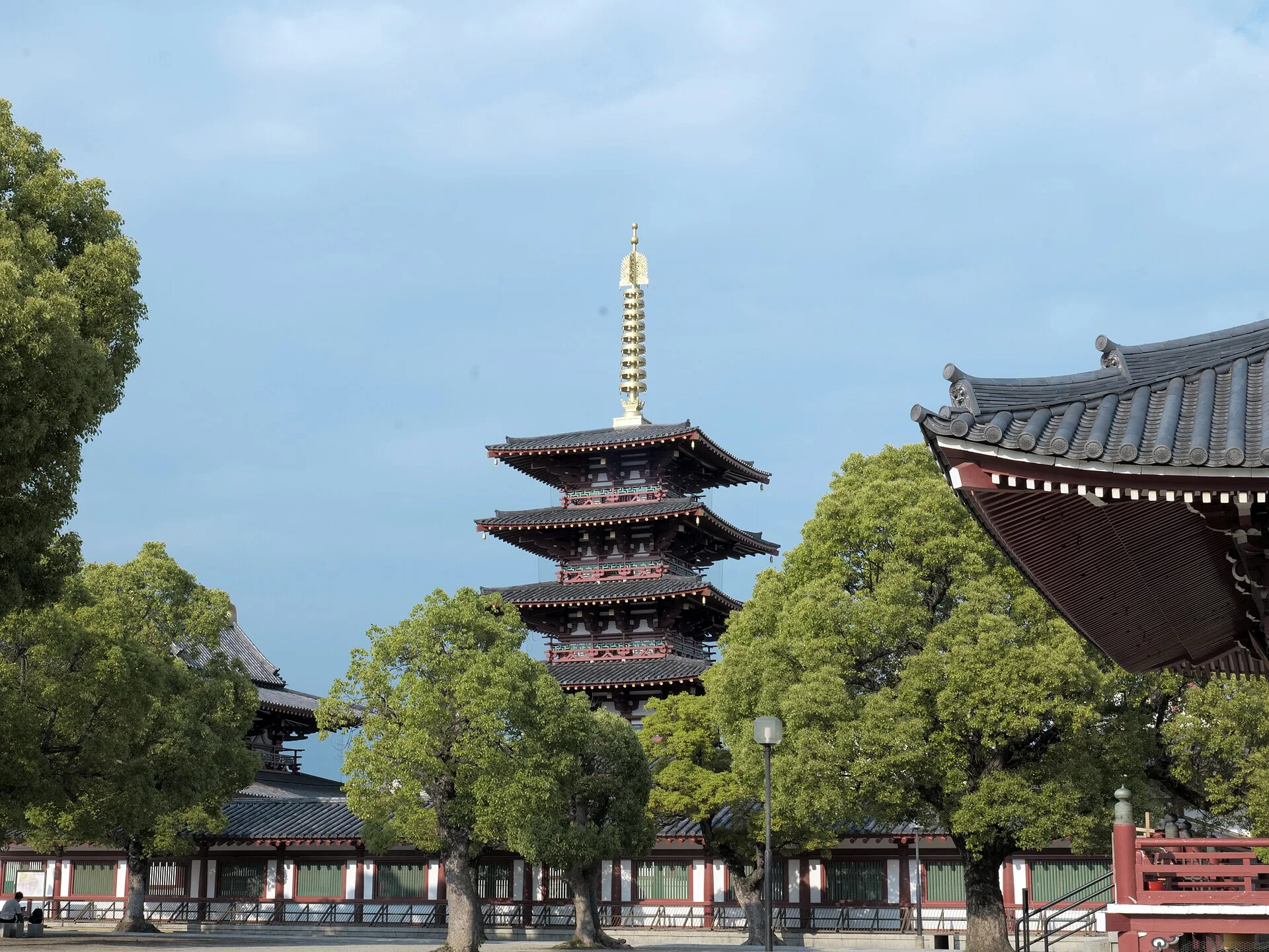
The outer gates, temple halls and ticketed precincts follow different opening schedules. Shitennoji's main outer gates remain open 24 hours for outdoor prayer, while its New Year page notes that the halls open at 08:30 on 1 January. If you are only strolling in to hear the bells, stick to the open outer grounds at night. To enter the Central Precinct (Chushingaran) and see the Main Hall (Kondo) and Five-Storey Pagoda, come by day: standard hours from October to March are 08:30 to 16:00. Individual admission to the Central Precinct is ¥500 for adults (including university students) and ¥300 for senior high school students, with free entry for junior high school pupils and younger. Separate tickets apply for the Honbo Garden and the Treasure House. Shitennoji admission and opening hours
Which gate you enter by depends on your approach. Walking south from Shitennoji-mae Yuhigaoka Station on the Osaka Metro Tanimachi Line takes around 5 minutes, making it the quickest route from Higashi-Umeda or anywhere along the Tanimachi Line. Walking north from JR or Osaka Metro Tennoji Station takes around 12 minutes according to the temple. If you are staying in Tennoji, walk your planned night-time return route once during daylight and pick an obvious meeting point. For a full breakdown of the gates, gardens and usual sightseeing flow, read our complete guide to visiting Shitennoji Temple. Shitennoji official access guide
Shitennoji's 2027 Offerings, Ceremonies and Special Exhibition
In October 2026, Shitennoji announced its 2027 New Year offerings, with rice cakes and sake placed before the temple altars from 1 to 5 January. Those wishing to sponsor an offering can register in person at the relevant hall by 22 December 2026 for rice cakes (¥3,000) or by 24 December for sake (¥3,500), giving your name and quantity to the hall staff. If you are arriving in Osaka right before New Year's Eve, simply visit the halls to pay your respects on New Year's Day without squeezing in an extra trip to register. Shitennoji 2026 announcements
If you are praying for a student sitting upcoming exams, Shitennoji will hold its exam-success prayer service at the Ganzan Daishido Hall on 3 January 2027, with registration opening at 08:30 and the ceremony running from 10:00 to 15:30. Wooden goma prayer sticks cost ¥300, while formal prayer packages are ¥3,000, ¥5,000 or ¥10,000 depending on the talismans included, as posted on site. Anyone in your group who is only sightseeing can pay respects outside the hall, tour the ticketed Central Precinct and reunite at an easy-to-find gate. The temple's Shusho-e New Year services also continue until 14 January, so travellers seeking other blessings can check the special New Year prayers at the Rokujido Hall before deciding which halls to visit. Shitennoji January events and Ganzan Daishi service
From 1 January to 7 February 2027, the Treasure House is staging a New Year exhibition on Shitennoji and women's religious devotion. Volume 6 of the National Treasure Senmen Hokekyo Sasshi (Fan-Shaped Lotus Sutra) goes on display from 1 to 14 January. Standard exhibition hours are 08:30 to 16:00, with last entry 20 minutes before closing, except on 21 January when hours extend from 08:00 to 17:00. Special exhibition tickets are ¥500 for adults and ¥300 for senior high school students, with free admission for junior high school pupils and younger. If New Year's Day morning brings rain and you are staying around Tennoji for half a day, shift your outdoor stroll time indoors to this exhibition.
From the Sorihashi Bridge to the Four Main Shrines: Key Landmarks
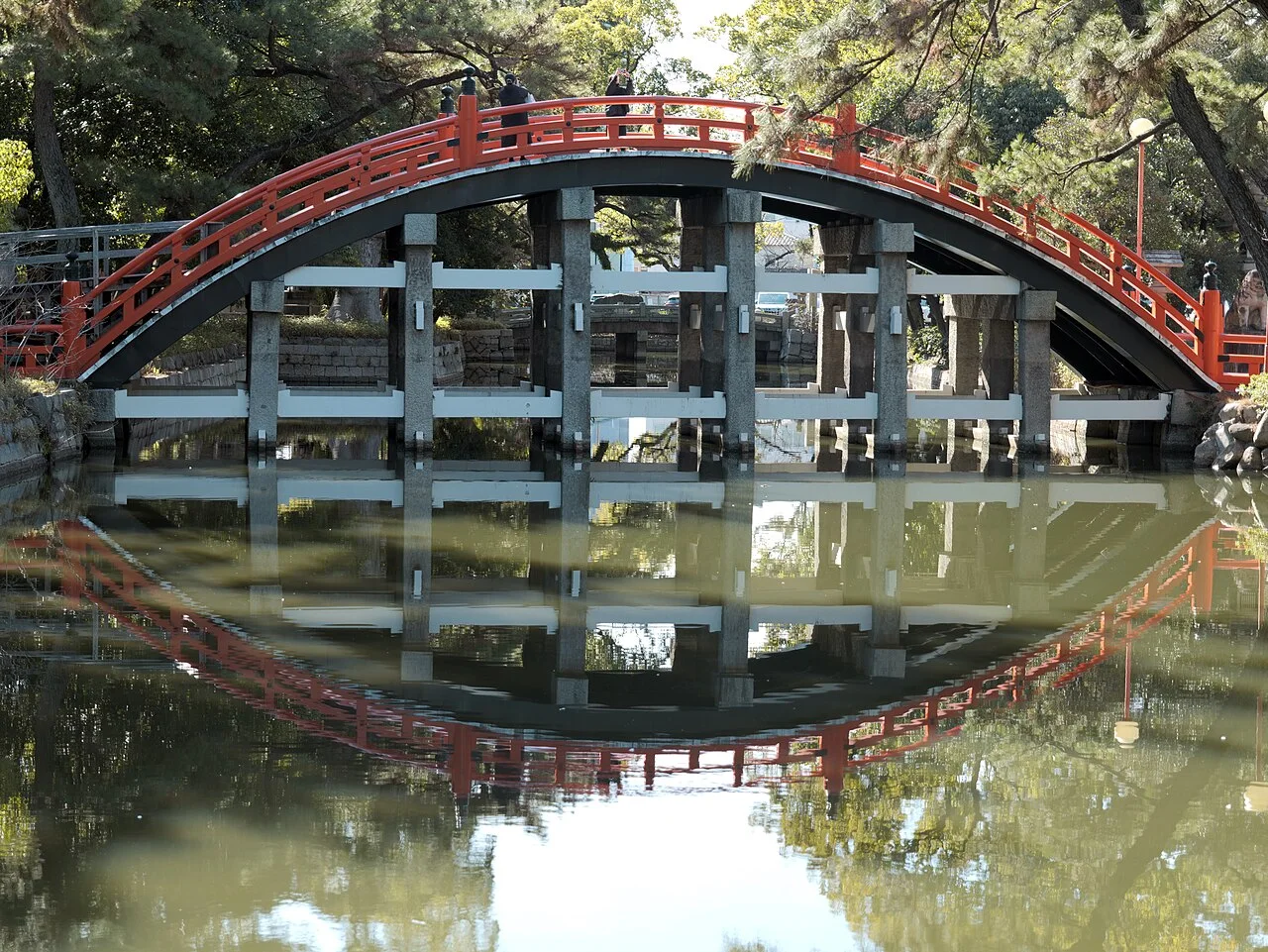
Approaching from either Nankai Sumiyoshi-taisha Station or the Hankai Sumiyoshi-toriimae tram stop, the main approach brings you first to the West Grand Torii gate. Just beyond it, the vermilion Sorihashi Bridge—also known as the Taikobashi drum bridge—rises roughly 3.6 metres at its crest with a maximum slope of about 48 degrees. On a clear day you can take in its steep arch and reflection from the pond edge; in wet weather, ask staff for the day's level bypass route. The shrine asks everyone crossing to hold the handrails on both sides and not to stop at the summit for group photos. If you have a pushchair, wheelchair or anyone who needs extra support on steps, mention this before entering the crowd-control lanes so stewards can point you towards the open step-free gate. Sumiyoshi Taisha Sorihashi Bridge and grounds highlights
Outside peak holidays, the shrine's suggested route from the Sorihashi Bridge past the temizuya purification fountain to the four main halls takes around 20 minutes, though during hatsumode you should budget extra time for queues. Main Halls 1 to 3 sit in a straight line one behind another, with Main Hall 4 standing beside Main Hall 3, and you may visit them in any order. The first three enshrine the three Sumiyoshi deities and the fourth honours Empress Jingu; all four main sanctuaries are National Treasures and textbook examples of Sumiyoshi-zukuri architecture. From the front worship halls you can make out their straight two-sloped roofs, gable-end entrances, vermilion pillars and whitewashed walls. When New Year crowd routing directs visitors through a side entrance, start at whichever worship hall opens before you and follow the stewards onwards. Sumiyoshi Taisha worship route, the four National Treasure main halls
With children, start by locating the temizuya purification pavilion to rinse your hands before stepping up to the worship hall. At Sumiyoshi Taisha, shrine etiquette is to toss in a coin offering, bow twice, clap twice and bow once more at the end (whereas at Buddhist temples like Shitennoji, you simply press your palms together quietly). Follow the separate signs for omamori charms, goshuin stamp books and formal prayers. Sumiyoshi Taisha is well known for travel-safety charms, while Shitennoji's Ganzan Daishido Hall is the place to look for study and exam talismans. Save screenshots of the specific charm or goshuin page from the official website on your phone beforehand so you can simply point and ask a steward rather than searching a translation app in the middle of a crowd. Sumiyoshi Taisha worship etiquette
Entering Sumiyoshi Taisha for regular New Year prayers is free: simply walk up to the worship hall. Requesting a formal blessing from a priest for your family is a separate paid service, and New Year reception rules differ from ordinary days. Last season, the National Treasure main halls only accepted o-azukari kito (proxy prayers), where your application is submitted and priests perform the rite on your behalf without seating inside the sanctuary. If you just want to pick up an omamori charm and skip the prayer-desk queue, head straight to the charm counter after bowing at the hall. The shrine's visitor FAQ notes that the souvenir shop and the Nankunsha sub-shrine take cash in yen only, so keep cash ready for charms separately from your transport IC card. Sumiyoshi Taisha visitor FAQ
Rainy Weather, Toddlers and Step-Free Rest Stops
Because Sumiyoshi Taisha's approach is outdoors, agree on a clear meeting point outside the queues beforehand, such as the Nankai station entrance you came through. If two adults split up so one can buy charms while the other waits with family, specify the exact station and exit rather than saying 'by the torii'—otherwise one person may wait at the West Grand Torii while the other stands at the Sumiyoshi-toriimae tram stop. When folding a pushchair, it helps to have a second adult free to hold the child and bags; if you are travelling solo with a toddler, keep the visit to one short stretch and wait until you reach an open spot before repacking your things.
In wet weather, waterproof jackets, hats and grippy shoes are far easier to manage in a dense crowd than large umbrellas. Slow down on the bridge and stone steps, and step aside to the pond bank or path edge to photograph the Sorihashi Bridge away from the moving queue. At Shitennoji, you can adapt to the weather by taking the short walk from Shitennoji-mae Yuhigaoka Station, viewing one courtyard structure and heading straight inside the Treasure House, saving the full central axis and surrounding stroll for clearer skies. If there is a wait for the indoor gallery, pausing at an open cafe near Tennoji Station before returning takes much less effort than pushing on to a second shrine.
If anyone in your party uses a wheelchair, plan station lifts, temple gates, accessible gallery floors and toilets as separate checkpoints. Nankai's station pages and Shitennoji's official website provide station layouts and precinct maps; save them offline so you can point directly to a junction when asking staff. At Sumiyoshi Taisha, ask the information centre for accessible toilets and baby-changing facilities, and remember that eating and drinking are prohibited inside the shrine grounds. If older relatives need water or a sit-down, head outside the gates to a pre-arranged rest spot before deciding whether to go back in.
Planning Around Queues, Crowds and Meals
When travelling as a family, agree on a cut-off time for standing in a queue so anyone taking a break knows where to meet the rest of the group later. Daylight gives you much better light for photographing the four National Treasure main halls and judging the slope of the Sorihashi Bridge, so take your photos after leaving the worship halls. If a queue spills out to the street crossing, ask a steward whether it is for the main shrines, the charm counter or the tram platform—getting into the right queue matters more than how long you planned to wait.
Next to Tennoji Station, both the Main Building and Plaza Building of Tennoji MIO are closed on 31 December 2026 and 1 January 2027, with only select shops trading independently. General trading resumes from 10:30 on 2 January, though individual outlets set their own hours. If you are staying nearby, eat dinner close to your hotel before heading to the temple on New Year's Eve, and arrange breakfast at your accommodation on New Year's Day. Even when a shopping centre is attached to the station, check individual restaurant holiday hours first and keep lunch on the same side of the city as your shrine or temple visit. Tennoji MIO New Year closure notice
For a night-time outing, travel light with a small pouch of cash, your phone and warm layers, leaving main bags at your hotel after confirming luggage storage and any late-night door codes. If you are staying near the Nankai line, get a proper night's sleep and visit in daylight on New Year's Day instead. Gather a handful of small coins before midnight so you are not digging through a rucksack right in front of the offering box.
Fitting It Into Half a Day on New Year's Day, or Shifting to Early January
If you only have New Year's Day morning free, guests staying in Abeno or Tennoji can pair a visit to Shitennoji with either the Central Precinct or the Treasure House before heading back towards the station for lunch. From Namba, if you want to see the Sumiyoshi-zukuri architecture, take a Nankai Main Line Local to Sumiyoshi-taisha, cover the bridge area and the four main shrines, and pick one counter item to queue for. Trying to see both on the same day works best if you visit Sumiyoshi Taisha first, eat lunch in Tennoji and then decide whether you still have time before Shitennoji's ticketed areas close. Even if you miss hall entry, you can still pray outside the halls at Shitennoji, whereas at Sumiyoshi Taisha you must arrive before the seasonal gate closing time.
Sumiyoshi Taisha's fixed January calendar lists the Genshisai ritual at 08:00 on 3 January, the Toka Shinji ritual at 13:00 on 4 January and the Aouma Shinji (White Horse Ceremony) at 11:00 on 7 January. During the White Horse Ceremony, a sacred white horse visits each of the main halls in turn to ward off misfortune for the year; last season, the shrine also announced special same-day goshuin stamps and bamboo-horse charms. If your dates line up with 7 January, make the ceremony your main stop and treat any limited charms or stamps as a bonus. If you just want to admire the architecture at your own pace, choose a quieter daytime slot with no scheduled ritual so you can wander through the four main halls, Goshogozen and the smaller shrines unhurried.
Sumiyoshi Taisha holds the annual festival for its Ichi-Ebisu Daikoku-sha shrine on 9 and 10 January. Elsewhere in the city, Imamiya Ebisu Shrine stages its larger Toka Ebisu festival from 9 to 11 January across three days: Yoi-Ebisu (Eve), Hon-Ebisu (Main Day) and Nokori-Fuku (Remaining Fortune). Head to Imamiya Ebisu if you want to see the Fukumusume lucky maidens handing out fukuzasa bamboo branches; the shrine has already confirmed the 2027 Hoekago palanquin parade for 9 January. Its closest station is Nankai Imamiyaebisu on the Koya Line, or you can walk from Ebisucho or Daikokucho on the underground. Anyone staying in Namba can walk there or take a one-stop ride without meeting at Sumiyoshi Taisha first. Imamiya Ebisu Shrine 2027 Toka Ebisu announcement
Imamiya Ebisu Shrine also separates its counter hours across 9 to 11 January 2027. Lucky fukuzasa bamboo branches are distributed daily from 07:00 until 01:00 the next morning, though you need to visit between 09:00 and 21:00 to receive one directly from the Fukumusume maidens, while regular charms and goshuin stamps run from 09:00 to 22:00. Worship remains open overnight until the festival finally closes at 01:00 on 12 January. You do not need to attend all three days—just match your visit to the Hoekago parade or your preferred counter window. Afterwards, stay on the Shinsekai or Namba side for a meal, linking neatly into the neighbourhoods covered in our three-day Osaka itinerary. Imamiya Ebisu Toka Ebisu counter hours
If you are in town in mid-January, Sumiyoshi Taisha's Kofuda Shono-shiki ritual on 15 January burns old shrine talismans, charms and New Year shimenawa straw ropes in a ceremonial fire. That same morning sees the New Year Ken'ei-sai poetry reading, where priests chant selected waka poems in traditional style—a far quieter atmosphere than the New Year's Eve queues. The annual calendar schedules the ritual fire at 09:00 and the poetry ceremony at 10:00, making that morning an atmospheric time to visit the main halls. On any other ordinary day, pick a quiet sub-shrine to explore at leisure from our complete guide to Sumiyoshi Taisha.
A few useful answers
Do JR trains run after midnight on New Year's Eve in Osaka?
Yes, on the Osaka Loop Line and JR Yumesaki Line. Moving into 2027, extra trains run in both directions on the Osaka Loop Line from roughly 00:00 to 03:00 at around 10-minute intervals, with extra services also running between Sakurajima and Nishikujo on the Yumesaki Line. Other JR routes end at their normal last-train times.
How do you get from Shitennoji to Sumiyoshi Taisha?
Walk to Hankai Tramway's Tennoji-ekimae stop and take a tram bound for Abikomichi or Hamadera-ekimae that calls at Sumiyoshi-toriimae. For the return journey, wait at Sumiyoshi-toriimae for a tram signed for Tennoji-ekimae.
Does the Nankai Airport Express stop at Sumiyoshi-taisha Station?
Normally only Local trains stop at Sumiyoshi-taisha Station. If you take the Airport Express from Kansai International Airport, change at Sakai onto a Namba-bound Local train.
Can I sponsor rice cake or sake offerings at Shitennoji for New Year 2027?
Offerings are placed on the hall altars from 1 to 5 January 2027, though registration closes earlier: apply in person with hall staff by 22 December 2026 for rice cakes and by 24 December 2026 for sake.
Do I need a Central Precinct ticket to ring the New Year's Eve bell at Shitennoji?
No, New Year's Eve bell ringing uses numbered tickets distributed from 23:00 according to the temple's December schedule. Central Precinct tickets are for daytime admission to the Main Hall and Five-Storey Pagoda.
Do I have to climb the steep Sorihashi Bridge to reach Sumiyoshi Taisha's main halls?
No, you can take a level path around the side. During hatsumode crowd routing, show the precinct map to a steward at the entrance to find whichever step-free route is currently open for pushchairs or wheelchairs.
Official information and references
Sources used in this guide.
- JR West | 2026 New Year's Eve Special Trains
- Sumiyoshi Taisha | Gate Hours, Access and General New Year Traffic Restrictions
- Sumiyoshi Taisha | Previous Season (Reiwa 8) Hatsumode Page
- Sumiyoshi Taisha | December Oharai Purification and Joyasai Ritual
- Sumiyoshi Taisha | January Annual Rituals
- Sumiyoshi Taisha | Sorihashi Bridge and Grounds Highlights
- Sumiyoshi Taisha | Visitor FAQ, Admission and Facilities
- Sumiyoshi Taisha | Four Main Halls Worship Route
- Nankai Electric Railway | Sumiyoshi-taisha Station
- Nankai Electric Railway | Trains Calling at Sakai Station
- Nankai Electric Railway | Previous Year-End and New Year Services
- Hankai Tramway | Sumiyoshi-toriimae Timetable
- Hankai Tramway | Boarding, Fares and Payment
- Hankai Tramway | Previous Year-End and New Year Services
- Shitennoji Temple | December Events and New Year's Eve Bell
- Shitennoji Temple | Access and Walking Times
- Shitennoji Temple | Admission, Tickets and 2027 New Year Treasures Exhibition
- Shitennoji Temple | 2027 New Year Rice Cake and Sake Offering Registration
- Shitennoji Temple | 2027 Ganzan Daishido Exam-Success Prayer Service
- Imamiya Ebisu Shrine | Reiwa 9 (2027) Toka Ebisu and Hoekago Parade
- Imamiya Ebisu Shrine | Toka Ebisu Counter Opening Hours
- JR West WESPO | Tennoji MIO New Year Opening Hours