Reach Sumiyoshi Taisha from Namba on the Nankai Local or from Tennoji on the Hankai Tramway. Opening hours, Sorihashi Bridge, the four National Treasure halls, Godairiki stones, Hattatsu four-shrine circuit and the Sumiyoshi Matsuri.
- Region & Focus
- Osaka
- Reading Scope
- 21 min read · 9 chapters · 6 Q&As
- Official Verification
- 35 official sources checkedUpdated 22 November 2026
Chapter Route Map (tap any stop)
- Getting from Namba and Tennoji to Sumiyoshi Taisha
- Opening Hours, Amulet Counters and Prayer Times
- Crossing Sorihashi Bridge and Navigating the Four Main Halls
- Spotting Sumiyoshi-zukuri Roofs and Traces of Maritime History
- Godairiki Pebbles, Charm Pouches and Otoshisha's Light-Heavy Stones
- Birth Stones for Safe Childbirth and Omotosha for Relationships
- The Hattatsu Mairi Circuit from Tanekashisha to Otoshisha
- Picking Dates for Otaue Shinji, Sumiyoshi Matsuri and Hatsumode
- Half an Hour, a Morning, or Continuing South to Sakai
- Quick Q&A
General admission to Sumiyoshi Taisha in Osaka is free. From Nankai Namba, take a Nankai Main Line Local train to Sumiyoshi-Taisha Station (NK08) and walk east for about three minutes. From Tennoji, take the Hankai Tramway. For a first weekday visit, allow 60 to 90 minutes to cross Sorihashi Bridge, see the four National Treasure main halls, and search for the Godairiki stones at Gosho-gozen. There is no fixed order for visiting the four main halls, whereas the Hattatsu Mairi circuit follows Tanekashisha, Nankunsha, Asazawasha, and Otoshisha. If you want amulets or formal prayers, plan to arrive from 9:00 JST onwards.
Getting from Namba and Tennoji to Sumiyoshi Taisha
Sumiyoshi Taisha stands at 2-9-89 Sumiyoshi, Sumiyoshi-ku, Osaka. If you are staying in Namba, depart from Nankai Namba Station on a Nankai Main Line 'Local' train to Sumiyoshi-Taisha Station (NK08). Local trains run directly there with several intermediate stops, while faster services such as the Nankai Airport Express and Limited Express Rapi:t pass straight through under standard timetables. Once inside the station, check the train type before boarding a southbound Local service and watch the onboard display for your stop. Leave the station and walk east across the Hankai Tramway tracks to reach the West Great Torii Gate.
From the Tennoji and Abeno area, board a Hankai Tramway tram at Tennoji-Ekimae heading towards Abikomichi or Hamadera-Ekimae that stops at Sumiyoshi-Toriimae (HN12). Sumiyoshi-Toriimae sits right at the front of the shrine, with the West Great Torii visible just across the road. The route map also shows a Sumiyoshi (HN10) stop, which is within walking distance too. Enter 'Sumiyoshi-Toriimae' when checking your outbound route, and look for 'Tennoji-Ekimae' on the destination blind for the return journey to Tennoji. Northbound trams also include services bound for Ebisucho.
Board Hankai trams through the rear door and alight at the front. The flat single fare is ¥240 for adults and ¥120 for children, payable in Japanese yen cash or with a transport IC card. Tap your IC card when boarding and again when alighting, and top up beforehand as you cannot add credit onboard. Travellers with a pushchair or wheelchair can look for low-floor tram markings on the Sumiyoshi-Toriimae timetable. If you need step-free lift access for the whole journey, enter and exit via Sumiyoshi-Taisha Station on the Nankai Main Line after checking the accessible routes on Nankai's station maps.
If you are coming from along the Nankai Koya Line, take a Local ('Kakutei') train to Sumiyoshi-Higashi Station and walk west for about five minutes. Sumiyoshi-Higashi lies on the eastern side of the precinct, bringing you straight up towards the main halls before you head west out through the torii gate to connect to the Hankai Tramway or Nankai Main Line. To experience the classic front approach over Sorihashi Bridge, seeing the elevation changes and main halls from outside in, arrive via Sumiyoshi-Taisha Station on the Main Line and choose your return station based on your next stop. The two Nankai stations sit on opposite sides of the shrine, so type the full station name when searching.
Departures from Namba often bring up three separate stations sharing the 'Namba' name. Nankai Namba is the starting point for Local trains to Sumiyoshi Taisha, so factor in transfer walking time if you are arriving via Kintetsu or Hanshin Osaka-Namba or Osaka Metro Namba. You can also connect from the Osaka Metro Sakaisuji Line at Tengachaya to catch a Nankai Main Line Local. If taking the Hankai Tramway, verify whether any travel pass you plan to buy actually covers Hankai services; for a single ride, paying by cash or IC card is simplest.
| Departure area | How to travel | After alighting |
|---|---|---|
| Namba, Tengachaya | Nankai Main Line Local to Sumiyoshi-Taisha (NK08) | Walk east for about 3 minutes to the front approach |
| Tennoji, Abeno | Hankai Tramway to Sumiyoshi-Toriimae (HN12) | Steps from the West Great Torii |
| Along the Nankai Koya Line | Koya Line Local to Sumiyoshi-Higashi | Walk west for about 5 minutes to the east side of the shrine |
Reach Sumiyoshi Taisha from Namba on the Nankai Local or from Tennoji on the Hankai Tramway. Opening hours, Sorihashi Bridge, the four National Treasure halls, Godairiki stones, Hattatsu four-shrine circuit and the Sumiyoshi Matsuri.
Opening Hours, Amulet Counters and Prayer Times
General worship is free and the shrine has no regular closing days. The gates open at 6:00 JST from April to September and 6:30 JST from October to March, opening early at 6:00 JST during the winter half-year on the 1st of each month and on Hattatsu days. In the afternoon, keep track of two separate closing times: 16:00 JST for the outer perimeter gates and 17:00 JST for the inner enclosure (Migaki-uchi). If you want to stroll in from the front approach and include the outer auxiliary shrines, aim to arrive before 15:00 JST. If you only make it near 16:00 JST, focus on the four main halls rather than trying to squeeze in multiple amulet stops and stone hunting at the last minute.
The amulet counter opens from 9:00 to 17:00 JST, prayer applications are accepted until 15:50 JST, and Gosho-gozen remains open until 16:00 JST. You can start looking for Godairiki pebbles as soon as the gates open, though the protective pouches to hold them are only issued from 9:00 JST. An early morning visit just to see the bridge and main halls wraps up nicely in time for breakfast. To collect a pouch or goshuin shrine stamp, either tour the main halls first and return to the counter at 9:00 JST, or schedule your arrival later in the morning.
For formal prayers at the main shrine on an ordinary day, apply in person without an appointment at the counter marked 'Kito Uketsuke' (prayer reception) between 9:00 and 15:50 JST. Decide on your prayer request in advance, have your name and address ready, and let anyone waiting with you know where to meet. From 1 April 2026, the standard individual prayer fee is ¥10,000 per request, alongside a ¥5,000 proxy prayer option performed by priests on the day with your talisman or amulet collected at the counter. Family rites such as Hatsumiya and Shichi-Go-San have their own categories and fees, while safe childbirth prayers cost ¥10,000.
Enquire at the main shrine reception for goshuin stamps. If you specifically want goshuin from Nankunsha or the other Hattatsu shrines, confirm beforehand whether they are part of the daily issue, Hattatsu-day issue, or a seasonal New Year programme, as designs and collection counters change with the calendar. If buying amulets is a priority, browsing the Japanese names on the shrine's omamori page ahead of time helps. Regular amulets, wooden ema plaques hung in the grounds, goshuin stamps, and self-collected Godairiki pebbles from Gosho-gozen each follow their own procedure; bring Japanese yen cash for both the amulet counter and Nankunsha.
Hatsumode (New Year visits) and the Sumiyoshi Matsuri follow special schedules. Shrine announcements list separate times for gates, amulet counters, formal prayers, and individual ceremonies, and some services close even while the grounds stay open. Pick your visit date around what you actually want to experience, such as watching a portable shrine procession route, collecting a specific goshuin, or avoiding peak crowds with family. Relying on the standard weekday timetable risks confusing gate opening, queue cut-offs, and ceremony start times.
| Facility or service | Hours (JST) | Planning notes |
|---|---|---|
| Main gate opening | 6:00 (Apr-Sep), 6:30 (Oct-Mar) | Opens at 6:00 on the 1st of the month and Hattatsu days |
| Outer gates / Inner enclosure | Close at 16:00 / 17:00 | Arrive early to cover the full grounds |
| Gosho-gozen | Gate opening to 16:00 | Godairiki pouches issued from 9:00 |
| Amulet counter (Juyosho) | 9:00 to 17:00 | Amulets, ema plaques, and Godairiki pouches |
| Main shrine formal prayers | 9:00 to 15:50 reception | Walk-in applications accepted on ordinary days |
Crossing Sorihashi Bridge and Navigating the Four Main Halls
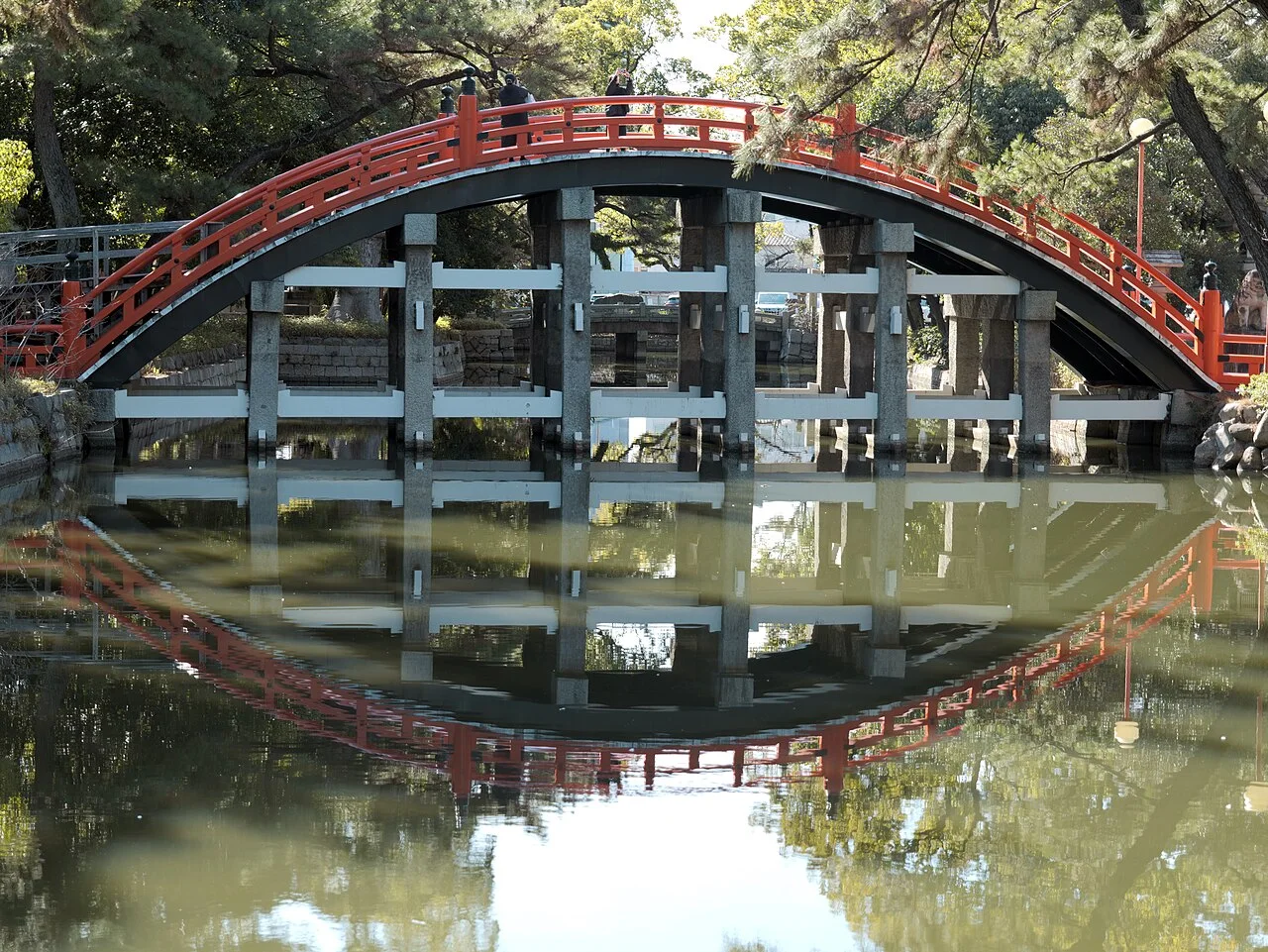
Stepping through the West Great Torii brings you straight to the sacred pond. Sorihashi Bridge measures around 20 metres long and 3.6 metres high, rising to an incline of roughly 48 degrees with stepped treads. Shrine tradition regards crossing the bridge as a purification rite before worship, and the present stone piers are said to have been donated by Yodo-dono in prayer for Toyotomi Hideyori's healthy growth. Looking from the pond's edge, you can pick out the vermilion railings, dark timber deck, and stone supports; when the water is still, step to the side of the pond to frame both the bridge and its reflection.
Put your phone away while crossing, watch your footing on the steps, and take your time on the descent. Save wide shots of the whole bridge for the pondside on your way in or out, clear of the foot-traffic bottlenecks at either end. Travellers with pushchairs or wheelchairs, anyone uncomfortable with steep steps, or visitors arriving in wet weather should use the flat path around the pond instead. According to Osaka Convention and Tourism Bureau's accessibility guide, a ramp on the north side beside the prayer hall is roughly one wheelchair wide; decide on your step-free route before deciding whether to continue on to Nankunsha or Otoshisha.
After crossing, stop at the temizuya water basin to purify your hands. Hold the ladle to rinse your left hand first, switch hands to rinse your right, then pour a little water into your cupped left palm to rinse your mouth before tipping the ladle upright so the remaining water washes down the handle. At the offering box before the worship hall, toss your coin and follow Sumiyoshi Taisha's etiquette: bow twice deeply, clap twice, make your silent prayer, then bow once more. If some in your group wish to linger over prayers, others can step aside along the approach to admire the architecture and leave space at the front.
The First, Second, and Third Main Halls stand in an east-west line, with the Third Main Hall furthest west near the front approach and the Fourth Main Hall standing directly beside it. Behind the Third sits the Second Main Hall, with the First Main Hall furthest back. The shrine's official 20-minute route covers all four halls and explicitly notes that there is no mandatory order. Coming from Sorihashi Bridge, it is natural to pay respects at the Third and Fourth halls first before continuing to the Second and First; arriving from Sumiyoshi-Higashi Station lets you start from the inner halls instead. Finishing at the First Main Hall leads smoothly straight into Gosho-gozen just to its south for the Godairiki pebbles.
The First Main Hall enshrines Sokotsutsu-no-o-no-mikoto, the Second Nakatsutsu-no-o-no-mikoto, and the Third Uwatsutsu-no-o-no-mikoto, collectively known as the Three Sumiyoshi Deities. The Fourth Main Hall is dedicated to Empress Jingu (Okinagatarashihime-no-mikoto). If you are visiting with older relatives or young children and only want to stop at one or two halls, pause at the side-by-side Third and Fourth Main Halls, where you can compare both west-facing structures from the open approach. When identifying each deity, check the hall signs on site and match them against the numbered map layout from First to Fourth rather than guessing from building proportions.
Along the approach you will share space with families attending formal prayers, wedding processions, and sightseers pausing for photos. Pick a fixed landmark if you need to regroup, such as outside the temizuya pavilion or beside the West Great Torii, rather than waiting on the bridge or in front of a worship hall entrance. Visitors are prohibited from stepping off designated paths, flying drones, or conducting unauthorised commercial shoots, and should put cameras away during formal prayer ceremonies. Stick to personal photography of the bridge, pondside views, and main hall exteriors from public walkways.
Ramps also lead into the grounds from both the north and south car parks, with the route from the south car park offering greater width. Another steeper slope sits near the prayer entrance, so arrange someone to assist if pushing a wheelchair, or ask shrine staff for guidance on arrival. Traditional Chinese leaflets are available alongside general visitor information, and staff at the service desk can direct you to accessible toilets and baby-changing facilities. Plan these stops into your main-hall loop before deciding if you have energy left for the auxiliary shrines.
Spotting Sumiyoshi-zukuri Roofs and Traces of Maritime History
Shrine legend dates Empress Jingu's founding of Sumiyoshi worship here to AD 211, while the four National Treasure main halls standing today were all built in 1810. Sumiyoshi Taisha holds the rank of Ichinomiya (chief shrine) of former Settsu Province and serves as the head shrine for Sumiyoshi shrines across Japan. Keeping the mythological origins separate from the physical construction dates gives you clear reference points as you pass stone lanterns, bridges, and halls from different centuries.
To recognise the Sumiyoshi-zukuri architectural style on the National Treasure halls, look up at the triangular gable facing the front. Sumiyoshi-zukuri features a straight gabled roof thatched in cypress bark with its entrance on the gable end, known in Japanese as 'tsumairi'. Standing out front, you can see the two long roof slopes sweeping down from the ridge beam, setting off the vermilion pillars, whitewashed lime-plaster boarding, and dark bark roofing. Shifting slightly to one side lets you distinguish the outer worship hall from the inner sanctuary behind it; all four halls face west towards Osaka Bay, and seeing the Fourth Main Hall flanking the three-in-a-row line makes the layout's geometry immediately clear.
Because the Three Sumiyoshi Deities protected seafarers, the shrine links its history to the ancient port of Sumiyoshi-tsu and diplomatic voyages to Sui and Tang China. During the Edo period, thriving coastal shipping led merchants and sailors to dedicate stone lanterns praying for safe passage. The shrine counts roughly 600 stone lanterns across the grounds, many donated by shipping guilds; look closely at the inscriptions on lantern bases near Sorihashi Bridge before walking north from the main halls to Daikai Shrine, which enshrines the sea-palace deities Toyotamahiko and Toyotamahime.
Daikai Shrine's main hall is also built in the Sumiyoshi-zukuri style, yet dates to 1708, making it over a century older than the four main halls. Its main hall, offering hall, connecting corridor, and west gate are all designated Important Cultural Properties. To compare the two complexes, note the front gable at the main shrine first, then walk north to see how Daikai links its sanctuary directly to the hall in front. Just before the shrine sits the Tama-no-i well, where legend says Yamasachihiko submerged the tide-raising jewel given to him by the sea god; looping north here combines historic architecture with maritime folklore in one short detour.
If maritime heritage particularly interests you, seek out Funadama Shrine inside the precinct as well. Historically revered by shipbuilders and sailors, its doors carry painted depictions of traditional higaki-kaisen cargo vessels, sailing ships, and even aircraft. If time is tight, pick either Daikai Shrine or Funadama Shrine; both sit close to other subordinate shrines on the main map, and following the site signage by name is quicker than hunting for English translations on a map.
Heading towards the south gate brings you to the Ishibutai (stone stage) and the East and West Music Pavilions. Sumiyoshi Taisha links the dedication of the stone stage to Toyotomi Hideyori's building patronage, and the stage along with its neighbouring structures holds Important Cultural Property status. From there, follow signs for 'Onda' to reach the sacred rice paddy where the annual Otaue Shinji rice-planting ritual takes place. Even on a quiet weekday, walking past lets you get your bearings around the south approach if you plan to return for the planting ceremonies and court dances.
Sumiyoshi also appears frequently in classical waka poetry, with shrine records noting verses in both the Man'yoshu and Kokin Wakashu anthologies. To connect those ancient coastal verses with modern Osaka, leave through the West Great Torii and cross past Nankai Sumiyoshi-Taisha Station into Sumiyoshi Park, which preserves the historic Shiokake-michi approach and a reconstructed tall beacon lantern (Takatoro) along the old sea-to-shrine axis. Save snacks, letting children run around, and ball games for the park or station area afterwards, as eating, drinking, feeding animals, and ball games are prohibited inside the shrine grounds.
Godairiki Pebbles, Charm Pouches and Otoshisha's Light-Heavy Stones
Gosho-gozen sits just south of the First Main Hall on the spot where the Sumiyoshi deities are said to have first been enshrined. Visitors reach through the stone fence into the designated bed to pick up three pebbles inscribed with the characters for 'Go' (five), 'Dai' (great), and 'Ryoku' (power). Together they represent five kinds of strength: physical vitality, wisdom, wealth, good fortune, and longevity. Take just one set of three pebbles and step aside so the next person has room, searching only within the marked area and leaving the surrounding stones and stone railing untouched.
Once you have all three pebbles, take them to the amulet counter to collect a Godairiki charm pouch, listed on the shrine's general worship page at an offering of ¥500 from 9:00 JST onwards. Slip the three pebbles inside to carry as a protective charm; since January 2026, the shrine has expanded the pouch range to ten colours available at the same counter. Tradition holds that when your wish is fulfilled, you return to Gosho-gozen with both your original set and a matching 'Kansha no Koishi' (gratitude pebbles) set obtained from the amulet counter, returning six stones in total.
You can visit Gosho-gozen on its own or continue to Otoshisha on the southeastern edge of the precinct to test the Omokaru-ishi (light-heavy stones). The shrine's wish-fulfilment itinerary combines both spots and the amulet counter into a loop of around 40 minutes. At the small shrine behind Otoshisha, bow twice, clap twice, and bow once, lift one of the round stones to gauge its weight, rest your hands on it while making your wish, then lift it a second time: folklore says that if it feels lighter the second time, your wish will come easily. Place the stone gently back when finished.
Expect queues at the Omokaru-ishi on weekends and Hattatsu days. If both the pebble enclosure and the lifting stones are busy, complete one first and use the spare time to tour the main halls or stroll across to Sumiyoshi Park. Walking out to Otoshisha takes you beyond the central main-hall enclosure, so agree to regroup at 'Otoshisha entrance' or 'the amulet counter' rather than leaving part of your group waiting back at Gosho-gozen. Remember to head back inside the main precinct to the amulet counter before leaving if you still need a Godairiki pouch.
If younger children find Sorihashi Bridge daunting, take the flat path round the pond to see the Sumiyoshi Divine Rabbit statue outside the Fourth Main Hall, then continue to Tanekashisha to see Issun-boshi's soup-bowl boat. Shrine tradition ties the sacred rabbit to Sumiyoshi Taisha's founding in the Year, Month, and Day of the Rabbit, and visitors stroke the bronze figure for good health. In the folktale, a childless couple prayed at Sumiyoshi for a son who later sailed from these shores to Kyoto in a wooden bowl, and Tanekashisha displays a giant replica bowl you can step inside for photos—far easier to time with toddlers than queuing at the lifting stones.
Birth Stones for Safe Childbirth and Omotosha for Relationships
For safe childbirth prayers, register first at the prayer reception counter, attend the blessing, visit the main halls—especially the Fourth Main Hall dedicated to Empress Jingu—and finish at the Tanjo-ishi (birth stone). While Japanese tradition often pairs maternity-sash blessings with the Day of the Dog in the fifth month of pregnancy, Sumiyoshi Taisha accepts safe childbirth prayers on any ordinary day. Companions can bookmark the birth stone's location in advance to guide anyone needing rest along a shorter return path, saving the four Hattatsu shrines and Sumiyoshi Park for another visit.
The birth stone also comes with a pebble custom. According to the shrine's safe-childbirth guidance, you pick one small pebble from the marked enclosure, wrap it in paper printed with the birth-stone motif, and place it inside the triangular 'Anzan-mamori' paper packet. Later, when you return with your baby for Hatsumiya or to give thanks, you bring the pebble back to the birth stone. Anyone in your group doing the Godairiki route instead should head to Gosho-gozen for the three inscribed pebbles and a pouch from the amulet counter.
For matchmaking and good relationships, head from the four main halls towards Omotosha on the precinct map. Dedicated to Sumiyoshi Taisha's first chief priest, Tamomi-no-Sukune, and his wife, it sits at the end of a roughly 20-minute shrine route: first pick up an Omoto doll at the amulet counter, then offer prayers at Omotosha, or choose a pair of 'Hadakabina' dolls when praying for marital harmony. If companions have different prayers in mind, agree to split up and meet back at the amulet counter before walking out together to the station.
The Hattatsu Mairi Circuit from Tanekashisha to Otoshisha
'Hattatsu' originally meant the first Dragon Day of each month, so the calendar date shifts every year. The shrine publishes an annual schedule and occasionally designates an alternative Dragon Day; in January 2026, for instance, it fell on the second Dragon Day (18 January), while the final Hattatsu day of 2026 falls on Tuesday 8 December. Check the current year's list on the official Hattatsu page before travelling, and consult the dedicated Hatsumode notice around New Year for adjusted opening and counter times.
Hattatsu Mairi centres on business prosperity and household safety. The four-shrine walk starts at Tanekashisha, moves to Nankunsha, and then leaves the core precinct for Asazawasha and Otoshisha—symbolically following a wish from sowing seeds to harvest, which is why local shopkeepers return every month. On Hattatsu days, prayer reception runs from 6:00 to 15:30 JST at Tanekashisha, until 15:45 JST at Nankunsha, and until 16:00 JST at Asazawasha and Otoshisha (with Asazawasha's Hattatsu-day prayers handled at Otoshisha's counter). Starting at Tanekashisha in the morning gives you the most breathing room.
Tanekashisha is stop one, associated with seed capital for new ventures, fertility, and wisdom. To add blessed 'Otanasen' (seed money) to your own business funds, apply for a Tanekashisha prayer—listed at ¥1,500 on Hattatsu days, while weekday applications are handled through Nankunsha. Look out for the Tanekashi dolls dedicated in thanksgiving for children, then follow the precinct signs back towards Nankunsha, the second stop and home of the beckoning lucky cats.
Nankunsha is affectionately nicknamed 'Hattatsu-san', echoing the Japanese word for growth and prosperity. Its beckoning cat figurines (maneki-neko) alternate paws by the calendar: odd-numbered months raise the left paw to invite good connections and family harmony, while even-numbered months raise the right paw for wealth and thriving trade. Regulars collect one small figurine each month for four years—48 in all—before trading them in for a medium-sized cat, playing on a pun between '48 Dragon Days' and 'always prospering'. Casual visitors who happen to arrive on a Hattatsu day can simply walk the four-shrine loop once, though Nankunsha is open daily too if you just want to browse its regular charms.
Stop three is Asazawasha, revered as Sumiyoshi's Benten shrine for artistic skill and women's protection. Follow the southeastern path from there to stop four, Otoshisha, where worshippers pray for a good harvest and smooth debt collection; those receiving formal prayers receive an Otoshi charm marked with the character 'Dai'. Finish the four-stop route before deciding whether to join the queue for the Omokaru-ishi lifting stones. If you want to see Nankunsha's biggest annual celebration, look for the Hattatsu Taisai Grand Festival listed in May.
On non-Hattatsu days, the exact same route makes a pleasant weekday walk through the auxiliary shrines. If you only want to see the lucky cats and the giant camphor tree, stopping at Nankunsha is enough; otherwise save Asazawasha and Otoshisha for the end of your visit. The shrine estimates roughly 40 minutes for its business-and-home-safety loop, though on Hattatsu days you should budget extra time for queues and amulet counters—especially if you are catching a train on to Sakai or back to Namba before lunch.
| Stop | Shrine | Prayers and charms |
|---|---|---|
| Stop 1 | Tanekashisha | Business capital, fertility; Otanasen seed money after prayer |
| Stop 2 | Nankunsha | Business growth, household safety; maneki-neko lucky cats |
| Stop 3 | Asazawasha | Artistic skill, women's protection |
| Stop 4 | Otoshisha | Harvest, debt collection; Otoshi charm and Omokaru-ishi stones |
Picking Dates for Otaue Shinji, Sumiyoshi Matsuri and Hatsumode
To witness Sumiyoshi Taisha's annual rice-planting ceremony, the regular calendar schedules Otaue Shinji for 14 June at 13:00 JST, starting at the First Main Hall before moving to the sacred Onda paddy. Designated an Important Intangible Folk Cultural Property, the rite combines actual rice planting with shrine-maiden dances, samurai-armour performances, local children's planting dances, and the closing Sumiyoshi Odori. Position yourself around the paddy for the planting and dances, or arrive at the start if you want to watch the procession leave the main hall. Year-round purifications include Minazuki Oharai on 30 June and Shiwasu Oharai followed by the Joya-sai New Year's Eve service on 31 December—note that late-December purifications run separately from overnight Hatsumode crowds.
Sumiyoshi Matsuri is Osaka's major midsummer festival. Look for 'Mikoshi Togyo' if you want the grand procession carrying the portable shrines from Sumiyoshi Taisha down to Shukuin Tongu in Sakai along the Yamato River and Kishu Kaido road, or look for Yoimiya-sai and Nagoshi-no-Harai Shinji / Reitaisai for rituals held inside the shrine grounds. For 2026, the Mikoshi Togyo procession fell on 26 July, Nagoshi-no-Harai and Reitaisai on 31 July, and the Tongu-sai at Shukuin Tongu on 1 August. Booking accommodation simply around 'late July to early August' risks missing the procession day altogether.
During the 2026 procession, traffic restrictions stretched from Sumiyoshi Taisha all the way towards Shukuin in Sakai, making rail the easiest way to reach a viewing spot along the route. If you plan to worship and pick up amulets on a festival day, check exact gate and counter closing times first: on 31 July 2026, for instance, the grounds and amulet counters stayed open until 19:00 JST while formal prayer reception closed at 18:00 JST. Always check the current year's Sumiyoshi Matsuri notice to match your inbound and outbound stations to the festival timetable and road closures.
Poetry lovers might aim for the Mid-Autumn Moon-Viewing Festival (Kangetsu-sai), when selected tanka poems are chanted in traditional style atop Sorihashi Bridge, followed by Sumiyoshi Odori and classical gagaku dance. If you want a crisp daytime photo of the bridge and its reflection in the pond, come back on a quiet weekday morning and leave festival evening free to watch the performances on the bridge. By day Sorihashi serves as the main approach; on Kangetsu-sai night it becomes a floodlit stage, making two separate visits worthwhile.
Hatsumode brings enormous New Year crowds across the opening days of January, when you should rely on the shrine's dedicated Hatsumode guide for entry slots, counter arrangements, and exit routes. During the 2026 New Year period, Godairiki pebble picking and pouch distribution were suspended from 31 December 2025 to 4 January 2026, alongside special goshuin designs and issuing rules. Families worried about losing each other in the crowds will find a quiet weekday morning far easier for covering the bridge, main halls, and amulet counters; if you specifically want the New Year atmosphere, agree to meet in an open space outside the station before crossing to the torii gate together.
Half an Hour, a Morning, or Continuing South to Sakai
With only 30 minutes to spare inside the grounds—excluding station walks and train waits—enter from the Nankai or Hankai front approach, admire Sorihashi Bridge by the pond, rinse at the temizuya, and walk through the four main halls before heading back. To focus on architecture, pause beside the paired Third and Fourth Main Halls; if you prefer to walk deeper in, follow the approach to the First Main Hall. Whenever goshuin stamps or Godairiki pebbles are top of your list, 30 minutes may be tight once you factor in counter queues, particularly around New Year or festival days.
With 60 to 90 minutes, tour the four main halls first and then add either Gosho-gozen or the four-shrine Hattatsu circuit. If paths are wet or someone in your party needs a break, keep to the pondside, four main halls, and amulet counter before resting in Sumiyoshi Park across from the station. Visitors keen on architecture or farming traditions can pair the main halls with the Ishibutai stone stage and Onda rice paddy before exiting via the West Great Torii. Saving a precinct map beforehand makes spotting signs for 'Ishibutai' and 'Onda' effortless.
Pairing Sumiyoshi with Tennoji works well as a two-part walking day. Start at Sumiyoshi Taisha in the morning, then ride the Hankai Tramway back from Sumiyoshi-Toriimae to Tennoji-Ekimae for lunch around Tennoji and Abeno. If Shitenno-ji Temple is already on your plan, you can visit the temple first and board the Hankai tram at Tennoji-Ekimae afterwards, though put Sumiyoshi first in the morning if you want formal prayers or a Godairiki pouch. With extra time, stroll through Tennoji Park as well—both religious complexes have extensive grounds, so slower walkers are best focusing deeply on just one per day.
To continue south along the same line, ride a Hankai tram bound for Hamadera-Ekimae from Sumiyoshi-Toriimae to Shukuin and walk one minute to Sakai Risho no Mori, dedicated to tea master Sen no Rikyu and poet Akiko Yosano. If the first tram terminates at Abikomichi, follow Hankai's designated-station transfer procedure to catch the next southbound tram. Alternatively, take a Nankai Main Line Local from Sumiyoshi-Taisha via Suminoe and Shichido to Sakai Station and walk about 10 minutes. For the Mozu Kofun Group, take the Nankai Koya Line to Mikunigaoka, transfer to the JR Hanwa Line to Mozu Station, and walk to Daisen Park or the Emperor Nintoku's Tomb worship area as a separate excursion; see our Sakai Mozu Kofun Group guide for details.
Adding Sumiyoshi Taisha on a Kansai Airport arrival or departure day only makes sense if you have spare time. Although Sumiyoshi-Taisha Station sits on the Nankai Main Line, only Local trains stop there regularly: heading to the airport, take a Local to Sakai Station—where Airport Express trains stop—and change there, or do the reverse in Sakai on your way in from the airport. If you are carrying large suitcases and staying in Osaka overnight, drop your bags at your hotel first for a much easier visit. On a departure day, tally up luggage retrieval, train transfers, and airport check-in deadlines before deciding between a quick main-hall loop and a longer walk to the outer shrines; you can compare airport trains and tickets in our Kansai Airport to Osaka transport guide.
A few useful answers
Do I need to buy a ticket to enter Sumiyoshi Taisha?
General entry and worship are free. Formal prayers, amulets, goshuin stamps, and other conferred items carry separate fees.
Do I have to visit the four main halls in numerical order?
No. Sumiyoshi Taisha's official worship guide explicitly states there is no fixed order for the four main halls. Entering from the West Great Torii brings you first to the side-by-side Third and Fourth Main Halls, followed by the Second and First further inside.
Can I take the Airport Express from Nankai Namba to Sumiyoshi Taisha?
Under standard timetables, take a Nankai Main Line Local train, as only Local services stop at Sumiyoshi-Taisha Station. From the exit, walk east for about three minutes to the front approach.
How do I collect the Godairiki stones and when can I get the pouch?
Head to Gosho-gozen just south of the First Main Hall and find one pebble each marked 'Go', 'Dai', and 'Ryoku' within the designated area. Gosho-gozen is open until 16:00 JST, and the charm pouches are issued at the amulet counter from 9:00 JST.
When is Hattatsu Mairi held?
It is usually held on the first Dragon Day of each month, though the shrine occasionally adjusts dates—check the official Hattatsu calendar for your travel year. In December 2026, it falls on Tuesday 8 December.
Can wheelchairs or pushchairs cross Sorihashi Bridge?
No—Sorihashi Bridge has steep steps, so use the flat path around the pond instead. There is a ramp at the prayer entrance, and another ramp on the north side beside the prayer hall that is roughly one wheelchair wide.
Official information and references
Sources used in this guide.
- Sumiyoshi Taisha Access and Gate Hours
- Sumiyoshi Taisha Precinct Map
- Sumiyoshi Taisha Worship Route and Godairiki Charm Pouch
- Sumiyoshi Taisha Worship Etiquette
- Sumiyoshi Taisha National Treasure Main Halls and Sumiyoshi-zukuri
- Sumiyoshi Taisha History and Origins
- Sumiyoshi Taisha Deities and Maritime Dedications
- Sumiyoshi Taisha Sessha (Subordinate Shrines)
- Sumiyoshi Taisha Massha (Omotosha and Hattatsu Shrines)
- Sumiyoshi Taisha Sorihashi Bridge, Gosho-gozen and Omokaru-ishi
- Sumiyoshi Taisha Nankunsha (Giant Camphor Tree and Lucky Cats)
- Sumiyoshi Taisha 2026 Godairiki Stone Charm Announcement
- Sumiyoshi Taisha Precinct Rules
- Sumiyoshi Taisha Visitor FAQ (Admission and Payment)
- Sumiyoshi Taisha Prayer Categories and Fees
- Sumiyoshi Taisha April 2026 Prayer Fee Revision
- Sumiyoshi Taisha Safe Childbirth Prayers and Tanjo-ishi
- Sumiyoshi Taisha Amulets, Goshuin and Conferred Items
- Sumiyoshi Taisha Hattatsu Mairi and 2026 Dates
- Sumiyoshi Taisha Special Festivals (Otaue Shinji, Sumiyoshi Matsuri and Kangetsu-sai)
- Sumiyoshi Taisha June Events (Otaue Shinji and Minazuki Oharai)
- Sumiyoshi Taisha December Events (Shiwasu Oharai and Joya-sai)
- Sumiyoshi Taisha 2026 Sumiyoshi Matsuri Announcement
- Sumiyoshi Taisha 2026 Hatsumode Announcement
- Sumiyoshi Taisha Ishibutai Stone Stage and the Toyotomi Clan
- Osaka Info: Sumiyoshi Taisha Accessible Travel Guide
- Osaka Prefecture Sumiyoshi Park Overview (Shiokake-michi and Takatoro Lantern)
- Nankai Electric Railway: Sumiyoshi-Taisha Station
- Nankai Electric Railway: Sumiyoshi-Higashi Station
- Nankai Electric Railway: Main Line Route and Stops
- Hankai Tramway: Sumiyoshi-Toriimae Station and Timetable
- Hankai Tramway: How to Ride and Fares
- Hankai Tramway: Transfer Guide
- Sakai Risho no Mori: Access
- Sakai City: Access to Emperor Nintoku's Tomb (Daisen Kofun)