Walk to Umeda Sky Building from JR Osaka, Hankyu Osaka-Umeda or Midosuji Line Umeda stations, and navigate 39th-floor ticketing, the 15:00 Osaka Amazing Pass cut-off, see-through escalators, wet-weather rooftop rules and dusk entry.
- Region & Focus
- OsakaAttractions
- Reading Scope
- 23 min read · 8 chapters · 6 Q&As
- Official Verification
- 24 official sources checkedUpdated 27 November 2026
- Key Topics
- ItinerariesBookingNeighbourhoods
Chapter Route Map (tap any stop)
- How to Buy Tickets and What Changes at 15:00
- Walking to the Twin Towers from JR Osaka, Hankyu or the Underground
- Find the Dedicated Entrance First, Then Ride the Escalators to Ticketing
- Seating and Coffee on the 40th Floor, Open-Air Panorama on the Rooftop
- Arrive an Hour Before Sunset and Follow the Changing Light
- Handling Rain, Wind and Glass Reflections
- Extra Stops Around Shin Umeda City Above and Below Ground
- Planning Half a Day in Umeda and When to Pick Abeno Harukas Instead
- Quick Q&A
To catch both sunset and night views from Kuchu Teien Observatory at Umeda Sky Building, aim to reach the base of the towers around an hour before sundown. Enter through the dedicated observatory entrance beside the plaza and ride the see-through escalators suspended between the twin towers to reach the 39th-floor ticket counter. The 40th floor offers indoor views behind glass, while the rooftop forms a full open-air circuit. Standard adult admission is ¥2,000. If you hold an Osaka Amazing Pass and want to use its included entry benefit, plan your visit for the daytime and arrive at the gate by 15:00 at the latest.
How to Buy Tickets and What Changes at 15:00
Kuchu Teien Observatory generally opens from 09:30 to 22:30, with last admission at 22:00. Adult fares apply from junior high school age upwards (¥2,000), children aged four through primary school pay ¥500, and under-fours enter free; all prices include tax. Same-day tickets are sold on the 39th floor, or you can pick a date online through the official ticketing page. If you prefer to wait and check the weather before committing, leave buying your ticket until you arrive. Once your date is fixed, the official Asoview booking page currently lists advance adult e-tickets at ¥1,800, while advance child tickets remain ¥500.
Free admission with the Osaka Amazing Pass is accepted until 15:00, after which showing the pass gives a 10 per cent discount on observatory admission. When planning your schedule, count the time you reach the actual ticket counter. Walking into the ground-level plaza at 14:55 still leaves the dedicated entrance, lift and inter-tower escalators ahead of you, making it very tight to beat the free-entry cut-off. Pass holders are better off scheduling the observatory for the first half of the day, then continuing to Umeda shopping or another central Osaka sight in the afternoon. If you are coming specifically for sunset, budgeting for a standalone ticket is far more straightforward.
Both the Osaka Amazing Pass post-15:00 discount and the official advance adult e-ticket currently bring the ¥2,000 standard fare down to ¥1,800, so there is little reason to buy a day pass solely for an evening visit. Families with primary-school children can also price each person's ticket separately. Everyone heading up to the rooftop must go through observatory admission, so members of a group who prefer to skip the heights can wait in the 39th-floor shops or dining spaces while others go up. Each ticket allows a single entry, meaning it makes more sense to schedule dinner either before or after your entire observatory visit if you want both sunset and night views.
Heart Lock padlocks are sold as limited-quantity online packages bundled with observatory admission. Choose the bundle when booking if you want a specific colour or are planning a birthday surprise; if you simply want to see the display on site, a standard ticket is enough. Visitors presenting an accepted original disability certificate receive half-price standard admission at the counter, and the same discount extends to an equal number of accompanying carers.
Check the ticketing page calendar before travelling in case of maintenance or altered hours. The operator has already announced shorter hours on 18 April 2027, closing at 18:00 with last entry at 17:30; on a spring trip, plan a daytime visit for that date. The Naniwa Yodogawa Fireworks Festival can also split entry into dedicated time slots; in 2026, certain hours were restricted to special fireworks-plan ticket holders. If you are aiming for the next fireworks evening, wait for that year's official ticket announcement before locking in your slot and ticket type.
| Item | Price or Hours | How It Applies |
|---|---|---|
| Standard adult ticket | ¥2,000 | Junior high school age and above; sold on the 39th floor |
| Child ticket | ¥500 | Ages 4 to primary school; free under age 4 |
| Asoview advance adult e-ticket | ¥1,800 | Booked by date via the official ticket-plan page |
| Osaka Amazing Pass | Free until 15:00; 10% off afterwards | Present pass at the counter within eligible hours |
| Standard opening hours | 09:30–22:30 | Last entry 22:00; special operating dates listed separately |
Walk to Umeda Sky Building from JR Osaka, Hankyu Osaka-Umeda or Midosuji Line Umeda stations, and navigate 39th-floor ticketing, the 15:00 Osaka Amazing Pass cut-off, see-through escalators, wet-weather rooftop rules and dusk entry.
Walking to the Twin Towers from JR Osaka, Hankyu or the Underground
Umeda Sky Building stands at 1-1-88 Oyodonaka, Kita-ku, Osaka, inside the Shin Umeda City complex north-west of Osaka Station. Before setting off, get your bearings around two similarly named developments outside the station: Grand Front Osaka, split into South and North buildings, serves as a useful landmark as soon as you exit, while Grand Green Osaka encompasses Umekita Park and sits closer to Sky Building itself. As you approach the final blocks, set your map destination to the Kuchu Teien Observatory Dedicated Entrance or Wonder Square so you arrive on the right side.
From JR Osaka Station, official directions put the walk at around seven minutes. Leave the ticket barriers at the 3rd-floor Renrakubashi Exit (Connecting Bridge Exit), follow signs for Chuo-Kita Exit (Central North Exit) down to the 2nd floor, and continue down to street level. Walk alongside Grand Front Osaka's South Building towards Grand Green Osaka, then cross the road towards the twin towers. Treat the Central North Exit as your north-south divider: if you open your navigation app near the department-store entrances on the south side of Osaka Station, head back north first before picking a pedestrian crossing.
Travellers arriving on the Kansai Airport Limited Express Haruka disembark at the underground Umekita platforms of Osaka Station. Follow signs for the Umekita Underground Exit before ascending; once at street level, your walk begins near the South Building of Grand Green Osaka. If you need to drop bags at your hotel or catch an onward train later that evening, factor in platform walking, concourse transfers and locker time separately. Official walking estimates start from the station exits, so counting the climb from the underground platforms keeps you from cutting sunset too fine.
From Hankyu Osaka-Umeda Station, use the Chayamachi Exit for an estimated nine-minute walk. Turn right outside the barriers, head down to street level, and walk west to slip between the North and South buildings of Grand Front Osaka. Once the two towers flank the avenue, follow that central axis straight towards Grand Green Osaka. Visitors returning from Kyoto along the Hankyu line often meet friends for dinner around Chayamachi; just leave a few extra minutes for this east-west stretch before your planned entry time.
On the Osaka Metro Midosuji Line, aim for the Kita Gate (North Gate) at Umeda Station. The official estimate is about nine minutes: head towards Yodobashi Umeda, pass through LINKS UMEDA to street level, then cross the road and walk between the two Grand Front Osaka buildings. Coming from Higashi-Umeda on the Tanimachi Line, orient yourself towards the north side of JR Osaka Station or Yodobashi first; Nishi-Umeda on the Yotsubashi Line sits closer to the station's south side. When a group arrives on different lines, meeting at Wonder Square beneath the towers is far easier than trying to rendezvous at an Umeda station exit.
If you are pushing a pushchair, wheeling luggage or using a wheelchair, open the Barrier-Free Route on the official access page to pick lift-equipped station exits and follow street-level pavements and pedestrian crossings around the park. The final stretch runs outdoors, so keep an umbrella or waterproofs to hand in wet weather. Once inside the complex, check the positions of the West Tower, East Tower and Dedicated Entrance so you know straight away whether you are heading up to the observatory or dropping bags first.
Find the Dedicated Entrance First, Then Ride the Escalators to Ticketing
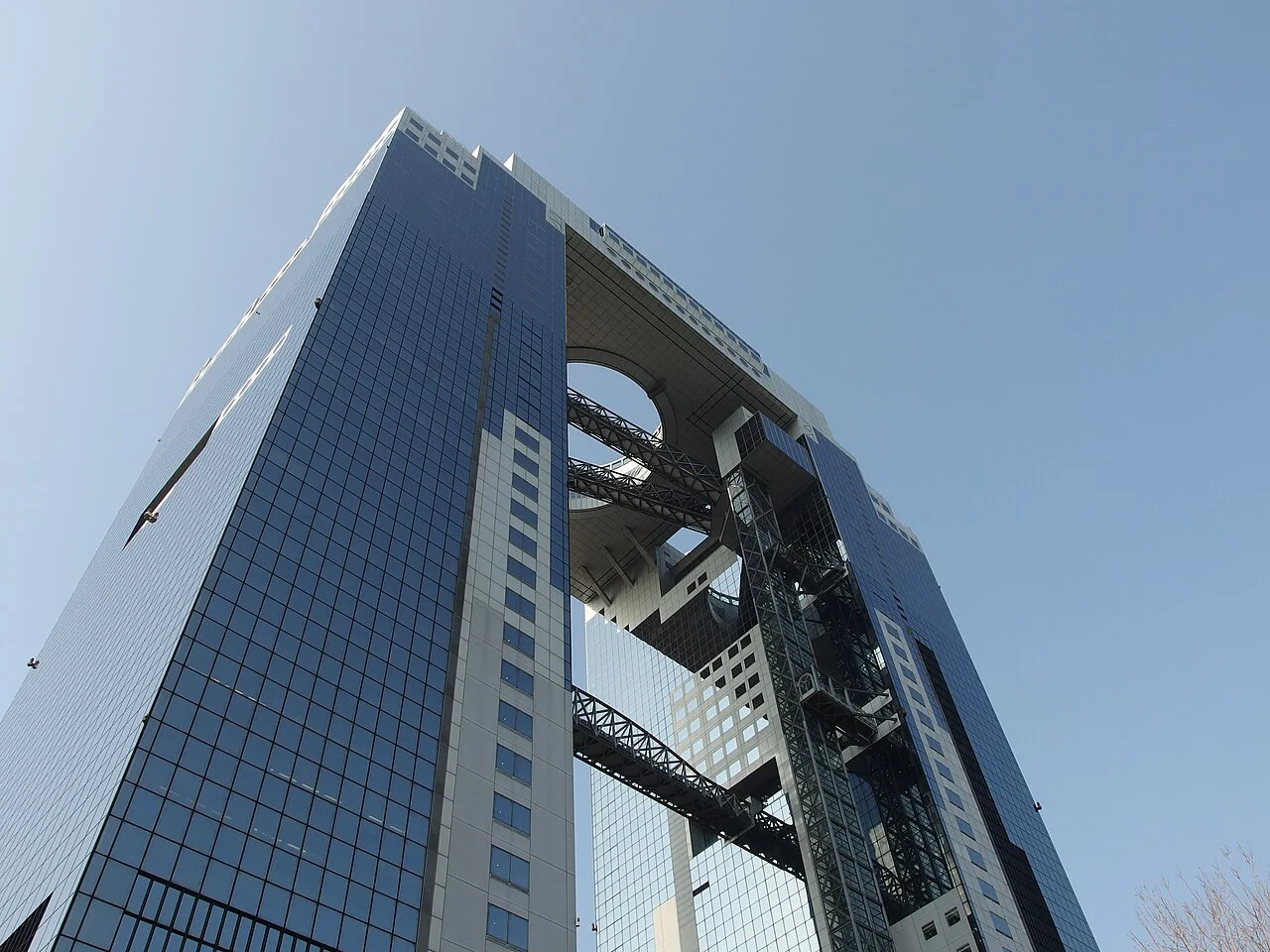
Upon reaching Shin Umeda City, walk into Wonder Square between the two towers. Look straight up from the plaza and you will spot the circular opening in the roof with two diagonal tube walkways crossing beneath it. The observatory entrance sits at ground level beside the plaza; follow signs for the Kuchu Teien Observatory Dedicated Entrance rather than stepping into the office lobbies of the East or West towers, whose standard lifts follow a different route. If you are carrying a child or pulling suitcases, pause together in the square while one person locates the exact entrance sign.
The standard visitor route rises from the dedicated entrance to the 3rd floor, takes an express observatory lift up to the 35th floor, and then boards the see-through escalators spanning across to the 39th floor. From the ground, those two tubes look like bridges slung between office blocks; riding inside them shifts your perspective continuously across the central void and opposite facade. Because this ascent happens before ticket inspection, anyone who simply wants to ride the escalators and browse the 39th-floor gift shop can follow the regular route up, though only ticket holders continue to the 40th floor and the rooftop.
For photographs of the see-through escalators, take a shot from a stationary spot before stepping on rather than fumbling for your phone mid-ride. Once on the escalator, keep your footing steady, swing backpacks to your front or tuck loose straps away, and step clear of the landing before putting your camera away. At night, lights lining the tunnel and city windows outside appear in the same frame, letting one side's rails lead the eye into the distance. If you are photographing friends, wait for a wider space past the exit rather than blocking the top of the escalator.
Wheelchair users take a high-rise lift directly from the ground floor of the East Tower to the 39th floor. The operator also routes non-folding pushchairs this way because the see-through escalators are narrow and steep. If part of a group wants to ride the escalators while others take the lift, split up on the ground floor and reunite near the 39th-floor ticket counter. Visitors needing a step-free route throughout should ask staff at the counter for guidance between the upper observatory levels. Accessible toilets are located on both the 39th and 40th floors—the 39th floor includes stoma-friendly facilities—and nursing rooms are available on both levels.
There is no left-luggage counter inside the observatory itself. The official FAQ lists three coin-locker locations in the complex: behind the ATM area in Garden 5 on the ground floor, in Takimi-koji on basement level B1, and in the B2 car park. If you plan to collect bags after night views, check each area's closing hours—for example, Takimi-koji lockers stay accessible until 23:00, while Garden 5 on the ground floor usually stays open until midnight except on the second Saturday of each month, when it closes at 21:00. Travellers heading straight back to Osaka Station afterwards may find it simpler to store suitcases at the station and pick them up through the same exit on the return walk.
Seating and Coffee on the 40th Floor, Open-Air Panorama on the Rooftop
Once past the ticket barrier, take a moment on the 40th floor to get your bearings. The official floor map labels different sections as City View, River View and other named zones. First-time visitors can start with the familiar outline of Osaka Station, match Grand Front Osaka and Umekita Park to the route just walked, and then move round to find the Yodo River. Identifying roads, channels and bridges while daylight remains makes it much easier to read the skyline after dark, and any window nook makes a handy meeting point if someone wants to sit down.
Inside the paid area on the 40th floor, cafe SKY 40 serves drinks and light bites. On blustery evenings, lingering beside the glass over a drink is a comfortable way to spend time, especially since food and beverages are not permitted up on the rooftop. If you are coming primarily for a sit-down meal, the restaurants and bar on the 39th floor are open without an observatory ticket. Anyone booking dinner in the building should note the restaurant floor separately from the observatory ticket gate so you do not mix up dining reservations with viewing entry.
Upstairs, the rooftop Sky Walk crowns the bridge connecting both towers at roughly 173 metres above ground. Walking the loop around the central opening carries you past city blocks, mountain ridges and Osaka Bay in turn, and looking inwards shows how the circular aperture frames the sky. Down on the 40th floor, large panes naturally encourage straight-ahead views; up on the roof, every step shifts the relationship between the outer skyline and the inner ring, making the full circuit worth unhurried time.
If you arrive with time to spare before sunset, do one lap of the rooftop early to scout your preferred spot, then head back indoors to look at the exhibits. When daylight is already fading, linger on the western side for a while, step downstairs to rest, and return to the roof once darkness settles. Anyone in your party uncomfortable with open heights can wait comfortably on the 40th floor; just agree to meet before taking the lifts back down so nobody exits the paid zone early and gets stuck outside.
The circular roof you saw from ground level is explained in window-side displays upstairs. Designed by Hiroshi Hara and his architectural studio, Umeda Sky Building was completed in 1993, with the observatory opening the same year. The upper connecting structure was assembled on the ground and hoisted into place with cables; official architectural notes record a lift speed of about 35 cm per minute. Comparing the view up from Wonder Square with the construction diagrams and connection joints upstairs brings the scale of that lift into focus.
For a closer look at the engineering, find the screening corner on the 40th floor, where a six-minute animation titled Sora e (Into the Sky) recreates how the towers were built alongside videos and exhibits on the lift-up method. The rooftop ring, known as the Kuchu Crater, uses semi-reflective glass along its inner wall; by day, reflections of visitors and clouds overlap in the same pane. Back down at street level, look up again towards the middle of the towers to spot the horizontal bridge on the 22nd floor, originally built as an evacuation link several storeys below the diagonal 35th-floor escalators; spotting both connectors makes the twin-tower structure click.
Arrive an Hour Before Sunset and Follow the Changing Light
Look up the exact sunset time for your date from the National Astronomical Observatory of Japan and count backwards to set your arrival at the ground-level entrance. For a first visit, reaching the plaza about an hour before sunset gives comfortable margin for finding the entrance, riding up, buying tickets and settling by a window. On weekends or when Wonder Square is hosting an event, add extra buffer for station crowds and lift queues. On the observatory calendar, select Osaka and check the Iri (sunset) column, and save the building's official landmark view map beforehand so you can match towers and rivers once upstairs.
Using the astronomical observatory's Osaka city tables as a guide, sunset falls at 16:51 JST on 22 December 2026—meaning a 15:50 arrival at the plaza—whereas on 21 June 2027 it is at 19:14 JST, leaving time for a much later ascent. That gap of more than two hours also shifts where the sun drops along the horizon: look towards the west-south-west in December and the west-north-west in June. Before framing the sun over Osaka Bay, check on site which arc has the cleanest sightline rather than assuming one fixed corner works year-round.
While the light is still bright, find a vantage point overlooking the Yodo River, pick out its wide channel and crossings, and trace the water westwards towards Osaka Bay. The river slices across the city and opens up towards the western horizon; on crisp days, use the official view map to spot the Akashi Kaikyo Bridge and Awaji Island in the distance. When haze softens the far horizon, frame the river bend and nearer bridges instead, or watch light breaking beneath coastal cloud bands rather than holding one spot for distant landmarks.
Swinging round towards the city centre brings Osaka Station and Grand Front Osaka close underfoot, while looking south and south-west reveals Kyocera Dome, Osaka Aquarium Kaiyukan and the Tempozan Ferris Wheel marked on the view map. Because those landmarks sit at vastly different distances, locating their rough directions in daylight makes their illuminated silhouettes easy to recognise later. Even with a standard wide-angle phone lens, letting the closer buildings and avenues fill most of the frame beneath a band of sky keeps the urban grid readable.
Once the sun dips below the horizon, linger on the same side for a few minutes as roads, bridges and office towers switch on in waves. Taking a second photograph from the exact same spot—with the riverbank or a bridge anchored in the same position—lets you compare afterwards how solid towers dissolve into lit windows and how reflections surface on the water. Staying put over one familiar stretch of the city captures that dusk-to-dark transition far better than chasing whichever side looks brightest.
In summer, late sunsets leave plenty of daylight even after an afternoon coffee break, though anyone planning dinner afterwards should double-check restaurant last-order times. In winter, treating night views as your pre-dinner centrepiece works well: bring a windproof jacket, split your rooftop time into two short loops with a warm-up on the 40th floor in between, and let children match trains or plazas they walked across earlier before the ground vanishes into city lights.
If you only care about after-dark photography, pick a time window that slots neatly before or after dinner. Arriving late at the 39th floor? Head straight up to walk the half of the rooftop circuit you want most, then frame extra shots indoors on the way down. Weekday midday visits are ideal for photographing the exterior towers and escalators in peace while keeping the whole evening free. When visiting two Osaka observation decks on one trip, dedicating one to daytime city topography and the other to night views gives far more variety than repeating the same hour twice.
Handling Rain, Wind and Glass Reflections
The observatory stays open during ordinary rain, though umbrellas are banned on the rooftop for safety and rain ponchos are sold in the 39th-floor shop. In severe weather, staff may close the open-air rooftop while keeping the indoor 40th floor open. In light drizzle, keep rooftop walks brief and secure phones, cameras and bags indoors before stepping out. If driving wind and rain roll in, the bridges and junctions visible from the 40th floor still make crisp close-range frames before you head down to Takimi-koji—or, if low cloud blankets every window, swap the climb for dinner or the museum and save the view for a clearer evening.
Shooting indoors through glass is mostly a battle against reflections from lights and screens behind you. Hold the lens close to the pane, keep it facing nearly straight ahead, and cup your hands or drape a jacket around the sides to block interior glare. Switch off your phone's flash and nudge exposure down slightly against bright neon signs and headlights so highlights retain their shape. If raindrops dot the outer glass, tap to refocus on a distant tower or bridge rather than letting autofocus lock onto the droplets.
Up on the roof there is no glass glare, only steady wind tugging at clothing and cameras. Brace yourself in an open space where you can stand slightly sideways, hold your phone with both hands, and leave a little extra margin around the frame for straightening later. Tripods are permitted as long as they do not obstruct other visitors, though staff will ask you to pack them away when the walkway gets busy. Keep them folded in narrow bottlenecks where two people need to pass, and put long tripods away altogether if the weather turns rough so both hands stay free for handrails and gear.
After a shower, damp surfaces and metal rails on the rooftop catch low light cleanly, making the glowing diagonal escalators and inner circular opening worthwhile subjects before you return to the outer skyline. At night, the Lumi Sky Walk surface also features glowing embedded accents; if a group wants a portrait, choose a spot with steady footing and room behind you, hold still while phone night mode captures the frame, then step aside so others can keep moving round the loop.
Extra Stops Around Shin Umeda City Above and Below Ground
One floor below ground, Takimi-koji recreates a Showa-era alleyway filled with restaurants, period shopfronts, vintage signage and stone paving. Eating before going up for night views often suits older relatives or children better than hunting for seats late at night, though dining afterwards is equally convenient if you check last-order times for your chosen kushikatsu, okonomiyaki or set-meal spot in advance, as individual kitchens set their own hours.
At street level around the plaza lie two landscaped pockets: Chushizen-no-Mori (Middle Nature Forest), with waterfalls and wooded paths, and Hanano: Shin-Satoyama on the building's north side, beside the green living wall known as the Wall of Hope (Kibo no Kabe), conceived by architect Tadao Ando. Architecture buffs can stand in the square beneath the central opening, then step back towards the greenery to frame the twin towers rising behind the trees. Even without going upstairs, looping from Hanano back through the plaza and down to Takimi-koji for a meal makes a complete ground-level stop.
From 13 November to 25 December 2026, Wonder Square hosts a free-entry Christmas market with stalls open from 12:00 to 22:00 (last order 21:30), alongside seasonal decorations inside the paid 40th-floor zone. In December, plaza light shows run every hour and half-hour from 17:00, with the final show at 21:30; coming down after a winter sunset usually lines you up neatly for one. You can pair the market with dinner downstairs in Takimi-koji, or branch out to other venues with our Osaka Christmas markets guide.
On the 27th floor of the West Tower, the Koji Kinutani Tenku Art Museum is reached via the West Tower high-rise lifts. Galleries are split into blue and red zones and feature 3D visual works alongside paintings. For a balanced indoor-outdoor afternoon, visit the museum first, take a breather at ground level, and then head up the observatory rather than rushing to the 27th floor after sunset. Combined tickets covering both venues are listed by the museum at ¥2,500—available on the day at the 39th-floor observatory counter or online through the museum's ticketing links.
The museum generally opens from 10:00 to 18:00, extending until 20:00 on Fridays, Saturdays and the eve of public holidays, with last admission 30 minutes before closing. It usually closes on Tuesdays—or opens on a public-holiday Tuesday and closes the following weekday instead—as well as over the New Year period and between exhibitions. Standalone adult museum admission is ¥1,300, and primary-school children and younger enter free, so families should price individual tickets rather than buying a combined pass for children who get in without charge.
Just across the road in Grand Green Osaka lies Umekita Park, offering an open lawn to the south and woodland and water features to the north. On 20 November 2026, the developers opened Umekita-no-Mori on the west side of the North Park along with the full roughly 350-metre length of the elevated north-south pedestrian bridge Hirameki-no-Michi. Walking out from Osaka Station through the park and across the bridge to the north side sets up a natural stroll before crossing towards the twin towers; schedule the park before heading upstairs if you want daylight, then walk straight back towards the station after dinner.
Planning Half a Day in Umeda and When to Pick Abeno Harukas Instead
On a first trip to Osaka with an afternoon set aside for Umeda, start around the department stores north of Osaka Station, stroll through Umekita Park, and continue to Sky Building. Photograph the exterior before going up, stay for night views, and walk back towards the station for dinner so you have straightforward access to JR, Midosuji Line or Hankyu trains afterwards. Pick one daytime anchor from our Osaka shopping districts guide before setting out, and leave any shops with long till queues until after the observatory so you do not get held up and miss sunset.
If you only have an hour to spare in Umeda, let your starting point decide. Already standing in the plaza in clear weather? Spend most of that hour on the 40th floor and the rooftop. Still factoring in the walk to and from the station, locker stops or an airport train? Stick to ground-level photos beneath the towers and eat near the station. Combining the observatory with the neighbouring park and museum comfortably fills an entire afternoon; work backwards from dinner to divide time between the galleries, plaza and roof.
Day-trippers commuting from Kyoto or Kobe should let their return line shape the evening. Arriving from Kyoto on Hankyu and heading back the same way makes Chayamachi the logical hub for meeting up, eating and catching your train; JR travellers are better off meeting on the north side of Osaka Station. If you have large bags stored for the evening, save a note on your phone with the exact locker floor and exit name—extra walking in Umeda usually comes from leaving via the wrong station exit or walking to the wrong railway operator on the way back.
When choosing just one Osaka observation deck, pick Kuchu Teien Observatory if you are staying in Umeda, using Osaka Station for Kansai day trips, already shopping nearby, or specifically want the inter-tower escalators and open-air rooftop ring. If your daytime plans centre on Tennoji Park, Shinsekai or Abeno, save night views for Harukas 300 instead: rising 300 metres above Abeno, its observatory spans the 58th to 60th floors, pairing a glass-enclosed 60th-floor corridor with an open-air atrium plaza on the 58th. Splitting the two across separate days works far more smoothly, and our 3-day Osaka itinerary helps balance Umeda, Namba and Tennoji.
Guests staying around Nakanoshima can pair two different vantage points in one evening: watch sunset and early city lights over the Yodo River and station district from Umeda Sky Building, eat nearby, and finish with a riverside walk across the smaller bridges near your hotel. If someone in your group only wants a half-day outing, pick either the observatory or Nakanoshima rather than doubling up, leaving room to catch later trains cleanly.
Osaka Amazing Pass holders can flip the usual order: arrive in Umeda earlier to enjoy clear daytime visibility over the Yodo River and Osaka Bay, then walk across to the Koji Kinutani Tenku Art Museum in the West Tower—also listed among pass-eligible attractions, though note its closing days differ from the observatory's. Families with pre-schoolers might go up right after lunch to make easy use of the 39th-floor baby facilities before deciding whether to walk the whole rooftop loop. And anyone with evening dinner, cruise or theatre bookings keeps the schedule tidy by slotting Kuchu Teien into the afternoon.
If fog blankets the area all evening, pivot to indoor shopping around the station, the West Tower museum or dinner in basement B1, and save the observatory for your next clear night. When skies are crisp despite brisk wind, you can still pair indoor 40th-floor windows, the escalator ride and ground-level exterior shots in a single visit. Just decide who is heading where before leaving the 40th floor if part of the group has an early start or a train to catch, so one half can walk straight to the station while the rest head downstairs for dinner.
A few useful answers
How much are on-the-day tickets for Kuchu Teien Observatory?
Standard walk-up admission is ¥2,000 for junior high school students and adults, ¥500 for children aged four to primary school, and free for children under four. Same-day tickets are sold on the 39th floor.
Can you see the night view at Kuchu Teien Observatory for free with the Osaka Amazing Pass?
Free admission is accepted until 15:00; after that, showing the pass grants a 10 per cent discount on observatory entry. Schedule a daytime visit and reach the ticket counter before the cut-off if you want free entry.
What time should I go to see both sunset and night views?
Check the sunset time in Osaka for your date and aim to reach the ground-level plaza roughly one hour earlier. Start on the western side of the rooftop for sunset, then walk the full loop after dark to see the illuminated river, bridges and station district.
Can wheelchair users and pushchairs bypass the see-through escalators?
Yes. Wheelchair users and non-folding pushchairs take a high-rise lift from the ground floor of the East Tower straight to the 39th floor. Ask staff at the 39th-floor ticket counter for step-free directions between the upper levels.
Can you still visit Kuchu Teien Observatory when it rains?
Yes, the observatory remains open during normal rain, though umbrellas are banned on the rooftop. In severe weather the rooftop may close while the indoor 40th-floor viewing area and cafe stay open.
Are there scheduled shortened hours in 2027 or advance discount tickets?
Yes. For facility inspection on Sunday, 18 April 2027, hours are shortened to 9:30–18:00 (last entry 17:30); regular hours otherwise stay 9:30–22:30 (last entry 22:00). Walk-up adult admission is ¥2,000, while advance date-specific e-tickets via Asoview on the official ticket page are ¥1,800.
Official information and references
Sources used in this guide.
- Umeda Sky Building | Opening Hours, Same-Day Tickets, Discounts & Special Hours
- Umeda Sky Building | Advance E-Tickets, Heart Lock Bundles & Walking Map
- Osaka Amazing Pass | Participating Attractions & Umeda Observatory Entry Cut-Off
- Umeda Sky Building | Access & Barrier-Free Route
- Umeda Sky Building | Kuchu Teien Observatory Dedicated Entrance Location Map
- Umeda Sky Building | Observatory Floors & Open-Air Walkway
- Umeda Sky Building | Viewing Directions & Landmark Map
- Umeda Sky Building | Rainy Weather, Lockers, Re-Entry & Wheelchair Access FAQ
- Umeda Sky Building | Shin Umeda City Architecture & Lift-Up Construction
- Umeda Sky Building | Shin Umeda City Ground-Level Gardens
- Umeda Sky Building | Floor Dining & Takimi-koji
- Umeda Sky Building | 2026 Christmas Market, Last Orders & Light Shows
- Osaka Convention & Tourism Bureau | Takimi-koji Gourmet Street
- Koji Kinutani Tenku Art Museum | Address, Closed Days & Admission
- Koji Kinutani Tenku Art Museum | Gallery Zones & 3D Artwork Screenings
- Koji Kinutani Tenku Art Museum | Online Combined Ticket Channels
- GRAND GREEN OSAKA | Access to Umekita Park, North & South Buildings
- GRAND GREEN OSAKA Developers | 20 November 2026 Park & Pedestrian Bridge Opening Release
- GRAND GREEN OSAKA | Umekita Park 20–23 November Opening Events
- National Astronomical Observatory of Japan Ephemeris Computation Office | Sunset Lookup by Location and Date
- National Astronomical Observatory of Japan | December 2026 Osaka Sunrise & Sunset Table
- National Astronomical Observatory of Japan | June 2027 Osaka Sunrise & Sunset Table
- Abeno Harukas 300 | Observation Floors & Access
- JR-West | Osaka Station Umekita Underground Exit & Haruka Underground Platforms