Walk to Umeda Sky Building from JR Osaka, Hankyu Osaka-Umeda, or Midosuji Line Umeda stations, and navigate 39F ticketing, the 3:00 PM Osaka Amazing Pass cutoff, glass escalators, rain rules, and sunset timing.
- Region & Focus
- OsakaAttractions
- Reading Scope
- 23 min read · 8 chapters · 6 Q&As
- Official Verification
- 24 official sources checkedUpdated November 27, 2026
- Key Topics
- ItinerariesBookingNeighborhoods
Chapter Route Map (tap any stop)
- Tickets, Pricing, and the 3:00 PM Pass Cutoff
- Walking Routes from JR Osaka, Hankyu, and the Subway
- Finding the Dedicated Entrance, Glass Escalators, and 39F Ticketing
- 40F Indoor Seating and Coffee vs. the Rooftop Loop
- Timing Sunset One Hour Early and Tracking the Light
- Handling Rain, Wind, and Window Glare
- Extra Stops Inside Shin Umeda City: Ground Level and B1
- Planning Half a Day in Umeda vs. Switching to Abeno HARUKAS
- Quick Q&A
If you want to catch both sunset and city lights at Umeda Sky Building's Kuchu Teien Observatory, plan to reach the building's base about an hour before sundown. Enter through the dedicated observatory entrance beside the plaza and ride the glass-enclosed escalators spanning the two towers up to the 39th-floor ticket counter. The 40th floor offers floor-to-ceiling indoor views, while the rooftop forms a full open-air ring. Standard adult admission is ¥2,000. If you have an Osaka Amazing Pass and want to use its included free entry, move your visit to daytime—last admission for the pass benefit is 3:00 PM.
Tickets, Pricing, and the 3:00 PM Pass Cutoff
Regular hours at the Kuchu Teien Observatory run 9:30 AM–10:30 PM, with last admission at 10:00 PM. Adult tickets apply from junior high school age and up; children ages 4 through elementary school are ¥500, and kids under 4 enter free (all prices tax-inclusive). Same-day tickets are sold on the 39th floor, and dated tickets can be booked online through the observatory's official ticket page. If you would rather wait for a clear forecast before committing, leave ticket purchase for the day of your visit. Once your date is locked in, the official Asoview booking page currently lists advance adult e-tickets at ¥1,800, while advance child tickets remain ¥500.
Free admission with the Osaka Amazing Pass is accepted only until 3:00 PM; after that, showing the pass gets you 10% off standard admission. Build your schedule around the time you reach the ticket counter, not the plaza downstairs. Stepping onto the ground-floor plaza at 2:55 PM still leaves the dedicated entrance, elevator ride, and cross-tower escalator between you and the gate, making the cutoff tough to beat. Pass holders are better off visiting the observatory earlier in the day and pairing the afternoon with Umeda shopping or another stop in central Osaka. If you are coming strictly for sunset, buying a standalone ticket keeps the math simple.
Right now, both the Osaka Amazing Pass discount and the official advance e-ticket bring the ¥2,000 adult fare down to ¥1,800. There is no reason to buy a transit pass just for one evening view or force an entire day's itinerary around pass-covered routes. When traveling with elementary-school children, calculate individual fares separately as well. Everyone heading to the rooftop must go through observatory admission, so anyone in your group who wants to skip the deck can wait at the 39th-floor shops or dining spaces. Each ticket allows one entry only. If you plan to stay through sunset into night, schedule dinner either before going up or after coming back down.
Heart Locks are sold online as a limited-quantity combo package bundled with an observatory ticket. If you want to pick a specific color or include a lock for a birthday trip, choose that bundle when booking. If you simply want to see the installation on-site, a regular ticket is all you need. Visitors holding an accepted original disability certificate receive half off standard admission at the counter, along with the same discount for one accompanying caregiver per certificate holder.
Check the calendar on the official ticket page before you go in case of maintenance closures or shortened hours. The facility has already posted shortened hours for April 18, 2027, closing at 6:00 PM with last entry at 5:30 PM—a good day for a daytime visit if you are planning a spring trip to Osaka. On the day of the Naniwa Yodogawa Fireworks Festival, entry may also be split into special time blocks; in 2026, a designated window was restricted to fireworks package ticket holders. If you are aiming for the next festival, wait for that year's package announcement before choosing your time slot and ticket type.
| Item | Price or Hours | How It Applies |
|---|---|---|
| Standard Adult Ticket | ¥2,000 | Junior high school age and up; same-day purchase on 39F |
| Child Ticket | ¥500 | Ages 4 through elementary school; free under age 4 |
| Asoview Advance Adult E-Ticket | ¥1,800 | Select date via the official ticket plan page |
| Osaka Amazing Pass | Free until 3:00 PM; 10% off after | Present pass at the counter within eligible hours |
| Regular Operating Hours | 9:30 AM–10:30 PM | Last entry 10:00 PM; special hours posted separately |
Walk to Umeda Sky Building from JR Osaka, Hankyu Osaka-Umeda, or Midosuji Line Umeda stations, and navigate 39F ticketing, the 3:00 PM Osaka Amazing Pass cutoff, glass escalators, rain rules, and sunset timing.
Walking Routes from JR Osaka, Hankyu, and the Subway
Umeda Sky Building stands at 1-1-88 Oyodonaka, Kita-ku, Osaka, inside the Shin Umeda City complex northwest of Osaka Station. Before looking down at your map, get oriented around two similarly named landmarks right outside the station: Grand Front Osaka (split into South and North buildings) serves as an easy visual anchor as soon as you exit, while Grand Green Osaka encompasses Umekita Park and sits closer to the towers. As you get near, set your map destination specifically to the Kuchu Teien Observatory Dedicated Entrance or Wonder Square so you approach from the right side.
From JR Osaka Station, the official walking estimate is about 7 minutes. Exit through the 3rd-floor Renrakubashi Exit gates, follow signs for the Central North Exit (Chuo-Kita Exit) down to the 2nd floor, and continue to street level on the 1st floor. Walk alongside the Grand Front Osaka South Building toward Grand Green Osaka, then cross the street toward the twin towers. Treat the Central North Exit as your north-south compass point—if you accidentally open maps near one of the department store entrances on the station's south side, cut back to the north side first before looking for a crosswalk.
If you arrive on the Haruka Kansai-Airport Express at Osaka Station, your train pulls into the underground platforms on the Umekita side. Follow signs for the Umekita Underground Exit before heading up; at street level, you will start near the Grand Green Osaka South Building. Factor in platform exits, station corridors, and coin-locker stops if you still need to drop bags or catch another train later. The building's official walk time starts once you are outside the station, so include the climb from the underground tracks when timing a sunset visit.
From Hankyu Osaka-Umeda Station, take the Chayamachi Exit for an estimated 9-minute walk. Turn right past the ticket gates, head down to street level, and walk west until you reach the corridor between Grand Front Osaka's North and South buildings. Once those two buildings flank the street on either side of you, follow that straight line west toward Grand Green Osaka. Travelers coming back into Osaka on the Hankyu Line often meet for dinner around Chayamachi—just budget a few extra minutes for this east-west walk before heading up.
On the Osaka Metro Midosuji Line, aim for the North Ticket Gate (Kita-Kaisatsu) at Umeda Station. Official guidance puts the walk at about 9 minutes: head toward Yodobashi Umeda, pass through LINKS UMEDA to street level, then cross the road and walk between the two Grand Front Osaka buildings. Coming via the Tanimachi Line (Higashi-Umeda Station), orient yourself toward the north side of JR Osaka Station or Yodobashi first; on the Yotsubashi Line (Nishi-Umeda Station), you will emerge closer to the station's south side. If your group is arriving on different lines, meet at Wonder Square beneath the towers rather than at a vague Umeda Station exit.
For visitors with strollers, rolling luggage, or wheelchairs, open the accessible route guide (Barrier-Free Route) on the building's access page, choose a station exit with elevators, and stick to the park-edge sidewalks and crosswalks. The final stretch runs outdoors, so keep an umbrella handy if rain is in the forecast. Before stepping inside, check the layout of the West Tower, East Tower, and dedicated observatory entrance so you know right away whether you are heading up to the deck or storing bags first.
Finding the Dedicated Entrance, Glass Escalators, and 39F Ticketing
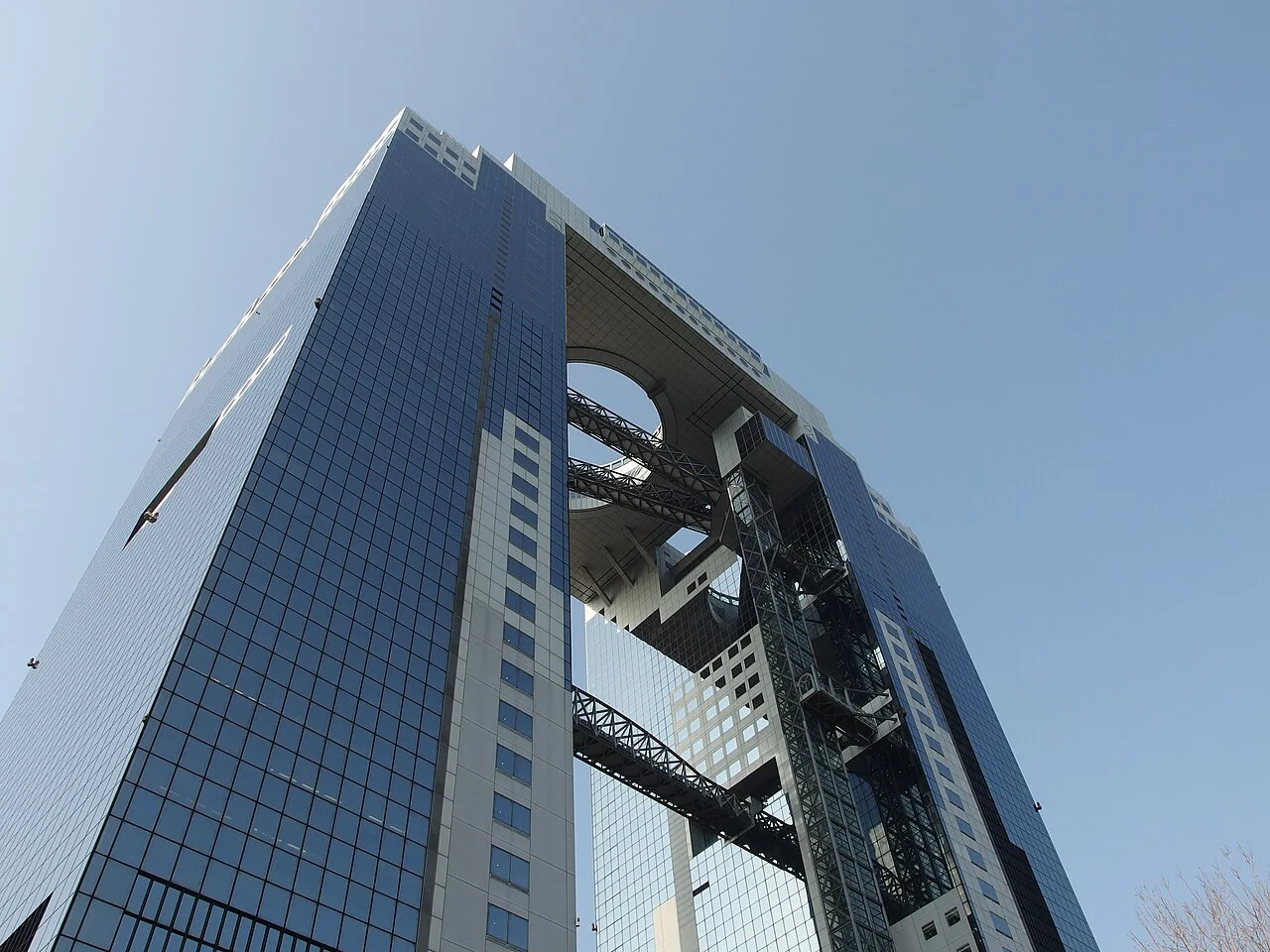
Once you reach Shin Umeda City, step into Wonder Square between the twin towers. Look straight up from the plaza to spot the circular opening in the roof and the two diagonal glass tubes suspended beneath it. The observatory entrance sits along the ground-level walkway beside the plaza—look for signs reading Kuchu Teien Observatory Dedicated Entrance. Do not head into the East or West Tower office lobbies for standard elevators, as those serve a different path. If you are managing kids or heavy bags, pause in the square while one person walks over to confirm the entrance doors.
Standard admission routes you from the dedicated ground entrance up to the 3rd floor, onto an observatory elevator to the 35th floor, and finally across the suspended glass-enclosed escalators to the 39th floor. From the ground, those two tubes look like bridges slung between office towers; riding inside, your view tilts upward across the open void as the opposite tower shifts angle. This escalator ride happens before ticket inspection, so visitors who only want to experience the ride and browse the 39th-floor gift shop can still take the regular route up. Only ticketed guests continue from the 39th floor to the 40th floor and rooftop.
To photograph the glass escalators cleanly, take a static shot from the landing before stepping on rather than fumbling for your phone mid-ride. Once on the escalator, keep a firm footing, swing backpacks to your front or tuck loose straps, and wait until you clear the exit landing before stopping to put your camera away. At night, the tube's edge lighting and city lights outside both enter the frame, letting you trace a glowing line from the foreground deep into the background. If you are taking photos of companions, wait for the wider space past the landing so the exit stays clear for riders behind you.
Wheelchair users take a high-rise elevator directly from the 1st floor of the East Tower to the 39th floor. The building also routes non-folding strollers this way, since the glass escalators are narrow and steep. If part of your group wants the escalator ride and others need the elevator, split up on the ground floor and reunite near the 39th-floor ticket counter. Visitors who need to avoid stairs throughout the deck can ask staff at the counter to direct them between upper levels. Accessible restrooms are located on both the 39th and 40th floors—with ostomy-friendly facilities on the 39th floor—and nursing rooms are available on both levels.
The observatory itself does not offer luggage storage. Its official FAQ lists three coin-locker locations on-site: behind the ATM area in Garden 5 on the 1st floor, on B1 in Takimi-koji, and in the B2 parking level. If you plan to pick up bags after dark, double-check each locker area's closing hours before locking anything away—Takimi-koji lockers on B1 stay accessible until 11:00 PM, while the 1st-floor Garden 5 area usually stays open until midnight except on the second Saturday of each month, when it closes at 9:00 PM. If you are catching a train out of Osaka Station afterward, storing suitcases at the station beforehand and returning to the same exit is often simpler.
40F Indoor Seating and Coffee vs. the Rooftop Loop
Once past the ticket gate, orient yourself on the 40th floor before heading onto the roof. Official floor maps label the perimeter zones as City View, River View, and similar vantage points. On a first visit, start with familiar landmarks: line up Osaka Station, Grand Front Osaka, and Umekita Park below, then shift to another window to pick out the Yodo River. Identifying roads, waterways, and bridges while daylight holds makes it much easier to read the skyline after dark. If anyone in your group needs a break, pick one window bay on this floor as your meeting spot.
Inside the paid area on the 40th floor, cafe SKY 40 serves drinks and light bites. On windy evenings, sitting by the glass with a drink makes an easy detour between rooftop loops. Food and drinks are not permitted on the rooftop deck, so finish any beverages in the cafe zone first. If you are coming primarily for a full meal, the restaurants and bar on the 39th floor are open without an observatory ticket. Anyone booking dinner in the building should note both the restaurant floor and the observatory gate time separately so you do not mix up your dining reservation with your deck entry.
Up top, the Sky Walk loops around the roof where the two towers join, about 173 meters above street level. Following the ring takes you past city towers, distant mountains, and Osaka Bay in one continuous circuit. Between sweeps of the outer skyline, glance inward to see how the central circular void frames the sky directly overhead. Down on the 40th floor, large panes tend to lock you into one straight-ahead view; walking the rooftop loop keeps both the surrounding city and the building's geometry shifting at every step, making the full circuit worth the time.
If you arrive with time to spare before sunset, do one quick lap of the rooftop first to scout your favorite spot, then drop back down to the 40th floor to browse the exhibits. When the light is already fading, head straight to the west side for sunset, step indoors to warm up or rest, and go back up once full darkness settles. Anyone in your group who is uncomfortable with heights can stay behind on the 40th floor. Just make sure everyone reunites before taking the elevators back down—once you leave the paid zone, re-entry is not allowed.
The circular ring you spotted from the plaza has its own story displayed along the 40th-floor windows. Designed by architect Hiroshi Hara and his studio, Umeda Sky Building was completed in 1993, with the observatory opening the same year. Engineers assembled the upper bridge structure at ground level first and winched the entire mass upward on steel cables—architectural displays note it rose at roughly 35 centimeters per minute. Looking up from the plaza first and then inspecting the connection points and lift records upstairs lets you see the exact section they hoisted into place.
For a closer look at the architecture, stop by the screening area on the 40th floor for 'Sora e,' a roughly six-minute animated short recreating how the building was constructed, alongside videos and exhibits explaining the lift-up method. The rooftop's central opening is called the Sky Crater, lined with semi-reflective glass that catches passing silhouettes and clouds side by side during the day. Back on the plaza afterward, look halfway up the facade to spot the horizontal connecting bridge on the 22nd floor—built partly as an emergency evacuation route, several stories below the diagonal escalators starting at the 35th floor. Spotting both bridges makes the twin-tower engineering click.
Timing Sunset One Hour Early and Tracking the Light
Look up the exact sunset time for your visit date from the National Astronomical Observatory of Japan, then work backward to your arrival at the ground-floor plaza. On a first visit, reaching the plaza about an hour before sunset gives you comfortable margin for finding the entrance, riding the elevators, buying tickets, and claiming a spot by the glass. On weekends or when events are running in the plaza, build in extra buffer for station crowds and ticket lines. On the observatory's lookup table, select Osaka and check the sunset ('iri') column, and save the building's landmark map beforehand so you can match skyscrapers and rivers as soon as you step out.
Looking at Osaka city data from the observatory, sunset falls at 4:51 PM on December 22, 2026—meaning a 3:50 PM plaza arrival works well—while on June 21, 2027, sunset shifts all the way to 7:14 PM, letting you head up around an hour beforehand. Because those two dates sit more than two hours apart, the sun also sets much farther south or north along the horizon: aim west-southwest in December and west-northwest in June. Rather than locking yourself into one corner, check which side of the deck has the clearest sightline on site and use Osaka Bay as your foreground.
While daylight is still strong, head to the side overlooking the Yodo River, pick out its widest channel and bridges, and trace the water west toward Osaka Bay. From up high, the river cuts straight across the urban grid before opening toward the western horizon. On crisp, clear days, use the landmark guide to spot the Akashi Kaikyo Bridge and Awaji Island in the distance. When haze softens the horizon, frame the river bends and nearby bridges instead—and if clouds bank up in the west, watch for shafts of light breaking underneath rather than waiting on a distant landmark to appear.
As you circle back from the west side toward downtown, look close in for Osaka Station and Grand Front Osaka. Panning south and southwest, the official view map points out Kyocera Dome Osaka, Osaka Aquarium Kaiyukan, and the Tempozan Giant Ferris Wheel. Because these landmarks sit at very different distances, get your bearings by daytime topography first, then match their silhouettes once the lights come on. If you only have a smartphone's wide-angle lens, let the denser downtown towers and arterial roads fill most of the frame while keeping a band of sky on top so the neighborhood layout stays readable.
Stay on the same side for a little while after the sun drops below the horizon to watch highways, bridges, and office towers light up in waves. Keep your daytime framing for a second shot with the riverbank or bridge anchored in the same spot. Comparing the two photos later shows solid buildings dissolving into grids of lit windows while reflections wake up across the water. Holding one familiar district steady captures the dusk-to-night shift much better than chasing whichever patch looks brightest on your screen.
Because summer sunsets run late, you can stop for an afternoon snack first and still catch plenty of daylight upstairs; if you plan a full dinner afterward, check kitchen last-order times in advance. In winter, treat the night view as the main event before dinner, pack a windproof layer, and split your rooftop time into two short loops with a warm-up break on the 40th floor. With kids along, point out trains they just rode or the plaza you crossed while street-level details are still visible—once everything turns into a sea of lights, tracing your earlier route gets much harder.
If you only care about night photography, pick a window right before or after dinner that pairs neatly with your restaurant booking. Arriving late on the 39th floor? Head straight up to walk the half of the rooftop loop you want most, then grab indoor shots on the way out. Weekday afternoons work well for photographing the exterior towers and glass escalators while keeping your evening free elsewhere in Osaka. If you are visiting two observation decks on the same day, do one in daylight for urban geography and save the other for after dark so the two stops do not blur together.
Handling Rain, Wind, and Window Glare
The observatory stays open in ordinary rain. Umbrellas are banned on the rooftop for safety, though rain ponchos are sold at the 39th-floor shop. During severe weather, staff may close only the rooftop deck while keeping the 40th-floor indoor gallery open. In light rain when the roof remains accessible, sort out your phone, camera, and bag indoors before stepping outside for a short loop. If wind and rain pick up, the bridges and intersections visible from the 40th floor still make strong close-range subjects before you head down to Takimi-koji—and if low clouds swallow the entire view, pivot to dinner or the museum and save the deck for another evening.
Inside on the 40th floor, window glare comes mostly from ceiling lights and screens behind you. Press your lens close to the glass, angle straight ahead, and cup your hands or drape a jacket around both sides of the lens to block interior light. Turn off your phone flash and dial exposure down slightly against bright city lights so neon signs and headlights keep their detail. If raindrops cling to the outer pane, tap to refocus on a distant building or bridge so the camera does not lock onto the drops in front of you.
The rooftop removes glass glare altogether, replacing it with steady wind tugging at your camera and coat. Find a spot off to the side where you can brace your stance, hold your phone with both hands, and frame slightly wider than you think you need so you can crop later. Tripods are allowed as long as they do not block walkways, though staff will step in if crowds thicken. Assess foot traffic first before setting up legs, switch to handheld in narrow bottlenecks, and collapse tall tripods in gusty weather so you keep a free hand for railings and gear.
After a rain shower, low light reflects sharply off wet rooftop paving and metal beams. Start by shooting the inner Sky Crater ring and illuminated diagonal struts, then turn outward toward the skyline. At night, the Lumi Sky Walk embeds glowing accents into the walkway surface; if your group wants a posed photo, step into a spot with solid footing and room behind you, hold still while Night Mode finishes exposing, and step aside right away to keep the path moving.
Extra Stops Inside Shin Umeda City: Ground Level and B1
On level B1, Takimi-koji recreates a Showa-era dining alley indoors with retro storefronts, vintage signs, and stone-paved lanes. Eating dinner before going up makes meal timing much easier if you have older relatives or young kids in tow. Eating afterward is just as convenient as long as you pick a spot that stays open late—each restaurant sets its own hours, so check last-order times for kushikatsu, okonomiyaki, or set meals before heading downstairs to look for a table.
Around the ground-level plaza, you will also find Nakashizen-no-mori, a landscaped woodland with waterfalls and walking paths, and Hanano Shin Satoyama on the north side of the complex beside the Wall of Hope (Kibo no Kabe), a living green wall conceived by architect Tadao Ando. If you enjoy exterior photography, frame the central opening from the plaza first, then back away toward the greenery to capture both towers rising behind the trees. Even if you skip the observatory altogether, looping from Hanano back through Wonder Square and down to Takimi-koji for a meal makes a complete ground-level stop.
From November 13 to December 25, 2026, Wonder Square hosts a free-entry Christmas market with stalls open 12:00 PM–10:00 PM (last order 9:30 PM), while matching holiday displays sit inside the 40th-floor paid zone. In December, the plaza light show runs every hour and half-hour starting at 5:00 PM, with the final show at 9:30 PM—meaning you can catch a winter sunset upstairs and still come down in time for a show. Put the light show before dinner by grabbing snacks at the market and heading down to Takimi-koji, or branch out to other venues with our Osaka Christmas markets guide.
The Koji Kinutani Tenku Art Museum occupies the 27th floor of the West Tower, reached via the West Tower's high-rise elevator. Galleries are split into blue- and red-themed zones alongside 3D film projections of the artist's works. For a balanced afternoon split between indoor art and outdoor skyline, visit the museum first, take a breather downstairs, and head up to the observatory afterward rather than rushing to the 27th floor after sunset. If you want both attractions, the museum posts a combined ticket for ¥2,500; same-day combo tickets are sold on the observatory's 39th floor, and advance combo e-tickets are available via the museum's website.
Standard museum hours are 10:00 AM–6:00 PM, extending to 8:00 PM on Fridays, Saturdays, and the eves of national holidays, with last entry 30 minutes before closing. It normally closes on Tuesdays—staying open when Tuesday is a national holiday and closing the following weekday instead—as well as over year-end holidays and exhibition changeovers. Standalone adult museum admission is ¥1,300, and children elementary school age and younger enter free. Families should price out individual tickets before buying combos, since kids do not need the same bundled ticket as adults.
One block east in Grand Green Osaka, Umekita Park mixes broad lawns on the south side with woodland paths and water features to the north. On November 20, 2026, the development team announced the opening of Umekita Forest on the western edge of North Park alongside the full opening of Hirameki no Michi, an elevated north-south pedestrian bridge stretching about 350 meters. Walk toward the park from Osaka Station, cross to the north side along the skybridge, and stroll over to the crosswalk facing the twin towers. Putting the park walk before going up lets you enjoy the grounds in daylight before heading back toward the station after dinner.
Planning Half a Day in Umeda vs. Switching to Abeno HARUKAS
On a first trip to Osaka with an afternoon set aside for Umeda, start around the department stores north of Osaka Station, stroll through Umekita Park, and continue to Umeda Sky Building. Shoot exterior views before heading up, then return toward the station district for dinner so your only decision afterward is whether to board JR, the Midosuji Line, or Hankyu. Pick one daytime focus beforehand from our Osaka shopping neighborhoods guide—and if your purchases involve long checkout lines, save shopping for after the observatory so you do not get stuck in a store and miss sunset.
If you only have an hour to spare in Umeda, decide based on where you are already standing. If you are already on the plaza in clear weather, give most of that hour to the 40th floor and rooftop. If you still have to walk from the station, fetch luggage, or catch an airport train, stick to plaza-level photos of the towers and a meal near the station. To fit in the park and the Tenku Art Museum too, block out a full afternoon and work backward from your dinner reservation to divide time among the museum, plaza, and rooftop.
Day-trippers coming from Kyoto or Kobe should match the observatory to their rail line before locking in a time slot. Riding Hankyu from Kyoto and returning the same way makes Chayamachi the cleanest hub for meeting friends, eating dinner, and catching the train back; JR riders can regroup on the north side of Osaka Station instead. If you are retrieving large suitcases that night, jot down the locker floor and station exit name in your phone—most extra walking in Umeda comes from taking the wrong exit or wandering into a different railway company's entrance on the way back.
When choosing just one observatory in Osaka, pick Kuchu Teien if you are staying in Umeda, commuting through Osaka Station, or already spending time in the neighborhood—especially if you want the cross-tower escalators and open-air rooftop loop. If your daytime itinerary already puts you around Tennoji Park, Shinsekai, or Abeno, save the night view for HARUKAS 300 instead: standing 300 meters tall, its 58th-to-60th-floor observatory pairs a glass-walled indoor corridor on the 60th floor with an open-air atrium plaza on the 58th. Splitting the two decks across separate days flows much better; use our three-day Osaka itinerary to balance Umeda, Namba, and Tennoji.
Staying around Nakanoshima gives you an easy way to shift between two city scales in one evening: take in the Yodo River and station district from Umeda Sky Building first, then return after dinner for a riverside walk along the smaller bridges near your hotel. If someone in your group only wants a half-day outing, pick either the observatory or Nakanoshima rather than cramming both before catching a late train. Both work well around dinner, so choose based on where you are sleeping instead of doubling back to Umeda twice.
Osaka Amazing Pass holders should flip the usual order: arrive in Umeda earlier, take in daytime views toward the Yodo River and Osaka Port, and walk over to the Koji Kinutani Tenku Art Museum in the West Tower right after. The pass's participating-attractions list also includes the museum, though keep in mind its closed days differ from the observatory's. Families with preschoolers can head up after lunch, use the 39th-floor nursing and care facilities first, and then see how much of the rooftop loop everyone feels up for. If you have evening dinner, cruise, or show reservations elsewhere, knocking out Kuchu Teien during a daytime window keeps your schedule tidy.
If thick fog rolls in across the entire evening, pivot to indoor shopping around the station, the West Tower art museum, or dinner on B1, and save the observatory for your next clear evening. On clear but windy nights, the indoor 40th-floor windows, glass escalators, and ground-level angles still hold up fine in the same visit. If anyone in your group has an early morning or a train to catch, agree on next steps before leaving the 40th floor so part of the group can head straight back to the station while everyone else rides down for dinner.
A few useful answers
How much are same-day tickets for the Kuchu Teien Observatory?
Standard admission is ¥2,000 for junior high school students and adults, ¥500 for children ages 4 through elementary school, and free for kids under 4. Same-day tickets are sold on the 39th floor.
Can I use the Osaka Amazing Pass for free night entry to the observatory?
Free admission is accepted until 3:00 PM; after that, showing the pass gives you 10% off admission. To use free entry, schedule your visit for daytime and reach the ticket counter before the cutoff.
What time should I arrive to see both sunset and night views?
Check Osaka's sunset time for your exact date and aim to reach the ground-floor plaza about an hour earlier. Start on the west side of the rooftop for sunset, then walk the full loop after dark to see the river, bridges, and station lights come on.
Can wheelchairs or strollers bypass the glass-enclosed escalators?
Yes. Wheelchair users and non-folding strollers take a high-rise elevator directly from the 1st floor of the East Tower to the 39th floor, where ticket counter staff can direct you through the accessible route between upper levels.
Can you still visit the Kuchu Teien Observatory when it rains?
Yes, the observatory stays open in ordinary rain. Umbrellas are not permitted on the rooftop, and the open-air deck may close in severe weather, while the 40th-floor indoor viewing gallery and cafe remain open.
Are there any scheduled shortened hours in 2027 or discounted advance e-tickets?
Yes. Due to facility inspection, hours on Sunday, April 18, 2027 are shortened to 9:30–18:00 (last entry 17:30); standard hours otherwise remain 9:30–22:30 (last entry 22:00). Same-day adult tickets at the 39th floor cost ¥2,000, while date-specific advance e-tickets via Asoview linked on the official site are ¥1,800.
Official information and references
Sources used in this guide.
- Umeda Sky Building | Hours, Same-Day Tickets, Discounts, and Special Schedules
- Umeda Sky Building | Advance E-Tickets, Heart Lock Combos, and Walking Map
- Osaka Amazing Pass | Participating Attractions and Kuchu Teien Entry Cutoff
- Umeda Sky Building | Access and Barrier-Free Routes
- Umeda Sky Building | Observatory Dedicated Entrance Map
- Umeda Sky Building | Observatory Floors and Open-Air Sky Walk
- Umeda Sky Building | Viewing Directions and Landmark Map
- Umeda Sky Building | Rain Policy, Coin Lockers, Re-Entry, and Wheelchair Access
- Umeda Sky Building | Shin Umeda City Architecture and Lift-Up Construction
- Umeda Sky Building | Shin Umeda City Ground-Level Grounds
- Umeda Sky Building | Floor Dining and Takimi-koji
- Umeda Sky Building | 2026 Christmas Market, Last-Order Hours, and Light Show
- Osaka Convention & Tourism Bureau | Takimi-koji Dining Street
- Koji Kinutani Tenku Art Museum | Address, Closures, and Admission
- Koji Kinutani Tenku Art Museum | Galleries and 3D Artworks
- Koji Kinutani Tenku Art Museum | Online Combo Ticket Channels
- GRAND GREEN OSAKA | Umekita Park, North Building, and South Building Access
- GRAND GREEN OSAKA Development Team | November 20, 2026 Park and Skybridge Opening Announcement
- GRAND GREEN OSAKA | Umekita Park November 20–23 Opening Events
- National Astronomical Observatory of Japan Ephemeris Computation Office | Sunset Lookup by Location and Date
- National Astronomical Observatory of Japan | December 2026 Osaka Sunrise and Sunset Table
- National Astronomical Observatory of Japan | June 2027 Osaka Sunrise and Sunset Table
- Abeno HARUKAS 300 | Observatory Floors and Access
- JR-West | Osaka Station Umekita Underground Exit and Haruka Underground Platforms