The 2027 Osaka Mint Bureau Cherry Blossom Passage dates are not announced yet. Use the 2026 official record to plan free timed entry, the South Gate entrance, North Gate exits, late-blooming double blossoms, and a half-day along the Okawa River.
- Region & Focus
- Osaka
- Reading Scope
- 19 min read · 11 chapters · 5 Q&As
- Official Verification
- 23 official sources checkedUpdated November 22, 2026
- Key Topics
- SeasonsBookingItineraries
Chapter Route Map (tap any stop)
- Planning for 2027: Lock Your Dates First, Then Track Both Blooms
- How 2026 Reservations Worked: Two Release Waves and Entry Passes
- Morning, Afternoon, or Evening: Choosing the Right Entry Slot
- Three Stations Reach the South Gate: Save Your Exit Before Leaving
- Walk the 560-Meter Passage North Past the Old Main Gate
- Gyoiko, Kanzan, and Fugenzo: How to Tell the Cultivars Apart
- Rainy Days, Families with Kids, and Accessibility Planning
- Where to Go After the North Gate: Pick Your Side of the River First
- Fitting the Passage Into a Half-Day: Keep One Timed Ticket at Most
- No Reservation? Walk the Outside Bank or Pick an Indoor Museum
- The Mint Museum and Factory Tour Are a Separate Visit
- Quick Q&A
Normally inside a restricted Mint Bureau compound, the Osaka Mint Bureau Cherry Blossom Passage opens to the public each spring as a roughly 560-meter one-way walk entering from the South Gate near Tenmabashi and exiting at the North Gate near Sakuranomiya Bridge. As of November 22, 2026, the 2027 dates and admission rules have not been announced. The 2026 event ran from April 9 to 15 with free, first-come, first-served timed reservations. If you are heading to Osaka this spring, pencil in a half-day around Tenmabashi and the Okawa River now, then slot in your reservation once the Mint announces the schedule.
Planning for 2027: Lock Your Dates First, Then Track Both Blooms
The official event is called Sakura no Torinuke (Cherry Blossom Passage). Because 2027 corresponds to Reiwa 9 in the Japanese imperial calendar, watch for that year label when checking official updates. The Japan Mint Osaka event portal currently points to the closed 2026 (Reiwa 8) wrap-up page, so all hours, bloom statuses, and traffic restrictions listed there apply to 2026. Treat the schedule announcement, reservation opening, and daily bloom updates as three separate milestones. Base your hotel and intercity transit bookings on how flexible your travel dates are, then lock in your Osaka half-day as each milestone drops.
Past schedules show the event ran April 13–19 in 2022, April 7–13 in 2023, April 5–11 in both 2024 and 2025, and April 9–15 in 2026. All five recent editions lasted seven days, and even back-to-back matching dates shift eventually. Travelers locked into fixed vacation days should anchor their trip around Osaka Castle Park or Kema Sakuranomiya Park, which they would want to visit regardless. If the Mint Bureau's late-blooming double cherry blossoms are your primary goal, book refundable lodging and leave an open block in central Osaka until the official dates are confirmed.
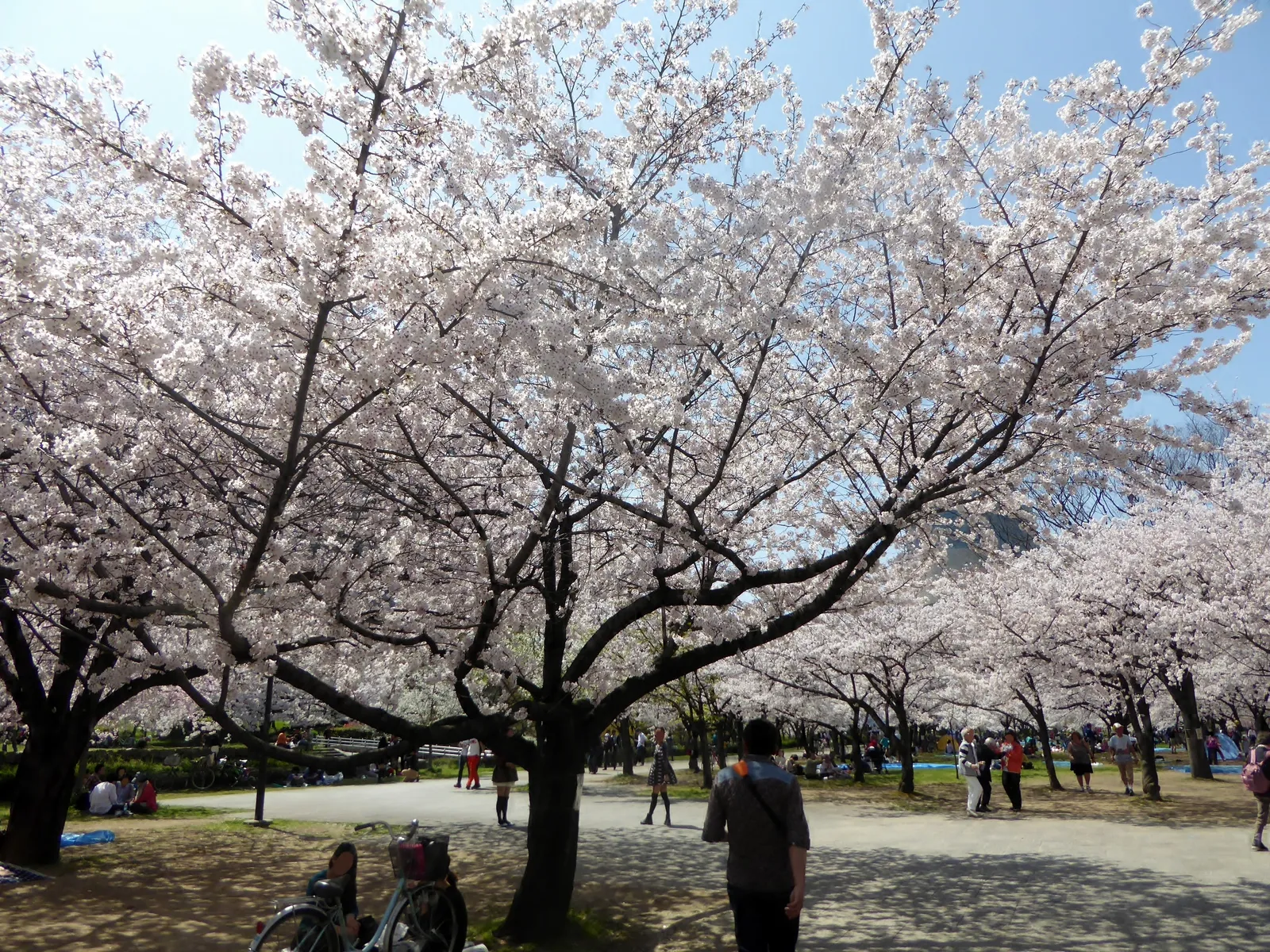
In 2026, the Osaka Regional Meteorological Observatory recorded full bloom for Somei-Yoshino on its sample tree at Nishinomaru Garden in Osaka Castle Park on April 3—six days before the Mint Bureau gates even opened. Use meteorological observatory reports to time citywide Somei-Yoshino, but check the Mint's own event page for specific cultivars inside the grounds. On the final day of the 2026 opening, the Mint rated overall blooming at about 70 percent, with roughly 60 percent of trees at peak bloom, nearly 20 percent beginning to shed petals, and the 2026 featured cultivar Gyoiko in full bloom.
If your trip falls in late March or early April, prioritize open city parks first and save late-blooming cultivars for another window. With only one day in Osaka during early to mid-April, lock in your intercity trains first and pick from whatever entry slots remain once booking opens. If you have two or more half-days in Osaka, designate one as your primary reservation target and leave the second flexible for riverfront bloom conditions and weather. Families, photographers, and casual strollers each thrive at different times of day; putting a single reservation in the right time slot for your group beats changing hotels just to chase peak bloom on a specific date.
The 2027 Osaka Mint Bureau Cherry Blossom Passage dates are not announced yet. Use the 2026 official record to plan free timed entry, the South Gate entrance, North Gate exits, late-blooming double blossoms, and a half-day along the Okawa River.
How 2026 Reservations Worked: Two Release Waves and Entry Passes
The 2026 official guidelines laid out a clear schedule: bookings opened at 9:00 AM JST on March 18, releasing roughly three-quarters of total capacity across all time slots. The system went down for scheduled maintenance on April 1 from 7:00 AM to 9:00 AM JST, then reopened at 9:00 AM JST until slots filled. Any time slots with remaining capacity stayed open for booking until the event ended. Looking at that pattern, if you miss your preferred time on opening day, mark the second release date from the guidelines—and wait until you hold a confirmed pass before adjusting intercity train tickets.
Each day in 2026 was divided into 30-minute entry windows. Standard capacity was capped at 2,350 visitors per half-hour, while the opening hour on both weekdays and weekends was capped at 1,200 visitors per half-hour. Morning slots hold fewer people, making them ideal if you want an early walk and an exit before lunch. If you can only get an afternoon slot, schedule lunch near Tenmabashi and head to the South Gate on time instead of rushing out of Kyoto or Kobe for the first window. Caps reflect booking limits only; actual queue length still depends on arrival timing and bag-check throughput.
The online form requested your preferred entry window, party size, and the lead applicant's email address and phone number, alongside a brief survey and data consent checkbox. In 2026, reservations were limited to individual applicants, up to five people per booking including the lead applicant (infants and toddlers not counted), and one time slot per applicant per day. Everyone on a single reservation had to check in together, though fewer people could show up than booked. Groups of six or more can have separate lead applicants book the same slot—or grab adjacent slots, walk in separately, and meet outside the North Gate.
Once submitted, the organizer emailed a confirmation containing a QR code. Have the lead applicant's email and phone number ready beforehand, then verify the date, entry time, and headcount on the confirmation before forwarding it to your group. Printing a backup copy of the QR code alongside the mobile version is smart insurance. If companions only have data-only eSIMs in Japan, put the person who can easily pull up the confirmation email at the front of the line so the queue does not stall at check-in. Old phone numbers and booking URLs belong to past editions; always start from the main Japan Mint event portal for the current year's official link.
Morning, Afternoon, or Evening: Choosing the Right Entry Slot
In 2026, gates opened at 10:00 AM on weekdays and 9:00 AM on Saturdays and Sundays, with last entry at 7:15 PM and full grounds clearance by 7:45 PM. First-time visitors who want to read the cultivar plaques should pick a daylight slot, meet right outside the station exit, and walk to the gate together. Evening slots work well if your daytime is already packed and you are staying in Osaka overnight. If you hold the final entry window of the evening, clearing time will cut into your stroll—so pick an earlier slot if your group wants to inspect every tree label.
Under the 2026 rules, visitors were expected to enter during the window printed on their confirmation. Outside opening and closing hours, staff allowed minor leeway for transit hiccups. If you are coming from another city, factor in transfers, station navigation, the roughly 15-minute walk, and bag-check queues. If delayed, follow staff directions when you arrive. If your whole group knows it will be significantly late, keep a backup route along Kema Sakuranomiya Park ready so you can pivot straight to the riverbank from the train instead of walking all the way to the gate first.
Go during daylight if you care about true petal colors and distinguishing blossom centers; even on overcast days, subtle greens, yellows, and pinks are easy to compare along the walk. Photographers planning castle or keep shots should check the castle's closing hours first before deciding whether to book an evening Mint pass or move the Mint to another half-day. If you are traveling with seniors or young kids, match your slot to normal meal and rest rhythms so everyone can still sit down for food on schedule after exiting.
When a half-day opens up shortly before your trip, check which slots remain online first, then weigh the forecast and distance to your next stop. If several slots work equally well and daily bloom updates are posted, lean toward days when your target cultivars are further along. Between morning and afternoon on the same day, transit connections, your group's walking pace, and natural light are easier to judge. Once the logistics are locked in, you can actually slow down in front of the trees that catch your eye.
Three Stations Reach the South Gate: Save Your Exit Before Leaving
Entry starts at the Mint Bureau's South Gate near Tenmabashi, at 1-1-79 Tenma, Kita-ku, Osaka. When searching map apps, look up "Japan Mint South Gate" or "Sakura no Torinuke Entrance." Saving only "Japan Mint" or "Mint Museum" often routes you to the regular weekday main gate along National Route 1 on the north side. Drop pins for both the South Gate and North Gate in your group chat so anyone arriving on different train lines can confirm exactly which exit they are using.
On the Osaka Metro Tanimachi Line, take Tenmabashi Station via the North Ticket Gate to Exit 2—an easy direct ride from Higashi-Umeda, Tanimachi 4-chome, or Tennoji. The Keihan Main Line also serves Tenmabashi Station; use the East Ticket Gate and Exit 14. Both operators share the station name but use separate exit numbering. Saying only "meet outside Tenmabashi Station" leads to lost time in street-level crowds, so specify one exact exit or pick a clear sign at the north end of Tenmabashi Bridge.
The JR Tozai Line is convenient from Kitashinchi or Kyobashi. Leave Osakajokitazume Station via Exit 3 and walk to the South Gate to start your visit. Official guidance estimates about 15 minutes on foot from all three station exits—measured from street level. Factor in bridge bottlenecks and crosswalk crowds along the Okawa River; JR riders can sort tickets, phones, and jackets inside the concourse before stepping out to follow event signage. On JR route maps, look specifically for Osakajokitazume—nearby Osakajokoen Station sits on the Osaka Loop Line and is much farther from the South Gate.
In 2026, surrounding streets were closed to vehicles during the event. The Mint's traffic map marked multiple vehicle-restricted zones from the north side of Tenmabashi to Higashi-Temma, scheduled from 9:30 AM on weekdays and 8:30 AM on weekends through 7:30 PM. There is no event parking or tour-bus drop-off inside the grounds. Groups arriving on different lines should meet at a single Tenmabashi exit, and anyone heading straight to the airport or another city afterward should leave large suitcases at a hotel or transfer-station locker and budget time to retrieve them after exiting.
| Rail Line | Station | Official Exit Route |
|---|---|---|
| Osaka Metro Tanimachi Line | Tenmabashi | North Ticket Gate, Exit 2 |
| Keihan Main Line | Tenmabashi | East Ticket Gate, Exit 14 |
| JR Tozai Line | Osakajokitazume | Exit 3 |
Walk the 560-Meter Passage North Past the Old Main Gate
After entering the South Gate beside the Okawa River, the crowd follows an internal path inside the Mint perimeter toward Sakuranomiya Bridge. That 560 meters covers only the passage itself; the full visit includes QR-code check-in, bag inspection, stopping at trees, and walking out from the North Gate. Giving it the bulk of a half-day keeps the pace relaxed. If you have a lunch reservation or an intercity train afterward, count your buffer starting from the North Gate exit and add extra time to cross bridges, intersections, and reach your station.
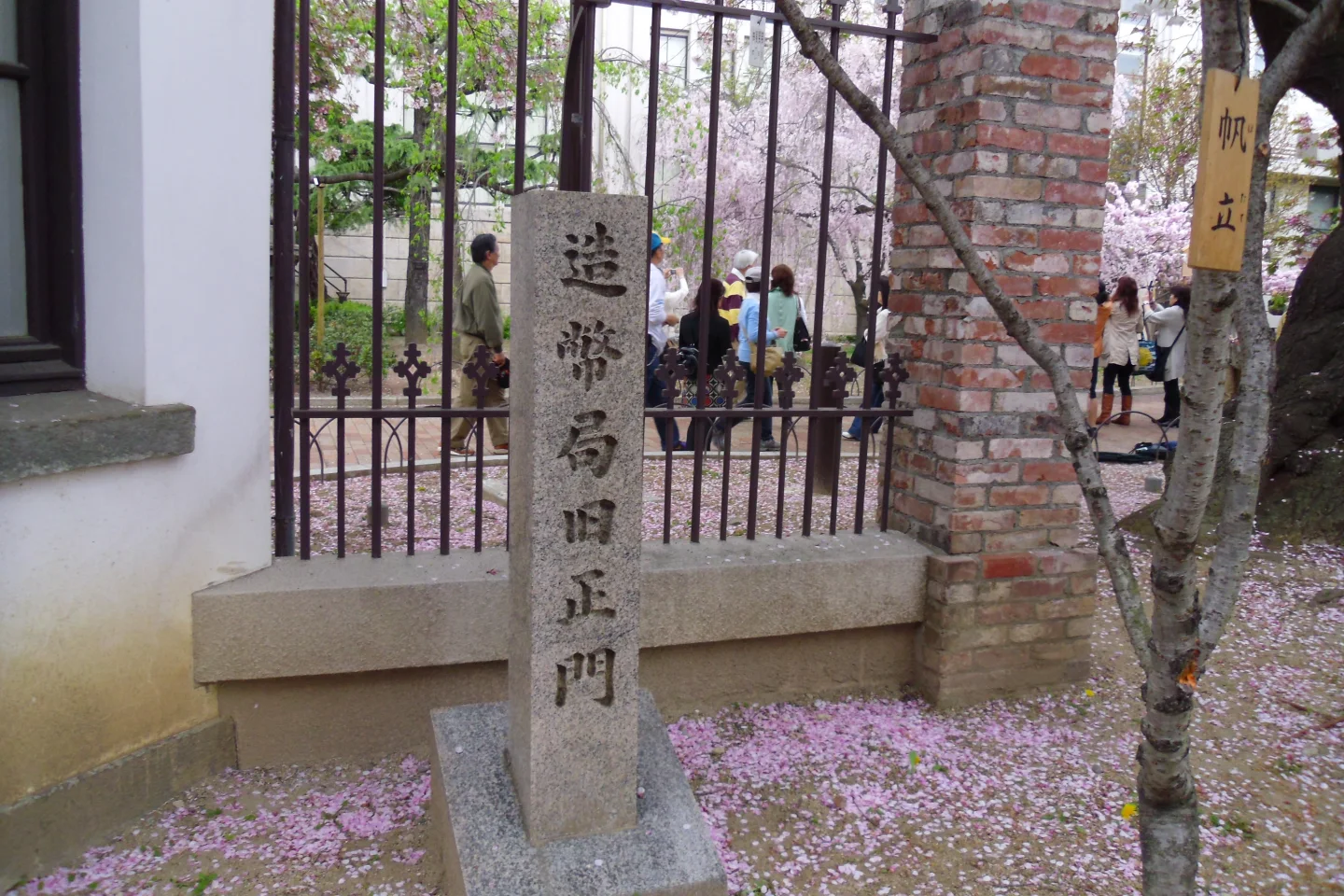
Osaka City's heritage notes highlight the preserved Old Main Gate along the passage, built when the Mint opened in 1871 and easy to spot by its octagonal red-brick guardhouse. The stone pillar seen in the lead photo is inscribed with the Old Main Gate's historic Japanese name. Two other Meiji-era structures stand nearby: the former Foundry Front Entrance and Senpukan, once used as a Mint reception hall. If historic architecture interests you, pin those names before you go so you know where to look as you pass the Old Main Gate.
According to Mint Bureau records, the cherry collection dates back to the early Meiji era, when satozakura trees were transplanted from the nearby Todo clan storehouse grounds. In 1883, then-director Kinsuke Endo proposed opening the riverside path to the public during peak bloom. Torinuke literally means passing straight through the grounds from one end to the other. Today's one-way route preserves that tradition: for a few hundred meters inside the gates, you are walking through an active currency facility, whereas normal riverside strolls stick to the parks outside the walls.
In thick crowds, check a tree plaque first and trace which branch belongs to it before looking up from a safe spot to stand. When branches extend over neighboring trees, the blossoms closest to a plaque do not always match that label. To pair blossoms with their cultivar name in your photos, take one wider shot showing the tree and plaque together, then step in for a close-up of the flowers—and if the crowd pushes forward, keep moving and sort your shots once you reach the riverbank or a cafe.
Gyoiko, Kanzan, and Fugenzo: How to Tell the Cultivars Apart
The 2026 Mint catalog listed 331 cherry trees across 140 cultivars, with one highlighted each year as the Blossom of the Year. That year's pick, Gyoiko, opens pale yellow-green with roughly 15 petals that gradually develop red vertical streaks. Compare it side by side with Ukon, another greenish-yellow cultivar whose 10 to 15 petals are named for their resemblance to turmeric root. Because phone screens distort subtle greens, photograph the plaque first and study the flower center and petal veining with your own eyes instead of tweaking camera filters.
Making its Mint debut in 2026, Fukuzakura descends by grafting from an original tree in Kanazawa's Kenrokuen Garden that died in 1961. The Mint describes it as purplish-pink with chrysanthemum-like layered petals (kikuzaki) that even contain chloroplasts. If you are new to chrysanthemum-flowered cherries, view the narrow layered petals head-on first and then from the side to judge the blossom's depth rather than trying to count petals under the tree. Even if only one or two Fukuzakura blossoms are open, you can still study their shape with a full row of blooming Kanzan behind them.
Kanzan is the workhorse of the collection—58 trees in 2026—producing rich pink blossoms with around 30 petals. Shogetsu opens pale pink and fades toward white, letting you spot the leaf-like pistil at its center. Fugenzo is famous for two green leaf-like pistils projecting from the center with curved tips, which the Mint's notes compare to the trunk of the white elephant beneath the bodhisattva Fugen. Look for the blossom shapes first, then match the plaques—Kanzan, Shogetsu, and Fugenzo are three classics you can recognize immediately.
Otemari, Kotemari, and Benitemari all take their names from dense pom-pom clusters at the branch tips. The Mint describes Otemari as pale pink flowers packed into large spheres, Kotemari as smaller clusters, and Benitemari as deeper red. Step back half a pace to view an entire cluster at once and the naming makes immediate sense. On the Mint's website, cultivars are indexed by Japanese kana order: look under "o" for Otemari, "ko" for Kotemari, "he" for Benitemari, and "ki" for Gyoiko. Screenshot a short wish list before arriving so you can match shapes quickly and still leave time to pause at unexpected favorites.
Rainy Days, Families with Kids, and Accessibility Planning
The 2026 rules asked visitors to refrain from eating or drinking inside the grounds, enforced a strict no-smoking policy, and banned open parasols, selfie sticks, and tripods along the passage. Pets are prohibited, with exceptions for assistance dogs accompanying visitors with disabilities. Because bag checks happen at entry, consolidate your gear into one easy-to-open daypack. If you are visiting with young kids, handle snacks, water, and restroom breaks before lining up, and plan another rest stop once you exit the North Gate. Save cherry-blossom picnics for permitted park areas outside the walls.
According to the Mint's 2026 accessibility guidance, electric wheelchairs and handlebar-steered three- or four-wheel mobility scooters are permitted inside at low walking speed. Anyone needing staff assistance ahead of them can ask attendants or security guards at the gate. When mapping this route, check station layouts for elevator exits first and build in unhurried walking time. Whoever in your group knows the street layout best should check which side of the bridge the exit feeds onto so you do not end up backtracking or crossing an extra bridge after the North Gate.
If the event stays open in light rain, pack a compact raincoat, a waterproof phone pouch, and shoes with good grip. Wipe your phone screen dry before scanning your QR code at the gate, or keep your printed confirmation handy. Watch for puddles and foot traffic when snapping photos, sticking to spots where you can frame a shot without blocking the flow. In severe weather, the Mint may suspend entry on short notice—in 2026, updates went out on the official website and via email to ticket holders. Check your inbox before boarding an intercity train so your group can pivot indoors together if needed.
On Osaka Metro at Tenmabashi Station, the station map marks a step-free path taking an elevator from the platform to the North Ticket Gate and then the Keihan-side elevator up to street level. Using the Keihan Tenmabashi entrance directly, the street-level elevator sits on the Hachikenyahama riverfront side, with interior elevators connecting down to the platforms. When setting a meeting point, name both the rail operator and the exact street-level elevator exit—since lines form outdoors, underestimating underground transfer times is the easiest way to miss your window.
For seniors and visitors with mobility needs, 2026 also featured a dedicated special viewing day on April 8, one day before general admission opened. That session required a separate application with procedures published on the annual event page. If anyone in your group needs a slower pace, trim your itinerary down to one main sight plus a seated lunch break, and save the walking route from the North Gate to your return station on your phone beforehand.
Where to Go After the North Gate: Pick Your Side of the River First
Exiting the North Gate puts you right by Sakuranomiya Bridge. If Osaka Tenmangu Shrine is next, stay on the Mint's side of the river and walk toward Higashi-Temma and Minami-morimachi; the shrine sits just off the southern stretch of Tenjinbashisuji Shopping Street. Shrine access notes highlight Exit 4 at Minami-morimachi Station and Exit 7 at JR Osaka-temmangu Station, both useful landmarks for navigating the covered arcade and your train back. For midday slots, grab a light bite before entering and sit down for a full meal afterward—booking lunch toward Minami-morimachi saves crossing back and forth over the river.
Just outside the North Gate, Senpukan opens its grounds for exterior viewing from 10:00 AM to 5:00 PM (closed the second Wednesday of each month and over Year-End/New Year holidays). Look for Senpukan on the north side of the Mint from the west end of Sakuranomiya Bridge. It is a short detour to admire the two-story colonnade before deciding whether to continue toward Minami-morimachi or cross the bridge for a riverside walk. Architecture fans get a compact pairing here, linking the Old Main Gate inside the passage with the Mint's early reception hall.
To reach the east bank of Kema Sakuranomiya Park, turn out of the North Gate, cross Sakuranomiya Bridge, and stroll north along the water toward JR Sakuranomiya Station. The park spans both banks of the Okawa River from Kema Weir down to Tenmabashi, lined with long stretches of cherry trees and wide water views. Save Sakuranomiya Bridge and Sakuranomiya Station as two separate pins on your map: the bridge sits right next to the Mint's north side, while the station is farther north along the river, making it easy to walk one stretch and hop straight onto the Osaka Loop Line without looping back to the South Gate.
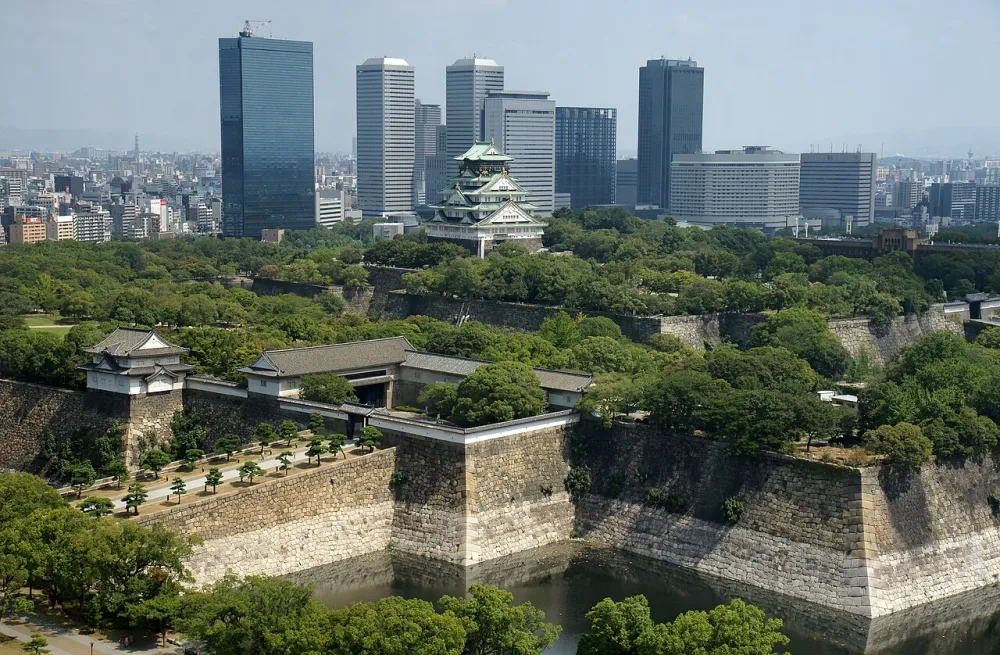
Heading toward Osaka Castle or the Fujita Museum next? You can also cross Sakuranomiya Bridge from the North Gate and angle toward Osakajokitazume Station. If you want to enter Nishinomaru Garden or climb the main keep, check the entrance layout in our Osaka Castle Keep and Park guide first. Osakajokitazume Station sits southeast of Sakuranomiya Bridge, and reaching Nishinomaru Garden means entering the castle grounds and walking around the moat to the garden gate. If you only have an afternoon window left, pick either the outer park or Nishinomaru Garden; save the main keep—with its timed admission or garden closure days—for a dedicated block of time.
If you are catching a Keihan train back toward Kyoto, you can also walk south outside the Mint walls along the river road back to Tenmabashi and allow a little buffer to reach the Keihan ticket gates. Want dinner or an arcade stroll first? Head toward Minami-morimachi and pick a station from there. Your choice comes down to crossing the river, catching JR, or walking back west along the same bank—not everyone in a group needs to take the exact same route home. If you are splitting up after the walk, pick a wide intersection just past the North Gate to get oriented before heading to your respective trains.
Fitting the Passage Into a Half-Day: Keep One Timed Ticket at Most
With a morning slot, make the Mint Bureau your anchor. Meet at Tenmabashi, enter at your reserved time, and after clearing the North Gate choose either Osaka Tenmangu Shrine or Kema Sakuranomiya Park. The shrine route pairs a quick visit with lunch along Tenjinbashisuji Shopping Street before departing from Minami-morimachi or Osaka-temmangu Station. The park route lets you follow blooming trees north to Sakuranomiya Station and ride the Osaka Loop Line straight back to Umeda. Both keep you moving forward without backtracking.
If you hold an afternoon reservation, spend the morning in Osaka Castle Park. To see the keep framed by blossoms from Nishinomaru Garden, check the garden's opening days first, then head to Tenmabashi after lunch for the South Gate. If you want time for multiple castle exhibits or the climb to the top floor, give Osaka Castle its own separate day and pair your Mint slot with a relaxed riverside walk and lunch nearby. The outer castle grounds are easy to wander anytime, whereas Nishinomaru Garden and the keep maintain separate hours—check whichever stop is least flexible before locking in your afternoon Mint slot.
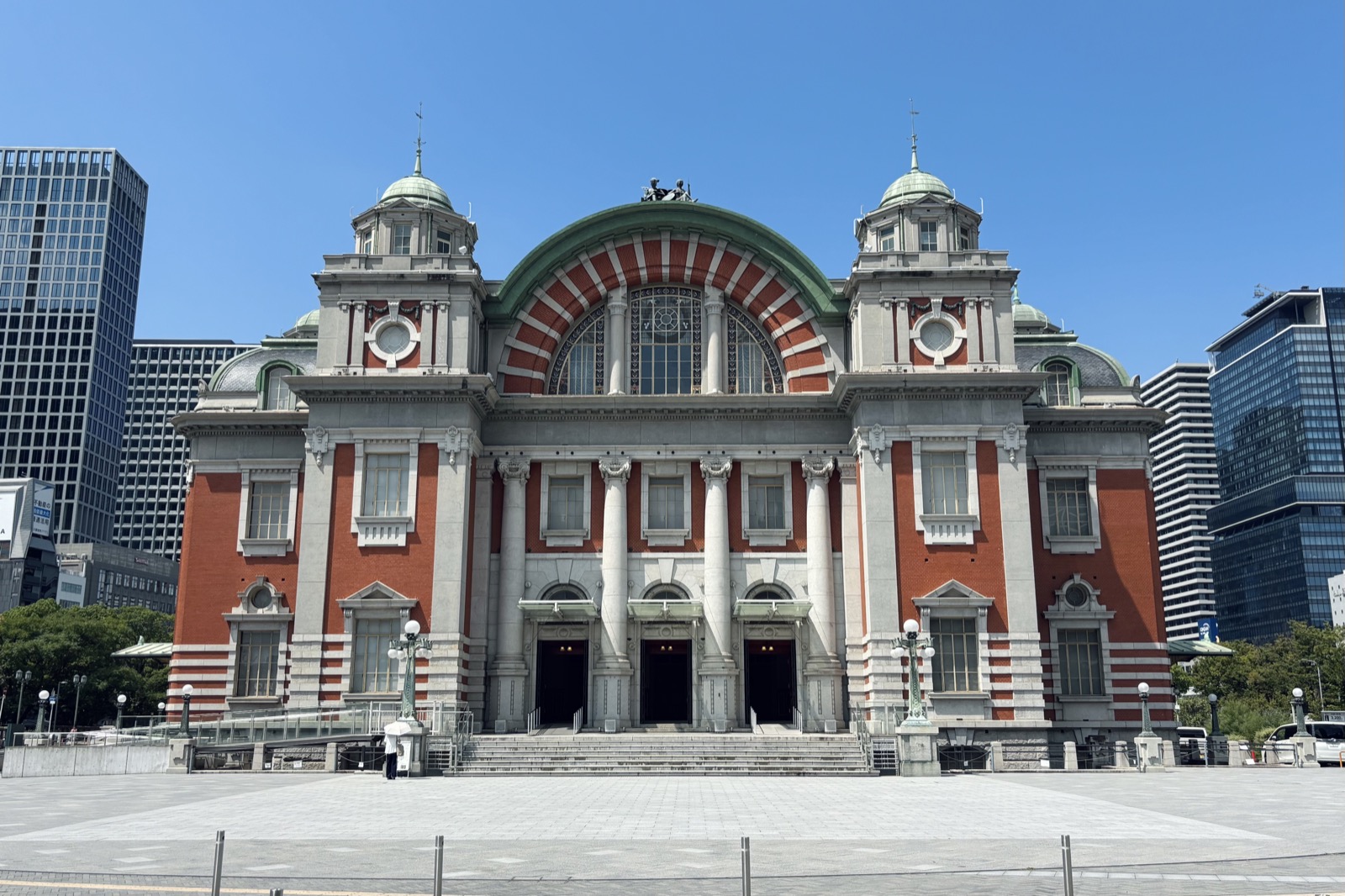
For an evening reservation, start at Hachikenyahama on the south side of Tenmabashi—a waterfront promenade looking toward the tip of Nakanoshima with sightseeing boat piers nearby, ideal for filling a short pre-entry window. If you plan to visit Osaka City Central Public Hall or follow our Nakanoshima museums and public hall guide, factor in gallery hours and last admission before heading east to Tenmabashi. Afterward, exit the North Gate for dinner and your train back, giving yourself seated breaks during both day and night.
Day-trippers coming from other cities are most likely to trip up on return trains. Coming from Kyoto, treat Keihan Tenmabashi Station as your inbound hub and decide after exiting the North Gate whether to walk back there. If you have a Shinkansen or airport train that evening and your Mint window runs close to departure, skip extra add-ons and choose an exit route that connects straight to your luggage locker. Especially with kids or older relatives, one timed attraction is plenty for a half-day—the entrance and exit are half a kilometer apart, and you do not want every variable crammed into the final hour.
No Reservation? Walk the Outside Bank or Pick an Indoor Museum
Kema Sakuranomiya Park is open around the clock. Starting from Tenmabashi, you can walk north along the riverbank following the best blooms and decide which bank to explore as you near Sakuranomiya Bridge. Visitors arriving at Osakajokitazume Station can drop straight down to the water near the bridge. The park and the Mint passage sit on opposite sides of the compound boundary with separate cherry trees: head to open lawns in the park for sweeping water-and-canopy views, while keeping an eye on Mint reservation availability if rare cultivars like Gyoiko are what you really want.
If your trip comes before the Mint opens, the Somei-Yoshino trees and moat views inside Osaka Castle's Nishinomaru Garden make a complete cherry-blossom outing on their own. Arriving after Somei-Yoshino has peaked? Pivot by cultivar or neighborhood instead—some late-blooming spots have fewer trees, yet open access from morning to night makes them far easier to fit into a short Osaka stay. Browse our Osaka cherry blossom spots and routes guide for broader bloom timing and keep one or two nearby backups pinned for the riverbank.
When rain cuts outdoor plans short, keep the nearby Fujita Museum in your back pocket. Located right next to Exit 3 of JR Osakajokitazume Station, it is currently listed as open 10:00 AM–6:00 PM with no reservation required for individual visitors; admission is ¥1,000, and free for visitors aged 19 and under with ID showing age. If you are bringing teens or kids, pack their ID beforehand for smooth entry. Travelers wanting historic architecture without a Mint pass can also stroll the riverbank facing the Mint walls before continuing west toward Osaka City Central Public Hall in Nakanoshima—pick based on your station, since the east bank puts you closer to the Fujita Museum while Tenmabashi and Kitahama lead straight toward Hachikenyahama and Nakanoshima.
The Mint Museum and Factory Tour Are a Separate Visit
During the 2026 public passage from April 9 to 15, the Mint Museum closed temporarily starting April 8 and stayed shut through April 15; its regular calendar explicitly lists the Cherry Blossom Passage period among scheduled closures. To combine coin history with cherry blossoms on the same trip, schedule the museum on an open day before or after the passage window. If you only have one night in Osaka and your sole free window falls during the passage, walk the blossoms first and choose another open museum nearby.
On regular days, you enter the Mint Museum through the Main Gate on the north side along National Route 1. Convenient stations are Minami-morimachi on the subway and JR Osaka-temmangu, each roughly a 15-minute walk according to the Mint. Admission is currently free, open 9:00 AM–4:45 PM with last entry at 4:00 PM. It typically closes on Wednesdays (opening on national holiday Wednesdays and closing the following Thursday instead). Groups of nine or fewer need no reservation, while parties of 10 or more must arrange entry in advance. Because the museum and passage share the same street address, double-check that you are approaching from National Route 1 on regular days rather than looping around to Tenmabashi.
Housed in a former thermal power plant built in 1911 and converted into a museum in 1969, the galleries display roughly 4,000 items—including historic Japanese oban and koban gold coins, Meiji-era and modern currency, commemorative medals, and foreign coinage. Multilingual audio guides (including Chinese) are available to borrow inside; using the floor map to focus on either currency history or minting technology helps pace your visit. Since July 2026, the Mint has also offered a browser-based VR tour with English and Chinese interfaces—handy if you want a look inside while the building is shut during blossom week.
Factory tours require a separate free reservation and normally run Mondays, Tuesdays, Thursdays, and Fridays, excluding national holidays, Year-End/New Year breaks, the day before the Cherry Blossom Passage begins, and the passage week itself. Expect about 60 minutes for the guided tour, or roughly 90 minutes including self-guided museum browsing. Introductory videos are available in Chinese and other languages, while the tour guide explains production in Japanese as you view the floor from behind glass windows. Bring your confirmation and a valid photo ID for the lead registrant, and check in 10 minutes before your slot as required. If you only want the museum exhibits, skip the factory schedule—independent museum entry fits much more easily around other Osaka plans.
A few useful answers
Have the 2027 Osaka Mint Bureau Cherry Blossom Passage dates been announced?
As of November 22, 2026, the Osaka Mint Bureau event portal still links to the 2026 wrap-up record; the 2027 dates and reservation launch time have not been announced.
Do you need to buy tickets for the Osaka Mint Bureau cherry blossoms?
Admission in 2026 was free, using first-come, first-served timed reservations made in advance. Show the QR code in your confirmation email at check-in, and have everyone on the same booking enter together.
Which Osaka Metro station and exit should I use?
Take the Tanimachi Line to Tenmabashi Station, go through the North Ticket Gate to Exit 2, and walk about 15 minutes to the South Gate entrance. The Keihan Line also serves Tenmabashi Station—use the East Ticket Gate and Exit 14.
Can you visit the Osaka Mint Bureau Cherry Blossom Passage both day and night?
In 2026, entry ran from 10:00 AM on weekdays and 9:00 AM on weekends, with last entry at 7:15 PM and grounds clearing at 7:45 PM. Choose a daytime slot if seeing true blossom colors and reading cultivar plaques matters most.
Where can I see cherry blossoms in Osaka if I arrive in late March?
Check Nishinomaru Garden at Osaka Castle Park or Kema Sakuranomiya Park first. The Mint Bureau focuses on late-blooming cultivars and has historically held its opening in April.
Official information and references
Sources used in this guide.
- Japan Mint Osaka Cherry Blossom Passage Event Portal
- Japan Mint 2026 Event Record (Dates, Bloom Status, Access, and Entry Rules)
- Japan Mint 2026 English Event Announcement (Free Admission, Time Slots, and Gates)
- Japan Mint 2026 Application Guidelines (PDF)
- Japan Mint Passage History, Past Dates, and Viewing Records
- Japan Mint Osaka Cherry Blossom Cultivar Directory
- Osaka Regional Meteorological Observatory 2026 Somei-Yoshino Full-Bloom Report (PDF)
- Osaka City 2026 Event Notice (Applications and Special Viewing Session)
- Osaka City Call Center FAQ: Access and Entrances for the Mint Cherry Blossom Passage
- Japan Mint 2026 Surrounding Traffic Restriction Map (PDF)
- Osaka City Heritage Guide: Mint Old Main Gate, Foundry Entrance, and Senpukan
- Osaka City Important Cultural Property Senpukan Exterior Viewing Info
- Osaka Metro Tenmabashi Station Map and Accessible Routes
- Keihan Tenmabashi Station Layout Map (PDF)
- Osaka City Kema Sakuranomiya Park Information
- Osaka Tenmangu Shrine Access Information
- Osaka Castle Park Nishinomaru Garden
- Osaka Prefecture Hachikenyahama Waterfront Information
- Fujita Museum Access and Opening Hours
- Mint Museum Osaka Opening Hours and Group Admission Information
- Mint Museum Osaka Building and Exhibition Overview
- Mint Museum Osaka VR Tour
- Japan Mint Osaka Factory Tour and Reservation Guide