Reach Sumiyoshi Taisha from Namba on the Nankai Main Line Local or from Tennoji on the Hankai Tramway. Covers gate hours, the Sorihashi bridge and four National Treasure main halls, Godairiki stones, the four Hattatsu shrines, and the Sumiyoshi Festival.
- Region & Focus
- Osaka
- Reading Scope
- 21 min read · 9 chapters · 6 Q&As
- Official Verification
- 35 official sources checkedUpdated November 22, 2026
Chapter Route Map (tap any stop)
- Getting to Sumiyoshi Taisha from Namba and Tennoji
- Different Hours for Gates, Amulet Counters, and Prayers
- Crossing the Sorihashi Bridge to the Four Main Halls
- Spotting Sumiyoshi-zukuri Roofs and Maritime History
- Godairiki Stones, Amulet Pouches, and Otoshi-sha's Weighing Stone
- Tanjo-ishi for Safe Childbirth and Omoto-sha for Relationships
- Walking the Hattatsu Circuit from Tanekashi-sha to Otoshi-sha
- Timing Your Trip for Otaue, Sumiyoshi Matsuri, and Hatsumode
- 30-Minute, Half-Day, and Sakai Connection Itineraries
- Quick Q&A
Admission to Sumiyoshi Taisha in Osaka is free. From Nankai Namba Station, take a Nankai Main Line Local train to Sumiyoshitaisha Station (NK08), then walk east for about 3 minutes. From Tennoji, ride the Hankai Tramway. On a first weekday visit, allow 60 to 90 minutes to cross the Sorihashi bridge, see the four National Treasure main halls, and look for Godairiki stones at Goshogozen. There is no fixed worship order for the four main halls, while the monthly Hattatsu circuit visits Tanekashi-sha, Nankun-sha, Asazawa-sha, and Otoshi-sha in sequence. If you want amulets or formal prayers, arrive after 9:00 AM.
Getting to Sumiyoshi Taisha from Namba and Tennoji
Sumiyoshi Taisha is located at 2-9-89 Sumiyoshi, Sumiyoshi-ku, Osaka. If you are staying near Namba, depart from Nankai Namba Station on a Nankai Main Line Local train to Sumiyoshitaisha Station (NK08). Local trains run directly there with several stops along the way. Faster Nankai services such as the Airport Express and Limited Express Rapi:t pass through this station under standard timetables. Once inside the station, check the train type before boarding a southbound Local, and watch the onboard station display. Exit the station and walk east across the Hankai Tramway tracks to reach the Nishi-Otorii (West Great Torii).
From the Tennoji or Abeno area, board a Hankai Tramway car at Tennoji-ekimae bound for Abikomichi or Hamadera-ekimae that stops at Sumiyoshitoriimae (HN12). Sumiyoshitoriimae sits directly in front of the shrine, with the West Great Torii visible right across the street. There is also a Sumiyoshi stop (HN10) on the route map within walking distance of the shrine. Enter Sumiyoshitoriimae when checking your outbound route, and look for cars signed for Tennoji-ekimae on the return trip to Tennoji. Northbound cars also run toward Ebisucho.
On the Hankai Tramway, board through the rear door and exit at the front; a single ride costs ¥240 for adults and ¥120 for children. You can pay with Japanese yen cash or a transit IC card. Tap your IC card when boarding and again when getting off, and make sure your balance is loaded beforehand because you cannot top up onboard. If you are traveling with a stroller or wheelchair, check the Sumiyoshitoriimae timetable for designated low-floor cars. If you need step-free elevator access for the entire journey, use Sumiyoshitaisha Station on the Nankai Main Line and check the Nankai station maps for accessible routes at both ends.
If your previous stop is along the Nankai Koya Line, take a Local train to Sumiyoshihigashi Station and walk west for about 5 minutes. Sumiyoshihigashi sits on the east side of the shrine, bringing you straight toward the main halls first before you exit west through the torii toward the Hankai Tramway or Nankai Main Line. To experience the front approach in sequence - the Sorihashi bridge, the change in elevation, and then the main halls - arrive via Sumiyoshitaisha Station on the Main Line and choose your departure station based on your next stop. The two Nankai stations sit on opposite sides of the shrine, so type the full station name when searching.
Departing from Namba often brings up three different Namba stations in route searches. Nankai Namba is the starting point for Local trains to Sumiyoshitaisha, so factor in transfer walking time if you are coming from Kintetsu/Hanshin Osaka-Namba or Osaka Metro Namba. You can also transfer from the Osaka Metro Sakaisuji Line at Tengachaya to catch a Nankai Main Line Local. If you plan to ride the Hankai Tramway, verify that any transit pass you buy actually covers Hankai before purchasing; for a single ride, simply pay by cash or transit IC card.
| Starting Area | Transit Route | After Getting Off |
|---|---|---|
| Namba, Tengachaya | Nankai Main Line Local to Sumiyoshitaisha (NK08) | Walk east about 3 minutes to the front entrance |
| Tennoji, Abeno | Hankai Tramway to Sumiyoshitoriimae (HN12) | Right across from the West Great Torii area |
| Along the Nankai Koya Line | Koya Line Local to Sumiyoshihigashi | Walk west about 5 minutes to the east side of the shrine |
Reach Sumiyoshi Taisha from Namba on the Nankai Main Line Local or from Tennoji on the Hankai Tramway. Covers gate hours, the Sorihashi bridge and four National Treasure main halls, Godairiki stones, the four Hattatsu shrines, and the Sumiyoshi Festival.
Different Hours for Gates, Amulet Counters, and Prayers
General shrine entry is free, and the grounds are open year-round with no fixed closing days. The gates open at 6:00 AM from April to September and at 6:30 AM from October to March. During the winter half of the year, opening moves up to 6:00 AM on the 1st of each month and on Hattatsu days. In the afternoon, note two separate closing times: the outer perimeter gate closes at 4:00 PM, and the inner sanctuary enclosure (Mikakiuchi) closes at 5:00 PM. If you want to enter from the front, walk at an unhurried pace, and visit the auxiliary shrines, aim to arrive before 3:00 PM. If you cannot get there until close to 4:00 PM, focus on the four main halls rather than trying to squeeze in multiple amulet counters and stone collecting at the very end.
The amulet counter (Omamori Juyosho) is open from 9:00 AM to 5:00 PM, formal prayer registration runs until 3:50 PM, and Goshogozen closes at 4:00 PM. You can start searching for Godairiki stones as soon as the gates open, though the cloth pouch for holding them is not available until 9:00 AM. Early morning visitors looking only to see the bridge and main halls can finish before heading out for breakfast. If you want a stone pouch or a goshuin stamp, tour the main halls first and return to the counter at 9:00 AM, or plan a later arrival.
For formal prayers at the main shrine on regular days, apply in person at the counter marked Prayer Reception (Kito Uketsuke) between 9:00 AM and 3:50 PM; no advance appointment is needed. Decide on your prayer intention beforehand, have your name and address ready, and let anyone waiting with you know where to meet. Starting April 1, 2026, general individual prayers cost ¥10,000 per intention, with a ¥5,000 proxy prayer option where priests perform the rite that day and you pick up the ofuda talisman or amulet at the counter. Family rites such as Hatsumiya (first shrine visit for newborns) and Shichi-Go-San have separate categories and fees, while safe-childbirth prayers are ¥10,000.
Ask at the main shrine reception counter for goshuin shrine stamps. If you want goshuin from Nankun-sha or the other Hattatsu shrines, check whether the stamp you are after is a regular daily issue, a Hattatsu-day special, or a New Year edition, as pickup locations and designs change by event. If your priority is buying amulets, check the Japanese names on the shrine's amulet page ahead of time. Regular amulets, ema wooden plaques for writing wishes to hang on-site, goshuin stamps, and the Godairiki stones you pick yourself at Goshogozen are all obtained differently. Bring Japanese yen cash for the amulet counter and Nankun-sha.
New Year Hatsumode and the Sumiyoshi Festival run on special schedules. Shrine notices list separate hours for gate opening, amulet counters, formal prayers, and festival events, and some services close early even while the grounds remain open. Pick your visit date around what you actually want to do - such as catching a mikoshi procession route, visiting a specific goshuin window, or bringing family outside peak crowds. Relying on the standard weekday schedule makes it easy to confuse entry hours, queue cutoffs, and event start times.
| Facility or Service | Hours | Planning Notes |
|---|---|---|
| Gate Opening | 6:00 AM (Apr-Sep), 6:30 AM (Oct-Mar) | Opens at 6:00 AM on the 1st of each month and on Hattatsu days |
| Outer Gate / Inner Enclosure | Closes at 4:00 PM / 5:00 PM | Arrive early if touring the entire grounds |
| Goshogozen | Gate opening - 4:00 PM | Godairiki stone pouches are handed out from 9:00 AM |
| Amulet Counter | 9:00 AM - 5:00 PM | Amulets, ema plaques, and Godairiki stone pouches |
| Main Shrine Prayers | Reception 9:00 AM - 3:50 PM | Walk-in applications accepted on regular days |
Crossing the Sorihashi Bridge to the Four Main Halls
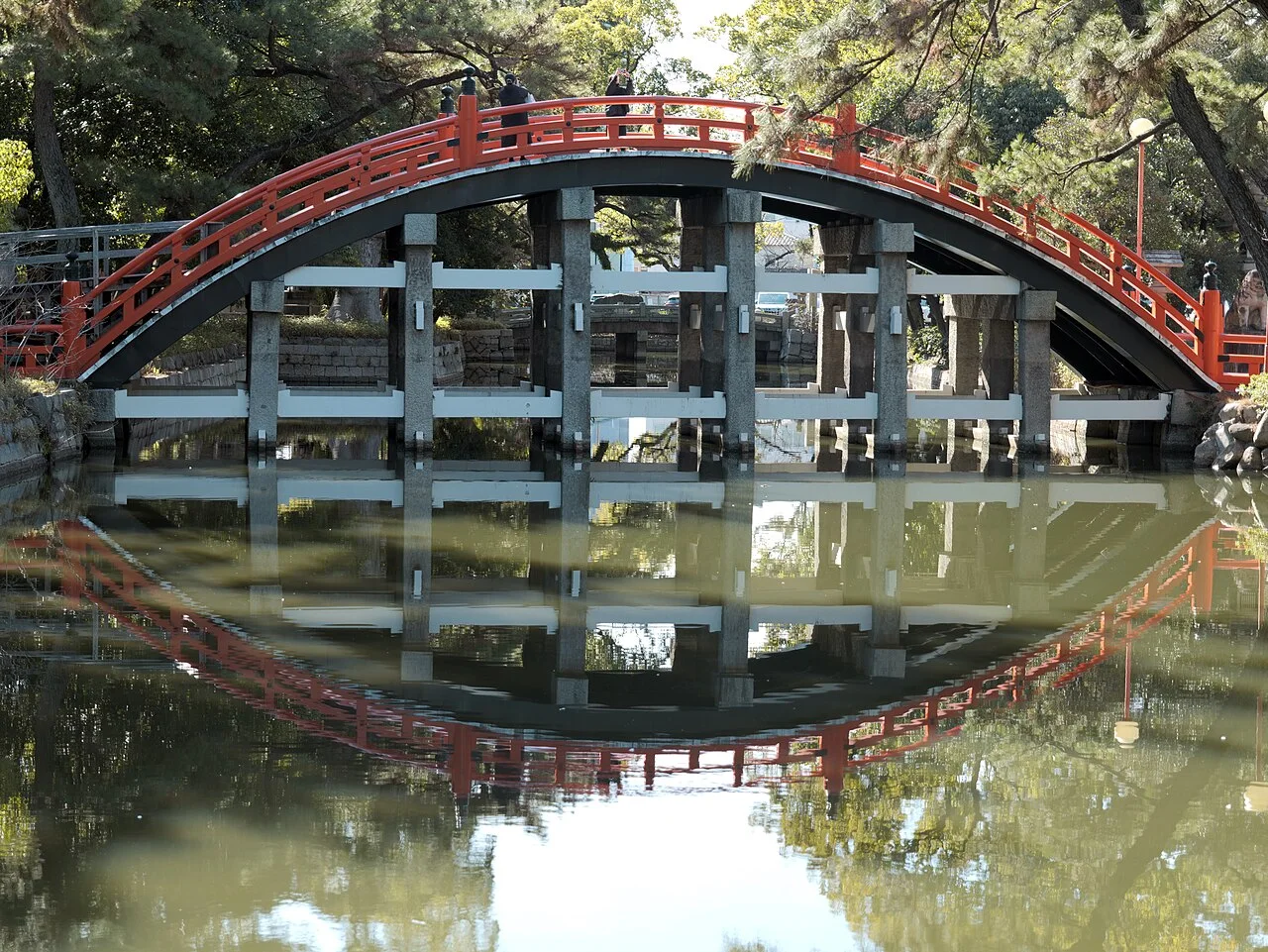
Entering through the West Great Torii brings you straight to the sacred pond. The Sorihashi bridge measures about 20 meters long and 3.6 meters high, reaching an incline of roughly 48 degrees at its steepest point, with steps built into the deck. Shrine tradition treats crossing the bridge as a purification before worship, and the current stone piers are said to have been donated by Yodo-dono to pray for Toyotomi Hideyori's healthy growth. From the edge of the pond, you can clearly make out the vermilion railings, dark timber span, and stone piers. When the water is calm, step to the side of the pond to fit both the bridge and its reflection into one shot.
Put your phone away before crossing, watch the steps as you go, and take your time coming down the far side. Save photos of the full span for the pondside on your way in or out, rather than stopping at either landing. If you have a stroller, use a wheelchair, dislike steep slopes, or visit in the rain, take the level path around the pond instead. Osaka Tourism's accessibility guide notes a ramp on the north side next to the prayer hall that is about one wheelchair wide. Decide on your flat, bridge-free route before deciding whether to add the longer walk to Nankun-sha or Otoshi-sha.
After crossing the bridge, wash up at the temizuya purification basin. Using the ladle, rinse your left hand first, switch hands to rinse your right, pour water into your left palm to rinse your mouth, and finally tilt the ladle upright so the remaining water washes down the handle. At the worship hall, toss an offering coin and follow Sumiyoshi Taisha's etiquette: bow twice, clap twice, say your prayer, and bow once more. If someone in your group wants to linger in prayer, others can step aside along the approach to admire the architecture and keep the front of the hall clear.
The First, Second, and Third Main Halls are arranged in a single east-west line, with the Third Main Hall closest to the front western approach and the Fourth Main Hall standing right beside it. The Second Main Hall sits behind the Third, and the First Main Hall is farthest back. The shrine's official 20-minute standard worship route lists all four halls and explicitly notes there is no required order. Arriving from the Sorihashi bridge, it is natural to visit the Third and Fourth halls first and then work inward to the Second and First. Coming from Sumiyoshihigashi Station, you can start from the innermost hall instead. Once you reach the First Main Hall, Goshogozen lies right next to its south side if you want to search for Godairiki stones.
The First Main Hall enshrines Sokotsutsunoo-no-Mikoto, the Second enshrines Nakatsutsunoo-no-Mikoto, and the Third enshrines Uwatsutsunoo-no-Mikoto - together known as the Three Sumiyoshi Deities (Sumiyoshi Sanjin). The Fourth Main Hall enshrines Empress Jingu under the divine name Okinagatarashihime-no-Mikoto. If you are with older relatives or young children and only want to see one or two halls, stop at the side-by-side Third and Fourth Main Halls. From the public approach, you can compare both west-facing sanctuaries directly. Check the name plaques on-site and match them against the four-hall layout, counting First through Fourth on the map rather than guessing by building size.
Along the approach, you will share space with families attending formal prayers, wedding processions, and travelers pausing for photos. Pick a clear landmark as a meeting spot - such as outside the temizuya or beside the West Great Torii - rather than the middle of the bridge or the entrance to a worship hall. The shrine prohibits stepping off designated paths, flying drones, and unauthorized commercial photography on the grounds, and asks visitors to put cameras away during formal prayers. Stick to personal photos of the bridge, pondside, and main hall exteriors from public walkways.
Both the north and south parking lots connect to the grounds via ramps, with a wider path from the south lot. There is also a steeper ramp at the prayer entrance, so plan ahead if someone in your group needs help pushing a wheelchair. Once you arrive, staff can help direct you. Ask at the information desk for the locations of accessible restrooms and baby-changing tables. Build those stops into your main-hall loop first, and save the auxiliary shrines for later if you still have energy.
Spotting Sumiyoshi-zukuri Roofs and Maritime History
Shrine tradition dates Empress Jingu's founding of Sumiyoshi worship here to AD 211. The four National Treasure main halls standing in the courtyard today all date to 1810. Historically ranked Ichinomiya (the foremost shrine) of Settsu Province, Sumiyoshi Taisha is also the head shrine of Sumiyoshi shrines nationwide. Keeping the legendary founding separate from the physical construction dates helps make sense of the mix of stone lanterns, bridges, and halls from different eras along the path.
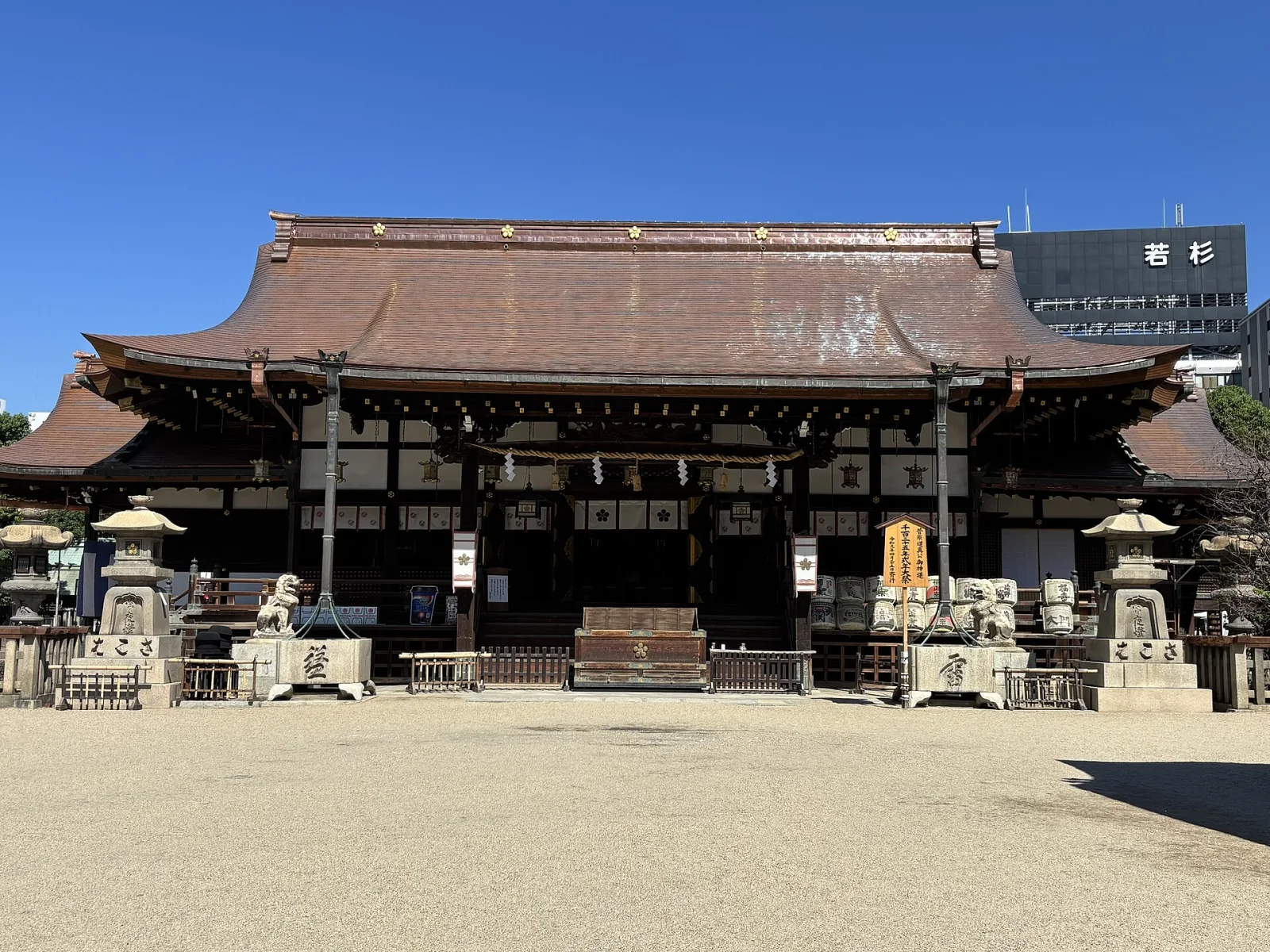
To recognize a National Treasure main hall, look up at the triangle of its front gable. The Sumiyoshi-zukuri architectural style uses a straight-pitched gable roof (kirizuma) clad in cypress bark, with the entrance placed under the gable end (a layout known as tsumairi). From the front, two long roof slopes sweep downward from the ridge toward each side, paired with vermilion pillars, whitewashed board walls, and dark roofing. Step slightly to the side to tell the outer worship hall (haiden) apart from the inner sanctuary (honden) behind it. All four main halls face west toward Osaka Bay, and seeing the Fourth Main Hall alongside the three in a row reveals the distinctive layout of the complex.
The Three Sumiyoshi Deities were long revered by seafarers, and the shrine ties its history to the ancient port of Sumiyoshi-tsu as well as the diplomatic voyages of the Kentoshi and Kenzuishi envoys to China. During the Edo period, thriving coastal shipping led maritime merchants and sailors to carve their prayers for safe voyages onto stone lanterns. The shrine counts around 600 stone lanterns on the grounds, many donated by shipping guilds. Check the inscriptions on the lantern bases near the Sorihashi bridge, then walk north of the main halls to Daikai-jinja, which enshrines the sea-palace deities Toyotamahiko and Toyotamahime.
Daikai-jinja's main hall is also built in the Sumiyoshi-zukuri style, and its surviving buildings date to 1708 - more than a century older than the four main halls. Its main hall, offering hall, connecting corridor, and west gate are all designated Important Cultural Properties. To compare the two complexes, note the gable profile at the main shrine first, then walk north to see how Daikai-jinja links its main hall to the offering hall in front. Right outside stands the Tama-no-i well, where legend says Yamasachihiko submerged the Shio-mitsu-tama (tide-raising jewel) given to him by the sea god. Taking this northern loop combines sea-deity architecture with one of the site's oldest maritime legends.
If maritime history interests you, look for Funatama-jinja as well. The shrine notes that boatmen and shipping workers have venerated it since antiquity, and its doors feature reliefs of higaki-kaisen cargo ships, sailing vessels, and even an airplane. If time is tight, pick either Daikai-jinja or Funatama-jinja. Both sit near the other auxiliary shrines on the main precinct map, and following the Japanese names on the signposts is faster than hunting for English translations on a map.
Head toward the south gate to find the Stone Stage (Ishibutai) and the East and West Music Pavilions (Gakusho). Sumiyoshi Taisha links the Stone Stage's dedication to Toyotomi Hideyori's reconstruction project, and both the stage and its adjoining structures are Important Cultural Properties. From there, follow signs for the sacred rice paddy (Omita), where the Otaue Shinji rice-planting ritual takes place. Even on a regular weekday, walking past the paddy helps you orient yourself along the south approach if you plan to return for the planting ceremonies and bugaku dances.
Sumiyoshi also appears frequently in classical waka poetry, with the shrine noting verses set here in both the Man'yoshu and the Kokin Wakashu. To connect those poetic coastal landscapes to modern Osaka, exit through the West Great Torii and cross past Nankai Sumiyoshitaisha Station into Sumiyoshi Park. The park preserves the Shiokake-michi historic approach and a reconstructed Takadoro tall lighthouse, tracing the old seaward axis into the shrine. Save snacks, running around for kids, and rest breaks for the park or station area afterward - eating, drinking, feeding animals, and ball games are prohibited inside the shrine grounds.
Godairiki Stones, Amulet Pouches, and Otoshi-sha's Weighing Stone
Goshogozen sits just south of the First Main Hall. Tradition holds that Sumiyoshi's deities were first enshrined on this spot, and today visitors search inside the fenced pebble bed for stones painted with the characters for go (five), dai (great), and riki (power) - taking one of each. In the Godairiki tradition, the five powers stand for physical strength, intellect, wealth, good fortune, and longevity. Together the three stones form one complete set. Once you find a set of three, step back to let the next person look, stick strictly to the marked search area, and leave the stone fence and surrounding loose pebbles untouched.
After collecting your stones, head to the amulet counter to pick up a Godairiki pouch (Godairiki Mamori-bukuro). The shrine's standard worship guide lists the offering at ¥500, available starting at 9:00 AM. You place the three stones inside to create your amulet, and in January 2026 the shrine expanded the pouch lineup to 10 colors at the same counter. When your wish is fulfilled and you return to give thanks, custom is to bring your original three stones back to Goshogozen along with a second set of three 'gratitude pebbles' (Kansha no Koishi) provided by the amulet counter - six stones in total. Follow the posted instructions to keep the cycle of collecting, bagging, and returning straight.
You can visit Goshogozen on its own or continue southeast out of the main precinct to Otoshi-sha for the Omokaru-ishi weighing stone. The shrine's wish-fulfillment route pairs both stops with the amulet counter in a roughly 40-minute walk. At the small shrine behind Otoshi-sha, bow twice, clap twice, and bow once, then lift the round stone once to gauge its weight. Place your hands on it, make a silent wish, and lift it a second time. By tradition, if it feels lighter the second time, your wish is likely to come true. Set the stone gently back down for the next visitor.
The shrine notes that queues often form at the weighing stone on weekends and Hattatsu days. If lines build up at both Goshogozen and Omokaru-ishi, pick one and use the extra time for the main halls or Sumiyoshi Park. Walking to Otoshi-sha takes you outside the core precinct, so agree on a meeting point like the Otoshi-sha entrance or the amulet counter rather than leaving part of your group waiting back at Goshogozen. If you still need to pick up a stone pouch afterward, make the main-precinct amulet counter your landmark on the way back.
If kids want an interactive stop without tackling the steep bridge, use the level path around the pond and look for the Sumiyoshi Rabbit statue in front of the Fourth Main Hall, then continue to Tanekashi-sha to see Issun-boshi's soup bowl. Shrine lore connects rabbits as divine messengers to the shrine's founding in the Year, Month, and Day of the Rabbit, and visitors pat the statue for good health. In the folk tale of Issun-boshi, a couple prays to Sumiyoshi's deities for a child, and the tiny hero later paddles off from Sumiyoshi's shore toward Kyoto in a bowl. Tanekashi-sha displays a giant bowl you can step inside for photos - a much easier stop with young children than waiting in line for the weighing stone.
Tanjo-ishi for Safe Childbirth and Omoto-sha for Relationships
If you are visiting for a safe-childbirth (anzan) prayer, register at the Prayer Reception counter first, attend the rite, visit the main halls - especially the Fourth Main Hall dedicated to Empress Jingu - and then stop by the Tanjo-ishi (birth stone). Japanese custom traditionally marks the fifth month of pregnancy on the Day of the Dog (Inu no Hi) with a maternity sash, though Sumiyoshi Taisha accepts safe-childbirth prayers on regular days regardless of the calendar day. Companions can pin Tanjo-ishi's location beforehand so anyone needing rest can take the shorter exit route and save the four Hattatsu shrines or Sumiyoshi Park for another trip.
Tanjo-ishi also has a stone-collecting tradition. According to the shrine's childbirth guidance, take one small pebble from the designated area, wrap it in the paper printed with the Tanjo-ishi illustration, and slip it into the triangular paper packet marked Anzan-mamori. Later, when you bring the baby back for Hatsumiya or to give thanks, you return that stone to Tanjo-ishi. If someone else in your group is doing the Godairiki route, they will still need to find three separate character-marked stones at Goshogozen for the pouch from the amulet counter.
For matchmaking and relationship blessings, follow the precinct map from the four main halls to Omoto-sha. Pronounced Omoto-sha, this shrine honors Sumiyoshi Taisha's first chief priest, Tamomi-no-Sukune, and his wife. On the shrine's matchmaking route, you pick up an Omoto Ningyo figurine at the amulet counter before praying at Omoto-sha, or choose a pair of Hadakabina dolls when praying for marital harmony. The shrine estimates about 20 minutes for this loop. If two companions are praying for different things, meet back at the amulet counter afterward and walk out the main gate toward the station together.
Walking the Hattatsu Circuit from Tanekashi-sha to Otoshi-sha
Hattatsu originally refers to the first Day of the Dragon (Tatsu no Hi) in each month, so the exact date shifts with the traditional calendar. The shrine publishes an annual Hattatsu schedule and occasionally designates a different Dragon Day - for example, January 2026 used the second Dragon Day on January 18. The final Hattatsu day of 2026 falls on Tuesday, December 8. Check the current year's list on the official Hattatsu page before going, and check the Hatsumode page for gate and counter hours around New Year.
Hattatsu visits focus on business success and household safety. The four-shrine route begins at Tanekashi-sha, moves to Nankun-sha, and then steps outside the core precinct to Asazawa-sha and Otoshi-sha. People liken the four stops to carrying a wish from planting seed to harvest, which is why shopkeepers and business owners return every month. If you want formal prayers at all four shrines on a Hattatsu day, Tanekashi-sha accepts applications from 6:00 AM to 3:30 PM, Nankun-sha until 3:45 PM, and Asazawa-sha and Otoshi-sha until 4:00 PM. Note that on Hattatsu days, prayers for Asazawa-sha are handled at the Otoshi-sha counter. Starting from the first stop in the morning gives you the most breathing room.
Tanekashi-sha is stop one, where visitors pray for startup capital, children, and wisdom. To receive symbolic seed money (Otanegane) to add to your working funds, apply for a Tanekashi-sha prayer - listed at ¥1,500 on Hattatsu days. On ordinary weekdays, those applications are handled at Nankun-sha. Inside Tanekashi-sha, look for the small dolls donated in thanks for answered prayers for children, then follow the precinct map back to Nankun-sha, where the lucky beckoning cats await at stop two.
Nankun-sha is affectionately nicknamed Hattatsu-san, a pun echoing the Japanese word for growth and prosperity (hattatsu). Its beckoning cats (maneki-neko) raise different paws by month: in odd-numbered months they raise their left paw to invite good relationships and family harmony, and in even-numbered months they raise their right paw for wealth and thriving business. Tradition says collecting one small cat each month for four years - 48 in total - lets you trade them in for a medium-sized cat, playing on 'forty-eight dragons' sounding like 'prospering from start to finish.' First-time visitors who happen upon a Hattatsu day can simply walk the four-stop loop once. Nankun-sha is open for visits on ordinary days too; check the shrine's catalog if you want regular amulets.
Stop three, Asazawa-sha, is Sumiyoshi's Benten shrine, visited for artistic skill and as a guardian shrine for women. Follow the road along the southeast side to reach stop four, Otoshi-sha, which governs harvests and collecting receivables; prayer participants here receive an Otoshi-mamori marked with the character for 'great.' Once you finish the four-shrine circuit, decide whether you want to join the line for the weighing stone behind the shrine. May's Hattatsu Grand Festival is Nankun-sha's major annual celebration - look for Hattatsu Taisai on the official calendar if you want to catch it.
When your trip does not fall on a Hattatsu day, the same path makes a quiet weekday walk through the auxiliary shrines. If you only want to see the beckoning cats and the giant camphor tree, stopping at Nankun-sha is enough; for the full route, leave Asazawa-sha and Otoshi-sha for the end before heading out. The shrine estimates about 40 minutes for its business-and-family model course across the four shrines. On actual Hattatsu days, add extra buffer for queues and amulet counters, especially if you plan to continue to Sakai or return to Namba before lunch.
| Stop | Shrine | Prayers and Amulets |
|---|---|---|
| Stop 1 | Tanekashi-sha | Startup capital, children; Otanegane seed money after prayer |
| Stop 2 | Nankun-sha | Business growth, family safety; beckoning cats |
| Stop 3 | Asazawa-sha | Artistic mastery, women's guardian shrine |
| Stop 4 | Otoshi-sha | Harvest, debt collection; Otoshi-mamori and weighing stone |
Timing Your Trip for Otaue, Sumiyoshi Matsuri, and Hatsumode
To witness the annual rice-planting ceremony, the shrine's regular calendar schedules Otaue Shinji for June 14 at 1:00 PM, beginning at the First Main Hall before moving to the Omita paddy. Designated an Important Intangible Folk Cultural Property, the rite features rice planting in the paddy alongside miko shrine-maiden dances, armored warrior processions, local children's planting dances, and the closing Sumiyoshi Odori dance. Head straight to the paddy edge if you want to see the planting and dances, or arrive early for the start if you want to watch the procession leave the main hall. The annual calendar also lists the Minazuki Oharai purification on June 30, and Shiwasu Oharai followed by the Joyasai New Year's Eve rite on December 31. If you plan a year-end visit, look up Shiwasu Oharai separately from post-midnight Hatsumode.
The Sumiyoshi Festival (Sumiyoshi Matsuri) is Osaka's classic summer festival. For the street procession, look for Mikoshi Togyo, when the portable shrine is carried from Sumiyoshi Taisha across the Yamato River along the Kishu Kaido road to Shukuin Tongu in Sakai. To watch rituals inside the main grounds, check the dates for Yoimiya-sai or the Nagoshi-no-Harae and Reitaisai grand festival. In 2026, the official schedule set Mikoshi Togyo for July 26, Nagoshi-no-Harae and Reitaisai for July 31, and the Tongu-sai ceremony at Shukuin Tongu for August 1. Booking flights or hotels solely around 'late July to early August' makes it easy to miss the procession day.
In 2026, traffic restrictions for the Mikoshi Togyo procession stretched from Sumiyoshi Taisha down to Shukuin in Sakai, so taking the train and picking a waiting spot along the route is the easiest way to watch. If you want to combine worship with buying amulets on the same festival day, double-check closing and reception cutoffs first. On July 31, 2026, for instance, the shrine grounds and amulet counter stayed open until 7:00 PM, while formal prayer reception closed at 6:00 PM. Whatever year you visit, check that year's Sumiyoshi Matsuri announcement to match your stations and return times to the ceremony schedule and traffic closures.
Poetry lovers can target the Mid-Autumn Moon Viewing Festival (Kangetsu-sai), where priests chant selected tanka poems in traditional style atop the Sorihashi bridge, followed by Sumiyoshi Odori and bugaku dances. If you want a crisp daytime shot of the bridge reflected in the pond, come back on a separate weekday and save festival night for watching the performances on the span. On ordinary days the bridge is an approach; during Kangetsu-sai it becomes a stage, rewarding a second visit from a different vantage point.
Hatsumode brings massive New Year crowds from January 1 through the first days of the year. Check the shrine's Hatsumode guidance page for entry windows, counter setups, and exit routing. For the 2026 New Year season, the shrine suspended Godairiki stone picking and pouch distribution from December 31, 2025 through January 4, 2026, and issued designated New Year goshuin stamps with specific pickup rules. If your family is likely to get separated in heavy crowds, a regular weekday morning is far better for seeing the bridge, main halls, and amulet counter together. If you do go for Hatsumode, pick a wide meeting spot outside the station before crossing the street to the torii.
30-Minute, Half-Day, and Sakai Connection Itineraries
With only 30 minutes, enter from the front via the Nankai or Hankai station, admire the Sorihashi bridge from the pondside, stop at the temizuya, walk through the four main halls, and head back out. That 30-minute window counts time inside the grounds only, excluding station walks and train waits. Look at the side-by-side Third and Fourth Main Halls if you want to focus on architecture, or continue deeper along the axis to the First Main Hall. If collecting a goshuin stamp or Godairiki stones is a priority, adjust that 30-minute estimate for counter queues, especially around New Year or festivals.
With 60 to 90 minutes, finish the main halls first and then add either Goshogozen or the four-shrine Hattatsu circuit. If the paths are wet or anyone in your group needs to take it easy, stick to the pondside, four main halls, and amulet counter, then cross past the station to rest in Sumiyoshi Park. If your companions are interested in rice cultivation or historic structures, make the Omita paddy and Stone Stage your second half before exiting through the West Great Torii. Save a precinct map beforehand so you can follow signs for the Stone Stage (Ishibutai) and Omita along the way.
Pairing Sumiyoshi Taisha with Tennoji splits neatly into two walking blocks on the same day. Visit Sumiyoshi in the morning, ride the Hankai Tramway back from Sumiyoshitoriimae to Tennoji-ekimae, and have lunch around Tennoji or Abeno. If Shitenno-ji Temple is already on your list, visit the temple first and walk back to Tennoji-ekimae to catch the tram south. Put Sumiyoshi first in the morning if you want formal prayers or a Godairiki pouch. With extra time left, you can also stroll through Tennoji Park. Both religious complexes have expansive grounds, so slower walkers may prefer focusing on just one per day.
To continue south along the same corridor, take the Hankai Tramway from Sumiyoshitoriimae toward Hamadera-ekimae and get off at Shukuin, a 1-minute walk from Sakai Plaza of Rikyu and Akiko (Sakai Risho no Mori), dedicated to tea master Sen no Rikyu and poet Yosano Akiko. If the first tram terminates at Abikomichi, follow Hankai's designated station transfer procedure to catch the next car south. You can also take the Nankai Main Line Local from Sumiyoshitaisha via Suminoe and Shichido to Sakai Station and walk about 10 minutes. For the Mozu Tombs (Mozu Kofungun), ride the Nankai Koya Line to Mikunigaoka, transfer to the JR Hanwa Line to Mozu Station, and walk to Daisen Park or the Emperor Nintoku Tomb viewing area as a separate excursion - see the Sakai Mozu Kofun cluster guide.
Only tack Sumiyoshi Taisha onto a Kansai Airport arrival or departure if you have comfortable spare time. Sumiyoshitaisha Station sits on the Nankai Main Line, but only Local trains stop there regularly. Heading to the airport, take a Local to Sakai Station - where Airport Express trains also stop - and transfer to a Kansai Airport train; coming from the airport, switch at Sakai to a northbound Local. If you have large luggage and are staying in Osaka overnight, drop your bags at your hotel first for a much easier visit. On departure day, factor baggage pickup, transfers, and airport check-in cutoffs into your schedule before deciding whether to tour only the main halls or linger at the auxiliary shrines. Compare airport rail options and tickets in the Kansai Airport to Osaka transit guide.
A few useful answers
Do you need to buy a ticket to enter Sumiyoshi Taisha?
General shrine admission is free. Formal prayers, amulets, goshuin stamps, and other conferred items carry separate fees.
Do you have to worship at Sumiyoshi Taisha's four main halls in numerical order?
No. Sumiyoshi Taisha's official worship guide states there is no fixed order for the four main halls. Entering from the West Great Torii brings you first to the side-by-side Third and Fourth Main Halls, then inward to the Second and First.
Can I take the Nankai Airport Express from Nankai Namba to Sumiyoshi Taisha?
Under regular timetables, take a Nankai Main Line Local train; only Local trains stop at Sumiyoshitaisha Station. From the exit, walk east about 3 minutes to the front entrance.
How do you get Godairiki stones, and when can you pick up the pouch?
Go to Goshogozen on the south side of the First Main Hall and find one stone each marked go, dai, and riki in the designated area. Goshogozen is open until 4:00 PM, and pouches are available at the amulet counter starting at 9:00 AM.
Which day is Hattatsu-mairi?
It is usually the first Day of the Dragon each month, though the shrine occasionally adjusts the date, so check the official schedule for your travel year. In December 2026, it falls on Tuesday, December 8.
Can wheelchairs or strollers cross the Sorihashi bridge?
The Sorihashi bridge has steep stairs, so wheelchairs and strollers should take the level path around the pond. There is a ramp at the prayer entrance, and the ramp on the north side next to the prayer hall fits roughly one wheelchair in width.
Official information and references
Sources used in this guide.
- Sumiyoshi Taisha Access and Gate Hours
- Sumiyoshi Taisha Precinct Map
- Sumiyoshi Taisha Worship Route and Godairiki Stone Pouch
- Sumiyoshi Taisha Worship Etiquette
- Sumiyoshi Taisha National Treasure Main Halls and Sumiyoshi-zukuri Architecture
- Sumiyoshi Taisha History and Origins
- Sumiyoshi Taisha Enshrined Deities and Maritime Dedications
- Sumiyoshi Taisha Sessha Auxiliary Shrines
- Sumiyoshi Taisha Massha Subordinate Shrines (Omoto-sha and Hattatsu Shrines)
- Sumiyoshi Taisha Sorihashi Bridge, Goshogozen, and Omokaru-ishi
- Sumiyoshi Taisha Nankun-sha (Camphor Tree and Beckoning Cats)
- Sumiyoshi Taisha 2026 Godairiki Stone Amulet Announcement
- Sumiyoshi Taisha Precinct Visitor Rules
- Sumiyoshi Taisha Visitor FAQ (Admission and Payment)
- Sumiyoshi Taisha Prayer Categories and Fees
- Sumiyoshi Taisha April 2026 Prayer Fee Revision
- Sumiyoshi Taisha Safe Childbirth Prayers and Tanjo-ishi
- Sumiyoshi Taisha Amulets, Goshuin, and Conferred Items
- Sumiyoshi Taisha Hattatsu Circuit and 2026 Dates
- Sumiyoshi Taisha Special Festivals (Otaue Shinji, Sumiyoshi Matsuri, and Kangetsu-sai)
- Sumiyoshi Taisha June Events (Otaue Shinji and Minazuki Oharai)
- Sumiyoshi Taisha December Events (Shiwasu Oharai and Joyasai)
- Sumiyoshi Taisha 2026 Sumiyoshi Matsuri Announcement
- Sumiyoshi Taisha 2026 Hatsumode New Year Announcement
- Sumiyoshi Taisha Stone Stage and the Toyotomi Clan
- Osaka Info Sumiyoshi Taisha Accessible Travel Guide
- Osaka Prefecture Sumiyoshi Park Overview (Shiokake-michi and Takadoro)
- Nankai Electric Railway Sumiyoshitaisha Station
- Nankai Electric Railway Sumiyoshihigashi Station
- Nankai Electric Railway Main Line Route and Stops
- Hankai Tramway Sumiyoshitoriimae Stop and Timetable
- Hankai Tramway How to Ride and Fares
- Hankai Tramway Transfer Guide
- Sakai Plaza of Rikyu and Akiko Access Guide
- Sakai City Emperor Nintoku Tomb Access Guide