The 2027 Hirosaki Cherry Blossom Festival runs from April 16 to May 5. Use zone-by-zone bloom reports to time the outer moat petal mats, West Moat cherry tunnel, and Hirosaki Castle, with Honmaru tickets, night boat rides, and transit from Hirosaki Station.
- Region & Focus
- Hirosaki
- Reading Scope
- 24 min read · 11 chapters · 6 Q&As
- Official Verification
- 23 official sources checkedUpdated November 22, 2026
- Key Topics
- SeasonsItinerariesRail travel
Chapter Route Map (tap any stop)
- 2027 Hirosaki Cherry Blossom Festival Dates & Bloom Timing
- Where to Spot Outer Moat Petal Mats First
- Walking From Otemon Gate to the Honmaru & Castle Keep
- Honmaru & Kita-no-Kuruwa Tickets: Do You Need One for the Water?
- How to Walk the West Moat Cherry Tunnel & Shunyo-bashi Bridge
- West Moat Rowboats vs. Middle Moat Sightseeing Boats
- Night Illuminations: How Long to Stay & Where to Exit
- Getting There: Hirosaki Station Central Exit Buses & Aomori/Shin-Aomori Connections
- Planning a Half-Day, Full-Day, or Overnight Stay
- Driving to Hirosaki: Where to Park Near the Gates
- Rainy Days & Late Arrivals: Indoor Stops & Late-Blooming Sakura
- Quick Q&A
On your first cherry blossom trip to Hirosaki, set aside a full day for Hirosaki Park. The outer moat only forms its signature petal mats (hana-ikada) after the blossoms begin to fall, whereas the West Moat cherry tunnel is best walked while the branches are packed with blooms. The 2027 Hirosaki Cherry Blossom Festival is scheduled for April 16 through May 5. Because Hirosaki City plans to move the castle keep back to its original foundation in March of that year, spring visitors can view the castle's exterior while the interior remains closed. If you plan to stay past dusk for photos of the lit water, sort out your return transit to Hirosaki Station, Aomori, or Shin-Aomori before heading out.
2027 Hirosaki Cherry Blossom Festival Dates & Bloom Timing
The 2027 festival dates published by the Hirosaki Convention and Visitors Bureau run from Friday, April 16 to Wednesday, May 5, though organizers adjust the schedule if blooms arrive early or late. While the annual notice at the top of the event page lists the upcoming season's dates, the detailed listings farther down still reflect 2026 programming. Double-check the year labeled on each section before relying on times for night illuminations, food stalls, or temporary shuttle buses. If your visit overlaps Japan's Golden Week holidays starting April 29 and running into early May, check hotel availability for the nights before and after to decide which day works best for Hirosaki.
Bloom stages can differ by a full day from one moat to the next. The Hirosaki Park bloom status page compiles city updates into separate rows for the park grounds, outer moat, West Moat's west bank, and the cherry blossom tunnel, plus dedicated entries for petal flurries and floating petal mats. Scroll to the Somei-Yoshino section and check the date for the exact zone you want to see. Looking up a generic "full bloom" forecast for Aomori Prefecture or Hirosaki City makes it easy to mistake the outer moat's peak for the tunnel's peak. The park holds roughly 2,600 cherry trees across 52 varieties, including about 1,700 Somei-Yoshino. The Yaebenishidare weeping cherries in the Honmaru have their own line on the chart—track that row if you want blossoms framing the castle keep.
The 2026 season illustrates how these dates stagger. In the city's April 16 report, the outer moat and West Moat's west bank were already at full bloom while the tunnel sat at around 50 percent. Park-wide Somei-Yoshino peaked from April 17 to 20, and the outer moat's petal mats lasted from April 20 to 23. Meanwhile, the Honmaru's Yaebenishidare trees hit full bloom starting April 21. Use that sequence to read the timing order, then plug in the live 2027 zone dates as the season unfolds.
If you need to book long-distance trains early in spring, anchor your schedule around the scene you want most. For dense overhead canopies shading the footpaths, target Hirosaki during Somei-Yoshino full bloom. For a solid pink carpet across the water, aim for just after peak bloom—ideally keeping your Hirosaki and Aomori City days swappable. If your trip lands in early May, check the planting map and bloom chart for late-blooming double-petaled varieties (yaezakura) and spend your afternoon in the Honmaru, Ni-no-Maru, or the Botanical Garden. That way, even if friends were posting photos from the West Moat a week earlier, you will know straight where the fresh blossoms still are.
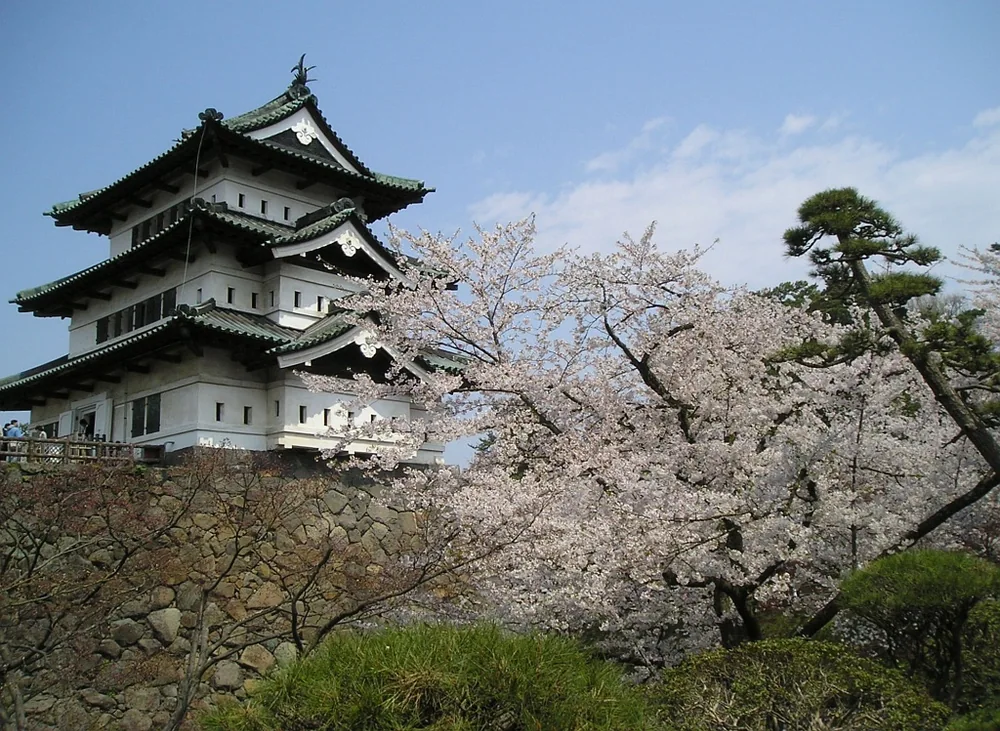
The 2027 Hirosaki Cherry Blossom Festival runs from April 16 to May 5. Use zone-by-zone bloom reports to time the outer moat petal mats, West Moat cherry tunnel, and Hirosaki Castle, with Honmaru tickets, night boat rides, and transit from Hirosaki Station.
Where to Spot Outer Moat Petal Mats First
Step off the bus at Shiyakusho-mae (City Hall) and stay outside Otemon Gate at first. Walk east along the outer moat toward Higashimon Gate, checking the water from the bridges before choosing which gate to enter. Heading inward toward the keep, you will cross the middle and inner moats, but for outer moat petal mats, the outermost public sidewalk along the park perimeter gives the clearest angle. Otemon and Higashimon make easy landmarks bookending this stretch, so you can walk a short section and step straight through a gate into the park.
Petals drift down onto the water and are pushed toward one bank by the breeze. Once you spot long pink ribbons forming on the surface, follow the sidewalk and check both sides of each bridge. Sometimes the bridge deck shows the full sweep of the moat, while stepping down close to the bank reveals how densely the petals are packed. The Hirosaki tourism association counts the outer moat among its "Seven Views of Hirosaki Sakura," with petal mats typically peaking around three days after full bloom. Even the earliest scattered petals are worth pausing for, when a single frame still catches both blooming branches on shore and pink streaks on the water.
Arrive during early full bloom and you will find cherry boughs leaning out over the outer moat, letting you gauge from the bridges how closely the trees frame both banks. Once the petal-mat window passes, both the water and branches shift to green, so redirect your walk toward later-blooming varieties elsewhere in the park. During the 2026 festival, organizers opened three grassy outer-moat embankments between Higashimon Gate and the courthouse so visitors could get closer to the water for photos. Normally, the perimeter sidewalk and bridges give plenty of vantage points from above; if you want lower bank access, look for current-season signage marking official "Hana-ikada" photo spots and open entry points, and stay behind any ropes or barriers.
If you are short on time before catching a train, walking the outer moat to Higashimon Gate and cutting back via Dotemachi is far simpler than hurrying back from the far side of the West Moat. If you also plan to ride a Middle Moat sightseeing boat, enter through Higashimon Gate and look for the next gate inward, marked Higashi-Uchimon Gate. Their names differ by just one word, with a stretch of park path between them, so send the exact gate name to anyone meeting you inside.
Walking From Otemon Gate to the Honmaru & Castle Keep
Otemon Gate sits directly across from Hirosaki City Hall and the Hirosaki City Tourist Information Center. Walking inward takes you past the Hirosaki Castle Botanical Garden area, the Tatsumi-yagura turret beside the middle moat, and across the bright red Sugi-no-Ohashi Bridge into Ni-no-Maru via Minami-Uchimon Gate. To reach the castle keep viewpoint, follow signs for Gejo-bashi Bridge—the stretch of Ni-no-Maru right before the bridge also offers good places to linger. Because two red bridges span two different moats inside the park, read the bridge name on the signpost before texting friends where to meet.
The walk between Minami-Uchimon Gate and Gejo-bashi Bridge is one of the few stretches in the park where the castle's layered defenses are easy to read. Sugi-no-Ohashi spans the middle moat, guarded by the Tatsumi-yagura corner turret, while Gejo-bashi crosses the inner moat right beside the Honmaru and the keep's original southeast corner site. If you take a Middle Moat boat ride mid-walk, disembarking at Higashi-Uchimon Gate lets you cut straight across Ni-no-Maru to Gejo-bashi without backtracking to Otemon Gate.
Updated in October 2026, Hirosaki City's castle keep relocation schedule splits the work into two phases. The city plans to slide the keep back onto its original stone foundation in March 2027, followed by under-structure inspections and anchoring through autumn. When visiting for cherry blossoms, follow the updated park detours to reach the keep. According to city engineering notes, work platforms will cover parts of the first floor during fiscal 2027, leaving the second and third stories visible from the outside. If you run into fencing or scaffolding near Gejo-bashi, frame the full stone wall and upper eaves first, then walk into the Honmaru for cleaner angles.
The keep interior remains closed during preservation and seismic retrofitting. For castle history and exhibits, step into the Hirosaki Castle Information Center across from Gejo-bashi Bridge, typically open from 9:00 to 17:00. With a Honmaru ticket, spend your time on the panoramic terrace atop the stone walls and among the Honmaru's weeping cherry trees. Look toward Mount Iwaki from the open edge—on clear days, its ridge rises cleanly behind the grounds. When clouds hide the peak, stroll past the relocated keep site and continue north into Kita-no-Kuruwa.
A 2026 construction notice currently lists parts of the Honmaru's south side as closed roughly through March 31, 2027, with temporary detour routes that include stairs. If you are pushing a stroller, using a cane, or walking with relatives who move slowly, check the posted signs at the bridge before deciding whether to use the south approach, walk around to the Kita-no-Kuruwa ticket gate, or skip the Honmaru in favor of Ni-no-Maru and the outer moat. If kids are getting tired, exiting near Higashimon Gate toward town is an easy wrap-up, leaving the west side for another visit.
Honmaru & Kita-no-Kuruwa Tickets: Do You Need One for the Water?
You do not need a ticket to walk the outer moat sidewalks, the Otemon Gate area, the West Moat cherry blossom tunnel, or Shunyo-bashi Bridge. Admission applies only to the Honmaru and Kita-no-Kuruwa paid zone, the separately ticketed Hirosaki Castle Botanical Garden, and Fujita Memorial Garden just outside the park. Visitors who want waterfront blossoms, historic castle gates, and red-bridge views can keep their budget for a boat ride or dinner. If you want to stand atop the stone ramparts and see the Honmaru's weeping cherries up close, simply buy a single-zone ticket at the Honmaru gate. Boat rides are paid separately.
Hirosaki City sets single-day admission for the Honmaru and Kita-no-Kuruwa at ¥320 for high school students and adults, and ¥100 for elementary and junior high students. Standard paid hours run from April 1 to November 23, 9:00 to 17:00, though festival dates bring extended schedules listed separately each year for paid entry and evening light-off times. If you want to enter the Honmaru near dusk, check the festival notice for official paid hours (yuryo jikan) and work dinner around the cutoff. If you only plan to see the illuminated outer and West moats after dark, tour the Honmaru in daylight instead.
A three-site combination pass covers the Honmaru and Kita-no-Kuruwa, the Hirosaki Castle Botanical Garden, and Fujita Memorial Garden for ¥520 for high school students and adults, or ¥160 for elementary and junior high students. Visiting just two of those sites saves ¥120 for adults (¥40 for students) over buying separate tickets, though fitting in all three works best if you start in the morning. Fujita Memorial Garden sits just south of the park in Kamishirogane-cho, while the Botanical Garden lies inside the San-no-Maru grounds. If you plan only to rest at Fujita's free-entry Western-style villa and visit the Honmaru, stick to the single-zone ticket.
If part of your group just wants an easy stroll, split up near the Hirosaki Castle Information Center: one group can enter the Honmaru for weeping cherries while the others explore Ni-no-Maru's old Somei-Yoshino trees or walk down to Sugi-no-Ohashi Bridge over the middle moat. Pick a meeting spot outside the ticketed perimeter so everyone can reach it freely. If you buy the combination pass, visit the Botanical Garden or Fujita Memorial Garden earlier in the day before their ticket windows close—the Botanical Garden typically stops selling tickets at 16:30—and save the open-access moats for later.
| Option | High School & Adults | Elementary & Junior High | Areas Covered |
|---|---|---|---|
| Free walking route | Free | Free | Outer moat, Otemon Gate area, West Moat tunnel, Shunyo-bashi Bridge |
| Hirosaki Castle single-zone ticket | ¥320 | ¥100 | Honmaru and Kita-no-Kuruwa |
| Three-site combination pass | ¥520 | ¥160 | Honmaru & Kita-no-Kuruwa, Hirosaki Castle Botanical Garden, Fujita Memorial Garden |
How to Walk the West Moat Cherry Tunnel & Shunyo-bashi Bridge
The West Moat's Sakura no Tunnel runs along the park-side bank, where trees on both edges of the footpath arch overhead into a canopy. Coming from the Honmaru or Kita-no-Kuruwa, head toward the West Gate and Nishi-no-Kuruwa, then follow the water south to Shunyo-bashi Bridge and look for the blossom-lined shoreline leading into the tunnel. If you started at Otemon Gate in the morning, saving the west side for afternoon keeps the loop flowing cleanly. Once you finish taking photos, you can exit near Shunyo-bashi or keep walking past the tunnel toward the Municipal Gymnasium and Technical High School exits to find dinner on the south side of town.
From Shunyo-bashi Bridge, the cherry trees lining both banks appear mirrored in the moat below. For a sweeping shot down the length of the canal, find an angle along the bridge span and step back to the bridgehead once you have your frame so crowds can keep moving. To capture blossoms close to eye level, return to the tunnel path and angle upward toward the canopy on either side. Because the city tracks the West Moat's west bank and the tunnel separately, if the bloom report says the west bank is peaking while the tunnel is still opening, walk across Shunyo-bashi to view the fuller side or frame it from the bridge.
Once rowboats hit the West Moat in steady numbers, oars break up the reflections on the water. For crisp mirror shots, time Shunyo-bashi Bridge before rental hours begin or after they wind down, or wait near the bank for a calm lull between boats. Overcast skies soften the pale pink Somei-Yoshino under the tunnel canopy, while bright sun gives you long views combining the bridge, water, and treetops. Keep the narrow center of the tunnel clear for foot traffic, and step aside to a wider spot before lining up group photos.
Those overhead arches come down to pruning as much as tree genetics. Hirosaki City adapts local apple-orchard cultivation techniques to its cherry trees—pruning away dead wood, opening the canopy to air and sunlight, and fertilizing according to each tree's vigor. Look closely at the older trees near Higashi-Uchimon Gate from the branch tips back toward the trunk: thick trunks split cleanly into low, spreading lateral limbs. Once you spot that structure on one tree, you will notice it all down the row—and across the outer moat, where branches reach out so low they nearly meet their reflections on the water.
If you arrive late in the season and still want a tunnel-like cherry walk, pivot to Shi-no-Maru or the Picnic Square for double-petaled yaezakura. The city's bloom chart lists Ni-no-Maru, Shi-no-Maru, Picnic Square, and the Botanical Garden as main planting areas for deep-pink, thick-petaled Kanzan cherries. Also look out in Ni-no-Maru for a surviving Somei-Yoshino planted back in 1882. Even after its petals drop, the gnarled trunk and sweeping limbs are worth seeing before you follow the day's bloom report to nearby trees still in flower.
West Moat Rowboats vs. Middle Moat Sightseeing Boats
On the West Moat, you rent a rowboat from the dock near Nishi-no-Kuruwa and row yourself between blossom-draped banks. In 2026, each boat held up to three passengers, including children. Check the "Nishi-bori Boat" section on the Hirosaki Convention and Visitors Bureau festival page for 2027 operating hours and rates. Groups of four who want to stay in one boat should opt for the piloted sightseeing boats on the Middle Moat instead. Life jackets are mandatory for West Moat rowboats, and rentals close during strong winds or bad weather.
For 2027, the daytime Middle Moat sightseeing boat begins running in mid-April from 9:00 to 17:00, with ticket sales ending at 16:30. Each piloted ride lasts about 20 minutes, with tickets sold on-site at ¥1,500 for adults, ¥1,000 for junior and senior high school students, and ¥500 for elementary school students (one preschool child rides free per adult). Boats depart from the dock beside the stone bridge in front of Higashi-Uchimon Gate, glide past the Tatsumi-yagura turret toward Sugi-no-Ohashi Bridge, and return to the same pier. If you are crossing the park from east to west, factor in your walk time after disembarking.
Reservations for the 2027 Middle Moat night sakura boat are scheduled to open in early March, with limited seasonal sailings starting mid-April. Fares are ¥2,000 per person (with one preschooler free per adult) for a roughly 25-minute cruise. Listed departures run from 18:15 to 19:30, with the 18:15 sailing billed as a twilight cruise—book that earliest slot if you want residual daylight on the stone walls and blossoms, or pick a later departure for full reflection lighting, keeping your return train schedule in mind.
If you are traveling with young children, wait until you reach Higashi-Uchimon Gate around late morning to check current boarding conditions before deciding between the boat and the Honmaru. Both daytime boat operations adjust for wind, so keep a walking backup in mind. If boats are suspended, you can still view Higashi-Uchimon Gate and Tatsumi-yagura from the stone bridge and walk along Ni-no-Maru to Sugi-no-Ohashi Bridge for the exact same stretch of the Middle Moat. If you hope to try again when the weather clears, finish your east-side stops first so you are not trekking back and forth between the Honmaru and West Moat.
| Boat Type | How to Ride | Rates & Schedule |
|---|---|---|
| West Moat Rowboat | Rent and row yourself at the West Moat pier | 2026 standard rate ¥1,500 per boat / 60 min; check 2027 festival notice |
| Middle Moat Daytime Boat | Same-day ticket at Higashi-Uchimon Gate (~20 min) | 2027 adult fare ¥1,500; last ticket sale 16:30 |
| Middle Moat Night Sakura Boat | Advance reservation required (~25 min) | 2027 fare ¥2,000 per person; sales slated for early March |
Night Illuminations: How Long to Stay & Where to Exit
To catch both daytime scenery and evening lights without burning out, finish the Honmaru by late afternoon, step outside Otemon Gate or walk to Dotemachi for an early meal, then return to one side of the park. If you are staying in downtown Hirosaki, head back to Shunyo-bashi Bridge at dusk to watch the lights come up on the West Moat. If you are commuting back to Aomori City, cover the Honmaru and West Moat during the day and stick to the outer moat between Otemon and Higashimon gates after dark, keeping your walk back toward the station straightforward. Crossing back and forth between east and west at night quickly eats into photo time and train margins.
In 2026, special festival illuminations ran from sunset until 22:00; check the 2027 "Tokubetsu Light-up" listing for exact zones and turn-off times. Pick one bridge or shoreline stretch first and decide after the lights turn on whether to linger longer. Outside Otemon Gate, you get the gatehouse, outer moat, and direct street access toward town, while Shunyo-bashi Bridge frames both the West Moat water and the tunnel canopy—making it the best single west-side stop after dark. Whenever your group splits up, pick a named gate, bridge, or museum as your meetup point; exiting from Shi-no-Maru in the dark makes it especially easy to wind up at different gates.
If you book the night sakura boat, plan dinner and meetups near Higashi-Uchimon Gate. Visitors entering from Higashimon Gate need to walk inward to the Higashi-Uchimon pier. If you are already on the west side late in the afternoon as your boarding time nears, head directly across Ni-no-Maru to Higashi-Uchimon Gate, then view the eastern outer moat after disembarking. Because the boat returns to the same dock, add the walk between the pier and park exit when setting meetup times at the gate. If you only have one night and need a train back to Aomori, confirm your return timetable covers both the cruise and the walk back before booking.
Pack a windproof jacket for night viewing—one walk along the exposed West Moat bank makes the drop in temperature obvious. If an evening shower passes through, stone steps and wooden bridges stay slick, so build extra walking buffer into your return. Groups who prefer not to stand by the cold water all night can eat at an indoor restaurant first or wrap up near their hotel. If children or older travelers want to head back early, meet at Otemon Plaza so they can return to town while the rest of the group stays out.
Regular Dotemachi Loop Bus service wraps up before the late night-viewing crowds leave. Check the 2027 festival transit section for dates and stops of any temporary evening extensions; otherwise, plan to walk back to the station or take a taxi. Travelers returning to Aomori or catching a Shinkansen transfer should work backward from the final train that makes their connection, factoring in extra minutes at Hirosaki Station if you need to pick up luggage from lockers or grab food.
Getting There: Hirosaki Station Central Exit Buses & Aomori/Shin-Aomori Connections
Leave JR Hirosaki Station via the Central Exit. The walk from the station plaza to Otemon Gate is roughly 2 kilometers, or about 30 minutes on foot. To take the bus, find the dedicated Dotemachi Loop Bus stop in the plaza outside the Central Exit and ride to Shiyakusho-mae (City Hall). Some regular city bus lines stop at Shiyakusho-mae Koen Iriguchi (City Hall Park Entrance)—both drops sit right by the park's south entrance. If you are carrying luggage or pushing a stroller, verify the stop sign and route destination before boarding, and anyone exiting on the Joto side should walk back through the station concourse to the Central Exit.
Starting October 2026, the Dotemachi Loop Bus fare is ¥200 in cash or ¥180 with a transit IC card for adults, and ¥100 cash or ¥90 by IC card for children. From April to November, regular buses depart roughly every 10 minutes from 10:00 to 17:00 and every 20 minutes from 17:00 to 18:00. If you want early-morning low-angle light, walk from the station or check earlier regular bus routes. Confirm standard fares and schedules on the Hirosaki Convention and Visitors Bureau's loop bus page, and check festival announcements separately for seasonal extra service.
For a simple round trip to the park, paying single fares adds up to ¥360 by IC card or ¥400 in cash for adults, so pay per ride. The loop bus one-day pass costs ¥600 for adults and ¥300 for children, works only on MegoICa, Suica, or PASMO, and must be purchased from the driver before tapping off. With IC-card pricing, you only save money once you take four or more rides in a day—if you are staying near the station and spending the whole day in Hirosaki Park, skip the day pass.
Arriving via the Tohoku Shinkansen from Tokyo or Morioka, transfer at Shin-Aomori Station onto the JR Ou Main Line bound for Hirosaki. If you are staying in Aomori City, board the Hirosaki-bound train directly at Aomori Station. On your way back, check the Ou Main Line platform for Aomori-bound trains and confirm your train stops at your hotel's station—Aomori Station serves downtown, while Shin-Aomori is the Shinkansen hub. When staying two nights in Aomori with one evening reserved for Hirosaki's illuminated blossoms, pick your target return train on the JR East timetable ahead of time so you can easily shift your daytime arrival earlier if the blooms peak fast. If you still need to catch a southbound Shinkansen toward Morioka, pad your transfer window at Shin-Aomori beyond the walk to Hirosaki Station.
Flying into Aomori Airport, catch the Konan Bus bound for Hirosaki from Bus Stop 1; the ride to Hirosaki Bus Terminal takes about 55 minutes, with published airport fares at ¥1,600 for adults and ¥800 for elementary school students. If you plan to transfer locally to the park, check whether your itinerary says Hirosaki Bus Terminal or Hirosaki-ekimae (in front of Hirosaki Station). The two hubs sit a short walk apart in central Hirosaki—if your hotel is by the station, drop your bags there first and take the loop bus into the park. Fitting in one last walk on departure day is easiest if you stick near Otemon or Higashimon gates before heading back to the terminal for your airport bus.
Planning a Half-Day, Full-Day, or Overnight Stay
With only half a day, let the bloom conditions outside Otemon Gate set your route. If the outer moat is covered in petal mats, walk along the east bank, enter via Higashimon Gate, continue into Ni-no-Maru for Gejo-bashi Bridge and views of the keep, and exit on the same side toward town. If the branches are in full bloom and the outer moat is only starting to shed petals, start along the West Moat instead: walk the tunnel, cross Shunyo-bashi Bridge and Nishi-no-Kuruwa toward the Honmaru, and exit on the south side. Both options pair one water stretch with one castle view—put your top photo stop first and add extra gates only if time allows.
For a full day in Hirosaki, start along the outer moat in the morning and enter the park from the south or east. Take the daytime Middle Moat boat before noon if you want a cruise, then continue past Gejo-bashi Bridge into the Honmaru. Step outside Otemon Gate for lunch so everyone gets a real break, then cross to the park's west side in the afternoon for Shunyo-bashi Bridge and the cherry tunnel. During late-blooming varieties, visit the Botanical Garden before lunch and finish the afternoon wherever blooms look best between Shi-no-Maru and the Honmaru. If you stay for night illuminations, agree on your evening meetup point before dinner so no one has to backtrack to the morning entrance.
Spending one night in Hirosaki unlocks two distinct moods at the park. Drop your bags on arrival in the afternoon and head back out for twilight and illuminated views along the outer moat or Shunyo-bashi Bridge. The next morning, enter through a different gate to see the castle walls in crisp daylight and catch unrippled reflections before the rowboats launch, then head to the station. If rain hits one half of your stay, save the Honmaru and boat rides for the drier window and switch to indoor stops during the downpour. Staying near Hirosaki Station's Central Exit makes early trains effortless, while lodging near Dotemachi or south of the park trims both your morning and evening walks.
Basing yourself in Aomori City also works cleanly as a day trip, especially if you plan to browse the local markets around Aomori Station or catch trains elsewhere the next morning. Heading back to Aomori for dinner after walking the West Moat keeps the day relaxed, whereas staying overnight in Hirosaki gives you dedicated time for both night lighting and calm dawn reflections. If Hirosaki is one stop on a broader Tohoku cherry blossom rail itinerary, clustering your travel days back-to-back leaves room to swap cities if bloom peaks diverge across the region.
Driving to Hirosaki: Where to Park Near the Gates
Match your parking lot to the side of the park you want to see first. For the Honmaru or outer moat, check the underground garage at the Hirosaki City Tourist Information Center and lots around City Hall; if you are starting near Higashimon Gate, look at the Hirosaki Cultural Center lot. Festival traffic maps assign dedicated entrances and exits to these public lots, often requiring left-turn-only entry and exit—and on weekdays, City Hall parking prioritizes visitors with municipal business. If a queue is already forming at your first choice, move straight to your backup lot and walk a few extra minutes. If you also plan to drive toward Mount Iwaki later in the day, leave the park well before your final sightseeing window closes.
During past festivals, temporary free riverside parking has opened along the Iwaki River near Fujimi-bashi and Iwaki-bashi bridges. In 2026, both lots were a 15-to-20-minute walk from the park, closed at 18:00, and remained subject to closure if river levels rose. Before relying on riverside parking, check the current festival traffic page to see which bank is open and when vehicles must exit. Drivers staying for night illuminations should choose a lot with late-night exit hours and save the walking route back to the car on their phone. If part of your group needs to leave early, drop by the outer perimeter to meet them rather than pulling everyone out early.
Drivers arriving from Owani or southern Tsugaru who want to avoid city traffic can look into seasonal park-and-ride rail options. The Konan Railway Owani Line terminates at Chuo-Hirosaki Station, an easy walk to Dotemachi and Otemon Gate. Because Chuo-Hirosaki is separate from JR Hirosaki Station, search schedules using the exact Chuo-Hirosaki and Owani station names. Note that the Owani Line does not accept transit IC cards, so buy a paper ticket at Chuo-Hirosaki for your return. If friends are arriving by JR train from Aomori, meet directly at a park gate instead of detouring between the two stations.
Rainy Days & Late Arrivals: Indoor Stops & Late-Blooming Sakura
If rain greets you in the morning, start just outside Otemon Gate at the Old Hirosaki City Library. This twin-tower Western-style building on Otemon Plaza is typically open free of charge from 9:00 to 17:00. When the drizzle eases, cross the street into the park and walk to the Hirosaki Castle Information Center beside Gejo-bashi Bridge before deciding whether to buy Honmaru admission. On windy, wet days, knock out one indoor stop first and head out to the moats as soon as the sky clears. If someone in your group wants to check boat status, walking from the south side toward Higashi-Uchimon Gate lets you inspect the pier along the way.
When older relatives want only a short outing, the stretch from Otemon Plaza to the outer moat makes an easy route where you can turn back at any point. If everyone feels up to continuing, follow the outer sidewalk to Higashimon Gate before deciding whether to step into Ni-no-Maru or head back into town. Pick a rest stop on the park map ahead of time to note benches and restrooms. During the 2026 festival, free wheelchair rentals were offered near Otemon and Higashimon gates—look under "kurumaisu" on the 2027 festival page for current stations and hours. Visitors bringing their own wheelchairs who want to visit the Honmaru should check at the bridge whether temporary detour stairs are in place on the south approach and use the accessible path marked by park staff.
If heavy rain catches you on the park's west side, cut across the southern edge to the Western-style villa at Fujita Memorial Garden. In fair weather, the garden's upper terrace looks out toward Mount Iwaki while the lower lawn holds a pond and teahouse, though steep slopes connect the two levels. When paths are slick or older travelers want to avoid hills, stick to the flat Western-style building. Visitors staying north of the park or exiting through Kamenoko-mon Gate are close to Tsugaru-han Neputa Mura, which features full-scale Hirosaki Neputa floats and live Tsugaru shamisen performances. Surrounding streets preserve historic merchant and samurai-quarter facades for a short stroll once the rain stops.
Arriving around early May? Check the bloom report under the "Hirosaki Shichizakura" (Seven Cherries of Hirosaki) list. Look for pale greenish-yellow Ukon blossoms in the Honmaru, Picnic Square, and Botanical Garden; rich pink Kanzan blooms across Ni-no-Maru, Shi-no-Maru, and the Botanical Garden; and late-blooming Shogetsu trees around Kita-no-Kuruwa, the Botanical Garden, and Otemon Gate. In the city's final 2026 report on May 5, Ukon, Kanzan, and Fugenzo were still in full bloom. If you spot fresh green leaves along the outer moat, walk in through Otemon Gate and pick one late-blooming yaezakura cluster—from there it is easy to choose between a slow walk to Shi-no-Maru, a shorter loop to San-no-Maru near Higashimon Gate, or a combination pass linking the Honmaru and Botanical Garden.
A few useful answers
When is the 2027 Hirosaki Cherry Blossom Festival?
Organizers have scheduled the festival at Hirosaki Park for April 16 to May 5, 2027, subject to adjustment based on actual bloom conditions. You can check zone-by-zone bloom progress on the official Hirosaki Park bloom report page.
When is the best time to see the petal mats (hana-ikada) on Hirosaki's outer moat?
They typically appear a few days after the Somei-Yoshino cherry trees reach full bloom, and Hirosaki City's reports list peak petal-fall and petal-mat dates separately. Walk from outside Otemon Gate along the eastern outer moat toward Higashimon Gate, checking from the bridges where the petals are gathering along the bank.
Do you need a ticket to see the cherry blossoms at Hirosaki Park?
Walking along the outer moat, around Otemon Gate, the West Moat tunnel, and Shunyo-bashi Bridge is free. A one-day ticket for the Honmaru and Kita-no-Kuruwa zones costs ¥320 for high school students and adults, and ¥100 for elementary and junior high students. You can also choose a same-day combination pass that adds the Botanical Garden and Fujita Memorial Garden.
Can you go inside the Hirosaki Castle keep in spring 2027?
No, the interior of the keep remains closed to visitors. The city plans to slide the castle tower back onto its original stone foundation in March 2027, with stabilization work continuing into autumn. You can still view the exterior from the park or see castle exhibits at the Hirosaki Castle Information Center across Gejo-bashi Bridge.
Do you need reservations for the Hirosaki Middle Moat night sakura boat?
Yes, the night sakura boat requires advance reservations. Ticket sales are scheduled to open in early March 2027 at ¥2,000 per person, with one preschool child riding free per paying adult. Tickets for the daytime Middle Moat sightseeing boat are sold on-site at Higashi-Uchimon Gate.
Which bus goes from Hirosaki Station to Hirosaki Park?
Take the Dotemachi Loop Bus from the Central Exit of Hirosaki Station and get off at Shiyakusho-mae (City Hall). A single ride for adults costs ¥200 in cash or ¥180 with a transit IC card. Walking from the station to Otemon Gate takes about 30 minutes.
Official information and references
Sources used in this guide.
- Hirosaki Convention and Visitors Bureau | 2027 Hirosaki Cherry Blossom Festival Dates & 2026 Event Info
- Hirosaki Convention and Visitors Bureau | Hirosaki Park Bloom Status & 2026 Records
- Hirosaki City | Hirosaki Park Bloom Report & Late-Blooming Cherry Locations
- Hirosaki City Parks and Greenery Division | April 16, 2026 Hirosaki Park Bloom Report
- Hirosaki Convention and Visitors Bureau | Outer Moat Petal Mats (Hana-ikada) Locations & Peak Timing
- Hirosaki City Greenery Association | Hirosaki Park Official Map
- Hirosaki City | Updated Schedule for Moving the Castle Keep Back to Its Foundation
- Hirosaki City | Castle Keep Interior Closure & Preservation Repairs
- Hirosaki City | Exterior Views & Work Platforms During Keep Relocation
- Hirosaki City | Temporary Detour Route on the South Side of Honmaru
- Hirosaki City | Honmaru, Kita-no-Kuruwa & Combination Pass Fares
- Hirosaki Convention and Visitors Bureau | 2027 Middle Moat Sightseeing Boats & Reservations
- Hirosaki Convention and Visitors Bureau | Dotemachi Loop Bus Fares & Timetable
- Hirosaki City | 2026 Municipal Public Transit Map
- JR East | Hirosaki Station Ou Main Line Timetable
- Hirosaki City | Hirosaki Castle Information Center
- Hirosaki City | Old Hirosaki City Library
- Hirosaki City | Fujita Memorial Garden
- Hirosaki Convention and Visitors Bureau | Kamenoko-mon Gate & Tsugaru-han Neputa Mura
- Hirosaki City | Caring for Hirosaki Park Cherry Trees Using Apple-Orchard Techniques
- Aomori Airport | Hirosaki Airport Bus Stop & Fares
- Hirosaki Convention and Visitors Bureau | Festival Traffic Advisories & Parking Lots
- Konan Railway | Owani Line Chuo-Hirosaki Station