Based on annual scheduling, the 2027 Ouchi-juku Snow Festival falls on February 13–14. Compare regular vs. festival Saruyu-go buses, discount passes, and lodging.
- Region & Focus
- TohokuFestivals and fireworks
- Reading Scope
- 24 min read · 8 chapters · 6 Q&As
- Official Verification
- 31 official sources checkedUpdated November 22, 2026
- Key Topics
- WinterSeasonsRail travel
Chapter Route Map (tap any stop)
- Which Two Days to Block Off in 2027: Daytime Events vs. Evening Illumination
- Getting From Tokyo to Yunokami-Onsen Station: Via Aizuwakamatsu or Aizu-Tajima
- Separating the Regular Saruyu-go Timetable From Festival Night Shuttles
- Which Discount Ticket to Buy? Nishi-Wakamatsu Is Where the Rail Zone Starts
- Start With the Honjin Site, Then Walk to the End Before Climbing to the Overlook
- Choosing Between Village Minshuku, Yunokami-Onsen, and Aizuwakamatsu
- Driving, Walking on Snow, and Backup Plans for Bad Weather
- Put Your First and Last Legs on the Calendar Now
- Quick Q&A
For a first trip to Fukushima's Ouchi-juku Snow Festival, decide early whether you want daytime snow scenes or evening snow lanterns. A daytime visit works on regular Aizu Railway trains and daytime Saruyu-go shuttle buses, while staying after dark requires booking late transport or lodging inside the village. Shimogo Town traditionally holds the festival on the second Saturday and Sunday of February, which puts 2027 at February 13 and 14. As of November 22, 2026, organizers have not yet released the 2027 schedule or shuttle timetable. If you are coming from Tokyo and want to catch the evening events, spending a night in Ouchi-juku or Yunokami-Onsen gives you far more breathing room than rushing back to the capital.
Which Two Days to Block Off in 2027: Daytime Events vs. Evening Illumination
Pencil in Saturday, February 13, and Sunday, February 14, 2027, for now. The exact 2027 festival dates, fireworks, event order, and evening shuttles will each depend on that season's official announcements. When booking an overnight stay, compare the latest check-in cutoff, dinner seating times, and when cancellation fees kick in. If a half-board room serves dinner only during a fixed window, a slight shift in the festival schedule could clash with your meal. Travelers basing themselves in Aizuwakamatsu for a single day trip up the mountain can block off both full days first and pick which day to go once the schedule drops.
The 40th festival's official timetable gives a clear sense of the event scale. On Saturday, February 14, 2026, noon featured the Nippon-ichi no Dangosashi rice-dumpling tree ritual, followed in the afternoon by mochi catching (gushi-mochi hiroi), Okawa Keiryu Taiko drumming, a soba speed-eating contest, and traditional dance. At 17:00 came the sacred fire ceremony and procession, with fireworks at 18:00. Sunday's daytime lineup added more dance, mochi catching, soba contests, and taiko before closing at 15:00. Peak programming falls at different hours across the two days: if you want to catch kids' activities, time your arrival for that event's start; if you are after fireworks photos, plan backward from your ride out at night.
Last time, snow lanterns and Honjin illumination ran separately from February 13 to 15, from 18:00 to 20:00 each night. Closing times, lights-out hours, and shuttle departures each occupy their own column on the schedule. If your transport leaves right after the fireworks, keep your evening plan tight; if you want a slow stroll down the illuminated main street, factor in the post-fireworks bus queue or the walk back to your room. In 2026, Saturday's last festival shuttle departed at 19:00, one full hour before the lanterns went dark.
Entry to the festival along the village's main street is free. Save your budget for transport, meals, and paid admission to individual exhibition halls. Visitors who want to join the mochi catching, dango-branch decorating, or eating contests can check the on-site headquarters for that day's assembly point and sign-up rules. Parents traveling with children should pick a meetup spot outside the main event area in advance—that way, if part of the group stays by the stage for taiko while others duck inside a shop to warm up, everyone can regroup easily.
If the sacred fire ritual is your priority, check the timetable to see whether the ceremony, procession, and fireworks fall on the same evening. In 2026, they spanned dusk into early night, giving visitors time to admire the lanterns along the street while waiting for the fireworks. Spectators along the procession route need to leave space for the marchers and take photos from the cleared sides of the road. Taiko and dance also have daytime slots, so travelers who dislike the cold or need to head down the mountain early can shift their must-see performances to daylight hours, when roof snow and icy paths are easier to read.
If your main goal is photographing snow-covered thatched roofs, a weekday daytime visit is easier to plan. Shimogo Town typically sees reliable snow cover from New Year's through mid-February, and the town hall runs a live camera overlooking Ouchi-juku so you can check the main street, rooftops, and road conditions the morning you leave. Rain, melting, and snow-clearing change street surfaces and roof accumulation separately, so pick your photo dates around the look you want—and save an overnight festival booking for when lanterns and processions are the priority.
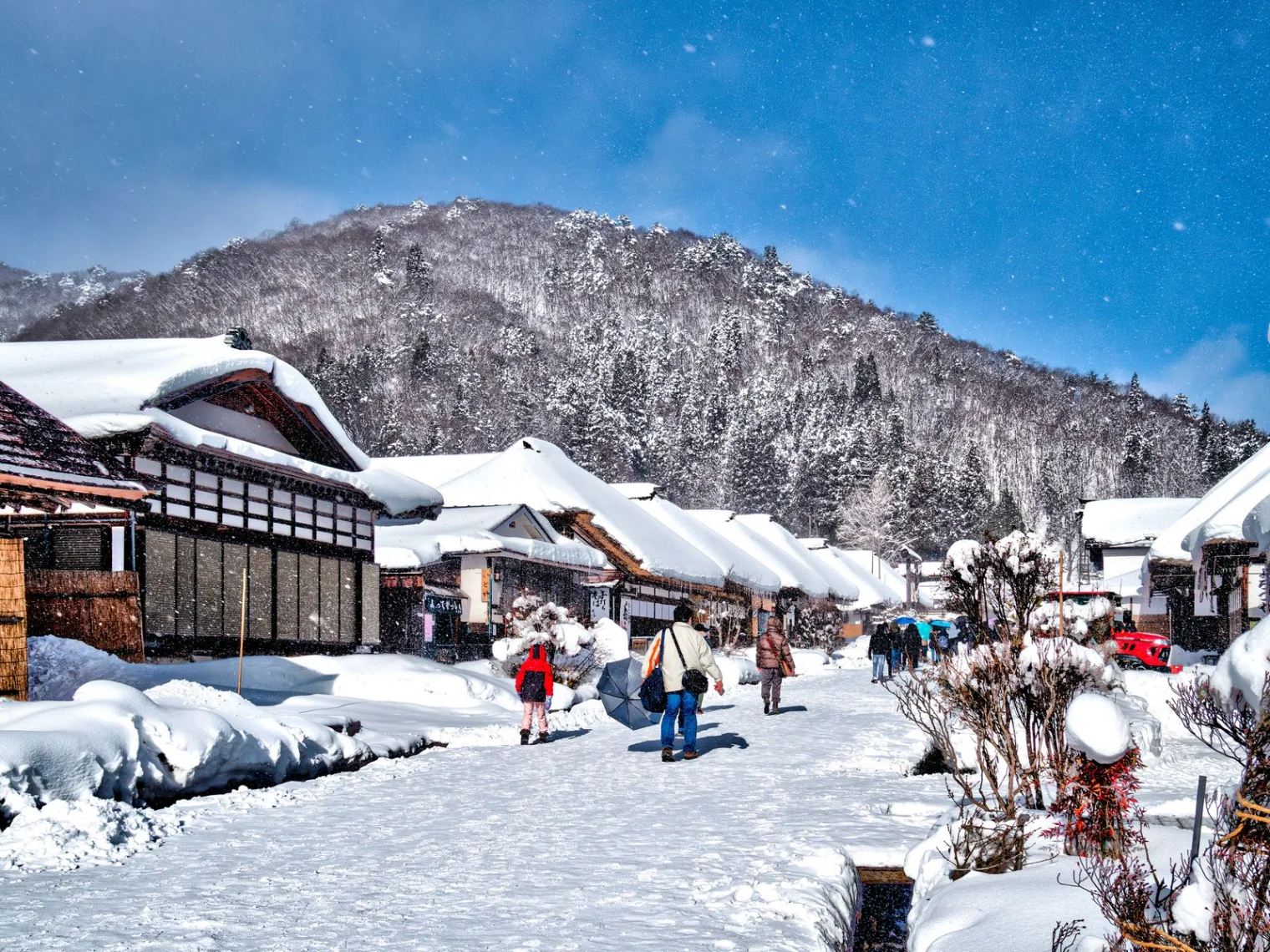
Based on annual scheduling, the 2027 Ouchi-juku Snow Festival falls on February 13–14. Compare regular vs. festival Saruyu-go buses, discount passes, and lodging.
Getting From Tokyo to Yunokami-Onsen Station: Via Aizuwakamatsu or Aizu-Tajima
If you are staying near Tokyo Station—or pairing the trip with Sendai or Koriyama—take the Tohoku Shinkansen from Tokyo to Koriyama and transfer to the JR Ban-etsu West Line to Aizuwakamatsu. From there, catch a train bound for Aizu-Tajima that stops at Yunokami-Onsen. The ride from Aizuwakamatsu to Yunokami-Onsen usually takes about 40 minutes, but the corridor includes similarly named stops like Aizuwakamatsu, Nishi-Wakamatsu, and Nanokamachi, so search timetables using the exact station near your hotel. Travelers staying downtown can drop large suitcases at their hotel first and plan the next morning's departure around whichever stop their train serves.
Aizuwakamatsu Station has two counters to keep in mind. Buy regular fares up to Nishi-Wakamatsu at the JR ticket office or vending machines. For the Ouchi-juku Combined Discount Ticket, head to the station's Ekitabi Desk tourist counter, open 9:00–17:00 and cash-only. If you want an early start the next morning and are already in Aizuwakamatsu the night before, drop by during opening hours to confirm the pass start date. Catching the 9:02 departure leaves no buffer if you wait until the counter opens at 9:00 to queue for the pass; instead, buy it at the Yunokami-Onsen Station window after arrival and pick a bus departure that leaves time to transact.
Departing from Asakusa or Kita-Senju, or connecting from Kinugawa Onsen, points you toward the Tobu Railway route into Aizu. When searching for Revaty Aizu limited express trains, set Aizu-Tajima as your transfer point and switch there to an Aizu Railway train toward Aizuwakamatsu, getting off at Yunokami-Onsen. Tobu's online limited express tickets go on sale one month prior to travel at 9:00 AM JST, and the limited express surcharge is separate from the base fare. Some trains split at Shimo-Imaichi for Tobu-Nikko, so check your ticket's destination and car number before boarding coupled trainsets to avoid ending up in Nikko.
Entering from one side and exiting via the other works cleanly for a two-day itinerary. For instance, sleep in Aizuwakamatsu, ride up to Ouchi-juku in the morning, and head south via Aizu-Tajima toward Kinugawa or Asakusa the next day. Or start from Asakusa into Aizu-Tajima, split two days between Ouchi-juku and Aizuwakamatsu, and return to Tokyo via Koriyama. Either direction places the February mountain transfers in the middle of your trip rather than forcing a late-night dash across regional rail lines. Even travelers keeping a base hotel in Tokyo with an overnight bag can choose entry and exit routes based on seat availability and combined fares.
Both Yunokami-Onsen Station and Ouchi-juku feature thatched roofs, making the station building a sight in its own right. There is a footbath right outside the station, best saved for when you have spare minutes before a train—give yourself time to dry off and put socks and winter boots back on. Outside the exit, look for signs reading Saruyu-go and Ouchi-juku Iriguchi with your tickets ready in hand; if the train-to-bus transfer is tight, walk straight to the boarding area. If your ryokan provides pickup, specify Yunokami-Onsen Station as the meeting point so the driver does not wait at Ouchi-juku Iriguchi.
Separating the Regular Saruyu-go Timetable From Festival Night Shuttles
Aizu Railway's regular Saruyu-go timetable takes effect on March 14, 2026, and remains valid until the 2027 timetable revision. It lists six daily departures from Yunokami-Onsen Station to Ouchi-juku Iriguchi, with a scheduled ride of 20 minutes. The first bus leaves at 9:45 and arrives at 10:05; the last inbound bus leaves at 14:55 and arrives at 15:15. The final return bus departs Ouchi-juku Iriguchi at 15:15 and reaches Yunokami-Onsen Station at 15:35. Because the last inbound bus arrives right as the final return bus leaves, anyone planning to spend time in the village needs to take at least one bus earlier on the way in.
Catching the first regular bus gets you into the village at 10:05—plenty of time for brunch, the exhibition hall, and the overlook. If you reach Yunokami-Onsen Station closer to midday, inbound buses still run at 12:15 and 13:35, letting you pair them with a 13:55 or 15:15 return depending on your onward train. Leaving Ouchi-juku Iriguchi at 12:35 puts you back at Yunokami-Onsen Station at 12:55, which under Aizu Railway's regular schedule connects cleanly with the 13:30 train reaching Aizuwakamatsu at 14:08. Built-in buffers for walking back down the street and lining up for the bus make midday connections far more forgiving for families with kids or slower walkers.
Tighter connections happen in the morning. The 9:02 local train from Aizuwakamatsu passes Yunokami-Onsen Station southbound at 9:42. To catch the first Saruyu-go at 9:45 just outside the station, any train delay quickly eats up your three-minute margin. If you miss it, look to the 10:30 or 11:30 buses, or book a taxi ahead of time. Travelers using wheelchairs, groups with large luggage, or parties traveling together on festival weekend can reserve in advance with operator Hirota Taxi (0242-75-2321), specifying pickup time, passenger count, and number of large bags.
On February 14, 2026, the festival timetable added three later return buses from Ouchi-juku Iriguchi at 16:30, 17:40, and 19:00, with the 19:00 bus arriving at Yunokami-Onsen Station at 19:20. Aizu Railway also issued separate notices for extra festival trains that year. Use those past times only as a reference for how special services bridge the gap; for a 2027 evening visit, wait for the official 2027 festival bus schedule and Aizu Railway operating notices. When booking hotels while only the regular timetable is out, treat 15:15 as the latest confirmed bus departure and arrange separate return transport for the night.
The last regular bus returns to Yunokami-Onsen Station at 15:35, connecting northbound with the 16:31 train toward Aizuwakamatsu or southbound with the 17:01 local train toward Aizu-Tajima. Both leave a wait at the station, making this the ideal window for the footbath. If you are continuing toward Kinugawa or Asakusa, do not stop your planning at Aizu-Tajima—save the onward Yagan Railway or Tobu leg and reserve any limited express seats in advance. At Aizu-Tajima, verify your transfer platform against three details: train name, departure time, and destination.
If you cannot secure an evening seat down the mountain, choose early on between leaving before dusk or staying overnight. Guests booked inside the village simply walk back to their inn after the lanterns. Guests staying in Yunokami-Onsen should book both their inbound ride and a confirmed pickup from the village entrance, saving the exact waiting spot shared by the driver or ryokan. Walking down the mountain road from the lit entrance to the station in the dark is unsafe, so wait only at designated pickup areas for shuttles or taxis after dusk. If members of your group are splitting into different vehicles, meet at the village entrance for a headcount before boarding.
| Station to Village | Arrive Ouchi-juku Iriguchi / Turnaround | Return to Yunokami-Onsen Station |
|---|---|---|
| 09:45 | 10:05 | 10:25 |
| 10:30 | 10:50 | 11:10 |
| 11:30 | 11:50 | 12:10 |
| 12:15 | 12:35 | 12:55 |
| 13:35 | 13:55 | 14:15 |
| 14:55 | 15:15 | 15:35 |
Which Discount Ticket to Buy? Nishi-Wakamatsu Is Where the Rail Zone Starts
The Ouchi-juku Combined Discount Ticket costs ¥2,200 for adults and ¥1,100 for children and covers both the railway and Saruyu-go bus across two consecutive days. Round-trip options cover Nishi-Wakamatsu to Yunokami-Onsen from the north, or Aizu-Tajima to Yunokami-Onsen from the south. For cross-Aizu itineraries, one-way passes run from Nishi-Wakamatsu via Yunokami-Onsen to Aizu-Tajima, or in reverse from Aizu-Tajima via Yunokami-Onsen to Nishi-Wakamatsu, allowing stopovers as long as you do not backtrack. On an overnight trip with a one-way pass, you can ride Saruyu-go into the village, return to Yunokami-Onsen, and continue along the rail line in the same direction the next day.
Aizu Railway's own example from Nishi-Wakamatsu compares ¥860 each way to Yunokami-Onsen (¥1,720 round-trip) plus ¥1,100 for the adult Saruyu-go fare, totaling ¥2,820—meaning the adult pass saves ¥620. Note that the JR segment between Aizuwakamatsu and Nishi-Wakamatsu costs ¥200 each way for adults and is paid separately, bringing a full adult rail-and-bus round-trip from Aizuwakamatsu to ¥2,600 before long-distance trains to Aizuwakamatsu. Pay close attention to the station boundaries on the pass, since many trains run straight through from Aizuwakamatsu to Yunokami-Onsen without requiring a transfer at Nishi-Wakamatsu.
The official site lists ticket sales at Nishi-Wakamatsu, Ashinomaki-Onsen, Yunokami-Onsen, and Aizu-Tajima stations, as well as from conductors on staffed trains and onboard the Saruyu-go bus. However, driver-only (one-man) Aizu Railway trains do not have a conductor selling passes onboard; if you board one from Aizuwakamatsu, buy the pass after disembarking at the Yunokami-Onsen Station window, listed as open 8:30–17:00. One person can queue at the counter while companions wait with luggage in the waiting area—and if you have time before the next bus, handle ticket purchase before touring the station building.
If your rail travel is already covered and you only need the Saruyu-go bus, pay onboard at ¥1,100 for adults and ¥500 for children. When staying near Yunokami-Onsen for two days with both village rides falling inside the pass zone, the combo ticket makes budgeting straightforward. If you plan to take the bus one way and a taxi back at night, add the taxi quote into your total before deciding—even cheap train tickets may not offset an unplanned mountain taxi fare compared with a different lodging choice.
Starting March 14, 2026, JR East consolidated its regional passes under the updated JR EAST PASS. Foreign passport holders can choose an adult 5-day pass at ¥35,000 or a 10-day pass at ¥50,000, covering the Tohoku Shinkansen between Tokyo and Koriyama plus the JR Ban-etsu West Line, while Aizu Railway and Saruyu-go require separate payment. If Ouchi-juku is your only major rail excursion, compare individual Shinkansen and JR round-trip tickets plus the Ouchi-juku pass against the 5- or 10-day pass—the latter makes sense mainly if you are adding Sendai or further northern Shinkansen legs. Tobu's Revaty Aizu from Asakusa is also outside the JR pass, so match your ticket choice to your actual departure route even if your broader trip includes Nikko.
Start With the Honjin Site, Then Walk to the End Before Climbing to the Overlook
Entering from Ouchi-juku Iriguchi, the main street naturally links dining spots, the exhibition hall, and the overlook. Ouchi-juku once served as a post town along the Aizu Nishi-Kaido highway connecting Aizuwakamatsu and Nikko Imaichi, and in 1981 was designated an Important Preservation District for Groups of Traditional Buildings. Houses line the former post road, mixing private homes and shops under overhanging roofs. Stick to public walkways across roadside channels, wooden planks, and packed snow, framing close-ups from the street so residents' entryways remain clear.
Midway down the street sits the Ouchi-juku Townscape Exhibition Hall (Machinami Tenjikan), reconstructed on the site of the former Honjin. Hours are 9:00–16:30 (closed December 29–January 3), with admission at ¥250 for adults, ¥150 for elementary and junior high students, and free for preschoolers. Inside, the raised formal reception room, dedicated entrance, and historic household tools put the street's architecture in context, while the sunken hearth burns wood whose smoke helps preserve the thatched roof. If wet snow starts falling outside, spend half an hour inside before tackling the climb so your outer layers do not get soaked and chilled.
At the far end of the main street near Koyasu Kannon, steps lead up to the classic overlook looking back over the village roofs. A separate approach west from the main street leads through cedar trees to Takakura Shrine. If you only have time for one, choose the overlook for the classic village vista or Takakura Shrine for a quiet forest walk. When heavy snow narrows visibility, zoom in on eaves, snow-piled doorways, and roadside channels—close framing still captures the village's layout and rhythm.
Do your first scouting walk up to the overlook in daylight. Watch your footing on icy stone steps and stop moving before pulling out your phone; if the steps are closed or too slick to stand safely, stay on the main street. For snow lantern photos after dark, pick two or three spots along the main street facing different directions—start somewhere the roof silhouettes show against the sky, then shoot lanterns closer to the Honjin. Avoid setting up tripods in cramped pinch points beside stairs or gutters, and when shooting handheld, tuck your elbows in from a stable spot at the street edge that leaves room for passersby.
At Misawaya, the signature Takato soba pairs 100% buckwheat noodles with grated daikon and a whole green onion used as both chopsticks and garnish; the shop lists hours of 9:30–16:00 and prices Takato soba at ¥1,500. For something hot, check the seasonal menu, which includes both warm and chilled kenchin soba. Festival crowds pack restaurants at midday, so eat early if you plan to watch noon events. If you arrive in the afternoon to wait for evening lanterns, pick up trail snacks beforehand and save dinner for your inn or back in Aizuwakamatsu. The local tourism association lists 9:00–16:00 as core business hours across village shops and posts monthly operating calendars—on winter weekdays, pick a primary restaurant and a backup along the main street from that calendar so a surprise closure does not eat into your return bus buffer.
Choosing Between Village Minshuku, Yunokami-Onsen, and Aizuwakamatsu
To stay until the lanterns go out, lodging right on Ouchi-juku's main street is the top choice. The Shimogo Town Tourism Association lists Iseya and Honke Ogiya inside the village. Iseya converts part of a historic farmhouse into guest rooms without en-suite bathrooms. Standard meal-inclusive plans list check-in from 15:00 to 17:00 and dinner at 18:00, which overlaps directly with typical lantern hours—decide before booking whether you prefer eating inside or watching the lights outside. Room-only plans list an alternative 19:00–21:00 check-in window, as staff prepare and serve dinner from 17:10 to 18:50.
Iseya also posts a members-only Snow Festival package limited to three groups, with reservations opening December 1, check-in from 12:00 to 17:00, and dinner at 19:00 after the events. Listed rates are ¥22,000 per person with two meals or ¥17,000 per person room-only, across room configurations for 2, 3–4, or 4 guests—specific to that inn's limited allotment. Regular guests should note that last-minute dinner add-ons are not available on the day, and tracking down an evening meal in the village after viewing the lights is much harder than in town.
Iseya does not offer shuttle pickups; its website estimates a 15-minute taxi ride from Yunokami-Onsen Station at roughly ¥2,500. Parties driving together can reserve one parking spot per group on the back lane east of the main street, valid from 13:00 on check-in day until noon the next day. Once you book a main-street room, pin the inn's parking lot on your map and follow their access road on arrival so navigation apps do not steer you into pedestrian-only festival zones. Transit-only travelers can split luggage-heavy legs between buses and taxis on arrival and departure days.
If hot springs and a warm soak at night matter more, look to Yunokami-Onsen. The local hot spring association lists Japanese-style Hotel Oshima as roughly a 2-minute walk from the station, convenient for families with young kids or early morning trains. Toryukan's website lists a 10-minute walk from the station plus local station pickup, as well as a reservable shuttle from Shin-Shirakawa Station (must be booked one day ahead) for guests wanting to bypass the full local rail ride. Walking distance to the station makes a real difference at night with heavy bags on snowy roads. Remember you still need separate evening transport from Ouchi-juku down to your ryokan; staying near the station saves the final walk after your train arrives.
Ryokan half-board plans lock in your dinner hour along with your room. If you plan to come down after the evening events, ask in advance about a late dinner seating or book a room-only or breakfast-only plan from the start. Treat check-in cutoffs and dinner times as separate constraints—a property that allows late arrival to your room may not hold dinner service late. Confirm room layouts, twin beds, private baths, and children's meal policies property by property, and track cancellation deadlines separately for lodging, Tobu limited express tickets, and private taxis, as bookings made on the same day can follow different cutoff clocks.
Using Aizuwakamatsu as your base fits daytime rail travelers or anyone combining the trip with Tsuruga Castle and Nanokamachi. Stay near the station if you want easy access to the first southbound train, or base between Nanokamachi and downtown for evening walks and dinner, catching the morning train from either Aizuwakamatsu or Nanokamachi depending on stops. Evening festivalgoers still need booked transport down from the village entrance and must verify whether the last northbound train from Yunokami-Onsen still runs in time. Anyone waiting until the end of the festival before sorting out a ride faces a longer haul back to the city than to Yunokami-Onsen.
Driving, Walking on Snow, and Backup Plans for Bad Weather
Drivers should set their navigation to Ouchi-juku Parking Lot (Ouchi-juku Chushajo). The Shimogo Town Tourism Association lists cash-only parking fees at ¥500 for standard cars, ¥1,500 for microbuses, ¥3,000 for large buses, and free for motorcycles. Approaching from Aizuwakamatsu, the town hall recommends driving via Aizumisato onto the Ouchi-juku Kobushi Line (Prefectural Route 131), setting Aizumisato Town Hongo Branch Office as a waypoint in your GPS. From the Yunokami-Onsen side, take National Route 121 onto Prefectural Route 329. Book snow tires directly with your rental car and check Shimogo Town's live camera and road updates the morning you drive to pick the better approach.
Even with a car, plan for walking time. The path from the parking lot to the main stage passes the village entrance, so groups with older travelers can agree on a meeting spot near the entrance while the driver parks and walks back. During dusk traffic and shuttle peaks, keep coats, water, and hand warmers on you so you do not have to trek back to the car. Follow parking attendants' instructions during snow-clearing or temporary traffic controls, and if you are unfamiliar with mountain roads, drive down before dark—leaving the evening illumination for a night with booked transport or village lodging. Organizers for the 40th festival directed evening vehicles to the tourist parking lot and advised bringing a flashlight for footing; keep a small flashlight in your coat pocket for the walk from the village entrance to the far end of the street and back out past the lit strip.
For kids or anyone sensitive to cold knees and slick surfaces, wear waterproof winter boots with deep treads. Pack a spare pair of dry socks in your daypack so you can swap immediately indoors if slush seeps over your cuffs. On Ouchi-juku's main street, you can turn back at any point—front-load stage viewing or lunch near the entrance and midsection, then decide whether to climb higher while your feet are still warm. After sundown, meltwater freezes quickly on stone steps, wooden bridge edges, and rutted tire tracks. Stroller wheels bog down easily in slush and packed snow; if part of your group climbs to the overlook, having one adult wait with toddlers on level ground saves everyone the strain.
When storms hit and you are staying in the village, scale the afternoon down to the exhibition hall and a bowl of soba. During rain, snow can slide off Ouchi-juku's thatched eaves, so wait for rides or companions at the designated entrance area or inside cooperating shops. If you stay down in Aizuwakamatsu, the Fukushima Museum makes a solid indoor backup. Open 9:30–17:00 (last ticket 16:30, typically closed Mondays or Tuesday if Monday is a holiday), permanent gallery admission is ¥400 for adults and university students and free for high schoolers and younger. Ride the city loop bus to Tsurugajo Sannomaruguchi, explore the folk and natural history exhibits first, and walk over to Tsuruga Castle only if the weather clears.
With just half a day in Aizuwakamatsu, you can also head straight to Tsuruga Castle Keep, open 8:30–17:00 (last entry 16:30), with adult keep admission at ¥410. Reaching the keep entrance from the outer grounds still involves an outdoor walk, so ducking inside the exhibits beats circling the full park during wet snow. If you want to visit both the keep and the Fukushima Museum, check both ticket cutoff times first and prioritize one. Have lunch downtown, and if you are catching an evening Shinkansen out, stop back by station lockers for your luggage before departing.
If you want to add To-no-Hetsuri cliffs, save it for another day after Ouchi-juku. Located south of Yunokami-Onsen, it is skipped by some Aizu-Tajima-bound trains, so confirm your train actually stops at To-no-Hetsuri. On festival day itself, if you cannot reach the village until noon, drop the side trip and protect fixed-hour stops like the exhibition hall and daylight arrivals. Returning to Aizuwakamatsu early in the afternoon gives you half a day to pair with our car-free Tsuruga Castle and Nanokamachi itinerary instead of waiting out the cold on the mountain.
Put Your First and Last Legs on the Calendar Now
For a day trip, reach Aizuwakamatsu in the morning, head up to the village before noon for an early lunch on the main street, and tour the exhibition hall and overlook in daylight. Aim for the 13:55 or 15:15 regular bus down to catch the Ban-etsu West Line back to Koriyama. Families with kids or travelers connecting to long-distance Shinkansen routes should target the 13:55 bus and skip the overlook if arriving late. With multiple transfers on the return, pick an acceptable Shinkansen departure from Koriyama first, work backward to the Ban-etsu West Line train, and leave breathing room to grab bento boxes and find your reserved car.
For an overnight trip, drop luggage at your inn or designated spot first, reserving the afternoon for the main street and dusk events. Guests staying inside Ouchi-juku can push the overlook climb to the next morning, keeping day one clear for scheduled performances. Guests staying in Yunokami-Onsen should count backward from their reserved pickup time to decide when to step away from the lanterns. On day two, use the remaining validity of your discount pass to return to Aizuwakamatsu or continue onward to Aizu-Tajima—leaving time after breakfast for the thatched station building and footbath before your train.
Mixed-energy groups—say, grandparents wanting an early hot spring soak and younger travelers staying for night photos—can still share one hotel. Tour the main street together by day, send the early group back on a regular bus, and book a later pickup for the night crew; if the inn serves a fixed-time dinner, sort out each group's meal plan before arrival. For parties of three or four, compare a pre-booked taxi's total cost against individual bus fares, and check which station a ryokan shuttle serves and how many daily runs it makes. When reserving a return ride, confirm both the exact pickup spot and the maximum hold time so nobody ends up watching the same show and waiting at different corners.
Write down two concrete landmark names for group meetups—such as outside the Ouchi-juku Townscape Exhibition Hall during the day, and at the Ouchi-juku Iriguchi bus stop for the ride back. Save screenshots of both outbound and return timetables on your phone alongside the bus company's phone number, hotel check-in hours, and boarding-area pin. Anyone traveling via Asakusa should screenshot their Aizu-Tajima rail connection too, rather than pulling off gloves in the snow to search station by station. Finally, add your village departure time and ryokan dinner time as separate calendar events so the tighter deadline is obvious at a glance.
A few useful answers
What are the 2027 Ouchi-juku Snow Festival dates?
Following Shimogo Town's annual schedule, the 2027 festival is projected for Saturday, February 13, and Sunday, February 14. As of November 22, 2026, organizers have not yet published the 2027 event schedule or shuttle timetable.
Can I take the Saruyu-go bus back after viewing the snow lanterns?
The last regular bus leaves the village entrance at 15:15. In 2026, Saturday festival shuttles ran until 19:00; for a 2027 evening return, wait for that year's special festival timetable, pre-book a taxi, or stay inside the village.
If I buy the Ouchi-juku Combined Discount Ticket at Aizuwakamatsu, do I pay extra for JR?
Yes. The pass is ¥2,200 for adults and ¥1,100 for children and covers two days on eligible Aizu Railway lines plus the Saruyu-go bus. The JR segment between Aizuwakamatsu and Nishi-Wakamatsu costs an extra ¥200 each way for adults.
Is there an admission fee for the Ouchi-juku Snow Festival?
Festival entry along the village street is free. The Ouchi-juku Townscape Exhibition Hall on the main street charges ¥250 for adults, ¥150 for elementary and junior high students, and is free for preschoolers.
Should I stay at Iseya in the village or in Yunokami-Onsen to see the lanterns?
Staying at Iseya inside Ouchi-juku lets you walk straight back to your room after the lights. Yunokami-Onsen ryokans suit travelers who want hot spring baths, though you must arrange separate evening transport from the village entrance and coordinate dinner hours.
Where do you park when driving to Ouchi-juku?
Park at the paid Ouchi-juku Parking Lot, which charges ¥500 for standard cars. Coming from Aizuwakamatsu, Shimogo Town recommends routing via Aizumisato Town Hongo Branch Office onto Prefectural Route 131, with snow tires fitted on winter rental cars.
Official information and references
Sources used in this guide.
- Shimogo Town Hall | Ouchi-juku Preservation District and Annual Festival Schedule
- Ouchi-juku Tourism Association | Official Organizer Updates
- Aizuwakamatsu Tourism Bureau | 40th Ouchi-juku Snow Festival Dates and Program
- Ouchi-juku Tourism Association | 40th Festival and Shuttle Poster
- Aizu Railway | Service Notices
- Aizu Railway | Train Timetable Revised March 14, 2026
- Aizu Railway | 2026–27 Regular Saruyu-go Timetable and Bus Fares
- Aizu Railway | Ouchi-juku Combined Discount Ticket Fares, Coverage, and Sales Stations
- Aizu Railway | Yunokami-Onsen Station Thatched Building and Footbath
- Aizuwakamatsu Tourism Bureau | Station Ticket Counters and Ouchi-juku Access
- Tobu Railway | Limited Express Timetables
- Tobu Railway | Online Limited Express Ticket Release Times
- JR East | JR EAST PASS Fares and Valid Lines
- Shimogo Town Hall | Ouchi-juku Townscape Exhibition Hall Hours and Admission
- Japan Tourism Agency | Ouchi-juku Cultural Guide and Takakura Shrine Approach
- Misawaya | Takato Soba Menu and Business Hours
- Shimogo Town Tourism Association | Lodging Directory
- Iseya | Snow Festival Package and Check-in Hours
- Iseya | Parking, Bus, and Taxi Information
- Yunokami-Onsen Tourism Association | Hotel Oshima
- Toryukan | Walking Access from Station and Guest Shuttles
- Shimogo Town Tourism Association | Ouchi-juku Parking Lot Fees
- Shimogo Town Hall | Ouchi-juku Road Info and Live Camera
- Nishitokyo City & Shimogo Town | Winter Snowfall Season in Shimogo
- Aizuwakamatsu Tourism Bureau | Fukushima Museum Hours, Admission, and Access
- Aizuwakamatsu Tourism Bureau | Tsuruga Castle Keep Hours and Admission
- Shimogo Town Tourism Association | Winter Driving and Icy Roads
- Fukushima Minami-Aizu Construction Office | Ouchi-juku Access via Route 121 and Route 329
- Ouchi-juku Tourism Association | 40th Festival Special Saruyu-go Timetable
- Ouchi-juku Tourism Association | Village Shops and Cash Parking Fees
- Ouchi-juku Tourism Association | Saruyu-go Bus and Hirota Taxi Contact Information