Choose between Hachinohe Sansha Taisai’s five days, find streets for viewing floats, travel via Hon-Hachinohe Station and see permanent displays outside festival dates.
- Region & Focus
- TohokuFestivals and fireworks
- Reading Scope
- 25 min read · 14 chapters · 4 Q&As
- Official Verification
- 8 official sources checkedUpdated October 27, 2026
Chapter Route Map (tap any stop)
- Choose your day: stationary floats or a procession
- Floats, portable shrines and the three shrines
- From harvest prayers to three shrine processions
- Where to watch: wide streets for unfolding, opening night for details
- Read the four float types and listen to the procession
- August 2: mounted ball games by day, floats at night
- Getting there: Hon-Hachinohe, then a walk into the center
- Paid seats or joining a float-pulling group
- Stay in the center or return via Hachinohe Station that night?
- Where to see floats outside the festival
- Sample visits: one procession day or two days of displays and movement
- Use the official map for the day you attend
- Plan time for children and companions
- Use annual float titles to identify the stories
- Quick Q&A
Hachinohe Sansha Taisai centers on shrine processions and neighborhood floats. Figures and scenes drawn from myths, legends and kabuki move through the city-center streets. Choose August 1 or 3 to see portable shrines and floats together. For illuminated floats, choose the August 2 evening procession or the stationary displays on the opening and closing evenings. The festival usually runs from July 31 to August 4 in central Hachinohe, Aomori Prefecture. JR Hachinohe and Hon-Hachinohe are different stations. After arriving by Shinkansen at Hachinohe, you still need transport toward the center. From JR Hon-Hachinohe Station, the central festival area is about a ten-minute walk.
Choose your day: stationary floats or a procession
The schedules, prices and participation rules below come from the organizer’s announcements for the completed 2026 event. Combined shrine-and-float processions, evening float runs and stationary displays offer different viewing experiences. Choose the activity before booking accommodation and travel to and from Hachinohe.
Otori and Okaeri are shrine processions traveling in different directions. On August 1, 2026, the combined procession left from in front of Hachinohe City Hall; on August 3, it started in Kajicho. Choose a spot with room to stay and let the procession pass, rather than following every float. For a fixed seat, paid viewing areas operated from August 1 to 3 that year.
The floats stay still at the opening evening festival, making it easier to examine figures and scenery and hear each group’s festival music. There were no paid viewing seats for the 2026 opening evening. Walk part of the street, then return to a favorite float. Keep pedestrian routes clear and do not reserve unattended space for long periods with tape, mats or luggage.
| Date | Main event and time | How to watch |
|---|---|---|
| July 31 | Opening evening, 18:00–21:00 | Floats displayed in the center and outside the City Hall annex; walk around for a close look |
| August 1 | Otori, 15:00–19:00 | Departs from City Hall; the three shrine processions travel with floats |
| August 2 | Evening floats, 18:00–21:00 | Departs from the Bancho side of the Mikkamachi intersection; illuminated floats on the move |
| August 3 | Okaeri, 15:00–19:00 | Departs from Kajicho; the three shrine processions travel with floats |
| August 4 | Closing evening, 18:00–21:00 | Floats displayed in the center and outside the City Hall annex |
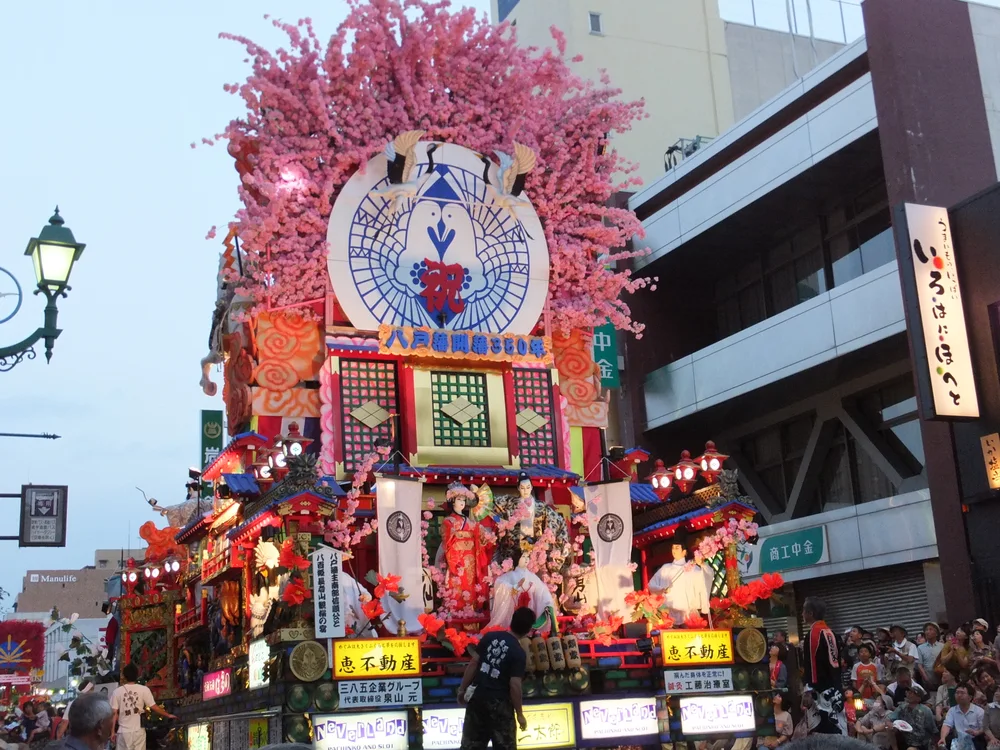
Choose between Hachinohe Sansha Taisai’s five days, find streets for viewing floats, travel via Hon-Hachinohe Station and see permanent displays outside festival dates.
Floats, portable shrines and the three shrines
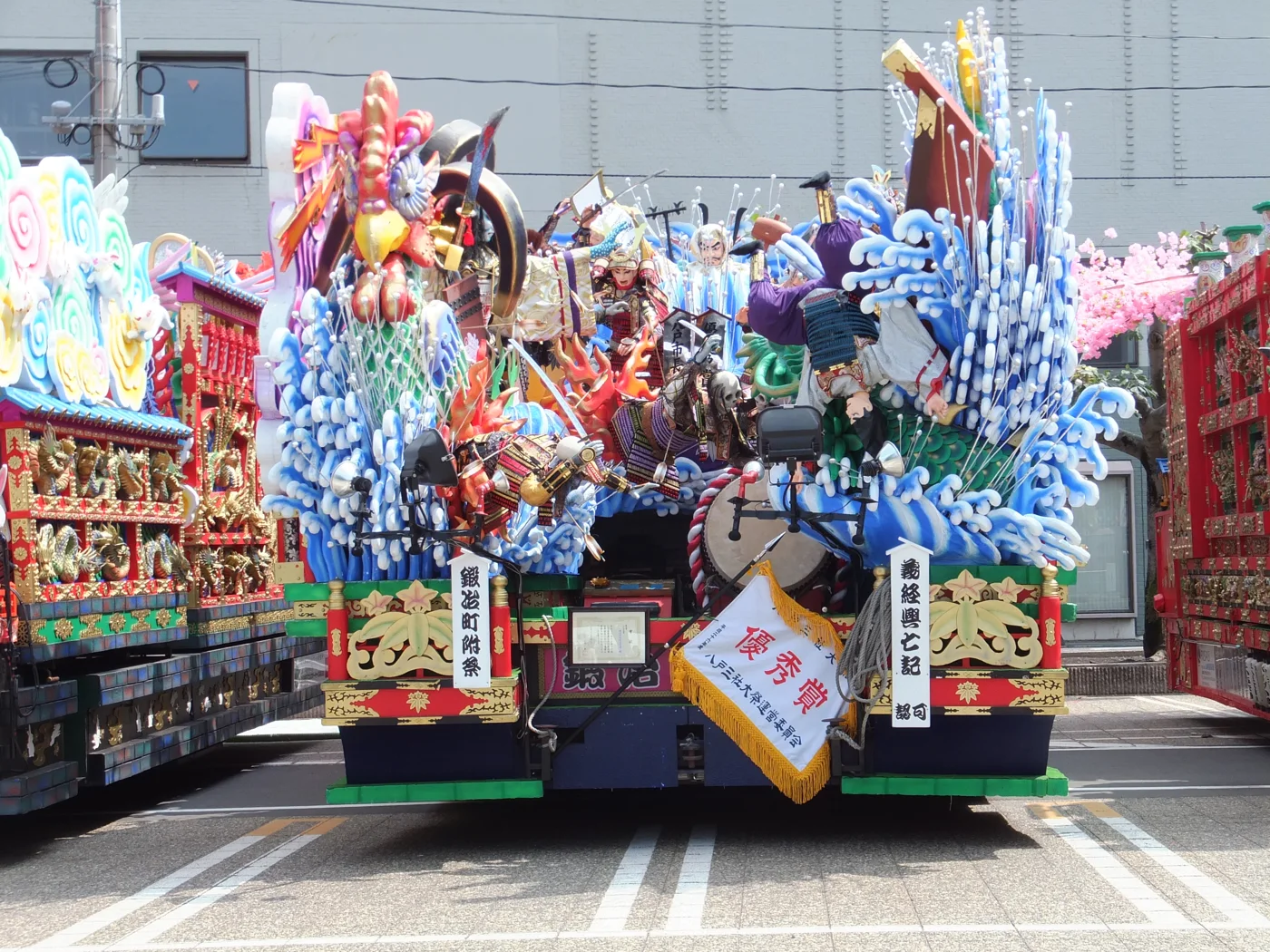
Ogami Shrine, Chojasan Shinra Shrine and Shinmeigu jointly hold the festival. Neighborhood floats take part as accompanying festivities alongside the portable-shrine processions. Myths, legends, history and kabuki form scenes whose opening mechanisms reveal different levels in the street. The organizer’s 2026 introduction says expanded floats can reach about 11 meters high and eight meters wide, with dimensions varying by work.
The procession also includes Daikagura, lion dances and tiger dances. On a first visit, look beyond the floats to the groups in front and behind. Portable shrines, musicians, float pullers and performers make up the same festival, while each neighborhood’s float has its own theme. Aomori’s tourism website says floats are made each year around subjects such as folktales and kabuki. VISIT Hachinohe lists that year’s titles; read the list before going if you want to understand particular floats.
The Hachinohe Sansha Taisai float events were designated an Important Intangible Folk Cultural Property of Japan in 2004. In 2016, they joined UNESCO’s Intangible Cultural Heritage list as part of Japan’s “Yama, Hoko, Yatai, float festivals.”
From harvest prayers to three shrine processions
Hachinohe City traces the festival to 1721. Horeisha, today’s Ogami Shrine, sent a portable shrine through the castle town and on to the predecessor of today’s Shinra Shrine, praying for improved weather and a good grain harvest. Neighborhood groups and performing arts later joined, developing into the present joint festival of three shrines. VISIT Hachinohe records Shinra Shrine joining in 1884 and Shinmeigu in 1889. Float makers also moved from reusing existing figures toward making new works annually.
The sacred procession centers on priests, the chief officiant and portable shrines, with sacred sakaki branches, horses, banners and local performing arts before and behind them. Float groups include flag bearers, tekomai dancers, pullers, festival musicians, kiyari song leaders and operating staff. Both parts connect within one procession. Identify the shrine first, then the accompanying floats behind it.
The organizer’s 2026 introduction lists Shinmeigu, Ogami Shrine and Chojasan Shinra Shrine with their accompanying floats in Otori. The shrine order in Okaeri is Shinmeigu, Chojasan Shinra Shrine and Ogami Shrine. The hana-yatai comes at the end. Historically linked to singing and dancing in the local entertainment quarter, it was revived in 1997 after an interruption. Use the sequence to identify each part while watching from the street, rather than starting to look only when large floats appear.
Where to watch: wide streets for unfolding, opening night for details
Floats are not fixed stages. On some, the front and center extend sideways while the rear rises. Mechanisms fold away for narrower streets and open again where the road is wider. Watch the body approach, then the figures and backgrounds change. Mechanisms differ between floats, and available street space affects whether they open.
For Otori in 2026, the organizer recommended the main streets around Nijusan-nichimachi, Jusan-nichimachi and Mikkamachi for expanded floats. Yoka-machi was recommended for Okaeri, and main streets including Yoka-machi for the middle day’s evening run. Paid seats were available on all three days. Back streets such as Nijuroku-nichimachi, Juroku-nichimachi, Muikamachi and Tsuitachimachi are narrower, limiting full expansion. Choose the main streets if mechanisms are a priority. Back streets may suit viewers more interested in neighborhood atmosphere or the procession passing close by.
The opening evening offers an easier way to compare groups: floats are gathered in the center while viewers walk around them, without timing every passing vehicle. Look at the whole stage and figure positions first, then costumes, expressions and backgrounds. Another side may reveal decoration hidden behind a figure. Procession days bring the groups, music and moving mechanisms together. A two-night stay can include one of each.
This festival short from Hachinohe City Tourism Section shows floats, shrine processions and performances. Use it to distinguish the groups from the floats before choosing a festival day.
Read the four float types and listen to the procession
Float scenes use different compositions. VISIT Hachinohe describes four common types: rocky floats with black crags, pines, autumn leaves or waterfalls; wave floats built around the sea, boats and waves; building floats centered on a castle or large gate; and railing floats surrounded by red railings, with a raised rear decorated with eave flowers.
You do not need to memorize titles first. Start with the terrain: waves or rocks underfoot? A castle gate, building or rising platform behind the figures? Then compare it with the organizer’s annual title list to understand the characters and story. Groups make new floats each year, so a favorite shape from last year may not appear again.
Look away from the floats too. Shinmeigu’s procession includes children in shrine-maiden clothing. Ogami Shrine has Horei Kagura, whose dancers hold lion heads and clack their jaws together in a synchronized display. Mounted warriors appear in Chojasan Shinra Shrine’s procession. Accompanying floats follow these groups, so the end of a shrine procession may still be followed by floats.
Tiger dance is another performance to recognize. Dancers operate tiger figures that roll on the ground or stand upright. VISIT Hachinohe connects it with local beliefs in fire prevention and safe navigation. In koma-odori, dancers wear horse models around their waists and advance with jumping steps. Both floats and folk performances move. Stay in the viewing area and give the groups room to pass.
VISIT Hachinohe says construction generally begins after the May holidays. Many participants have regular jobs and build in their spare time. After the festival, works may be loaned to nearby festivals, then dismantled before new themes are built the following year.
Watch for tekomai at the front of a float group. VISIT Hachinohe describes two traditionally dressed tekomai walking ahead and tapping staffs. Behind them come pullers, taiko and shinobue musicians, kiyari song leaders and operating staff. The figures and mechanisms are just part of the group. Listen for flute and drums, then find the flags and tekomai to distinguish groups before the huge scenery appears.
Sasa-no-ha odori features dancers holding bamboo leaves and moving to music. It left the festival during the Meiji period and was revived by Ogami Shrine from old documents during the Heisei period. Its costumes, props and movements differ from mounted warriors, tiger dance and floats. Note what you see, then look up the name on the organizer’s introduction page rather than calling every performance a lion dance. Daikagura leads each shrine procession with the meaning of purifying the road.
August 2: mounted ball games by day, floats at night
If August 2 is your only option, combine Chojasan Shinra Shrine with the evening run. In 2026, Kagami-ryu mounted dakyu and the on-foot version were held from 14:00 to 16:00 at the shrine’s Sakura horse ground. The evening floats began at 18:00 on the Bancho side of the Mikkamachi intersection. These are separate viewing locations. Allow time for travel, a meal and finding a spot after the daytime event.
In mounted dakyu, watch how red and white teams use long sticks to pick up balls and put them into a goal called the kyumon. The on-foot game follows the same rules without horses. VISIT Hachinohe dates this equestrian contest of the Hachinohe domain to 1827 and links it to the local riding tradition. The horse ground and city center offer different views of the daytime shrine rites and evening floats.
The middle day also includes annual rites at two shrines. In 2026, Chojasan Shinra Shrine’s rite began at 11:00, Ogami Shrine’s middle-day rite ran 13:00–14:00 and mounted dakyu followed after 14:00. Visitors focused on rites can choose one shrine before moving to the horse ground. If you only want the evening floats, there is no need to wait in the center from early morning. The evening run consists of floats alone, without the combined portable-shrine procession. Choose August 1 or 3 for portable shrines, warriors and shrine-maiden groups.
Getting there: Hon-Hachinohe, then a walk into the center
From Tokyo or other Tohoku Shinkansen stations, take the Tohoku Shinkansen to JR Hachinohe, then the JR Hachinohe Line to Hon-Hachinohe. Alternatively, take transport from Hachinohe Station toward the center. Hachinohe Station is not beside the main festival streets. Aomori’s official tourism website lists about 25 minutes by car from that station to the center. Hon-Hachinohe is the more direct choice for walking in.
City-center roads close for processions during the festival. Bus diversions and vehicle access follow that year’s notices. For the return journey, check the restriction map for your day and train times, then add the walk from your viewing spot to the station. The evening run’s finishing time is not a boarding time. Whether you stay in the center or near a station, use the actual walking route.
Drivers can use temporary parking listed for the relevant year. In 2026, the organizer listed paid temporary parking in Nagane Park. Leave luggage at your accommodation first, keeping hands and passageways free, then collect it after viewing.
Nagane Park’s 2026 temporary parking allowed entry and exit from 8:30 to 21:30. Ordinary vehicles cost ¥1,000 per vehicle per day. Buses required advance reservations and cost ¥4,000 per day. Ordinary vehicles could pay cash or PayPay; buses and other non-ordinary vehicles, and amounts of ¥2,000 or more, required cash. For an evening visit, work backward from the 21:30 parking closure, including leaving the crowd, walking and collecting the car. Find your parking before the floats finish.
Paid seats or joining a float-pulling group
Paid viewing seats suit visitors who need a fixed spot or a seat for a long viewing period. The 2026 general-sale seats were reserved folding chairs, one per person, with no roof. Food and drink were allowed, with rubbish taken home. Anyone needing a seat required a ticket regardless of age. After general sales sold out, the organizer said there would be no same-day or additional sales. When a future edition announces seats, buy for your party’s needs at release rather than assuming tickets will be available on site.
Plan routes even with a seat. Locate the entrance and seating street in the ticket information and compare them with that day’s restriction map. With children or slower companions, consider walking distances, toilets and rest locations. Seats are uncovered, so rain gear must also respect other viewers’ sightlines. Pack water and a rubbish bag to reduce trips away from the seat.
In 2026, the organizer also offered the Hipparitai float-pulling experience, placing participants in a float group and lending hanten jackets and other clothing. Sessions on August 1, 2 and 3 each lasted about two hours. Participation cost ¥5,000 per person, plus ¥2,000 for each additional day. Applications have closed.
In 2026, children in sixth grade or below had to be accompanied by a paying guardian wearing a hanten. Anyone unable to complete the route after check-in had to tell their float group’s leader. For families, consider eligibility, meeting times and stamina together. Joining requires check-in, changing and moving with the group. Watching from the street offers more freedom to rest, eat or leave.
Wheelchair users could buy that year’s viewing ticket, then contact VISIT Hachinohe to arrange viewing. The 2026 notice gave 0178-70-1110 as the contact number. All seats were non-smoking, with entry according to reserved places and staff guidance. A fixed stopping point is useful, but also plan the journey from accommodation or the arrival stop within your companions’ mobility needs.
The 2026 Hipparitai schedule began before the procession. On August 1 and 3, clothing collection was 13:00–14:30 at festival headquarters outside City Hall, followed by assembly at 14:30 and the procession at 15:00. On August 2, collection was 16:00–17:30, assembly 17:30 and departure 18:00. Hanten, yellow sashes, flower hats and patterned hand towels were lent together. Jackets and sashes had to be returned afterward; hats and towels could be kept. An afternoon experience therefore required arrival before 15:00 to allow for check-in, clothing and assembly.
Participants join a float group and cannot switch to a portable-shrine team or hana-yatai. Smoking and eating are prohibited while participating. Follow the group leader’s instructions for photos and video, and say when joining whether you will finish the route or leave partway. Choose the experience for close involvement in pulling and group movement. Street viewing better suits photography, choosing your own streets or eating when you wish.
Stay in the center or return via Hachinohe Station that night?
Your accommodation changes the route after the festival. A city-center stay lets you walk back after the procession and store bags more easily during the day. Compare the hotel location with the closure map when booking; a central address does not mean every entrance is accessible by car. Ask about luggage storage times before arriving with large bags, then walk to the festival with a light load.
Staying near Hachinohe Station helps with Shinkansen connections, but adds travel to and from the center. For the JR Hachinohe Line, check Hon-Hachinohe departures toward Hachinohe, then your onward train. Enter the full station names to distinguish them. JR East lists timetables separately toward Same and Kuji and toward Hachinohe. Choose the Hachinohe direction to return to the Shinkansen station.
If you leave by Shinkansen that night, work backward from departure. Include the transfer at Hachinohe, the train from Hon-Hachinohe, the walk after viewing and crowds. If this requires leaving before the floats finish, choose an earlier departure from the opening evening or stay overnight in Hachinohe. Ordinary daytime travel times do not cover the whole journey after festival crowds disperse.
Drivers should also choose their departure direction in advance. Central road closures may change available entrances. After setting your hotel or parking in navigation, consult that year’s organizer map and follow instructions on site.
Where to see floats outside the festival
Outside the five festival days, or when family members need an indoor break, add a permanent display to your Hachinohe visit. Youtree connects directly to JR Hachinohe Station by passageway. Its Sansha Taisai information corner explains the origins, shrine processions and float construction, and displays a full-size recreation of the front half of a float’s upper section. VISIT Hachinohe lists 9:00–18:00 hours, free admission and closure December 30–January 1. It fits arrival or departure at Hachinohe Station without a separate trip to the center.
Hachinohe Portal Museum “Hacchi” in the center displays a miniature wave float, “Seven Lucky Gods and the Treasure Ship,” on its second floor. A first-floor Horei Kagura mechanical clock shows lion heads clacking on the hour. Hacchi is at 11-1 Mikkamachi. VISIT Hachinohe lists free admission, hours of 9:00–21:00, Tuesday closure or the following day if Tuesday is a holiday, plus December 31 and January 1. Shops have separate hours. About ten minutes on foot from Hon-Hachinohe Station, it makes an indoor stop after entering the center.
Youtree’s half-float has a specific subject: “Journey to the West: Sun Wukong in Battle.” Young members of the Hachinohe Float Promotion Association made the full-size recreation of the upper front half. Outside festival dates, it lets you examine the depth of the figures: Sun Wukong’s staff and Zhu Bajie leaning forward spread one story across several layers. Hacchi’s “Seven Lucky Gods and the Treasure Ship” is a smaller work, useful for comparing how waves, a ship and figures form a wave float. Their different sizes also call for different viewing distances when taking photos.
Hacchi’s first floor has shops selling local crafts and design goods, including Yawata horse figures, Nambu sakiori woven accessories and Hachinohe pottery. Some companions can rest while others continue viewing in the same building, without the whole party moving again.
For Hacchi by city or Nambu bus, get off at “Hachinohe Chushingai Terminal (Mikkamachi)” nearby. VISIT Hachinohe lists about 20 minutes by car from Hachinohe Station. Hacchi has no parking, so drivers need nearby paid spaces. From a central hotel, include it in a walking route. With luggage and a Shinkansen transfer, see Youtree at Hachinohe Station first, then decide whether to enter the center based on your accommodation.
Sample visits: one procession day or two days of displays and movement
Half a day for the August 1 or 3 procession. At Hachinohe Station, change to the Hachinohe Line for Hon-Hachinohe and walk into the center. Eat and store bags first, then use that day’s route map to reach a main street. Both 2026 processions started at 15:00. Choose a roadside spot and leave a full period for the long procession, rather than switching streets after the first float. Walk back to Hon-Hachinohe or your central hotel afterward. On August 1, with enough time, you could first visit Ogami Shrine’s departure ceremony, held at 13:30 in 2026.
A full middle day. Arrive before noon and store luggage. Watch dakyu at Chojasan Shinra Shrine’s Sakura horse ground in the afternoon, return to the center for food and see evening floats. In 2026, dakyu was 14:00–16:00 and the evening run roughly 18:00–21:00. Stay in Hachinohe to watch the full event without relying on a Shinkansen that night.
Two days for the opening evening and Otori. Walk around the opening-night displays, noting favorite floats and street locations. The next day, see the combined procession and compare moving, expanding floats in the same neighborhoods. See stationary works on the first evening, then shrine groups, musicians and floats moving through streets the next day, without keeping the same viewing spot for both.
Use the official map for the day you attend
The organizer’s schedule page groups daily events and road-restriction maps together. Choose your travel date, then locate a viewing point, return station and accommodation direction on that day’s route. Include the date when saving a screenshot. For two consecutive days, check the second day’s map again rather than reusing the previous starting point and streets.
Once you choose a spot, the event-day “float live” map can show float positions. Despite the live label, its purpose is location information: it shows how far the groups have traveled. You need not leave your chosen street to chase them in the opposite direction. Save the schedule, route and ticket details together: the first gives starting times, the second waiting streets, and the third reserved seats and entry points.
Plan time for children and companions
With small children or older companions, first choose an activity format they can manage. Opening-night displays allow you to walk at their pace and leave the viewing area for a break. Combined processions suit people able to wait in one spot. Separate waiting, viewing and departure in your plan so someone who needs rest can leave the crowd early. Find a safe meeting point near toilets before deciding to watch everything.
That year’s organizer information listed toilets, cooling areas, first aid and festival headquarters, alongside an event-day-only float-position map. Save the essentials before arriving and give each companion the meeting location. If separated, meet there rather than everyone moving along the procession. When buying supplies, note your street and route back, and tell companions when you expect to return.
Photographers can choose one side to stay on, leaving passageways and accessible routes clear. The organizer asks visitors not to hold space for long periods with unattended mats, tape or luggage. Consider people behind you before raising a phone. Staff manage procession movement. Follow restrictions and guidance, especially avoiding the parade route just to photograph a float.
Use annual float titles to identify the stories
The 2026 organizer page lists float groups, titles and judging results alongside routes. Examples include Shimo-gumicho’s “Genpei: Dan-no-ura,” which won the Aomori Governor’s Award; Juichinichimachi Ryugumi’s “The Battles of Coxinga,” the Hachinohe Mayor’s Award; and Uchimaru Shinbokukai’s “Hachiman Deity,” the Hachinohe Chamber of Commerce and Industry President’s Award. These works and results belong to that year and help identify groups in historical photos or video. Use the new year’s list for the next festival.
The same figure can appear in different groups and scenes. The 2026 list includes Ushiwakamaru, the legend of Yoshitsune’s northern journey and Ushiwakamaru training on Mount Kurama. Remembering Yoshitsune’s name alone is not enough; read the place or event in the title too. If Japanese stories are unfamiliar, choose one or two works, read their subjects, then look at figure positions and backgrounds. You need not memorize the entire list.
Record the float group’s name as well as the title; that is easier to find than a saved photo alone. The organizer lists floats under the accompanying festivities of Shinmeigu, Ogami Shrine and Chojasan Shinra Shrine, so you can match them to shrine processions. A special 2026 entry was Same Seinenkai’s “Flight of Kabushima’s Guardian Maiden.” Titles, makers and shrine affiliations are separate fields, answering which story, who made it and where it appears in the procession.
A few useful answers
On a first visit with only one day, which date offers the fullest view?
Prioritize Otori on August 1 or Okaeri on August 3. Both combine the three shrine processions with accompanying floats, so you see portable shrines, local performances and floats together. Choose August 2 for illuminated floats in motion, or the opening and closing evening displays if you cannot stand for long or prefer close study. Check the relevant edition’s announcement, then choose for your actual arrival time.
Can I walk straight to the festival from Hachinohe Station?
The festival is in the center near Hon-Hachinohe on the JR Hachinohe Line, rather than beside the Shinkansen’s Hachinohe Station. Change to the Hachinohe Line and walk from Hon-Hachinohe, or take transport from Hachinohe Station to the center. Enter the two station names separately for return tickets and timetables, allowing for transfers and the walk after viewing.
Can I see floats outside festival dates?
See the half-float and interpretation at Youtree, connected to Hachinohe Station, or a small wave float at Hacchi in the center. These displays let you examine figures and composition. For shrine processions, music, pulling and mechanisms moving on the streets, visit on a combined-procession or evening-run date.
Can I step into the procession and pull a float?
Look for the organizer’s Hipparitai recruitment for the relevant edition. In 2026, this required advance application and payment, with placement in a float group, assembly times, borrowed clothing and child-accompaniment rules. Ordinary spectators should stay in viewing areas and keep out of ropes and procession routes.
Official information and references
Sources used in this guide.
- VISIT Hachinohe: 2026 schedule and transport
- Hachinohe City: festival origins and float events
- Aomori Tourism: Hachinohe Sansha Taisai
- VISIT Hachinohe: viewing and float displays
- VISIT Hachinohe: history and float construction
- VISIT Hachinohe: Hacchi
- VISIT Hachinohe: Youtree
- JR East: Hon-Hachinohe timetables