Plan a car-free day at Akiyoshido and Akiyoshidai. Compare Shin-Yamaguchi, Yamaguchi/Yuda and Mine buses, the three cave entrances, stairs and return routes, plus Karstar, the science museum and plateau access during construction.
- Region & Focus
- Chugoku and ShikokuAttractions
- Reading Scope
- 30 min read · 14 chapters · 4 Q&As
- Official Verification
- 11 official sources checkedUpdated November 22, 2026
- Key Topics
- ItinerariesChugoku & Shikoku
Chapter Route Map (tap any stop)
- Separate the bus center, cave entrances and plateau on your map
- Shin-Yamaguchi is the simplest direct option: choose the return first
- From Yamaguchi or Yuda Onsen, take Chugoku JR Bus directly
- The Mine route connects Asa and Nagato, with bus transfers rather than trains
- From the bus center, walk through the shopping street to the front entrance
- Front, Kurotani and elevator entrances connect to different sections
- From Hyakumaizara to Kogane-bashira, watch water shape limestone
- Use Karstar as your plateau landmark during construction
- Plateau paths and loop buses: weekdays differ from weekends
- The science museum connects grassland and cave in one cross-section
- With wheelchairs, older relatives or children, plan a manageable section
- Separate admission prices from entry hours: September has extended hours at standard prices
- Cave in the morning, plateau in the afternoon; shorten the surface section if arriving late
- Choose Shin-Yamaguchi, Yuda or Mine according to the next day
- Quick Q&A
Take a direct bus from Shin-Yamaguchi Station to Akiyoshido. How far you walk inside, where you turn back and whether you take the elevator up to Akiyoshidai will determine your afternoon bus. Give the cave, grassland and geology exhibits a full day. The karst observation deck is under construction in autumn and winter 2026, so use Karstar and nearby walking paths for your plateau visit.
Separate the bus center, cave entrances and plateau on your map
Save three locations first: Akiyoshido Bus Center, Akiyoshido Front Entrance and Akiyoshido Elevator Entrance. The first is your transport and return meeting point; the second is the natural cave opening beyond the shopping street; the third is on the plateau, linked by elevator to the middle of the cave route. A bus arriving at Akiyoshido still leaves a walk before you enter the cave. Taking the elevator out also puts you at a different surface location. Mark each point separately to avoid heading toward the wrong part of a place with the same name.
The tourist section of Akiyoshido is about 1 km. Official visiting times are about 40 minutes, or about 70 minutes for an out-and-back walk. The map labels the route from the front toward the cave interior as uphill. Akiyoshidai above is rolling grassland and limestone, rather than a flat park immediately outside the cave. A cave section, a plateau section, meals and bus waits fit more comfortably into a full day. For cave scenery alone, enter and return through the front to avoid surface transfers. Official Akiyoshido information
The key surface condition is construction: Akiyoshidai Karst Observation Deck is closed throughout July 7, 2026–March 26, 2027. Remove climbing the deck from plans during that period. Nearby Mine Akiyoshidai Geopark Center Karstar has large windows toward the grassland and a free rest area, making it a useful plateau landmark. Choose walking paths open on site from there. Observation deck construction notice

Plan a car-free day at Akiyoshido and Akiyoshidai. Compare Shin-Yamaguchi, Yamaguchi/Yuda and Mine buses, the three cave entrances, stairs and return routes, plus Karstar, the science museum and plateau access during construction.
Shin-Yamaguchi is the simplest direct option: choose the return first
If arriving in Yamaguchi by Sanyo Shinkansen and returning to Hiroshima or Fukuoka that day, prioritize Bocho Bus from Shin-Yamaguchi Station to Akiyoshido. The tourism association’s current access page lists ¥1,170 one way, about 40 minutes, and departures revised October 1, 2026. Daily departures from Shin-Yamaguchi include 10:05, 11:00, 12:05, 13:00 and 15:05. The 10:05 bus arrives at 10:40, leaving daylight for cave and plateau.
Choose early services by day. The 7:35 departure, arriving at 8:10, runs on weekdays only, excluding Saturdays, Sundays, national holidays and December 29–January 3. The 8:45 departure, arriving at 9:20, runs on weekends and national holidays. Early arrivals can sort out food, the shopping street and the return stop; normal cave admission starts at 9:00. If your Shinkansen connection is tight, take the next bus and shorten the plateau section, leaving real transfer time at the station.
Useful afternoon departures back to Shin-Yamaguchi are 14:05, 15:10 and 16:10, arriving at 14:42, 15:47 and 16:47 respectively. The timetable’s last direct return leaves Akiyoshido at 17:35 and arrives at 18:12, but does not run December 29–January 3. On those six days, 16:10 is the final direct return. Extended cave admission and extended bus service are separate matters. Even in summer, a late cave visit remains limited by this timetable. Shin-Yamaguchi–Akiyoshido timetable (Bōchō Kotsū)
If you have booked your return Shinkansen, plan the 15:10 or 16:10 bus and keep a later service as a buffer. On December 29–January 3, choose 15:10 and leave the final 16:10 as backup. Beyond the listed bus arrival, allow time to get off, enter the station, find the platform and board. If leaving Shin-Yamaguchi only at 15:05 and reaching Akiyoshido at 15:40, focus on the cave. Do not add plateau walks and the museum: arrival is already close to the normal 16:30 admission cutoff.
From Yamaguchi or Yuda Onsen, take Chugoku JR Bus directly
From accommodation near Yamaguchi Station or Yuda Onsen-dori, Chugoku JR Bus to Akiyoshido avoids going back to Shin-Yamaguchi. The association’s access page lists ¥1,230 one way from Yamaguchi Station, via Yuda Onsen-dori and Oda-chuo. Its published timetable was revised March 14, 2026. The weekday morning option leaves Yamaguchi at 8:30, passes Yuda Onsen-dori at 8:48 and reaches Akiyoshido at 9:32. Another leaves Yamaguchi at 10:00 and arrives at 11:02.
Weekends, national holidays and December 29–January 3 use the holiday timetable. The 8:30 early service still runs, with arrival at Akiyoshido listed as 9:30, but the next departure is 13:00, arriving at 14:00. A slow breakfast in Yuda can therefore leave a long morning gap if you miss the first bus. For cave, plateau and science museum, settle breakfast time and the Yuda Onsen-dori stop when choosing accommodation the night before.
Afternoon returns toward Yamaguchi include 14:24 and 16:19. The last leaves at 18:04, reaching Yuda Onsen-dori at 18:47 and Yamaguchi Station at 19:02. Weekday and holiday schedules share those three departure times, with slight differences in intermediate arrival minutes. These buses suit an overnight return to Yamaguchi or Yuda and run later than the direct Shin-Yamaguchi service. For a Shinkansen connection, add the Yamaguchi Line and station transfer separately. Yamaguchi Station is not Shin-Yamaguchi Station. Yamaguchi and Yuda Onsen bus timetables
The names are easy to confuse: Yuda Onsen-dori is this bus route’s stop; Yuda Onsen Station is the railway station. Search accommodation around the actual bus stop to reduce luggage walking on cave day. If your ryokan includes dinner, work backward from bus arrival to check-in and mealtime. Leaving Akiyoshido at 18:04 better suits a stay with flexible dinner arrangements.
The Mine route connects Asa and Nagato, with bus transfers rather than trains
The Ammonite-go bus from Mine Station to Akiyoshido costs ¥200 one way. It is useful if already staying in Mine or traveling from Asa or Nagato. From Shin-Yamaguchi specifically for Akiyoshido, the direct Bocho bus needs fewer transfers. Include the journey before Mine when comparing costs. ¥200 covers only Mine–Akiyoshido, not the total equivalent of a trip from Shin-Yamaguchi.
Heavy rain in 2023 damaged the JR Mine Line between Asa and Nagatoshi. All trains remain suspended, with replacement buses providing transport. The association has published the October 1–December 31, 2026 replacement timetable. Asa–Mine has regular and rapid services, plus weekend Yamaguchi DC rapid services. For October–December, read bus arrival times in the Asa Station → Mine Station direction before connecting to Ammonite-go. Do not plan it as a rail-platform transfer. Mine Line replacement and local buses
For example, the weekday 8:25 rapid replacement bus from Asa is listed to reach Mine at 8:50. Connect to Ammonite-go at 9:25 for Akiyoshido at 9:53, leaving 35 minutes between buses. On weekends, use Asa 7:53–Mine 8:26, then Mine 9:30–Akiyoshido 9:58, with a longer wait. These examples follow the existing timetable and suit travelers willing to make transport part of the trip.
The last return to Mine also depends on the day: weekdays leave Akiyoshido at 18:30 and arrive at 18:58; weekends and national holidays leave at 17:50 and arrive at 18:18. For Asa or Nagatoshi afterward, check the replacement timetable’s direction and operating marks. The local bus holiday schedule also applies August 14–16, December 31 and January 2–3; January 1 is a national holiday. The JR replacement table separately says December 28–31 uses its weekday schedule. Apply each leg’s own day rules over New Year.
From the bus center, walk through the shopping street to the front entrance
Akiyoshido Bus Center is around the Akiyoshidai Tourism Exchange Center. The front cave entrance lies beyond the shopping street. The official map gives about ten minutes on foot from the bus center to the Akiyoshido information office. The street is also the natural place for meals and souvenirs. Check your return stop and destination direction before entering the street. Eating on this section avoids an extra return from the plateau just for lunch. Cave entrance and shopping-street map
Those ten minutes cover walking from the transport point to the information office. Add ticket purchase, toilets and looking at the entrance scenery. Leave large luggage at your accommodation in Shin-Yamaguchi or Yamaguchi and take the bus with a day bag. Cave stairs and plateau slopes make a full circuit with a suitcase strenuous. A small pack for a light jacket, water and essentials keeps the route simpler.
Pause at the front to watch the change from outside to cave: water flows from the tall natural opening, and the path follows it inward as daylight gives way to cave lighting. Sort clothing and camera in a wider space before entering the darker section, so you can focus on footing. Agree on a turning point with companions before entry. Walking the whole tourist route and going only to Hyakumaizara require very different effort.
Front, Kurotani and elevator entrances connect to different sections
The front entrance is a useful start for bus travelers. Enter from the shopping street, see Hyakumaizara near the opening, then continue toward Senmachida, Kogane-bashira and Senjojiki. The cave route rises and falls, so calculate your return from wherever you reach. Using the same front entrance in both directions is easy to explain, and companions walking different distances can meet at the shopping street. The main cost is retracing the cave route.
Kurotani connects to the other end of the tourist route. Entry first passes through the “300 Million Years Time Tunnel,” with stairs shown on the map, before reaching the main cave. Kurotani toward the front is the map’s downhill direction and suits visitors who have already reached the plateau and can manage surface transport. Kurotani is on the opposite side from the front. Exiting there still leaves transport or walking back to the bus center; emerging from the cave does not return you to your original stop.
The elevator entrance is a vertical link in the middle of the cave. Its surface exit is on the plateau, about ten minutes toward the karst observation deck on the official map. It connects cave and grassland, but its position does not cover the whole cave route. To see the Kurotani end, first walk that way and return to the elevator branch. For the front end, follow the cave path back past Hyakumaizara to the natural opening.
A convenient car-free combination is to enter at the front, see your chosen cave sections, then take the elevator to the plateau. Return by re-entering on your admission ticket and walking out the front, or take the surface loop bus when it operates. The official map says your ticket allows free re-entry after leaving by the elevator entrance, so keep it with you. Use the earlier afternoon for the plateau if returning this way. Admission at the Akiyoshidai information office ends at 16:30. Three entrances and cave cross-section map
An adventure route near the front is described on the official map as climbing rock, using ladders and passing between cave formations, taking about 20 minutes. Its extra climbing differs from the main path. With preschool children, sore knees or plateau walking planned afterward, spend that time on main-route stops instead. If taking part, remove those 20 minutes from later activities so lunch and transfers do not become rushed.
From Hyakumaizara to Kogane-bashira, watch water shape limestone
Hyakumaizara, near the front, is a good first place to slow down. The linked shallow pools have rims of different heights. Their water surfaces and stone boundaries are more interesting than counting to a hundred. Change your angle from the path and foreground rims hide pools behind them. Look first at the terraced pattern, then how water passes over each level. Wait for companions in wider areas rather than stopping halfway up narrow stairs for a photograph.
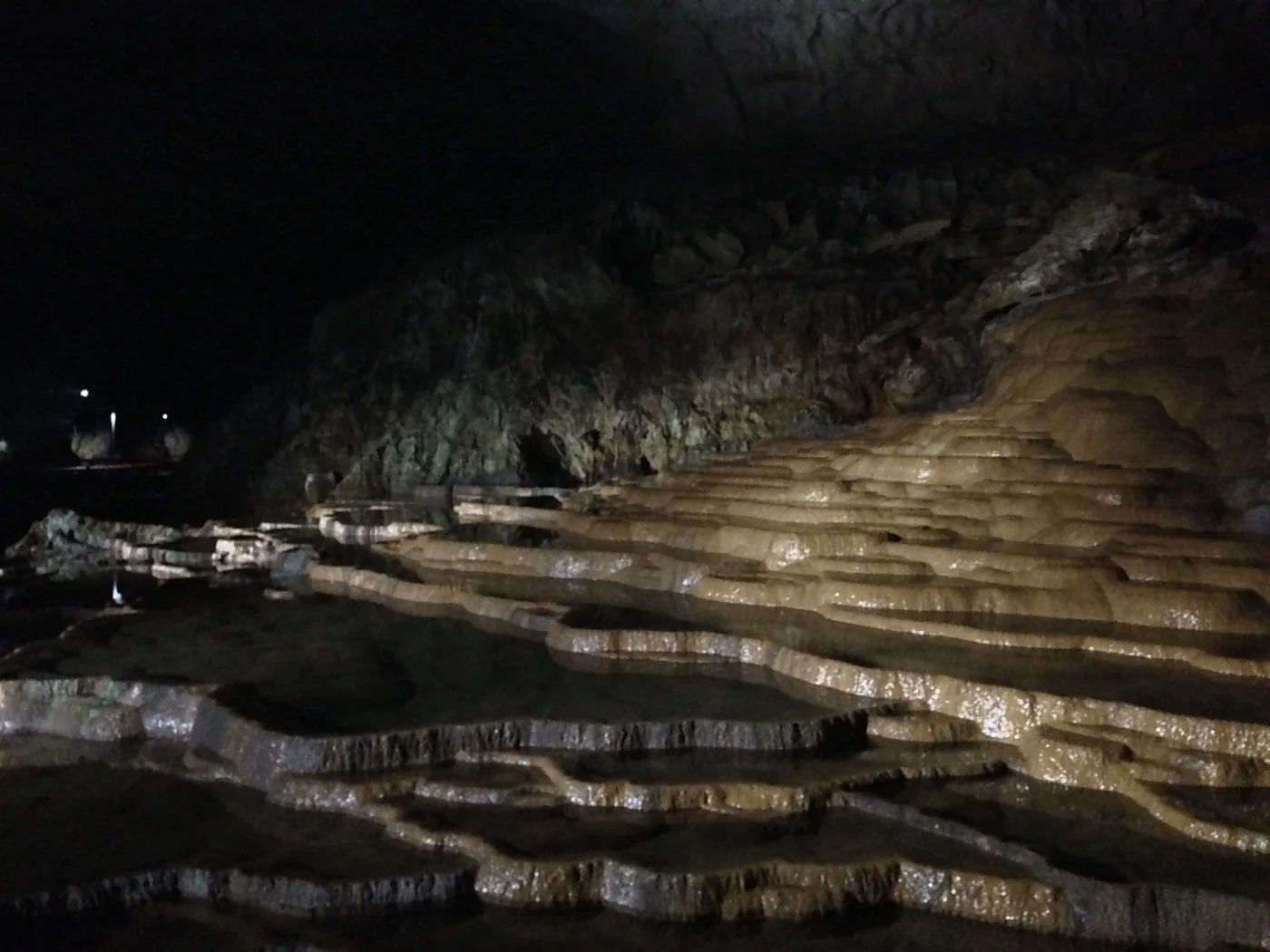
Farther in, Senmachida, Kogane-bashira and Senjojiki on the map signal changes in scale. After details near water level, the Golden Pillar lifts your eyes and Senjojiki draws attention to the whole underground space. Use Hyakumaizara, Kogane-bashira and Senjojiki as a few main stops rather than chasing every named shape. Match the map directly to Japanese signs: the Golden Pillar is 黄金柱 and Senjojiki is 千畳敷.
Follow one water route to connect limestone above and caves below. Ministry of the Environment material explains that surface and soil water enter limestone cracks and gradually dissolve the rock to form caves. Water beneath the eastern plateau generally flows northeast to southwest before joining the Koto River. The flowing cave entrance gives seemingly static rock a direction of movement. Depressions above then become another clue. Ministry of the Environment: Akiyoshidai groundwater system
This limestone began as coral reefs around the tops of submarine volcanoes about 340–260 million years ago. Plate movement, collision and uplift later brought it near the surface. Read this after seeing the cave: today’s grassland was connected to an ocean, while caves formed later through prolonged water action after the rock rose near the surface. Separating reef age from the cave you visit is clearer than calling everything a “300-million-year-old cave.”
This 30-second Akiyoshido video, released by Yamaguchi Tourism Federation on October 4, 2018, introduces the cave’s limestone scenery through Hyakumaizara and the Golden Pillar.
Use Karstar as your plateau landmark during construction
Akiyoshidai consists of grassland, exposed gray-white limestone and rolling terrain. After the cave elevator, let your eyes adjust to daylight, then head toward Karstar and the walking-path entrance. You are now at another surface level. Decide how to return to the front before leaving the elevator area. For ticket-based cave re-entry, walk the plateau around midday and return to the elevator earlier in the afternoon.
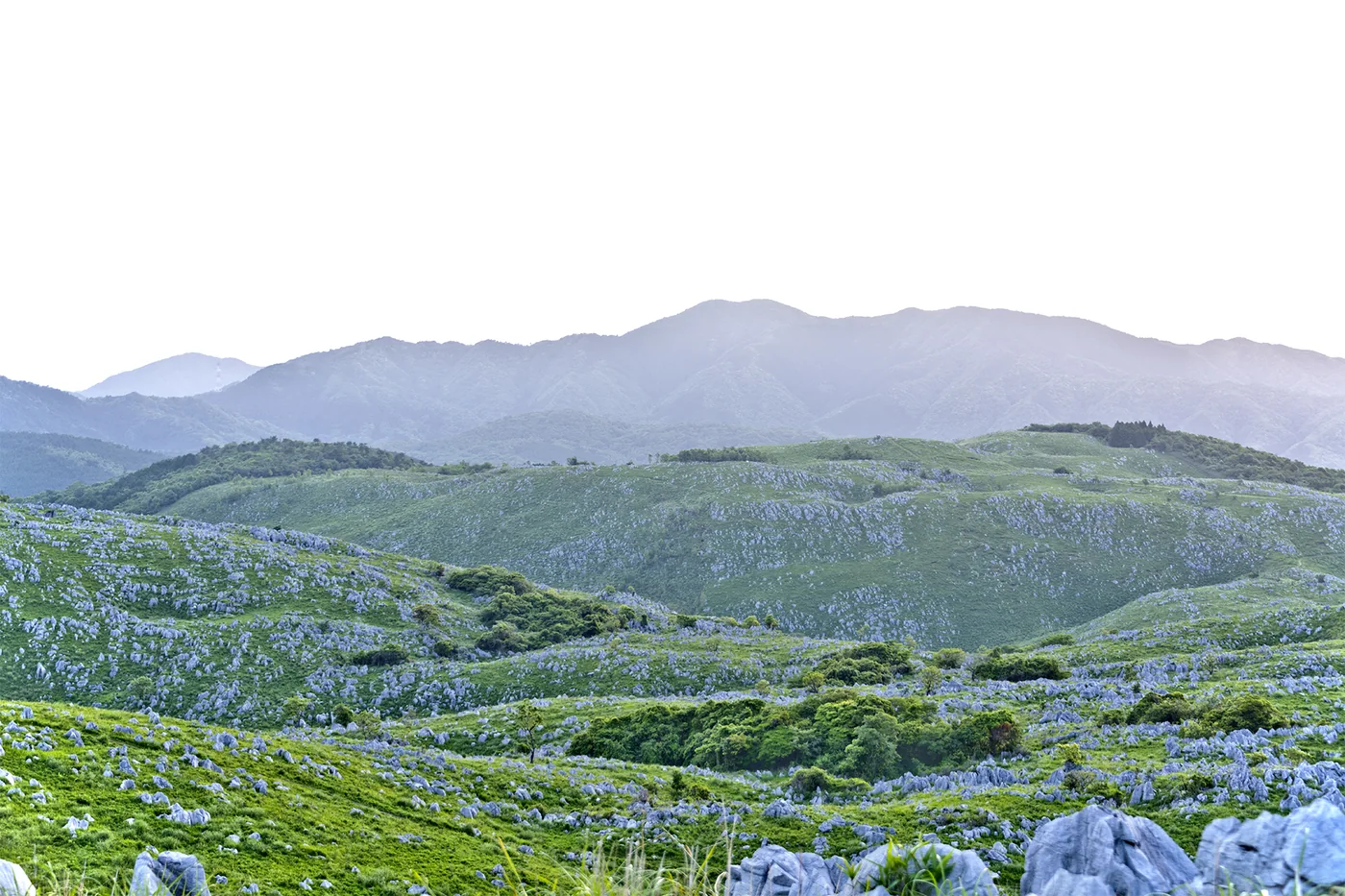
Karstar has large windows facing Akiyoshidai, tourist information, free rest space and coffee service. Official hours are 9:00–17:00, closed over New Year. After cave stairs, sitting inside to see the grassland can work better than immediately starting a long hike. Rain, wind or companions wanting only a view also justify shortening the plateau here. Treat the window view, walking paths and observation-deck building under repair separately. Focus this visit on the first two. Karstar Geopark Center
Outside, choose a path with a clear return direction. Look at nearby rocks, then rounded distant hills and depressions. Japanese explanations call the depressions dolines, a clue to limestone terrain. Give children one small task: find raised rocks and lowered ground from the path, then compare a terrain map indoors. A short observation still connects cave water routes with the surface.
The grassland also depends partly on human maintenance. The science museum explains that this warm, wet environment would gradually become forest if left alone. Burning and mowing remove young trees and maintain the open view. Official seasonal information gives mid-November to early December as the usual period for autumn-colored grass. In late October, focus on terrain and limestone; in late November, give grass color a larger role. Akiyoshidai seasons and terrain
Plateau paths and loop buses: weekdays differ from weekends
Official transport guidance gives about 30 minutes on foot from Akiyoshido bus stop to Akiyoshidai. From the elevator’s surface exit toward the observation-deck area, the map gives about ten minutes. These start at different places and cannot replace each other. From inside the cave, use the elevator to reach the plateau. From the bus center for grassland alone, plan the full surface walk and wear shoes suitable for slopes.
The loop bus runs Akiyoshido → Kurotani Entrance → Akiyoshidai → Akiyoshido. The association’s published loop timetable was revised March 14, 2026 (Chugoku JR Bus). Departures from Akiyoshido run hourly from 11:30 to 15:30, passing Kurotani at :35, Akiyoshidai at :39 and returning at :45. It normally runs on weekends and national holidays, daily July 20–August 31; December 29–30 follows the weekend and holiday schedule, and December 31–January 3 only some trips on the New Year schedule run. Akiyoshido loop bus operating days and times
On weekends, avoid a downhill walk by taking the 14:39 or 15:39 bus from Akiyoshidai, reaching Akiyoshido at 14:45 or 15:45. Connect to the 15:10 or 16:10 Shin-Yamaguchi bus, with 25 minutes each time. Visitors exiting at Kurotani can also use this one-way loop via Akiyoshidai back to Akiyoshido. Read in its actual operating order, rather than treating the service via Kurotani as a direct reverse-direction descent.
The regular weekday plan has no such loop service. Choose a plateau section you can complete on foot, or walk earlier and re-enter the cave by elevator on your ticket to return to the front. Official information also lists a weekday Karst Taxi touring service. If relying on a vehicle for a one-way route, arrange that day’s pickup point and departures at the Tourism Exchange Center first. A walk you can complete independently suits visitors who do not want another shuttle timetable.
The science museum connects grassland and cave in one cross-section
Mine City Akiyoshidai Museum of Natural History is on the plateau, officially about two to three minutes on foot from beside Akiyoshidai bus stop and the green-space park parking lot. Admission is free, with hours of 9:00–17:00. It closes Mondays, or the next day when Monday is a national holiday, and December 28–January 4. Check that morning whether it is open before dividing post-cave time between exhibits and grassland.
Exhibits cover the formation of Akiyoshidai and Akiyoshido, limestone terrain, local fossils, animals and plants, plus stone tools and pottery used by local people. After Hyakumaizara and Kogane-bashira, rocks, fossils and terrain displays place individual features within the whole plateau. Ask children to describe one cave shape, then find a diagram or specimen connected to that question. You do not need to read every panel.
The museum updated its second-floor Akiyoshidai Karst exhibition in February 2025 and its history of Akiyoshidai geological research display in March 2026. Geology enthusiasts can focus on plateau cross-sections, rock origins and the accumulation of research. If you mainly need shelter and a rest, Karstar’s seating is more direct. The two indoor bases serve different needs; with only an hour left, choose what you most want to do. Museum exhibition updates
The museum prohibits food, drink and pets, and has no toilet usable by wheelchair users. Eat in the shopping street below or another permitted space, and handle toilet needs at a suitable earlier facility. Bicycles and motorcycles are prohibited on plateau walking paths, and collecting plants and insects is restricted by conservation rules. Observe and photograph from existing paths to preserve the details worth seeing. Museum hours and plateau use rules
With wheelchairs, older relatives or children, plan a manageable section
The official wheelchair route is about 300 m from the front entrance to Hyakumaizara, with an assistant required. The map specifically marks the entrance slope as very steep. The first-floor information office at Akiyoshidai Tourism Exchange Center lends wheelchairs free and accepts advance reservations. Focus this visit on the entrance, flowing water and Hyakumaizara, then return to the shopping street. The Golden Pillar, Kurotani and a full cave traverse include stairs. An elevator does not make the whole cave step-free.
For older companions who walk slowly but can use stairs, enter and exit at the front, turning back according to interest and energy. Family members wanting the plateau can agree on a meeting time at the front or Tourism Exchange Center, giving those below a clear rest location. If staying together, make either the cave return or a short plateau section the main activity instead of hurrying through both.
The cave stays around 17°C year-round. In summer, a light jacket over short sleeves is useful. In autumn and winter, pack a thick coat away rather than carry it while using stairs. Prioritize grip and stair walking when choosing shoes, and stand firmly before looking at a camera screen. Prepare at the entrance to avoid searching for items in the dark. Cave length, temperature and visiting times Before children reach stairs, free their hands before photographs or snacks. The front-to-Hyakumaizara section already has clear cave forms and water scenery; reaching Kurotani need not turn the last half-hour into pressure. For the adventure route, match its ladder climbing to what children can do.
Separate admission prices from entry hours: September has extended hours at standard prices
Akiyoshido revised admission on April 1, 2026, with variable individual prices. For high-school age and above, standard admission is ¥1,600, peak-period admission ¥1,900 and the December–end-of-February low-season price ¥1,350.
Junior-high-school students pay ¥1,300 in standard and peak periods, or ¥1,050 in low season. Elementary-school students pay ¥850 in standard and peak periods, or ¥700 in low season. Budget standard prices for late October and November.
The summer peak-price period is July 1–August 31, but extended entry reception runs July 1–September 30. September therefore has standard individual adult prices while the front entrance still has extended hours. Normal reception is 9:00–16:30; July–September is 9:00–17:30. Kurotani and Akiyoshidai information offices still end reception at 16:30. Record both your entrance and its admission cutoff.
The official special Golden Week period for 2026 was April 27–May 7. Reception also starts early at 8:30 on August 8–16. Do not apply these early openings to autumn or winter, or carry past Golden Week terms into next year’s budget. The usable autumn/winter 9:00 opening and 16:30 reception cutoff make early arrival and afternoon returns easier to align.
List return bus fares, lunch and extra experiences separately from admission. From Shin-Yamaguchi, the current ¥1,170 one-way fare makes ¥2,340 return. Add standard adult cave entry at ¥1,600 for ¥3,940, before food and plateau transfers. Compare this base budget with accommodation and time available rather than adding two transfers for a cheap single bus leg. 2026 admission prices and reception hours
Cave in the morning, plateau in the afternoon; shorten the surface section if arriving late
With Shin-Yamaguchi 10:05–Akiyoshido 10:40, allow walking and ticket time and begin the cave around 11:00. See Hyakumaizara, continue toward the Golden Pillar and your chosen sections, then return to the elevator branch for the plateau, keeping cave stops around midday. This suits a snack at Shin-Yamaguchi followed by a late lunch back on the shopping street. For lunch at a fixed time, eat below first, then use the afternoon for cave and a short plateau section.
An early bus separates lunch and cave more simply. Arrive at 9:20 on a weekend, walk the cave in the morning and take the elevator up. See Karstar or the museum around noon, then use an afternoon loop bus down. For more grassland time, connect the 15:39 loop to the 16:10 Shin-Yamaguchi bus. For cave and exhibits as priorities, descend an hour earlier for food and the more relaxed 15:10 return.
On regular weekdays, walk the plateau around midday, return to the elevator earlier in the afternoon and choose the 15:10 or 16:10 Shin-Yamaguchi bus. Walking back to the elevator, waiting, returning through the cave to the front and crossing the shopping street all belong to the return journey. For 16:10, leaving Karstar around 15:00 can serve as your own turnaround cue. Start earlier with slower companions.
If you leave accommodation after 11:00 or do not want outdoor walking in the weather, make a front-entrance cave return the main visit, eat and take the 15:10 or 16:10 bus to Shin-Yamaguchi. For the plateau without the full cave, reverse the emphasis: visit grassland and museum and leave the cave for another trip.
Choose Shin-Yamaguchi, Yuda or Mine according to the next day
For one night focused on Akiyoshido and Akiyoshidai before a Shinkansen departure, prioritize Shin-Yamaguchi. Bus journeys and luggage revolve around one station, avoiding a luggage transfer from central Yamaguchi the following morning. This favors rail connections before or after Hiroshima, Kitakyushu or Fukuoka. Compare hotels by the actual walk to your bus boarding point.
For an evening hot spring, the Yuda Onsen-dori area fits the day better. Take Chugoku JR Bus in the morning and return to the same main road, ending with your inn’s dinner and bath times. Near Yamaguchi Station, weigh city accommodation against bus convenience. Both bases allow a day at Akiyoshido without moving luggage. The service leaving Yamaguchi at 8:30 maximizes daytime.
Mine suits travel already following Asa–Mine–Nagato. Stay within walking distance of the Mine Station bus connection and continue by replacement bus the next day. Its strengths are fitting your existing route and a cheap local bus to Akiyoshido. Moving there merely because it looks close on a map still adds Asa transfers and luggage handling. Plateau accommodation merits further consideration for morning grassland or a local guided tour; book meals and transport up and down together.
If Hagi is next, allow another day for its castle town: see Hagi without a car and an overnight stay. Toward Hiroshima, place Iwakuni’s Kintaikyo Bridge and castle town on a separate travel day.
A few useful answers
How do I get from Shin-Yamaguchi Station to Akiyoshido by bus, and when is the last direct bus back?
The direct Bocho bus from Shin-Yamaguchi Station to Akiyoshido takes about 40 minutes and costs ¥1,170 one way. The last direct bus leaves Akiyoshido at 5:35 p.m., or at 4:10 p.m. from December 29 through January 3.
How much is admission to Akiyoshido Cave?
Individual tickets for high school students and older visitors cost ¥1,600 at the regular rate, ¥1,900 at peak times, and ¥1,350 from December through February. Junior high and elementary school students pay ¥1,300 and ¥850 at regular and peak times. From December through February, those prices are ¥1,050 and ¥700.
How do I get from Akiyoshido to Akiyoshidai and back to the bus center without a car?
Enter through the main entrance and take the elevator from the middle section of the cave up to the plateau. Keep your ticket for free reentry via the elevator entrance, which stops admitting visitors at 4:30 p.m. Exit through the main entrance and walk along the shopping street to Akiyoshido Bus Center.
Where can I see the Akiyoshidai grasslands during work on the Karst Observation Deck?
See the grasslands through Karstar’s large windows or walk one of the open trails nearby. The Karst Observation Deck is closed from July 7, 2026, through March 26, 2027. Karstar is open from 9 a.m. to 5 p.m. and closes around New Year’s.
Official information and references
Sources used in this guide.
- Mine Tourism Association: transport, route revision dates and October–December 2026 Mine Line replacement timetable
- Mine Tourism Association: Akiyoshido, April 2026 individual prices and entrance reception
- Mine Tourism Association: three entrances and wheelchair route map, October 2025; used for route layout
- Mine Tourism Association: observation deck works, July 7, 2026–March 26, 2027
- Mine Akiyoshidai Geopark: Karstar Geopark Center
- Ministry of the Environment: Ramsar Sites in Japan 51, Akiyoshidai groundwater system
- Mine Tourism Association: Akiyoshidai, autumn grass and surface transport
- Mine City Akiyoshidai Museum of Natural History: exhibits and updates
- Mine City Akiyoshidai Museum of Natural History: hours, museum and plateau rules
- Yamaguchi Tourism Federation: Akiyoshido video, Hyakumaizara and Golden Pillar
- Yamaguchi Tourism Federation: Akiyoshido video guide, released October 4, 2018