Choose your Umeda base by the trains and exits you use most. Compare direct JR Osaka Station hotels, Chayamachi and Nakatsu, and Higashi-Umeda and Sonezaki, plus Kansai Airport transfers, Kyoto, Kobe and Nara day trips, family rooms and rainy-day routes.
- Region & Focus
- OsakaAccommodation
- Reading Scope
- 17 min read · 11 chapters · 5 Q&As
- Official Verification
- 35 official sources checkedUpdated 22 November 2026
- Key Topics
- Where to stayNeighbourhoodsRail travel
Chapter Route Map (tap any stop)
- Pick Your Primary Station First
- Direct Access at JR Osaka Station: Central Gate vs West Gate
- Chayamachi, Nakatsu and Nakazakicho: What Each Saves You
- Higashi-Umeda, Sonezaki and Nishi-Umeda After Dark
- Kansai Airport to Umeda: Choose Your Drop-Off Point First
- Quad Rooms, Quiet Rooms and Multi-Night Stays: Comparing by Room Setup
- Budget for the Whole Trip, Including Osaka's Per-Person Accommodation Tax
- Day Trips to Kyoto, Kobe and Nara: Match the Destination to the Operator
- Umeda or Namba? Three Trip Patterns to Decide
- Rainy Days with Children, or a Slower Pace with Older Relatives
- One Evening in Umeda: Put the Sky Building Before Returning to Your Room
- Quick Q&A
Start choosing a Umeda hotel by checking which train you will catch most often. If you are taking the HARUKA from Kansai Airport and heading to JR Kyoto Station or Universal Studios Japan by day, stay around JR Osaka Station. For trips to Kyoto-Kawaramachi or Kobe-Sannomiya, a room in Chayamachi near Hankyu makes every outing smoother. Higashi-Umeda and Sonezaki suit travellers who rely on the Tanimachi Line and plan to dine around Kita Ward. Before comparing room rates, turn vague booking claims like 'five minutes from Umeda Station' into the exact railway operator, ticket gate and hotel entrance.
Pick Your Primary Station First
Around Osaka Station you can walk to JR, Hankyu, Hanshin and Osaka Metro lines. Searching for 'Osaka-Umeda Station' brings up the same name for both Hankyu and Hanshin, even though their entrances sit on opposite sides. Hankyu stands in the Chayamachi and department-store quarter, serving Kyoto-Kawaramachi, Kobe-Sannomiya and the Takarazuka branch. Hanshin's platforms lie underground, giving you a second route towards Kobe. On the underground network, Umeda Station serves the Midosuji Line, Higashi-Umeda serves the Tanimachi Line and Nishi-Umeda serves the Yotsubashi Line. JR Kitashinchi is another station altogether, on the JR Tozai Line. Typing the operator's name into your map app saves far more confusion than searching 'Umeda' alone.
Use ward names and street addresses only for an initial filter. Pick the ticket gate for the line you will ride most, then trace the walk from that gate to your hotel lobby, factoring in road crossings, lifts and detours through shopping centres. If you have a pushchair or large suitcases, map out a street-level route for late evenings too. Treat ten minutes as a sensible ceiling for the walk home at the end of the day; when slopes, rain or multi-level complexes slow you down, shaving off a few minutes on foot matters more than saving two minutes on the train.
If your itinerary includes one unmovable early train, match your exit to that morning's wake-up call. Suppose you only catch the Shinkansen from Shin-Osaka on the final morning of a four-night stay: basing yourself near JR Central Gate or Midosuji Line Umeda Station keeps the morning to one clean transfer. Bullet trains depart from Shin-Osaka Station, which you can reach from Osaka Station via the JR Kyoto Line or from Umeda Station via the Midosuji Line. When buying Shinkansen tickets towards Tokyo or Nagoya, search specifically for 'Shin-Osaka'.
| Main Daily Route | Where to Focus Your Search | Station Exit to Pin When Booking |
|---|---|---|
| HARUKA, JR Kyoto Line, Universal Studios Japan | Osaka Station core, west side of the station | JR West Gate, Central Gate or Renrakukyo (Bridge) Gate |
| Hankyu Kyoto Line or Hankyu Kobe Line | Chayamachi, south side of Midosuji Line Nakatsu Station | Hankyu Osaka-Umeda Chayamachi Gate or 2F Central Gate |
| Tanimachi Line, evenings in Sonezaki | Higashi-Umeda to Sonezaki | Passages linking Higashi-Umeda Station to Whity Umeda |
| Yotsubashi Line, western airport coach stops | Nishi-Umeda, Umeda 2-chome | Nishi-Umeda Station, HERBIS OSAKA |
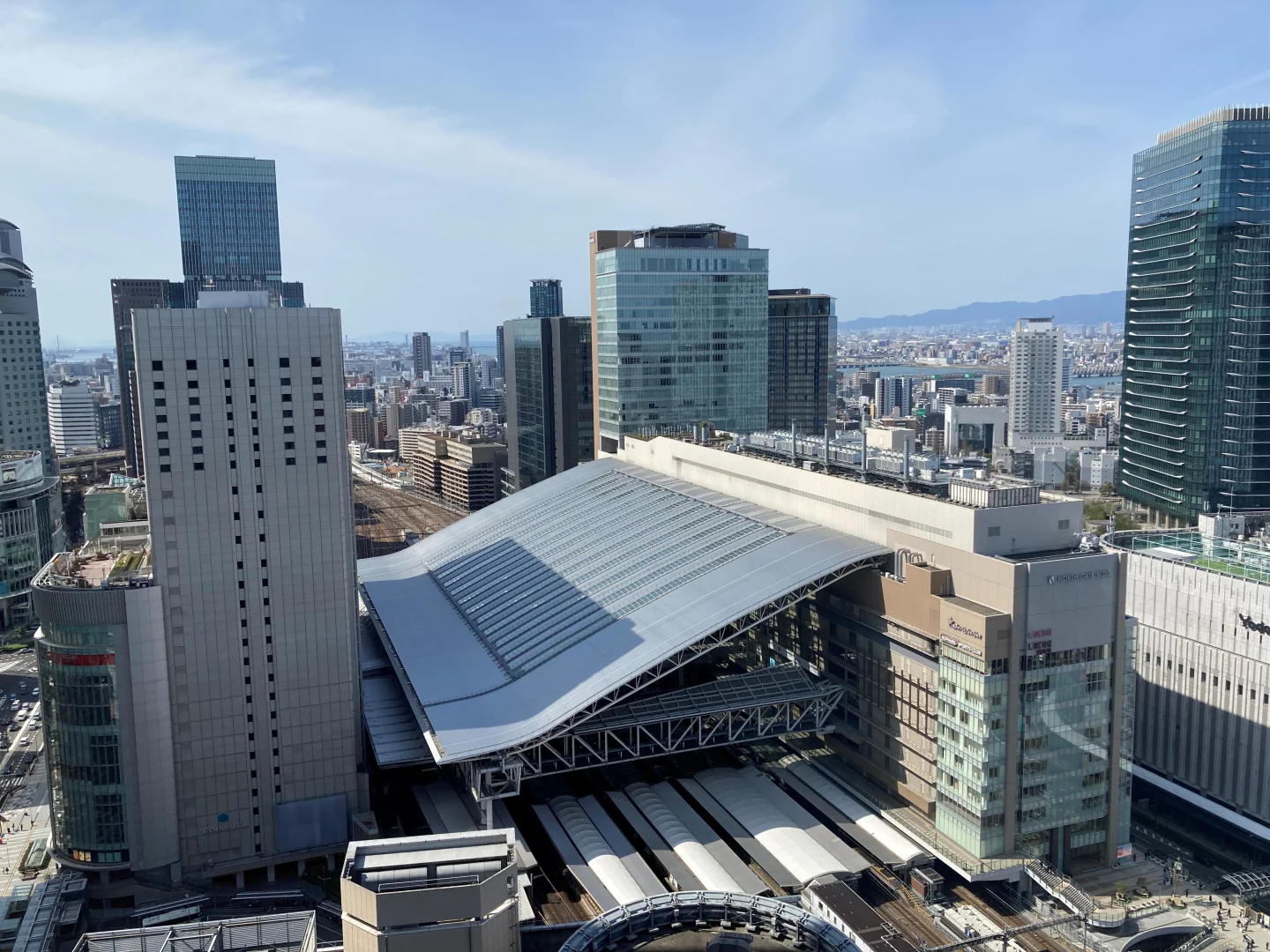
Choose your Umeda base by the trains and exits you use most. Compare direct JR Osaka Station hotels, Chayamachi and Nakatsu, and Higashi-Umeda and Sonezaki, plus Kansai Airport transfers, Kyoto, Kobe and Nara day trips, family rooms and rainy-day routes.
Direct Access at JR Osaka Station: Central Gate vs West Gate
The upper-level Renrakukyo (Bridge) Gate, street-level Central Gate and West Gate at JR Osaka Station lead to completely different hotels. Arriving on the HARUKA puts you on the underground platforms, where an internal passage connects directly to the West Gate. If you are staying on the west side, follow station signs inside the concourse to the West Gate before tapping out, avoiding any orientation guesswork at street level. If your hotel is near the Central Gate, build in extra time to get up from the underground platforms to your target exit. JR's Osaka Station layout map shows all concourse transfer routes floor by floor, while its accessibility guide lists which gates and platforms have lifts.
THE OSAKA STATION HOTEL sits inside JP Tower Osaka, home to KITTE Osaka; from the JR Osaka Station West Gate you can walk straight to the ground-floor hotel entrance and take the lift to reception on the 29th floor. If you arrive on the HARUKA, use the internal passage from the underground platforms to the West Gate and head straight into the building. From Kansai Airport by coach, the stop the hotel lists as roughly a two-minute walk is HERBIS OSAKA. Both arrival routes keep you on the station's west side, keeping the final stretch short in heavy rain or when travelling with older relatives.
Hotel Granvia Osaka is also connected to Osaka Station, but on the southern side. Its shortest walking route uses the Central Gate or Sakurabashi Gate, which involve stairs or escalators. When travelling with a pushchair or wheelchair, switch the hotel's access page to its step-free route and follow the instructions for the lifts from the Renrakukyo Gate. For arrivals on the HARUKA or Kuroshio limited express, the hotel designates the West Gate as the starting point. Pick one main route before you book rather than trying to juggle all four gates in your itinerary.
To the north, Hotel Hankyu RESPIRE OSAKA occupies Yodobashi Umeda Tower, with reception on the 9th floor, an indoor entrance on the 2nd floor, and the main entrance and vehicle drop-off at street level. The hotel quotes around three minutes from the JR Osaka Station 3rd-floor Renrakukyo exit, six minutes from the Umekita Underground Exit and five minutes from the North Gate of Umeda underground station. If you pick up dinner on the north side at LUCUA or GRAND FRONT OSAKA, you can head straight back up to your room in the same area. For taxis, enter the hotel's full name and ground-floor entrance; wheeling suitcases through the shopping-centre entrance only leaves you hunting for lifts.
You will also spot Hotel Hankyu GRAN RESPIRE OSAKA in search results. Despite differing by just one word, the two properties sit in different locations. If companions are arriving separately, share the exact Japanese property name and address from the booking confirmation and agree to meet at the hotel reception rather than saying 'above Yodobashi' or 'Osaka Station North Exit'.
Chayamachi, Nakatsu and Nakazakicho: What Each Saves You
Chayamachi suits travellers who catch Hankyu trains in the morning and dine in Umeda at night. The Chayamachi Gate at Hankyu Osaka-Umeda Station sits on the 2nd floor and feeds a different flow of foot traffic from the 2nd-floor Central Gate and 3rd-floor gates. At Hotel Hankyu International, for instance, official walking times are about three minutes from Hankyu's Chayamachi Gate and three minutes from Exit 4 of Nakatsu Station on the Midosuji Line, compared with around ten minutes from JR Osaka Station's Midosuji Gate and 15 minutes from the Umekita Underground Exit. If you spend a night in Kyoto-Kawaramachi before returning to Umeda, rolling luggage off the Hankyu line is effortless; if you return via JR every evening, that same room adds a noticeable walk.
When browsing hotels in Nakatsu, search separately for 'Midosuji Line Nakatsu' and 'Hankyu Nakatsu'. Midosuji Line Nakatsu is one stop north of Umeda and gives direct underground access if your days revolve around Shin-Osaka, Hommachi and Shinsaibashi. The other Nakatsu on the map belongs to Hankyu; to catch the Hankyu Kyoto Line, it is simpler to walk straight to Osaka-Umeda Station. If you plan to ride one stop from Nakatsu to Umeda and transfer to JR, count the descent to the platform, waiting time, tapping out and the walk between stations. In good weather, walking along the main road is often simpler—just budget the walk to Hankyu or JR separately.
Nakazakicho is one stop north of Higashi-Umeda on the Tanimachi Line. Osaka Convention & Tourism Bureau highlights its preserved wooden row houses (nagaya), many now converted into cafés and independent shops. If you already plan to explore this neighbourhood, choose a place near a main road or an underground exit so you can easily continue towards Tenjinbashisuji and Tenma in the morning. For guesthouses tucked down narrow lanes, evaluate luggage days and sightseeing days separately: a charming corner when strolling hands-free is easy to overshoot in the dark with two heavy suitcases. Pin the final street corner before the lane on your map and check where a taxi can pull up.
Both sit on the north-eastern side of Umeda, yet Chayamachi puts Hankyu at your doorstep while Nakazakicho puts you right on the Tanimachi Line. You can walk between them at street level, though anyone with several early JR departures should filter first by walking distance to the main JR gate. If one travel companion wants an early start while another prefers a late brunch nearby, the shopping-centre side of Chayamachi makes splitting up far easier.
Higashi-Umeda, Sonezaki and Nishi-Umeda After Dark
Higashi-Umeda connects directly into the Whity Umeda underground mall. From the North-East or North-West gates of Tanimachi Line Higashi-Umeda Station, follow signs towards Exit 1 to enter the arcade; on the Midosuji Line use Umeda Station's South Gate towards Exit 13, and on Hanshin use the East Gate. Those three underground approaches are handy when hunting for dinner, though if your hotel is in Sonezaki you should also note the street-level exit nearest your lobby. Check the Whity Umeda floor map for your closest staircase and, if carrying heavy bags, verify which lift reaches street level before committing to a route via Izumi no Hiroba.
Hotels in Sonezaki near the Tanimachi Line are routinely listed under 'Osaka Umeda' on booking sites. Hotel Elcient Osaka Umeda sits in Sonezaki 1-chome and lists official walking times of five minutes from JR Kitashinchi Station, seven minutes from Higashi-Umeda and 12 minutes from JR Osaka Station. You still have to walk to Osaka Station for the JR Kyoto Line, so Kitashinchi's proximity mainly benefits riders on the JR Tozai Line. If you plan to eat along Sonezaki Ohatsu Tenjin-dori in the evening, spot your hotel's turning from the covered shopping street beforehand. Light sleepers should check both room orientation and evening footfall, watching out for main arterial roads, late-night bar entrances and loading bays.
Around Umeda 2-chome and Nishi-Umeda, getting your bearings is easiest when arriving on the airport coach at HERBIS OSAKA. Staying on this side pairs neatly with daytime trips to Hommachi or Yotsubashi on the Yotsubashi Line. If you book dinner in Chayamachi, either save the walk across the station complex for the evening or spend one night dining in the west-side malls instead. When travelling with older relatives, save pins for the West Gate, HERBIS OSAKA and your hotel's vehicle driveway: arriving by rail and departing by coach keeps you on the same familiar side both ways.
In heavy downpours, the underground passages spare you long stretches under an umbrella, while a saved street-level junction with a clear building number helps after dark. Keep in mind that department-store walkways and mall doors open during daytime hours only have fixed closing times. Picking up late-night snacks between your final station and the hotel also saves a second trip back downstairs.
Kansai Airport to Umeda: Choose Your Drop-Off Point First
Both the JR HARUKA limited express and the Kanku Rapid run to Osaka Station. The HARUKA uses the underground platforms, departing back towards the airport from Platform 21; riding a limited express requires both a base fare ticket and a limited express ticket, so book reserved seats if you want to sit together. Kanku Rapid trains for the airport depart from ground-level Platform 1. On coupled services combining Kanku Rapid and Kishuji Rapid carriages, board the front four carriages marked for Kansai Airport, as the train splits at Hineno. On the return leg with shopping bags in tow, confirm your ticket gate and platform level before entering, and double-check the train destination on Platform 1, which also dispatches Osaka Loop Line and Yamatoji Line services.
Standard one-way fares on the airport limousine coach serving the Osaka Station area are ¥1,800 for adults and ¥900 for children. Look at HERBIS OSAKA for the west side, Hankyu Sanbangai for Chayamachi and the Hankyu side, and Candeo Hotels Osaka The Tower for selected Dojima services. Outbound and return timetables are separate, so check the 'From Kansai Airport' timetable for arrival stops when booking your hotel. Coaches departing Terminal 1 between 8:45 and 19:30 and Terminal 2 between 9:12 and 19:17 bypass Hankyu Sanbangai; if you land by day for a Chayamachi hotel, weigh the post-train walk against taking the coach to HERBIS and hopping in a street-level taxi.
Late-night coaches follow separate rules. Kansai Airport Transportation announced continued operation from 30 June 2026, with departures at 24:02 from Terminal 2 and 24:15 from Terminal 1, reaching Hankyu Sanbangai in roughly an hour—the sole drop-off stop on this service. Fares are ¥2,700 for adults and ¥1,350 for children, payable by cashless methods only. If you board past midnight, make sure your hotel booking starts on the night your flight lands: touching down on the evening of 3 December and catching the 24:15 coach puts you in Umeda in the early hours of 4 December, yet your stay must begin on 3 December. Message reception with your estimated arrival time and confirm late-night entrance and check-in cut-off arrangements.
If your flight arrives at Terminal 2, catching a train first requires taking the free shuttle bus from the ground floor to Aeroplaza—a 7 to 9-minute ride—before walking to Kansai Airport Station. For late arrivals, check your scheduled landing time against passport control, baggage reclaim and shuttle times to prepare both a 'catch the train' and a 'take the late-night coach' plan. Anyone with an early flight out can spend the final night near the airport and keep the middle nights in Umeda. An adult return ticket on the standard coach costs ¥3,300 and is valid for 14 days from the first ride, though it only makes sense if you take the standard daytime coach both ways—mixing in a HARUKA or late-night coach means costing each leg separately. See our Kansai Airport transfer comparison for further options.
Quad Rooms, Quiet Rooms and Multi-Night Stays: Comparing by Room Setup
For family bookings, enter the exact number of adults and children along with every child's age before inspecting available room types. For four guests, count the actual beds first: two double beds, two singles plus two rollaways, or four permanent beds leave very different walkways at night and space to open suitcases. At Hotel Hankyu RESPIRE OSAKA, the 47 m² four-bed room fits four 110 cm beds alongside a separate bath, toilet and washbasin—far more practical than a view when four people are taking turns to shower and brush their teeth. If four-bed rooms are sold out, compare the combined rate for two twin rooms; book an explicit connecting-room plan if you need an internal door, or email the hotel in advance to request rooms on the same floor or next door.
One adult travelling with two children, or a three-generation group, often runs into fine print around child co-sleeping (soine). Check each property's age limit, maximum co-sleeping children per bed and meal charges, and enter the true guest count when booking so you are not forced into extra beds or a rebooking at check-in. Scan room photos for bedside clearance and bathroom doorways; if a wheelchair or folding pushchair needs to fit inside, send the required door width, threshold height and bedside space directly to the hotel. Even when there are lifts from the concourse to the ticket gate, verify the final stretch into the hotel building.
For a quiet night's sleep, check which way the windows face. Rail tracks beside Osaka Station, Sonezaki's bar streets and main thoroughfares create very different noise profiles. Light sleepers worried about trains can ask for a room facing away from the tracks, while those sensitive to corridor noise should request a room away from lifts, ice machines or street-side entrances. Even on high floors, verify the room category's aspect, and favour booking plans that guarantee an orientation over those that only accept preference requests. If children need daytime naps, check blackout curtains and how sleeping zones are partitioned.
Umeda works well as a multi-night base: leave suitcases in one room and carry a daypack to Kyoto or Kobe. If you expect to do laundry around day five, inspect the floor guide to distinguish in-room washer-dryers, on-site coin laundries and dry-cleaning services. At RESPIRE OSAKA, for example, the 24th-floor coin laundry operates 24 hours and a standard 120-minute wash-and-dry cycle costs ¥700—easy to run during an evening rest back at the hotel. For serviced apartments with kitchens, check check-out times, cookware provision and extra cleaning fees. On a short trip a corner to stash bags is plenty; on a week-long stay where you open cases every day, shelving, laundry facilities and space to sit down for breakfast justify a higher budget.
If you arrive before check-in, pick a hotel that stores luggage so you can start exploring from the same station side. RESPIRE OSAKA, for instance, lists standard check-in at 15:00 and check-out at 12:00: arriving from Kansai Airport in the morning, you can drop your bags and catch the Midosuji Line straight down to Namba for lunch. If you have an afternoon flight on your final day, check post-check-out storage rules and pick-up cut-offs on the same reservation, and build baggage collection into your schedule so you are not rushing through lifts and platform transfers.
Budget for the Whole Trip, Including Osaka's Per-Person Accommodation Tax
Osaka Prefecture's current accommodation tax tiers apply to stays from 1 September 2025 onwards. Rates under ¥5,000 per person per night are exempt; ¥5,000 to under ¥15,000 incur ¥200; ¥15,000 to under ¥20,000 incur ¥400; and ¥20,000 or more incur ¥500. The tax is calculated on the room-only lodging charge and included accommodation services, excluding separately itemised meals and consumption tax. Two guests sharing a room-only rate of ¥24,000 per night pay based on ¥12,000 per person, totalling ¥400 for that night. On multi-night stays spanning weekday and Saturday pricing, each night is assessed at its own rate; when a booking screen states the tax is payable on arrival, keep enough yen on hand.
When comparing prices, put total accommodation cost, breakfast, both airport transfers and cancellation terms side by side. If only central station hotels offer a true four-bed room on your dates, compare that rate against two twin rooms slightly further out. Even if a station-side hotel costs more, avoiding a luggage move across three busy transit mornings can easily earn back the difference. Where you only wheel bags on the first night and rely on Osaka Metro thereafter, widening your search to Nakatsu or Higashi-Umeda opens up better value—just compare using identical guest counts, currency and cancellation rules so the true saving is clear.
If you arrive late in Osaka, have yet to book flights or might shift dates, pick a refundable rate first and note the exact cancellation deadline in Japan Standard Time (JST) on your booking log. For group bookings and multi-night discounts, check how early check-out is recalculated. On concert or event nights, pick a hotel along the direct walk back from the venue and compare the full stay total shifted one day earlier or later, checking weekday-versus-weekend swings on the same hotel's calendar rather than guessing which side is cheaper.
Day Trips to Kyoto, Kobe and Nara: Match the Destination to the Operator
If your Kyoto plan starts at Kyoto Station—for sights around the station, Toji or onward JR lines—take the JR Kyoto Line from Osaka Station. For shopping and dining around Kiyomizu-dera, Gion and Shijo-Kawaramachi, compare taking Hankyu directly to Kyoto-Kawaramachi. Note that Hankyu's Kyoto Line platforms at Osaka-Umeda also dispatch trains towards Kita-Senri, so check the destination and train type once inside the gates. Guests in Chayamachi can depart via the Chayamachi Gate in the morning and return through the exact same exit after dinner; if you visit Kyoto Station in the morning and finish in Kawaramachi at night, taking JR out and Hankyu back saves doubling back across Kyoto.
Kobe's two main central stations sound almost identical: JR calls its station 'Sannomiya', whereas Hankyu and Hanshin use 'Kobe-Sannomiya'. Staying near JR Osaka Station's West Gate puts you on the JR Kobe Line; Chayamachi gives you the Hankyu Kobe Line; and hotels next to Hanshin Osaka-Umeda connect straight onto the Hanshin Main Line. If a harbour walk ends around Motomachi or Kobe Port, you can simply ride a different line back to Umeda. Adding Arima Onsen means treating the Sannomiya-to-Arima hop as a separate leg and leaving a cushion for dinner back in Umeda; if shopping and hot springs run into dusk, decide which station entrance you will return through and book dinner along that walk home. Pair city plans with our Kobe Harbour evening guide.
For Nara, take the Yamatoji Rapid from Platform 1 at JR Osaka Station straight to JR Nara Station, then walk or catch a bus to Nara Park. To arrive at Kintetsu-Nara Station instead, ride the Midosuji Line from Umeda to Namba and transfer to Kintetsu at Osaka-Namba. You can also split arrival and departure—arriving close to the park and strolling down Sanjo-dori to JR Nara for the return—though anyone travelling with toddlers or older relatives will usually prefer the direct train with minimal transfers, adding a short bus hop in Nara if needed.
Save Wakayama for a full day. From Osaka Station's underground platforms, the Kuroshio limited express runs down towards Wakayama and Shirahama, while ground-level platforms offer the Kishuji Rapid into central Wakayama—just be careful to distinguish JR Wakayama Station from Nankai Wakayamashi Station. For trains along the Nankai network towards Kada, check Nankai's own timetables and connections. If you plan to soak in Shirahama and walk the coast the next morning, staying overnight beats doubling back to Umeda late at night. For a Umeda base covering only Kyoto, Kobe and Nara, add up standard point-to-point tickets first: the JR-West Kansai Wide Area Pass costs ¥12,000 for five consecutive days for adults and really pays off when you include long JR stretches like Shirahama, while Hankyu, Hanshin, Kintetsu and underground fares still remain separate.
Umeda or Namba? Three Trip Patterns to Decide
If you land from Kansai Airport on night one, visit Kyoto on day two, Kobe on day three and stay in central Osaka on day four, Umeda makes an ideal single base. Early starts and late returns from Kyoto and Kobe work seamlessly, leaving evening shopping for when you step off the train. Lock in which rail operator serves both day trips: choose the Osaka Station side if both run on JR, or Chayamachi if both rely on Hankyu. If only a Nara trip uses Kintetsu and you would rather not move hotels with bags, a single extra underground transfer on Nara day is painless.
If most evenings revolve around Dotonbori and Namba, or you use Nankai for both airport legs, base yourself in Namba instead. Nankai's Rapi:t limited express and Airport Express run straight between Kansai Airport and Nankai Namba Station. Check the exact exit even there, as Namba spans separate Osaka Metro, Kintetsu and JR stations. Staying in Namba with occasional shopping trips to Umeda just means hopping back down the Midosuji Line at night, and a single daytime trip to Kyoto simply carries a slightly longer outbound leg. Our Namba hotel areas guide compares Nankai against the other Namba stations.
When Kyoto takes two or more days and you want early-morning temple visits or evenings along the Kamogawa, move part of your stay to Kyoto. Factor in packing, check-out, luggage storage and the new hotel's check-in window when weighing the switch: one smooth sequence is covering Osaka, Kobe and Universal Studios Japan first, then moving to Kyoto for two nights before continuing on. See our Kyoto Karasuma stays guide if most of your sights cluster around Shijo and Kawaramachi. Conversely, if four travellers rely on one family room and moving bags is a chore, staying put in Umeda and commuting back and forth on two Kyoto days remains practical.
Only split a stay between two Osaka hotels if the second night brings a clear change of scene. From northern Umeda, Nakanoshima is close enough on foot or by train for an easy half-day riverside stroll; reserve riverside hotels as a base only when quiet morning runs and minimal intercity rail travel are your priority.
Rainy Days with Children, or a Slower Pace with Older Relatives
On clear mornings, head to Universal Studios Japan from Platform 1 at JR Osaka Station. Take a direct service to Universal City whenever one appears on the departure board, or ride to Nishikujo and change onto the JR Yumesaki Line. If you want to arrive before gates open, pick up breakfast items the evening before or verify how early your hotel's breakfast opens. Anyone queuing early for timed entry tickets avoids an extra morning underground hop by staying near a JR ticket gate; if you stay out until dinner, pick a restaurant near your return station so children can sit down straight off the train.
Save Osaka Aquarium Kaiyukan for a rainy day: take the Midosuji Line from Umeda to Hommachi and transfer to the Chuo Line for Osakako, about a five-minute walk from Exit 1. Follow the lift signs when changing at Hommachi with a pushchair so you only open umbrellas for the final stretch at Osakako. If rain arrives only in the afternoon, dine and shop around the complexes north of Osaka Station, or stroll between Umeda and Higashi-Umeda via Whity Umeda until skies clear. Before shifting an attraction to another day, check timed-ticket change policies and remaining slots at your alternative indoor venue; our Kaiyukan family tickets guide sets out entry options.
When meeting older relatives in Umeda, a photo of a landmark works far better than 'meet at the exit'. Agree to meet at a hotel's ground-floor entrance during the day and ride the lift up to the restaurant together rather than sending everyone straight to a department-store floor. Lifts are often shared with luggage-toting travellers, so build in extra buffer whenever you change levels twice. Save screenshots of JR Osaka Station's concourse map—showing gates, platforms and lifts—and Osaka Metro's street-level lift map: if anyone gets separated, they can read out an exact label like 'outside West Gate'.
Osaka Metro offers a 30-minute out-of-station transfer allowance between Midosuji Line Umeda, Higashi-Umeda and Nishi-Umeda for eligible tickets and routes. If you plan to stop in the underground arcade for dinner, tap out to end the first journey and start a fresh ride afterwards. Switching between JR, the underground, Hankyu and Hanshin always means exiting one operator's gates and entering another's, even through underground walkways, so keep those transfers for unhurried meal or shopping breaks rather than tight train connections.
One Evening in Umeda: Put the Sky Building Before Returning to Your Room
Umeda Sky Building stands north-west of Osaka Station, making a west-side hotel ideal for dropping bags before heading over for dusk. Ticket sales are on the 39th floor; use the dedicated Kuchu Teien Observatory entrance outside rather than following office workers into the main tower lifts. Standard hours are 9:30 to 22:30 with last entry at 22:00, and admission is ¥2,000 for adults, ¥500 for ages four through primary school, and free for under-fours. Note that on 18 April 2027 the observatory closes early at 18:00 (last entry 17:30) for equipment inspection, so move your visit to another evening if you will be in Kyoto that afternoon.
If you are aiming for city lights after dark, pick up water or snacks north of Osaka Station on the walk over. In heavy rain or high winds, save the open-air rooftop for another night and dine near Umeda Station or browse the South Building of GRAND GREEN OSAKA instead. Guests staying on the west side can eat west or north of JR Osaka Station and pick up stored luggage on the walk back; if you only have one evening and low cloud rolls in, swap the skyline for dinner north of the station and scope out your Kyoto or Kobe departure platforms afterwards if you have an early JR train the next morning.
A few useful answers
For a first stay in Umeda, should I choose JR Osaka Station or Chayamachi?
Look around JR Osaka Station first if you are catching the HARUKA or taking JR to Kyoto Station and Universal Studios Japan. Pick near the Chayamachi Gate if you mostly ride Hankyu to Kyoto-Kawaramachi and Kobe-Sannomiya.
Are Osaka Station and Shin-Osaka Station the same?
No—Osaka Station sits in Umeda, while Shinkansen bullet trains stop at Shin-Osaka Station. From Umeda, reach Shin-Osaka via the JR Kyoto Line from Osaka Station or the Midosuji Line from Umeda underground station.
Which airport coach stop in Umeda should I pick from Kansai Airport?
Compare HERBIS OSAKA for the west side of Osaka Station, Hankyu Sanbangai for Chayamachi and the Hankyu side, and Dojima for selected services. Daytime airport departures skip Sanbangai during set hours, while the late-night extended coach stops only at Sanbangai.
How should I book a room for four in Umeda?
Enter every guest's age and total headcount first, then compare four permanent beds against two doubles or two twin rooms. Check each hotel's co-sleeping age limits, per-bed child caps and meal charges.
Do I need to change trains to reach Nara from Umeda?
No if you take the Yamatoji Rapid direct from JR Osaka Station to JR Nara. To arrive at Kintetsu-Nara instead, ride the Midosuji Line to Namba and change to Kintetsu at Osaka-Namba.
Official information and references
Sources used in this guide.
- JR-West | Osaka Station Layout Map, Ticket Gates and Platforms
- JR-West | Osaka Station Step-Free Access Routes
- JR-West | Shin-Osaka Station Layout Map for Shinkansen Transfers
- Hankyu Railway | Osaka-Umeda Station Map, Timetables and Directions
- Hanshin Electric Railway | Osaka-Umeda Station Guide
- Osaka Metro | Out-of-Station Transfers Between the Three Umeda Stations
- Osaka Metro | Nakatsu Station on the Midosuji Line
- Osaka Metro | Nakazakicho Station Layout Map on the Tanimachi Line
- Osaka Chikagai | Whity Umeda Access and Exits
- Osaka Convention & Tourism Bureau | Nakazakicho Neighbourhood Guide
- THE OSAKA STATION HOTEL | Access via JR West Gate and Airport Coach
- Hotel Granvia Osaka | JR Ticket Gates and Step-Free Access
- Hotel Hankyu RESPIRE OSAKA | Walking Times from Station Exits
- Hotel Hankyu RESPIRE OSAKA | Entrance Floors, Check-In Hours and Laundry
- Hotel Hankyu RESPIRE OSAKA | Four-Bed Room Specifications
- Hotel Hankyu GRAN RESPIRE OSAKA | Hotel Location and Access
- Hotel Hankyu International | Routes from Chayamachi Gate, Nakatsu and JR Osaka
- Hotel Elcient Osaka Umeda | Sonezaki Address and Walking Times
- Kansai Airport Transportation | Osaka Station Area Coach Timetable, Stops and Fares
- Kansai Airport Transportation | Extension of Late-Night Osaka Station Coach Service from 30 June 2026
- JR-West | Guide to HARUKA, Kanku Rapid and Train Splitting at Hineno
- Nankai Electric Railway | Kansai Airport and Namba Connections
- Osaka Prefecture | Current Accommodation Tax Tiers and Effective Date
- Osaka Prefecture | FAQ on Accommodation Charges and Tax Calculation
- JR-West | Kansai Wide Area Pass Price and Coverage
- Universal Studios Japan | Rail Access Guide
- Osaka Aquarium Kaiyukan | Osakako Station Exit and Walking Time
- Umeda Sky Building | Kuchu Teien Observatory Hours, Fares and Dedicated Entrance
- GRAND GREEN OSAKA | South Building Floor Guide
- Hankyu Railway | Lines Serving Hankyu Nakatsu Station
- THE OSAKA STATION HOTEL | Hotel Floors and West Gate Entrance
- Kansai International Airport | Terminal 2 Free Shuttle Bus
- JR-West | Yamatoji Rapid Timetable (November 2026)
- JR-West | Kuroshio Limited Express and Shirahama Station Timetable
- Nankai Electric Railway | Wakayamashi Station to Kada Line