Compare staying near JR Tennoji East Exit, Abeno Harukas, Tennoji Park and Shitennoji-mae Yuhigaoka for airport arrivals, family afternoon naps and Nara day trips, with room layouts, underground exits and 2026 fares for three hotels.
- Region & Focus
- OsakaAccommodation
- Reading Scope
- 18 min read · 8 chapters · 5 Q&As
- Official Verification
- 34 official sources checkedUpdated 22 November 2026
- Key Topics
- Where to stayNeighbourhoodsBooking
Chapter Route Map (tap any stop)
- Choosing Your Side of the Station from Your First Walk Each Day
- Room Layouts, Bathrooms and Night Entrances at Three Stationfront Hotels
- Factoring Accommodation Tax, Breakfast and Date Changes into the Rate
- Getting Between Kansai Airport and Tennoji: HARUKA vs Kansai-Airport Rapid
- Take JR to Nara Park, and Osaka-Abenobashi for Yoshino
- A Day in Tennoji Park: Picking the Right Zoo Gate
- HARUKAS 300: Dusk Crowds, Rainy Days and Winter Bookings
- Splitting Nights Between Tennoji, Namba and Umeda
- Quick Q&A
If this is your first stay in Tennoji and you have large suitcases or an early JR train the next morning, start with a hotel near JR Tennoji Station's East Exit. Families planning to spend most of their time at the zoo will find it far easier to slip back for afternoon naps if they book near the park entrance. Only stretch the budget for the Abeno Harukas tower if watching Osaka's night skyline from your room really matters to you. On a map, these three spots look right on top of one another; in practice, the difference comes down to how many wide roads you cross each day, which ticket gate you use, and whether you can walk indoors when it rains. From Kansai Airport, direct JR trains run straight to Tennoji, and JR trains also run directly to Nara Station for Nara Park.
Choosing Your Side of the Station from Your First Walk Each Day
Open your booking map and mark JR Tennoji Station, Osaka Metro Tennoji Station and Kintetsu Osaka-Abenobashi Station separately. JR is the gateway for Kansai Airport, Nara City and the Osaka Loop Line. The underground has the Midosuji Line (M23) and the Tanimachi Line (T27): the former runs to Namba, Shinsaibashi and Umeda, while the latter serves Shitennoji-mae Yuhigaoka, Tanimachi 4-chome and Higashi-Umeda. Kintetsu's entrance sits around Abeno Harukas and mainly serves the Minami-Osaka Line. Underground passages link the stations, yet when wheeling heavy luggage, simply walking out of the wrong underground ticket gate adds an unnecessary detour.
Kintetsu's August 2026 station map lists standard walking times from the centre of its platforms via the West Gate: about 6 minutes to the JR ticket gates, about 5 minutes to the Midosuji Line and about 7 minutes to the Tanimachi Line, all with step-free routes. Those minutes only get you to the next operator's ticket gates. If you are returning from Yoshino in the evening and heading to Namba for dinner, look for the Midosuji Line after exiting Kintetsu's West Gate; walking to the Tanimachi Line takes longer and will not get you to Namba. If you are just heading back to a hotel near the East Exit, search the route to the hotel entrance directly so you do not walk to the JR gates first and double back.
The JR East Exit suits travellers treating Tennoji primarily as a rail hub. Miyako City Osaka Tennoji's official directions quote roughly a 1-minute walk from the JR East Exit, with underground access via Midosuji Line Exit 3. Having that single corridor dialled in makes next-day trips to Nara and airport departures effortless. The JR Central Gate is better positioned for Tennoji Park, the Kintetsu department store and Abenosuji. If a listing pin simply says 'Tennoji Station', check the hotel's own access map to see whether it actually routes guests to the East Exit, the Central Gate or Kintetsu's West Gate.
If you want shopping, dining and your room under one roof, pick Harukas on the south side of the station. Osaka Marriott Miyako Hotel occupies the tower itself, with official JR walking directions starting from the Central Gate and leading into the tower's dedicated lift up to the 19th-floor lobby. For couples who care about the night view, the room rate buys you quiet time looking over the city lights after dinner. If older family members in your group will be going out to catch JR trains every day, factor in the extra lift transfers and the walk to the platforms.
Travelling with children to the park? Set the Tenshiba entrance of Tennoji Park as your walking endpoint on the map. The lawn entrance, the zoo's Tenshiba Gate and the Osaka City Museum of Fine Arts are three separate points, and there is still a walk along park paths once you leave the station. Staying on the park entrance or Chausuyamacho side makes morning zoo visits and post-lunch naps back in the room much easier to manage. If the family is only visiting the zoo once and using JR on all other days, saving the effort of hauling suitcases further from the station is usually the better trade-off.
If you want Shitennoji Temple as a daily morning stroll, consider staying around Shitennoji-mae Yuhigaoka Station. The temple's official walking times are about 5 minutes south from that station, or about 12 minutes north from JR Tennoji. Booking in Yuhigaoka puts you right beside the temple, the Tanimachi Line and the east side of Nipponbashi, though heading back for the HARUKA airport express requires taking the Tanimachi Line one stop or walking down to Tennoji. When comparing two properties, trace three routes for each — arrival check-in, returning from your last dinner and departure — and only take on the extra walk if the neighbourhood itself fits your trip.
| Location | Best-Suited Itinerary | Landmarks to Check First |
|---|---|---|
| JR Tennoji East Exit | Heavy luggage, direct airport trains, JR Yamatoji Line to Nara | JR East Exit or Midosuji Line Exit 3 |
| Abeno Harukas & Asahimachi | Department store dining, high-rise views, Kintetsu trains to Yoshino | Kintetsu West Gate, tower lobby entrance or Apollo Building |
| Near Tennoji Park Entrance | Tennoji Zoo, midday naps back in the room, Osaka City Museum of Fine Arts | Tenshiba entrance, Abechika underground arcade |
| Around Shitennoji-mae Yuhigaoka | Morning temple walks, Tanimachi Line-focused trips | Shitennoji-mae Yuhigaoka Station and hotel entrance |
Compare staying near JR Tennoji East Exit, Abeno Harukas, Tennoji Park and Shitennoji-mae Yuhigaoka for airport arrivals, family afternoon naps and Nara day trips, with room layouts, underground exits and 2026 fares for three hotels.
Room Layouts, Bathrooms and Night Entrances at Three Stationfront Hotels
Multi-generational groups can start with the room listings at Miyako City Osaka Tennoji. Standard Twins are 24 sq m for up to 2 guests, and Standard Triples are 27 sq m for up to 3. Selected 27 sq m Superior Twins can accommodate 3 guests with a paid extra bed, so check the room type and extra-bed plan together when booking. The Quadruple Room is listed at 37 sq m for up to 4 guests, with a separate bathroom and toilet that makes busy mornings much calmer. Its official FAQ lists standard check-in from 15:00 and check-out at 11:00, with left-luggage storage at reception both before check-in and after check-out. If you are heading to the park on arrival morning, drop your bags and simply walk west from the station front.
Via Inn Abeno Tennoji sits in Asahimachi, about a 2-minute walk from Midosuji Line Tennoji Station Exit 5 according to the hotel's website. Its twin rooms come in two noticeably different layouts. The 15 sq m Compact Twin has two 90 cm beds and a modular unit bathroom — fine for one night with cabin bags. The 20 sq m Twin offers two 100 cm beds plus a separate bath and toilet. If you need a child's step stool or a proper soak in the tub, those extra 5 sq m of floor space are far more practical than paying for a higher-floor view. Both twin types have a maximum capacity of 2 guests, so if three travellers each need their own bed, search directly for a triple or two separate rooms.
Via Inn's accessible room is 26 sq m for up to 2 guests and is bookable by telephone only. If a wheelchair needs to enter the bathroom, share the chair's width and transfer side when booking and ask the hotel to confirm doorway clearance and bedside space before locking in the room. For longer stays, coin laundry machines are on the 10th floor and a microwave is in the 7th-floor lounge. Between 01:00 and 06:00, the main automatic entrance locks and requires your room keycard. If your first-night flight lands late, send your arrival date and estimated arrival time to reception before travelling, and contact them under your booked check-in date even if you will arrive after midnight.
Osaka Marriott Miyako Hotel is the choice when high-rise views are part of the experience itself. Enter the tower from the Kintetsu department store side at Osaka-Abenobashi and take the lift to the 19th-floor lobby; official standard hours are 15:00 check-in and 12:00 check-out. If you are staying only one night before an early flight, you will likely only sit by the window for a single evening; paying extra makes far more sense on a night when you can linger over breakfast and watch the morning sky clear. When comparing room categories, check aspect, bed count and maximum occupancy separately. If a child needs their own bed, add the extra bed and guest count to your search before choosing the room size.
At the Osaka Marriott, connecting Superior Twin and Superior Double rooms are available in limited numbers and must be requested at booking. Parents splitting up with one child each who want to move easily between both rooms should enquire about this pairing early. Official policy allows children under 12 sharing existing beds to stay free of charge, whereas a child needing an individual bed is charged at the adult rate; cots can be borrowed free of charge with advance notice. Room pricing also varies depending on whether breakfast is included, so search using your children's exact ages and bedding needs.
With the same budget, you can also split rooms. For four adults with four large suitcases, compare the total multi-night rate for one quadruple room versus two twins. Two rooms give you an extra bathroom and let early sleepers turn in without disturbance; one larger room keeps children within sight and luggage in one place. Before picking two rooms, request the same floor or adjacent rooms on your booking and put anyone needing closer assistance in the same room. If you plan to do laundry or warm up meals daily, compare where shared facilities sit inside each hotel: doing laundry every couple of days works fine with a single laundry room, whereas heating baby food every day makes microwave floor access much more noticeable.
Light sleepers should check a local map to see which road sits right below the window. Main boulevards, railway tracks and lift lobbies all carry different noise profiles. Start by choosing a clearly marked non-smoking room with a specified aspect, and ask the hotel for a room away from lifts and main roads. Even if you stay along the quieter lanes by the temple, think through your late-night walk back — especially when returning with luggage after dinner in Shinsekai, sticking to main streets or taking the underground to the exit closest to your hotel is much easier to navigate than cutting through the park.
Factoring Accommodation Tax, Breakfast and Date Changes into the Rate
Osaka Prefecture levies an accommodation tax per person, per night based on the nightly room charge. Under the current brackets, stays under ¥5,000 are exempt, ¥5,000 to under ¥15,000 incur ¥200, ¥15,000 to under ¥20,000 incur ¥400, and ¥20,000 or more incur ¥500. These brackets apply to stays from 1 September 2025 onwards, determined by the actual stay date rather than when you booked or paid. Mandatory charges tied to the stay such as bedding or service fees count towards the taxable room rate, while meals and consumption tax are excluded.
Take two adults staying three nights: if the taxable room charge is ¥12,000 per person per night, the total accommodation tax comes to ¥1,200; at ¥17,000 per person per night, it is ¥2,400. When checking booking platforms, enter your exact guest count and dates first, then inspect the final checkout breakdown to see what is collected online and what is payable at the property. When two quotes are only a few hundred yen apart, check-out times, breakfast inclusion and free date-change flexibility usually matter more. Across weekday and weekend nights, comparing night-by-night rates is clearer than relying on a blended nightly average.
For Golden Week, cherry-blossom weekends or New Year holidays, lock in rooms with three or more beds first. If your rate allows free cancellation, save the deadline in your calendar in Japan Standard Time (JST) and re-check prices once train times and group numbers are settled. If the first half of your trip is in Nara or Kyoto and Tennoji comes at the end, luggage forwarding lets you travel light on transfer days — just leave a realistic arrival window at the hotel to collect or hand over bags. Judge Tennoji's value across the whole itinerary: a well-sized triple on a busy Saturday can still undercut two twins one stop further out.
Even at the same hotel, standard direct rates and travel-agency packages can carry different cancellation terms. Osaka Marriott Miyako Hotel's FAQ notes standard cancellation fees of 20% the day before check-in, 80% on the day and 100% for a no-show without notice, while individual plans may specify their own rules. If you are waiting on companions' schedules or flight confirmations, rely on the booking page's specific cancellation policy rather than general FAQ wording. Should an overnight flight be rescheduled, update your check-in date or notify reception of a late arrival in advance so the first night is not marked as a no-show.
Check your morning departure times before adding hotel breakfast. If your first train leaves before breakfast service opens, save the money for the airport or pick something up the night before. If you plan to browse the Kintetsu department store on arrival day, its basement level sells Japanese and Western pastries and bread that make an easy breakfast the next morning. On days when reception holds your bags and you return later to collect them, try to go in and out via the same ticket gate side in one trip; station lockers have strict size limits and fill up quickly, which is awkward when you have a fixed airport train to catch.
Getting Between Kansai Airport and Tennoji: HARUKA vs Kansai-Airport Rapid
Kansai Airport Station serves both JR and Nankai, so if your hotel is next to JR Tennoji, head through the JR ticket gates. Both the HARUKA limited express and the Kansai-Airport Rapid run directly to Tennoji — around 30 minutes on HARUKA and about 50 minutes on the Rapid, plus extra time for waiting, collecting tickets and exiting the station. If you land with two or more large suitcases or have travellers who struggle standing for long stretches, look first for a HARUKA departure with available seats. Most of the time, if you would have to wait for the next limited express, compare the actual arrival times of both services: the train you can board right after landing is often the one that gets you in sooner.
HARUKA requires both a basic fare and a limited express supplement. JR West's discounted one-way HARUKA ticket for eligible short-term foreign visitors costs ¥1,600 for adults and ¥800 for children aged 6 to 11 between Kansai Airport and Tennoji. Make sure you select Tennoji as your destination when purchasing, as Osaka, Shin-Osaka and Kyoto each have their own fare zones. With a transit IC card, you can tap straight on to the Kansai-Airport Rapid, whereas boarding HARUKA requires a valid limited express ticket or pass covering the express leg. Keep every family member's paper or digital tickets handy and double-check passenger counts and train times before tapping through the gates.
Heading back to the airport, some Kansai-Airport Rapid trains run coupled with Kishuji Rapid services and split at Hineno Station. For Kansai Airport, board the front four carriages in the direction of travel, checking the 'Kansai-Airport' destination displays on the platform and carriage sides before stepping aboard. If you spot 'Wakayama' on a carriage at Tennoji, walk along the platform to the front section there rather than hauling suitcases between carriages at Hineno. For HARUKA towards Kansai Airport, the JR station map directs passengers to Platform 15; Kansai-Airport Rapid services can depart from different platforms, so follow the live departure boards rather than relying on a single fixed sign.
When building your airport-bound schedule, add buffer time for collecting luggage from reception, taking lifts, walking, waiting for the train and transferring between terminals. For Terminal 2 flights, leave Kansai Airport Station and head to the ground-floor bus stop at Aeroplaza for the free shuttle bus, which takes 7 to 9 minutes plus waiting time. On late-night arrivals, list the last few JR departures alongside your hotel's reception cut-off on one sheet, and message the hotel promptly if your flight is noticeably delayed. If your return flight is very early on the final morning, consider moving just your last night near the airport — one move after three well-placed nights in Tennoji, Nara and Namba is easier than commuting from further out all week. See Kansai Airport transfers for route and terminal details.
Take JR to Nara Park, and Osaka-Abenobashi for Yoshino
For Nara Park and Todai-ji Temple, aim for JR Nara Station by taking a Yamatoji Rapid bound for Nara or Kamo from Tennoji. Check the departure board destination first, as services terminating at Oji require a change. JR Nara sits further from the western edge of the park than Kintetsu-Nara, making it a natural fit if you want lunch along Sanjo-dori before strolling up; to save your legs for Todai-ji and the park's slopes, hop on a local bus outside JR Nara towards the park. On the way back, if you end up near Kintetsu-Nara Station, you can take the Kintetsu Nara Line to Osaka-Namba and transfer to the Midosuji Line back to Tennoji.
The same distinction applies if you are staying upstairs in Harukas. For Nara City, take the lift down and walk across to JR rather than turning into the 'Kintetsu' gates right below the tower. Trains from Kintetsu Osaka-Abenobashi run on the Minami-Osaka Line, connecting with the Yoshino Line for Kashiharajingu-mae, Asuka and Yoshino. Yoshino is also in Nara Prefecture, yet it sits on an entirely different railway line from Nara Park. If your itinerary includes both cherry blossoms in Yoshino and deer in Nara Park on separate days, staying near the Tennoji Central Gate or Abeno station front keeps both stations right at your feet.
For Kyoto, you can catch a HARUKA service from JR Tennoji that stops at Kyoto Station. On regular trains, take the Osaka Loop Line to Osaka Station and transfer to a Special Rapid on the JR Kyoto Line, allowing a few minutes to walk between platforms. If you plan two early starts in Kyoto, shifting one night to Kyoto Station or basing yourself around Umeda saves travel time morning and evening. For a single day trip to Kyoto, staying put at Tennoji spares you half a day of checking out, storing bags and locating a new hotel.
For Sakai, choose your line based on your first stop. From JR Tennoji, take a Hanwa Line train stopping at Mozu; walking about 350 metres west from Mozu Station brings you to the Mozu Tombs Visitor Centre next to Daisen Park (open 09:00–18:00, closed over New Year). On weekends and Japanese national holidays between 20 March 2026 and 28 March 2027 (except 1–3 January 2027), a free shuttle bus links the visitor centre with Sakai Old Port via Sakai Plaza of Rikyu and Akiko — handy for combining the ancient burial mounds and tea culture in one day. If you only want Sumiyoshi Taisha Shrine, take the Hankai Tramway from Tennoji-ekimae Station outside underground Exit 11 for about 16 minutes to Sumiyoshitoriimae, an easy half-day outing from a Tennoji base.
A Day in Tennoji Park: Picking the Right Zoo Gate
If you have preschoolers, check Tennoji Zoo's opening calendar first and plan your visit for the morning. Standard hours are 09:30–17:00 with last entry at 16:00, and some animals move off-view after 15:00. Admission is ¥800 for adults, ¥200 for primary and junior high school pupils living outside Osaka City, and free for preschoolers. The zoo typically closes on Mondays, shifting to the following day when Monday falls on a public holiday, with extra openings listed on its 2026–2027 fiscal calendar during spring break and New Year. If your trip spans New Year, check the zoo's April 2026 to March 2027 calendar directly rather than assuming a standard Monday closure.
To enter via the zoo's Tenshiba Gate from Tennoji Station, the zoo lists both walking and lift routes from the JR Tennoji Central Gate, Midosuji Line West Gate and Kintetsu Osaka-Abenobashi West Gate. Allow 5 to 10 minutes on foot, or 10 to 15 minutes using lifts. If you only want to see one or two zones, mark your target enclosures and nearby toilets on the map and exit back out the same gate to return to your hotel. If you are heading to Shinsekai for a meal afterwards, leave via the Shinsekai Gate at the far end instead of doubling back across the park — walking over to the shopping arcade before the lunch rush also lets anyone needing an early rest head back cleanly.
When part of the group splits off to pick up breakfast in the morning, the lawn at the park entrance makes an easy meeting point. Tenshiba, Tennoji Park's entrance zone, generally opens 07:00–22:00, with individual shops keeping their own hours. The 'Tenshiba+' facility in the entrance area has toilets and nursing rooms open 06:00–24:00, useful for a quick stop with small children before entering the zoo. If you stay out in Shinsekai for a late supper, walk back along the main roads outside the park or take the Midosuji Line after 22:00 so you do not arrive at a locked park gate and have to turn round.
For dinner in Shinsekai, you can ride the Midosuji Line one stop north from Tennoji (M23) to Dobutsuen-mae (M22). The zoo's step-free route to the Shinsekai Gate uses Dobutsuen-mae Exit 1, while lift users follow signage from the East Gate; JR Shin-Imamiya Station also has a Tsutenkaku Exit (East Exit) nearby. Agree on an exact exit before splitting up in the evening so everyone finds their way back smoothly. Going back by underground from Dobutsuen-mae, Tennoji is the next stop in the Showacho / Nakamozu direction.
Another easy pairing is Shitennoji Temple in the morning and Tennoji Park in the afternoon. The temple's inner halls, Central Precinct (Chushin Garan) and garden generally open at 08:30, closing at 16:30 from April to September and 16:00 from October to March, while the outer grounds remain accessible around the clock. Central Precinct admission is ¥500 for adults, ¥300 for senior high school students and free for primary and junior high school pupils. Buy a Central Precinct ticket if you want to see the Kondo hall and five-storey pagoda up close, or save a quiet grounds stroll for before your final meal in the city; on the 21st and 22nd of each month, the Central Precinct opens free of charge under temple notices, so pick another morning if you prefer fewer crowds.
Monday and Tuesday stays in particular require separating park attractions and temple visits. Both Tennoji Zoo and the Osaka City Museum of Fine Arts usually close on Mondays, and each publishes its own public-holiday substitute closure schedule. When both are closed on the same day, pair Shitennoji Temple with the Kintetsu department store instead. If you are in Osaka between 1 January and 7 February 2027, Shitennoji's Treasure House announces it remains open daily during its New Year exhibition (typically 08:30–16:00 with last entry 20 minutes before closing, and extended hours on 21 January), offering a reliable indoor option when other venues are shut.
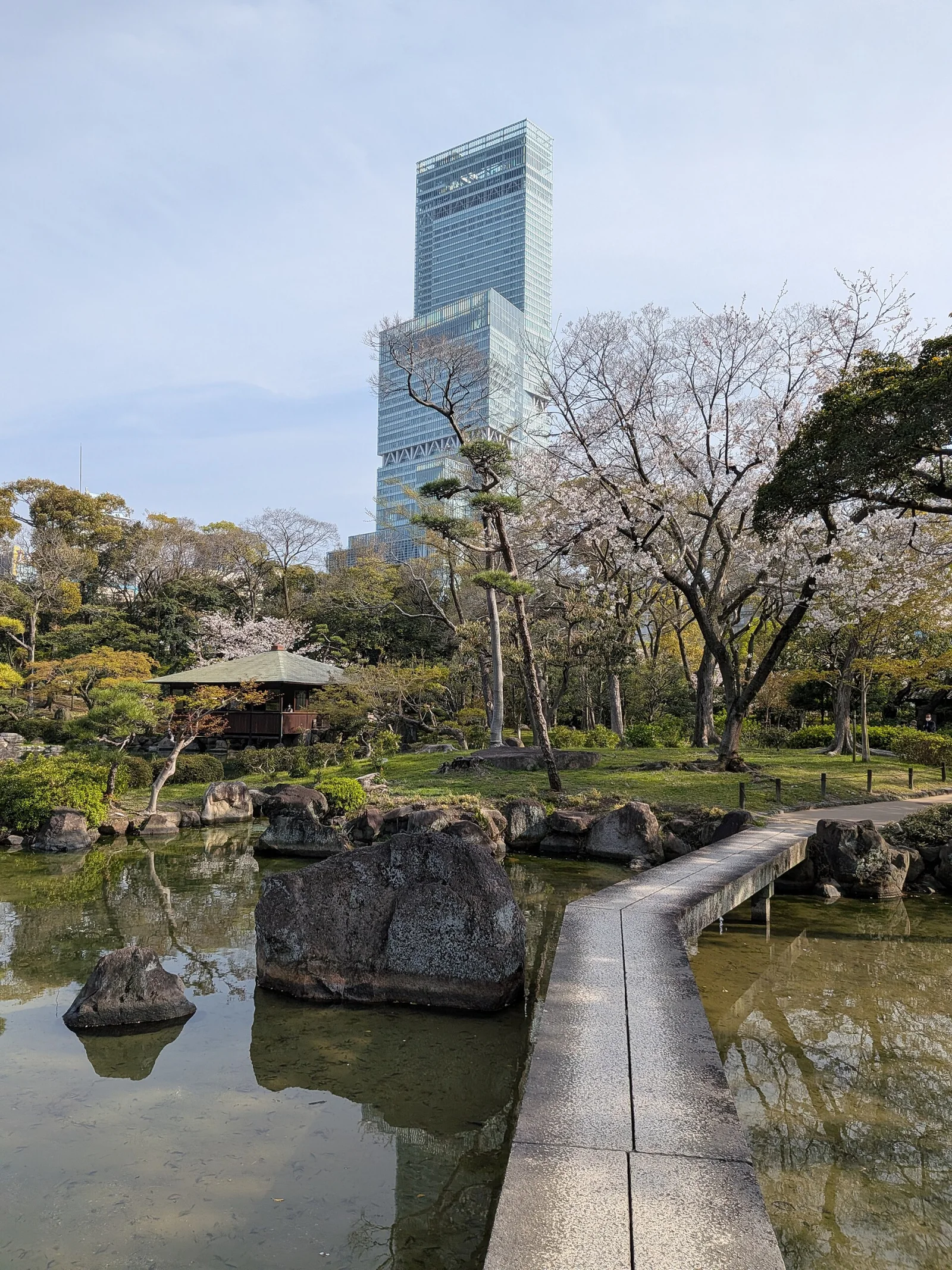
If you only have an afternoon free and want the view from the lead photo above, head to Keitakuen Garden beside the museum. Located inside Tennoji Park roughly 5 minutes on foot from Tennoji Station, it generally opens 09:30–17:00 with last entry at 16:30; adult entry is ¥300. A ¥600 combination ticket covers both the museum's collection galleries and the garden, and showing a special-exhibition ticket at the garden booth takes ¥100 off garden admission per official guidelines. Late in the day, choose either the exhibition or a circuit around the pond rather than cutting last entry fine at both.
HARUKAS 300: Dusk Crowds, Rainy Days and Winter Bookings
From the Kintetsu station or department store, enter the tower and take the shuttle lift up to the 16th-floor observatory entrance before riding up to the top floors. HARUKAS 300 generally opens 09:00–22:00 with last entry at 21:30, and same-day tickets are sold on the 16th floor. From 23 July 2026, same-day admission is ¥2,200 for adults and ¥900 for children (primary and junior high school age; under-6 preschoolers enter free, and 15-year-olds still in junior high pay the child rate). Official online advance tickets bought at least the day before are ¥1,980 and ¥810 respectively; advance QR codes are scanned directly at the 16th floor and are non-refundable.
If you only care about the night skyline, go up after dinner. To catch both daylight and dusk, enter 45 to 60 minutes before local sunset to allow time for queues and lifts. Single-entry tickets do not permit re-entry once you leave, so grab a bite on the ground first if you want to see the light change in one visit. Families planning to eat on the 58th floor should check dining hours separately from observatory admission: food service normally ends at 21:00, an hour before the observatory closes. When photographing through the glass, hold your lens close to the pane to cut down reflections from interior lights and phone screens.
On a rainy day with poor visibility, start at the Osaka City Museum of Fine Arts beside the park. It usually opens 09:30–17:00 with last entry at 16:30; collection exhibitions are ¥500 for adults, while special exhibitions are priced individually. With a baby and minimal appetite for outdoor walking, spend the afternoon inside the Kintetsu department store instead: the 8th floor of the Tower Wing stocks baby and children's goods, dining spans floors 12 to 14, and both the Tower and Wing buildings offer pushchair and wheelchair loans on the 2nd floor. General retail floors close at 20:00, while restaurant floors list standard hours until 23:00, though many individual restaurants shut at 22:00 or earlier — check your chosen spot's last-order time before heading down for dinner, then decide whether visibility is worth queuing for the observatory.
From 29 October 2026 to 28 March 2027, the 58th-floor Sky Garden hosts a seasonal heated kotatsu dining plan. Published hours start at 17:00–21:45 on weekdays and from 11:30 on weekends and Japanese national holidays, with last orders at 21:30. The oden set costs ¥2,480 per adult (minimum two guests), plus separate observatory tickets, and primary-school-aged children and older must order a set. For two adults pairing advance observatory tickets with this plan, the combined total comes to ¥8,920 excluding drinks. If you want this as a centrepiece evening over a New Year stay, book your table before buying observatory admission, as outdoor service may be cancelled in severe weather.
In winter, adjust the order so everyone enjoys the view comfortably. Head up to the enclosed 60th-floor glass observation deck first, let anyone keen for crisp air step out into the 58th-floor open-air garden, and leave the rest of the group indoors. Sitting outside for dinner can feel chilly if someone in your party dislikes the cold; book an indoor weekday dinner instead and simply ride up afterwards for the skyline. If you already have a high-floor city-view room, one evening at the observatory and another watching the lights come on from your room is plenty — save your third dusk for the streets of Shinsekai or a quiet walk past Shitennoji.
Splitting Nights Between Tennoji, Namba and Umeda
If you arrive directly from Kansai Airport on day one, visit the zoo and Shitennoji on day two, and head to Nara on day three, staying all three nights in Tennoji saves you an unnecessary hotel move. On the Midosuji Line, Tennoji to Namba calls at Dobutsuen-mae, Daikokucho and Namba — three stops with no changes. If you only plan one evening in Dotonbori, keep Tennoji as your base and ride the same line back after dinner. If your itinerary revolves around nightly strolls through Shinsaibashi and Dotonbori, or you want a single Nankai train from Nankai Namba to Kansai Airport, stay in Namba instead — just double-check the exact Nankai, Kintetsu/Hanshin, underground and JR station entrances there too.
When most of your days point towards Kyoto, Kobe or the Shinkansen, compare Umeda or Shin-Osaka first. Even if only one person in a group wants a day in Kyoto while everyone else goes to the zoo, Tennoji works cleanly for splitting up and meeting later at Kintetsu Department Store or Tennoji Mio. Rather than saying 'meet at Tennoji Station exit', name a specific shop counter or floor. If your trip ends in Osaka with a final evening around Shinsekai, picking a hotel close to the Midosuji West Gate or with a straightforward route to the JR Central Gate keeps bag collection and the airport trip the next morning intuitive.
When moving wheelchairs, pushchairs and large suitcases through the same station complex, map a single lift route between your platform and hotel door. Exiting the Midosuji Line West Gate, follow station barrier-free signs to the north ground exit by Exit 7, or take the Exit 10 lift towards Abeno; from the East Gate towards Kintetsu, follow Exit 4 to the Kintetsu plaza lift. Whenever you expect multiple trips back to the room, compare how many road crossings and lift changes lie between your room and the platform. At New Year or on busy weekends, arrange a meeting spot outside the gates so children and older relatives can head straight to the hotel while others pick up food or supplies.
For a single-night stay, book beside whichever line you are catching the next morning rather than crossing to a neighbouring station to retrieve stored bags. For four or five nights, look beyond location to whether you can easily pick up next-day breakfast after dinner, when laundry machines are free, and whether everyone in the room can rest quietly on different schedules. If a rate jump only hits the weekend, weigh the extra cost of staying in one hotel against the half-day lost to switching properties. Walking back from Yuhigaoka adds distance, yet if the morning stroll is part of the appeal, it earns its spot; keep stationfront hotels for early trains, pushchairs and frequent midday breaks.
A few useful answers
Which side of Tennoji should first-time visitors stay on?
Choose the JR Tennoji East Exit if you have large suitcases or several JR rail days. Families needing afternoon naps at the hotel do better near the Tenshiba entrance of Tennoji Park, while travellers prioritising high-rise skyline views can look at Osaka Marriott Miyako Hotel inside Abeno Harukas.
Should I take JR or Kintetsu from Tennoji to Nara Park?
Take a Yamatoji Rapid bound for Nara or Kamo from JR Tennoji to JR Nara Station, then walk or catch a local bus to the park. Kintetsu Osaka-Abenobashi serves Kashiharajingu-mae, Asuka and Yoshino on a separate line.
Do I need to change trains between Tennoji and Kansai Airport?
No — both HARUKA and the Kansai-Airport Rapid run direct. Note that some Kansai-Airport Rapid trains run coupled with Kishuji Rapid services and split at Hineno Station, so board the front four carriages in the direction of travel when heading to the airport.
Are there Tennoji hotel rooms for four adults sharing?
Miyako City Osaka Tennoji offers a 37 sq m Quadruple Room for up to 4 guests with a separate bath and toilet. It is also worth comparing the combined nightly rate of two standard twin rooms.
How should I spend a rainy Monday in Tennoji when museums are closed?
Browse the shops and restaurants in the Kintetsu department store, then check visibility on the 16th floor before buying same-day HARUKAS 300 tickets. You can also take the Tanimachi Line to Shitennoji Temple, whose inner halls typically open 08:30–16:00 from October to March.
Official information and references
Sources used in this guide.
- JR West Tennoji Station Map and Platforms
- Osaka Metro Tennoji Station Exits and Area Map
- Osaka Metro Tennoji Station Lifts and Line Connections
- Osaka Metro Station and Route Information
- JR West HARUKA One-Way Ticket
- JR West Kansai Airport Rail Access Guide
- JR West HARUKA Weekday and Holiday Timetable
- Kintetsu Osaka-Abenobashi Station Map and Transfer Times
- Miyako City Osaka Tennoji Guest Rooms
- Miyako City Osaka Tennoji Access and Luggage Storage FAQ
- Via Inn Abeno Tennoji Access, Rooms and Facilities
- Via Inn Abeno Tennoji Station Exit Directions
- Via Inn Abeno Tennoji Late-Night Entry and Laundry FAQ
- Osaka Marriott Miyako Hotel Walking Directions to the 19th-Floor Lobby
- Osaka Marriott Miyako Hotel Rooms and Check-In Times
- Osaka Prefecture Current Accommodation Tax Brackets
- Tennoji Zoo Hours, Admission, Gates and Lift Routes
- Tennoji Zoo Fiscal 2026 Operating Calendar
- Shitennoji Temple Hours, Fees and 2027 Treasure House New Year Exhibition
- Shitennoji Temple Official Walking Times from Stations
- Osaka City Museum of Fine Arts Hours, Fees and Combination Tickets
- Osaka Convention & Tourism Bureau Keitakuen Garden Guide
- HARUKAS 300 Observatory Hours and 2026 Revised Admission
- HARUKAS 300 Winter Heated Kotatsu Dining Announcement
- Abeno Harukas Kintetsu Main Store Floor Guide and Services
- Abeno Harukas Kintetsu Main Store Pushchair Loan Service
- Abeno Harukas Kintetsu Main Store Restaurant Opening Hours
- Kintetsu Minami-Osaka, Yoshino and Nara Line Route Map
- Osaka Marriott Miyako Hotel Connecting Rooms, Child Policy and Cancellation Terms
- Kansai Airport Terminal 2 Shuttle Bus Stop and Journey Time
- Tennoji Park Entrance Area Hours and Nursing Room Schedule
- Sakai City Mozu Tombs Visitor Centre and Weekend Shuttle Bus
- Hankai Tramway Tennoji-ekimae to Sumiyoshitoriimae Journey Time
- Sakai City World Heritage Shuttle Bus Timetable and Suspension Notice