Choose one island from Takamatsu. Plan around standard Meon ferry times and fares, the Onigashima Cave bus, Ogijima’s hillside lanes and lighthouse, lunch bookings and 2026 indoor art opening dates. Includes a two-island alternative with transfer time.
- Region & Focus
- Takamatsu
- Reading Scope
- 34 min read · 14 chapters · 7 Q&As
- Official Verification
- 18 official sources checkedUpdated 27 October 2026
- Key Topics
- ItinerariesBookingFood
Chapter Route Map (tap any stop)
- Megijima for the cave and stone walls; Ogijima for hillside lanes and a lighthouse
- Six standard Meon return sailings: save the return before choosing your departure
- Find Prefectural Pier 3 in Takamatsu; foot passengers board in arrival order
- Calculate fares by the three legs; ferry and cave child categories differ
- Megijima cave day: choose uphill and harbour-bound buses separately
- The cave presents a legend; allow separate time for the summit
- Watch the wind at Megijima harbour: gulls, ote walls and the moai
- Lunch at Megino: groups of four or fewer are seated in arrival order
- Start Ogijima at the community centre; choose hillside lanes or the southern artwork
- Make the lighthouse a main walk: at least an hour there and back
- Ogijima lunch and overnight stays: Yukulu bookings, numbers and meals
- 2026 indoor art openings follow set dates, not a whole festival season
- Two-island alternative: land at Megijima at 10:20, then sail to Ogijima at 12:20
- Luggage, the return port and sea wind: keep the final stretch near the harbour
- Quick Q&A
With one island day from Takamatsu, choose between Megijima’s cave and coast and Ogijima’s hillside lanes and lighthouse. A 10:00 departure and 15:40 return under the standard timetable leave time to explore one island slowly and sit down for lunch. Use the two-island alternative only with time between connections, and plan the last ferry’s direction, buses and restaurant opening dates together.
Megijima for the cave and stone walls; Ogijima for hillside lanes and a lighthouse
The ferry takes 20 minutes from Takamatsu to Megijima and another 20 to Ogijima. They share a route, but sailing time alone is a poor basis for choosing. Megijima divides into the harbour settlement and Onigashima Cave partway up the mountain, with a bus for the climb. Ogijima mainly requires walking: houses stack up the slope, and lanes, steps and corners are part of the visit. Choose Megijima for cave legends and coastal walks. Choose Ogijima if you are comfortable on slopes and interested in a stone lighthouse and village life.
For a first visit with just one day, explore one island properly. For Ogijima, leave Takamatsu at 10:00 and return from the island at 15:00. This gives four hours and 20 minutes for lunch and a longer walk. The same 10:00 departure reaches Megijima, where a 15:20 return leaves five hours for the cave bus, food and harbour. Both reach Takamatsu at 15:40, leaving dinner in the city. These examples use the standard timetable; its period of operation is explained below.
For sore knees, pushchairs or groups with very different walking speeds, Megijima’s harbour and coast are easier to shorten. Add the bus uphill and downhill if you want the cave. On Ogijima, assess shrine steps, upper village and lighthouse walks separately. The island’s perimeter is not a measure of an easy walk. If you enjoy watching boats or having coffee, leave a gap before and after lunch on one island rather than buying another inter-island ticket.
This day can replace Yashima in a Takamatsu itinerary. For city gardens, accommodation areas and airport travel, see the two-day Takamatsu guide. For museums, tides and buses on Naoshima and Shodoshima, see the Seto Inland Sea island guide. Megijima and Ogijima reward attention to small settlements. The number of islands visited need not measure the day.
Kagawa Prefecture’s 2013 video introduces Megijima’s cave and coast, and Ogijima’s lighthouse and village scenery.
Choose one island from Takamatsu. Plan around standard Meon ferry times and fares, the Onigashima Cave bus, Ogijima’s hillside lanes and lighthouse, lunch bookings and 2026 indoor art opening dates. Includes a two-island alternative with transfer time.
Six standard Meon return sailings: save the return before choosing your departure
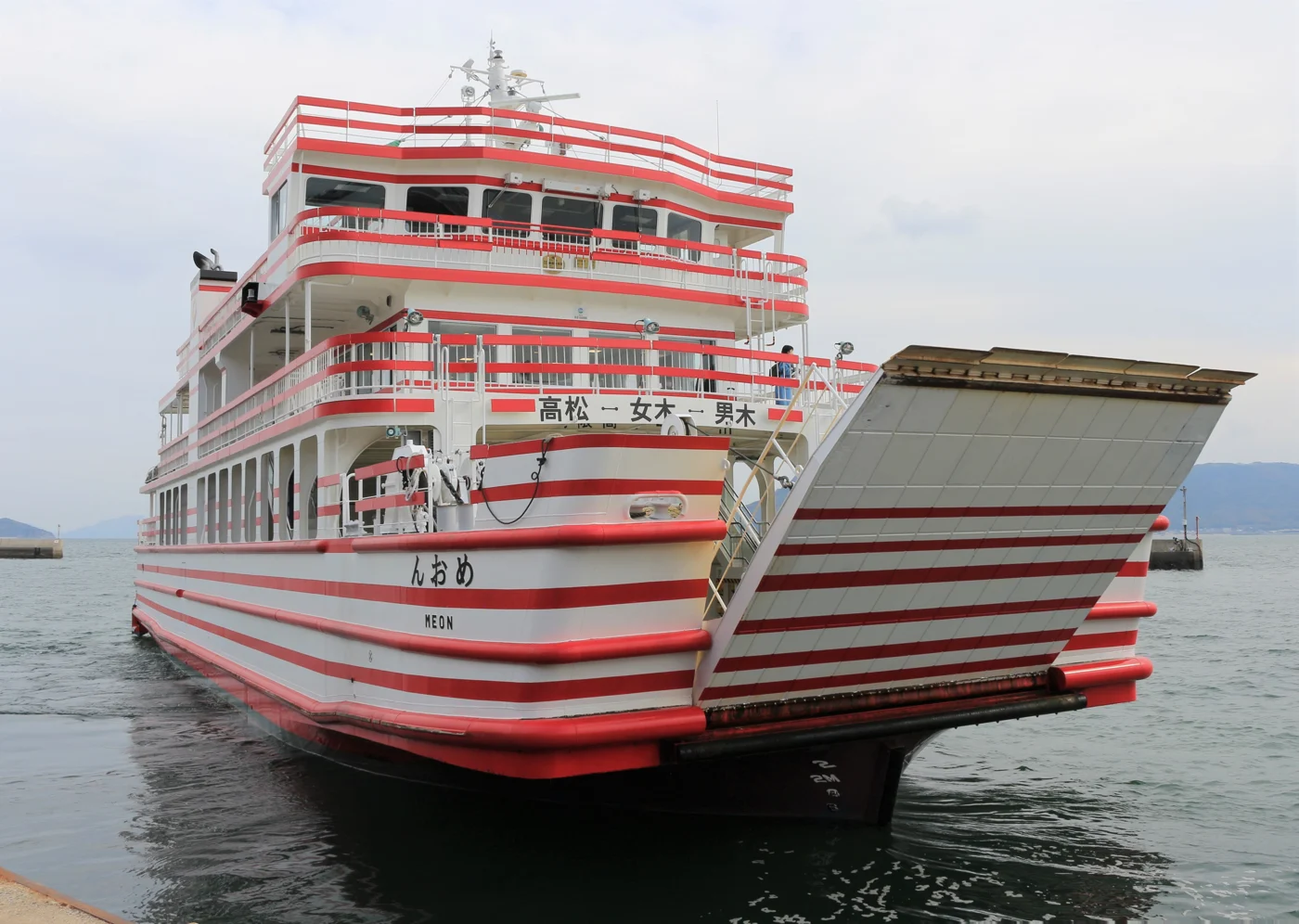
Meon, operated by Shiyujima Kaiun, links Takamatsu, Megijima and Ogijima. The standard sailing period covers dates outside 1–20 August. The official standard timetable lists departures from Takamatsu at 08:00, 10:00, 12:00, 14:00, 16:00 and 18:10. Add 20 minutes for Megijima and 40 for Ogijima. In reverse, departures from Ogijima are 07:00, 09:00, 11:00, 13:00, 15:00 and 17:00, reaching Megijima 20 minutes later and Takamatsu another 20 minutes after that.
The Megijima arrival/departure column covers both a call and an onward departure. Direction determines where the ferry goes next. The 10:20 at Megijima goes to Ogijima; the 11:20 goes to Takamatsu. A ferry at the pier is not automatically city-bound. Save the port, direction and time together: “Megijima 15:20 → Takamatsu 15:40” or “Ogijima 15:00 → Takamatsu 15:40”. If splitting up, agree on the same return port and sailing.
In the standard period, the last ferry back to Takamatsu leaves Ogijima at 17:00 and Megijima at 17:20. The 18:10 from Takamatsu heads towards the islands. There is no matching return from Ogijima after 18:00. If staying in Takamatsu and hoping for sunset on Ogijima, compare sunset with departure time. An evening outward sailing is not an evening return. To stay after the ferry, arrange accommodation and dinner together.
The busy summer timetable applies from 1 to 20 August. Extra services run between Takamatsu and Megijima; for Ogijima, use a row that actually calls there. Starred sailings only run between Takamatsu and Megijima. They cannot fill a connection gap at Ogijima. Do not apply art festival, event or old travel-blog extra sailings to an ordinary weekday. Save outward and return times from the same official edition for your date, then check the operator’s latest notices on departure day. If the operator cancels your sailing, stay on land in Takamatsu.
| Outward: Takamatsu → Megijima → Ogijima | Return: Ogijima → Megijima → Takamatsu | Suitable plan |
|---|---|---|
| 08:00 → 08:20 → 08:40 | 13:00 → 13:20 → 13:40 | Early start, back in the city in the afternoon |
| 10:00 → 10:20 → 10:40 | 15:00 → 15:20 → 15:40 | One island at a slower pace, with lunch |
| 12:00 → 12:20 → 12:40 | 17:00 → 17:20 → 17:40 | Short afternoon visit; this is the last return |
Find Prefectural Pier 3 in Takamatsu; foot passengers board in arrival order
Board at Prefectural Pier 3 in Sunport Takamatsu, north of JR Hotel Clement Takamatsu. The operator’s boarding FAQ gives the address as 8-1 Sunport, Takamatsu. Megijima’s landing is at 15-22 Megicho and Ogijima’s at 1986 Ogicho. All three appear on the official boarding maps. Look for Shiyujima Kaiun, Meon and number 3, rather than heading to a Naoshima, Shodoshima or Takamatsu East Port departure point.
JR Takamatsu Station is near the sea, but you still need to find the right ticket office, buy tickets, queue and board. Sales start 30 minutes before departure. For the 10:00 ferry, aim to reach the pier for tickets at 09:30, with extra walking and navigation time on holidays. Arriving early covers ticketing and waiting; foot passengers still board in arrival order. If staying in Kawaramachi, finish breakfast and travel to the port before 09:30.
Foot passengers board first come, first served. Vehicle reservations follow separate rules. Cars can be booked through the ticket office from 30 days before sailing until the day before, with some busy periods excluded. The ability to reserve a car does not reserve a seat for an ordinary foot passenger. The website has an online ticket link, but after payment the ticket’s conditions and boarding rules still apply. Include vessel capacity in your planning.
There is no need to hire a car for this day. The operator’s pages for both islands ask visitors to avoid bringing cars. Ogijima in particular is for walking and has no island bus. The operator has no dedicated car park in Takamatsu; use nearby paid parking according to its rates and vehicle-size rules. Leave large luggage at your Takamatsu accommodation or an arranged storage point. Take a small bag with water, a jacket and daily essentials.
Calculate fares by the three legs; ferry and cave child categories differ
Standard adult single fares checked in October 2026 were ¥370 for Takamatsu–Megijima, ¥510 for Takamatsu–Ogijima and ¥240 for Megijima–Ogijima. Primary school pupil fares were ¥190, ¥260 and ¥120 respectively. An adult return to Megijima costs ¥740, or ¥1,020 to Ogijima. Disembarking on both islands makes three legs, Takamatsu → Megijima → Ogijima → Takamatsu, totalling ¥1,120 for an adult or ¥570 for a primary school pupil. Staying aboard as the return ferry passes through Megijima differs from disembarking there and taking a later sailing.
The operator allows one child aged one to below school age free per adult. The second and each additional child pay the primary school pupil fare. Babies under one travel free. Two adults and one primary school pupil travelling only to Ogijima and back pay ¥1,020 × 2 + ¥520 = ¥2,560. Recalculate by actual passengers and legs for more young children, two islands or bicycles. The cave’s child fare covers primary and junior high school pupils. A junior high school pupil therefore falls into different ferry and cave categories.
Bicycle carriage costs ¥340 single or ¥680 return, in addition to the rider’s fare. An adult return from Takamatsu to Megijima with a bicycle costs ¥1,420, plus hire charges in Takamatsu and the return deadline. For the cave alone, the uphill bus often involves fewer steps. A bicycle does not flatten Ogijima’s sloping lanes and stairs. It is not an effort-saving option for every visitor.
Separate ferry, island transport, cave entry and food in the budget to see what omitting a leg saves. An adult Megijima return at ¥740, return cave bus at ¥1,000 and cave entry at ¥600 total ¥2,340. List meals, coffee and local Takamatsu transport separately. For a walking-only Ogijima visit, fixed transport starts at ¥1,020; add any current indoor art ticket. Compare the routes you will actually take, rather than combining two-island fares with single-island admissions into an incomplete total.
Megijima cave day: choose uphill and harbour-bound buses separately
Onigashima Cave is partway up Washigamine. Oni no Yakata beside Megijima Port is the starting point for information and buses. The tourism association’s access page currently lists adult bus fares of ¥1,000 return or ¥700 single, and child fares of ¥500 return or ¥300 single. Disregard old descriptions quoting ¥800 return. The current chart lists departures from Oni no Yakata at 08:30 and 09:25, then hourly from 10:25 to 16:25. Cave return departures are 08:40, then hourly from 09:40 to 15:40, plus 17:00.
A horizontal row is not necessarily one usable return trip. Taking the 10:25 uphill bus and the 10:40 downhill bus leaves very little visiting time. Choose a later harbour-bound service, such as 10:25 up and 11:40 down. Leave longer for the viewpoint and connect to a ferry going in the right direction. Finishing on the mountain is not arriving at the harbour: waiting, riding and walking to the pier still follow.
The standard 10:20 arrival at Megijima leaves only five minutes for the 10:25 bus. This suits people who can go straight from the ferry to the bus stop. For storage, toilets or getting children ready, use the next bus or the early ferry arriving at 08:20. This leaves room for tickets and directions. Five minutes is not spare time for dealing with luggage, buying tickets and setting off slowly.
The bus chart does not provide a day-by-day operating calendar for the whole year. For winter, quieter dates or a trip specifically for the cave, ask Onigashima Kanko Jidosha on 087-873-0277 about your date and required uphill and downhill times. Oni no Yakata’s official guidance also directs operating questions to this bus company. Without a usable return, choose a harbour walk or a city day. The uphill trail and bus involve different physical demands. A cancelled bus is no reason to commit the whole group to climbing.
The cave presents a legend; allow separate time for the summit
The operator’s cave guide currently lists opening at 08:35, last admission at 16:40 and closing at 16:55. Admission is ¥600 for high school age and above, ¥300 for primary and junior high school pupils, ¥500 for ages 65 and over, and free for preschool children under the standard admission rules. Keep last admission separate from the last bus to the harbour. Entering at 16:40 leaves little time before the 17:00 bus, followed by the last Takamatsu-bound ferry at 17:20. An earlier daytime visit is more relaxed.
Inside are displays such as the ogres’ hall, living quarters and guard areas. The tourism association explains that Takamatsu primary school teacher Sentaro Hashimoto discovered the cave in 1914. It was then linked with the Momotaro legend and became a central theme of Megijima tourism. Look separately at the staged ogre story and the cave space. Children can find expressions on the ogres; adults can see how passages and rooms were fitted into the legend. This gives more to the visit than an entrance-sign photograph.
The cave and its surroundings also contain the Oninoko Tile Project, with ogre roof tiles made by Kagawa junior high school pupils. The tiles meet the story’s ogres in the same place. Compare facial expressions, horns and tile shapes. For more art, first look closely at what is already on the cave route. There is no need to cross another island for a brief gallery stop.
Washigamine viewpoint is 188 m above sea level. Its Seto Inland Sea view involves another walk beyond the cave. Shoe grip, wind and the return bus determine how far to go. If someone does not want another slope, make the cave everyone’s endpoint. For the summit, choose a later downhill bus beforehand and allow time back to its stop. The cave being open does not mean the whole mountain area fits before the last service.
Watch the wind at Megijima harbour: gulls, ote walls and the moai
Back at the harbour, walk along the shore and through the village for more island details. Takahito Kimura’s “Seagulls Parking Lot” lines gulls along the breakwater; they turn together as the wind changes. Watch their direction rather than seeking the exact composition of someone else’s photograph. View from public walking space. The rows show how the harbour relates to sea wind.
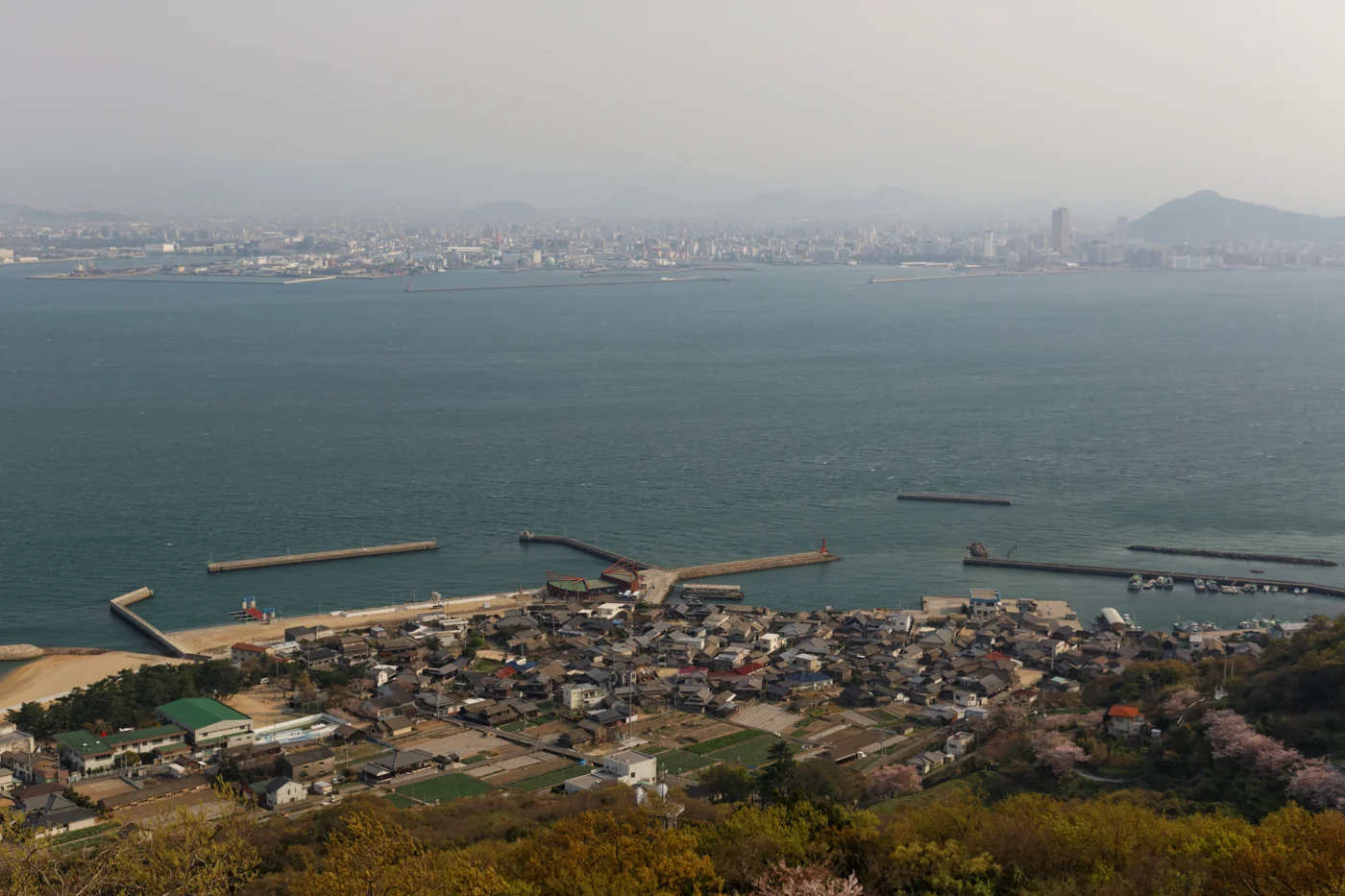
The settlement’s high stone walls are called ote. They protect houses from the strong winter wind known as otoshi. They share the tourist map with the ogre legend, but serve an everyday purpose: walls shape lanes and shelter homes. Follow the bends in the streets and the openings in the walls. This says more about the island than treating every wall as a relic of an ogre fortress.
The harbour moai is a replica used in lifting tests for Kagawa company TADANO’s work restoring Easter Island statues. The distant-looking figure connects with Takamatsu’s crane industry. See it alongside Meon, the fishing harbour and the walls. Megijima then reveals links with the city and sea transport, beyond its Momotaro association.
Without the uphill bus, the harbour, coast and an open café make a shorter day. Check the return direction on arrival, walk according to your energy, then rest near Oni no Yakata in the afternoon before sailing. In strong coastal wind, move into the village. Swimming and SUP are separate activities requiring the right season, equipment and operator arrangements. On an ordinary walking day, keeping shoes and clothes dry makes the return to Takamatsu easier.
Lunch at Megino: groups of four or fewer are seated in arrival order
Seaside Megino normally opens its café from 11:00 to 15:00. Outside summer it closes on Thursdays and Fridays, with additional irregular closures. Monthly dates appear on its social media and the harbour noticeboard. The café page says groups of four or fewer are served in arrival order. Groups of five or more can submit a booking form by the previous day; same-day bookings are not accepted. For lunch after the cave, match the downhill bus to this meal window.
The website menu lists Margherita pizza at ¥800, beef curry at ¥1,000, coffee at ¥500 and Setouchi lemonade at ¥500. An adult lunch of curry and lemonade costs ¥1,500. Added to the ¥2,340 ferry, cave and bus example, the total is ¥3,840. This is a food-and-transport example for one selected route. Add orders by group size rather than using the café’s cheapest item as a full-meal budget.
A small café handles a large group differently from one or two visitors. For five or more, arrange seating before the ferry plan. If catching an afternoon boat, explain your available time before ordering. Having to leave before the food is ready helps neither the café nor your companions. On an irregular closure day, bring a simple meal, eat where permitted and take rubbish back. Return to Takamatsu earlier for a full meal.
The tourism association’s food page also lists different patterns: Oni no Daidokoro opens only on weekends and holidays, 10:30–14:30; Onigashima Club opens Friday–Monday and holidays, 09:00–17:00. These are nearby alternatives. Use each operator’s current notice for the chosen business and menu. Do not rely on a summer beach hut for weekday supplies. Eat breakfast, bring enough water and sit down for one island meal so food becomes part of the visit.
Start Ogijima at the community centre; choose hillside lanes or the southern artwork
The white roof of letters at Ogijima Port is Jaume Plensa’s “Ogijima’s Soul”, also a community centre and ferry waiting space. Letters from different languages form the roof. From the arriving ferry, see it against the layered houses behind. Identify the return boarding point before entering the village. You will return here, so there is no need to spend all your photography time immediately.
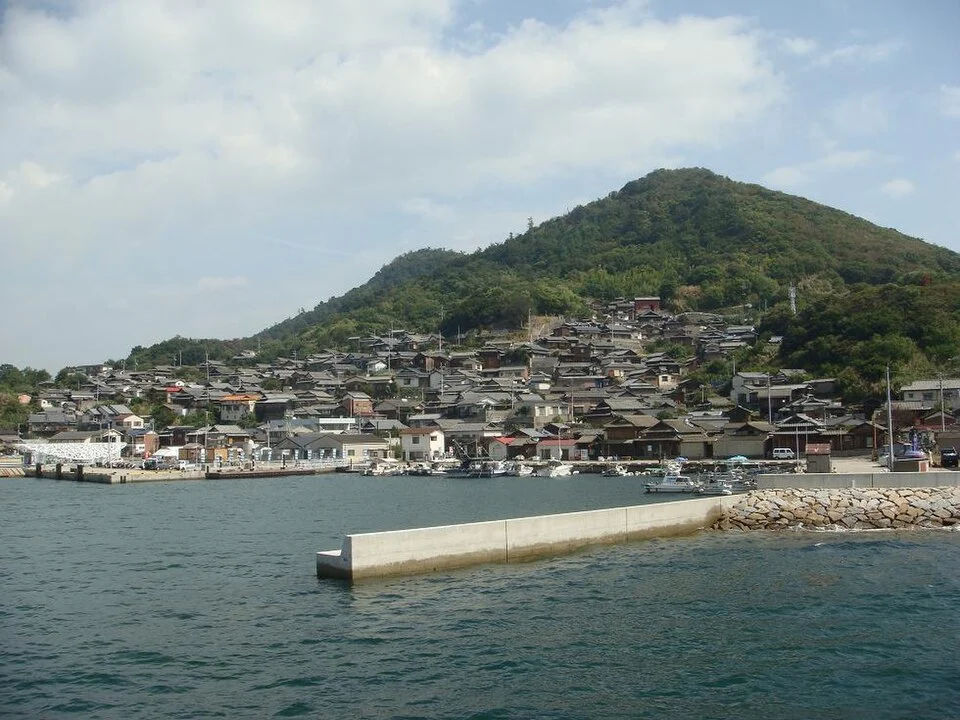
The operator’s Ogijima guide states that there is no island bus. Walking is the main means of travel, and houses cluster on the south-west slope. Climb gradually from the port towards Toyotamahime Shrine, looking at walls, steps and changing rooflines, then descend to the sea. To avoid stone steps, keep a shorter route around the harbour and lower village. Before seeking a high view, check that everyone can descend safely. Slow down at corners and stone steps in rain.
The lanes explain why onba handcarts are everyday island tools. Narrow slopes make carrying goods difficult. Residents use carts, and an art project adds colour to them. Rikuji Makabe’s lane murals use discarded island materials to place landscape silhouettes on house walls. While viewing, keep track of doors, passages and the routes residents need. The art shares a living space.
Keisuke Yamaguchi’s “Walking Ark” at the southern fishing harbour lies in the opposite direction from the northern lighthouse. With around four hours and a booked lunch, choose village plus south or village plus lighthouse. Both ends are not casual extra stops before sailing. If lane art interests you most, spend your time in the village rather than missing details to complete the coast.
The tourism association’s visitor FAQ asks people to preserve access and residents’ privacy. Do not enter private homes, empty houses or fields without permission. Wait for pedestrians to pass before photographing a lane. Keep tripods and bags within your control. Give way to deliveries and handcarts on narrow routes. People still live here: you can change your route, while a doorway is unsuitable for a long photo session.
Make the lighthouse a main walk: at least an hour there and back
Ogijima Lighthouse stands at the northern end. The tourism association gives about 30 minutes each way from the port: one hour of walking before time for the buildings, rest and preparing to sail. The official summer event guide warns of little shade and no vending machines on the lighthouse route. Bring drinks before setting off. From a four-hour-and-20-minute stay, allocate about 90 minutes to two hours to this walk first, then fit lunch around it.
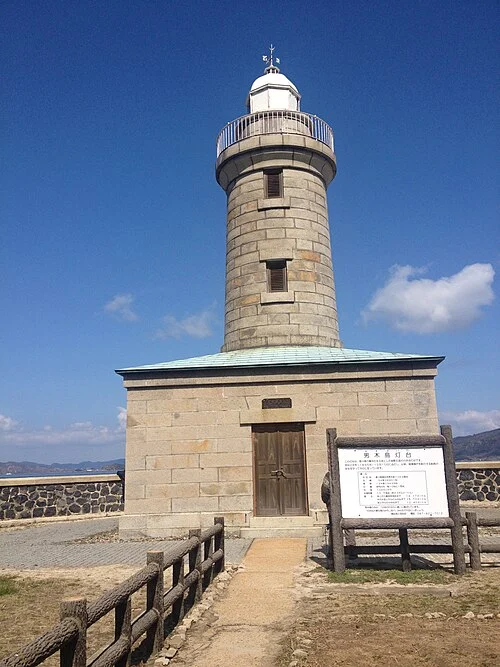
Completed in 1895, the lighthouse has finely worked granite walls with the stone surface exposed, rather than painted white like many lighthouses. Takamatsu’s cultural property record says the lighthouse, former staff quarters and former No. 1 storehouse were designated Important Cultural Properties on 15 January 2026. Look beyond the tower to how duty, accommodation and storage formed a maritime transport facility.
An ordinary walk covers the exterior and surrounding open paths. Interior visits occur at specific public events. The 1 November 2026 Lighthouse Day cleaning, weeding and daffodil-planting event includes an interior tour, but registration closed on 26 October. Travellers planning after 27 October should not treat this closed-registration event as walk-in access. The stone exterior itself shows the building’s character.
For the 15:00 return ferry, work backwards before starting a post-lunch lighthouse walk. If heat, strong wind or fatigue intervenes, return along the same route to the village. The 17:00 last ferry is not a reason to extend every walk. On a short late-afternoon visit, choose the village first. Make the lighthouse the main walk only when arrival time, energy and daylight all suit it.
Ogijima lunch and overnight stays: Yukulu bookings, numbers and meals
Traditional-house café and accommodation ogijima Yukulu publishes monthly opening information. Its October 2026 notice lists lunch from 11:30 on 31 October, limited to ten portions and by reservation only, with café hours of 11:30–16:00. Other announced weekends that month use the same lunch format. Normal café opening days are Saturdays, Sundays and holidays, with lunch 11:30–14:00, closing at 16:00 and last orders at 15:45. Choose a date from the monthly business notice and book through the email address the operator provides.
Weekday lunch is accepted for groups of six or more. It is not a regular service for two people arriving on a weekday. For an 11:30 weekend lunch, arrive at 10:40, walk briefly in the lower village, then eat. Afterwards, make the lighthouse or hillside lanes the main activity. Without a lunch booking, bring a simple meal or shorten the stay and eat in Takamatsu. Finding the café building does not mean having a seat and a meal.
To stay for evening and morning, compare Yukulu’s whole-house rental for one group. The website lists two sleeping spaces: an eight-tatami-sized wooden-floor room with two beds, plus an extra bed for a third person; and a six-tatami Japanese room with three futon sets. The whole house accommodates at most six people, including preschool children. Primary school pupils pay the adult accommodation rate. One young child sharing bedding stays free per adult; select the relevant charge if bedding is needed. Six adults plus children exceed the total limit.
Check-in is 16:00–19:00 and check-out is 10:00. Dinner and breakfast are optional extras. For bookings with children, the instructions say to choose accommodation without meals first, then add meal quantities. The operator contacts you to confirm after the request is submitted. The website’s cancellation table lists 30% three or two days before, 50% the day before and 100% on the day. Set meals, numbers and acceptable cancellation terms before booking a night, then use an actual next-day sailing such as 07:00 or 09:00.
The island has no convenience store or pharmacy. Yukulu also asks guests to bring nightwear, toothbrushes and personal medicines. Staying overnight lets you eat slowly after a daytime walk and see the port again in the morning. It also requires meal and next-day transport arrangements. Leaving large luggage in Takamatsu and carrying one night’s essentials usually suits the slopes better than a suitcase.
2026 indoor art openings follow set dates, not a whole festival season
For art, choose the date before the route. Takamatsu’s 2026 indoor artwork opening notice lists the second weekend of each month from May to November on Megijima, Ogijima and Oshima. October adds the 12th for the three-day holiday; the next dates are 14 and 15 November. An ordinary weekend after 27 October does not inherit the daily exhibition route used during the 2025 festival.
The city notice lists a regional pass at ¥1,000 per area or individual artwork admission at ¥500. Buy with cash at artwork reception; tickets are valid that day. Visitors aged 18 and under enter free. Calculate “per area” by your chosen island. One ticket is not a day pass for Megijima, Ogijima and Oshima together. Works inside Onigashima Cave also require cave admission. Ferries, buses and food are separate.
Choose the specific works and closing times from current opening information in the Setouchi Triennale artwork calendar. Select one or two indoor works first, then plan one island. If opening hours occupy the middle of the day, omit either lighthouse or cave. For outdoor gulls, the letter roof and the village itself, keep an ordinary day for walking. A ticket need not push you into every exhibition.
The festival has brought art and visitors to both islands, while the original walls, fishing harbours and lanes remain worth seeing. Separate landscapes visible in public spaces from indoor exhibitions requiring reception. This shows which part depends on dates. Companions with different interests can use the same port as their endpoint and spend time within their own feasible range.
Two-island alternative: land at Megijima at 10:20, then sail to Ogijima at 12:20
If certain you want both islands, one standard-period example is Takamatsu 10:00 → Megijima 10:20, Megijima 12:20 → Ogijima 12:40, then Ogijima 17:00 → Takamatsu 17:40. Use two hours on Megijima for the harbour and village. Ogijima’s four hours and 20 minutes cover lunch and hillside lanes, or a smaller village route plus the lighthouse. This uses the last return. To keep a later sailing available, leave Ogijima at 15:00, reducing the second island to two hours and 20 minutes.
Adding the cave on Megijima first requires a usable bus. Going uphill at 10:25 and downhill at 11:40 normally leaves harbour time before the 12:20 Ogijima ferry. However, the five-minute ferry-to-bus connection is tight, and lunch should move to Ogijima or be a meal you bring. For storage, children’s toilets or the mountain viewpoint, take the 08:00 early ferry or make the cave a single-island day. This is steadier than squeezing every step into two hours.
The reverse is possible: Takamatsu 08:00 → Ogijima 08:40, Ogijima 13:00 → Megijima 13:20, then Megijima 15:20 or 17:20 → Takamatsu. This gives Ogijima a full morning and Megijima an afternoon harbour visit. For an afternoon climb, connect the downhill bus with the last ferry. Without a specific plan for the second island, remaining on the first often better serves a slow walk.
Write down what cancels the second island: a full first ferry, no bus or delayed lunch. Do not use a later boat to chase a route already shortened. If deteriorating seas are known before boarding, stay in Takamatsu. Both islands share the same waters; changing islands does not remove weather disruption. Returning straight from the first island to your base is the easiest exit.
| Order | Megijima stay | Ogijima stay | Trade-off |
|---|---|---|---|
| 10:00 Takamatsu → Megijima → Ogijima → Takamatsu | 10:20–12:20, 2 hours | 12:40–15:00, 2 hours 20 minutes | Megijima harbour and Ogijima village; a later 17:00 return remains |
| 10:00 Takamatsu → Megijima → Ogijima → Takamatsu | 10:20–12:20, 2 hours | 12:40–17:00, 4 hours 20 minutes | More time on Ogijima, but uses the last ferry |
| 08:00 Takamatsu → Ogijima → Megijima → Takamatsu | 13:20–15:20, 2 hours | 08:40–13:00, 4 hours 20 minutes | Ogijima main route and Megijima harbour in the afternoon |
Luggage, the return port and sea wind: keep the final stretch near the harbour
The operator’s Ogijima page lists community-centre luggage storage from 09:00 to 17:00. A ¥500 deposit is returned on collection, and some days storage is unavailable. If arriving at 08:40, do not go far and return just to store a bag before 09:00. For the 17:00 last ferry, collect it early. Oni no Yakata on Megijima has lockers and opens until 17:20. Leaving large luggage in Takamatsu is simplest. Carry daily essentials to avoid putting collection and the final boat in the same minute.
A pushchair works on level ground but may need carrying or a changed route at Ogijima’s stone steps. An accessible ferry cabin does not make the whole island accessible. Meon’s first-floor cabin gives priority to island residents and people with mobility difficulties. The second floor contains the general cabin and viewing deck. Ask about boarding assistance when buying tickets. For difficulty with slopes and steps, stay within the harbour and places you can return from safely. Plan a comfortable sailing and meal first.
Carry enough water, shoes suitable for stone steps, a windproof jacket and a small rubbish bag. In summer, do the long lighthouse section earlier and add rests where shade is scarce. In rain, reduce steps, shore and mountain sections, then wait in a sheltered harbour area. If wind and waves already affect sailings, Takamatsu’s gardens, museums or shopping streets avoid the pressure of arranging a return after reaching an island.
For the 15:00 Ogijima ferry, spend the last half-hour around the community centre collecting bags, using toilets and preparing tickets, then board as directed. Work backwards the same way for Megijima’s 15:20 ferry. Reaching Takamatsu at 15:40 leaves room for dinner and onward city transport. Keep the last island stretch for the sea view and waiting, with a clear end to the day.
A few useful answers
Which island should I choose on a first visit?
Choose Megijima for Onigashima Cave, harbour walls and coast. Choose Ogijima if you are comfortable on hillside lanes and want the stone lighthouse and village. With one day, start with one island. Megijima’s cave needs uphill and downhill bus connections; Ogijima has no island bus.
When is the last Meon ferry to Takamatsu?
In the standard period it leaves Ogijima at 17:00 and Megijima at 17:20, reaching Takamatsu at 17:40. Takamatsu’s 18:10 sailing goes towards the islands. Check the summer timetable for 1–20 August: not all extra Megijima services extend to Ogijima.
How much are the ferries from Takamatsu?
Adult single fares are ¥370 for Takamatsu–Megijima, ¥510 for Takamatsu–Ogijima and ¥240 for Megijima–Ogijima. A single-island return is ¥740 for Megijima or ¥1,020 for Ogijima. Three legs with a visit to each island total ¥1,120.
Can I use the same row of the cave bus chart as one return trip?
Choose uphill and downhill times separately. The 10:25 from Oni no Yakata followed by a 10:40 descent gives very little visit time. Choose a later return such as 11:40, then the 12:20 ferry to Ogijima or 13:20 to Takamatsu. Ask Onigashima Kanko Jidosha about operation on your date.
Can I fit Ogijima Lighthouse in as a quick detour?
It is about 30 minutes’ walk each way from the port: at least an hour before visiting and resting. Allowing 90 minutes to two hours works better. There is little shade and no vending machine on the route, so bring water.
Can two people walk in for weekday lunch at Yukulu?
The regular café opens on weekends and holidays. Weekday lunch is accepted for groups of six or more. Lunch on 31 October 2026 is limited to ten portions by reservation only. For other dates, use the monthly notice.
Does indoor art open every weekend in 2026?
The city notice specifies the second weekend of each month from May to November, plus 12 October. The next dates are 14 and 15 November. Use current festival information for specific works and hours. Regional passes cost ¥1,000 per area or individual entry ¥500; ages 18 and under enter free.
Official information and references
Sources used in this guide.
- Shiyujima Kaiun | Standard and summer timetables, fares, piers and vessels
- Shiyujima Kaiun | Foot passengers, vehicle bookings and ticketing FAQ
- Shiyujima Kaiun | Ogijima walking, storage and cultural sights
- Shiyujima Kaiun | Megijima walls, gulls and moai
- Onigashima Tourism Association | Cave bus fares and current chart
- Onigashima Tourism Association | Cave hours, admission and island sights
- Onigashima Tourism Association | Cave discovery and the Momotaro legend
- Onigashima Tourism Association | Megijima food and opening patterns
- Megino | Café menu, dates and bookings for five or more
- Ogijima Tourism Association | Visiting, photography and private land FAQ
- Ogijima Tourism Association | Summer 2026 guide and lighthouse walk supplies
- Takamatsu City | Ogijima Lighthouse cultural designation and architecture
- Ogijima Tourism Association | Lighthouse Day on 1 November 2026 and registration deadline
- ogijima Yukulu | October 2026 lunch, accommodation capacity and cancellation
- Takamatsu City | 2026 regular indoor art openings and prices
- Oni no Yakata | Cave bus operating enquiries
- Kagawa Prefecture | Official YouTube account directory
- Setouchi Triennale | Current artwork opening information