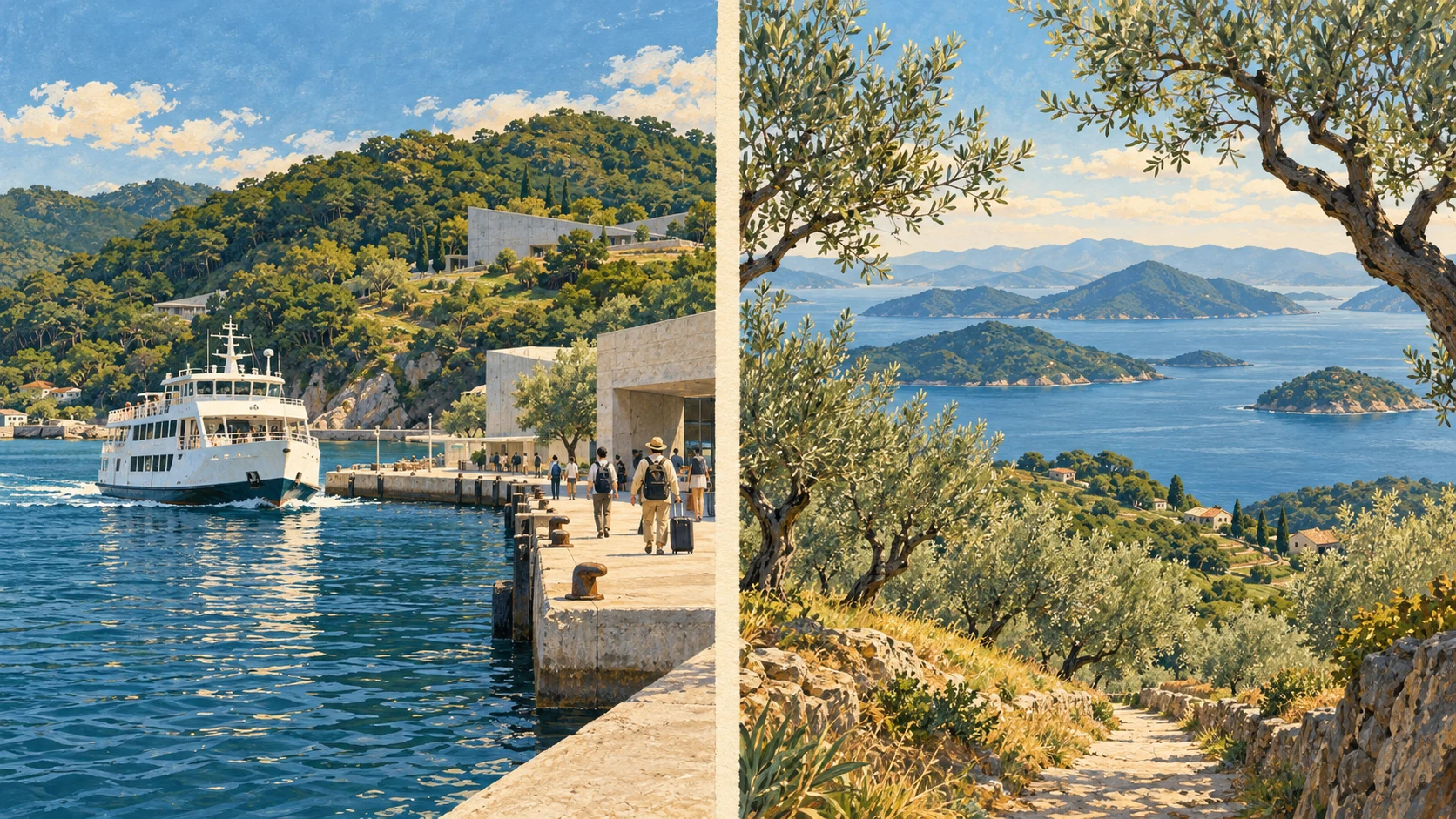
With one island day, choose between Naoshima's art and Shodoshima's mountains and coast. This guide compares ports, admission bookings, tides, island transport and accommodation within complete journeys, helping you plan a workable day trip or two days with one night while leaving room for the return and weather changes. If you have chosen your island, go to Naoshima admission bookings, Shodoshima bus passes, Angel Road tides or Kankakei transport.
Naoshima or Shodoshima? Choose what you want from the day
Choose Naoshima if you want time with museums, architecture and artworks; choose Shodoshima for coastal walks, olive groves, a mountain gorge and soy-sauce villages. Both are accessible from Takamatsu, but their local transport, booking requirements and worthwhile lengths of stay differ. For a first visit with just one island day, choosing one island and two or three priorities usually delivers more than Naoshima in the morning and Shodoshima in the afternoon.
A day on Naoshima can revolve around a Chichu Art Museum reservation, with Honmura or another museum added. On Shodoshima, start with Angel Road's tidal window or make Kankakei your main destination, then select other stops along that route. If you want several Naoshima museums, Shodoshima's coast and mountains, and overnight stays on both islands, add days. Sea crossings take time just like any other transfer.
This guide uses official information checked on 22 October 2026. Shodoshima Olive Bus has announced a special November day-pass price, and Naoshima New Museum of Art has a dated exhibition schedule. Check prices, opening days and sailings for your travel date. The time blocks below are planning suggestions; actual departures and booked admission times determine what works. For the mainland portion, see choosing bases and transport in Shikoku, and allow a full island day rather than counting it as half a day in central Takamatsu.
Bases and departure ports: Takamatsu for choosing an island, Uno for Naoshima
Staying in Takamatsu lets you arrange island days around weather and museum opening days, then return to the same base to organise your bags. Takamatsu Port and Takamatsu East Port are different boarding locations. The former commonly serves Naoshima's Miyanoura and Shodoshima's Tonosho; for Shodoshima's Sakate, check Takamatsu East Port. Put the operator, port, vessel type and exact terminal on the same itinerary before leaving.
Coming from Okayama, Uno is an important gateway to Naoshima. For Shodoshima, also compare the route from Shin-Okayama Port to Tonosho. Okayama is a city name; Uno Port and Shin-Okayama Port are not interchangeable. Avoid searching only for “the ferry terminal for Shodoshima,” especially when a hotel or hire office collects guests at just one port. Reaching the wrong port can consume your sightseeing time in an extra road journey.
Compare room prices together with transport at both ends of each day. Takamatsu suits several nights in one base with individual island trips; Uno fits Naoshima into an Okayama itinerary. Island accommodation suits travellers who want another morning or evening and are willing to arrange dinner and the following day's ferry. The Shodoshima Tourism Association's route overview explains the gateways; once your dates are fixed, check fares and cancellations with the actual ferry operator.
| Base or port | Suitable plans | Limits to check first |
|---|---|---|
| Takamatsu | Separate day trips to Naoshima or Shodoshima | Check Takamatsu Port and Takamatsu East Port separately |
| Uno / Okayama | Naoshima combined with Okayama | The road or rail journey from Okayama to Uno is additional to the crossing |
| Tonosho, Shodoshima | Western tides, island buses and some hotel transfers | A different port from Sakate, Ikeda and Fukuda |
| Miyanoura or Honmura, Naoshima | Art and village visits spread over two days | Dinner, luggage and next-day sailings off the island |
Naoshima ferries: compare Takamatsu and Uno fares, durations and last departures separately
Shikoku Kisen's Takamatsu–Miyanoura route currently lists one-way ferry fares of ¥680 for adults and ¥340 for children; the high-speed passenger boat costs ¥1,590 and ¥800 respectively. The ferry takes about 50 minutes to Miyanoura and 60 minutes back to Takamatsu, while the fast boat takes about 30 minutes. The fast boat cannot carry bicycles or cars, so its shorter crossing does not make it suitable for a vehicle-based trip.
On the Uno–Miyanoura route, standard daytime one-way fares are ¥370 for adults and ¥190 for children. The ferry takes about 20 minutes and the passenger boat about 15 minutes; late-night passenger boats have separate fares. The official child category is elementary-school pupils ages 6–12. If you arrive from Uno and leave for Takamatsu, buy tickets for the respective routes. The cheaper Uno fare cannot be used to estimate the Takamatsu crossing.
In the Takamatsu timetable checked for this guide, the last ferry from Miyanoura is at 17:00, with a separate high-speed passenger boat at 19:45. The last ferry toward Uno is at 20:25. These are different destinations and vessel types, not alternative times for the same boat. Shikoku Kisen does not accept boarding reservations; when a boat is full, you must wait for a later departure. Aim for a return with alternatives still available and check operating notices before boarding.
You can visit Naoshima without cycling, but the town bus does not serve every museum door
Naoshima's town bus mainly connects Miyanoura Port, Nokyo-mae in Honmura and Tsutsuji-so. Chichu, Lee Ufan Museum and the Benesse House area require a further walk or site shuttle. The tourism association's local transport guide lists ¥100 per adult ride and ¥50 for children from age 5 through elementary school. There is no change machine; pay with coins when getting off. The town bus has no unlimited day pass, so bring change instead of looking for a nonexistent package.
Residents use this bus too. Official guidance warns of limited capacity, especially on weekend afternoons toward Miyanoura, when not everyone waiting may board the same bus. The free museum-area shuttle is not a private connection guaranteed to meet every reservation. It normally does not run on days when Chichu and Lee Ufan Museum are closed. Add together arrival at the port, waiting for the town bus, changing to the site shuttle and walking to the entrance when choosing a museum time slot.
Electric-assist bicycles suit people comfortable with hills and proper parking, but they do not remove sun exposure, rain or return deadlines. The Naoshima transport FAQ notes slopes and limited shade. If you are not accustomed to cycling, have young children or use a wheelchair, consider a smaller sightseeing area and confirm bus assistance. Bringing a car to the island does not mean driving to every museum entrance: Honmura and the museum grounds still involve walking. The official map around Benesse House marks the private area between the East Gate near Tsutsuji-so and the North Gate near Lee Ufan Museum. Vehicles, including bicycles, may not enter unless you are a Benesse House guest. Ask your rental provider about parking outside the grounds, then walk or take the shuttle; do not wait until you reach the gate to revise the route.
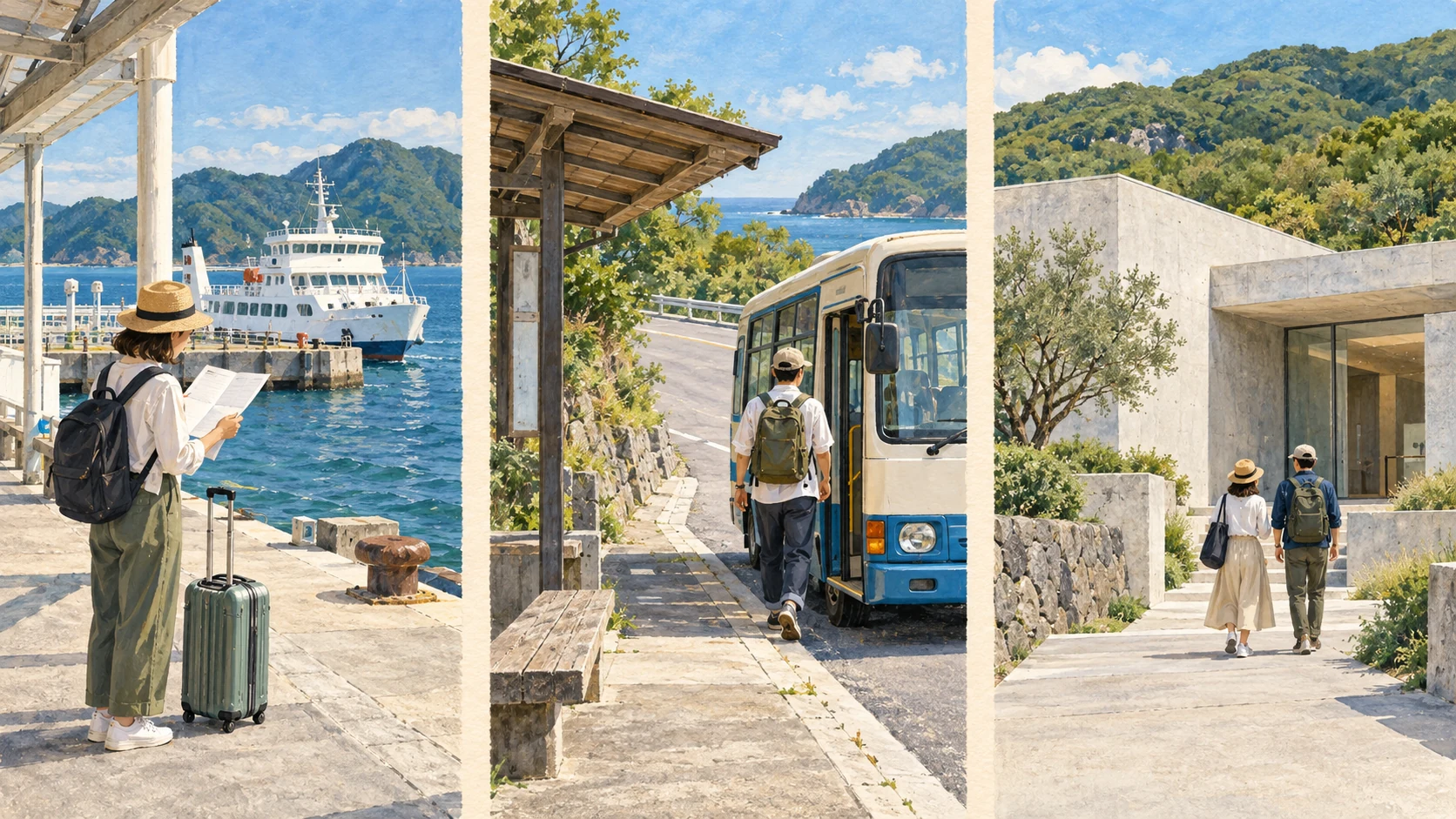
Chichu Art Museum: secure a usable slot before fitting in ferries and other museums
Chichu Art Museum's official information currently lists opening hours of 10:00–17:00, with last admission at 16:00. It normally closes on Mondays, with adjustments around national holidays and other exceptions; check the calendar. Online tickets cost ¥2,500 on weekdays and ¥2,700 on weekends and holidays; on-site tickets cost ¥2,800 and ¥3,000 respectively. Prices vary by date and purchase method, so the lowest price is not available every day.
Chichu requires a reservation for a specific date and time. The official policy expressly says that when online tickets sell out, no tickets are sold on site either. Queuing at the entrance is not a way to obtain an unavailable slot. Children age 15 and under enter free but still need the appropriate number of tickets in the booking. Add accompanying children, then check the electronic ticket's date, admission time and museum name so that the adults have not booked without them.
The museum's appeal lies in the relationship between art and space. Allow time for Monet's paintings and the works of Walter De Maria and James Turrell. Nearby points on a map do not justify a tight reservation immediately before or afterward. If only an afternoon slot is available, visit Honmura first and then the museum area. If no tickets remain, choose another museum with availability and reconsider the day's plan before departing.
The Art House Project pass excludes Minamidera and kinza, and lunch closures come in two groups
The Art House Project uses separate buildings around Honmura; it is not one museum where a single entrance leads to everything. The official ticket list limits the multi-site pass to Kadoya, Ishibashi, Haisha, Go'o Shrine and Gokaisho. It costs ¥1,200 online or ¥1,400 on site. A single-site ticket is ¥600 online or ¥700 on site. Minamidera and kinza have separate tickets and reservations, so do not plan around an older six-site pass description.
Minamidera and kinza each currently cost ¥600 online or ¥700 on site and require a dated time slot. Due to the nature of the work, Minamidera does not admit children age 5 and under. Kinza admits one person at a time; travelling as a pair does not mean entering together. The five-site pass has free admission for age 15 and under, but do not apply that condition automatically to every separate ticket. Read the age rules for the product you select.
Kadoya, Ishibashi and Haisha close for lunch from 12:00 to 13:00; Go'o Shrine and Gokaisho close from 13:00 to 14:00. Arranging your meal around these staggered closures can reduce backtracking, but not every Honmura site stays open at noon. With only half a day, choose Minamidera plus one or two works that interest you, or a small selection of the five pass sites. There is little benefit in rushing through the village just to use every admission.
If Tadao Ando's architecture interests you, substitute ANDO MUSEUM for an Art House site. Concrete spaces are inserted inside an old wooden Honmura house, with photographs, models and sketches. Tickets cost ¥600 online or ¥700 on site. Opening hours are 10:00–13:00 and 14:00–16:30, with last admission at 16:00. There are changes in floor level and pushchairs are not permitted, so arrange care for young children beforehand. This is a separate museum ticket, outside the Art House Project pass.
Choosing Lee Ufan Museum, Benesse House and Naoshima New Museum of Art
To concentrate on the southern museum area, place Lee Ufan Museum before or after Chichu and allow time to explore the spaces formed by stones, iron plates, paintings and emptiness. Tickets are ¥1,200 online or ¥1,400 on site; hours are 10:00–17:00, with last admission at 16:30, and it normally closes on Mondays. Even two museums in the same area require travel and rest. Buying both tickets does not establish that consecutive time slots will work.
Benesse House Museum costs ¥1,300 online or ¥1,500 on site; admission is free for visitors aged 15 and under and Benesse House guests. The museum lists 8:00–21:00, with last admission at 20:00. Valley Gallery, included on the same ticket, opens only 9:30–16:00, with last admission at 15:30. An evening visit to the main museum does not grant evening access to the valley site. Visitors who are not staying at Benesse House must also arrange transport out of the grounds.
Naoshima New Museum of Art is on the Honmura side and fits a day in the village. Tickets cost ¥1,500 online or ¥1,700 on site; visitors aged 15 and under enter free but still need tickets. It is part of the official online ticketing system, so do not treat it as a stop requiring no ticket planning. Current hours are 10:00–16:30, with last admission at 16:00. The listed exhibition runs 7 June–23 November 2026; check later displays rather than treating the opening exhibition as permanent. An official temporary-closure notice also announces that the museum will be closed from 24 November through the morning of 12 December 2026. It reopens at noon on 12 December, while &CAFE remains closed that day. Choose other museums during this closure instead of relying on normal hours.
Outdoor pumpkins, villages and photography: distinguish locations from access rules
The Red Pumpkin near Miyanoura Port and the yellow Pumpkin by the southern shore are not both visible from where you step off the ferry. Traveling from the port to the museum area, then to Honmura or back to Miyanoura, takes time. The Benesse House outdoor art list includes Yayoi Kusama's Pumpkin as part of a southern-area visit, but weather or maintenance can temporarily restrict access to outdoor works.
Do not make a long photo queue your first priority after disembarking if a museum reservation follows. Visit places with fixed dates and times first, then see the port artworks if you have time before departure. In rough conditions on the southern shore, view the sea from somewhere safe rather than moving to the water's edge for the same photograph. A photo should not consume your return margin.
Photography rules at the art facilities vary by museum and work. It is inaccurate to say all indoor photography on the island is prohibited, and outdoor permission does not imply indoor video is allowed. Honmura is also a residential village. Keep entrances clear, stay out of private gardens and read signs before taking photographs.
Near Miyanoura, Naoshima Bath “I♥湯” is an art bathhouse where visitors actually bathe. Admission is ¥660 for adults, ¥310 for age 15 and under, and free for children under 3. It opens 13:00–21:00, with last entry at 20:30, and normally closes Mondays. On Saturdays, Sundays and holidays, 13:00–15:50 is a bathhouse-viewing period, not ordinary bathing time. Photography is prohibited while bathing, and towels are not available to rent. If you stop before your ferry, allow time to wash, dress and wait at the port.
A Naoshima day trip: one essential reservation plus one area
From Takamatsu, the 08:12 ferry arriving at Miyanoura at 09:02 is one timetable example. On arrival, deal with luggage and local transport before heading to your Chichu reservation. That sailing does not guarantee a connection to every morning slot, especially when buses fill up. If your reservation is too early for a comfortable transfer, change the booking or your departure base instead of assuming every connection involves no waiting.
For the middle of the day, choose one of two approaches. Museum-focused visitors can remain in the south for Chichu plus Lee Ufan or Benesse House. Those interested in the village can continue from Chichu to Honmura for the Art House Project or new museum. Include lunch and walking breaks. Avoid committing to three southern museums, every Art House site and the port artworks together. On a daytime visit, leaving out a museum usually works better than reducing each stop to a picture of its entrance.
If taking the 17:00 ferry from Miyanoura to Takamatsu, work backward through leaving the final attraction, waiting for the bus, retrieving luggage and buying tickets. Check the local bus and shuttle timetables for your day; the 19:45 fast boat is neither a free fallback nor unlimited in capacity. Visitors from Uno can use the same “one museum plus one area” approach with their own sailings, without copying Takamatsu's times.
Staying on Naoshima: another morning or evening brings another fixed commitment
Miyanoura suits visitors prioritising the next ferry and simpler luggage handling. Honmura suits a more relaxed two-part visit to the village and new museum. For the southern area, confirm accommodation transfers, dinner and evening travel first. These are location tradeoffs, not promises of walk-in rooms, late meals or free shuttles throughout each area. Choose the area you want to see, then compare accommodation that actually has availability.
Leave large bags at a base that has confirmed storage, or check port lockers' dimensions and collection hours in advance. The Naoshima New Museum of Art admission guidance requires large luggage to be left in lockers or at reception; you cannot roll a suitcase through the galleries. Storage at a museum does not imply overnight safekeeping or collection after closing. The extra detour to retrieve luggage is easily overlooked on an island day.
An overnight stay lets you separate Chichu on day one from Honmura on day two, but dinner, checkout and the ferry each still need a workable plan. If the final day connects to inflexible long-distance transport, consider returning to Takamatsu or the Okayama side the night before. That reduces reliance on another sea crossing; it does not guarantee weather. When booking meals with accommodation, use these checks for included meals and arrival times rather than comparing starting nightly prices alone.
Choose your Shodoshima port first: Tonosho, Ikeda, Sakate and Fukuda serve different plans
From Takamatsu Port to Tonosho, the current Shodoshima Ferry fare table lists adult fares of ¥700 one way or ¥1,330 return, and child fares of ¥350 one way or ¥670 return. The crossing takes about 60 minutes. Tonosho suits Angel Road on the western side and local bus connections; Ikeda can suit central accommodation and travel; Sakate is near the southeastern soy-sauce district. Fukuda, served from Himeji, is on another side of the island. Choose the port around your accommodation and first destination.
The Takamatsu–Tonosho fast boat takes about 35 minutes and costs ¥1,400 one way for adults or ¥700 for children. The operator announced fewer sailings from 16 May 2026, so older impressions of a very frequent fast-boat service no longer apply. Whether the time saved over the ferry justifies the higher fare depends on the onward bus connection, not simply the difference between 35 and 60 minutes.
On the Takamatsu–Tonosho timetable, the weekday 15:10 from Takamatsu and 19:30 from Tonosho are designated sailings for vehicles carrying dangerous goods and cannot be used by ordinary passengers. Holiday periods lasting three or more days may also have specified dates. Do not copy the last rows without reading the notes. Shodoshima Ferry and Shikoku Kisen to Naoshima have similar names but different reservation and vehicle rules. Being able to reserve a car crossing to Shodoshima does not establish that Naoshima sailings can be reserved.
Shodoshima's bus day pass: November has its own price, so count your actual rides
The standard Olive Bus day-pass page currently lists ¥1,600 for adults and ¥800 for children. However, an operator notice dated 21 October 2026 changes the price to ¥2,000 and ¥1,000 for 1–30 November 2026, when the pass also covers the seasonal Kankakei route. For November travel, use this newer notice with its explicit validity period; the general product page is not a year-round price guarantee.
The pass's value depends on rides you can actually take, not the number of attractions. Add the individual fares for the outbound journey, intermediate legs and return to port, then compare that total with the day-pass price for your date. You may not need one for a short stay around Tonosho. Do not rely on old descriptions of a two-day pass either: check what the operator currently sells rather than asking a driver for a product shown in an old screenshot.
Routes have different frequencies and termini. The Sakate or Minamimawari Fukuda route commonly serves Olive Park; for Marukin, check Marukin-mae on the Sakate route. The movie village requires the Tanoura direction. Use the official bus timetable index for both outward and return journeys. An outbound bus alone does not make a complete day trip. Confirm the final connection back to the port your ferry ticket uses before adding stops.
Rail-pass holders must also check the version they bought. JR Shikoku's 6 August 2026 notice says ALL SHIKOKU Rail Passes sold from 1 October 2026 no longer include the Takamatsu–Tonosho ferry or Shodoshima Olive Bus. Passes bought on or before 30 September retain their former coverage. Sales of KAGAWA Mini Rail & Ferry Pass also ended 30 September. Do not use an old coverage map to assume a newly purchased pass includes a free island day.
Hire cars and sightseeing buses: match the transport to the spread of your stops
A day combining western Angel Road, mountainous Kankakei and the southeastern soy-sauce villages needs more transport than Tonosho and Olive Park alone. A hire car reduces bus waiting but still requires pickup, return, fuel, parking and mountain driving. Taking a car across also adds a vehicle ferry fare. For one island day, compare renting on the island with renting in Takamatsu and shipping the car, including rental time when you are not using it.
Confirm which port the hire office serves, whether it collects customers, late-return charges, child seats and cancellation terms. Returning to a different port may not be possible; a booking labelled “Shodoshima” does not mean pickup at all four ports. The Kankakei access guide links to island hire cars, taxis and scheduled sightseeing buses. Use it to find the actual provider, then check dates and services for your trip.
If you prefer not to drive mountain roads but want several dispersed sights, compare a reserved sightseeing bus departing Tonosho. Check whether its stops fit your tidal window or museums. A fixed tour does not adjust Angel Road's exposure time for each passenger. If your group cares about only two places, ordinary buses and short walks may suffice; do not buy unnecessary transport just to claim you have covered the whole island.
Angel Road's tide chart predicts an exposed-sandbar interval, not fixed opening hours
The official 2026 Angel Road tide chart lists predicted intervals when the sandbar is exposed. These are neither a single low-tide time nor fixed daily morning or afternoon opening hours. For example, 22 October 2026 has a daytime interval of 11:26–17:26. That illustrates how to read the table; it cannot be used for another date. Match intervals crossing midnight with the correct dates so that a nighttime window does not become a daytime plan.
The chart itself warns that weather and water level can change conditions. At the site, observe the sea, waves and local instructions. Visible sand does not mean every part is accessible, and there is no need to wait until the predicted interval ends before returning to shore. You can watch the sandbar change from the shore or an open, permitted viewpoint. With young children, unsteady walkers or shoes unsuitable for wet surfaces, stay farther from the water.
For a day through Tonosho, let the tide determine whether Angel Road comes in the morning or afternoon, then fit in the town or Olive Park. If your only daytime window conflicts with the ferry, viewing the coast, changing the date or staying overnight is more practical than rushing. Preserve time to return to port, and do not treat Angel Road as a swimming beach.
Olive Park: allow for the uphill walk after the bus, photographs and a break
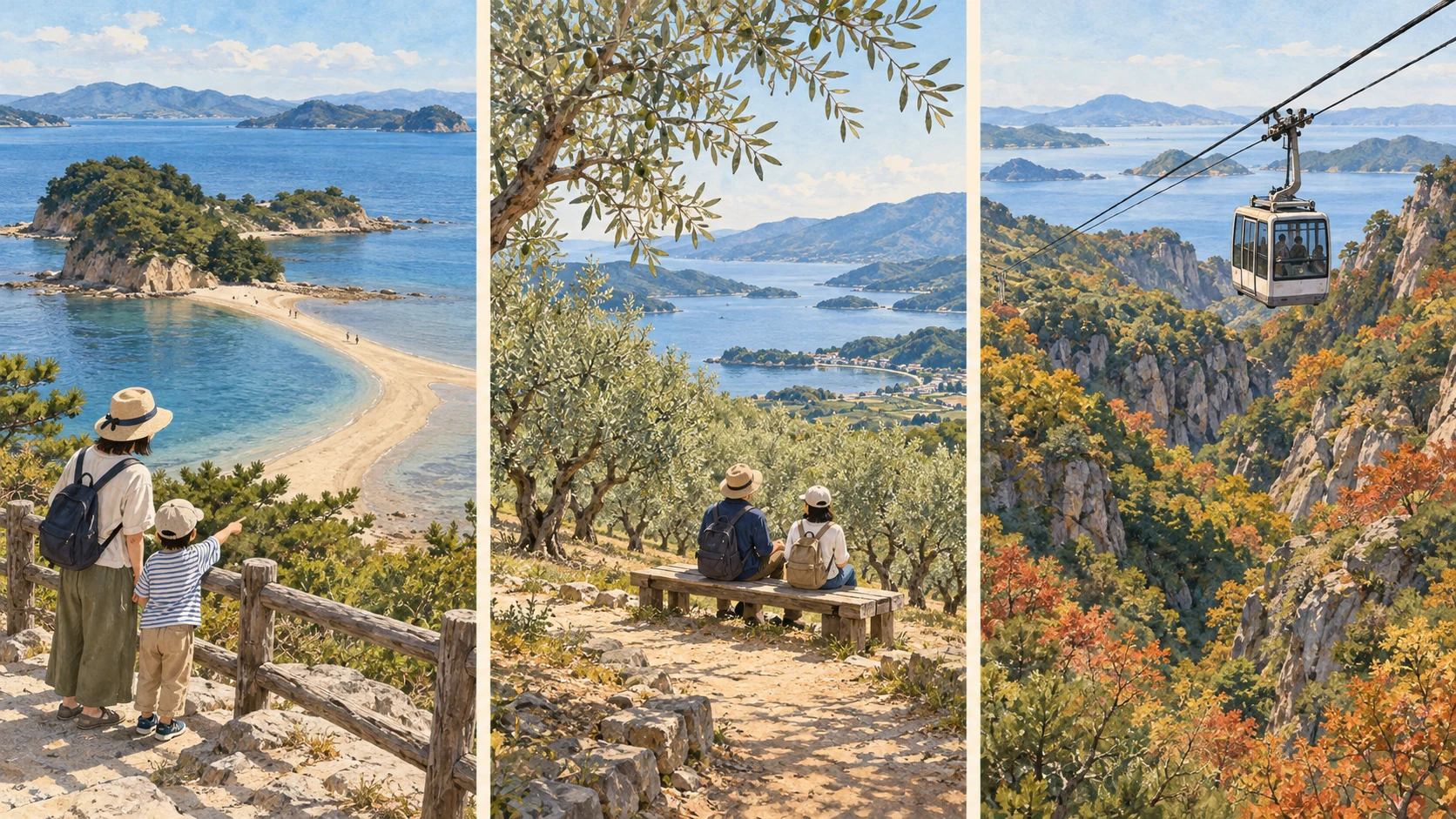
The Shodoshima Olive Park access guide says the park is about a seven-minute walk from Olive Koen-guchi (オリーブ公園口), served by the Sakate and Minamimawari Fukuda routes. The bus does not drop you beside the windmill. The park occupies a small hill, so include the climb, finding a place for photographs and walking back to the stop. With a pushchair or slower walkers, assess that walking effort before combining the park with Kankakei.
This is a place to enjoy olive trees, a Greek-style windmill and sea views on one walk, rather than waiting only for a jumping photograph. The park lists free magic-broom loans from the Olive Memorial Hall for use within the grounds, 8:30–17:00. Check the current broom-lending instructions and collection and return arrangements on site. Return the borrowed prop after your photographs, keep it within the park and leave walking routes clear. In strong wind or rain, choose level walks and indoor stops instead of jumping to reproduce a photograph.
General service hours are listed as 8:30–17:00, but dining, activities and individual facilities may keep different schedules. The park's overall hours do not guarantee every counter will be open. If lunch matters to the plan, check that the restaurant opens that day and confirm last orders. When the bus connections work, use the park as a stop between Tonosho and the southeast, avoiding repeated journeys for one photograph.
Kankakei: check November buses, ropeway fares and the connection back from Kusakabe separately
The Kankakei Ropeway connects Koun Station at Kountei with the summit station in about five minutes one way. The official fares vary by period: an adult return costs ¥2,340 in period A, ¥2,700 in November's period B and ¥2,160 in period C, 11 December–20 March. Child fares are ¥1,170, ¥1,350 and ¥1,080 respectively. Period A covers 21 March–31 October and 1–10 December, so autumn does not have one uniform fare.
For a November visit, take the Kankakei bus route from the Kusakabe-ko stop to Kountei. Here, “Kusakabe Port” is the name of a transfer stop, not evidence that you can currently take an off-island ferry there; attraction access pages may retain old port information. The Kankakei timetable currently linked by Olive Bus lists the town-operated service separately from the seasonal November service. Read the table for your travel month and check the onward connection after returning to Kusakabe.
Olive Bus has announced an adult day pass of ¥2,000 for November 2026. Do not describe the Kusakabe connection as free in every month; check current arrangements for the town-operated service in other months. No ordinary route bus leaves from the summit. Before buying a one-way ropeway ticket without a car, establish how you will get back to Kountei. A ropeway ride of a few minutes does not make the summit visit, queue and descent equally brief.
Changing a Shodoshima day when the summit is windy, the ropeway stops or the leaves have not turned
Kankakei's official information says strong wind and other weather can suspend operations, and maintenance can also require closure. Autumn foliage generally changes through early to late November, without a fixed-date guarantee. Read the operating and current mountain-condition notices before choosing to go up. Discovering a suspension only after reaching the foot of the mountain can add substantial transport costs if you then cross the island for another attraction.
Ropeway hours also vary seasonally. The timetable lists 8:00–17:00 for 21 October–30 November, while the last departure is at 16:30 for 21 December–20 March. The operator warns that the final departure cannot be used for a return trip. A return ticket does not promise two rides regardless of your arrival time. Wheelchair users should ask in advance: the official guide notes steps between the parking area and boarding point at the lower station and recommends driving to the summit station for a return ride. The usual bus approach cannot simply be assumed suitable.
If mountain conditions are unsuitable, concentrate on Olive Park and the soy-sauce district, or walk near Tonosho. If sea winds are also strong, choose indoor facilities that remain open and shorter journeys. Do not automatically replace a suspended ropeway with a hike: your shoes, the trail and your fitness may not suit it. Visitors coming specifically for autumn colour should leave a day that can be exchanged with another plan and accept that current leaves may differ from promotional photographs.
Older mountain guides often add Choshikei Monkey Country, but the current Kagawa tourism association page still marks it temporarily closed from 18 August 2025. Until reopening is confirmed, exclude it from usable family attractions and avoid buying a trip through an old ticket-price link. For rural scenery, allow separate time around Nakayama Senmaida, introduced by the Ministry of the Environment, to see stone-supported rice terraces and waterways. These are working fields that need maintenance. View them from public roads, staying off field banks and keeping farm vehicles' routes clear.
Hishio-no-Sato and Marukin: plan village walks, the museum and activities separately
Shodoshima's Hishio-no-Sato is a district of soy-sauce and tsukudani producers. Looking at buildings from public roads, entering open shops and visiting a named facility are different activities. Check which areas are open to visitors, the fees and the visiting arrangements at each site; do not assume one museum's admission ticket covers other factories. To learn about production, make Marukin Soy Sauce Museum a specific destination. Take Olive Bus's Sakate route to Marukin-mae instead of marking one broad “soy-sauce village” area on the map.
Marukin normally opens 9:00–16:00, extended to 16:30 for 16 October–30 November 2026. Admission is ¥500 for junior-high-school students and older, ¥250 for elementary-school pupils and free for preschool children. The official information also allows for irregular closures and maintenance; these are not identical opening hours every day of the year. Soy-sauce soft-serve and souvenirs are separate purchases. Museum admission does not imply that every tasting, activity and product is included.
The museum currently lists moromi-pressing sessions starting at 10:00 and 14:00. Individuals do not need advance reservations but should enter ten minutes before the start and tell reception they wish to join; groups must book ahead. If this activity is a priority, arrange both bus journeys around its fixed start time. With food allergies, ask about actual ingredients and handling instead of assuming a tasting is suitable because the product is “only soy sauce.”
Twenty-Four Eyes Movie Village: allow half a day rather than treating it as a quick stop beside the soy-sauce district
If you enjoy cinema, literature and seaside wooden school buildings, put Twenty-Four Eyes Movie Village on Shodoshima's second day, or use it instead of Kankakei. The official access page gives approximate driving times of 30 minutes from the Olive Park area, 13 minutes from near Marukin and 40 minutes from Angel Road. Parking, waiting for transport and sightseeing are additional. Places along the same southern coast are not necessarily joined by a short walk.
The Movie Village ticket list has three seasonal adult prices: ¥900 for 15 March–20 July, ¥1,000 for 21 July–30 November and ¥850 for 1 December–14 March. The Misaki Branch School has a separate ticket, with a combined ticket also available. Decide whether you want film sets, exhibitions or the Misaki Branch School, then buy the relevant admission. A combined offer is no reason to add a place you have no time to visit.
Without a car, check buses toward Tanoura Movie Village and choose your departure before visiting. The official guide also describes a boat from the Olive Beach side, but this is a separate service affected by season and weather, not a year-round shortcut available whenever you arrive. Check that day's departures and operating status before combining it with a road return. If you cannot confirm it, use the bus you have checked or reduce the number of stops.
One day on Shodoshima: choose a western tide-focused route or a southeastern culture route
For a first visit without a car, arrive and depart through Tonosho, making Angel Road and Olive Park the priorities. Use your date's tide chart to decide which comes first, then select a workable Sakate or Minamimawari Fukuda bus to the park. Add a walk through Tonosho only if both tides and buses leave room. Promising the summit, Movie Village and a soy-sauce activity on the same day turns every visit into a hurried photograph.
If fermentation culture and film settings matter more, make Marukin, Hishio-no-Sato and the Movie Village your main route, leaving Angel Road for another day or omitting it. Compare sailings through Sakate, or take an island bus from Tonosho to the southeast. Your actual ports, departures and accommodation determine the route; you need not begin at the best-known port. Eat near a place whose opening hours you have confirmed so that lunch does not leave almost no time at the next stop.
For a return from Tonosho to Takamatsu, the ferry timetable checked lists departures including 16:30, 17:30 and 18:40. Choose one that works with the bus back to port and retain later possibilities. This does not mean every sailing connects to an evening train or flight, and the weekday 19:30 restriction still matters. Reopen the full timetable and its notes before departure, allowing waiting time at the port instead of matching the bus's arrival directly to the boat's departure.
A short gap in Tonosho can be spent in Meiro-no-Machi and around Dofuchi Strait. The former consists of lived-in lanes around Saikoji Temple; the narrow strait can be viewed around Eitai Bridge. These suit a short walk around an Angel Road visit or before returning to port. There is no need to assign a photo stop to every lane. Check your remaining time and transport to the port before deciding how far to walk.
Two days and one night on Shodoshima: more room for tides, mountains and the coast
With one night, devote day one to western tides and Olive Park, then choose Kankakei or the southeastern culture route on day two according to the weather. Match accommodation to this division. Compare Tonosho and nearby properties if easier arrival, departure and luggage handling matter; look around Sakate or the soy-sauce district if you want to begin the second morning in the southeast. A sea view should not obscure the distance to your next bus or a fixed dinner arrival time.
Shodoshima International Hotel is one accommodation example near Angel Road. The hotel's official transfer information limits its free shuttle to Tonosho Port. Reservations are required, and guests may also call on the day to advise their sailing. It does not collect guests at Ikeda, Sakate or Fukuda. Arriving through another port means arranging the road journey; a hotel reservation does not include collection from every port on the island.
For a stay including dinner, the hotel FAQ advises arrival by 18:00 where possible and check-in no later than 19:00. That affects whether the mountain or Movie Village can be added in the afternoon. The benefit of staying overnight is a slower pace, rather than five more daytime attractions. Confirm luggage storage and the port shuttle after checkout on day two so that the final leg does not depend on finding a taxi at short notice.
Family rooms and costs: sharing a bed does not remove a child from the headcount or include free meals
When choosing an island as a family, list ferry age bands, museum age restrictions, the total number staying and required beds separately. On Naoshima, Chichu's free admission for age 15 and under still requires tickets, while Minamidera does not admit age 5 and under. Shodoshima transport and accommodation have their own child categories. One age field cannot represent every provider's definition, particularly around starting school or a sixth or twelfth birthday. Check each product's rules.
For example, Shodoshima International Hotel's official FAQ charges a tax-inclusive facility fee of ¥2,200 per child from age 3 through age 6 before entering elementary school, with meals charged separately. Children age 2 and under do not pay this facility fee. Ordinary Japanese-style and Japanese-Western rooms have a maximum occupancy of four, so five people cannot stay even if the fifth child shares a bed. The specified Type A special room with an open-air bath is the exception, allowing five. A double-room starting price in search results therefore cannot represent the family's total.
The same FAQ says bed guards are unavailable and most room types cannot have their beds pushed together; Premium Twin is the exception. Confirm the room type if you need sleeping arrangements for an infant or toddler. These conditions concern this hotel, not every property on Shodoshima. Keep the room type, included meals, children's ages, headcount, transfer and cancellation deadline beside your order, then compare an overnight stay using a budget based on the whole family's spending.
Give Teshima another day rather than treating it as a hop-on, hop-off stop between islands
Consider adding Teshima if you already know you enjoy spatial art and will make time for one work. Teshima Art Museum uses reservations for specific dates and times. Tickets cost ¥1,800 online or ¥2,000 on site; when online tickets sell out, there are no on-site sales either. It is on a separate island. Naoshima's site shuttle and Art House Project pass cannot serve as your next connection or admission.
Its closure pattern also differs from Naoshima's. Official information lists Tuesdays as the usual closing day in March–November, and Tuesdays through Thursdays in December–February, with holiday adjustments. From October through February, it closes at 16:00 with last admission at 15:30. Assuming Naoshima's usual Monday closure applies to Teshima could produce a visit on the wrong day. Check each island's calendar before deciding the overnight sequence.
For connections from Uno, Naoshima or the Shodoshima side, check the relevant operator and actual ports, such as Ieura and Karato. The Shikoku Kisen FAQ explicitly says a through ticket from Naoshima to Inujima cannot be reused after getting off at Teshima. Inter-island tickets are not city hop-on, hop-off passes. With only one day on a first visit, you need not add a third island because it appears close on a map.
Seasons and weather: another island may face the same wind and waves
Spring and autumn suit outdoor walking, but popular holidays still bring capacity limits on boats, buses and museums. In summer, allow for sun exposure and drinking water instead of treating walking everywhere as a cost-free saving. In winter, check seasonal museum closures, shuttles and earlier darkness. Choose conditions you can comfortably travel in, rather than interpreting the Seto Inland Sea's mild climate as a promise of suitable sailing weather every day.
Unsettled seas can affect both Naoshima and Shodoshima. Switching islands at short notice may not solve a cancelled sailing. Check Shikoku Kisen's operating information and notices for your chosen Shodoshima route, distinguishing a fast boat from a ferry, a particular leg from an entire route. One operator showing a normal departure does not establish that another company's boats, island buses or the ropeway will also run.
If you are still in Takamatsu, exchange the island day with a mainland plan only if museum tickets and accommodation can be changed under their terms. If already staying on an island, contact your accommodation and onward transport providers first instead of buying several unconfirmed alternatives at once. Keep a workable way back rather than filling the day with an island you have not researched.
Cancellations and lateness: handle boats, admission tickets, hire cars and hotels separately
Benesse's official online ticket guidance lets you view and cancel orders through My Page; deadlines differ by facility. The museum FAQ about late arrival says admission after the booked time may be impossible because of that day's visitor situation or closing time. During the cancellation window, you can cancel and purchase again, but the original ticket does not automatically move to the next slot. Read your ticket's deadline before deciding to change it.
A cancelled sailing does not automatically refund a hire car, dinner, accommodation and museum tickets. Bad weather does not establish that all providers apply the same exception. Contact each booking's designated office, keep operating notices and replies, and establish whether cancellation is complete, merely requested or awaiting processing. Otherwise, one reservation may keep accruing charges while you believe everything has been cancelled.
A booking platform, hotel website and package tour may have different terms. A generic FAQ does not necessarily replace your particular offer. If the order includes meals, transfers or outsourced activities, identify what has been paid, what is payable on site and which office can make changes. With uncertain dates, establish compatibility with the least flexible reservations before buying several cheap products whose times do not connect.
Comparing island budgets: use the same route to understand the difference
For one adult taking an ordinary ferry from Takamatsu to Naoshima and back on a weekday, plus an online Chichu ticket, the boat and museum alone cost ¥680 × 2 + ¥2,500 = ¥3,860. Three town-bus rides add ¥300, for ¥4,160. This is not an all-inclusive day price: meals, other museums, rental transport, luggage storage and accommodation are extra. Recalculate the actual fare if you return by fast boat instead of keeping the original lower total.
A November Shodoshima example combines an adult Takamatsu–Tonosho return ferry ticket at ¥1,330, the period's ¥2,000 bus day pass and a ¥2,700 Kankakei return ropeway ticket, totaling ¥6,030. Food and other activities are extra here too. The two examples buy different experiences, so they cannot establish that one island is universally better value. If you are not going up the mountain, its ropeway fare is not a compulsory expense.
Families and drivers need separate calculations. Whether a vehicle fare includes its driver, how accompanying passengers pay and whether children need additional museum tickets depend on the chosen route and product. First list required transport and the admissions you have decided to buy, then optional food, shopping and removable stops. Compare whether the cost of staying overnight buys enough extra time. Do not combine a per-person starting rate based on two sharing, one-way boat fares and free child tickets into an unrealistically cheap family total.
Before departure: put ports, reservations and the journey home on the same itinerary
Before paying, write arrival and departure ports, operators, vessel types, valid dates, museum reservations and the final island transport leg on one itinerary. Start Naoshima with the museum slot you most want, or Shodoshima with the tide or mountain priority. Check hotel shuttles and dinner against the same plan. If a leg still relies on deciding later, identify which paid reservation it could affect.
Recheck sailing and facility notices the day before, then check operating status again that morning. Bring offline booking records, enough cash, suitable walking shoes and what the day requires; leave large luggage somewhere that has confirmed storage. Obtain a clear reply in advance if you need special assistance, a child seat or a specified transfer. A service's existence does not guarantee spare capacity that day. Card equipment does not remove every need for cash: Shikoku Kisen's high-speed passenger-boat tickets for the Takamatsu–Miyanoura route are cash-only, and Naoshima's town bus needs coins. Check payment methods for restaurants, rentals and other transport separately.
Keep the experiences you actually want. Naoshima can mean an unhurried Chichu visit and the village; Shodoshima can mean a coastal walk and olive groves, or another day devoted to the gorge. Both deserve time at their own pace. When bookings, tides or weather conflict, removing a stop often preserves more of the day than adding an unverified transfer.
A few useful answers
Should I choose Naoshima or Shodoshima for a first Seto Inland Sea island trip?
Choose Naoshima for museums and architecture, or Shodoshima for a tidal sandbar, olive groves, a gorge and soy-sauce villages. With one day, choose one island: transport and reservations between the two cannot be combined as casually as city attractions.
Can I queue at Chichu Art Museum if online tickets are sold out?
The official policy says no tickets are sold on site when online tickets have sold out. Chichu uses specific dates and time slots. Children age 15 and under enter free but still need tickets for the correct number of visitors.
Does the Art House Project multi-site pass include Minamidera?
No. The current pass covers five sites; Minamidera and kinza require separate tickets and reservations. Minamidera does not admit children age 5 and under.
Do I need to arrange tickets for Naoshima New Museum of Art?
The new museum is included in the official online ticketing system. Buy admission for the date you need before travelling and check the ticket's requirements. Opening days, capacity and ticketing still need planning.
Do I have to rent a bicycle on Naoshima?
No. Take the town bus to Honmura or Tsutsuji-so, then walk or use the site shuttle. Check timetables, capacity and the shuttle's suspension on museum closing days first.
How much is the Shodoshima bus day pass in November 2026?
The operator's 21 October 2026 notice sets 1–30 November prices at ¥2,000 for adults and ¥1,000 for children, including the seasonal Kankakei route. The general product page's ¥1,600/¥800 prices cannot be applied directly to that period.
Can I always walk Angel Road in the afternoon?
No. Check the official predicted sandbar-exposure interval for your travel date, then consider actual water levels, waves and local instructions. Another date's times cannot substitute for yours.
Can I buy only a one-way Kankakei Ropeway ticket?
Yes, but no ordinary route bus leaves from the summit. Arrange a vehicle connection or a walking route for which you are prepared before going up. Visitors without a car should not wait until reaching the summit to work out the return to Kountei.
Does Shodoshima International Hotel collect guests from every port?
No. The official free transfer serves Tonosho Port only and requires a reservation. It does not cover Ikeda, Sakate, Fukuda or other ports.
Can I visit Naoshima, Shodoshima and Teshima in one day?
That is not recommended for a first trip intended to give each island a proper visit. Multiple crossings and museum reservations sharply reduce time on the islands. Teshima deserves an extra day, and its closing days differ from Naoshima's.
If a boat is cancelled, are all hotels and admission tickets automatically refunded?
No. Check each booking's cancellation deadline, applicable conditions and contact office separately, and keep the operating notice and provider replies.
Check with the source
Schedules, availability and rules can change. These official sources are the place to confirm details before you book.
- Shikoku Kisen: Takamatsu–Naoshima Miyanoura route
- Shikoku Kisen: Uno–Naoshima Miyanoura route
- Shikoku Kisen: reservations, tickets and intermediate disembarkation FAQ
- Naoshima Tourism Association: island buses and shuttles
- Naoshima Tourism Association: transport and travel FAQ
- Benesse Art Site: Chichu Art Museum
- Benesse Art Site: museum reservations and free child tickets
- Benesse Art Site: Art House Project tickets and opening hours
- Benesse Art Site: Lee Ufan Museum
- Benesse Art Site: Benesse House Museum and Valley Gallery
- Benesse Art Site: Naoshima New Museum of Art
- Benesse Art Site: photography rules
- Benesse Art Site: opening calendar
- Benesse Art Site: lateness and cancellation guidance
- Shodoshima Tourism Association: port routes and island transport
- Shodoshima Ferry: Takamatsu–Tonosho route
- Shodoshima Ferry: reduced fast-boat departures from May 2026
- Shodoshima Olive Bus: standard day pass
- Shodoshima Olive Bus: November 2026 special-fare notice
- Shodoshima Olive Bus: timetables
- Shodoshima Olive Bus: Kankakei timetable PDF
- Tonosho Town: 2026 Angel Road tide-chart PDF
- Shodoshima Olive Park: access and park information
- Shodoshima Olive Park: magic brooms
- Kankakei: seasonal fares, operations and FAQ
- Kankakei: access
- Marukin Soy Sauce Museum: admission, hours and activities
- Twenty-Four Eyes Movie Village: seasonal ticket prices
- Twenty-Four Eyes Movie Village: access
- Shodoshima International Hotel: transfers and ports
- Shodoshima International Hotel: children, occupancy and arrival times
- Benesse Art Site: Teshima Art Museum
- Benesse Art Site: new museum temporary closure in November–December 2026
- JR Shikoku: rail-pass coverage changes from October 2026
- Benesse Art Site: map of site vehicle restrictions
- Benesse Art Site: ANDO MUSEUM
- Benesse Art Site: Naoshima Bath I♥湯
- Kagawa Tourism Association: temporary closure of Choshikei Monkey Country
- Ministry of the Environment: Nakayama Senmaida
- Shodoshima Tourism Association: Meiro-no-Machi
- Shodoshima Tourism Association: Dofuchi Strait
- Naoshima Tourism Association: visiting Miyanoura, Honmura and the museum area