Choose one island from Takamatsu: Megijima or Ogijima. Plan around regular Meon ferries and fares, the Onigashima Cave bus, Ogijima’s sloping lanes and lighthouse, lunch reservations and 2026 indoor art opening dates. Includes a two-island alternative with transfer time.
- Region & Focus
- Takamatsu
- Reading Scope
- 34 min read · 14 chapters · 7 Q&As
- Official Verification
- 18 official sources checkedUpdated October 27, 2026
- Key Topics
- ItinerariesBookingFood
Chapter Route Map (tap any stop)
- Choose Megijima for the cave and stone walls, Ogijima for lanes and the lighthouse
- Meon normally makes six round trips: save the return before choosing the departure
- Find Prefectural Pier 3 in Takamatsu; foot passengers board in arrival order
- Calculate three separate ferry legs; child categories differ from cave tickets
- Megijima cave day: choose uphill and return buses separately
- The cave presents a legend; allow extra time for the summit viewpoint
- Watch the wind by Megi Port: gulls, ote walls and the Moai
- Megino lunch on Megijima: groups of four or fewer are seated in arrival order
- Start Ogijima at the visitor center, then choose lanes or southern art
- Make the lighthouse a main activity: at least one hour of round-trip walking
- Lunch and a night on Ogijima: Yukulu reservations, capacity and meals
- Indoor art has scheduled openings in 2026; do not reuse festival-season hours
- Two islands are an alternative with gaps: Megijima at 10:20, onward at 12:20
- Luggage, return to port and sea wind: keep the final stretch near the pier
- Quick Q&A
With one island day from Takamatsu, choose between Megijima’s cave and coast, or Ogijima’s sloping lanes and lighthouse. In the regular timetable, a 10:00 departure and 15:40 return to Takamatsu leave time to explore one island and sit down for lunch. Use the two-island alternative only with transfer time, and plan the last ferry’s direction, buses and restaurant dates together.
Choose Megijima for the cave and stone walls, Ogijima for lanes and the lighthouse
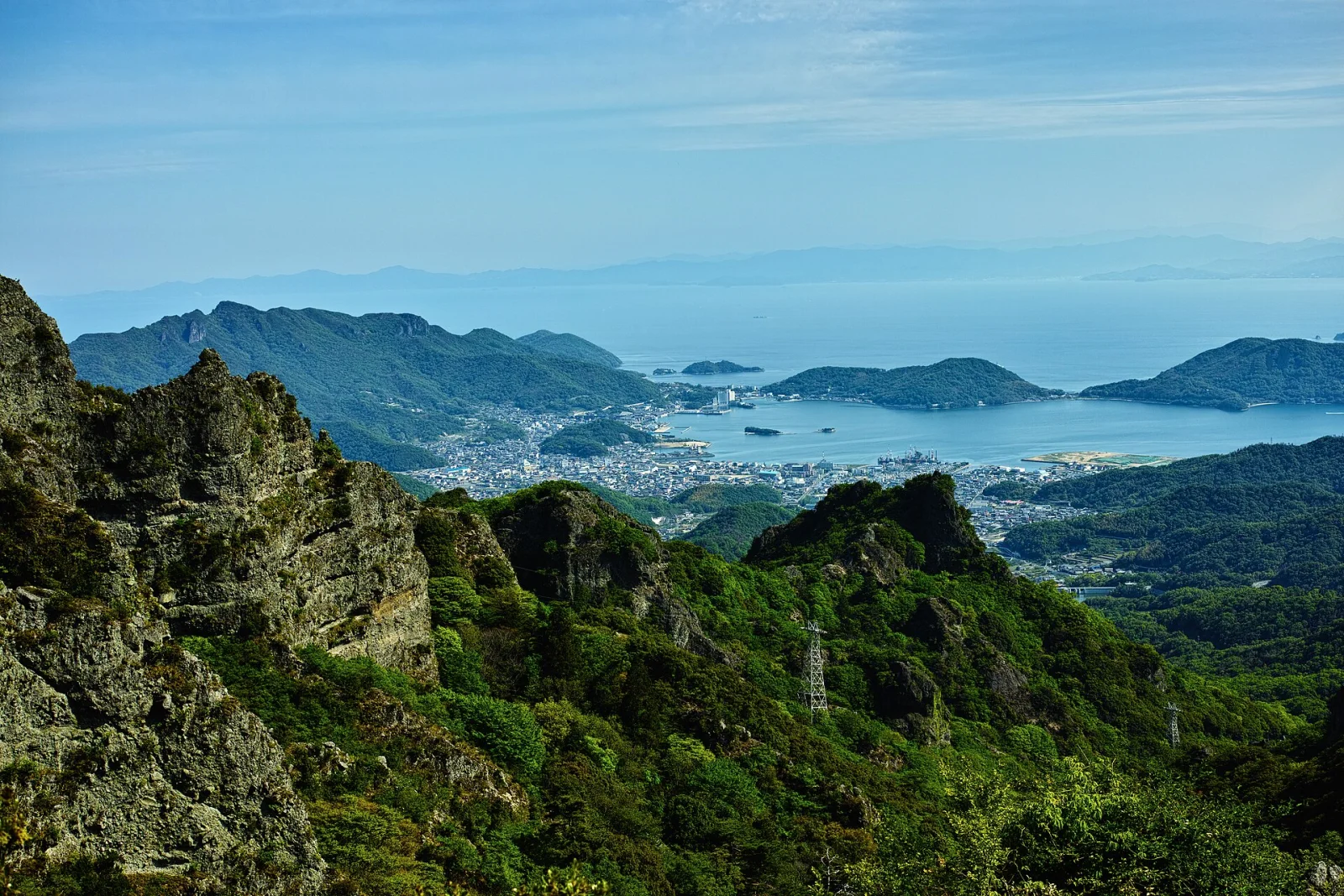
The ferry takes 20 minutes from Takamatsu to Megijima, then another 20 to Ogijima. The islands share a route, but crossing time alone should not decide your choice. Megijima has a port village and Onigashima Cave partway up the mountain, with a bus for the climb. On Ogijima you mainly walk after landing. Houses rise along the slope, and lanes, stone steps and corners form the visit. Choose Megijima for cave legends and coastal walks; choose Ogijima if you enjoy slopes, a stone lighthouse and village life.
For a first visit with only one day, explore one island properly. On Ogijima, take the 10:00 ferry from Takamatsu and return at 15:00. That gives four hours and 20 minutes on the island, with room for lunch and a longer walk. For Megijima, take the same 10:00 departure and leave the island at 15:20, giving five hours for the cave bus, food and port area. Both reach Takamatsu at 15:40, leaving dinner in the city. These are regular-timetable examples; its date range is explained next.
For sore knees, strollers or a group with very different walking speeds, Megijima’s port and coast are easier to shorten. Add the cave only with a bus that covers both the climb and descent. On Ogijima, choose separately among shrine steps, the upper village and the lighthouse. The island’s full perimeter is not an easy walking distance. If you like watching ferries over coffee, leave time before and after lunch on one island instead of buying another inter-island ticket.
This day can replace the Yashima day in a Takamatsu itinerary. For city gardens, hotel areas and airport travel, see the two-day Takamatsu guide. For Naoshima and Shodoshima museums, tides and buses, see the Seto Inland Sea island guide. Megijima and Ogijima reward attention to small villages. You do not need a high island count for a full day.
Kagawa Prefecture’s 2013 video introduces Megijima’s cave and coast, and Ogijima’s lighthouse and village scenery.
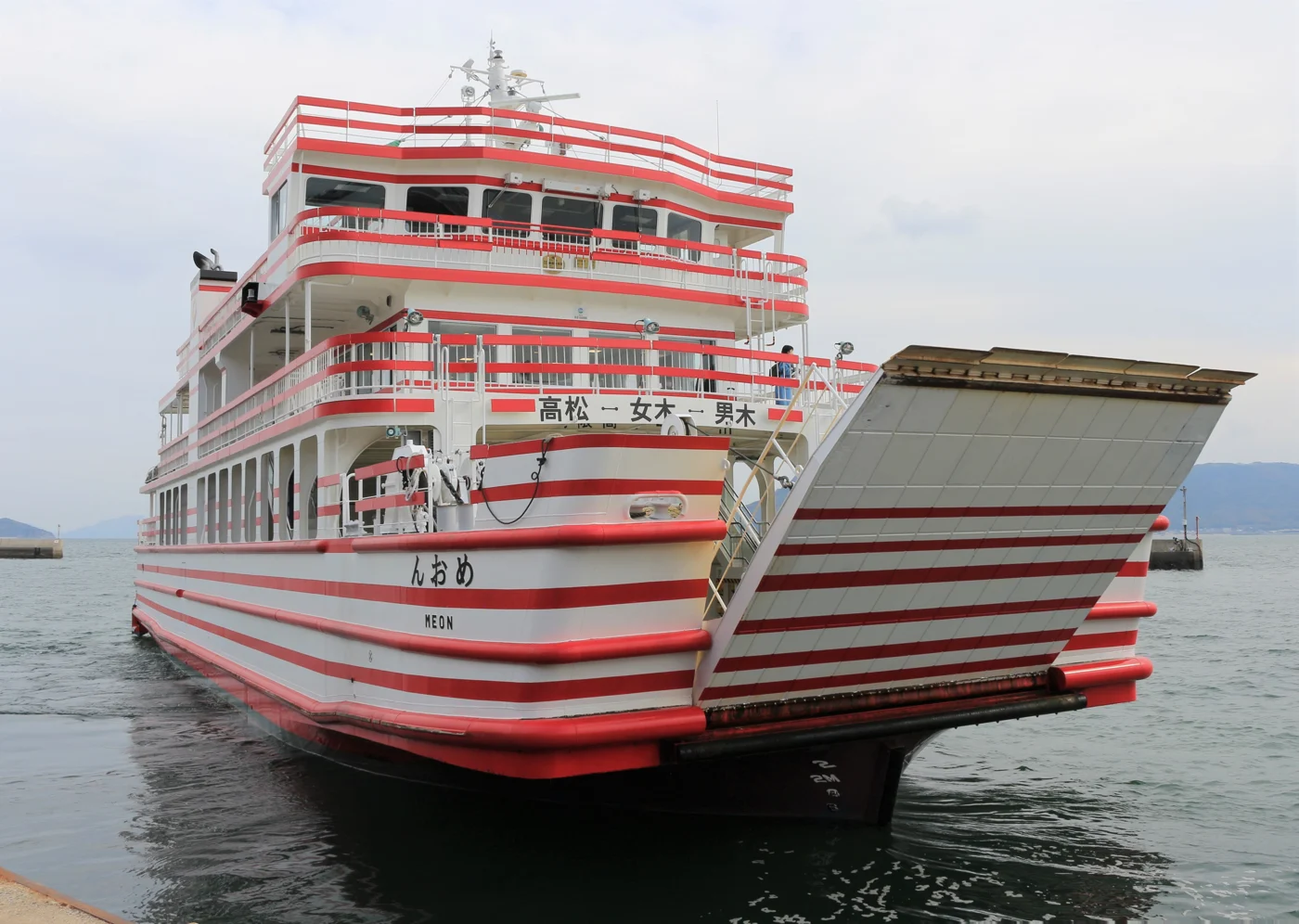
Choose one island from Takamatsu: Megijima or Ogijima. Plan around regular Meon ferries and fares, the Onigashima Cave bus, Ogijima’s sloping lanes and lighthouse, lunch reservations and 2026 indoor art opening dates. Includes a two-island alternative with transfer time.
Meon normally makes six round trips: save the return before choosing the departure
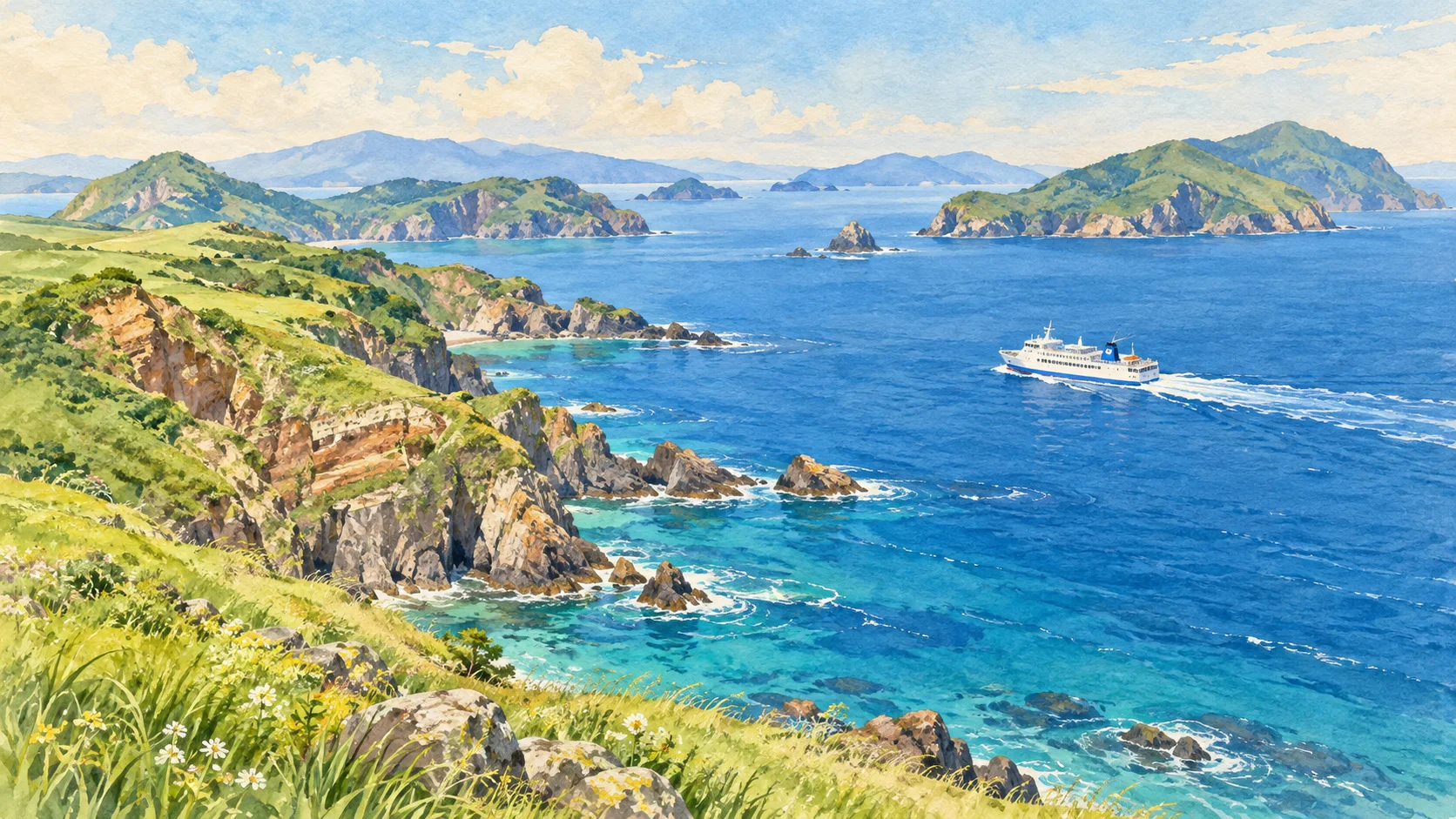
Meon links Takamatsu, Megijima and Ogijima. The regular timetable applies outside August 1–20. The official regular timetable lists Takamatsu departures at 8:00, 10:00, 12:00, 14:00, 16:00 and 18:10. Add 20 minutes for Megijima and 40 for Ogijima. In reverse, Ogijima departures are 7:00, 9:00, 11:00, 13:00, 15:00 and 17:00, reaching Megijima 20 minutes later and Takamatsu another 20 minutes after that.
The “Megijima arrival/departure” column covers both the stop and departure. Direction determines the next destination. The 10:20 ferry at Megijima goes to Ogijima; the 11:20 goes to Takamatsu. A ferry at the pier is not necessarily city-bound. Save the port, direction and time together: “Megi 15:20 → Takamatsu 15:40” or “Ogi 15:00 → Takamatsu 15:40.” If your group walks separately, agree on the same return port and sailing.
In the regular timetable, the last Takamatsu-bound departures are 17:00 from Ogijima and 17:20 from Megijima. The 18:10 departure from Takamatsu goes out to the islands; there is no matching departure after 18:00 from Ogijima to the city. If you stay in Takamatsu and want an Ogijima sunset, compare sunset with the day’s departure time first. A late outward service is not a late return. To remain after the ferry, arrange accommodation and dinner together.
August 1–20 uses the busy summer timetable, with extra Takamatsu–Megijima services. For Ogijima, use a row that actually calls there. Starred services run only between Takamatsu and Megijima and cannot fill an Ogijima transfer gap. Temporary festival or event sailings from old travel posts should not be applied to ordinary weekdays. Save outward and return tables from the same official version for your date, then read the latest operating notice on departure day. If the operator cancels your service, stay on land in Takamatsu.
| Outward: Takamatsu → Megi → Ogi | Return: Ogi → Megi → Takamatsu | Best fit |
|---|---|---|
| 8:00 → 8:20 → 8:40 | 13:00 → 13:20 → 13:40 | Early start, afternoon back in the city |
| 10:00 → 10:20 → 10:40 | 15:00 → 15:20 → 15:40 | A slow island walk and lunch |
| 12:00 → 12:20 → 12:40 | 17:00 → 17:20 → 17:40 | Short afternoon visit; this is the last return |
Find Prefectural Pier 3 in Takamatsu; foot passengers board in arrival order
The boarding point is Prefectural Pier 3 at Sunport Takamatsu, north of JR Hotel Clement Takamatsu. The operator’s boarding FAQ gives the address as 8-1 Sunport, Takamatsu. Megijima’s pier is at 15-22 Megicho and Ogijima’s at 1986 Ogicho. All three locations are linked from the official boarding maps. Look for the ferry company, Meon and the number 3, so you do not end up at a pier for Naoshima, Shodoshima or Takamatsu East Port.
JR Takamatsu Station is near the sea, but you still need to reach the correct counter, buy tickets, line up and board. Ticket sales begin 30 minutes before departure. For the 10:00 ferry, aim to reach the pier for tickets at 9:30, with extra walking and navigation time on holidays. Early arrival gives time for tickets and waiting; foot passengers still board in arrival order. If staying near Kawaramachi the night before, fit breakfast and the trip to the port before 9:30.
Foot passengers use first-come boarding. Vehicle reservations follow separate rules. Cars can be booked through the ticket office from 30 days before travel until the previous day, with some busy periods excluded. A vehicle reservation option does not mean an ordinary foot passenger has a reserved seat. The official website has an online ticket link. After payment, follow the ticket and boarding rules, and account for vessel capacity.
There is no need to rent a car for this island day. The operator asks visitors to avoid bringing cars to either island. Ogijima in particular is explored on foot and has no island bus. The operator has no dedicated parking in Takamatsu, so use a nearby paid lot under its own size and price conditions. Leave large luggage at your Takamatsu accommodation or an arranged storage point. Board with a small bag of water, a jacket and day supplies.
Calculate three separate ferry legs; child categories differ from cave tickets
Ordinary adult one-way fares checked in October 2026 were ¥370 Takamatsu–Megijima, ¥510 Takamatsu–Ogijima and ¥240 Megijima–Ogijima. Elementary school fares were ¥190, ¥260 and ¥120 respectively. An adult return trip costs ¥740 to Megijima only or ¥1,020 to Ogijima only. Getting off at both islands on Takamatsu → Megijima → Ogijima → Takamatsu costs ¥1,120, or ¥570 for an elementary school child. Passing Megijima on the return while remaining aboard differs from getting off to explore and taking a later ferry.
The operator allows one child aged one to preschool age free per adult; each additional child pays the elementary school fare. Infants under one travel free. Two adults and one elementary school child visiting only Ogijima pay ¥1,020 × 2 + ¥520 = ¥2,560 return. Recalculate for extra preschool children, two islands or bicycles using the actual party and legs. Cave child tickets cover elementary and junior high school students. A junior high school student therefore does not use the same “child” category for ferry and cave tickets.
Bicycle carriage costs ¥340 one way or ¥680 return, plus the rider’s fare. An adult taking a bicycle from Takamatsu to Megijima and back pays ¥1,420 for ferry and bicycle, before rental charges and the rental return deadline in Takamatsu. If the cave is the only aim, the uphill bus often involves fewer steps. A bicycle does not flatten Ogijima’s steep lanes and steps, so it is not an easier option for every traveler.
Separate ferry, island transport, cave admission and food to see the cost of each choice. For an adult on Megijima, ¥740 return ferry + ¥1,000 return cave bus + ¥600 admission = ¥2,340. Add meals, coffee and Takamatsu city transport separately. For a walking-only Ogijima visit, fixed transport starts at ¥1,020, with current indoor art tickets added if wanted. Compare routes you will actually take, rather than combining two-island fares with single-island admission into an incomplete total.
Megijima cave day: choose uphill and return buses separately
Onigashima Cave is partway up Washigamine. Oni no Yakata beside Megi Port is the starting point for information and buses. The Onigashima Tourism Association access page currently lists adult bus fares of ¥1,000 return or ¥700 one way, and child fares of ¥500 return or ¥300 one way. Do not use old descriptions giving ¥800 return. The current chart lists departures from Oni no Yakata at 8:30, 9:25, then hourly at :25 from 10:25 to 16:25. Cave returns are 8:40, hourly at :40 from 9:40 to 15:40, and 17:00.
One horizontal row in the chart is not automatically a suitable round trip. Going up at 10:25 and down at 10:40 leaves very little time. Choose a later return for a visit, such as uphill at 10:25 and down at 11:40. Allow another interval if you want the viewpoint, and connect the next ferry in the correct direction. Finishing on the mountain is not reaching the port: waiting, riding and walking to the pier still remain.
The regular 10:20 arrival at Megijima leaves only five minutes for the 10:25 bus. This works for travelers who can go directly from the ferry to the stop. For luggage storage, restrooms or getting children ready, use the later bus or the early ferry arriving at 8:20, leaving time for tickets and questions. Do not treat five minutes as enough to drag luggage, buy tickets and start slowly.
The bus chart does not provide a year-round daily operating calendar. For winter, quieter dates or a trip specifically for the cave, give Onigashima Kanko Jidosha your date and required uphill and downhill times at 087-873-0277. Oni no Yakata’s official guidance also directs operating questions to this bus company. With no usable return, choose a port walk or a city day. Walking uphill requires different fitness from a bus ride. A canceled bus is no basis to commit the whole group to a climb.
The cave presents a legend; allow extra time for the summit viewpoint
The operator’s cave guide currently lists opening at 8:35, last admission at 16:40 and closing at 16:55. Admission is ¥600 for high school students and older, ¥300 for elementary and junior high school students, and ¥500 for people aged 65 and over. Ordinary preschool admission is free. Record last admission separately from the final port bus. Even if you reach the cave by 16:40, a 17:00 return bus leaves a short visit, followed by the last 17:20 Takamatsu ferry. An earlier cave visit is more relaxed.
Displays include the ogres’ hall, living room and guard spaces. The tourism association says Takamatsu elementary school teacher Sentaro Hashimoto discovered the cave in 1914. It later became linked to the Momotaro legend and a major Megijima tourism theme. Look separately at the arranged ogre story and the cave spaces. Children can study expressions while adults see how passages and rooms were fitted into the legend. This offers more than a photo of the entrance sign.
The Oni no Ko Tile Project also appears inside and around the cave, with ogre roof tiles made by Kagawa junior high school students. The tiles meet the story’s ogres in the same place. Look at expressions, horns and tile forms. For more art, first explore what is already on the cave route rather than crossing to another island for only a brief gallery visit.
Washigamine Viewpoint is 188 m above sea level. Reaching it for Seto Inland Sea views is a separate walk beyond the cave. Shoe grip, wind and the return bus determine how far to go. If someone does not want slopes, use the cave as the shared endpoint. To add the summit, choose a later downhill bus before starting and allow time to return to the stop. An open cave does not mean you can cover the whole mountain area before the final service.
Watch the wind by Megi Port: gulls, ote walls and the Moai
Back at the port, walk along the coast and through the village for more island detail. Takahito Kimura’s “Seagulls Parking Lot” lines gulls along a breakwater. They turn together as the wind changes. Watching their direction explains the work better than copying a fixed photo composition. View from public walking areas; the line of gulls shows the connection between port and sea wind.
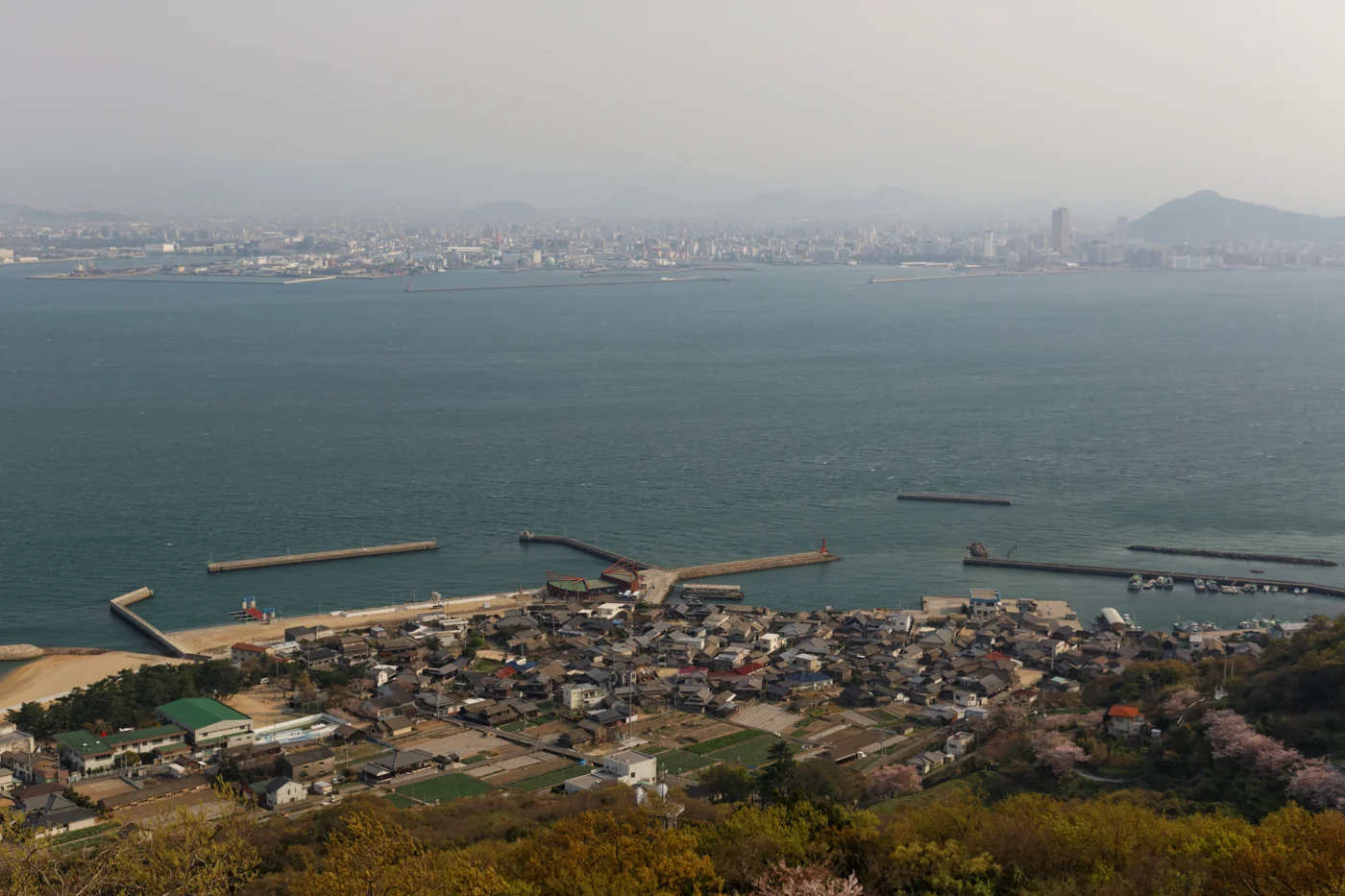
The village’s tall stone walls are called ote. They protect houses from strong winter winds known as otoshi. They share the tourist map with cave ogre legends, but serve an everyday purpose: walls define lanes and shelter homes. Follow the turns and entrances to understand the island, rather than reading every wall as a remnant of an ogre fortress.
The port’s Moai is linked to Kagawa company TADANO’s project to restore Easter Island statues. It is a replica used for lifting tests. Behind this seemingly distant cultural image is Takamatsu’s crane industry. Seen together with Meon, the fishing port and stone walls, it reveals links between island, city and shipping beyond the Momotaro label.
Without the uphill bus, the port, coast and an open cafe can make a short day. Check the return direction on arrival, then walk as far as your energy allows. Return near Oni no Yakata in the afternoon to rest and wait. In strong sea wind, move into the village. Swimming and SUP are separate activities with their own seasons, equipment and operator availability. On an ordinary walking day, dry shoes and clothing make the return to Takamatsu easier.
Megino lunch on Megijima: groups of four or fewer are seated in arrival order
Megino is by the sea. Its usual cafe hours are 11:00–15:00, closed Thursdays and Fridays outside summer, with additional irregular closures. Monthly opening dates appear on the shop’s social media and the port information board. The cafe page says groups of four or fewer are served in arrival order. Groups of five or more can submit a reservation form by the previous day; same-day reservations are not accepted. For lunch after the cave, connect your downhill bus with this meal window.
The official menu includes Margherita pizza at ¥800, beef curry at ¥1,000, coffee at ¥500 and Setouchi lemonade at ¥500. For an adult lunch of curry and lemonade, the meal is ¥1,500. Added to the ¥2,340 Megijima ferry, cave and bus example, the total is ¥3,840. This is a food and transport example for a specific route. Add other orders by party size; the cheapest cafe item is not a full-meal budget.
In a small shop, a large group waits differently from one or two visitors. For five or more, arrange seats before planning ferries. If you need an afternoon sailing, explain your available time before ordering. Leaving while food is still being prepared is awkward for both shop and group. On an irregular closing day, use a simple meal brought in advance, eat where allowed and take trash back. Return to Takamatsu earlier for a full meal.
The tourism association also lists different patterns nearby: Oni no Daidokoro opens weekends and public holidays only, 10:30–14:30; Onigashima Club opens Friday–Monday and public holidays, 9:00–17:00. Treat these as alternatives and use each operator’s current notices for hours and menus. A summer beach house is not a fixed weekday supply stop. Eat breakfast, bring enough water and sit down for one island meal so food becomes part of the stay.
Start Ogijima at the visitor center, then choose lanes or southern art
The white letter-covered roof at Ogi Port is Jaume Plensa’s “Ogijima’s Soul.” It also serves as a visitor center and ferry waiting space. Its roof uses letters from different languages. As the ferry arrives, you can see it against the rising houses behind. Locate the return boarding point before entering the village. You will return here, so there is no need to spend all your photo time immediately after landing.
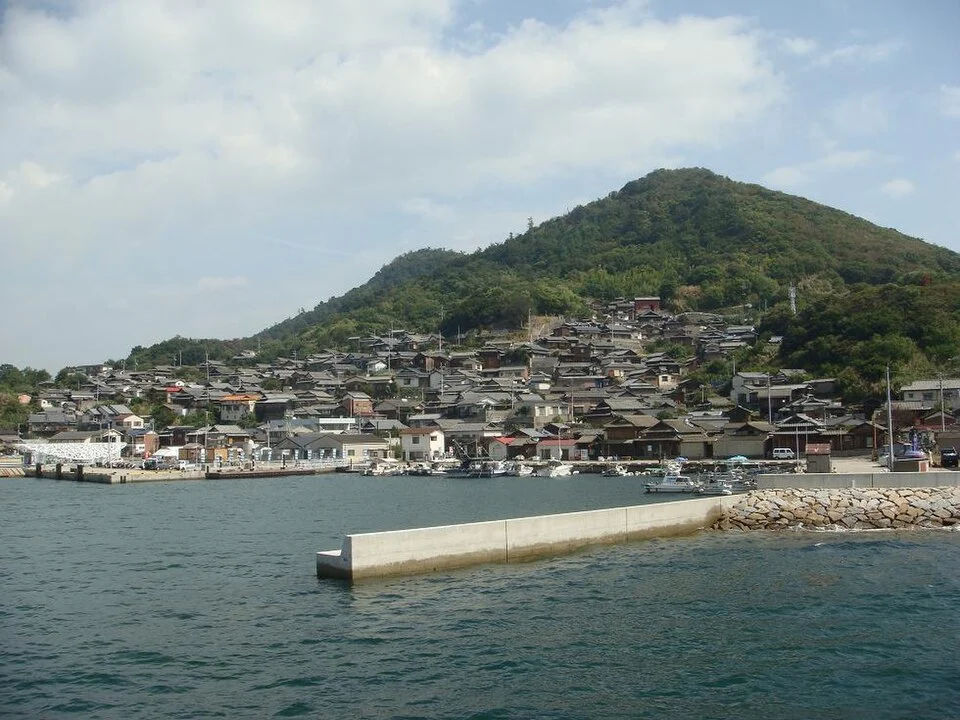
The operator’s Ogijima guide states that there is no island bus and visitors mainly walk. Houses cluster on the southwest slope. From the port, climb gradually toward Toyotamahime Shrine to see stone walls, steps and changing rooflines, then return to the coast. If avoiding stone steps, keep to short port and lower-village sections. Before climbing for the view, check that companions can descend safely. Slow down at corners and stone steps in rain.
The lanes explain why onba handcarts are part of daily island life. Narrow slopes make carrying goods difficult, so residents use carts, which an art project has decorated. Rikuji Makabe’s alley murals use discarded island materials to place landscape silhouettes on house walls. While viewing art, notice passageways, entrances and residents’ direction of travel. These works occupy living spaces.
Keisuke Yamaguchi’s “Walking Ark” at the southern fishing port lies in the opposite direction from the northern lighthouse. With around four hours and a booked lunch, choose village plus southern art, or village plus lighthouse. Both ends are not quick stops on the way back. If alley art interests you more, stay in the village instead of missing details to complete the coastline.
The Ogijima Tourism Association’s visitor FAQ asks travelers to keep routes clear and respect residents’ privacy. Do not enter private homes, empty houses or fields without permission. Wait for pedestrians to pass before photographing lanes, and keep tripods and bags where you can manage them. Give way to deliveries and handcarts on narrow paths. People still live here. You can change your route; a doorway is not a place for a long photo session.
Make the lighthouse a main activity: at least one hour of round-trip walking
Ogijima Lighthouse is at the northern end of the island. The tourism association gives about 30 minutes on foot each way from the port. The round-trip walk alone takes an hour, before viewing, resting and preparing at the port. The official summer activity guide highlights little shade and no vending machines on the lighthouse route. Bring drinks before setting out. Within a four-hour-20-minute island stay, reserve about 90 minutes to two hours for this section before fitting lunch around it.
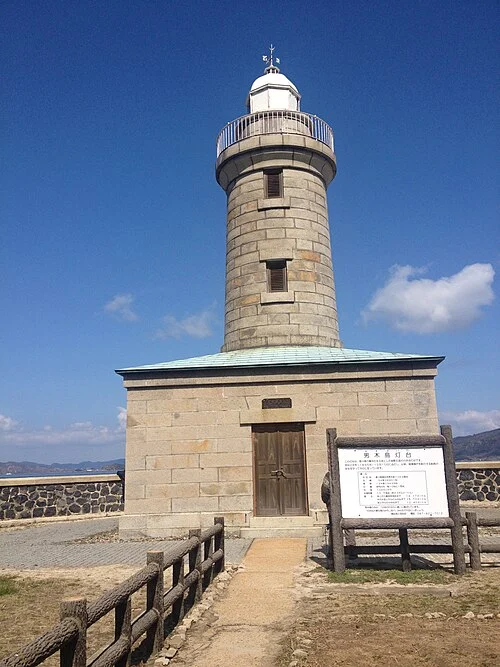
Completed in 1895, the lighthouse has finely worked granite walls. The stone surface remains exposed rather than painted white like many lighthouses. Takamatsu’s cultural-property record says the lighthouse, former staff rest building and former No. 1 storehouse were designated Important Cultural Properties on January 15, 2026. Look beyond the tower to how duty, housing and storage formed a maritime transport facility.
An ordinary walk covers the exterior and open surrounding routes. Interior visits are arranged for specific public events. The November 1, 2026 Lighthouse Day cleaning, weeding and daffodil-planting event included an interior visit, but applications closed October 26. Travelers planning after October 27 should not treat it as a walk-in opening. Seeing the stone building from outside still shows its character.
For the 15:00 Ogijima return ferry, work backward before setting out for the lighthouse after lunch. If heat, strong wind or tired companions become a problem partway, return to the village along the same route. The 17:00 last ferry should not be a reason to extend every walk. For a short late-afternoon arrival, choose the village first. Make the lighthouse the main walk only when arrival time, fitness and daylight suit it.
Lunch and a night on Ogijima: Yukulu reservations, capacity and meals
The traditional-house cafe and accommodation ogijima Yukulu publishes monthly operating information. Its October 2026 notice listed lunch from 11:30 on October 31, limited to ten meals and by reservation only, with cafe hours 11:30–16:00. Other announced weekends that month followed the same lunch format. Usual cafe days are Saturdays, Sundays and public holidays, with lunch 11:30–14:00, closing at 16:00 and last orders at 15:45. Choose your date from the shop’s monthly notice and reserve through its listed email.
Weekday lunch is offered for groups of six or more, rather than as a regular service for two walk-in visitors. For an 11:30 weekend lunch, the 10:40 Ogijima arrival allows a short lower-village walk first. After lunch, make the lighthouse or lanes the main activity. Without a lunch reservation, bring a simple meal for a walking day or shorten the stay and eat in Takamatsu. Finding the cafe building does not secure a seat or food.
To stay for morning and evening, compare Yukulu’s whole-house rental for one group. The official website lists two sleeping spaces: an eight-tatami-size wooden-floored room with two beds and an extra folding bed for a third person, and a six-tatami room with three futons. The whole property holds up to six people, including preschool children. Elementary school children pay the adult accommodation rate. One preschool child per adult can stay without separate bedding free; choose the applicable charge if bedding is needed. Six adults plus children exceed the whole-house limit.
Check-in is 16:00–19:00 and checkout is 10:00. Dinner and breakfast are separate options. Booking instructions for children say to select room-only accommodation first, then add the required number of meals. The operator contacts guests to confirm after the reservation request. The official cancellation table lists 30% three or two days before arrival, 50% the previous day and 100% on the day. Set meals, party size and acceptable cancellation terms before booking a night, then plan departure using an actual next-day ferry such as 7:00 or 9:00.
The island has no convenience store or drugstore. Yukulu asks guests to bring pajamas, toothbrushes and personal medicines. Staying overnight gives time for a slow meal after daytime walks and another look at the port next morning. It also requires meals and next-day transport planning. Leaving large luggage in Takamatsu and carrying one night’s supplies is usually easier than dragging a suitcase uphill.
Indoor art has scheduled openings in 2026; do not reuse festival-season hours
For art, choose the date before the route. Takamatsu’s 2026 indoor artwork opening notice lists the second weekend of each month from May to November on Megijima, Ogijima and Oshima. October added the 12th for the three-day holiday; the next dates are November 14 and 15. For an ordinary weekend after October 27, do not reuse a daily-viewing route from the 2025 festival.
The city notice lists a regional combined ticket at ¥1,000 per area, or ¥500 per individual artwork. Buy with cash at artwork reception; tickets are valid that day. Admission is free for ages 18 and under. Calculate “per area” by the island you choose. One ticket is not a day pass covering Megijima, Ogijima and Oshima. Art inside Onigashima Cave also requires cave admission, and ferry, bus and food charges are separate.
Use current listings in the Setouchi Triennale artwork calendar to choose which works open and when they close. Circle one or two indoor works first, then plan one island. If their opening windows occupy the middle of the day, omit the lighthouse or cave. For outdoor gulls, the letter roof and the village itself, keep an ordinary day for walking without chasing every display to justify a ticket.
The festival brings artworks and visitors to both islands, while the existing walls, fishing ports and lanes remain worth seeing. Separate landscapes usually visible in public space from indoor displays with reception. This shows which parts depend on dates. Companions with different levels of interest in art can use the same port as their endpoint while exploring within their own limits.
Two islands are an alternative with gaps: Megijima at 10:20, onward at 12:20
If you want both islands, one regular-timetable example is Takamatsu 10:00 → Megijima 10:20, Megijima 12:20 → Ogijima 12:40, and Ogijima 17:00 → Takamatsu 17:40. Two hours on Megijima cover the port and village. Four hours and 20 minutes on Ogijima allow lunch and lanes, or a shorter village visit plus the lighthouse. This uses the last return. To retain a later option, leave Ogijima at 15:00, reducing the second island to two hours and 20 minutes.
Adding Megijima’s cave requires a usable bus first. Going up at 10:25 and down at 11:40 usually leaves a port gap before the 12:20 Ogijima ferry, but the five-minute ferry-to-bus connection remains tight. Move lunch to Ogijima or bring a simple meal. For luggage storage, children’s restrooms or the mountain viewpoint, take the 8:00 early ferry or keep the cave for a single-island day. Either is steadier than squeezing all steps into two hours.
The reverse order is also possible: Takamatsu 8:00 → Ogijima 8:40, Ogijima 13:00 → Megijima 13:20, then Megijima 15:20 or 17:20 → Takamatsu. This gives Ogijima a full morning and Megijima’s port an afternoon. For an afternoon cave climb, connect the return bus with the last ferry. Without a chosen second-island activity, remaining on the first often better serves a slow visit.
Write the conditions for dropping the second island before leaving: a full first ferry, no bus or delayed lunch means canceling island two. Do not use a later sailing to chase a route already shortened. If worsening sea conditions are known before boarding, stay in Takamatsu. Both islands lie in the same sea area, so switching islands does not remove weather effects on the route. Returning directly from the first island to base is the easiest exit.
| Order | Megijima stay | Ogijima stay | Trade-off |
|---|---|---|---|
| Takamatsu 10:00 → Megijima → Ogijima → Takamatsu | 10:20–12:20; 2 hours | 12:40–15:00; 2 hours 20 minutes | Megi port and Ogi village; the 17:00 return remains available |
| Takamatsu 10:00 → Megijima → Ogijima → Takamatsu | 10:20–12:20; 2 hours | 12:40–17:00; 4 hours 20 minutes | More time on Ogijima, but uses the last return |
| Takamatsu 8:00 → Ogijima → Megijima → Takamatsu | 13:20–15:20; 2 hours | 8:40–13:00; 4 hours 20 minutes | Ogijima as the main visit, Megi port in the afternoon |
Luggage, return to port and sea wind: keep the final stretch near the pier
The operator’s Ogijima page lists visitor-center luggage storage from 9:00 to 17:00, with ¥500 collected and refunded on retrieval. Some days have no service. If arriving at 8:40, do not walk far before 9:00 only to return for storage. For the 17:00 last ferry, collect bags early. Oni no Yakata on Megijima has lockers, and the building itself stays open until 17:20. Leaving large bags in Takamatsu and carrying day supplies remains easiest, avoiding a storage deadline at the exact time of the last ferry.
Strollers work on level ground but require carrying or a different route at Ogijima’s steps. An accessible ferry cabin does not mean the whole island has smooth access. Meon’s first floor has a cabin with priority for people with mobility difficulties and island residents. The second floor has general seating and a viewing deck. Ask about boarding assistance when buying tickets. For companions who struggle with slopes and steps, keep to short port walks and places they can return from safely. Arrange a comfortable crossing and meal first.
Bring enough water, shoes suited to stone steps, a windproof jacket and a small trash bag. In summer, walk the longer lighthouse section earlier and rest more where shade is scarce. In rain, reduce steps, coast and mountain sections, then wait in a sheltered port area. If wind and waves already affect ferries, stay with Takamatsu’s gardens, museums or shopping arcades instead of solving the return after reaching an island.
For the 15:00 Ogijima ferry, keep the final half hour around the visitor center for bags, restrooms and tickets, then board as directed. Work backward in the same way for the 15:20 Megijima ferry. Reaching Takamatsu Port at 15:40 leaves an easier connection to dinner and city transport. Use the final island stretch for sea views and waiting, so the ending remains clear wherever you walk.
A few useful answers
Which island should I choose for a first visit?
Choose Megijima for Onigashima Cave, port stone walls and coast. Choose Ogijima for sloping lanes, the stone lighthouse and village. With one day, start with one island. Megijima’s cave needs uphill and downhill buses; Ogijima has no island bus.
When is the last Meon ferry back to Takamatsu?
In the regular timetable, it leaves Ogijima at 17:00 and Megijima at 17:20, reaching Takamatsu at 17:40. The 18:10 Takamatsu departure goes out to the islands. Use the separate summer table for August 1–20; not all extra Megijima sailings continue to Ogijima.
How much are the ferries from Takamatsu?
Adult one-way fares are ¥370 Takamatsu–Megijima, ¥510 Takamatsu–Ogijima and ¥240 Megijima–Ogijima. Return trips to Megijima only cost ¥740, or ¥1,020 to Ogijima only. Three legs with a visit to both islands total ¥1,120.
Can I use one row of the cave bus chart as a round trip?
Choose uphill and downhill services separately. Boarding at Oni no Yakata at 10:25 and descending at 10:40 leaves very little visiting time. Choose a later return such as 11:40, then connect with the 12:20 ferry to Ogijima or 13:20 to Takamatsu. Onigashima Kanko Jidosha handles operating questions for your date.
Is Ogijima Lighthouse a quick stop after landing?
It is about 30 minutes on foot each way from the port, at least an hour for the round trip before viewing and rest. Allow about 90 minutes to two hours. There is little shade and no vending machine on the way, so bring water before leaving.
Can two people walk into Yukulu for weekday lunch?
The usual cafe opens weekends and public holidays; weekday lunch is for groups of six or more. Lunch on October 31, 2026 was limited to ten meals by reservation only. Choose other dates from the shop’s monthly notice.
Is indoor art open every weekend in 2026?
The city notice lists the second weekend each month from May to November, plus October 12. The next dates are November 14 and 15. Check the festival’s current information for works and hours. Regional combined tickets cost ¥1,000 per area, individual works ¥500, with ages 18 and under free.
Official information and references
Sources used in this guide.
- Meon | Regular and summer timetables, fares, piers and vessels
- Meon | Foot passenger, vehicle reservation and ticket-time FAQ
- Meon | Ogijima walking, luggage storage and culture
- Meon | Megijima stone walls, gulls and Moai
- Onigashima Tourism Association | Cave bus fares and current chart
- Onigashima Tourism Association | Cave hours, admission and island sights
- Onigashima Tourism Association | Cave discovery and the Momotaro legend
- Onigashima Tourism Association | Megijima dining and hours
- Megino | Cafe menu, opening days and reservations for five or more
- Ogijima Tourism Association | Visitor, photography and private-land FAQ
- Ogijima Tourism Association | Summer 2026 guide and lighthouse walk supplies
- Takamatsu City | Ogijima Lighthouse cultural designation and architecture
- Ogijima Tourism Association | November 1, 2026 Lighthouse Day and application deadline
- ogijima Yukulu | October 2026 lunch, accommodation capacity and cancellation
- Takamatsu City | 2026 indoor art openings and admission
- Oni no Yakata | Cave bus operating inquiries
- Kagawa Prefecture | Official YouTube account directory
- Setouchi Triennale | Current artwork openings