The Keihan Kyoto 1-Day Pass costs ¥1,100 and the Osaka-Kyoto pass is ¥1,650. Compare 1-day passes, 24-hour passes, and ICOCA using real fares to plan stops at Fushimi Inari, Uji, Gion, and Hirakata Park.
- Region & Focus
- Kyoto
- Reading Scope
- 18 min read · 12 chapters · 6 Q&As
- Official Verification
- 34 official sources checkedUpdated 22 November 2026
- Key Topics
- Rail travelTravel budgetItineraries
Chapter Route Map (tap any stop)
- Two Keihan Pass Zones: Check Your First and Last Station
- List Your Exit Stations, Then Recalculate the Fare
- Connecting From Your Hotel Without Taking the Wrong Exit
- Pairing Fushimi Inari With Gion: Save the Mountain Climb for Morning
- Fitting Uji Into Your Day Around Phoenix Hall Entry Slots
- Fushimi Sake Breweries From Chushojima, or South to the Cable Car
- Demachiyanagi: A Simple River Stroll or an Eizan Railway Connection
- Hirakata Park: Compare Pass Bundles Against Gate Admission
- Buying, Sharing, and Scanning QRtto Mobile Passes
- Standard Carriages on Limited Express Trains vs. Reserved Premium Cars
- Count Non-Keihan Fares All the Way to Your Hotel Door
- Check Your Final Connection Before Heading Back
- Quick Q&A
If you are only visiting Fushimi Inari and Gion, tapping an ICOCA smartcard is usually enough. Setting off from Yodoyabashi in Osaka, stopping at Fushimi Inari and Gion-Shijo, and returning to Osaka totals ¥1,210 in adult Keihan fares—less than the ¥1,650 Osaka-Kyoto 1-Day Pass. Add Uji to the mix and those four journeys reach ¥1,690, putting the pass marginally ahead. Travellers staying in Kyoto can compare the ¥1,100 Kyoto-only pass, which covers Iwashimizu-Hachimangu to Demachiyanagi, the Uji Line, and the Approach Cable Car. Jot down every station where you will actually exit the ticket barriers before deciding whether to buy a pass.
Two Keihan Pass Zones: Check Your First and Last Station
If you are staying near Gion, Sanjo, or Demachiyanagi and can list every Keihan station on your itinerary, look at the Kyoto-only pass first. Keihan's official Kyoto 1-Day Pass (¥1,100 for adults, ¥550 for children) covers Demachiyanagi to Iwashimizu-Hachimangu, the Uji Line, and the Iwashimizu-Hachimangu Approach Cable Car. JR services from Kyoto Station to Tofukuji, Kintetsu trains to Tambabashi, and municipal underground trains from Sanjo Keihan all cost extra. Walking from Kyoto Station to Shichijo saves a separate connecting fare—just factor that walk into your transfer time if you are wheeling large suitcases.
Departures from Yodoyabashi, Kitahama, Temmabashi, Kyobashi, or Nakanoshima call for the intercity pass. The Keihan Osaka-Kyoto 1-Day Pass (¥1,650 for adults, ¥830 for children) covers the Keihan Main Line, Oto Line, Nakanoshima Line, Katano Line, Uji Line, and the Iwashimizu-Hachimangu Approach Cable Car. The Kyoto pass stops at Iwashimizu-Hachimangu, so riding even one stop further towards Osaka to Hashimoto puts you outside its zone. Both flat-fare passes exclude the Otsu Lines. If you board the Kyoto Municipal Subway Tozai Line at Sanjo Keihan on a through-train onto the Keihan Keishin Line past Misasagi, the entire stretch still requires a separate fare even though the carriage bears Keihan livery.
Keihan also sells digital passes aimed at overseas visitors. Its English and Traditional Chinese visitor pages list the Kyoto-Osaka Sightseeing Pass (1-Day) at ¥1,650 and the Kyoto Sightseeing Pass (1-Day) at ¥1,100, alongside 24-hour versions at ¥1,850 for the intercity pass and ¥1,300 for the Kyoto pass. The 1-day passes activate after 03:00 JST on the day of use, whereas the 24-hour passes count from the moment of activation. Those four visitor passes are sold as adult tickets only; families travelling with children can buy 1-day passes with child pricing via QRtto instead. If your route includes the Iwashimizu-Hachimangu Approach Cable Car, both QRtto 1-day passes explicitly cover it.
Each 24-hour pass costs ¥200 more than its 1-day counterpart and makes the most sense when your Keihan rides genuinely span two calendar days. For example, if you move from Osaka to Kyoto in the afternoon, ride Keihan to Sanjo that evening, and take Keihan again the next morning to Fushimi Inari or Uji, add up all those trips and compare them against ¥1,850. On a trip where you only grab dinner by the river and catch a JR train from Kyoto Station the next morning, you may still only take one or two Keihan rides despite crossing midnight. If you have a return journey the following day, time your activation so every paid leg falls within the 24-hour validity window.
| Pass Type | Fare (JPY) | Best Suited For |
|---|---|---|
| Keihan Kyoto 1-Day Pass (QRtto) | Adult ¥1,100 / Child ¥550 | Iwashimizu-Hachimangu to Demachiyanagi, Uji Line, and Approach Cable Car |
| Keihan Osaka-Kyoto 1-Day Pass (QRtto) | Adult ¥1,650 / Child ¥830 | Osaka-Kyoto round trips including Uji, Nakanoshima, and Katano lines plus Approach Cable Car; excludes Otsu Lines |
| Visitor Kyoto Sightseeing 24-Hour Pass | ¥1,300 | Itineraries spanning two days entirely within the Kyoto pass zone |
| Visitor Kyoto-Osaka Sightseeing 24-Hour Pass | ¥1,850 | Heavy Keihan travel between Kyoto and Osaka across two consecutive days |
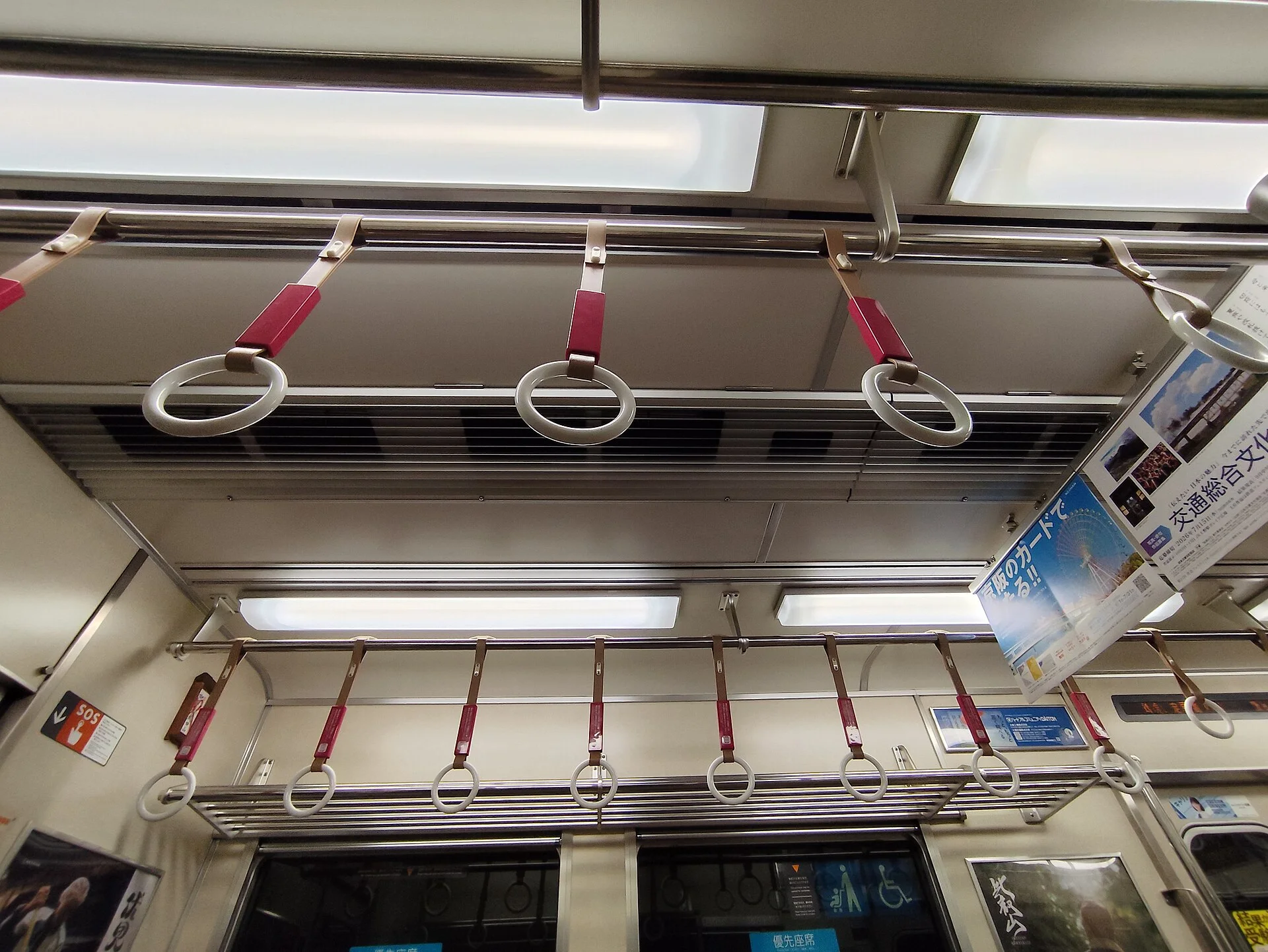
The Keihan Kyoto 1-Day Pass costs ¥1,100 and the Osaka-Kyoto pass is ¥1,650. Compare 1-day passes, 24-hour passes, and ICOCA using real fares to plan stops at Fushimi Inari, Uji, Gion, and Hirakata Park.
List Your Exit Stations, Then Recalculate the Fare
A single Keihan fare runs from the barrier where you tap in to the barrier where you tap out. Travelling from Fushimi Inari to Uji requires changing from the Main Line to the Uji Line at Chushojima; stay inside the ticket barriers and it counts as one continuous Keihan fare, whereas stepping out to browse the sake breweries splits it into two separate fares. Conversely, boarding a Limited Express from Yodoyabashi for speed and changing to a Local train within the station still bills only the direct Yodoyabashi to Fushimi Inari fare when you exit. That distinction alone determines whether a day pass pays off.
A two-stop day from Osaka is easy to tally. Yodoyabashi to Fushimi Inari costs ¥480, Fushimi Inari to Gion-Shijo is ¥240, and Gion-Shijo back to Yodoyabashi is ¥490—total ¥1,210, which is ¥440 cheaper on an IC card than the intercity 1-day pass. Adding Uji turns that ¥240 middle hop into ¥360 from Fushimi Inari to Uji plus ¥360 from Uji to Gion-Shijo, raising the total to ¥1,690. Only when you make an Osaka day trip with three Kyoto exits does the pass edge ahead by ¥40. If you start at Kyobashi, finish at Nakanoshima, or sleep in Kyoto, recalculate using your actual stations.
From Gion-Shijo, riding Keihan to Fushimi Inari, continuing to Uji, and returning straight to Gion-Shijo costs ¥240 + ¥360 + ¥360, or ¥960 in total. Even with three separate rides, that remains ¥140 below the Kyoto 1-Day Pass. Continuing from Uji up to Demachiyanagi by the Kamogawa River adds a ¥460 leg, followed by ¥240 back to Gion-Shijo, bringing the day to ¥1,300. Walk back along the river to Gion instead of taking that final train and single tickets drop to ¥1,060. The same Kyoto itinerary yields three different totals depending on your afternoon stop and how you return after dinner.
Adding a return cable car ride pushes you past the break-even point sooner. Gion-Shijo to Iwashimizu-Hachimangu is ¥360 each way, and the cable car costs ¥300 per adult each way; a return train trip plus return cable car totals ¥1,320, saving ¥220 with the Kyoto 1-Day Pass. If someone in your party rides the cable car up and walks down the shrine path, calculate each person separately—a return train ticket plus a one-way cable car costs ¥1,020. Companions do not all need to buy the same ticket type. Treat any attraction discounts bundled with a pass as a bonus only if you were already planning to pay for those entries.
| Station Exit Sequence | Adult Single-Ticket Total | Pass Comparison |
|---|---|---|
| Yodoyabashi -> Fushimi Inari -> Gion-Shijo -> Yodoyabashi | ¥1,210 | ¥440 cheaper than Osaka-Kyoto 1-Day Pass |
| Yodoyabashi -> Fushimi Inari -> Uji -> Gion-Shijo -> Yodoyabashi | ¥1,690 | Osaka-Kyoto 1-Day Pass saves ¥40 |
| Gion-Shijo -> Fushimi Inari -> Uji -> Gion-Shijo | ¥960 | ¥140 cheaper than Kyoto 1-Day Pass |
| Gion-Shijo -> Fushimi Inari -> Uji -> Demachiyanagi -> Gion-Shijo | ¥1,300 | Kyoto 1-Day Pass saves ¥200 |
| Gion-Shijo to Iwashimizu-Hachimangu return, with return cable car | ¥1,320 | Kyoto 1-Day Pass saves ¥220 |
Connecting From Your Hotel Without Taking the Wrong Exit
If you are staying around Osaka Umeda or Namba, take the Midosuji underground line to Yodoyabashi and look for the Keihan ticket barriers. Hotels listed under an 'Osaka Station' address still require a short city hop to reach Keihan: take the underground from Umeda to Yodoyabashi if that walk is easier, or ride the JR Osaka Loop Line to Kyobashi if you are right beside JR Osaka Station. Elsewhere in central Osaka, Kitahama connects to the Sakaisuji Line, Temmabashi meets the Tanimachi Line, and Kyobashi links the JR Osaka Loop Line, Gakkentoshi Line, JR Tozai Line, and Nagahori Tsurumi-ryokuchi underground line. Your neighbourhood dictates your entry station; Yodoyabashi is simply the clearest benchmark for fare maths.
Staying on Osaka's Nakanoshima island means checking which of Keihan's Nakanoshima, Watanabebashi, Oebashi, or Naniwabashi stations is closest to your hotel. The Nakanoshima Line splits from the Keihan Main Line at Temmabashi, while Yodoyabashi is the Main Line terminus. Returning from Kyoto on a Yodoyabashi-bound train, change at Temmabashi for Nakanoshima-bound services, or get off at Kitahama or Yodoyabashi and walk across a bridge if that puts you closer to your street. Keihan station maps place Nakanoshima-bound departures on Platform 2 and Yodoyabashi-bound trains on Platform 4 at Temmabashi. Check Naniwabashi against Yodoyabashi near Osaka City Central Public Hall, and compare Watanabebashi with Nakanoshima near the art museums. If dinner is across the river, route the bridge crossing on your map beforehand so you do not end up at Nakanoshima Station on the wrong bank.
Guests near Kyoto Station can walk to Shichijo and ride Keihan south to Inari or north to Gion. When pressed for time or hauling luggage, taking the JR Nara Line one stop to Tofukuji is a handy alternative, passing through each operator's own ticket barriers. If Fushimi Inari Taisha is your first stop of the morning, the JR Nara Line drops you at Inari Station right by the shrine approach, and you can walk over to Keihan Fushimi Inari Station afterwards to continue to Gion, Sanjo, or Uji. Starting at JR Inari Station trims a few blocks off the walk—particularly welcome on an early start from Kyoto Station.
A loop bus also links Shichijo and JR Kyoto Station. Come up to street level via Exit 1 at Keihan Shichijo Station and head slightly south to find the Shichijo Keihan-mae bus stop; at the JR end, the bus stops outside THE THOUSAND KYOTO on the east side of Kyoto Station. The regular single fare is ¥230, or ¥100 in cash if you pick up a transfer discount voucher from the ticket machine inside Keihan Shichijo's barriers and hand it to the driver on alighting. This bus requires a separate fare, so log it as the first or last leg of your daily budget.
In central Kyoto, the Kamogawa River is a more reliable landmark than phone GPS. Gion-Shijo Station sits on the east bank of Shijo Bridge, putting Hanamikoji Street and Yasaka Shrine straight ahead as you exit, while crossing the bridge westwards leads to Hankyu's Kyoto-Kawaramachi district. Searches for 'Shijo' often surface both railways, so remember that transferring between them means walking over the river. At Sanjo, check the operator name first too: Keihan calls its station Sanjo, while the municipal underground calls its adjoining station Sanjo Keihan, and entering the underground requires buying a separate ticket or tapping your IC card. For the Okazaki museum district, either walk above ground from Sanjo or transfer to the Tozai Line one stop to Higashiyama.
Pairing Fushimi Inari With Gion: Save the Mountain Climb for Morning
From Osaka on the Keihan Main Line, board a Limited Express calling at Tambabashi or Chushojima to cover the bulk of the distance, then switch to a Sub-Express or Local that stops at Fushimi Inari. Double-check that Fushimi Inari appears on the platform departure board before boarding, as Demachiyanagi-bound Limited Express trains run straight through without stopping. If you prefer a single-seat ride, take a through-service scheduled to call at Fushimi Inari, bearing in mind that travel time depends on train type and passing loops. From Keihan Fushimi Inari Station, follow the shrine signs east for roughly 5 minutes on foot.
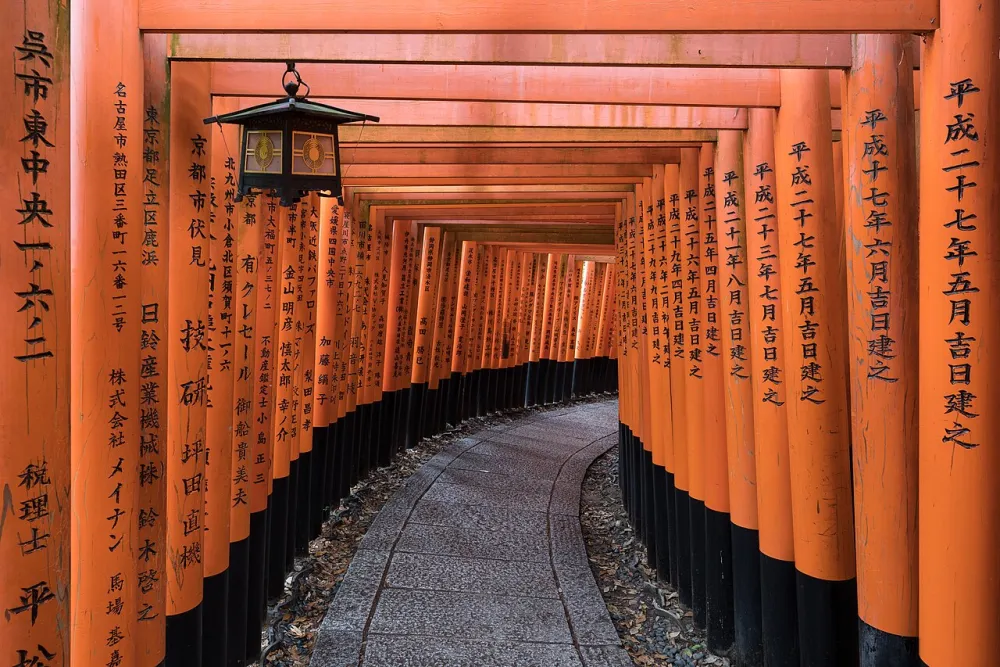
Decide at the base how far up Mount Inari you want to walk. Visitors focusing on the main hall and the Senbon Torii gates can turn back at Okusha Haisho and keep the afternoon free for Gion and the Kamogawa River. Continue up to the Yotsutsuji viewpoint for wide views across Kyoto before heading to Gion, or set aside the whole morning if you plan to complete the full summit loop. Because every stretch up and down is on foot, your legs—rather than train timetables—usually dictate when you leave Fushimi Inari and where you eat lunch. To preview each stage of the climb, see our Fushimi Inari mountain route guide.
Back at Keihan Fushimi Inari Station, use the ground-level barriers signed for Sanjo and Demachiyanagi to reach Platform 1 for Gion. If you are heading to Uji first instead, use the opposite entrance signed for Yodoyabashi and the Nakanoshima Line to reach Platform 2 and change at Chushojima. Each direction has its own dedicated ticket gate, so verify your destination before tapping in.
At Gion-Shijo, start the afternoon at Kenninji Temple and Hanamikoji Street, or follow Shijo-dori to Yasaka Shrine before strolling north along the Kamogawa River to Sanjo. Save temple visits for early afternoon and leave the backstreets and riverbanks for dusk. Around Hanamikoji, stick to public thoroughfares and respect street signs prohibiting photography or entry on private lanes. Which bridge you cross affects dinner logistics more than which station you depart from: if your restaurant is on the Kiyamachi side, stroll up to Sanjo Bridge and catch Keihan back to Osaka from there. For a mapped route, check our Gion and Hanamikoji walking guide.
If rain or sore legs catch up with you after the shrine climb, keep your afternoon close to Shijo Bridge so you can board and alight at Gion-Shijo without long detours. If you still have energy after Kenninji, walking north along Kawabata-dori to Sanjo saves one city-centre rail hop—just remove the Gion-Shijo to Sanjo fare from your tally, or adjust the final fare to reflect boarding at Sanjo after dinner.
Fitting Uji Into Your Day Around Phoenix Hall Entry Slots
To step inside Byodoin's Phoenix Hall, take a Limited Express from Osaka stopping at Chushojima and change inside the barriers to the Uji Line to its terminus. Uji trains normally depart from Platform 3, though some early-morning services use Platform 4. Keihan Uji Station sits on the north bank of the Uji River, so cross Uji Bridge and follow the Omotesando approach to Byodoin. Once inside the garden, head straight to the interior viewing desk to buy a timed entry ticket: sales open at 09:10 JST on a first-come, first-served basis, capped at 35 visitors per slot, with tours running from 09:30 to 16:10 until sold out. You must gather 5 minutes before the time printed on your ticket.
If you are assigned a slot near midday, spend the wait photographing the Aji-ike Pond and Phoenix Hall exterior, and save the Hoshokan Museum for a longer gap. Byodoin Garden opens from 08:45 to 17:30 (last entry 17:15), and the Hoshokan Museum admits visitors until 16:45; combined garden and museum admission is ¥700 per adult, with the interior hall ticket paid separately. Leaving teahouse stops until after your tour avoids rushing through a pot of matcha or missing your assembly call in a queue. If you only plan to walk by the river, drink tea, and view the hall from outside, climbing Fushimi Inari first and changing at Chushojima before noon works smoothly.
For a dedicated half-day in Uji, walk one riverbank out from Uji Bridge and return to Keihan Uji Station along the opposite bank. Byodoin and the tea-lined Omotesando sit on the west side of the bridge, while Ujigami Shrine and Uji Shrine lie on the Keihan station side. When meeting companions at 'Uji Station', always specify the railway company: JR Uji Station sits closer to town across the river from Keihan Uji Station. Returning straight to Kyoto Station is simplest on the JR Nara Line from JR Uji Station, whereas continuing to Gion-Shijo or Demachiyanagi keeps both legs on a single Keihan ticket via Chushojima. Plan both banks with our Uji tea street and World Heritage day guide.
Squeezing Fushimi Inari, Uji, and Gion into one day works best when only one stop gets a full half-day. Once your Phoenix Hall time slot is fixed, trim Fushimi Inari to the lower shrine grounds or keep Gion for an evening stroll. Anyone determined to hike the full Mount Inari loop is better off moving Uji to another day rather than rushing lunch and sightseeing. Skipping the Fushimi Inari exit altogether—Yodoyabashi to Uji, then Gion-Shijo, then Yodoyabashi—costs ¥490 + ¥360 + ¥490 = ¥1,340 on single tickets, erasing the intercity day pass's savings.
Fushimi Sake Breweries From Chushojima, or South to the Cable Car
To explore the Fushimi sake district, exit at either Chushojima or Fushimi-Momoyama. The Gekkeikan Okura Sake Museum is roughly a 5-minute walk from Chushojima; afterwards, wander along the canal towards the Fushimi-Momoyama shopping arcade and catch a northbound train from there. Because Fushimi-Momoyama is a smaller Main Line stop, Limited Express riders from Osaka should alight at Chushojima. The museum generally opens 09:30 to 16:30 (last admission 16:00), closing from 28 December to 4 January over New Year; admission for visitors aged 20 and over is ¥600 including tasting, with cashless payment inside. If you plan to sample sake and tackle stone steps on the same day, finish the mountain climb in the morning. See our Fushimi Inari and sake district day route for details.
From the Okura Sake Museum, walking back to Chushojima puts you straight onto the Uji Line for Byodoin and Uji Bridge. If the brewery district is just a brief detour with companions, count that extra station exit separately in your fare total. When you have a fixed Phoenix Hall entry slot, consider visiting Uji first and exiting at Chushojima on the way back so your timed reservation stays safe. Keep in mind that the sake district and the shrine sit in different parts of Fushimi Ward: look for Chushojima or Fushimi-Momoyama for breweries, and Fushimi Inari for the shrine.
Iwashimizu-Hachimangu Shrine sits atop Mount Otokoyama. Ride Keihan to Iwashimizu-Hachimangu Station, walk over to the base Cable Hachimangu-guchi Station, and ride the Approach Cable Car up to Cable Hachimangu-sanjo Station. Keihan lists the cable car fare separately on its site, though both QRtto 1-day passes cover it—decide before buying whether you will ride both ways or walk one direction, as a return cable car trip normally costs ¥600. If you are continuing to Uji in the afternoon, ride the Main Line back north to Chushojima. Check cable car departure times separately from Main Line trains so you factor in waits on the mountain and at the platform.
Demachiyanagi: A Simple River Stroll or an Eizan Railway Connection
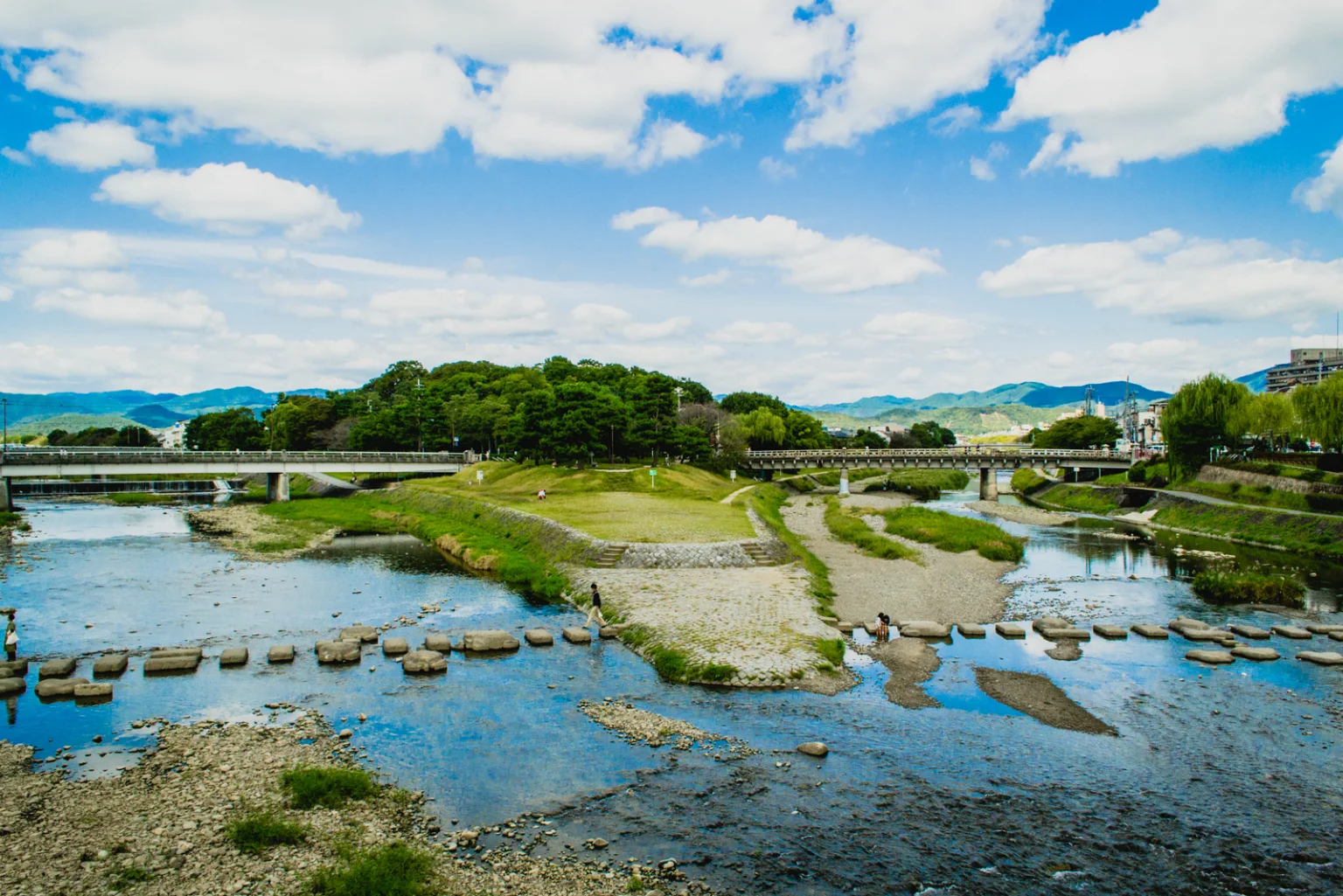
Guests staying in Gion or Sanjo can stroll partway up the Kamogawa River before hopping on Keihan to Demachiyanagi. Stepping outside leads straight to the Kamogawa Delta where the Kamo and Takano rivers meet; take a moment to note which bridge returns to the station, then walk north along the river into Tadasu-no-Mori Forest for Shimogamo Shrine. If Demachiyanagi is simply a return trip on top of regular riding, single tickets stay cheaper; only add the Eizan Electric Railway return fare to your comparison if you decide to head into northern Kyoto. For a walking order around the delta, see our Demachiyanagi, Kamogawa Delta, and Shimogamo Shrine guide.
If you are based in Osaka and committed to transferring from Keihan onto the Eizan Railway for Kurama, Kibune, or Yase, compare the Eizan Electric Railway & Keihan Electric Railway 1-Day Pass. Sold via QRtto at ¥2,100 for adults and ¥1,050 for children, it covers Keihan's pass zone, the Approach Cable Car, and all Eizan lines, valid within 3 months of purchase through 31 March 2027. Note that for Kifune Shrine, the Eizan train only goes as far as Kibuneguchi, so the connecting bus up to the shrine still costs extra. If your day ends at Shimogamo Shrine and the delta, you can do the whole stretch on foot and leave Eizan out of your budget.
Hirakata Park: Compare Pass Bundles Against Gate Admission
For the amusement park, aim for Hirakata-koen Station. From Osaka, take a Sub-Express or Local calling directly at Hirakata-koen; from Kyoto on a Limited Express, change at Hirakatashi onto an Osaka-bound train that stops at Hirakata-koen. The park sits roughly 3 minutes on foot from the station, so check locker plans if you are transferring hotels with luggage. Following Keihan's August 2026 timetable revision, some daytime Rapid Express services terminate at Hirakatashi between Yodoyabashi and Hirakatashi—if you board one heading towards Uji or Kyoto, make sure you switch to a continuing northbound service.
For a dedicated park trip from Yodoyabashi, return adult rail fares total ¥800 and gate admission at the park costs ¥2,000, coming to ¥2,800 combined. Keihan's visitor Hirakata Park Extended Edition pass costs ¥2,200 for adults and ¥1,250 for children aged 6 to 11, bundling one park entry with unlimited rides in the Keihan pass zone. This edition is on sale until 31 March 2027 and valid until 30 April 2027 within 3 months of purchase, meaning it can save money even on a single return train journey once admission is included.
Make sure you compare like for like. Adults simply accompanying family should benchmark against standard park admission, while anyone riding attractions non-stop needs to compare the park's combined admission-plus-ride-pass price against the extended rail pass plus an add-on ride wristband. Note also that Hirakata Park's own child admission starts at age 2, whereas the Keihan extended child pass starts at age 6, so toddlers do not need the same rail pass as older siblings. Check the park's official calendar for closure dates, seasonal events, and autumn or winter illuminations—if you stay late for evening lights, catch your hotel-bound train directly from Hirakata-koen. Find more family tips in our Hirakata Park family day guide.
Buying, Sharing, and Scanning QRtto Mobile Passes
Keihan's two standard 1-day passes on its Japanese site are sold through Surutto QRtto. Register an account on your smartphone and pay by credit card; each transaction allows up to 4 tickets across adult and child fares. Purchased passes stay in your account and can be activated on any single day within 3 months of purchase. If children will split off later with another adult, decide before boarding how to handle tickets: a group staying together can swipe through each QR code on one phone, whereas companions with their own phones who might exit separately should have passes transferred to their own registered QRtto accounts beforehand.
Before entering the station, open your pass page in QRtto, select the correct ticket, tap 'Start Using' right before you ride, and scan the QR code at a reader-equipped barrier. When one person holds multiple passes for a group, swipe through each companion's ticket first so they pass through ahead of you, then scan yourself through last; repeat the same active screen when exiting. Keep an ICOCA card handy for JR, Hankyu, or underground transfers outside Keihan. If you accidentally tap an IC card at a Keihan gate, that journey bills as a standard fare—stop at the same station and ask staff to help adjust it before riding further.
Because your phone must display the live web ticket throughout the day, log into your browser before leaving your hotel and keep mobile data and battery charged. Visitor-edition passes sold via Keihan's Traditional Chinese or English pages follow their respective platform's redemption and display rules. If you buy attraction tickets online as well, save the train pass and venue tickets as separate browser bookmarks. Should station reception dip underground, open your route map and check your next station names while waiting for signal to load the pass.
Travellers carrying a JR Pass or regional rail pass who ride JR from Kyoto Station to Inari or Uji should strip those JR-covered legs out before testing a Keihan pass. Taking JR to Inari in the morning and riding Keihan just once from Fushimi Inari to Gion-Shijo costs ¥240 for an adult, making an IC card far cheaper. When carrying two passes on the same day, write the operator name beside each transfer at Tofukuji or Uji so you tap the right gate every time.
Standard Carriages on Limited Express Trains vs. Reserved Premium Cars
Standard non-reserved carriages on Keihan Limited Express trains require only a regular ticket, IC card, or day pass across the valid zone. Only the Premium Car requires a separate seat reservation fee, priced at ¥400 or ¥500 depending on distance. Online bookings and designated station counters open at 10:00 JST 14 days before travel, while platform seat-ticket machines only sell remaining seats for imminent departures on the day. If you are still stopping at Fushimi Inari, book the Premium Car only on the long express stretch—such as Osaka to Tambabashi—then change to a local service stopping at Fushimi Inari.
If you reach the platform and find the booking window too tight, simply queue at the boarding marks for regular non-reserved carriages on the very same train. Car formations vary slightly by trainset, so follow the floor markers rather than memorising a single carriage number when avoiding the Premium Car doorway. Note also that RakuRaku Rapid Limited Express trains skip more stops than standard Limited Express services for faster city-centre runs, while Liner trains are all-reserved services with their own rules. Returning from Gion-Shijo to Osaka in the evening, non-reserved and Premium carriages travel on the exact same train—paying extra buys a guaranteed seat, not an earlier arrival.
Count Non-Keihan Fares All the Way to Your Hotel Door
If you are staying near Kyoto Station and focusing on Shijo-Karasuma, Nijo Castle, or Kitayama, build your plan around the underground and city buses first. Kyoto City's Subway & Bus 1-Day Pass costs ¥1,100 for adults and ¥550 for children—identical in price to the QRtto Keihan Kyoto pass—and covers municipal underground lines, Kyoto City Buses, and selected partner bus routes. Note that 'Keihan Bus' listed on the municipal pass refers to buses only; Keihan Electric Railway trains still charge separately. If your day involves just one morning Keihan hop followed by repeated underground rides, pay the single Keihan fare and buy the city pass instead. See our Kyoto subway and bus day pass guide for details.
When your itinerary involves multiple Osaka underground rides on the same day, look at the Keihan + Osaka Metro Sightseeing Pass listed on Keihan's visitor pages at ¥2,160 for adults, covering the Keihan pass zone plus Osaka Metro and most Osaka City Bus routes. The current edition sells until 31 March 2027 and remains valid within its usage limits until 30 April 2027, costing ¥510 more than the basic Osaka-Kyoto pass. If you only take one morning and one evening underground ride in Osaka, add those exact metro fares up first—especially if your Keihan rail total sits around ¥1,210, where paying everything on an IC card shifts the entire comparison.
Other railways often serve specific corridors better. From Osaka Umeda straight to Kyoto Station for Shinkansen connections, luggage storage, or city buses, JR puts you directly at both ends. For shopping around Kawaramachi from Umeda, Hankyu runs direct without crossing Shijo Bridge to Keihan. Going to Arashiyama from central Kyoto—especially if you finish by the river—usually suits Hankyu, JR, or Randen better depending on your hotel. And if you visit Osaka today and Uji two days later, save the Kyoto pass maths for that day; day passes cover a single day, so split multi-day plans accordingly.
Check Your Final Connection Before Heading Back
Keihan runs separate timetables for weekdays and weekends/holidays, and the revision taking effect on 22 August 2026 brought forward several last-train times. When returning to Osaka from Kyoto, search the full door-to-door route from the station nearest dinner to the station nearest your hotel rather than just checking 'last Kyoto-to-Osaka train'. Keihan's final arrival at Yodoyabashi and the Midosuji Line's final departure from Yodoyabashi follow different timetables—visitors staying near Kyobashi can walk back to their room, whereas anyone staying in Namba must verify that their late Keihan train still makes the last Midosuji underground connection.
Returning from Uji to Osaka, line up your Uji Line arrival at Chushojima with the onward Osaka-bound departure, and check whether the train runs to Yodoyabashi, Nakanoshima, or stops short. The same applies from Gion-Shijo back to Nakanoshima: if your train terminates at Yodoyabashi, allow transfer wait time at Temmabashi for the Nakanoshima Line. If you want a leisurely dinner in Kyoto, look up one connection earlier than the very last viable option and work backwards to set your departure time from the restaurant. If your Osaka hotel sits between two underground stations, run searches to both endpoints from Sanjo or Gion.
Even if you have used a Keihan pass all day, there is no obligation to stick with Keihan for the final ride home. Should dinner move to the west side of Shijo Bridge, riding Hankyu direct from Kyoto-Kawaramachi to Osaka-Umeda and walking back to your hotel may be smoother than crossing the river to Keihan and changing underground lines. Treat a day pass already bought as a sunk cost and pick your final train by location, transfers, and arrival time. On hotel-change days in Kyoto, prioritise the leg needed for luggage drop-off or check-in, then recalculate your afternoon fares from there.
A few useful answers
Is a Keihan Day Pass worth it for Fushimi Inari and Gion from Osaka?
Departing Yodoyabashi, exiting at both Fushimi Inari and Gion-Shijo, and returning to Yodoyabashi totals ¥1,210 in adult single fares—¥440 less than the ¥1,650 intercity 1-day pass. Adding an exit at Uji in between brings the day to ¥1,690.
Can I use the Keihan Kyoto 1-Day Pass to reach Kyoto Station?
No—JR, Kintetsu, and underground lines serving Kyoto Station all require separate fares. You can walk from Kyoto Station to Keihan Shichijo Station to start using your pass, or take JR one stop to Tofukuji and transfer to Keihan there.
Which Keihan pass covers Uji?
Both QRtto 1-day passes include the Uji Line. Stay within the Kyoto pass zone and the Kyoto 1-Day Pass suffices; only compare the Osaka-Kyoto pass if you are travelling from Osaka. Change inside the barriers at Chushojima and alight at Keihan Uji Station.
Can I ride Keihan Limited Express trains with a 1-day pass?
Yes, you can ride standard non-reserved carriages on Limited Express trains within the valid zone. Only the reserved Premium Car requires a separate seat ticket of ¥400 or ¥500 depending on distance.
Are there direct Keihan trains from Nakanoshima to Fushimi Inari?
Check whether your specific departure from Nakanoshima continues into Kyoto and calls at Fushimi Inari. If not, change onto a train stopping at Fushimi Inari along the Main Line after joining it at Temmabashi.
What is the price difference between the Keihan 24-Hour Pass and the 1-Day Pass?
The visitor 24-hour passes cost ¥1,850 for Osaka-Kyoto and ¥1,300 for Kyoto only—each ¥200 more than the corresponding 1-day pass. Because validity starts from first activation, they suit trips using Keihan across an afternoon and the following morning.
Official information and references
Sources used in this guide.
- Keihan Electric Railway Osaka-Kyoto 1-Day Pass
- Keihan Electric Railway Kyoto 1-Day Pass
- Keihan Traditional Chinese Visitor 1-Day and 24-Hour Sightseeing Passes
- Keihan Traditional Chinese Visitor Pass Comparison Table
- Keihan Visitor E-Ticket Child Fares and Train Stop FAQ
- Keihan Station Directory, Transfers, Lines, and Stops
- Keihan Temmabashi and Line Platform Layouts
- Keihan Fushimi Inari Station Dual-Gate Layout Map
- Keihan Chushojima Station Uji Line Boarding Guide
- Shichijo Station and JR Kyoto Station Loop Bus Stops
- Shichijo Station and JR Kyoto Station Loop Bus Fares
- Keihan Station Timetables for Weekdays and Holidays
- Keihan 22 August 2026 Timetable Revision Notice
- Keihan Fushimi Inari Station Regular Fare Table
- Keihan Gion-Shijo Station Regular Fare Table
- Keihan Uji Station Regular Fare Table
- Keihan Hirakata-koen Station Regular Fare Table
- Keihan Iwashimizu-Hachimangu Approach Cable Car Fares and Timetable
- Keihan Mobile Tickets and Multi-Passenger Gate Guide
- QRtto Ticket Sharing and Distribution Guide
- Keihan Premium Car Services and Seat Fares
- Keihan Premium Car Reservations and Ticket Purchase
- Keihan All-Reserved Liner Services
- Fushimi Inari Taisha Official Access Guide
- Byodoin Garden and Hoshokan Museum Visitor Information
- Byodoin Phoenix Hall Interior Viewing Guide
- Gekkeikan Okura Sake Museum Hours and Access
- Eizan Electric Railway & Keihan Electric Railway 1-Day Pass
- Kifune Shrine Official Access Information
- Keihan Hirakata Park Extended Edition Pass
- Hirakata Park Official Operating Calendar and Admission Fares
- Hirakata Park Official Train Access and Walking Guide
- Kyoto Municipal Transportation Bureau Subway and Bus Fares
- Keihan + Osaka Metro Sightseeing Pass