Choose the foothill shrines, Okusha, Yotsutsuji or Ichinomine. Plan torii paths, summit shrines, rail access, worship rules, food, rests and turn-back points for children and wet weather.
- Region & Focus
- KyotoShrines and temples
- Reading Scope
- 32 min read · 16 chapters · 4 Q&As
- Official Verification
- 24 official sources checkedUpdated 22 November 2026
- Key Topics
- ItinerariesRail travelSeasons
Chapter Route Map (tap any stop)
- Choose Okusha, Yotsutsuji or Ichinomine before setting your departure time
- Use JR from Kyoto Station, or Fushimi-Inari Station from the Keihan line
- Station facilities and luggage storage affect the route after descending
- Worship at Romon and the Main Sanctuary gives the foxes and torii context
- Senbon Torii to Okusha is the clearest short return route
- Beyond Kumataka Shrine and the pond, steps become the main activity
- Yotsutsuji offers city views and a sensible end to the climb
- For Ichinomine, allow the full route between the peaks
- Mitsurugisha and Gozen-dani make this more than a summit walk
- Eat in designated places and rest in suitable spaces
- Prepare shoes, rainwear and daylight for sustained stair walking
- Children, older people and wheelchair users can share the start with different lengths
- Wildlife, photography and pets follow the sacred grounds’ rules
- Use the same turn-back points in rain, summer heat and winter
- Walk the mountain by day; keep evening worship short
- Place the meal and return journey along the route after descent
- Quick Q&A
Fushimi Inari Taisha’s torii extend from the shrines at the foot of Mount Inari into the mountain. Walking through Senbon Torii to Okusha and making a pilgrimage to Ichinomine at 233 metres are different half-days. First-time visitors mainly wanting the torii can turn back at Okusha. For views over Kyoto, Yotsutsuji makes a good endpoint. To explore the mountain’s beliefs and sacred sites between the peaks, allow a full mountain walk. Decide your furthest point first, including the descent, meal and return journey. You can then shorten the route to suit your energy rather than continually climbing because the next stop seems nearly there.
Choose Okusha, Yotsutsuji or Ichinomine before setting your departure time
Worship in Fushimi Inari’s grounds is free. With only an hour or an afternoon reservation, focus on Romon, the Main Sanctuary and a short stretch of Senbon Torii. With about 90 minutes, use Okusha Hohaisho as a clear turn-back point, including worship, photographs, any wait for the Omokaru stones and the return to the foot of the mountain. These allowances start at the shrine grounds and include time to stop. Add the walk from your accommodation to the platform, train waits and breakfast beforehand.
Yotsutsuji suits those willing to climb steps steadily and pause above the city. Allow two to three hours in the grounds, rest at Yotsutsuji and return. If progress is slow, turn back at Kumataka Shrine or earlier. Both the short route and Yotsutsuji route offer a complete worship visit. You need not add an unvisited summit simply to say you have completed the mountain route.
Kyoto’s official tourism information gives the full mountain pilgrimage as about four kilometres and two hours. The Inari local business association gives its longer walking course as about 135 minutes, including mountain branches. Both indicate the scale of the walk. For worship at individual sites, unhurried photographs and food, allow three to four hours for the mountain, then rest below. Set the group’s pace by its slowest walker.
If the mountain is the morning’s main activity, eat lunch after descending and leave only one optional afternoon activity. For Chushojima’s sake district, see the Fushimi Inari and sake district day route and choose one meal or tour from it. With a midday admission already booked elsewhere, choose Okusha. If the mountain is your priority, keep unbooked afternoon activities flexible.
Choose the foothill shrines, Okusha, Yotsutsuji or Ichinomine. Plan torii paths, summit shrines, rail access, worship rules, food, rests and turn-back points for children and wet weather.
Use JR from Kyoto Station, or Fushimi-Inari Station from the Keihan line
JR Inari Station and Keihan Fushimi-Inari Station belong to different railway companies. The shrine’s access page places it immediately outside JR Nara Line Inari, the second stop from Kyoto Station, about five minutes by train. Keihan Fushimi-Inari is about five minutes’ walk west of the shrine. Compare JR if staying around Kyoto Station; direct Keihan travel is usually easier from accommodation on its line.
JR West’s current guidance lists Nara Line platforms 8, 9 and 10 at Kyoto Station, with local, regional rapid and rapid services to Inari. Still check the actual train’s stops on the platform and confirm Inari. The Nara Line has different service types; do not board solely because a train is heading towards Nara. With children, gather everyone before passing the gates and boarding together.
From Keihan, walk east towards the shrine through streets and a level crossing. Observe signals and take photographs clear of traffic and pedestrians. Save the station name and return direction even when following the crowd. Arriving on JR and leaving on Keihan suits accommodation or a next destination on Keihan; there is no need to return through Kyoto Station simply to copy the outward journey.
For a day trip from Osaka, choose JR or Keihan according to the departure station near your hotel. On Keihan, verify the Fushimi-Inari stop and transfers in the search results, and include luggage collection in the return. On JR, allow for changing trains on foot at Kyoto Station. Intercity travel takes part of the early morning and evening. Give other Kyoto districts another day if the mountain pilgrimage is a priority.
Station facilities and luggage storage affect the route after descending
Leave luggage at your accommodation or a transport point you will pass again that evening. On the mountain, you need your hands for layers, rails and personal items; large suitcases and shopping bags obstruct steps. If arriving by JR and leaving by Keihan, choose storage for that one-way route. A case left at JR means a real walk back to collect it.
The Keihan Fushimi-Inari facilities list includes coin lockers but no staffed left-luggage service. Use lockers according to available space and dimensions. Large cases are better stored at your accommodation before worship. Save the exit nearest your locker and the collection time, so you do not reach the opposite platform and have to find your way back.
The station has ramps, ordinary and wheelchair-accessible toilets, but no lifts or baby facilities. Read the plan separately for outward and return journeys and choose the entrance for your direction. Use the call intercom for assistance. The operator notes that some gates are unstaffed at certain times or for certain directions of travel, so wheelchair users, pushchair users and holders of special tickets should allow assistance time before their connection.
Worship at Romon and the Main Sanctuary gives the foxes and torii context
Romon is a clear landmark at the main worship area. The shrine’s Romon guide links its construction in 1589 with Toyotomi Hideyoshi’s prayer for his mother’s recovery. An ink inscription with the same date was found during dismantling repairs in 1973. After a frontal photograph, study its proportions from a position clear of passage, then follow the route inside rather than rushing straight uphill.
The Main Sanctuary (Honden) was rebuilt in 1499 and is an Important Cultural Property of Japan. Study the roof, beams and metalwork from publicly accessible areas, then allow time for worship. Kyoto’s tourism association describes its nagare-zukuri style: the roof extends a long way forwards from the ridge, with Momoyama-style carvings under the eaves. The front worship porch was added in the Genroku era, then attached to the inner worship hall when that hall was built in 1961. Look first at the roof’s projection towards worshippers, then the eaves’ decoration. The sanctuary need not be merely a passage to the torii. Companions who are not climbing can worship here and meet the walking group afterwards.
The shrine FAQ describes foxes as Inari Okami’s messengers and calls these invisible attendants white foxes. Look for objects in the statues’ mouths or beside them, giving children something specific to observe. Do not climb on or strike statues, stone lanterns or devotional structures. Notice the vermilion shared by the gate, sanctuary buildings and torii. The shrine interprets it as an expression of Inari Okami’s power to bring abundance and notes its long use in palaces, temples and shrines. Torii extend beyond Senbon Torii: the FAQ gives about 10,000 across the mountain paths, with donors’ rows continuing uphill.
Senbon Torii to Okusha is the clearest short return route
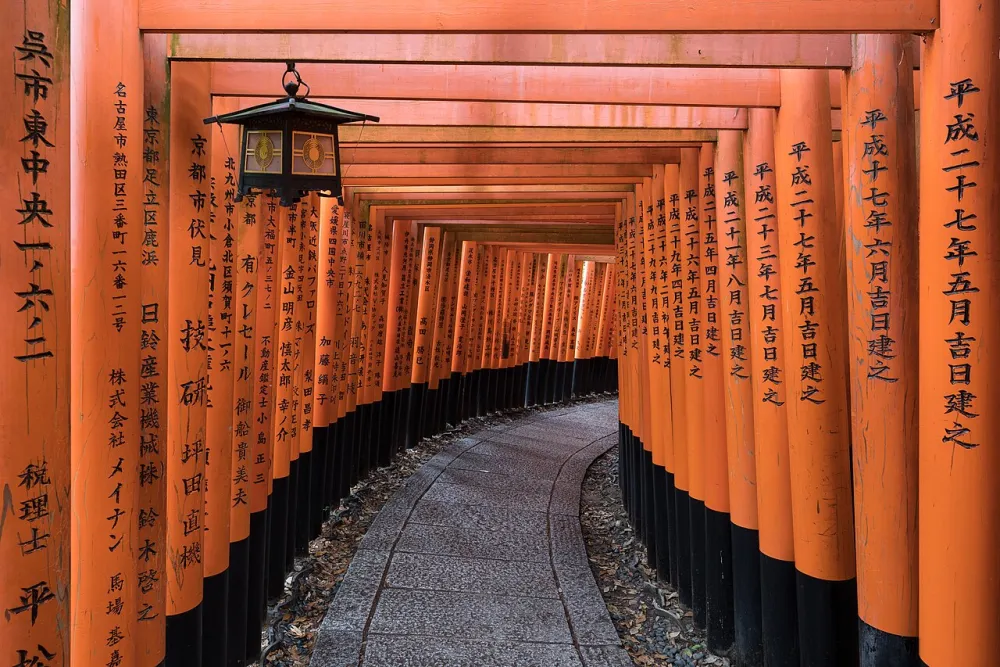
Dense vermilion gates form the Senbon Torii path. The official guide traces the custom of donating torii to the Edo period; prayers and gratitude gradually shaped this route. Keep your camera easy to reach but watch the ground while walking, stopping only where space allows. The path between the columns is still used for passage and worship.
Beyond the gates is Okusha Hohaisho, east of the Main Sanctuary in the area commonly called Myobudani. It is a place for worshipping Mount Inari’s three peaks from a distance. First-time visitors who do not want a climb can see the torii, worship and understand how the lower shrine connects with the mountain here. Follow return signs if lunch or another afternoon plan awaits.
The Omokaru stones behind Okusha on the right are the tops of a pair of stone lanterns used for a lifting test. The shrine explanation says to make a wish, then lift a top stone and compare its felt weight with what you expected. Follow the on-site order for this devotional custom. If a child tries, an adult should supervise lifting and replacement. Wait until the previous person finishes; those not taking part should stand clear.
Okusha is the first good point for the whole group to reconsider. Turn back if legs are tiring, carrying a child has become hard, or the weather worsens. You need not try another stretch just because a summit sign points onwards. Before splitting, those continuing should identify the next target and descent time, and agree the shorter-route group’s meeting point and latest contact time.
Beyond Kumataka Shrine and the pond, steps become the main activity
Continue uphill on the main path from Okusha towards Kumataka Shrine. The shrine identifies the neighbouring water as Shin-ike, also called Kodamagaike, with a worship place and a Kumataka Okami devotional mound beside it. Observe how the water, stone monuments and worship positions form a mountain religious space. Leave room for worshippers when photographing and do not cross the sacred fence to reach the pond.
If you already need frequent stops, make Kumataka Shrine your furthest point and return by the recognisable main path. Continuing to Yotsutsuji involves more steps and junctions. Save the Japanese 四ツ辻 for Yotsutsuji on your phone. At signs such as 三ツ辻 for Mitsutsuji, step aside, read carefully and follow Yotsutsuji. You need not follow others into side paths.
Many devotional mounds donated by worshippers line Mount Inari. Stone monuments are dense, and maps show shrines of different sizes. The FAQ explains shin-seki as places where deities were enshrined and shrine buildings once stood, continuing as sacred sites. Mountain shrines burned during the Onin War; despite later attempts at reconstruction, worship continued in this sacred-site form. Otsuka are stones donated by believers inscribed with the divine names they personally revere. Understanding the two terms distinguishes the old places of worship at the peaks from clusters of donated monuments. Stay on the main pilgrimage route, marking a specific sacred site’s relation to it if interested.
Yotsutsuji offers city views and a sensible end to the climb
Yotsutsuji is a junction and resting point. The local business association’s route lists it as a viewpoint. For mountain torii combined with Kyoto views, it is a reasonable endpoint. Keep the passage clear, sit or rest in a suitable spot, then decide whether to continue.
From the foothills to Yotsutsuji, you have already linked Senbon Torii, Okusha, the pond and steps into a mountain walk. The highest peak, Ichinomine, is mainly a pilgrimage destination. Those interested in city views need not pursue it just because it is highest. Continuing requires energy for the rises and falls between peaks, worship stops and return to Yotsutsuji. The steps ahead are only the start.
Use a simple test here: continue to Ichinomine only if everyone is steady, water and daylight are sufficient, and there is no urgent reservation ahead. If one is clearly lacking, return. Reconfirm arrangements if splitting: the short-route group rests below while the climbing group keeps the agreed time. Phone location can add information, but use landmarks everyone recognises for the meeting.
Before descending, identify the direction you came from and return signs such as 本社 for the main shrine. Mountain branches lead to other areas. On a first visit entering and leaving through the main shrine, use the familiar main route back. Photograph the sign for comparison at the next junction, rather than lining up across the steps to read it.
For Ichinomine, allow the full route between the peaks
For the full mountain pilgrimage, follow signs from Yotsutsuji towards Sannomine, then Ainomine, Ninomine and Ichinomine. Continue via Mitsurugisha and Gozen-dani Hohaisho back to Yotsutsuji before descending. Open the official grounds map beforehand to understand the circuit and match each name to its Japanese form. Follow the main paths that are open and signposted on the day.
Sannomine is the Lower Shrine sacred site, venerating Shiragiku Okami. Ainomine is the Kada sacred site, venerating Ise Okami; Ninomine is the Middle Shrine sacred site, venerating Aoki Okami. Stops need not be equal. Stay according to your own purpose of worship.
The stone gate at Ainomine’s entrance is called the Nune Torii. Gable-like forms on either side of its central strut resemble hands held together in prayer. The shrine’s individual site guide specifically describes this form. After the dense vermilion gates, look at the top of this stone torii to compare different offerings and architectural forms on the same mountain. Observe from the path without touching the stonework or entering offering areas.
Ichinomine, Mount Inari’s highest point at 233 metres, is the Upper Shrine sacred site, venerating Suehiro Okami. Identify the name, complete worship and secure your belongings before descending. Reaching the highest point does not finish the circuit. If companions are tired, return the way you came on a route you recognise that is open that day.
Mitsurugisha and Gozen-dani make this more than a summit walk
Mitsurugisha, also called the Choja Shrine sacred site, is described by the shrine as a place of worship marked with sword and thunder stones on old mountain maps. To its left is a well called Yakiba-no-mizu, linked with the legend of forging the sword Kogitsunemaru. Read these accounts after worship. View the stones, well and structures from open paths rather than treating legendary sites as places to climb or facilities to use.
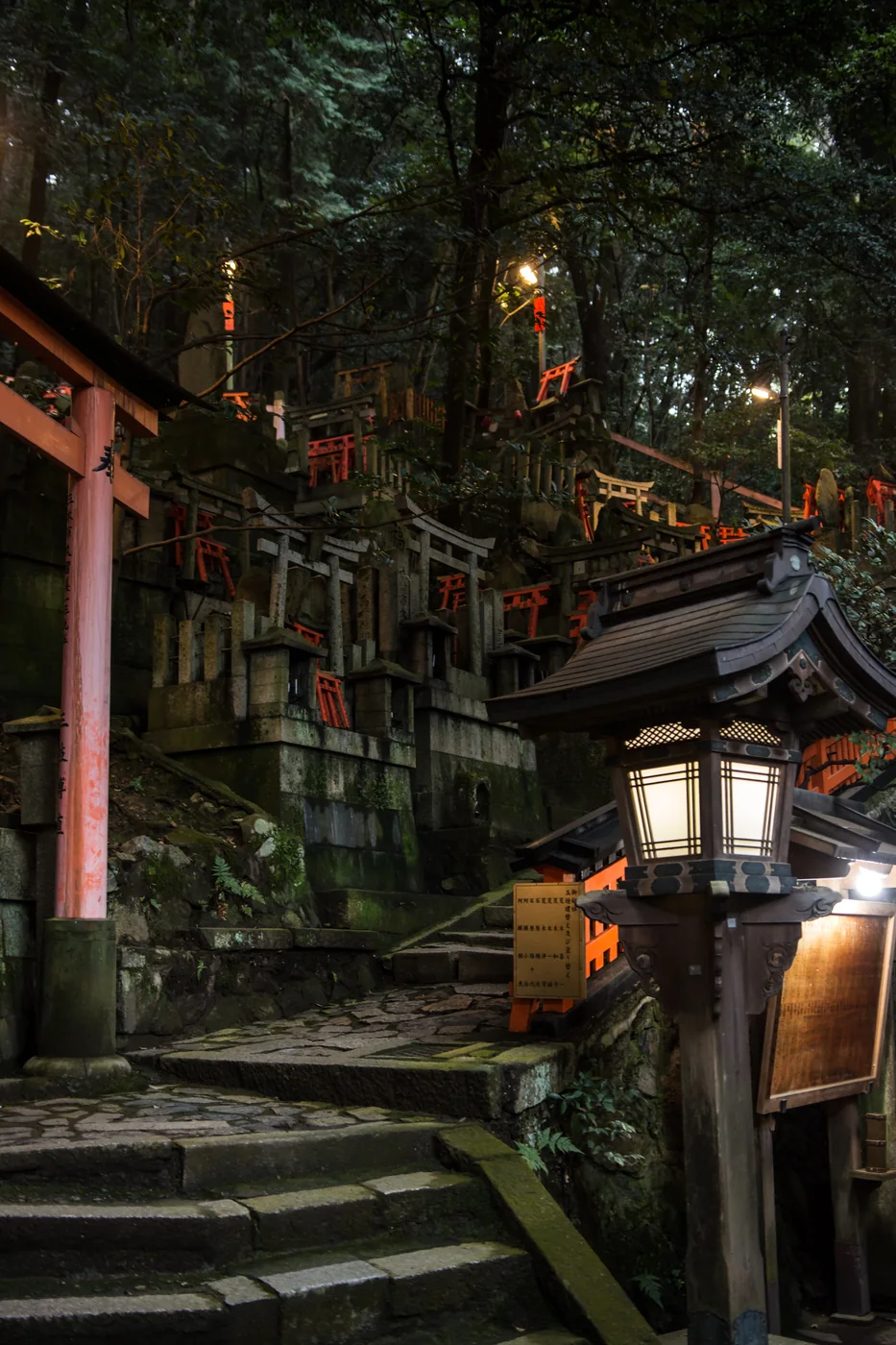
At Gozen-dani Hohaisho, the view shifts from the three peaks to the valley behind their northern sides. Their streams converge here. Formerly, the Gokyoden and Mikamaden stood here, a place for offerings to the three peaks’ deities. The shrine describes the annual Oyama Festival on 5 January: nakagumi sake is offered in traditional ritual earthenware on the sacred offering stone, about one metre square. Ritual participants then hang ishimatsu pine offerings and visit sacred sites on the mountain. Arriving in the valley after the peaks connects worship with offerings. Those interested in ritual can give this stretch more time and read the names of sacred sites and offering structures.
Different divine names carved into the devotional mounds reflect worshippers’ personal names for the deities of Inari belief. View the monuments, torii and woodland from public paths rather than entering between mounds for a quieter photograph. Wait for worshippers or pass in a suitable place, and check photography restrictions before pointing the camera towards an offering area.
An official channel formed by local residents, shops and public administration introduces the shrine, torii and mountain beliefs, complementing the pilgrimage between the peaks.
Eat in designated places and rest in suitable spaces
The shrine rules limit eating and drinking to designated places, namely the free rest areas, and prohibit eating while walking or standing. Finish a takeaway breakfast before entering the worship route, and use places permitted by shops for food bought on the approach. On the mountain, stop at a designated rest area for water or food. Steps, torii bases and offering tables are not picnic tables.
Teichoan stands beside Yashimagaike pond at the foot of the mountain. The shrine guide describes a rest house with terrace seating established in December 2017. A clear resting point like this can work for a shorter-route group waiting for climbers, according to opening, seating and food-area signs on the day. Write its name in the meeting message rather than simply saying “by the pond”.
Bring the drinking water you need before starting the full pilgrimage. Teahouses and shops can provide supplies when open, and lunch can wait until after descent. With an afternoon reservation, use it to set the latest turn-back time. Keep packaging, bottles and rubbish with you, and seal food in your bag to avoid attracting animals. Sort drinks, cameras and rainwear at a designated rest point before continuing on the steps.
Prepare shoes, rainwear and daylight for sustained stair walking
The most useful equipment is familiar, well-fitting footwear with suitable grip. Choose the route by everyone’s normal ability on steps rather than testing new shoes on the full circuit. In kimono or clothes chosen mainly for photographs, use the short route from Romon and the Main Sanctuary to the torii, with an endpoint your footwear and hems can manage. For the full mountain, wear clothes that let you lift your legs easily.
Keep your backpack light enough for a day, with water, rainwear, an adjustable light outer layer and phone within reach. Summer climbing causes sweating; drink and adjust clothing at a rest area. In winter you cool down when stopping, so keep your coat accessible. If carrying heavy photographic equipment, choose the lenses you will actually use at the foothills and leave the rest at your storage point.
In rain, take shorter steps and stand securely before using your phone. Watch wet leaves, stone surfaces and stair edges. Umbrellas can hit others under torii and on narrow paths; let oncoming walkers pass. If you need both hands for balance, use suitable rainwear or shorten the route. Plan food and rest stops earlier, leaving time to return to your accommodation if shoes and socks get wet.
Check the weather and sunset, then work backwards to your latest start from the foothills. For a first full pilgrimage, choose daylight that lets you read signs and see the ground. Arriving late is a reason to use the short Okusha route. The mountain is not high, but steps, worship and stops consume time. Give daylight to walking and browse shops after returning below.
Children, older people and wheelchair users can share the start with different lengths
With young children, focus on the Main Sanctuary and a short torii stretch, then decide at Okusha whether to return. After the climb, a child may need supervision or carrying downhill, so one adult should keep energy in reserve. If splitting, agree a foothill rest point, restaurant or station, plus contact arrangements if someone is late. Do not leave the shorter-route group standing on the pilgrimage path throughout.
A pushchair can link foothill transport and rests, but needs a separate plan at the steps. Shrine rules prohibit parking pushchairs outside designated places, so follow on-site guidance. If everyone wants the torii, decide who handles the pushchair and child before one adult is carrying the child and another the pushchair with no hands left for bags. A shorter route still offers worship and torii.
Older people comfortable on level ground but not repeated downward steps can complete the main worship at the sanctuary while others go to Okusha. If joining as far as Okusha, include rests and the return, without demanding another person’s uphill pace. A shorter version also makes sense after Higashiyama’s slopes or a mountain walk the previous day. Assess walking energy across both days.
Wheelchair users should plan a usable exit from the station map and focus on public foothill areas. Check the actual route for the steps at Senbon Torii and higher paths. Keihan’s ramps and wheelchair-accessible toilet address some station needs. For a continuous step-free route, contact the shrine beforehand with wheelchair details, party size and desired worship areas to establish the usable range.
Wildlife, photography and pets follow the sacred grounds’ rules
The shrine prohibits approaching or feeding wild birds and animals. Keep your distance, secure food and keep children beside adults rather than pursuing a close photograph. Kyoto City’s advice for wild boar encounters is to avoid provoking the animal, remain calm, move away slowly and secure your own safety. If an animal blocks the way, stop and return rather than detouring through the woods to continue.
Photography restrictions include obstructing narrow paths, entering no-photography areas, unauthorised commercial shoots and drones. For a full row of torii, wait for a suitable gap or position people within the space available. Tripods, long hems and groups taking turns posing must allow passage. If photographs require more time, shorten the route and stay with the sections you actually want to photograph.
Smoking and flames are prohibited. Do not climb lanterns, damage torii or trees, or enter buildings and fenced areas without permission. Stay outside spaces marked for private offerings or no entry. A route that appears physically passable is not necessarily open to visitors. Give worshippers priority at worship places before photographing.
The shrine also prohibits walking or worshipping with dogs and other pets, with exceptions for necessary assistance dogs and similar cases. Arrange pet care before deciding who enters. Do not hand a pet to a stranger or leave it waiting in a vehicle. Agree the mountain walk and care duties before departure rather than changing the plan at the torii.
Use the same turn-back points in rain, summer heat and winter
In continuous light rain, make Okusha the furthest target and return earlier if footing becomes uncertain. Senbon Torii remains on the main route. Leave Yotsutsuji and the circuit behind the peaks for a day with better surfaces and visibility. In heavy rain, strong winds or rail disruption, keep the half-day near your accommodation rather than setting out in bad weather to fulfil a prewritten summit plan.
In high summer, reduce sustained uphill effort. Start earlier in the daylight, eat breakfast and carry water. Pause at Okusha and Yotsutsuji to assess everyone’s energy. If reaching Yotsutsuji leaves you too hot and wanting to finish, descend for lunch and omit the full circuit. Rest at your accommodation in the afternoon and choose dinner somewhere easy to reach.
For autumn rituals, distinguish the fire ceremonies below and on the mountain. Kyoto’s tourism association describes the shrine’s 8 November Hitaki ceremony as thanksgiving after harvest, prayer for blessings and purification. Gozen-dani Hohaisho separately lists a fire ceremony at 14:00 on 28 November. These have different dates and venues. For a ritual-focused trip, fix the ceremony first, then choose Okusha, Yotsutsuji or the full pilgrimage. For an ordinary walk, continue to choose length by daylight and fitness.
In winter, plan departure around shorter daylight and wear layers you can remove uphill and replace at rests. Follow signs to change route or return if there is ice, snow or another access restriction. If footwear and ground conditions do not match, keep to foothill worship. You need not climb higher before accepting that the full circuit is unsuitable that day. Before reaching the station, sort wet umbrellas, coats and shoe soles for a more comfortable train journey.
Walk the mountain by day; keep evening worship short
Kyoto’s official information lists no closing time and year-round worship access. Late arrivals can make foothill worship part of the evening, but a first mountain pilgrimage is better in daylight. Identifying steps, junctions and the return at night adds demands beyond reading a map by day. For vermilion torii, you can also arrive while it is still light and eat after descending.
For a short evening route, save the return station and last usable trains, and choose the furthest familiar point before leaving your accommodation. If light, weather or the group’s condition are unsuitable, limit the visit to Romon and the Main Sanctuary. Do not turn a short night photography visit into a full mountain climb beneath the torii. Keep the phone charged and direct a torch at your own footing rather than worshippers.
Open paths and staffed counters have different hours. The current prayer service page gives usual ceremonies between 08:30 and 16:30, with registration completed by about 16:00; New Year and festivals have separate arrangements. Formal prayers require the selected ritual offering. Kyoto’s tourism association lists amulet counter hours of 08:00–18:00, so buy amulets within that window before or after the walk. If formal prayer is your priority, complete registration before the mountain. After leaving at night, pass quietly through neighbouring streets on public roads to your chosen station.
Place the meal and return journey along the route after descent
From a Kyoto Station base, take JR after breakfast, worship at the Main Sanctuary, continue through Senbon Torii to Okusha, then extend to Yotsutsuji if energy allows. Descend by the same route, organise belongings below, eat lunch and return to Kyoto Station. If choosing Ichinomine, move lunch later and leave only rest at your accommodation or a nearby activity for the afternoon. Let the mountain determine the day’s length.
For accommodation on Keihan, head to Fushimi-Inari Station and choose the platform for your destination. The station currently lists platform 1 towards Sanjo and Demachiyanagi, and platform 2 towards Yodoyabashi and Nakanoshima. Check the destination before the gate and buy tickets or prepare your IC card. After the mountain, you may simply want to sit; identify the platform before finding a waiting place rather than asking at the train doors.
If you have agreed on a meal in Fushimi’s sake district, make Keihan the afternoon’s main transport rather than returning across to Kyoto Station to start another route. With a later reservation, check your actual arrival time at the foothills and make changes through the original booking channel. Deduct an extra hour on the mountain directly from afternoon options. Before leaving, secure amulets, cameras and coats, confirm luggage locations and check everyone has descended. Align collection, food and the station in one direction where possible, so tired companions need not cross between the two stations again. Gather everyone before passing the gates together.
A few useful answers
How do I get to Fushimi Inari from Kyoto Station?
Take the JR Nara Line two stops to Inari, about five minutes from Kyoto Station. The shrine is just outside the station. If you’re staying near a Keihan Line station, get off at Fushimi Inari and walk east for about five minutes.
Is an hour enough to see the Senbon Torii gates?
An hour on site is enough to pay your respects at the main hall and see the first stretch of the Senbon Torii gates. With around 90 minutes, you can go through the gates to Okusha, stop to pray and take photos, then walk back down to the foot of the mountain.
Where at Fushimi Inari should I stop for views across Kyoto?
Yotsutsuji is the place to stop for views across the city. Allow two to three hours to walk up from the foot of the mountain via the Senbon Torii and Okusha, rest at Yotsutsuji and come back down. If the steps are hard going, turn back at Kumatakasha.
How much time should I allow for the full Fushimi Inari walk via Ichinomine?
The full pilgrimage route covers about 4 km, with roughly two hours of walking. From Yotsutsuji the loop takes you up to the 233-metre summit at Ichinomine and back to the same junction for the descent. Allow three to four hours if you’d like time for shrine visits, photos and breaks.
Official information and references
Sources used in this guide.
- Fushimi Inari Taisha: access
- Fushimi Inari Taisha: grounds map and mountain sacred sites
- Fushimi Inari Taisha: Senbon Torii
- Fushimi Inari Taisha: Okusha Hohaisho and Omokaru stones
- Fushimi Inari Taisha: Kumataka Shrine
- Fushimi Inari Taisha: Ichinomine
- Fushimi Inari Taisha: Ninomine
- Fushimi Inari Taisha: Ainomine
- Fushimi Inari Taisha: Sannomine
- Fushimi Inari Taisha: Mitsurugisha
- Fushimi Inari Taisha: Gozen-dani Hohaisho
- Fushimi Inari Taisha: Teichoan
- Fushimi Inari Taisha: Romon
- Fushimi Inari Taisha: Main Sanctuary
- Fushimi Inari Taisha: FAQ
- Fushimi Inari Taisha: visitor rules
- Fushimi Inari Taisha: prayer service times and registration
- Kyoto official tourism: Fushimi Inari Taisha
- JR Central: free worship and opening information
- Inari local business association: Mount Inari walking route
- JR West: Kyoto Station to Fushimi Inari Taisha
- Keihan Railway: Fushimi-Inari Station platforms and facilities
- Kyoto City: wildlife advice and wild boar encounters
- Kyoto City announcement: official Fushimi Inari channel and main film