General admission to Sanjusangendo is ¥600, a seven-minute walk from Exit 2 of Keihan Shichijo Station. Seasonal opening hours, highlights of the 1,001 Kannon statues and Wind and Thunder Gods, plus pairing with Kyoto National Museum and the January 2027 archery tournament.
- Region & Focus
- KyotoShrines and temples
- Reading Scope
- 18 min read · 11 chapters · 5 Q&As
- Official Verification
- 23 official sources checkedUpdated 22 November 2026
- Key Topics
- First tripItinerariesSeasons
Chapter Route Map (tap any stop)
- Tickets and Last Admission
- Getting There from Kyoto Station, Gion, or Fushimi
- Shoes Off Inside, Photos Outside
- Finding the Central Statue Among a Thousand Figures
- The Wind God, Thunder God, and the Twenty-Eight Attendants
- Step Back Outside to Take In the 120-Metre Roof
- Pairing Kyoto National Museum on a Shichijo Half-Day
- Start with One Gallery Inside the Museum
- Where to Go Along Shichijo When the Museum Is Closed
- 17 January 2027: Omato Archery Tournament and Willow Blessing
- Working Backwards from Luggage and Last Admission on Travel Days
- Quick Q&A
For a first visit to Sanjusangendo, allow an hour; arriving via Keihan Shichijo Station makes for the easiest walk. If you are only visiting the temple, save your time for the Thousand-Armed Kannon statues, the Wind and Thunder Gods inside the long hall, and the western veranda outside. With half a day to spare, head across Shichijo-dori to Kyoto National Museum. In winter, general admission ticket sales close at 15:30, so if you plan to see both on the same day, visit Sanjusangendo first and spend the rest of the day at the museum.
Tickets and Last Admission
Sanjusangendo's official name is Rengeo-in, and its address is 657 Sanjusangendomawari, Higashiyama-ku, Kyoto. When setting your navigation, select the visitor entrance for Sanjusangendo. Walking east along the temple wall from Shichijo-dori, follow the signs for admission reception (haikan uketsuke) into Fumonkaku to buy your ticket. You can glimpse the Main Hall's roof from outside, but the Thousand-Armed Kannon statues are all housed indoors and cannot be seen from the street.
General admission is ¥600 for adults, ¥400 for junior and senior high school students, and ¥300 for primary school pupils. Groups of 25 or more receive ¥50 off per person, bringing the rates to ¥550, ¥350, and ¥250 respectively. The temple states that group admissions are handled on site with no advance booking required. If you are arriving near closing time, meet your companions at the ticket window first and save the garden and exterior photos of the long hall for after you have seen the interior.
From 1 April to 15 November, gates open at 08:30, ticket sales end at 16:30, and the temple closes at 17:00. From 16 November to 31 March, hours shift to 09:00 opening, 15:30 last admission, and 16:00 closing. Because this changeover falls in mid-November, the second half of the autumn foliage season already operates on the 16:00 closing schedule. If you are travelling across town in winter, aim to reach the ticket office by 15:00 so you still have time inside the hall.
An hour is enough from the moment you reach the entrance, covering ticket purchase, taking shoes off and putting them back on, an unhurried walk through the Main Hall, and a short stroll outside. Allow 75 minutes if you want to use the touchscreens inside to look up individual statues, walk past the historic archery range under the eaves, or go at a gentler pace with companions. With only 40 minutes left, head straight into the Main Hall and leave the outer gates and garden for another day.
| Dates | Opens | Last Ticket Sale | Closes |
|---|---|---|---|
| 1 April – 15 November | 08:30 | 16:30 | 17:00 |
| 16 November – 31 March | 09:00 | 15:30 | 16:00 |
General admission to Sanjusangendo is ¥600, a seven-minute walk from Exit 2 of Keihan Shichijo Station. Seasonal opening hours, highlights of the 1,001 Kannon statues and Wind and Thunder Gods, plus pairing with Kyoto National Museum and the January 2027 archery tournament.
Getting There from Kyoto Station, Gion, or Fushimi
If you are staying near Kyoto Station and the weather is fine, the walk takes about 18 minutes. Exit the Central Gate towards Kyoto Tower on the north side and head north along Karasuma-dori. Turn right at the Karasuma-Shichijo intersection beside Higashi Hongan-ji, follow Shichijo-dori east, cross Shichijo Ohashi Bridge, and continue up a gentle slope. Sanjusangendo's wall will be on your right, with the museum on the north side of the road. With clear landmarks at every turn, it is an easy route to explain to family members visiting Kyoto for the first time.
To save your legs for the afternoon, or when crossing the bridge is wet and chilly, catch City Bus 206 or 208 from stand D2 in front of Kyoto Station and get off at Hakubutsukan Sanjusangendo-mae. The stop name also makes the return trip straightforward: look for the platform heading back towards Kyoto Station. Because route 206 also carries passengers bound for Kiyomizu-dera and Gion, walking on a dry day is often faster and more predictable when the bus queue grows long.
From Gion, take an Osaka-bound Keihan train from Gion-Shijo Station to Shichijo, where limited express trains also stop. If you are staying near Hankyu Kyoto-Kawaramachi Station, walk across Shijo Ohashi Bridge to Gion-Shijo on the east bank first. At Shichijo Station, come up to street level via Exit 2 and walk east along Shichijo-dori for about seven minutes. Coming north from Fushimi Inari Taisha, take the Keihan line from Fushimi-Inari to Shichijo; you arrive on the east bank of the Kamo River without needing to backtrack via Kyoto Station.
If you are taking the Keihan line straight from Osaka to Kyoto, Shichijo is itself a direct stop. When you also need to catch a JR Shinkansen or collect luggage from a hotel that day, save Kyoto Station for after your temple visit. Taking the JR Nara Line from Kyoto Station to Tofukuji and changing to a northbound Keihan train to Shichijo also works if you are already pairing the trip with Tofuku-ji. Starting directly from Kyoto Station, however, walking or taking the direct bus avoids two sets of station platforms.
The temple's seven-minute walking estimate starts from Exit 2 of Shichijo Station. Travellers using a wheelchair or needing a lift should check the Keihan Shichijo Station map first and choose the route with lift access for their direction of travel. If meeting friends, agree on the temple ticket office rather than underground exits so nobody has to double back below street level. Take note of Shichijo Ohashi Bridge on the way in; after your visit, head back towards the bridge to return to Keihan Shichijo Station for trains to Gion.
Shoes Off Inside, Photos Outside
Shoe lockers sit just inside the Main Hall entrance, as footwear must be removed before entering. Wear thick socks in winter and pack a dry spare pair on rainy days so you are not walking the length of the wooden floorboards in damp socks. If visiting in a group, note your locker number before stepping in so it is easier to regroup on the way out. Photography and filming are strictly prohibited inside the hall. If you want to check the Japanese statue titles beforehand, load the temple's statue webpage before entering and match them up once you step outside.
The corridor inside is shared by visitors viewing the statues, moving along the hall, and stopping to pray. Keep any table-sized leaflets folded away until you reach an open spot. If someone ahead is praying with clasped hands before the central image, slow down behind them and wait until space clears. With children, pick a specific detail before going in—such as the ring of drums behind the Thunder God—and let them point it out quietly when they spot it. There is a long stretch of hall to explore, so there is no need to stop at every figure in the front row.
Both the viewing corridor inside the Main Hall and the pathways across the grounds have ramped access, and the temple lends wheelchairs for indoor and outdoor use on request from nearby staff. Accessible toilets and baby-changing facilities are available on the grounds and in the car park. On windy or rainy days, getting from the bus stop through the ticket gate and taking shoes off takes extra time; if travelling with older relatives who walk slowly, factor that in before stepping off the bus rather than treating the seven-minute walk from the station as a target for everyone.
When companions have different levels of interest in the statues, agree on a meeting point outside the hall beforehand. Those who want more time with the sculptures can linger wherever there is space, while anyone finishing early can wander the garden and long eaves outside—far more relaxed than checking a phone while walking through the hall. Leave suitcases in your hotel or a station locker, especially if you are continuing to the museum; carrying only a light daypack makes moving through both entrances much easier.
Finding the Central Statue Among a Thousand Figures
As you enter the hall, look up first to spot the seated Thousand-Armed Kannon in the centre. Standing 355 cm tall, this principal image dates from the Kamakura-period reconstruction and was completed by master sculptor Tankei and his workshop. It is immediately recognisable because it sits elevated above the flanking rows of life-sized standing figures. Look down at the tiered octagonal lotus pedestal, then behind the head at the boat-shaped halo, where carved clouds and jewel trees are pierced so light filters through the gaps.
The seated statue was carved from Japanese cypress using the assembled-woodblock (yosegi-zukuri) technique, fitted with inlaid crystal eyes and finished in lacquer and gold leaf. Viewed straight on, the face and the pair of hands clasped in prayer stand out first; shift slightly along the corridor and the layered depth of the side arms becomes clear. According to the temple, the central image has 42 arms in total—one pair joined at the chest and 40 outstretched arms symbolising a thousand. Spotting that central pair first gives you an easy reference point for the small heads on the crown and the surrounding arms on the standing statues.
On either wing, stepped tiers hold roughly a thousand life-sized standing statues arranged in ten rows from front to back. Find a spot where you can angle your gaze down the length of the ranks: faces and shoulders stay nearly level across each line while the tiers rise progressively behind them. The faces in the front row are easiest to read, whereas the smaller hands of the back rows blend into the silhouettes ahead. Moving past the central statue and watching the rows open up in perspective explains far better than a single glance at the door why the hall was built so long.
Japan's Agency for Cultural Affairs registers the wooden Thousand-Armed Kannon under two National Treasure listings: 1,001 standing statues in one group, and the central seated statue separately. In its own descriptions of the flanking tiers, the temple refers to the main rows simply as the 1,000 statues. On explanatory boards inside the hall, 'central image' (chuson) refers to the seated statue, while 'thousand-bodied' (sentai) usually denotes the ranks of standing figures.
Compare two neighbouring standing statues closely: check the outer corners of the eyes or the chin first, then the slope of the shoulders, drapery folds, and hand positions. Some differences are subtle and easier to notice while standing in one spot. The temple notes that 124 statues in the group survive from the original Heian-period foundation, with the Kamakura restoration after the fire taking 16 years. Around 500 bear the names of their makers, from the In and En workshops as well as the Kei school. To check who carved a particular figure, look up its number or name on the touchscreens along the rear of the viewing corridor.
Standing statue No. 40, showcased by the temple, is also signed by Tankei, and you can inspect its details on the temple's statue webpage before your trip. For a simple way to read the sculpture during one visit, compare that figure with the central seated statue overseen by the same master. Start by noticing how each balances its weight—standing versus seated—then compare the facial features and outer hands. Once you know what to look for, keep moving; the distinctions among hundreds of figures often snap into focus only after one particular face sticks in your memory.
The Wind God, Thunder God, and the Twenty-Eight Attendants
Shift your gaze from the uniform rows of Kannon to the vividly painted wooden figures in dynamic poses along the front: these are the Twenty-Eight Attendant Deities (Nijuhachi Bushu). In Buddhist tradition, they accompany the Thousand-Armed Kannon and protect the Dharma. Like the main statues, the temple records that they are made of assembled Japanese cypress with inlaid crystal eyes. Remembering an object each holds is easier than memorising names—such as the pagoda in Bishamonten's hand—while Basusen stands out immediately from the armoured guardian figures through his gaunt frame, expression, and robes.
The Wind God (Fujin) and Thunder God (Raijin) are separate National Treasure sculptures in their own right. Look for Fujin's billowing windbag and bent legs, and the ring of drums and raised drumsticks behind Raijin. Their silhouettes alone convey wind and thunder, and stepping a pace or two to the side changes the negative space between the windbag or drum ring and their limbs. The temple notes that Tankei, who directed the Kamakura reconstruction, was closely involved in crafting them. When viewing the front row, consider these two independently from the Twenty-Eight Attendants.
In 2018, drawing on Kamakura-period woodblock prints and historical research, the temple rearranged the placement of the Twenty-Eight Attendants alongside the Wind and Thunder Gods. That same year marked the completion of a half-century restoration of the standing statues, all designated National Treasures, bringing back figures that had previously been on loan to the national museum. If an older guidebook marks a different spot for a statue, check the touchscreens inside for its current position, and note in the temple's commentary how repositioning the Wind and Thunder Gods alters the viewing angles.
Visitors with a keen interest in Japanese art can pair the three-dimensional sculptures with Tawaraya Sotatsu's famous Wind God and Thunder God folding screens on the same day. Kennin-ji in Gion displays a high-definition reproduction, while the original—owned by Kennin-ji and entrusted to Kyoto National Museum—is only brought out for select exhibitions listed on the museum's schedule. Looking at the screens, notice how the two deities sit at opposite edges across a wide expanse of gold leaf; recalling how the hall statues carve out space around the windbag and drums makes the shift between mediums rewarding.
For that pairing, it is easiest to visit Sanjusangendo first and head to Gion afterwards. Board a northbound train from Shichijo to Gion-Shijo and turn off Shijo-dori towards Kennin-ji. If anyone in your group wants to extend the stroll through Gion, follow our Hanamikoji walking route. When you only have half a day and want to focus on the Wind and Thunder Gods motif, those two temples are plenty; save a dedicated slot for the museum if an exhibition you want to see is on.
Step Back Outside to Take In the 120-Metre Roof
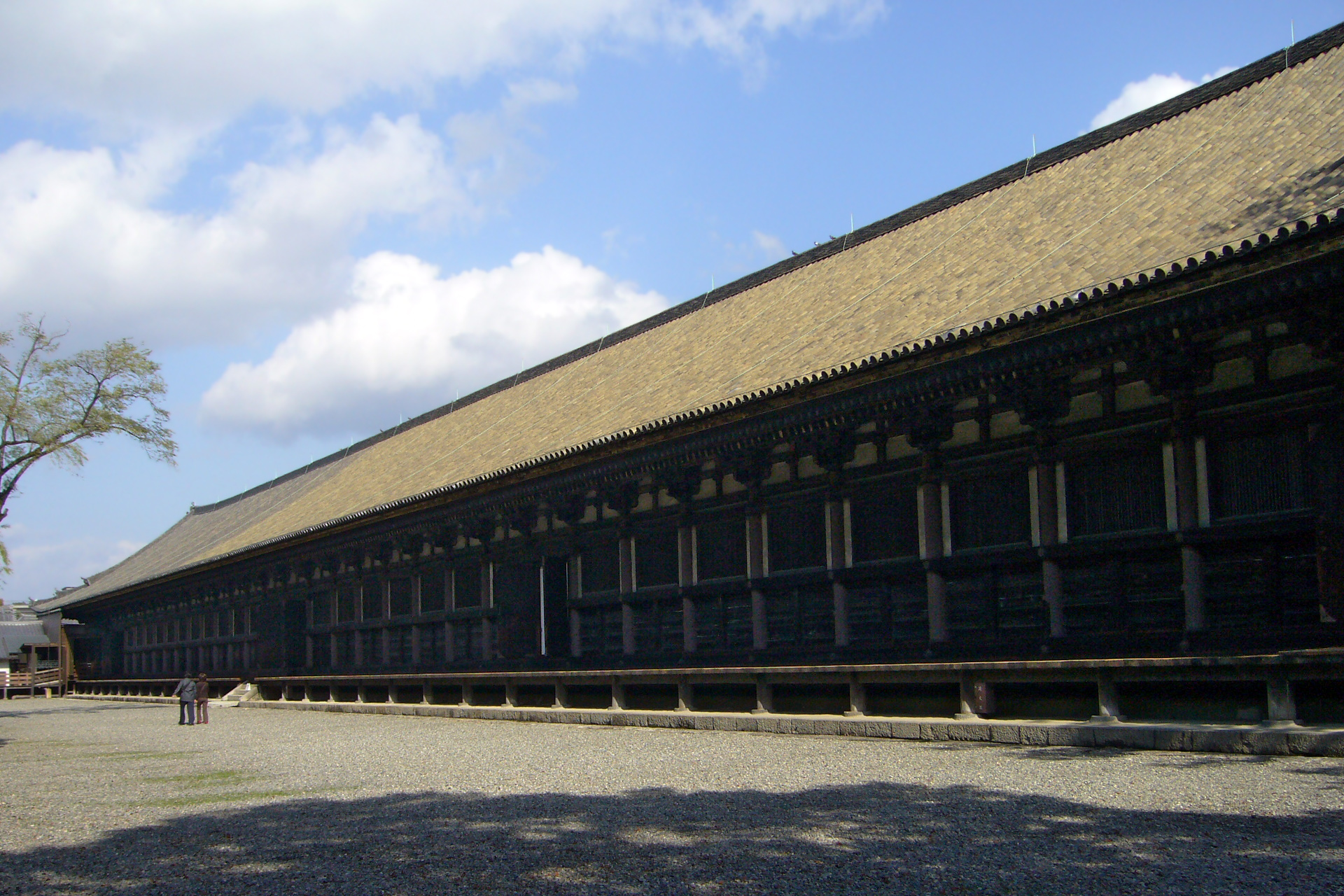
The 'sanjusan-gen' in Sanjusangendo refers to the 33 bays between the structural pillars of the inner sanctum. According to the temple, the Main Hall stretches roughly 120 metres north to south, 22 metres deep, and about 16 metres high. Once you step outside, walk to one end of the long facade and look along it at an angle: the repeating pillar intervals and tiled eaves converge into the distance. Stand at the midpoint too, looking left and right while picturing where the central statue sits inside, to anchor that long exterior line.
Two names sit behind the temple's founding. In 1164, Retired Emperor Go-Shirakawa had the hall built at his Hojuji-dono palace complex with financial backing from Taira no Kiyomori. After the original structure burned down in a Kyoto city fire in 1249, the Main Hall standing today was completed in 1266. A group of Heian-period standing statues survived the blaze and now share the rebuilt hall with Kamakura-period sculptures, so it helps to separate the age of the building from the dates of individual statues when reading the labels.
For architectural details you can easily spot, look at the roof tiles, the sweep of the great roof, and the timber boarding between the pillars. The temple explains that the reconstruction rested on a rammed-earth foundation of alternating sand and clay layers, reinforced internally with double tie-beams and horizontal planks slotted into grooved pillars so the wooden frame could flex during tremors. At ground level you see the continuous rhythm of posts, walls, and roof plane, while the foundation details are explained in the temple's hall notes. For a photograph that conveys the scale, frame the eaves diagonally across the shot with just a narrow strip of gravel courtyard below.
Head around to the western veranda to see where the Edo-period Toshiya archery contests took place. Having just walked past the 120 metres of pillars indoors, stepping along the outside gives a visceral sense of the covered range archers once faced. Even a walk from one end of the open pathway to the other conveys the distance clearly—easy to appreciate in either spring or winter, though you can cut the outdoor loop short in wind or rain.
If you prefer gardens, spend your remaining time in the east-side pond-and-stroll garden. Laid out in 1961 to mark the 770th anniversary of Retired Emperor Go-Shirakawa's death, it underwent conservation work completed in 2021. Wheelchair-accessible paths circle the water, offering views back towards the Main Hall before you decide whether to walk down to the Momoyama-period South Great Gate (Nandaimon) and Taiko Wall (Taikobei). Both are Important Cultural Properties tied to the Toyotomi family's temple building around Hoko-ji to the north, and well worth the short walk to the southern end if you enjoy historic architecture.
Pairing Kyoto National Museum on a Shichijo Half-Day
Kyoto National Museum sits directly north of Sanjusangendo: simply cross Shichijo-dori after leaving the temple and head for the South Gate bearing the museum's name. Map apps often highlight the red-brick Meiji Kotokan Hall first, which can tempt visitors towards the West Gate on Yamatooji-dori, but the public entrance is the South Gate and the indoor galleries are inside the Heisei Chishinkan Wing. Once inside the grounds, you can find the best angles for photographing the brick building from the garden.
Visit the Main Hall around 09:30, cross the road to the museum around 10:30, and set aside 90 minutes for one or two galleries that catch your eye. Seeing how the Thousand-Armed Kannon are arranged at the temple first gives great context before you pick out a Buddhist sculpture or painting in the museum to read its period and provenance. If you plan to cover every section of a special exhibition, allow longer and check the exhibition webpage beforehand to note specific works and whether they appear in the first or second rotation, as delicate folding screens are often swapped mid-run.
The museum's regular closed day is Monday; when a national holiday falls on a Monday, it opens as usual and closes on the Tuesday instead. General admission for the Collection Galleries is ¥700 for adults and ¥350 for university students, while visitors aged under 18, high school pupils and younger, and seniors aged 70 and over enter the permanent galleries free with ID. Standard hours are 09:30 to 17:00, with last entry at 16:30. Two adults visiting both the temple and the Collection Galleries will spend ¥2,600 in total—provided the museum calendar lists Collection Galleries for that day.
The museum calendar distinguishes between Collection Galleries, Special Exhibitions, and Garden Open days. Special exhibitions carry separate hours, ticket prices, and checklists, during which the regular Collection Galleries are suspended. On Garden Open days, the gallery buildings are closed and general admission is ¥300. If you are mainly ducking in to escape the rain while browsing art, verify that the Heisei Chishinkan Wing is open; save an outdoor-only visit for a sunny day when you just want photos of Meiji Kotokan Hall and a walk around the grounds.
The Kyoto special exhibition on The Tale of Genji runs until 29 November 2026. From 1 to 20 December, only the museum garden is open, with Collection Galleries returning from 22 to 27 December. The entire museum closes from 28 December to 1 January 2027, before the Collection Galleries resume from 2 January through 22 March 2027, followed by another Garden Open period from 24 March to 18 April. If you are staying by Kyoto Station over New Year, you can attend Sanjusangendo's New Year service on the morning of 1 January and save the museum galleries for 2 January or later.
If travelling as a pair with different priorities, split your timing when queues form. Hold timed special exhibition tickets? Protect that museum entry slot first and work backwards from the temple's last ticket sale. For an afternoon temple visit, consider pairing it with one of the museum's extended Friday evening openings, checking the exact closing time on that day's exhibition page. Alternatively, if one person wants to linger in the galleries while the other is ready to move on, meet at a clear landmark near the South Gate instead of waiting until closing time.
Start with One Gallery Inside the Museum
Where the temple hall makes it hard to see how the back of a statue is constructed, the museum's sculpture gallery picks up neatly. For the winter–spring season, Room 1F-1 of the Heisei Chishinkan Wing hosts an introduction to Buddhist sculpture from 22 December 2026 to 22 March 2027 (excluding closed days). Walking over from Sanjusangendo with crystal eyes, clasped hands, or pierced haloes fresh in mind makes it easy to spot those same techniques up close—especially on freestanding cases where you can inspect the back of a figure and how it joins its base.
For decorative arts, step next door into Room 1F-2. Running over the same dates from 22 December 2026 to 22 March 2027, the thematic feature Tea Ceremony Utensils and Procedure displays treasures including the National Treasure Oido tea bowl named Kizaemon alongside the storage boxes and silk wrappings that accompany each piece. If you only have half an hour, compare two contrasting tea bowls first, then look at how their boxes and cloths preserve them. Both the tea display and the sculpture room are covered by the standard Collection Galleries ticket.
For commentary on the pieces, pick up an audio guide in the 1F entrance lobby of the Heisei Chishinkan Wing. Both the standard and children's versions for the Collection Galleries cost ¥550 per unit (including a Chinese option), though each covers a slightly different selection of works. If a child is curious about how tea utensils are put together, look for the audio-guide symbols on the labels first before choosing which version to hire. With only half an hour before lunch, following the numbering in a single gallery room is plenty; note that special exhibitions use separate audio guides, and none are offered on Garden Open days.
Floor labels and entrance names across the two buildings can look confusing when both appear on a map. To plan your route before walking in, check the museum's floor map for the Heisei Chishinkan Wing and match the room numbers against the current exhibition list. The general map shows what each gallery typically holds, but cross-disciplinary themes sometimes reassign adjacent rooms, so rely on that day's exhibition page for exact locations. If someone in your group only wants to see the garden, simply arrange to meet back at the South Gate.
Where to Go Along Shichijo When the Museum Is Closed
Walk east from Sanjusangendo across Higashioji-dori to reach Chishaku-in. Its Treasure House holds National Treasure sliding-door paintings by Hasegawa Tohaku and his school, notably Maple and Cherry Blossoms. Moving from the wooden sculptures of Sanjusangendo to broad tree trunks and branches painted over gold leaf gives a natural continuity. The Treasure House and the scenic garden charge separate adult admissions of ¥500 each, making the paintings an ideal indoor stop in rain. The Treasure House closes for exhibition changes on 31 January, 30 April, 31 July, and 31 October—if your visit lands on one of those dates, tour the garden or switch routes.
If the Taiko Wall at the southern end of Sanjusangendo sparked an interest in the Toyotomi clan, cross Shichijo-dori and walk north past the museum to Toyokuni Shrine and Hoko-ji. Toyokuni Shrine stands out for its ornate Karamon gate, while Hoko-ji's temple bell carries the famous inscriptions 'Kokka anko' and 'Kunshin horaku' at the heart of a turning point in Japanese history. Sitting close together in the same neighbourhood, they tie the surviving earthen wall south of Sanjusangendo back to the former footprint of Hoko-ji.
If you would rather skip further admission fees, head west along Shichijo-dori back to Shichijo Ohashi Bridge. Walking across the bridge and strolling along the riverbank offer two different perspectives: the bridge gives wide views over the Kamo River, whereas heading down to the water calls for gentle ramps that everyone in your group can manage comfortably. Keihan Shichijo Station sits right on this bank if you are ready to ride, or you can cross the bridge back towards Kyoto Station. Because the bridge has little shade at midday in summer, save the riverside stroll for late afternoon in hot weather; on blustery winter days, boarding directly at Shichijo saves waiting around in the wind.
To continue towards Kiyomizu-dera or Gion, tackle the hilly streets while your energy is still high. When travelling with older adults or a pushchair, ride the Keihan line up to Gion-Shijo for flat walking around Gion and leave Kiyomizu-zaka slope for another day. If Fushimi Inari is your next stop, there is no need to transfer at Kyoto Station—simply take a southbound Keihan train straight from Shichijo. Hiking the mountain paths takes a block of time on its own, so settle your temple visit and lunch first and gauge how far up Fushimi to go by the remaining daylight.
17 January 2027: Omato Archery Tournament and Willow Blessing
Kyoto's official tourism site confirms that on Sunday, 17 January 2027, Sanjusangendo will hold both the Great Target Archery Tournament (Omato Zenkoku Taikai) and the Willow Branch Blessing (Yanagi-no-Okaji) on the same day, with both event listings showing hours from 09:00 to 15:30. The temple's annual calendar notes free admission to the grounds on event days. The archery tournament sees newly turned adults in formal kimono competing at long-range targets, while the religious rite sprinkles blessed water onto visitors with a willow branch in a traditional prayer for health and protection.
Historically, the Toshiya endurance contests ran along the western side of the Main Hall, with archers shooting from the south end under the eaves across roughly 120 metres to see how many arrows cleared the length. The temple records that the full Oyakazu match once ran continuously from dusk until the same hour the following evening; in 1686, Wasa Daihachiro of Kishu loosed 13,053 arrows, of which 8,133 flew the full distance. Today's January tournament carries on that archery tradition: on ordinary days you walk past the old range under the eaves, while on event day stewards direct spectators to dedicated viewing zones.
If you are coming specifically for the tournament, dedicate a full morning or afternoon to Sanjusangendo alone. Competitor check-in, spectator queues, and worship inside the hall each run to their own rhythm, so agree beforehand whether your group wants to watch the archery or join the blessing. Standing outdoors in January feels noticeably colder than browsing inside the hall on a normal day; put on a warm coat and gloves before crossing Shichijo Ohashi Bridge. Arriving on foot from Keihan Shichijo Station makes both getting in and leaving straightforward, and families with young children or older relatives who tire easily can rest outside the hall area and meet up at a set time rather than trailing every queue together.
If your priority is studying the Thousand-Armed Kannon in peace, schedule a standard visit on a day before or after the festival and treat the New Year events as a separate outing. From 1 to 7 January 2027, the temple also holds its New Year's Rite (Shusho-e), with public seating inside the inner sanctum open from 09:00 on 1–3 January—two weeks ahead of the archery tournament. On 3 March, the Peach Blossom Festival (Shunto-e) runs from 09:00 to 15:30 with floral offerings, ikebana displays, and a raised platform for viewing the thousand Kannon from above. Choose your festival dates before locking in your transport plans.
Working Backwards from Luggage and Last Admission on Travel Days
If you arrive in Kyoto by Shinkansen in the afternoon, drop your bags at a hotel or locker around the station first, head up Shichijo-dori to Sanjusangendo, and follow the visit with a riverside walk or dinner back near the station. Should your train pull in with barely an hour left before last admission—and you still need to check in or buy onward tickets—move the temple to the next morning. That works especially well in winter, when leaving Kyoto Station after 15:00 leaves almost no time to appreciate the hall.
On check-out day, build in enough margin to return to the station, collect your luggage, and reach your platform. If your hotel is on the Hachijo-guchi side of Kyoto Station, walking back from Shichijo-dori to the Kyoto Tower side still leaves a walk across the station complex. When departing after midday, visit Sanjusangendo in the morning and have lunch around the station, collecting bags either before or after eating before heading to the concourse. You can check hotel and locker zones in our Kyoto Station accommodation guide.
In wet weather, take the bus from stand D2 outside Kyoto Station, which drops you right on Shichijo-dori. Afterwards, cross to the museum on days when the Heisei Chishinkan Wing is open so you can step straight back indoors. If it happens to be a Garden Open day and you want indoor cover, head east to Chishaku-in's Treasure House instead—or, if companions simply want to sit down with a meal, stay along Shichijo or head back to Kyoto Station for lunch.
If the morning starts dry and bright and you want to cover Tofuku-ji or the riverbanks first, slot Sanjusangendo in after lunch. From 16 November onwards, however, eating near Kyoto Station and returning to your hotel for a rest cuts it fine against the 15:30 last ticket sale. In that season, keep your Higashiyama temple stops grouped in the daytime and return to the station area in the evening so luggage and dinner plans never clash with closing times.
A few useful answers
How long should I allow for Sanjusangendo?
Allow around an hour from the ticket window to walk through the Main Hall and spend a short while outdoors. Give yourself 75 minutes if you plan to use the touchscreens inside and walk both the western veranda and the east garden.
Do I need a bus or train from Kyoto Station to Sanjusangendo?
Kyoto City recommends walking from Kyoto Station's Central Gate along Shichijo-dori, which takes about 18 minutes. In the rain, take City Bus 206 or 208 from stand D2 in front of Kyoto Station to Hakubutsukan Sanjusangendo-mae.
Can I take photos inside Sanjusangendo's Main Hall?
Photography and video recording are prohibited inside the Main Hall, and you must also remove your shoes. To review the statues afterwards, check the illustrated guide on the temple's website once you step outside.
Are the Wind God and Thunder God screens always on display at Kyoto National Museum?
Tawaraya Sotatsu's original screens belong to Kennin-ji and are entrusted to Kyoto National Museum, where they are shown only during scheduled exhibitions. Kennin-ji displays a high-definition reproduction on site.
What date is the 2027 Toshiya archery event at Sanjusangendo?
Kyoto's official tourism site lists both the Great Target Archery Tournament and the Willow Branch Blessing for Sunday, 17 January 2027, with both events scheduled from 09:00 to 15:30.
Official information and references
Sources used in this guide.
- Sanjusangendo | Visiting Hours, Admission, Access & Accessibility
- Sanjusangendo | Winter Visiting Hours from November 2026
- Sanjusangendo | National Treasure Main Hall & Reconstruction
- Sanjusangendo | Grounds & Gardens
- Sanjusangendo | East Garden Pond-and-Stroll Landscape
- Sanjusangendo | National Treasure Statues & Search System
- Sanjusangendo | Image Use & Photography Guidelines
- Agency for Cultural Affairs | National Treasure Registration for Standing Thousand-Armed Kannon Statues
- Sanjusangendo | Willow Branch Blessing & Historic Toshiya
- Kyoto City Official Travel Guide | 2027 Great Target Archery Tournament
- Kyoto City Official Travel Guide | 2027 Willow Branch Blessing
- Sanjusangendo | 2027 Shusho-e New Year's Rite
- Sanjusangendo | Annual Events & Shunto-e Peach Blossom Festival
- Kyoto City Official Travel Guide | Higashiyama & Sanjusangendo Access
- Kyoto National Museum | Access & Bus Stand D2
- Kyoto National Museum | Closed Days, Opening Hours & Admission
- Kyoto National Museum | Campus Buildings & Entrances
- Kyoto National Museum | January 2027 Exhibitions & Galleries
- Kyoto National Museum | Tea Utensils Thematic Exhibition, Dates & Tickets
- Kyoto National Museum | Audio Guides
- Kennin-ji | Wind God and Thunder God Screens Deposit & Reproduction
- Kyoto City Official Travel Guide | Chishaku-in Treasure House & Scenic Garden
- Kyoto National Museum | Shichijo Area Map