Sanjusangendo admission is ¥600, a 7-minute walk from Keihan Shichijo Station Exit 2. Check seasonal hours, highlights of the Thousand-Armed Kannon statues and Wind and Thunder Gods, plus how to pair it with Kyoto National Museum and the January 2027 Toshiya archery event.
- Region & Focus
- KyotoShrines and temples
- Reading Scope
- 18 min read · 11 chapters · 5 Q&As
- Official Verification
- 23 official sources checkedUpdated November 22, 2026
- Key Topics
- First tripItinerariesSeasons
Chapter Route Map (tap any stop)
- Tickets and Last Admission
- Getting Here from Kyoto Station, Gion, or Fushimi
- Shoes Off Inside, Photos Outside
- Spotting the Central Statue Among a Thousand Figures
- Fujin, Raijin, and the 28 Attendant Deities
- Step Back Outside to See the 120-Meter Roofline
- Pairing Kyoto National Museum in a Half-Day Shichijo Plan
- Start with One Gallery Inside the Museum
- Backup Stops Along Shichijo When the Museum Is Closed
- January 17, 2027: The Omato Archery Tournament and Yanagi no Okaji
- Arrival and Departure Days: Work Backward from Luggage and Ticket Cutoffs
- Quick Q&A
Plan about an hour for a first visit to Sanjusangendo, which is easiest to reach from Keihan Shichijo Station. If you are only visiting the temple, focus on the Thousand-Armed Kannon statues, the Wind and Thunder Gods inside the main hall, and the long western veranda outside. With half a day, pair it with Kyoto National Museum right across Shichijo-dori. In winter, temple ticket sales end at 15:30, so if you want to see both in one day, start at Sanjusangendo and spend the rest of your time at the museum.
Tickets and Last Admission
Officially named Rengeo-in, Sanjusangendo sits at 657 Sanjusangendomawari-cho in Kyoto's Higashiyama Ward. Set your map pin to the temple's visitor entrance rather than the outer wall along Shichijo-dori, and follow the admission signs into Fumonkaku to buy your ticket. While you can glimpse the main hall's roof from the street, all of the Thousand-Armed Kannon statues are inside—you cannot see them from the perimeter path.
General admission is ¥600, with tickets at ¥400 for middle and high school students and ¥300 for elementary school students. Groups of 25 or more receive ¥50 off per person, bringing rates to ¥550, ¥350, and ¥250. The temple handles group admission at the ticket counter with no advance reservation required. If you arrive close to cutoff time, have everyone meet at the ticket counter first and save the garden and exterior photos for after you step out of the hall.
From April 1 through November 15, the temple opens at 8:30, stops selling tickets at 16:30, and closes at 17:00. From November 16 through March 31, hours shift to 9:00 opening, 15:30 ticket cutoff, and 16:00 closing. Because that switch happens mid-November, the second half of autumn foliage season already runs on the 16:00 closing schedule. If you are coming from across town in winter, aim to reach the ticket counter by 15:00 so you still have time inside.
Budget one hour from the moment you reach the entrance—enough to buy a ticket, take off and put back on your shoes, walk the full length of the main hall at an unhurried pace, and take a short loop outside. Give yourself 75 minutes if you want to use the touchscreens inside to look up specific statues, walk the western veranda where archers once competed, or move at a slower pace with companions. With only 40 minutes to spare, head straight into the main hall and save the outer gates and garden for another trip.
| Dates | Opens | Last Entry / Ticket Cutoff | Closes |
|---|---|---|---|
| April 1 – November 15 | 8:30 | 16:30 | 17:00 |
| November 16 – March 31 | 9:00 | 15:30 | 16:00 |
Sanjusangendo admission is ¥600, a 7-minute walk from Keihan Shichijo Station Exit 2. Check seasonal hours, highlights of the Thousand-Armed Kannon statues and Wind and Thunder Gods, plus how to pair it with Kyoto National Museum and the January 2027 Toshiya archery event.
Getting Here from Kyoto Station, Gion, or Fushimi
If you are staying near Kyoto Station in good weather, the walk takes about 18 minutes. Exit the Central Gate toward Kyoto Tower on the north side and head up Karasuma-dori. Turn right at Karasuma-Shichijo beside Higashi Hongan-ji, follow Shichijo-dori east across the Shichijo Ohashi Bridge, and continue slightly uphill. Sanjusangendo's wall runs along your right, with Kyoto National Museum on the north side of the street—every turn has an obvious landmark, making the route easy to navigate even with first-time visitors.
To save your legs for the afternoon—or when crossing the bridge feels cold and wet—board Kyoto City Bus 206 or 208 from stop D2 outside Kyoto Station and get off at Hakubutsukan Sanjusangendo-mae. The stop name makes the return trip straightforward too; just cross to the platform bound for Kyoto Station. Because the 206 bus also carries crowds heading to Kiyomizu-dera and Gion, walking on a clear day is often faster and more predictable when the bus line stretches down the curb.
From Gion, take an Osaka-bound Keihan train from Gion-Shijo Station to Shichijo Station, which Limited Express trains also serve. If you are staying near Hankyu Kyoto-Kawaramachi Station, walk east across the Shijo Ohashi Bridge to Gion-Shijo first. At Shichijo, take Exit 2 to street level and walk east along Shichijo-dori for about 7 minutes. Coming north from Fushimi Inari Taisha, ride the Keihan Line from Fushimi-Inari directly to Shichijo on the east bank of the Kamo River instead of backtracking through Kyoto Station.
Coming straight from Osaka on the Keihan Line puts you right at Shichijo with no transfers. If you need the Shinkansen or luggage storage at Kyoto Station later, save the station for after your temple visit. Riding the JR Nara Line from Kyoto Station to Tofukuji and transferring northbound to Keihan Shichijo also works well if Tofukuji is already on your itinerary. Starting directly at Kyoto Station, walking or taking the direct bus saves you two platform transfers.
The temple's 7-minute walk estimate starts at Keihan Shichijo Exit 2. If you use a wheelchair or need an elevator, check the Keihan Shichijo Station layout map ahead of time to pick the exit with elevator access for your direction of travel. Meet companions at the temple ticket counter rather than inside the station so nobody has to backtrack underground if someone takes a different exit. Remember where Shichijo Ohashi Bridge sits on your way in—heading back toward the bridge leads straight back to Keihan Shichijo for trains north to Gion.
Shoes Off Inside, Photos Outside
Shoe lockers line the entrance to the main hall, and everyone removes their shoes before stepping inside. Wear thick socks in winter, and pack a dry spare pair on rainy days so you are not walking the length of the wooden floorboards in damp socks. If you are visiting in a group, note which locker bank you used so regrouping on the way out is quick. Photography and video are strictly prohibited inside the hall; if you want to check Japanese statue names, pull up the temple's online statue guide beforehand and match photos to the plaques once you exit.
The long corridor inside serves as viewing space, walkway, and active worship area all at once. Keep large folded pamphlets tucked away until you reach a wider spot. If someone is praying in front of the central image, slow down behind them and wait for space to open up before stopping. Visiting with kids works best if you pick one concrete detail before entering—such as the arc of drums behind the Thunder God—and let them spot it quietly along the hall rather than stopping at every statue in the front row.
Ramps run along the main hall corridor and the outdoor garden paths, and the temple provides free wheelchairs for both areas upon request from nearby staff. Accessible restrooms and baby-changing facilities are available in the grounds and parking lot. On windy or rainy days, getting from the bus stop through ticketing and shoe removal takes longer than usual; if you are with older family members, build in buffer time before you even step off the bus rather than treating the 7-minute walk as a group countdown.
When people in your group have different levels of interest in Buddhist sculpture, pick a meeting spot outside the hall before going in. Those who want to linger over the statues can take their time at permitted viewing spots, while anyone finishing early can browse the garden and long eaves outside instead of checking phones along the corridor. Leave roller bags at your hotel or in station lockers—especially if you are heading to the museum afterward, carrying only a small daypack makes both stops much easier.
Spotting the Central Statue Among a Thousand Figures
Look up as you enter to anchor yourself on the central Seated Thousand-Armed Kannon. Standing 355 cm tall, this principal image dates to the Kamakura-era reconstruction and was sculpted by Tankei and his workshop. You will spot it immediately because it is seated, towering over the life-sized standing figures flanking both sides. Follow your eye down to the tiered octagonal lotus pedestal, then behind the head to the boat-shaped halo carved with openwork clouds and jewel trees that let light filter through.
The central statue is built from Japanese cypress using the yosegi-zukuri joined-wood technique, fitted with inlaid crystal eyes and finished in lacquer and gold leaf. Standing directly in front, the face and the pair of hands pressed together at the chest stand out first; step slightly sideways along the corridor to see how the remaining arms fan out in layers behind. According to temple records, the statue has 42 arms—one central pair in prayer, plus 40 others symbolizing a thousand arms. Spotting that central pair first, along with the small heads atop the crown, makes it much easier to read the same iconography on the standing statues.
On either wing, stepped altars arrange roughly a thousand life-sized standing statues across 10 ascending rows. Look down the corridor from an angle rather than straight on: the faces and shoulders hold a steady rhythm while each tier rises behind the next. Front-row expressions are the sharpest, while the outstretched hands of the back rows overlap into a dense silhouette. Pausing near the central image and letting the rows unfold as you walk makes the sheer length of the building click far better than a quick glance from the doorway.
Japan's Agency for Cultural Affairs registers the wooden Thousand-Armed Kannon statues as National Treasures in two separate designations: 1,001 standing figures and the central seated figure listed on its own. Temple materials generally refer to the main rows along both wings as 1,000 statues. In hall signage, "Chuson" refers to the central seated statue, while "Sentai" refers to the ranks of standing figures.
Compare two neighboring standing statues up close—first check the outer corners of the eyes or the jawline, then the slope of the shoulders, drapery folds, and hand positions. Some differences are subtle and easiest to catch while standing in one spot. Temple records note that 124 figures survive from the original Heian-period founding, while the Kamakura restoration after the fire spanned 16 years. Roughly 500 statues bear sculptors' signatures from the Kei, In, and En schools; to look up who carved a figure you just saw, check its number or name on the touchscreens along the back side of the corridor.
Standing statue No. 40, featured in the temple's own gallery, also carries Tankei's signature—worth previewing on the temple website before you go. For an easy visual comparison inside the hall, pair it with the central seated statue led by the same master sculptor: notice how weight shifts between seated and standing postures before comparing faces and outer arms. Once you know what to look for, keep moving down the line—hundreds of statues start feeling distinct the moment one specific face sticks with you.
Fujin, Raijin, and the 28 Attendant Deities
Shift your focus from the uniform rows of Kannon to the expressive, polychrome wooden statues lined along the front: the Twenty-Eight Attendant Deities who protect the Dharma and serve the Thousand-Armed Kannon. Also crafted from joined Japanese cypress with inlaid crystal eyes, these figures are easier to tell apart by what they hold than by memorizing names—look for the miniature pagoda in Bishamonten's hand, for instance. Then spot Basu-sen, whose gaunt frame, facial expression, and robes stand apart sharply from the armored guardian generals.
At either end stand Fujin (the Wind God) and Raijin (the Thunder God), each designated a National Treasure in its own right. Watch Fujin's billowing wind bag and bent knees, and Raijin's halo of drums and raised mallets—their silhouettes practically crackle with motion, and taking a step or two sideways changes the negative space between limbs, wind bag, and drums. Temple records credit Tankei, who oversaw the Kamakura rebuilding, with deep involvement in both statues. Treat these two as their own centerpiece apart from the 28 Attendant Deities.
In 2018, following research into Kamakura-era woodblock prints, the temple rearranged the placement of the 28 Attendant Deities along with Fujin and Raijin. That same year marked the completion of nearly half a century of conservation work on the standing statues—bringing all of them under National Treasure status and returning the figures previously on loan to the national museum back to the main hall. If an older guidebook lists a statue in a different spot, check the hall's digital directory, and notice how the updated placement frames Fujin and Raijin from the walkway.
If you are in Kyoto for Japanese art, pair these three-dimensional sculptures with Tawaraya Sotatsu's Wind God and Thunder God folding screens on the same day. Kennin-ji Temple in Gion displays a high-resolution reproduction, while the original—owned by Kennin-ji and entrusted to Kyoto National Museum—goes on view only during select museum exhibitions. Studying the painted screens, notice how each deity anchors an outer edge across an expanse of gold leaf, and compare that sense of space to how the temple sculptures carve air around the drums and wind bag.
Visiting Sanjusangendo first and Gion second flows best: catch a northbound train from Keihan Shichijo to Gion-Shijo, then walk south from Shijo-dori toward Kennin-ji. If anyone in your group wants to stroll Gion afterward, link up with our Hanamikoji walking guide. Two temples easily fill a half-day if your focus is the Wind and Thunder Gods; if Kyoto National Museum has a specific exhibition you want to catch, carve out a separate block of time for it.
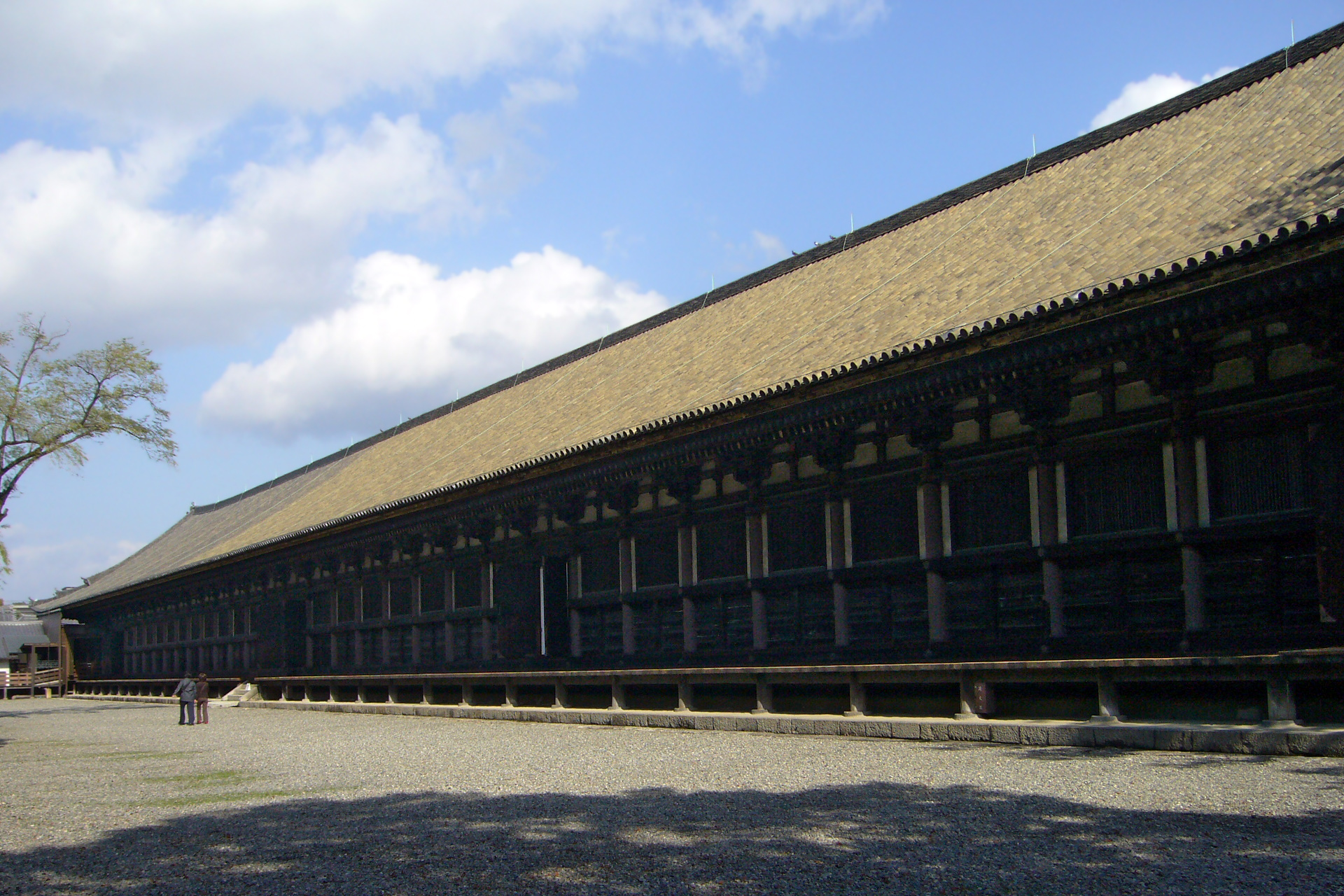
Step Back Outside to See the 120-Meter Roofline
The "sanjusan" in Sanjusangendo counts the 33 structural bays between the inner columns of the hall. Temple measurements put the building at roughly 120 meters north to south, 22 meters deep, and 16 meters high. Once you step outside, walk to one end of the long facade and look back at an angle to watch the repeating pillar intervals and tiled eaves telescope into the distance. Stand at the midpoint and glance left and right while picturing where the central Kannon sits inside—suddenly that long exterior line has a clear anchor.
Two historical names sit behind the hall's creation: in 1164, Retired Emperor Go-Shirakawa built the temple inside his Hojuji-dono palace complex with financial backing from Taira no Kiyomori. Fire swept through Kyoto in 1249 and destroyed the original structure; the hall standing today was rebuilt in 1266. Survivors among the Heian-period statues now share the same long hall with sculptures carved during the Kamakura reconstruction, so keep architecture dates and statue dates separate when reading placards inside.
For quick architectural details from ground level, look at the roof tiles, the broad sweep of the hip-and-gable roof, and the wooden plank walls fitted between pillars. Temple sources explain that the reconstruction rests on a rammed-earth foundation layered with sand and clay, reinforced internally by double beams and slotted columns holding horizontal planks that let the timber frame flex during tremors. You cannot see the foundation from the courtyard, though temple diagrams explain it; for photos with real depth, frame the roofline diagonally with just a narrow strip of gravel courtyard along the bottom.
Walk around to the western veranda to see where the Edo-period Toshiya archery contests took place. After seeing the 120-meter colonnade from inside, standing beneath the eaves outdoors brings home just how low and narrow that shooting corridor was for archers firing end to end. Strolling the open walkway from one side to the other gives you the physical scale immediately, year-round—just shorten your loop if wind or rain picks up.
If you prefer gardens, save your remaining time for the pond-stroll garden on the east side, built in 1961 to mark the 770th anniversary of Emperor Go-Shirakawa's death and restored in 2021. Wheelchair-accessible paths circle the pond and offer a clean view back toward the main hall before you decide whether to walk south to the Momoyama-period Nandaimon South Gate and Taikobei earthen wall. Both are Important Cultural Properties tied to Toyotomi Hideyoshi's nearby Hoko-ji temple precinct, making the detour to the south end worthwhile for architecture fans.
Pairing Kyoto National Museum in a Half-Day Shichijo Plan
Kyoto National Museum stands directly north of Sanjusangendo—step out of the temple, cross Shichijo-dori, and head for the South Gate marked with the museum sign. Maps that highlight the red-brick Meiji Kotokan Hall sometimes pull visitors toward the West Gate along Yamatooji-dori, but the main visitor entrance is the South Gate and active galleries are inside the Heisei Chishinkan Wing. Once inside the grounds, you can walk around the courtyard to photograph the brick facade.
Start at Sanjusangendo around 9:30, cross the street to the museum around 10:30, and plan 90 minutes to explore one or two galleries in depth. Having just seen how the Thousand-Armed Kannon figures are arranged in the temple, pick a Buddhist sculpture or painting inside the museum to read its provenance, date, and materials. If you are visiting for a Special Exhibition and want to cover every gallery, budget longer—and check the exhibition schedule beforehand to see whether folding screens rotate between early and late display periods.
The museum closes on Mondays, or on Tuesday when Monday is a national holiday. Masterworks Collection admission is ¥700 for adults and ¥350 for university students, while visitors high-school age and under (or under 18) and seniors 70 and older enter Collection galleries free with ID. Regular hours run 9:30 to 17:00, with last entry at 16:30. Two adults visiting both the temple and the regular Collection spend ¥2,600 total—provided the museum calendar lists Masterworks Collection rather than a Special Exhibition.
The museum calendar alternates between Masterworks Collection exhibitions, Special Exhibitions, and Garden-Only periods. Special Exhibitions carry their own hours, ticket prices, and gallery layouts, during which Masterworks Collection displays pause. Garden-Only days cost ¥300 for adults and do not include access to the exhibition halls. If you are mainly ducking out of rain, verify that the Heisei Chishinkan Wing is open that day; if the weather is clear and you only want to photograph Meiji Kotokan Hall and stroll outside, put the garden after the temple.
The 2026 Kyoto Special Exhibition on The Tale of Genji runs through November 29, 2026. From December 1 to 20, only the grounds are open; Masterworks Collection galleries reopen December 22 to 27, followed by a full year-end closure from December 28 through January 1, 2027. Masterworks Collection galleries resume January 2 through March 22, 2027, before another Garden-Only window from March 24 to April 18. If you are staying near Kyoto Station over New Year's, you can catch Sanjusangendo's morning ritual on January 1 and save the museum galleries for January 2 or later.
If companions want to prioritize different stops when queues form, split the schedule strategically. With timed Special Exhibition tickets, protect your museum entry slot first and work backward from Sanjusangendo's ticket cutoff. On afternoon visits, Fridays are easiest thanks to extended evening hours at the museum—check the daily exhibition page for exact closing times. If you finish part of the museum and want to linger while others are ready to leave, they can head across to the temple and meet you back near a clear landmark by the South Gate.
Start with One Gallery Inside the Museum
Because you cannot walk behind the statues inside Sanjusangendo, the museum's sculpture gallery makes an ideal follow-up. For the winter–spring schedule (December 22, 2026 to March 22, 2027, excluding closed days), Gallery 1F-1 of the Heisei Chishinkan Wing features an introductory Buddhist sculpture display. Carry over the details you just spotted—inlaid crystal eyes, mudra hand gestures, and openwork halos—and examine similar craftsmanship at close range on freestanding pedestals where you can see how the back and base join together.
For decorative arts, step next door into Gallery 1F-2. The featured tea exhibition runs the same dates (December 22, 2026 to March 22, 2027) and brings together historic utensils including the National Treasure O-Ido tea bowl known as Kizaemon, displayed alongside their storage boxes and protective wrappings. With just half an hour, compare two contrasting bowls and examine how their boxes and cloths preserve them. Both the sculpture and tea galleries are covered by the single Masterworks Collection ticket.
Audio guides are available at the 1F entrance lobby of the Heisei Chishinkan Wing for ¥550 per unit in both adult and children's versions, though the two tracks cover slightly different works. If kids are curious about tea utensils, look for the audio-guide icons on the object labels before choosing which version to rent. Even with only 30 minutes before lunch, following a single room's sequence feels complete; note that Special Exhibitions use separate audio guides and Garden-Only days do not offer the Collection guide.
Floor plans across the two museum buildings can look confusing on third-party maps. Before walking in, check the museum's official English floor map for the Heisei Chishinkan Wing alongside the current gallery list. Standard floor maps only show each room's usual genre, whereas cross-genre thematic shows sometimes reassign rooms—always trust the gallery numbers on the current exhibition page when hunting for a specific piece. If someone in your party only wants to see the garden, agree to meet back at the South Gate.
Backup Stops Along Shichijo When the Museum Is Closed
Walk east from Sanjusangendo across Higashioji-dori to Chishaku-in Temple, where the Treasure House displays National Treasure sliding-door paintings by Hasegawa Tohaku and his school, including Maple Tree and Cherry Tree. Moving from Sanjusangendo's wood carvings to Chishaku-in's broad sweeps of gold leaf and foliage creates a natural artistic throughline. The Treasure House and Scenic Garden charge ¥500 each for adults, making the gallery an easy rainy-day pivot—just note that the Treasure House closes for exhibition rotations on January 31, April 30, July 31, and October 31.
If the Taikobei wall at Sanjusangendo's south end sparked your curiosity about the Toyotomi clan, cross Shichijo-dori and walk north past the museum toward Toyokuni Shrine and Hoko-ji Temple. Toyokuni Shrine stands out for its ornate Karamon gate, while Hoko-ji's massive temple bell carries the famous inscriptions "Peace to the Nation" and "Prosperity to Lord and Vassal" tied to the political clash that brought down the Toyotomi family. Both sit within a few blocks, neatly connecting the earthen wall south of Sanjusangendo to Hoko-ji's former grounds.
For a no-ticket detour, head west along Shichijo-dori back to Shichijo Ohashi Bridge. Walking over the bridge gives you open views of the Kamo River, while stepping down to the riverbank works best via gentler ramps if anyone in your group prefers steady footing. Keihan Shichijo Station sits right on this side if legs are tired, or you can cross the bridge toward Kyoto Station. The bridge offers virtually no shade at midday in summer—save the riverside walk for dusk, and in blustery winter weather hop straight onto the train at Shichijo instead of waiting around on the span.
If you plan to continue to Kiyomizu-dera or Gion, tackle the steeper uphill stretches while everyone still has energy. Traveling with seniors or a stroller, ride the Keihan Line up to Gion-Shijo for flat streets around Gion and save Kiyomizu's hilly approaches for another day. Heading to Fushimi Inari instead? Skip Kyoto Station altogether and take the Keihan Line straight south from Shichijo. Because the shrine's mountain trails take time, lock in lunch and your temple stop first, then decide how far up Mount Inari to hike based on remaining daylight.
January 17, 2027: The Omato Archery Tournament and Yanagi no Okaji
According to Kyoto City's official tourism site, Sanjusangendo will hold both the National Archery Tournament (Omato Taikai) and the Yanagi no Okaji willow-branch blessing on Sunday, January 17, 2027, with both event pages listing hours from 9:00 to 15:30. Temple calendars note that grounds admission is free on this day. During the tournament, young adults turning 20 dress in formal kimono for long-range archery, while the temple ceremony uses sacred willow branches to sprinkle blessed water over visitors for health and protection.
Historically, the Toshiya ("passing arrows") contest ran along the western veranda from the south end, challenging archers to shoot as many arrows as possible straight down the 120-meter covered corridor. Temple records describe the 24-hour Daiyakazu endurance shoots from dusk to dusk—most famously in 1686, when Wasa Daihachiro of Kishu loosed 13,053 arrows and sent 8,133 cleanly down the length of the hall. Today's January tournament carries on that tradition; on regular days you see the quiet shooting lane along the veranda, whereas on event day staff guide spectators into designated viewing zones.
If you are coming specifically for the archery tournament, dedicate an entire morning or afternoon to Sanjusangendo alone. Competitor check-in, spectator queues, and worship lines each move at their own pace, so decide with your group beforehand whether to prioritize the archery range or the blessing inside. Waiting outdoors in January is noticeably colder than touring the hall on a normal day—bundle up with a heavy coat and gloves before you even cross Shichijo Ohashi Bridge. Keihan Shichijo makes arrivals and exits simplest; if children or older companions get tired standing, let them rest outside the spectator area and meet back at a set time.
To admire the Thousand-Armed Kannon statues without festival crowds, schedule a regular visit on a day before or after January 17 and treat the New Year events as their own outing. Earlier in the month, the temple holds its Shusho-e New Year prayer service from January 1 to 7, opening the inner sanctuary to visitors starting at 9:00 on January 1–3. On March 3, the Shunto-e Peach Blossom Festival runs from 9:00 to 15:30 with floral offerings, ikebana displays, and an elevated viewing platform overlooking the thousand Kannon statues—lock in your target date before booking transport.
Arrival and Departure Days: Work Backward from Luggage and Ticket Cutoffs
On the afternoon you arrive in Kyoto by Shinkansen, drop your bags at a station-area hotel or coin locker first, then walk or bus down Shichijo-dori to Sanjusangendo before taking a riverbank stroll or heading back for dinner. If your train arrives within an hour of ticket cutoff and you still need to check in or buy rail passes for the next day, push Sanjusangendo to the next morning. That matters especially in winter—leaving Kyoto Station after 15:00 leaves barely enough time to see the hall properly.
On checkout day, factor in the walk back from the temple, retrieving your bags, and reaching your Shinkansen platform. If your hotel is on the Hachijo (south) side of Kyoto Station, walking back from Shichijo-dori past Kyoto Tower still leaves you with a walk across the station complex. For an afternoon departure, tour Sanjusangendo in the morning and eat lunch near the station—either grab your bags before lunch or eat first and head straight to the tracks. Compare hotel and storage areas in our Kyoto Station stay guide.
On rainy days, board a bus from stop D2 outside Kyoto Station straight to the Shichijo-dori entrance. Afterward, cross the street to Kyoto National Museum on a day when the Heisei Chishinkan Wing is open so you step right back indoors. If the museum happens to be on a Garden-Only schedule, pivot east to the Chishaku-in Treasure House for indoor viewing—or if your group simply needs a warm break, linger over lunch along Shichijo or back at Kyoto Station.
When the morning starts clear and dry, use the good weather first for Tofukuji or a Kamo River walk and save Sanjusangendo for after lunch. From November 16 onward, just watch the clock if you eat near Kyoto Station and rest at your hotel before heading back out, since tickets stop at 15:30. On shorter winter days, grouping your Higashiyama temples together during daylight hours and returning to the station in the evening keeps both luggage and dinner free from admission deadlines.
A few useful answers
How much time should I budget for Sanjusangendo?
Plan about an hour from the ticket counter to walk through the main hall and spend a few minutes outside. Allow 75 minutes if you want to look up statues on the hall touchscreens and walk both the western veranda and eastern garden.
Do I need to take a bus or train from Kyoto Station to Sanjusangendo?
Kyoto City lists an 18-minute walk east along Shichijo-dori from Kyoto Station's Central Gate. In rainy weather, take Kyoto City Bus 206 or 208 from stop D2 outside the station to Hakubutsukan Sanjusangendo-mae.
Can I take photos inside Sanjusangendo's main hall?
No—photography and video are prohibited inside the main hall, and you must remove your shoes before entering. To review specific figures afterward, check the illustrated statue guide on the temple's website once you exit.
Is the Wind God and Thunder God folding screen always on display at Kyoto National Museum?
Tawaraya Sotatsu's original screen belongs to Kennin-ji Temple and is held on deposit at Kyoto National Museum, where it appears only during select exhibition periods. Kennin-ji displays a high-resolution reproduction on its grounds.
What date is Sanjusangendo's 2027 Toshiya archery event?
Kyoto City's official tourism site lists both the Omato Taikai (National Archery Tournament) and Yanagi no Okaji for Sunday, January 17, 2027, running from 9:00 to 15:30 on both event pages.
Official information and references
Sources used in this guide.
- Sanjusangendo | Visiting Hours, Admission, Access, and Accessibility
- Sanjusangendo | Winter Visiting Hours Starting November 2026
- Sanjusangendo | National Treasure Main Hall and Reconstruction
- Sanjusangendo | Temple Grounds and Gardens
- Sanjusangendo | East Garden Pond-Stroll Landscape
- Sanjusangendo | National Treasure Statues and Search System
- Sanjusangendo | Image Use and Photography Guidelines
- Agency for Cultural Affairs | National Treasure Designation: Wooden Standing Thousand-Armed Kannon
- Sanjusangendo | Yanagi no Okaji and Historical Toshiya Archery
- Kyoto City Official Travel Guide | 2027 Omato Taikai National Archery Tournament
- Kyoto City Official Travel Guide | 2027 Yanagi no Okaji Willow Blessing
- Sanjusangendo | 2027 Shusho-e New Year Service
- Sanjusangendo | Annual Events and Shunto-e Peach Blossom Festival
- Kyoto City Official Travel Guide | Access to Higashiyama Sanjusangendo
- Kyoto National Museum | Access and D2 Bus Stop Guide
- Kyoto National Museum | Closed Days, Opening Hours, and Admission
- Kyoto National Museum | Buildings and Entrances
- Kyoto National Museum | January 2027 Exhibitions and Galleries
- Kyoto National Museum | Tea Ceremony Feature Exhibition, Dates, and Tickets
- Kyoto National Museum | Audio Guide
- Kennin-ji Temple | Deposit of Original Wind God and Thunder God Screens and Reproduction
- Kyoto City Official Travel Guide | Chishaku-in Treasure House and Scenic Garden
- Kyoto National Museum | Shichijo Area Map