Visit Jingo-ji, Saimyo-ji, and Kozan-ji from Takao to Toganoo. Compare JR Bus vs. City Bus 8, temple fees, 2026 fall foliage, and spring 2027 openings.
- Region & Focus
- KyotoShrines and temples
- Reading Scope
- 22 min read · 12 chapters · 6 Q&As
- Official Verification
- 31 official sources checkedUpdated November 22, 2026 at 08:00 AM GMT+8
- Key Topics
- ItinerariesSeasonsKyoto, Osaka & Kansai
Chapter Route Map (tap any stop)
- Takao, Makio, and Togano: Three Place Names, Three Separate Bus Stops
- Take the JR Bus from Kyoto Station, or City Bus 8 from Shijo-Karasuma
- With Just One Ride Each Way, Single Fares Are Enough
- Climbing from Takao Bridge: Two Flights of Steps, Two Paces
- Yakushi Nyorai in Kondo Hall, Clay Discs at Jizo-in
- How the 812 Takao Initiation Connects All Three Temples
- Why Saimyo-ji's Main Hall Deserves a Dedicated Stop
- Kozan-ji: Focus on Sekisui-in and the Animal Scroll Replicas
- Pacing a Full-Day or Half-Day Itinerary
- Autumn Foliage Timing and Spring Special Openings
- Rain and Ice Adjustments on the Trail
- Matching Base Neighborhoods and Meals to Your Return Route
- Quick Q&A
On a first visit to Kyoto's Sanbi area, start with Jingo-ji in the morning: get off at the Takao stop, cross the bridge, climb the stone steps to Kondo Hall, and toss clay discs over the gorge in front of Jizo-in. If your legs and the weather hold up, continue on to Saimyo-ji and Kozan-ji, then catch a bus straight back to downtown from Toganoo. With only half a day, focus solely on Jingo-ji. If Sekisui-in's mountain-framing veranda is your main goal, flip the route and begin at Kozan-ji. Because each temple's gate and bus stop sit in different spots, decide upfront which stop deserves extra time so you can plan around the next bus.
Takao, Makio, and Togano: Three Place Names, Three Separate Bus Stops
Sanbi sits in the northwestern hills of Kyoto's Ukyo Ward. Heading out from the city toward Keihoku, you pass Jingo-ji in Takao, Saimyo-ji in Makio, and Kozan-ji in Togano. Bus stop signs read "Takao," "Makinoo," and "Toganoo," while some travel guides use alternate spellings or call the area Yamashiro-Takao. Check the destination display when boarding and listen for stop announcements—the bus stops use the local district names rather than the temple names Saimyo-ji and Kozan-ji.
They look close together on a map, yet in practice they are separated by highways, river valleys, and steep uphill approaches. Jingo-ji's main sights spread out around Kondo Hall and Jizo-in, meaning plenty of walking even after you buy your ticket. Saimyo-ji makes for a compact stop: cross the red bridge, climb the steps, and admire the garden from the main hall. Kozan-ji rewards setting aside unhurried time for Sekisui-in, a National Treasure pavilion framing the hills beyond. To save your energy, use the buses between valleys and do your walking inside the temple grounds.
Bus stops sit along the highway, while temple gates and ticket counters sit higher up the hillside. Getting off at Takao only places you at the trailhead of the approach, and heading home means climbing back up to road level to catch your bus. When arranging meetup spots with companions, specify exact landmarks—"in front of Kondo Hall," "at Takao Bridge," or "at the inbound Takao bus stop"—since there is a walk between each. If mobile signal drops in the gorge, keep offline screenshots of the walking map along with both outbound and inbound timetables.
| Temple | Bus Stop | Standard Hours | Key Highlights |
|---|---|---|---|
| Jingo-ji | Takao | 9:00–16:00 | Stone steps to Kondo Hall, Yakushi Nyorai, Kin'unkei Gorge at Jizo-in |
| Saimyo-ji | Makinoo | 9:00–17:00 (last entry 16:30) | Shigetsu Bridge, all-keyaki main hall, moss garden |
| Kozan-ji | Toganoo | 8:30–17:00 | Sekisui-in, Choju-jinbutsu-giga scroll replicas |
Visit Jingo-ji, Saimyo-ji, and Kozan-ji from Takao to Toganoo. Compare JR Bus vs. City Bus 8, temple fees, 2026 fall foliage, and spring 2027 openings.
Take the JR Bus from Kyoto Station, or City Bus 8 from Shijo-Karasuma
Staying near Kyoto Station? Exit through the Central (Karasuma) Gate and head to platform JR3 for the West Japan JR Bus Takao-Keihoku Line bound for Toganoo or Shuzan. Both directions pass through Sanbi; get off at Takao for Jingo-ji. Temple access guides estimate about 50 minutes from Kyoto Station to Takao, while Kozan-ji lists roughly 55 minutes to Toganoo. If you are connecting from a Shinkansen, Kintetsu train, or station lockers in the morning, allow extra buffer to walk to the Central Gate and wait at the platform.
JR Bus lines 47 and 48 follow different routes through the city. The transfer stop near JR Enmachi Station is named Nishinokyo Enmachi, and select departures also stop outside Nijo Station—check the timetable column for your stop. Boarding at Kyoto Station makes it easy for a group to meet at a single starting point. If you are already along the JR Sagano Line in the morning, catching the bus at Enmachi or Nijo avoids backtracking, though seats may already be occupied. When saving departure times, record both the via-route and final destination so you do not accidentally board a bus ending at Ritsumeikan University.
If you are staying near Shijo-Karasuma, arriving via the Hankyu Line at Karasuma Station, or riding the Karasuma Subway Line to Shijo Station, catch Kyoto City Bus Route 8 from Shijo-Karasuma bound for Takao and Toganoo. Route 8 also serves Shijo-Omiya and Uzumasa Tenjingawa Station. Transferring from the Tozai Subway Line? Take Exit 2 or 3 at Uzumasa Tenjingawa up to the station plaza and look for the Route 8 stop toward Takao. Watch the headsign if you spot "Toku 8" (Special Route 8), which runs toward Yamagoe Nakacho; if you want Kozan-ji first, wait for a bus signed specifically for Toganoo. Kyoto City Tourism lists the ride from Uzumasa Tenjingawa to Toganoo at about 28 minutes, cutting out a long city haul if you are already on the Tozai Line.
On the April 2026 West Japan JR Bus timetable, look under Nobori (inbound) for buses back to Kyoto Station and Kudari (outbound) for Toganoo and Shuzan. City Bus timetables separate weekdays, Saturdays, and holidays. Under the Route 8 schedule effective March 20, 2026, buses from Uzumasa Tenjingawa toward Takao depart at 16 minutes past the hour from 10:00 to 15:59. Missing a midday bus by a minute or two can cost nearly an hour of waiting, so factor the walk from the subway platform into your transfer margin.
You do not have to return on the same operator you took up the mountain. Take City Bus 8 back to Shijo-Karasuma or Uzumasa Tenjingawa, or board a JR Bus signed for Kyoto Ekimae to return to Kyoto Station. Both services overlap around Shijo-Omiya, giving you an extra option if one arrives first. Agree on your return neighborhood before splitting up—boarding the first "city-bound" bus that pulls up often forces an unnecessary transfer.
With Just One Ride Each Way, Single Fares Are Enough
Across Kyoto's flat-fare zone out to Toganoo, both Kyoto City Bus 8 and West Japan JR Bus charge ¥230 one way for adults and ¥120 for children. A round trip comes to ¥460 per adult, or ¥690 if you add one short hop between temples. If you climb up from Takao and walk all the way through to Toganoo before heading back, you only take two buses. Pick your operator based on your origin, return destination, and wait time—the single fare through Sanbi is the same either way.
The Kyoto Subway & Bus 1-Day Pass costs ¥1,100 for adults and ¥550 for children, covering municipal subways, City Buses, and the West Japan JR Bus flat-fare zone between Kyoto Station and Toganoo. It only comes out ahead if you already plan to ride the subway into town, make the Sanbi round trip, and visit another sight later that day. Keep in mind that Toganoo is the pass boundary for Kozan-ji—staying on toward Shuzan takes you outside the covered zone.
On City Bus 8, board at the rear door and pay at the front when exiting using cash or an IC card such as ICOCA or Suica. On West Japan JR Bus, also board from the rear door, take a numbered ticket if required at the stop (and tap your IC card on entry), then return the ticket and tap again at the front on exit. West Japan JR Bus Kyoto routes accept a valid Japan Rail Pass—simply show your pass and numbered ticket to the driver when getting off—whereas City Bus 8 requires a separate fare or eligible city pass. Carry small coins or a topped-up IC card if you plan to mix both operators in one day.
Temple admission is separate from bus fare. Adults pay ¥1,000 at Jingo-ji, ¥700 at Saimyo-ji, and ¥1,000 for Sekisui-in at Kozan-ji. During fall 2026, Kozan-ji collects an additional ¥500 mountain entry fee, bringing combined adult admission across all three temples to ¥3,200—or ¥3,660 with round-trip bus rides included. Mid-route bus hops, clay discs, tea breaks, and special openings vary from there. Separating temple cash from transit money makes buying clay discs or tickets at the next booth much faster than looking up prices on your phone along the trail.
Climbing from Takao Bridge: Two Flights of Steps, Two Paces
After getting off at Takao, follow signs for Jingo-ji down into the valley, descending to the Kiyotaki River before crossing Takao Bridge and climbing the far slope. Both the temple and Kyoto City Tourism estimate roughly 20 minutes on foot from the bus stop. West Japan JR Bus's Sanbi walking map builds in more cushion: about 15 minutes along the trail to Jingo-ji's main gate, plus another 15 minutes into the upper precinct. Use a 30-minute rule of thumb when planning meetups or return buses, then time your stays at Kondo Hall and Jizo-in separately.
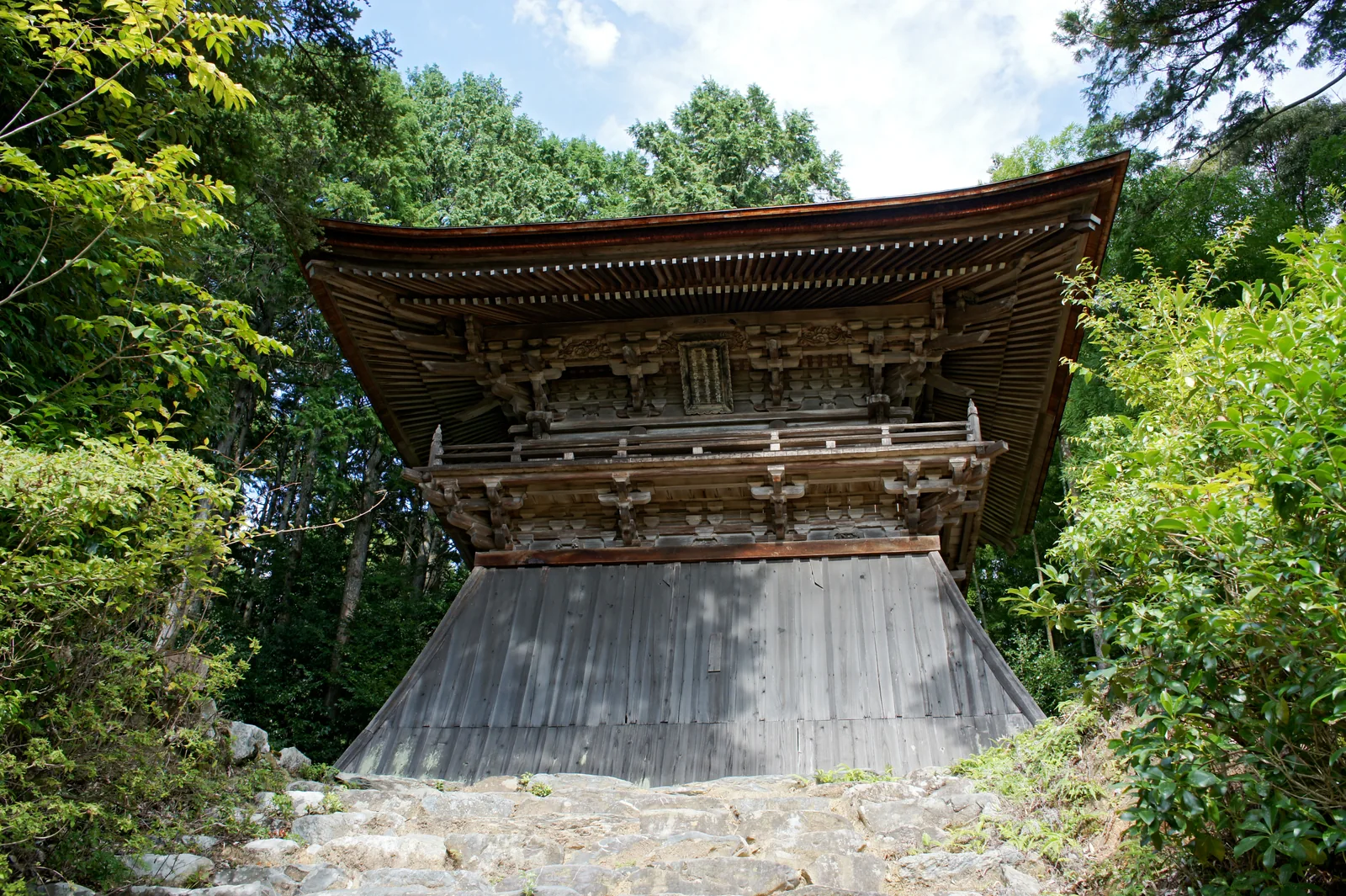
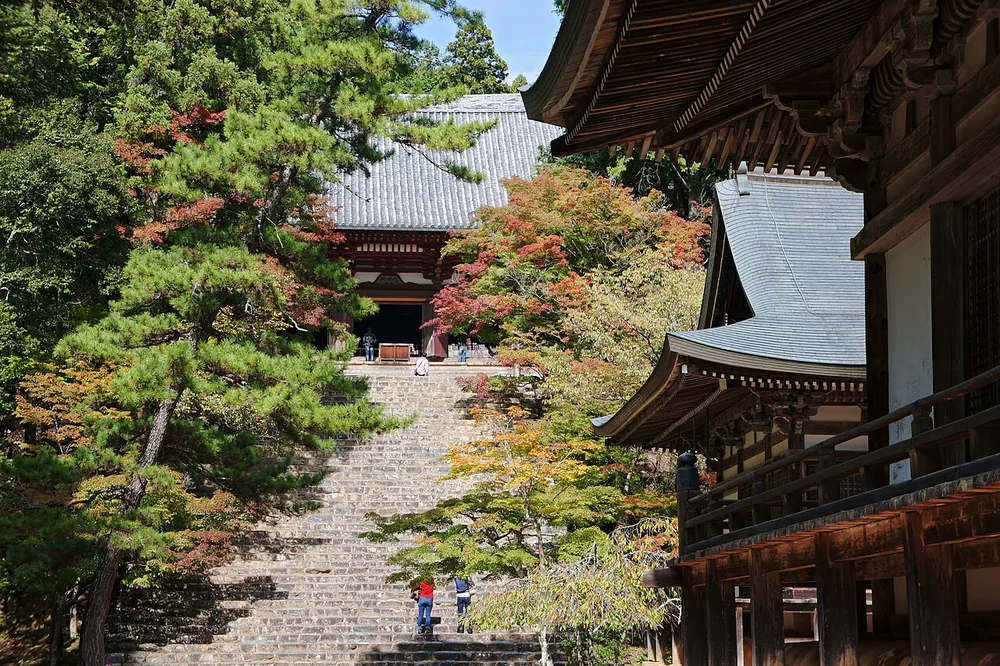
The first climb starts right past the bridge, passing Suzuri-ishi-tei midway—named for a large boulder linked by tradition to Kukai's inkstone. It serves as a reliable landmark in both directions and a natural pause point to see how far everyone wants to climb. Even after reaching the main gate, a broad flight of stone steps still leads up to Kondo Hall, as shown in the photo above, so leave extra minutes for that final ascent.
Heading back down means retracing the stone steps and then climbing out of the river valley back up to the highway. Anyone uneasy on stairs should set a turnaround point on the gentler stretch—gauge the grade right after crossing the bridge or around the teahouses. Older travelers moving slowly can step onto flat landings clear of crowds instead of waiting mid-staircase. Parents with strollers should expect stretches where both child and stroller must be carried. Kyoto Prefecture Tourism's Jingo-ji opening page states that the grounds are not wheelchair accessible and have no accessible restrooms, so groups needing full wheelchair access are better off choosing indoor city venues.
With children, the main gate, Kondo Hall, and Jizo-in each provide clear milestones, making it easy to take a breather at Kondo Hall before deciding whether to keep going. If a young child falls asleep right before the return trip, carrying them along stone steps takes longer than pushing a stroller on flat ground. Multi-generational groups should count the descent all the way to the bridge together so faster walkers do not board an earlier bus and leave others waiting by the mountain road.
Yakushi Nyorai in Kondo Hall, Clay Discs at Jizo-in
Once past Jingo-ji's ticket booth, head up to Kondo Hall first. Viewed from the Godai-do and Bishamon-do side, Kondo Hall's hip-and-gable roof rises cleanly at the top of the steps; the current hall was rebuilt in 1935. Admire the roof tiles and eaves outside, then step inside to note the coffered ceiling panels and floral motifs on the pillars, keeping the modern hall distinct from the ancient sculptures it houses. The hall enshrines a National Treasure standing statue of Yakushi Nyorai—follow on-site guidance when entering to pay respects. Even if you have an afternoon bus to catch, walking from the main gate to Kondo Hall gives you a complete encounter with Heian-period Buddhist sculpture.
Daishi-do and the Tahoto pagoda both merit an exterior look and hold special interior openings on select dates. Daishi-do's Important Cultural Properties include the hall itself and a wood-carved panel of Kobo Daishi; on ordinary days, take in its setting and proportions. The Tahoto pagoda houses five National Treasure statues of Kokuzo Bosatsu, worth timing around a scheduled kaicho opening if Buddhist sculpture is your priority. As you move from hall to hall, pay attention to how the terrain steps upward from the broad terrace inside the main gate.
Clay disc throwing, called kawarake-nage, takes place at a marked overlook in front of Jizo-in. Visitors toss small unglazed earthenware discs toward Kin'unkei Gorge to cast off bad luck—a separate stop from Kondo Hall. Purchase discs and throw from the designated platform in front of Jizo-in, letting kids watch an adult demonstrate first. Wait until the person ahead finishes before stepping up, and have companions taking photos stand behind the thrower to leave clear space for an arm swing.
If some companions want to throw discs while others just want the view, meet right in front of Jizo-in. After rain or in gusty wind, skip the discs if footing looks slick and enjoy the gorge from the permitted viewing area. To frame the valley, find a stable spot where nearby maple branches layer naturally over the distant wooded slope before raising your camera. If you check the clock at the far end of the grounds and realize your bus is due soon, walk straight back to the main gate instead of climbing the Kondo steps again for extra photos.
How the 812 Takao Initiation Connects All Three Temples
Though they share one river valley, the three temples trace their origins to different chapters of Kyoto's religious history. One forerunner of Jingo-ji, Takaosan-ji, was tied to the Wake clan and served as an early Heian base for Kukai. In 812, Saicho received both the Diamond Realm and Womb Realm esoteric initiation (kanjo) rites from Kukai here. Jingo-ji preserves the Kanjo Rekimyo—the handwritten roster recording those ceremonies and initiates—capturing the moment the two Buddhist founders worked side by side.
In 824, Takaosan-ji merged with Shingan-ji to become Jingo-kokuso-shingon-ji, shortened to Jingo-ji. Today's Kondo Hall, surrounding buildings, and mountain paths reflect centuries of reconstruction and patronage on the same ridge. Reading temple history markers with an eye toward separating early rites and name changes from later buildings clarifies why Daishi-do honors that period and why individual treasures open on different calendars.
Saimyo-ji is traditionally credited to Kukai's disciple Chisen as a branch temple of Jingo-ji before becoming independent in the Kamakura period. Kozan-ji in Togano also began as a Jingo-ji sub-temple until the monk Myoe revived it in 1206 on land granted by Retired Emperor Go-Toba. Walking the full route lets you compare three distinct temple layouts: Jingo-ji's halls spread across a mountain slope, Saimyo-ji's intimate compound entered via bridge and stone steps, and Kozan-ji's deep hillside views framed from Sekisui-in. For anyone interested in Buddhist history, that spatial progression sticks much better than memorizing dates alone.
Why Saimyo-ji's Main Hall Deserves a Dedicated Stop
Returning to the valley from Jingo-ji, follow West Japan JR Bus's Sanbi walking map onward to Saimyo-ji. Measured gate to gate, the bus map estimates about 20 minutes between the two temples. Leaving the highway to cross Shigetsu Bridge makes Saimyo-ji's entrance easy to spot—from the Makinoo bus stop, the temple estimates roughly a 5-minute walk. Bus riders drop down to the bridgehead first and only see the stone stairs ascending into the grounds once across.
Saimyo-ji normally opens 9:00–17:00, with last admission at 16:30. Current temple pricing is ¥700 for adults and ¥500 for junior high and high school students. Past the front gate sits the wide main hall, rebuilt entirely from Japanese zelkova (keyaki) wood in 1700 through patronage from Keishoin, mother of shogun Tokugawa Tsunayoshi. Inside, the principal image is a standing Shaka Nyorai attributed to Unkei, paired with an older Senju Kannon on the east side. With only 30 minutes to spare, spend it inside the main hall and along the veranda overlooking the garden, leaving bridge photos for the walk down.
East of the main hall, a moss garden pairs a white-walled storehouse and stone hokyointo pagoda against cedar trees behind. In bright light, the crisp white plaster draws the eye deeper into the garden even faster than the foliage along the railing. Sit inside the hall first, then walk out to the connecting corridor and look back—the shifting perspective opens up the depth between moss, eaves, and forest. In fall, maple leaves framed against the white wall outside the gate make a great photo; if the bridge is crowded on arrival, keep moving, since you will cross back over it when you leave.
If you have to cut one temple from a three-temple itinerary, travelers who favor quiet courtyards and indoor garden viewing usually keep Saimyo-ji and skip rushing to Sekisui-in after Jingo-ji. Visitors drawn specifically to the Choju-giga animal scrolls or Myoe often rest by Takao Bridge and catch the bus straight to Toganoo for Kozan-ji. Saimyo-ji has no private parking lot, so even bus passengers have a slope and stairs to climb. Using the bus to eliminate road walking frees up unhurried time inside the hall.
Kozan-ji: Focus on Sekisui-in and the Animal Scroll Replicas
Between Saimyo-ji and Kozan-ji, West Japan JR Bus's walking map lists roughly 20 minutes mixing footpath and national highway. When roadside traffic feels heavy or daylight is fading, taking the bus from Makinoo to Toganoo makes pacing far easier. The Toganoo bus stop and public parking side connect directly to the Ura-sando (rear approach), placing you closest to Sekisui-in. Watch for "Ura-sando" labels on maps so your entrance and return bus stop sit on the same side.
Kozan-ji's standard hours are 8:30–17:00. Admission to Sekisui-in is ¥1,000 for adults and ¥500 for elementary school students. From October 3 to December 6, 2026, the temple charges a separate autumn mountain entry fee of ¥500 for adults and ¥300 for elementary students. In autumn, walking the grounds and entering Sekisui-in involve two separate payments on site—totalling ¥800 for an elementary student visiting Sekisui-in during the autumn fee window.
Sekisui-in itself is a National Treasure pavilion dating back to Myoe's era. Looking out beneath the eaves, mountain slopes and tree canopies line up neatly between the wooden pillars. Keep your phone down at first and sit slightly back inside to watch how the framed landscape shifts as you move. While Saimyo-ji focuses on a close moss garden backed by cedars, Sekisui-in opens out onto deep hillside valleys. In light rain—when paths remain safe to walk—mist drifting through the trees makes lingering under the eaves far more rewarding than racing between three temples.
Kozan-ji's National Treasure Choju-jinbutsu-giga (Scrolls of Frolicking Animals) spans four scrolls—Ko, Otsu, Hei, and Tei—with replicas on view inside Sekisui-in. Exploring with kids, look for the rabbits, monkeys, and frogs in the Ko scroll and follow how each animal's posture shifts from frame to frame. Art enthusiasts can compare the Otsu scroll, which features both real animals and mythical creatures. Even if the scrolls brought you here, save time for Sekisui-in's architecture and mountain view—this single courtyard easily anchors an entire visit.
The grounds also feature a tea plantation linked to Toganoo tea, which the temple recognizes as Japan's oldest tea garden. From open paths, you can see how the tea rows adapt to the hillside slope alongside the temple buildings. To understand the monks' tea tradition, read the garden panels before walking the public precinct. Kozan-ji occasionally hosts reservation-only special openings that pair the normally closed Iko-an tearoom, the tea garden, and matcha on fixed dates with limited spots. On a standard visit, give your time to Sekisui-in and the forest views—and check the inbound Toganoo bus stop location before walking up so you know where to head on the way out.
Pacing a Full-Day or Half-Day Itinerary
For a full day from Kyoto Station, one workable plan follows the April 2026 JR Bus departure at 8:30, reaching Takao at 9:24. Tour Kondo Hall and Jizo-in in the morning, walk back down near Takao Bridge around noon for water and lunch, visit Saimyo-ji afterward, and keep roughly an hour for Kozan-ji at the end. Treat this as a flexible template: if you get down from Jingo-ji past 13:00, ride the bus between Saimyo-ji and Kozan-ji—or choose just one for the afternoon—instead of squeezing every stop short.
On the April 2026 revised JR Bus timetable, afternoon departures from Toganoo back toward Kyoto Station include 15:14, 15:34, and 16:14, with the 15:34 bus arriving at Kyoto Station at 16:31. To catch the 15:34, start walking out from Sekisui-in via the Ura-sando around 15:10 to allow time for queuing and finding the stop. Aiming for the 16:14 leaves extra slack if lines are long or you want to linger over the view. If a bus pulls up already full, your backup is simply the later departure you noted down earlier.
A half-day plan works best by dedicating a morning to Jingo-ji: figure roughly 50 minutes each way by bus plus waiting, the approach hike, temple viewing, and descent—about 4 hours round trip from downtown Kyoto. To add one temple in the afternoon, Jingo-ji and Saimyo-ji share the same valley side and let you ride back to the city from Makinoo. If you want both clay disc throwing and Sekisui-in, take the bus straight from Takao to Toganoo and save Saimyo-ji for another trip.
Running the loop in reverse works well if Sekisui-in is your top priority. Because Kozan-ji opens earlier, take a morning bus to Toganoo, enter via the Ura-sando, and walk or bus over to Saimyo-ji depending on energy. The catch with reversing the route is Jingo-ji in the afternoon: the precinct closes at 16:00, and you still have the climb up from the Takao bus stop. If you finish Saimyo-ji near 15:00, board your return bus at Makinoo and leave Jingo-ji for a separate morning.
On a first three-temple day trip, put your trade-offs in the shared itinerary before you leave. Anyone hoping to study the statues at Jingo-ji needs to know which side of the bridge the group is meeting on for lunch, while whoever cares most about Kozan-ji should keep track of Sekisui-in's remaining open hours. Agree on one easy-to-reach meetup point so even if half the group stays behind for leaf photos, everyone knows which bus takes them back to their hotel area.
Autumn Foliage Timing and Spring Special Openings
Kyoto City Tourism lists typical peak foliage at Jingo-ji from early to late November, Saimyo-ji around November 10, and Kozan-ji from mid- to late November. Even during the same week, colors vary across the river bridges, Kondo's stone staircase, and Sekisui-in's distant mountain ridge. Check Jingo-ji's live foliage updates if stone steps are your priority, or follow Saimyo-ji's own site for Shigetsu Bridge and white-wall conditions—Saimyo-ji posted same-day foliage photos on November 18, 2026, showing leaves right beside the bridge and grounds.
On busy autumn weekends, arriving early lets you climb Jingo-ji's steps before crowds build, leaving the afternoon for quieter courtyard viewing. West Japan JR Bus notes that extra buses may be added on select foliage weekends—outbound to Toganoo in the morning and inbound to Kyoto Station in the afternoon. If your group splits up, pick a clear meetup stop and anchor your schedule to regular timetable runs. When stairs are crowded in both directions, step onto a landing for full-staircase photos instead of pausing mid-step and slowing traffic behind you.
Jingo-ji's autumn 2026 Daishi-do special opening ended on November 7, so late-November visitors should dedicate daytime hours to Kondo Hall, the stone steps, and Kin'unkei Gorge. For the five Kokuzo Bosatsu statues inside the Tahoto pagoda, the temple has announced its spring 2027 kaicho opening for May 13–15, from 10:00 to 15:00, with an extra ¥500 fee (¥1,500 total for adults including standard entry). Because regular grounds stay open until 16:00 while the pagoda closes at 15:00, visit the Tahoto first before heading to Kondo Hall or Jizo-in.
From May through early summer, bright green maples frame Jingo-ji's steps and Saimyo-ji's bridge. Anyone in your group who prefers a short stroll can stop for photos at Takao Bridge or Shigetsu Bridge and head back to the bus stop. In winter, shorter daylight favors trimming a Kyoto Station departure down to one morning temple plus lunch so you return along the highway before dark; if Sekisui-in is your focus, riding directly to Toganoo and entering via the Ura-sando saves walking the national road late in the afternoon.
Rain and Ice Adjustments on the Trail
Light rain and heavy downpours call for different tactics. In steady drizzle with grippy shoes, choose a single temple, take the bus straight to its closest stop instead of walking between valleys, and spend your time at Saimyo-ji's main hall or Kozan-ji's Sekisui-in. Once stone steps collect water and wet leaves turn slick, pick one view rather than pushing to shoot the slopes, red bridge, and gorge together. Test your traction early and turn around before the bridge if needed—never rely on pulling a companion down wet steps by the hand.
A long riverside trail leads from Takao along the stream toward Kiyotaki, heading in the opposite direction from Saimyo-ji and Kozan-ji. On a three-temple Sanbi trip, turn uphill toward your next temple at Takao Bridge rather than mistaking the Kiyotaki trail for the connecting path. Pausing on Takao Bridge or Saimyo-ji's Shigetsu Bridge already delivers river views you cannot see from the stone steps—when water runs high, stick to the bridges and official approaches.
If heavy rain starts early in the morning—or forecasts call for snow and ice—swap your morning plan for Umekoji instead. The Kyoto Railway Museum is about a 2-minute walk from Umekoji-Kyotonishi Station on the JR Sagano Line; standard hours are 10:00–17:00 (last entry 16:30), closed most Wednesdays and from December 30 to January 1. Keeping an indoor alternative on the same train line helps families who cannot tackle slippery stairs, while leaving you ready to ride out to Sanbi from Kyoto Station if skies clear the next day.
If a downpour catches you already up in the hills, walk to the nearest highway stop, check both operators' inbound signs, and take the first open seat back to town. Once water begins pooling on the steps and umbrellas block your view of where you are stepping, cutting the mountain loop short is safer than waiting out the rain. Estimate how many minutes it will take to reach the next covered hall, then decide whether to wait out a passing squall or retreat to the highway early.
Matching Base Neighborhoods and Meals to Your Return Route
For a Sanbi day trip, staying near Kyoto Station or Shijo-Karasuma keeps transit straightforward. Kyoto Station gives you direct JR Bus departures plus easy evening connections to the Shinkansen or Sagano Line. Shijo-Karasuma puts you right on City Bus 8 and steps from subway stations for dinner back downtown. If you are staying along the Tozai Subway Line, Uzumasa Tenjingawa is the smoothest transfer point—same-station subway access both ways and a shorter bus ride up the valley.
Plan lunch either near Takao Bridge or at a restaurant where you hold a booking. Suzuri-ishi-tei sits halfway up Jingo-ji's approach, so remember that stopping for tea is separate from walking back down to the highway bus stop—if you have timed tickets or a Shinkansen later, start your clock only after leaving the teahouse. If some companions want an early meal while others linger for photos, regroup down by the bridge. Packing water and quick snacks makes pacing a temple-focused day toward Makio much easier than searching for walk-in tables along the highway.
If you want a longer sit-down lunch, Takao Kinsuitei lies about a 3-minute walk from the Makinoo bus stop. Its riverside kawayuka terrace season runs from May 1 through late September, with lunch starting at 11:30 and last arrival by 14:00; reservations are available through its Kyoto City Tourism listing. Scheduling lunch here pairs naturally with Jingo-ji in the morning and crossing Shigetsu Bridge into Saimyo-ji afterward, folding your transfer and meal into one stop. In November foliage season, riverside deck service shifts to off-season dining, so book an indoor meal instead and save daylight for the gorge.
Combining Sanbi with Arashiyama or western Kyoto shrines works best when each gets its own morning. If you finish Jingo-ji before noon and want to spend the afternoon in town, take City Bus 8 to Uzumasa Tenjingawa for the Tozai Line or ride the JR Bus back to Kyoto Station. When you have afternoon plans at Matsuo Taisha or elsewhere, stop after a single mountain temple so you keep ample margin for transfers and walking. Before heading out, check special opening dates and temple background in our dedicated Jingo-ji guide.
A few useful answers
Which bus stop do I get off at for Jingo-ji?
Both the West Japan JR Bus Takao-Keihoku Line and Kyoto City Bus Route 8 stop at Takao. From the stop, follow signs down to Takao Bridge, cross the Kiyotaki River, and climb the stone steps.
Where do you throw clay discs at Jingo-ji?
Clay discs are thrown from the designated spot in front of Jizo-in inside Jingo-ji's grounds, tossing small unglazed dishes out over Kin'unkei Gorge to ward off misfortune.
Do I have to walk between all three Sanbi temples in one day?
No. You can ride the bus between Takao, Makinoo, and Toganoo, though each temple still requires a walk from the highway stop to its gate. Jingo-ji has the longest stone staircase, so save most of your walking energy for that climb.
If I only have time for Saimyo-ji or Kozan-ji, which should I pick?
Choose Saimyo-ji for Shigetsu Bridge, white plaster walls, and the moss garden beside the main hall. Choose Kozan-ji's Sekisui-in for National Treasure architecture, Choju-giga scroll replicas, and mountain views from the veranda.
Does the Kyoto Subway & Bus 1-Day Pass cover the JR Bus to Jingo-ji?
Yes. It covers the West Japan JR Bus Takao-Keihoku Line within the flat-fare zone between Kyoto Station and Toganoo. If you are only riding there and back once, single adult fares total ¥460.
When can I see Jingo-ji's five Kokuzo Bosatsu statues in spring 2027?
Jingo-ji has announced its spring Tahoto pagoda opening for May 13–15, 2027, from 10:00 to 15:00. Special entry costs an extra ¥500, bringing adult admission with precinct entry to ¥1,500.
Official information and references
Sources used in this guide.
- Kyoto City Tourism Navi | Jingo-ji Visiting Info, Access & Treasures
- Kyoto Prefecture Tourism Federation | Jingo-ji 2027 Spring Tahoto Special Opening
- Kyoto City Tourism Navi | Jingo-ji History Plaque & Temple Name Origins
- Kyoto Prefecture Tourism Federation | Jingo-ji Treasure Airing & Precinct Admission
- Kyoto City Tourism Association | Sanbi Hiking, Green Maples & Suzuri-ishi-tei
- Kyoto City Tourism Association | Jingo-ji Jizo-in Clay Discs & Kondo Hall
- Kyoto City Tourism Association | Takao Walking Map
- Kyoto City Tourism Navi | Takao Area Autumn Foliage Report
- Saimyo-ji | Latest Announcements, Hours & Admission
- Saimyo-ji | Walking Route & Main Hall
- Kozan-ji | Access, Visiting Hours & Sekisui-in
- Kozan-ji | Precinct Map & Sekisui-in History
- Kozan-ji | The Four Choju-jinbutsu-giga Scrolls
- JR Central (Souda Kyoto) | Kozan-ji 2026 Autumn Mountain Entry Period
- West Japan JR Bus | Takao-Keihoku Line, Passes & Extra Buses
- West Japan JR Bus | April 1, 2026 Takao-Keihoku Line Timetable
- West Japan JR Bus | Takao Sanbi Walking Map
- Kyoto City Transportation Bureau | City Bus Route 8 Stops
- Kyoto City Transportation Bureau | Uzumasa Tenjingawa to Toganoo Timetable
- Kyoto City Transportation Bureau | Uzumasa Tenjingawa Station Exits
- Kyoto City Transportation Bureau | Subway & Bus 1-Day Pass
- Kyoto Railway Museum | Opening Hours & Closed Days
- Kyoto City Tourism Association | Takao Access & Uzumasa Tenjingawa Transfer
- Kyoto City Transportation Bureau | Kyoto Station Karasuma Gate Bus Platform Map
- Kyoto City Transportation Bureau | City Bus Fares & Boarding Guide
- West Japan JR Bus | IC Cards & Japan Rail Pass Usage
- Saimyo-ji | November 18, 2026 Autumn Foliage Photos
- Kozan-ji | 2026 Autumn Mountain Entry & Replica Display
- Kozan-ji | Sample Reservation Special Opening for Sekisui-in & Tearoom
- Kyoto City Tourism Navi | Takao Kinsuitei Dining Hours & Reservations
- Kyoto Railway Museum | Access & Umekoji-Kyotonishi Station