See the North and South Gardens from the Shiro Shoin, Kuro Shoin and Shinden, then compare the Kondo, pagoda and sutra repository. Choose a shorter visit or a full half-day around the autumn 2026 exhibitions.
- Region & Focus
- KyotoShrines and temples
- Reading Scope
- 32 min read · 16 chapters · 4 Q&As
- Official Verification
- 9 official sources checkedUpdated October 26, 2026
- Key Topics
- ItinerariesSeasonsKyoto, Osaka & Kansai
Chapter Route Map (tap any stop)
- Choose between the Goten and the grounds north of Chumon
- Distinguish the modern Goten from the Kondo moved from the Imperial Palace
- Shiro Shoin: painted pines first, then the South Garden
- Shinden: pause for the seasons painted inside
- Kuro Shoin: use room names to find the paintings
- North Garden: pond, hills, tea house and pagoda in one view
- What to look for at Hitotei, Ryokakutei and Reimeiden
- Niomon and Chumon: look at both sides of the gates
- Kondo: a palace roof and Huang An on the tiles
- Pagoda, bell tower and Kusho Myojin: three different outlines
- Kannondo and Miedo: a painted Buddhist hall and a founders’ hall
- Inside the sutra repository: the scale of the rotating bookcase
- Reihokan and the Sanskrit exhibition: objects or writing in the garden
- Omuro cherry grove: add the low branches to a spring route
- Omuro-Ninnaji and Hanazono stations lead to the front entrance
- Plan photography, rest stops and departure time
- Quick Q&A
At Ninna-ji, first decide whether to enter the Goten for its sliding-door paintings and two gardens, or spend more time north of the Chumon gate at the Kondo, five-story pagoda and seasonal openings. A garden-led visit brings white gravel, a pond garden and painted rooms together. If temple architecture interests you more, follow the gates and pagoda to the Kondo, adding the sutra repository along the way. The routes below allow half a day at this temple, with spring blossoms and autumn 2026 exhibitions added according to their opening arrangements.
Choose between the Goten and the grounds north of Chumon
Coming to Ninna-ji for a photograph of the pagoda calls for a different route from visiting the Goten gardens. Head north from Niomon and pass through Chumon to the temple buildings around the Kondo and five-story pagoda. The Goten instead links the Shiro Shoin, Kuro Shoin and Shinden with the South and North Gardens. The outdoor route suits visitors who want to study the forms of gates, towers and Buddhist halls. The Goten rewards a slower pace, looking through buildings toward gardens and examining the paintings inside. With just one afternoon, start with the Goten gardens, continue along the central axis to the Kondo, and take the pagoda side route on your way back.
If your companions prefer structures to gardens, reverse that order: Niomon, Chumon and Kondo first, then the pagoda and sutra repository on the return, before deciding whether to enter the Goten. The choice changes what you see. The white gravel and pond of the two gardens are viewed within the Goten admission area; the tiers of pagoda eaves can be studied from the outdoor grounds. Decide what you want to examine before buying a ticket.
Autumn 2026 brings two short-term options. The Goten gardens host a Sanskrit-character exhibition marking completion of repairs to the Shiro Shoin. The sutra repository has a special opening linked to the Ryuo shogi title match. The former combines characters in the South Garden’s white gravel with indoor displays; the latter takes you inside a repository normally seen only from outside. For one addition to a half-day visit, choose according to your interest in writing, gardens or interiors. The Reihokan treasure museum is a further exhibition option.
The temple FAQ gives about one hour for a general visit. Allow about two to three hours to see the Goten, pause at both gardens and walk through the main temple grounds. Use the Ninna-ji precinct guide alongside your route.
See the North and South Gardens from the Shiro Shoin, Kuro Shoin and Shinden, then compare the Kondo, pagoda and sutra repository. Choose a shorter visit or a full half-day around the autumn 2026 exhibitions.
Distinguish the modern Goten from the Kondo moved from the Imperial Palace
The temple’s Omuro heritage can be read through two different building histories. After abdicating and taking Buddhist vows, Emperor Uda became Ninna-ji’s first head priest, known as the retired Emperor Uda. Members of the imperial family later served as its head priests. This connection gave the temple palace-style spaces and ceremonial buildings, and brought some palace structures here in the Edo period. Relate that imperial history to the rooms, roofs and gardens in front of you; it is easier to remember than a string of era names.
The Kondo was the Imperial Palace’s Shishinden, built during the Keicho era and moved here during the Kanei era. The temple describes it as the oldest surviving Shishinden. The Shinden inside the Goten has a different history. Its predecessor was a Tsunegoten bestowed by the palace, destroyed by fire in 1887; the present Shinden was completed in 1914. Both have court connections, but their surviving buildings differ in age and origin. Keep this comparison in mind rather than reading the whole temple as an unchanged Heian-period site.
The Goten also includes the Kuro Shoin, completed in 1909, and Reimeiden, built in 1911. These Meiji- and Taisho-period structures stand alongside the Edo-period Kondo and pagoda. If your companions enjoy comparing dates, sort the buildings afterward: which were relocated, which rebuilt after fire, and which newly built to house a particular statue? The history then stays attached to things you have seen.
Shiro Shoin: painted pines first, then the South Garden
The Shiro Shoin stands west of the Shinden’s South Garden. The temple guide attributes its pine paintings to Fukunaga Seihan in 1937, extending across the room’s surfaces. Find a position with a broad view and follow the branches across the sliding doors, then see how the frames divide the composition. The visible arrangement changes with the doors and your viewing angle. This is the spatial experience of architectural painting that a single catalog image cannot provide.
Turn toward the South Garden: white gravel lies in front, with pines and cedars farther away. Compare the painted branches with the real trees outside. One set occupies walls and sliding doors; the other has actual depth and overlapping forms. Give the interior details more time if painting interests you. For gardens, change your viewing direction along the permitted route. Each room need not receive equal time.
The South Garden lies south of the Shinden, with the Sakon cherry and Ukon mandarin trees, and white gravel, pines and cedars in front. Treat the gravel as a large open field, find the boundaries made by trees and buildings, then look back at the two trees before the Shinden. Their paired placement connects the garden to palace design and contrasts clearly with the North Garden’s pond and artificial hills. This arrangement remains legible outside blossom season.
Autumn 2026 marks completion of the Shiro Shoin repairs. The Sanskrit-character exhibition announcement says work began in December 2023 and the exhibition follows its completion in the Goten gardens. Characters also appear in the South Garden, adding writing to the white-gravel scene for this period. Read the current arrangement before planning a photograph of an entirely plain gravel surface. If the characters are your interest, view the garden writing and indoor displays together.
Shinden: pause for the seasons painted inside
The Shinden is the Goten’s central building for ceremonies and rituals. Completed in 1914, it has a cypress-bark hip-and-gable roof. From an open viewing position, find the gables at the roof’s ends and the slopes extending on all four sides, then return your attention indoors. The roof explains the building’s overall volume; the paintings bring its scale back to eye level. Take these views in turn.
There are three rooms, with sliding-door and wall paintings by Hara Zaisen. Subjects include seasonal scenes, peonies and wild geese. Try finding a season instead of photographing each room in sequence. Flowers in different stages, groups of geese and the density of plants let you compare subjects by the same painter. After one circuit of the viewing positions, return to the painting that interests you most. This usually offers more than giving every wall the same amount of time.
Then turn to the North Garden, where the Shinden becomes a viewing point. White gravel and a pond garden face opposite sides of the same building. As you move from rooms to garden views, your eye shifts from flat paintings to water, slopes and the distant pagoda. This change is a main reason to spend time inside the paid Goten area; the outdoor temple route does not show this relationship.
Kuro Shoin: use room names to find the paintings
The Kuro Shoin stands west of the Shinden. It was moved and adapted from the former Yasui Monzeki residence’s shinden in Kyoto’s Hanazono area, completed in 1909 to a design by Yasuda Tokihide. Its history differs from the rebuilt Shinden. Think of it as a group of relocated and adapted rooms. The connected Goten buildings share a visitor route, but each took shape differently.
The Kuro Shoin has six rooms, including the Bamboo Room and Autumn Grasses Room. According to the temple, the room names use the titles Domoto Insho gave their sliding-door paintings. They offer an immediate viewing cue. For bamboo, find the joints, leaves and empty space; for autumn grasses, compare how the plants fill the picture. Start with the connection between name and image, even without knowing Japanese painting schools.
These paintings date from 1937, placing them in the same 1930s Goten setting as the Shiro Shoin pines. Recall the pines’ forms and compare them with the subjects distributed through the Kuro Shoin. Both buildings show plants: the Shiro Shoin surrounds rooms with pines, while different subjects connect the Kuro Shoin’s six rooms. This gives you a concrete reason to spend longer in one room. Photography is prohibited inside Buddhist halls and in the Reihokan. Note the room, artist and subject you liked, then find an official catalog by name. A distant room photograph often loses the brushwork and plant details that caught your eye. The room names provide an index you can use to match bamboo, autumn grasses and other subjects afterward.
North Garden: pond, hills, tea house and pagoda in one view
The North Garden, north of the Shinden, is a pond garden. Sloping ground carries a waterfall rock arrangement, artificial hills sit around the pond, and Hitotei rests on the hillside. Chumon and the pagoda appear farther away. Find the nearest water first, then the tea house on the slope, and finally the tower. This reveals the layers. Buildings contribute to the garden’s depth as well as plants.
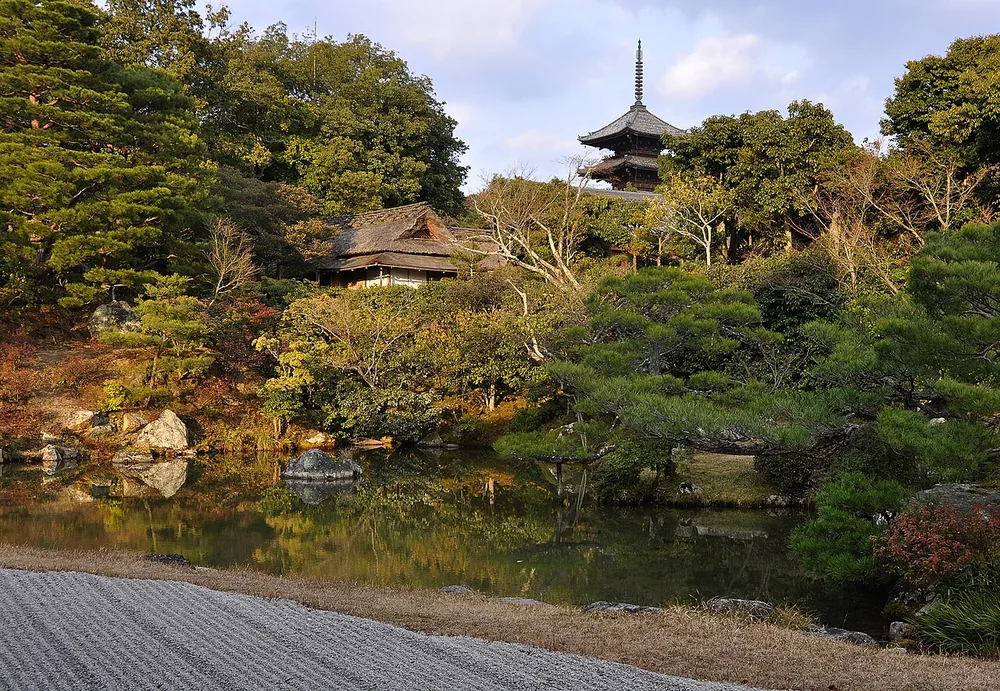
The temple does not give the North Garden a single creation date. Its guide records work by Kaku Doi and others in 1690, followed by work by the seventh Ogawa Jihei during the Meiji and Taisho periods. Today’s view reflects successive interventions. That history helps explain the pond and hills; there is no need to miss the arrangement of water and stone while searching for one original completion year.
See the pagoda in the distance from the North Garden, then study its body and eaves nearby after leaving the Goten. Compare what you could see across the pond with the close view in the temple grounds. This makes the pagoda a useful first stop after the Goten gardens.
What to look for at Hitotei, Ryokakutei and Reimeiden
Hitotei stands on an artificial hill in the North Garden, with a thatched hip-and-gable roof. Temple tradition associates it with Emperor Kokaku’s fondness for the tea house. Its roof makes it easy to identify in the garden: the small tea house and hillside thatch contrast with the Goten roofs. On a general garden visit, use it as a focal point on the hill. View the exterior from open paths and compare its height with the pond below.
The guide describes Hitotei as four and a half tatami mats plus a shortened daime mat, with a kininguchi entrance for high-ranking guests. Ryokakutei has a two-and-a-half-mat daime tea room, with a wing wall and low nijiriguchi entrance beneath the eaves. These entrances show different approaches to tea-house design and reward further study if tea ceremony or architecture interests you. Plan a standard garden-ticket route around the landscape and visible exteriors.
Ryokakutei stands west of Reimeiden and was moved from Katamachi in front of Ninna-ji. The temple compares its rust-colored walls and scattered long-fiber wall finish with Joan, the tea house favored by Oda Urakusai. Recognize it as a separate tea house; keep Hitotei’s thatched roof distinct from Ryokakutei’s entrance details. Find each building’s position before attaching its name to the view.
Reimeiden lies northeast of the Shinden. Designed by Kameoka Suekichi, it was built in 1911 to house the seated Yakushi Nyorai formerly worshipped as Kita-in’s principal image. It adds another function to the modern Goten: housing a Buddhist image. The temple FAQ lists this Yakushi as a hidden image. A standard visit offers the building; associate the statue with this location. For an exhibition of Buddhist images, consider the Reihokan as a separate type of visit.
Niomon and Chumon: look at both sides of the gates
Niomon is Ninna-ji’s front entrance, directly facing the road. It is 18.7 meters high, with two stories, a hip-and-gable roof and traditional full tile roofing. A and Un guardian figures flank the front; Chinese-style guardian lions stand at the rear. Turn around after passing through to see this second set. Photographing only the front before hurrying to the Kondo misses a change just behind you.
The temple guide compares Niomon’s Japanese-style architecture with the contemporary Zen-style main gates of Chion-in and Nanzen-ji. Start with the roof, two levels and column spacing rather than memorizing style names, then recall other temple gates you have seen. Niomon also provides a scale reference for the smaller Chumon farther on. Walking between them makes the divisions of the grounds clearer.
Chumon stands between Niomon and the Kondo, opening into the main grounds around the pagoda and Kannondo. It has a gabled, fully tiled roof and three bays with eight secondary posts. Guardians of the west and east stand on either side. From the front, read the three horizontal bays; from the side, look at the gable and roof. Its outline is easier to take in at once than Niomon’s two-story mass.
Beyond Chumon, choose your direction: the pagoda for tower proportions, the central axis to the Kondo for a relocated palace building, or the sutra repository for its rotating bookcase during special openings. The gate separates the Goten area from the main temple buildings and gives you a clear landmark for the return. The Omuro cherry grove lies to the west inside Chumon; turn here for the spring blossom route.
Kondo: a palace roof and Huang An on the tiles
The Kondo houses Ninna-ji’s principal Amida triad and is a National Treasure relocated from the Imperial Palace’s Shishinden. A useful question on site is what remains visible outside after a court building becomes a Buddhist hall. Follow the open viewing area to study the roof outline and facade proportions, then compare the Shinden’s cypress-bark roof in the Goten. The court connection becomes visible in two different buildings.
Look up at the roof tiles for a figure addressed in the temple FAQ: the immortal Huang An standing on a turtle, explained as a symbol of eternity. If you enjoy architectural ornament, find the figure-and-turtle combination, then locate it on the roof. Changing from the whole building to one tile ornament gives you a different reason to pause.
The temple describes Four Heavenly Kings, Brahma, and richly colored Pure Land and Kannon paintings inside the Kondo. A normal outdoor route focuses on its exterior and principal image; see the interior paintings during an announced special opening. The sutra repository opening from October 23 to November 8, 2026 offers its rotating bookcase and murals. Use this limited option if you want exterior architecture and an interior visit on the same day.
Pagoda, bell tower and Kusho Myojin: three different outlines
Built in 1644, the pagoda measures 32.7 meters for the tower body and 36.18 meters overall. The temple compares it with To-ji’s pagoda, noting relatively little difference in width between upper and lower levels. From a clear viewpoint, compare the top and bottom eaves, then follow the levels between. This makes the proportions described in the guide easier to retain than the height alone.
A Sanskrit-character plaque representing Dainichi Nyorai hangs on the west side of the first story. If the Sanskrit exhibition interests you, connect the South Garden’s writing with this architectural detail. The temple describes Dainichi and four directional Buddhas inside, a central pillar and tenchu pillars, plus the eight Shingon patriarchs and decorative motifs on columns and walls. A normal visit focuses on the exterior, eaves and plaque. The FAQ explicitly says the public cannot climb Niomon or the pagoda.
The bell tower calls for a different approach: wooden walls conceal its bell from outside. Identify the lower walls flaring outward like hakama trousers and the vermilion railing above. The temple calls this lower form hakamagoshi. There is no need to keep circling for a view of the bell. The materials and shapes of the two levels are the building’s visible features.
Kusho Myojin comprises a main shrine and left and right shrines protecting the temple grounds. The main shrine enshrines three Hachiman deities; other deities occupy the east and west shrines. To understand a shrine within a Buddhist temple, study how the three buildings stand together, then match deity names to the side shrines. Their side-by-side arrangement differs from the pagoda’s vertical tiers and the bell tower’s enclosed lower story. Give each stop a viewing question rather than simply collecting names.
Kannondo and Miedo: a painted Buddhist hall and a founders’ hall
The Kannondo also has a fully tiled hip-and-gable roof, with projecting worship porches at front and rear and high eaves. The temple guide identifies Thousand-armed Kannon as the principal image, flanked by Fudo Myoo and Gozanze Myoo and surrounded by the Twenty-eight Attendants. The interior is normally closed and remains in use for transmission of the religious lineage. On ordinary days, study the roof, porches and tall hall from outside. To see the figures, choose an opening event that specifically includes Kannondo.
Miedo, west of the bell tower, has a different scale. The temple gives it as about ten meters square, roofed in cypress bark and rebuilt during the Kanei era using part of the Imperial Palace’s Seiryoden and fittings from its hinged shutters. After the Kondo, this lets you compare two palace sources, Shishinden and Seiryoden, on one visit. Its smaller volume and roof material also contrast with Kannondo’s full tile roofing.
The hall enshrines Kobo Daishi, retired Emperor Uda and Prince Shoshin, Ninna-ji’s second head priest. These differ from the principal images of the Kondo and Kannondo. On an outdoor route, distinguish a principal-image hall, Kannon hall and founders’ hall, then see the bell tower east of Miedo and Mizukake Fudo. The latter stands between the bell tower and Miedo and houses a stone Fudo Myoo. Clear locations help keep the side routes distinct.
Inside the sutra repository: the scale of the rotating bookcase
The sutra repository was built between the Kanei and Shoho eras. Its pyramidal, fully tiled roof, front plank doors and cusped windows at the sides form a consistent Zen-style design. The roof and window shapes can normally be seen from outside. The special opening from October 23 to November 8, 2026 shifts attention to the rotating bookcase at the center. This is the clearest difference between the seasonal visit and an ordinary outdoor walk.
The temple’s precinct guide describes an octagonal rotating bookcase with 96 boxes on each face, 768 sutra boxes in total, holding the Tenkai edition of the complete Buddhist canon. First see how the bookcase fills the room, then follow the boxes from one face around the whole structure. These numbers explain the scale of the collection and the contrast between a compact exterior and dense interior.
Six figures inside include Shaka Nyorai, Monju and Fugen; the walls depict the Eight Great Bodhisattvas and Sixteen Arhats. The special-opening announcement also mentions a dragon mural connected with the Ryuo match theme. Move from the central bookcase to the surrounding figures and paintings, taking in structure before images. Photography is prohibited inside, so spend the time looking at the details.
The November 2026 calendar lists hours of 10:00–16:30, with admission ending at 16:00. The event page gives adult admission as ¥800. The Goten gardens are closed on November 2, 3 and 4; choose the temple grounds and repository on those dates. If the two gardens and Shinden are your main purpose, choose another open day.
Reihokan and the Sanskrit exhibition: objects or writing in the garden
The 2026 Reihokan autumn treasures exhibition, “Ninna-ji since the Edo period: returning to Ninna-ji and Omuro,” focuses on the revival of the temple buildings, treasures and religious texts gathered after reconstruction, and successive head priests. It suits an interest in the temple’s Edo-period rebuilding and complements seeing the relocated Kondo. If your main aim is sitting with the two gardens, prioritize the Goten and add the museum if time remains.
The temple’s autumn exhibition announcement gives October 3–November 29, 2026, closed Mondays except October 12 and November 23. Hours are 10:00–16:30, with last admission at 16:00. Admission is ¥500 for adults and free for high school students and younger visitors.
The Sanskrit-character exhibition takes place in the Goten gardens from October 3 to November 20, 2026. Admission is ¥1,000 for adults and free for high school students and younger visitors. Hours are 9:00–17:00, last admission 16:30; closures are October 5 and 23 and November 2, 3 and 4. The ordinary adult garden fee is ¥800, but budget ¥1,000 during this exhibition. For two adults visiting both exhibitions on a day when both are open, the total is ¥3,000, excluding the sutra repository.
The Sanskrit exhibition also offers character and stamp collecting at seven points in the grounds; collect a sheet after purchasing Goten garden admission. It connects the indoor exhibition with finding characters outside and gives companions a shared viewing task. The two October 11 sessions in which monks wrote characters on the white gravel have ended. Later visitors can see the exhibition and garden writing without scheduling a live writing session.
Omuro cherry grove: add the low branches to a spring route
The Omuro cherry grove lies west inside Chumon and south of Kannondo, separate from the Somei Yoshino trees before the Kondo and weeping cherries near the bell tower. The FAQ identifies the Omuro variety as Omuro Ariake: about 130 trees in the blossom garden and about 200 Omuro cherries across the grounds. Including other varieties, the temple has about 550 cherry trees. This distribution helps you decide between the grove and blossoms with buildings near the Kondo.
These cherries flower late and grow low, putting blossoms closer to eye level. Compare nearby flowering branches with the distant temple buildings instead of constantly looking up. The temple’s Omuro cherry explanation corrects the old claim that hard underground bedrock keeps them short: investigations found clay soil. Looking at their low clusters shows why the viewing distance differs from tall Somei Yoshino trees.
The Omuro Flower Festival’s special grounds admission is separate from Goten garden admission. The current ordinary fee list gives ¥800 for adults and free entry for high school students and younger visitors. Blossom viewing is mainly outdoors; add the Goten separately if you also want the painted rooms and both gardens. For a blossom-led day, shorten the detailed architectural stops and give the grove the longest visit instead of following the autumn garden route unchanged.
Eating and parties are prohibited in the blossom garden. The temple designates the square opposite the Reihokan for meals and prohibits bringing alcohol. Leave the grove before lunch to keep viewing and rest stops separate. The temple records each year’s blossom conditions; plan the next season using its announcements. Autumn and winter visitors can use the grove to orient themselves west of the main temple buildings, while focusing on what is available then.
Ninna-ji’s 2016 Omuro cherry footage shows low flowering branches, paths through the grove and temple buildings in the distance.
Omuro-Ninnaji and Hanazono stations lead to the front entrance
The temple is about three minutes on foot from Randen’s Omuro-Ninnaji Station, useful for trips along that line. From JR Hanazono Station, allow about 15 minutes on foot or five minutes by taxi. Both options appear on the temple’s access page. Choose according to your accommodation and the rest of the day: if you are already on the JR Sagano Line, the longer Hanazono walk may save a transfer. From the Randen line, Omuro-Ninnaji brings you closer to the gate.
The address is 33 Omuro Ouchi, Ukyo-ku, Kyoto, with Niomon directly beside the road. Once you reach the entrance, divide the visit into the Goten and the area north of Chumon. A three-minute walk from the station does not take you all the way to the Kondo. There is further north–south walking inside. If you have another afternoon booking, allow separate time to return to the main gate and station.
A shorter garden route can cover the Goten gardens, a look back at Niomon, then Chumon and Kondo, returning by the pagoda. Its focus is the paintings and two gardens, with only the Kondo and tower outdoors. For a full half-day, add either the repository or Reihokan and plan around its last admission. Both stop admitting visitors at 16:00; leaving either until the end can cut the visit short.
For visitors with limited mobility, the temple provides one indoor and one outdoor wheelchair. Contact the admissions office before visiting for assistance. Use this to set the route length: explain whether you want the Goten gardens or temple grounds, seek help suited to your needs, and keep one main section. If the Goten has used your energy, return directly to the front gate rather than continuing north to complete every building.
Plan photography, rest stops and departure time
Ninna-ji permits photography for personal interests and private use; commercial or profit-making use requires procedures. Photography is prohibited in the Reihokan and inside Buddhist halls. Tripods are allowed only outdoors and must not obstruct other visitors. Concentrate photographs on garden views and outdoor buildings, leaving indoor time for paintings. To record the pagoda’s proportions, stop where you do not block a path.
Pets must be in cages in the outdoor grounds; leashes are not accepted. They cannot enter buildings even in cages. This affects a group’s Goten visit, so divide arrangements according to who needs to enter. Eat brought food in the square opposite the Reihokan and take away your rubbish. Keep the halls and cherry grove for worship and viewing.
For an afternoon arrival, visit your preferred paid area first, then see gates and tower on the outdoor return. The precinct page lists Goten garden closing at 16:30 with admission ending at 16:00 in December–February. March–November generally closes at 17:00, with admission ending at 16:30. Where seasonal events such as Reihokan and repository openings use earlier admission times, plan around those.
Return to Niomon before leaving. If you headed straight north on arrival, see the guardian lions at its rear now, then exit for Randen Omuro-Ninnaji or JR Hanazono Station.
A few useful answers
Should I start with the gardens or temple buildings on a half-day visit?
Start with the Goten gardens for sliding-door paintings and the South and North Gardens. For the proportions and construction of halls and tower, start with Niomon, Chumon, Kondo and the pagoda. Add either the sutra repository or Reihokan for a full half-day.
Is Goten garden admission still ¥800 in autumn 2026?
During the Sanskrit exhibition, October 3–November 20, adult admission is ¥1,000 and high school students and younger visitors enter free. Closures are October 5 and 23 and November 2–4. ¥800 is the ordinary adult garden fee.
Is the Reihokan open every day?
The 2026 autumn exhibition runs October 3–November 29, closed Mondays except October 12 and November 23. Hours are 10:00–16:30, last admission 16:00.
Where are the Omuro cherries?
The main grove lies northwest of Chumon and south of Kannondo. Omuro Ariake are late-flowering, low-growing cherries. Somei Yoshino trees before the Kondo and weeping cherries near the bell tower occupy separate locations.
Official information and references
Sources used in this guide.
- Ninna-ji: precinct guide
- Ninna-ji: overview and history
- Ninna-ji: access and current ordinary admission fees
- Ninna-ji: frequently asked questions
- Ninna-ji: Omuro cherry blossoms
- Ninna-ji: 2026 Sanskrit exhibition marking completion of Shiro Shoin repairs
- Ninna-ji: 2026 Reihokan autumn treasures exhibition
- Ninna-ji: special opening of the sutra repository
- Ninna-ji: November 2026 calendar