Start in Takao and return from Toganoo on a practical guide to Jingo-ji's stone steps and clay-disc throwing, Saimyo-ji's Shigetsu Bridge, and Kosan-ji's Sekisui-in. Compares West Japan JR Bus and City Bus No. 8, temple admission fees, 2026 autumn foliage, and the 2027 spring opening.
- Region & Focus
- KyotoShrines and temples
- Reading Scope
- 22 min read · 12 chapters · 6 Q&As
- Official Verification
- 31 official sources checkedUpdated 22 November 2026 at 08:00 GMT+8
- Key Topics
- ItinerariesSeasonsKyoto, Osaka & Kansai
Chapter Route Map (tap any stop)
- Takao, Makinoo and Toganoo are place names, each with its own bus stop
- Take the West Japan JR Bus from Kyoto Station, or City Bus No. 8 from Shijo-Karasuma
- One bus each way: single fares are usually all you need
- Climbing from Takao Bridge: two sets of stone steps with different pacing
- Visit Yakushi Nyorai in the Kondo Hall first, then toss clay discs at Jizo-in
- Understanding the three temples through the 812 Takao abhisheka
- Saimyo-ji's Main Hall is worth a dedicated stop
- Save Kosan-ji for Sekisui-in, where replicas of the Choju-giga are on display
- How to pace all three temples in a day—or just half a day
- Pick one temple for autumn foliage, and watch spring for closed halls
- Adjusting your route for rain or icy stone steps
- Choosing where to stay and eat around your return bus
- Quick Q&A
On your first trip to Kyoto's Sanbi area, put Jingo-ji first in the morning: alight at Takao, cross the bridge, climb the stone steps to the Kondo Hall, and head to Jizo-in to toss clay discs across the valley. If your legs and the weather hold up, continue on to Saimyo-ji and Kosan-ji, then take the bus straight back to the city from Toganoo. If you only have half a day, save it all for Jingo-ji. Travellers keenest on the mountain views from Sekisui-in can reverse the order and begin at Kosan-ji. Because each temple's entrance and bus stop sit in different spots, deciding beforehand where you want to linger makes catching the next bus much simpler.
Takao, Makinoo and Toganoo are place names, each with its own bus stop
Sanbi (pronounced 'san-bi') lies in the north-west of Kyoto's Ukyo Ward. Heading out from the city towards Keihoku, the route passes Jingo-ji in Takao first, then Saimyo-ji in Makinoo, and finally Kosan-ji in Toganoo. Japanese bus-stop signs read Takao, Makinoo and Toganoo in that order, though some visitor guides spell Takao slightly differently or refer to the area as Yamashiro-Takao. Check the destination display when boarding and listen for the stop announcements as you approach. Saimyo-ji and Kosan-ji are the temple names, whereas the bus stops take the names of the districts rather than the temples themselves.
On a map the three temples look close together, yet in practice you are navigating main roads, river valleys and steep hillside approaches. At Jingo-ji, the main sights are spread between the Kondo Hall terrace and the overlook in front of Jizo-in, so walking continues well past the ticket gate. Saimyo-ji is easier to take in as one self-contained loop when time is tight: cross the red bridge, climb the steps and look out over the moss garden from the Main Hall. Kosan-ji rewards leaving a proper window for Sekisui-in, a National Treasure building framed by the surrounding peaks. To save your legs, spend your walking time inside the temple precincts and hop on a bus between stops.
All three bus stops sit along the roadside highway, while the temple gates and ticket booths lie further down or up the slopes. Taking a bus from central Kyoto to Takao only brings you to the foot of the approach, and on the return leg you must climb back up to road level to reach the stop. When arranging a meeting point with companions, specify clearly between the Kondo Hall forecourt, Takao Bridge and the city-bound Takao bus stop, as there is a fair walk between each. Mobile reception can be patchy in the valley, so save screenshots of the route map and separate screenshots of outbound and inbound bus stops beforehand.
| Temple | Bus stop | Standard hours | Highlights worth lingering for |
|---|---|---|---|
| Jingo-ji | Takao | 9:00-16:00 | Stone steps to Kondo Hall, Yakushi Nyorai, Kinunkyo Valley at Jizo-in |
| Saimyo-ji | Makinoo | 9:00-17:00 (last entry 16:30) | Shigetsu Bridge, all-zelkova Main Hall, moss garden |
| Kosan-ji | Toganoo | 8:30-17:00 | Sekisui-in, replica display of Choju-jinbutsu-giga scrolls |
Start in Takao and return from Toganoo on a practical guide to Jingo-ji's stone steps and clay-disc throwing, Saimyo-ji's Shigetsu Bridge, and Kosan-ji's Sekisui-in. Compares West Japan JR Bus and City Bus No. 8, temple admission fees, 2026 autumn foliage, and the 2027 spring opening.
Take the West Japan JR Bus from Kyoto Station, or City Bus No. 8 from Shijo-Karasuma
If you are staying near Kyoto Station, leave via the Central (Karasuma) Exit and head to bay JR3 on the station forecourt for the West Japan JR Bus Takao-Keihoku Line, boarding services bound for Toganoo or Shuzan. Both destinations serve all three Sanbi temples; alight at Takao for Jingo-ji. Temple guidance estimates around 50 minutes from Kyoto Station to Takao, while Kosan-ji lists roughly 55 minutes to Toganoo. If you are connecting off the Shinkansen, Kintetsu line or dropping luggage in station lockers first, factor in walking time from the platforms to the Central Exit plus queueing.
The JR Bus 47 and 48 routes follow slightly different corridors through the city. An intermediate transfer point near JR Enmachi Station is signed as Nishinokyo-Enmachi, and services also call outside Nijo Station; check the timetable column showing your preferred stop. Boarding at Kyoto Station keeps everyone in your group at a single starting point. If you are already along the JR Sagano Line that morning, joining at Enmachi or Nijo avoids doubling back, though seats may already be taken. When jotting down departure times, note both the route via-points and final destination so you do not board a bus terminating at Ritsumeikan University by mistake.
From Shijo-Karasuma, Hankyu Karasuma Station or Subway Karasuma Line Shijo Station, catch Kyoto City Bus No. 8 bound for Takao and Toganoo. This service also passes Shijo-Omiya and Uzumasa-Tenjingawa Station. Travellers transferring from the Subway Tozai Line can come up via Exit 2 or 3 onto the Uzumasa-Tenjingawa plaza and look for the No. 8 stop towards Takao. Where a stop lists Special No. 8 (Toku-8), check the front destination board carefully, as Toku-8 runs towards Yamagoe-Nakacho instead. To start at Kosan-ji, pick a departure explicitly bound for Toganoo. Kyoto City's official visitor site puts the ride from Uzumasa-Tenjingawa to Toganoo at about 28 minutes, noticeably shorter than sitting through central traffic on the full bus route.
On West Japan JR Bus timetables (April 2026 edition), services back to Kyoto Station are marked 'nobori' (inbound) and services towards Toganoo and Shuzan are marked 'kudari' (outbound). City Bus timetables split weekdays, Saturdays and public holidays into separate columns. Under the City Bus No. 8 schedule effective 20 March 2026, departures from Uzumasa-Tenjingawa towards Takao run at 16 minutes past each hour between 10:00 and 15:59. Missing a midday bus by a minute or two can mean nearly an hour's wait, so build underground-to-street transfer time into your plan.
You do not have to use the same operator both ways. Take City Bus No. 8 back towards Shijo-Karasuma or Uzumasa-Tenjingawa, or catch a JR Bus marked for Kyoto Station. Around Shijo-Omiya the two networks overlap, giving you the option of whichever arrives first. Agree on your final drop-off district with companions before boarding; jumping on any bus signed 'city-bound' often forces an unnecessary transfer later.
One bus each way: single fares are usually all you need
Within the flat-fare zone between central Kyoto and Toganoo, both Kyoto City Bus No. 8 and West Japan JR Bus charge ¥230 for an adult single and ¥120 for a child. An adult return comes to ¥460, or ¥690 if you add one short hop between temples. Walking up from Takao and returning from Toganoo uses only two bus rides. Choose between the two operators based on your starting point, final destination and departure times rather than price, as single fares along the Sanbi stretch are identical.
The Kyoto City Subway and Bus 1-Day Pass costs ¥1,100 for adults and ¥550 for children, covering municipal underground lines, City Buses and the West Japan JR Bus flat-fare section between Kyoto Station and Toganoo. It only pays off if you are already riding the underground into the centre, making the Sanbi return trip and adding another sightseeing stop elsewhere the same day. For Kosan-ji, alight at Toganoo; staying on towards Shuzan takes you beyond the pass's valid zone.
On City Bus No. 8, board at the rear door and pay at the front when alighting; ICOCA, Suica and other compatible IC cards work smoothly. On West Japan JR Bus, board at the rear door, take a numbered paper ticket (seiriken) as directed—and still tap your IC card on the reader—then hand in the ticket and tap again at the front when getting off. West Japan JR Bus Kyoto routes also honour a valid Japan Rail Pass: show both your pass and numbered ticket to the driver when disembarking, whereas City Bus No. 8 requires separate payment or a valid city pass. Keeping small change or a topped-up IC card handy makes switching between operators effortless.
Temple admission fees are separate. Adults pay ¥1,000 at Jingo-ji, ¥700 at Saimyo-ji and ¥1,000 to enter Kosan-ji's Sekisui-in. During Kosan-ji's 2026 autumn season, an extra ¥500 mountain-entry fee applies, bringing total adult temple admissions across all three sites to ¥3,200—or ¥3,660 including two bus rides. Mid-route bus hops, clay discs, teahouse stops and special openings sit on top of that. Setting aside cash for admissions and clay discs before setting off saves fumbling with your phone at each ticket counter.
Climbing from Takao Bridge: two sets of stone steps with different pacing
After alighting at Takao, follow the signs for Jingo-ji down into the valley, descending first to the Kiyotakigawa River before crossing Takao Bridge and climbing the opposite bank. Both Jingo-ji and Kyoto City Tourism quote roughly 20 minutes on foot from the bus stop. West Japan JR Bus's Sanbi walking map allows a more generous buffer: around 15 minutes along the footpath to the main temple gate (Sanmon), plus another 15 minutes up to the central precinct. Budgeting half an hour for the climb works well for meeting times and return planning, leaving you free to pace yourself once at the Kondo Hall and Jizo-in.
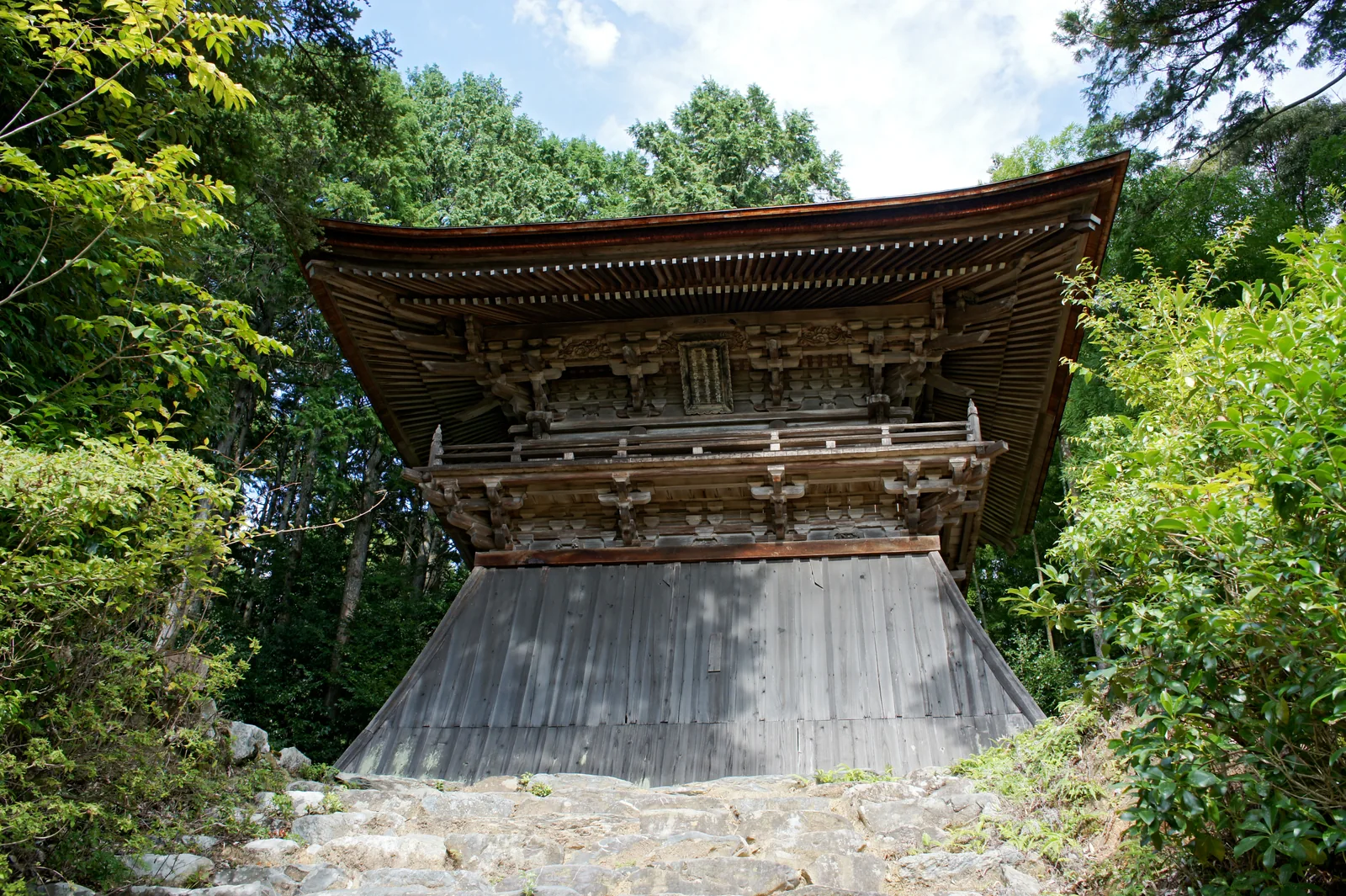
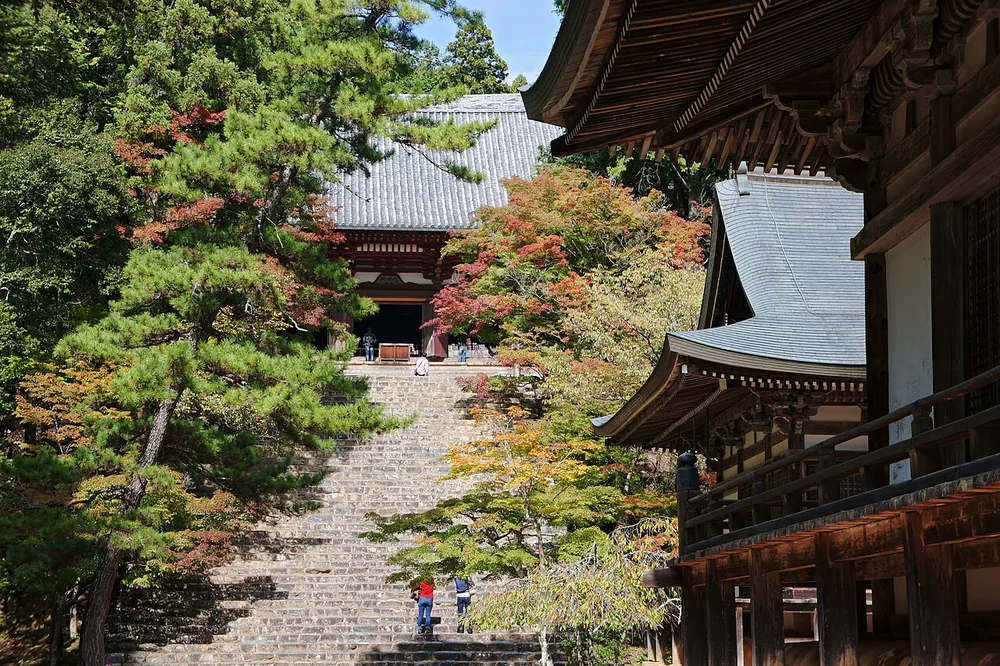
The first climb begins right after the bridge, passing Suzuriishi-tei halfway up—a teahouse named after a large boulder said to have been Kukai's inkstone. It serves as a handy landmark in both directions and a natural spot to decide how far your group wants to continue. Beyond the Sanmon gate, a broad flight of stone steps rises straight towards the Kondo Hall, as shown in the photo above. Even once you reach the gate, allow extra climbing time before arriving at the hall itself.
Everything you descend on the way in must be climbed again on the way out, including the final rise from the river valley back up to the highway bus stop. Anyone who finds steep steps hard going can set a turnaround point near the bridge or teahouse after sizing up the gradient. Older visitors walking at a gentle pace should pause on level landings clear of foot traffic rather than stopping mid-stairway. Families with pushchairs will have to fold and carry them in sections; the Kyoto Prefecture Tourism Federation's Jingo-ji listing notes that the grounds are not wheelchair-accessible and have no accessible toilets, so indoor city sights are a better match if someone in your party relies on a wheelchair.
With children along, the Sanmon gate, Kondo Hall and Jizo-in break the climb into clear stages where you can rest before deciding whether to go further. Bear in mind that if a toddler falls asleep just as you start heading back, carrying them up and down stone steps takes longer than pushing a buggy. Multi-generational groups should time the return around the slowest walker reaching Takao Bridge so faster walkers do not accidentally catch an earlier bus and leave others waiting alone by the roadside.
Visit Yakushi Nyorai in the Kondo Hall first, then toss clay discs at Jizo-in
Once past the ticket gate, head towards the Kondo Hall. Looking up from beside the Godai-do and Bishamon-do halls, the Kondo's hip-and-gable roof crowns the top of the steps; the present building dates from 1935. Take in the tiles and eaves from outside before stepping in to notice the coffered ceiling panels and hosoge floral motifs on the pillars, separating the modern reconstruction from the ancient statuary inside. The standing Yakushi Nyorai enshrined here is a National Treasure—follow on-site staff instructions when paying respects. For anyone eager to see Heian-period Buddhist sculpture, walking from the gate to the Kondo Hall makes a satisfying visit even on a tight afternoon schedule.
Both the Daishi-do Hall and the Tahoto Pagoda are worth viewing from outside throughout the year, with interiors reserved for special openings. Daishi-do houses Important Cultural Properties in both the structure itself and its carved wooden panel image of Kobo Daishi, though on normal days you appreciate its setting and proportions from the courtyard. The Tahoto Pagoda holds five National Treasure statues of the Five Great Kokuzo Bosatsu, best targeted specifically during their scheduled spring or autumn viewings. As you move between halls, notice the terraced layout: most visitors cross a broad flat plaza after the gate before branching uphill towards separate pavilions.
Clay-disc throwing, known as kawarake-nage, takes place at a designated overlook in front of Jizo-in. Visitors purchase small unglazed earthenware discs and hurl them out over Kinunkyo Valley to ward off misfortune—a completely separate stop from worship inside the Kondo Hall. Follow the posted instructions when buying and throwing discs, letting children watch an adult demonstrate first. Wait for the person ahead to finish before stepping up to the rail, and have anyone taking photos stand well behind the thrower so there is plenty of room to swing.
If some in your group want to throw discs while others prefer simply taking in the view, agree to regroup outside Jizo-in. After rain or in brisk winds, skip the discs if footing looks slick and enjoy the gorge from safe ground instead. For valley photographs, frame nearby maple branches against the forested slope across the ravine from a secure vantage point before raising your phone. If you glance at the clock deep inside the grounds and realise your bus is due soon, walk straight back to the Sanmon gate rather than detouring to retake photos on the Kondo steps.
Understanding the three temples through the 812 Takao abhisheka
Though strung along the same river valley, the three temples trace their histories to different chapters of Japanese Buddhism. One of Jingo-ji's precursors, Takaosan-ji, was tied to the Wake clan and became a base for Kukai in the early Heian period. In 812, Saicho received both the Diamond Realm and Womb Realm abhisheka (initiation) rituals from Kukai here. Jingo-ji preserves the Kanjo Rekimyo—Kukai's handwritten register recording those ceremonies and the names of initiates—which vividly captures the two monks' early partnership.
In 824, Takaosan-ji merged with Shingan-ji and was renamed Jingokokuso-Shingon-ji, shortened to Jingo-ji. The Kondo Hall, pagodas and pilgrim paths you walk today reflect centuries of rebuilding and devotion across the same mountain ridge. Reading the temple's history with its ceremonies, name changes and later structures kept distinct makes it clear why the Daishi-do commemorates that foundational era and why individual treasures keep separate viewing calendars.
Saimyo-ji is traditionally said to have been founded by Kukai's disciple Chisen and originally stood as a branch temple of Jingo-ji before gaining independence in the Kamakura period. Kosan-ji in Toganoo was likewise once a branch temple of Jingo-ji until Myoe revived it in 1206 on land granted by Retired Emperor Go-Toba. Walking the full route lets you read three distinct spatial layouts: Jingo-ji spreads its halls across a steep mountain flank, Saimyo-ji folds into an intimate courtyard linked by a bridge and stone steps, and Kosan-ji centres contemplation around Sekisui-in's mountain outlook—an easier way to remember their lineage than memorising dates alone.
Saimyo-ji's Main Hall is worth a dedicated stop
Descending back into the valley from Jingo-ji, you can follow West Japan JR Bus's Sanbi walking map north towards Saimyo-ji. Measured from gate to gate, the bus company's map puts the walk between Jingo-ji and Saimyo-ji at about 20 minutes. Stepping off the main road onto Shigetsu Bridge provides an unmistakable entrance; from the Makinoo bus stop, Saimyo-ji estimates around a five-minute walk. Travellers arriving directly by bus descend first to the bridgehead and only spot the ascending stone steps once they have crossed the river.
Saimyo-ji is normally open from 9:00 to 17:00, with last admission at 16:30. Current temple pricing is ¥700 for adults and ¥500 for junior-high and high-school students. Beyond the front gate rises the wide Main Hall, rebuilt in 1700 through the patronage of Keishoin, mother of shogun Tokugawa Tsunayoshi, and constructed entirely of zelkova wood. Its principal image is a standing Shaka Nyorai attributed to Unkei, with an older Senju Kannon enshrined on the east side. If you have only half an hour, spend it inside the Main Hall and along the veranda overlooking the garden, leaving photos of Shigetsu Bridge for your walk back down.
To the east of the Main Hall, a moss garden frames a white-walled storehouse, a hokyo-in-to stone pagoda and tall cedars rising behind. When sunlight filters through, the pale plaster wall draws the eye deeper into the garden even more effectively than the foliage by the railing. Sit inside the hall first, then step onto the connecting gallery to look back across the sweep of moss, eaves and distant treetops. In autumn, maple leaves against the white walls near the front gate make a striking approach—if the bridge is crowded on your way up, keep moving, as you will cross it again leaving.
If you are dropping one temple from a three-stop itinerary, visitors drawn to quiet courtyards and seated garden views usually keep Saimyo-ji and skip rushing on to Sekisui-in after Jingo-ji. Conversely, anyone prioritising the Choju-giga scrolls or Myoe's legacy can rest near Takao Bridge and hop straight on a bus to Toganoo for Kosan-ji. Saimyo-ji has no private car park, and even bus passengers face a slope and stone stairs; using the bus between stops lets you invest your energy in lingering quietly inside the hall.
Save Kosan-ji for Sekisui-in, where replicas of the Choju-giga are on display
From Saimyo-ji to Kosan-ji, West Japan JR Bus's walking map estimates around 20 minutes along a mix of footpaths and the national highway. If roadside traffic is heavy or dusk is closing in, riding one stop from Makinoo to Toganoo is safer and easier to pace. Near the Toganoo bus stop and public car park, the Ura-sando (rear approach) leads much closer to Sekisui-in. Watch for Ura-sando signs on the map so your entry and return bus stop stay on the same side of the precincts.
Kosan-ji's standard visiting hours are 8:30 to 17:00. Admission to Sekisui-in is ¥1,000 for adults and ¥500 for primary-school children. From 3 October to 6 December 2026, an additional autumn mountain-entry fee applies: ¥500 for adults and ¥300 for primary-school pupils. Visiting the grounds and entering Sekisui-in in autumn therefore involves two separate tickets at the gate, coming to ¥800 in total for a primary-school child during the peak season.
Sekisui-in itself is a National Treasure dating back to Myoe's era. From beneath its deep eaves, the valley slopes and forest canopy are framed cleanly between wooden pillars; put your phone away for a moment and shift slightly inwards from the veranda edge to see how the view changes with your seat. While Saimyo-ji focuses the eye on close-up moss and cedars, Sekisui-in opens out onto steep hillsides and distant ridges. Even in light rain—provided paths remain safe—mist drifting through the trees under the eaves rewards staying put here rather than hurrying between all three temples.
Kosan-ji's National Treasure Choju-jinbutsu-giga scrolls span four volumes (Ko, Otsu, Hei and Tei), with faithful replicas displayed inside Sekisui-in. Visiting with children, Volume Ko is easy to enjoy together: spot the rabbits, monkeys and frogs, and follow how the same animals shift poses from one scene to the next. Art-minded visitors can compare Volume Otsu with Volume Ko, noting how Otsu mixes real creatures with mythical beasts. Even if the scrolls are your main draw, leave time to simply sit with Sekisui-in's architecture and mountain backdrop.
The grounds also preserve a tea garden linked to Toganoo tea, recognised by the temple as Japan's oldest tea plantation. Looking at the terraced beds from the open path shows how both tea cultivation and temple buildings adapted to the steep hillside. Readers curious about monastic tea traditions can glance through the temple's tea-garden notes before strolling the public walkways. Kosan-ji occasionally hosts advance-booking special viewings combining the normally closed Iko-an teahouse, the tea garden and matcha service, each with fixed dates and limited places. On a standard visit, keep your focus on Sekisui-in and the grounds, and check the Toganoo city-bound stop before climbing up so leaving stays effortless.
How to pace all three temples in a day—or just half a day
For a full-day loop from Kyoto Station, the April 2026 JR Bus timetable offers a 08:30 departure arriving at Takao at 09:24. Cover Jingo-ji's Kondo Hall and Jizo-in in the morning, walk back down towards Takao Bridge around midday for water and lunch, visit Saimyo-ji in the early afternoon, and reserve roughly an hour at the end for Kosan-ji. Treat this as a flexible template: if you come down from Jingo-ji past 13:00, take a bus between Saimyo-ji and Kosan-ji—or choose just one for the afternoon—rather than squeezing every stop.
Under the April 2026 JR Bus timetable, afternoon departures from Toganoo back to Kyoto Station include 15:14, 15:34 and 16:14; the 15:34 service reaches Kyoto Station at 16:31. Aiming for the 15:34 bus means leaving Sekisui-in via the Ura-sando around 15:10 to allow for finding the stop and queueing. Targeting the 16:14 gives extra breathing room if crowds build up or you want to linger over the view. If a bus arrives already full, the following scheduled departure serves as your pre-checked backup.
A half-day plan gives a whole morning to Jingo-ji: allow roughly 50 minutes each way by bus plus waiting, the valley climb, temple sightseeing and descent—about four hours door to door from central Kyoto. If you want to add one afternoon temple, Jingo-ji and Saimyo-ji share the river-valley stretch, letting you finish at Makinoo for the bus back. Travellers determined to combine clay-disc throwing at Jingo-ji with Sekisui-in can ride the bus straight from Takao to Toganoo and save Saimyo-ji for another trip.
Running the route in reverse suits anyone putting Sekisui-in first. Kosan-ji opens earlier than its neighbours, so taking a morning bus to Toganoo via the Ura-sando puts you ahead of crowds, before walking or riding down to Saimyo-ji as energy allows. The catch comes at the end of the day: Jingo-ji closes at 16:00 and still requires a 20-to-30-minute walk up from Takao bus stop. If you finish Saimyo-ji approaching 15:00, catch your return bus from Makinoo and give Jingo-ji its own morning.
When planning a first group day across all three temples, write your trade-offs down before setting out. Whoever wants unhurried time with Jingo-ji's statues needs to know which side of Takao Bridge lunch and regrouping happen on; whoever cares most about Kosan-ji should keep an eye on the clock for Sekisui-in. Set one clear turnaround point everyone can manage so that even if part of the group stays behind to photograph maples, everyone knows which bus takes them back to their hotel.
Pick one temple for autumn foliage, and watch spring for closed halls
According to Kyoto Travel's seasonal guide, typical peak foliage runs early to late November at Jingo-ji, around 10 November at Saimyo-ji, and mid- to late November at Kosan-ji. Even within the same week the three sites vary, since Takao Bridge, the Kondo steps and Sekisui-in's distant ridges catch light and cold air differently. Check live foliage reports for Jingo-ji if stone-step photos are your goal, or Saimyo-ji's own updates for Shigetsu Bridge and the white plaster walls—on 18 November 2026, Saimyo-ji posted same-day photos online showing colour right around the bridge and inner courtyard.
On autumn weekends, arriving early gets you up Jingo-ji's steps before heavy foot traffic, leaving the afternoon for quieter courtyard viewing further up the valley. West Japan JR Bus notes that extra relief buses may run on peak autumn weekends—morning extras towards Toganoo and afternoon extras back to Kyoto Station—though groups splitting up should still anchor their plans around the regular published timetable. When photographing the main staircase during busy hours, step onto a flat landing to look back at the whole flight rather than pausing mid-step and slowing the flow behind you.
Jingo-ji's 2026 autumn Daishi-do special opening wrapped up on 7 November, so late-November visitors can focus their daylight on the Kondo Hall, the stone steps and Kinunkyo Valley. To see the Five Great Kokuzo Bosatsu statues inside the Tahoto Pagoda, the temple has announced its 2027 spring opening from 13 to 15 May, 10:00-15:00, for an extra ¥500 on top of general admission (¥1,500 combined for adults). Because that 15:00 cut-off is earlier than the general grounds' 16:00 closing time, visit the Tahoto Pagoda before heading to the Kondo Hall or Jizo-in.
From May into early summer, fresh green maples transform Jingo-ji's stone steps and Saimyo-ji's bridge; companions who only want a short stroll can stop at Takao Bridge or Shigetsu Bridge for photos and head straight back to the bus. In winter, shorter daylight means pairing a single morning temple with lunch from Kyoto Station so you return to the city while road visibility is still good. If Sekisui-in is your priority in winter, taking the bus to Toganoo and entering via the Ura-sando saves time over walking along the highway late in the afternoon.
Adjusting your route for rain or icy stone steps
Light drizzle and heavy rain call for different plans. In steady drizzle with grippy soles, pick a single temple, ride the bus to its nearest stop rather than walking between valleys, and focus on Saimyo-ji's Main Hall or Kosan-ji's Sekisui-in under the eaves. Once stone steps puddle and wet leaves turn slick, choose just one photo spot—the hillside steps, the red bridge or the valley overlook—test your footing after a few paces, and turn back before the bridge if needed rather than relying on someone else's arm down wet stairs.
From Takao, a longer riverside trail heads along the valley towards Kiyotaki in a different direction from Saimyo-ji and Kosan-ji. On a three-temple day trip, climb up from Takao Bridge towards your next temple rather than mistaking the Kiyotaki trail for part of the Sanbi route. Stops on Takao Bridge or Saimyo-ji's Shigetsu Bridge already give clear views along the Kiyotakigawa River and opposite bank that you cannot see from the stairs; when water levels run high, stick strictly to the bridges and main approaches.
If heavy rain is already falling at breakfast or snow and ice are forecast, swap the morning straight over to Umekoji instead. The Kyoto Railway Museum lies about two minutes on foot from Umekoji-Kyotonishi Station on the JR Sagano Line, normally open 10:00-17:00 (last entry 16:30), closed most Wednesdays and from 30 December to 1 January. It keeps families who want to avoid slippery steps on the same rail corridor, leaving you free to tackle Sanbi from Kyoto Station the next dry morning.
Should a downpour hit once you are already up in the hills, make for the nearest bus stop and check city-bound departures from both operators, taking whichever bus has space first. Once water starts streaming down the stone stairs and an umbrella blocks your view of the treads, cutting the mountain walk short beats waiting out the rain at the summit. Work out how many minutes lie between you and the nearest covered hall before deciding whether to shelter inside a temple or head straight back to the highway.
Choosing where to stay and eat around your return bus
For a dedicated Sanbi day, either Kyoto Station or Shijo-Karasuma makes a smooth base. Kyoto Station gives direct access to the JR Bus and easy evening connections onto the Shinkansen or Sagano Line. Shijo-Karasuma puts you right on City Bus No. 8 and drops you back in central dining neighbourhoods beside the underground. Travellers staying along the Tozai Line often find Uzumasa-Tenjingawa the tidiest hub, keeping both outbound and inbound rides tied to a single underground transfer.
For a proper sit-down meal in the hills, plan around Takao Bridge or book a restaurant in advance. Suzuriishi-tei sits halfway up Jingo-ji's approach; remember that stopping for tea and climbing back to the highway bus stop are separate chunks of time, so start counting down to timed tickets or evening trains only once you leave the teahouse. If part of your group finishes eating early while others linger with cameras, agree to meet down by the bridge. Carrying your own water and quick snacks on a temple-focused day also gives you more control than hunting for open roadside eateries before walking towards Makinoo.
If you want to build in a leisurely lunch, Takao Kinsuitei in Makinoo is roughly a three-minute walk from the bus stop. Its riverside kawadoko dining season runs from 1 May to the end of September, with lunch starting at 11:30 and arrivals required by 14:00; bookings can be made via the reservation form on the Kyoto City Tourism Association's venue page. Timing lunch here lets you visit Jingo-ji in the morning and cross Shigetsu Bridge into Saimyo-ji straight afterwards. For November foliage trips, note that kawadoko summer platforms are no longer running and seating switches to seasonal indoor menus, leaving daylight free for the valley.
To combine Sanbi with Arashiyama or western Kyoto shrines, give each area its own morning rather than cramming both into one day. After a morning at Jingo-ji, you can ride back to Uzumasa-Tenjingawa for the Tozai Line or take a JR Bus straight to Kyoto Station for central sights. If you already plan to visit Matsuo-taisha or another afternoon stop, limit your Sanbi morning to a single temple so transfers and walking stay relaxed. For deeper background on Jingo-ji's history and special openings before you set off, read our Jingo-ji temple guide.
A few useful answers
Which bus stop is for Jingo-ji?
Both the West Japan JR Bus Takao-Keihoku Line and Kyoto City Bus No. 8 stop at Takao. From the stop, follow signs down to Takao Bridge, cross the Kiyotakigawa River and climb the stone steps.
Where do you throw clay discs at Jingo-ji?
At the overlook in front of Jizo-in inside Jingo-ji's grounds, where unglazed clay discs (kawarake) are tossed out towards Kinunkyo Valley to ward off bad luck.
Do I have to walk between all three Sanbi temples on a day trip?
No—you can ride buses between Takao, Makinoo and Toganoo. You still need to walk from each roadside stop into the temple grounds, and Jingo-ji has by far the most steps, so save most of your walking energy for that climb.
If I can only pick one between Saimyo-ji and Kosan-ji, which should I choose?
Choose Saimyo-ji for Shigetsu Bridge, white plaster walls and the moss garden beside the Main Hall; choose Kosan-ji's Sekisui-in for National Treasure architecture, Choju-giga scroll replicas and sweeping mountain views from the veranda.
Does the Kyoto City Subway and Bus 1-Day Pass cover the JR Bus to Jingo-ji?
Yes. It covers the West Japan JR Bus Takao-Keihoku Line within the flat-fare section between Kyoto Station and Toganoo. If you are only taking two bus rides all day, however, paying single adult fares comes to ¥460 total.
When can visitors see Jingo-ji's Five Great Kokuzo Bosatsu statues in spring 2027?
Jingo-ji has announced the spring opening of the Tahoto Pagoda from 13 to 15 May 2027, 10:00-15:00. Special entry costs an extra ¥500, making combined adult admission with the general grounds ¥1,500.
Official information and references
Sources used in this guide.
- Kyoto Travel | Jingo-ji Temple: Visiting, Access and Treasures
- Kyoto Prefecture Tourism Federation | Jingo-ji 2027 Spring Special Viewing of the Tahoto Pagoda
- Kyoto Travel | Jingo-ji Information Plaque and Temple History
- Kyoto Prefecture Tourism Federation | Jingo-ji Treasures Airing (Mushiboshi) and Grounds Admission
- Kyoto City Tourism Association | Sanbi Hiking, Green Maples and Suzuriishi-tei
- Kyoto City Tourism Association | Kawarake-nage at Jizo-in and Kondo Hall at Jingo-ji
- Kyoto City Tourism Association | Takao Walking Map
- Kyoto Travel | Takao Area Autumn Foliage Report
- Saimyo-ji | Latest Notices, Visiting Hours and Admission Fees
- Saimyo-ji | Walking Route and Main Hall
- Kosan-ji | Access, Visiting Hours and Sekisui-in
- Kosan-ji | Precinct Layout and History of Sekisui-in
- Kosan-ji | Four Volumes of the Choju-jinbutsu-giga
- JR Central | Kosan-ji 2026 Autumn Mountain-Entry Period
- West Japan JR Bus | Takao-Keihoku Line, Passes and Relief Buses
- West Japan JR Bus | Takao-Keihoku Line Timetable (1 April 2026 Edition)
- West Japan JR Bus | Takao Sanbi Walking Map
- Kyoto City Transportation Bureau | City Bus Route No. 8 Stops
- Kyoto City Transportation Bureau | Departures from Uzumasa-Tenjingawa Station to Toganoo
- Kyoto City Transportation Bureau | Uzumasa-Tenjingawa Station Exits
- Kyoto City Transportation Bureau | Subway and Bus 1-Day Pass
- Kyoto Railway Museum | Opening Hours and Closed Days
- Kyoto City Tourism Association | Access to Takao and Transfers at Uzumasa-Tenjingawa
- Kyoto City Transportation Bureau | Kyoto Station Karasuma Exit Bus Terminal Map
- Kyoto City Transportation Bureau | City Bus Fares and How to Ride
- West Japan JR Bus | Using IC Cards and Rail Passes
- Saimyo-ji | Autumn Foliage Photos (18 November 2026)
- Kosan-ji | 2026 Autumn Entry and Replica Scroll Display
- Kosan-ji | Example Advance-Booking Special Viewing of Sekisui-in and Teahouse
- Kyoto Travel | Takao Kinsuitei Dining Hours and Reservations
- Kyoto Railway Museum | Access and Umekoji-Kyotonishi Station