Walk from Higashiyama Station in Kyoto to Heian-jingu Shrine to see the Otenmon Gate and Daigokuden Hall before deciding on a garden ticket. Covers ¥600 adult admission, the four-garden walking route, April red weeping cherries, Jidai Matsuri viewing spots and a half-day Okazaki plan.
- Region & Focus
- KyotoShrines and temples
- Reading Scope
- 22 min read · 8 chapters · 6 Q&As
- Official Verification
- 32 official sources checkedUpdated 22 November 2026 at 08:00 GMT+8
- Key Topics
- First tripItinerariesSeasons
Chapter Route Map (tap any stop)
- Heian-jingu tickets and hours: decide which areas to visit
- Walking Jingu-michi from Higashiyama Station: Keihan vs City Bus
- Beyond Otenmon Gate: the Chodo-in layout and Daigokuden Hall
- Exploring the four Shinen Gardens from the South Garden to Taiheikaku
- From cherry blossoms to autumn foliage: choosing your season
- Jidai Matsuri: watching at the start, city centre or Jingu-michi
- On a half-day schedule: pairing museums or the canal
- For garden lovers: linking Seiho-ike to Murin-an or Nanzen-ji
- Quick Q&A
Heian-jingu Shrine is roughly a 10-minute walk from Exit 1 of Kyoto's Higashiyama Underground Station. Allow 30–45 minutes if you only want to see the Great Torii, Otenmon Gate and Daigokuden Hall. To wander through the Shinen Gardens with their red weeping cherry trees and covered pond bridge, add ¥600 for an adult ticket and set aside 1.5–2 hours in total. If you reach Okazaki in the afternoon, check last entry first: from November to February it is 16:30. On 22 October, Jidai Matsuri moves garden hours to the morning so you can wait along Jingu-michi for the afternoon procession.
Heian-jingu tickets and hours: decide which areas to visit
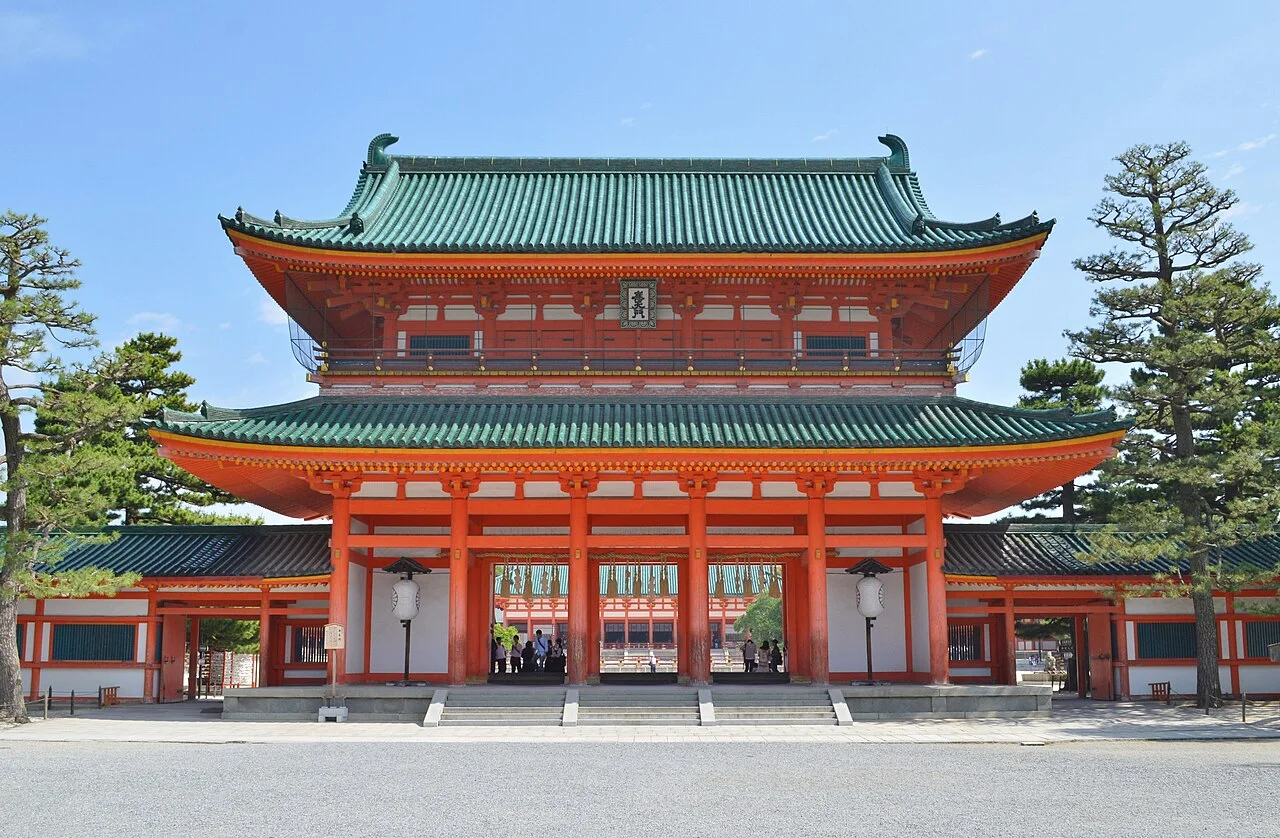
The Great Torii spans Jingu-michi in Okazaki. Walking north from the museum quarter, you pass beneath this gate and continue up the avenue to reach the vermilion shrine entrance bearing the Otenmon Gate plaque. Entering to see the Daigokuden Hall and pay respects at the outer worship hall is free. The Shinen Gardens wrap around the shrine buildings, with the ticket kiosk beside the Byakko-ro pavilion to the left of the Daigokuden. The drooping blossoms overhanging pathways and the roofed Taiheikaku bridge seen in spring photographs are inside the paid garden circuit. If anyone in your group prefers only to visit the main courtyard, split up before buying tickets and meet back just inside the Otenmon Gate.
Standard Shinen Garden admission is ¥600 for adults and ¥300 for junior high school pupils and younger; pre-school children enter free. For two adults and one primary-school child, garden tickets come to ¥1,500. Holders of a disability certificate and one accompanying carer are eligible for half-price tickets under shrine rules. The shrine typically opens the gardens free of charge on two days a year: one day in early June and 19 September, with the exact June date announced annually. Tripods and monopods are prohibited on free admission days, so photographers should pick a regular day instead.
General shrine grounds open daily at 06:00, while the Shinen Gardens open at 08:30. Last entry to the gardens is 17:30 from March to September, typically 17:00 in October, and 16:30 from November to February, closing 30 minutes after last entry. In November, visiting an exhibition first and arriving at the ticket kiosk at 17:00 leaves time only for a stroll back around the Great Torii. In winter, if you plan to walk from the South Garden all the way to the Taiheikaku bridge, aim to enter around 15:30 rather than cutting it close to 16:30. On cherry-blossom weekends, allow extra time for the ticket queue.
Early risers can save the morning light for the Great Torii and main courtyard, though arriving at 07:00 specifically for the gardens leaves more than an hour to wait. Walking north from Higashiyama Station, detour briefly along the canal to look at the water from the bridges and admire the museum exteriors before crossing under the torii towards the gardens. Goshuin shrine stamps carry a standard offering of ¥500, with pre-written sheets available. For formal prayers, visit the prayer reception desk between 09:00 and 16:00; ceremonies take around 20 minutes and can be requested on the day.
| Period | Shrine Grounds | Shinen Gardens | Last Garden Entry |
|---|---|---|---|
| 1 March–30 September | 06:00–18:00 | 08:30–18:00 | 17:30 |
| 1–31 October | 06:00–17:30 | 08:30–17:30 | 17:00 |
| 1 November–End of February | 06:00–17:00 | 08:30–17:00 | 16:30 |
Walk from Higashiyama Station in Kyoto to Heian-jingu Shrine to see the Otenmon Gate and Daigokuden Hall before deciding on a garden ticket. Covers ¥600 adult admission, the four-garden walking route, April red weeping cherries, Jidai Matsuri viewing spots and a half-day Okazaki plan.
Walking Jingu-michi from Higashiyama Station: Keihan vs City Bus
Staying near Kyoto Station and heading to a timed exhibition afterwards, take the Karasuma Line to Karasuma Oike and change to the Tozai Line towards Rokujizo or Biwako-Hamaotsu, getting off at Higashiyama Station. Leave via Exit 1 on the north side of Sanjo-dori, head east to Jingu-michi and turn left going north. You will cross Keiryu-bashi bridge over the canal before passing beneath the Great Torii. Follow the same road to its northern end until you reach the stone steps of the Otenmon Gate. Entering "Heian Jingu Otenmon" in your map app makes it easier to keep walking after dropping off near the Great Torii and gives companions a clear meeting point.
Street-level lift access at Higashiyama Station is at Exit 2 on the south side of Sanjo-dori. With a pushchair or wheelchair, cross at the pedestrian crossing to the north side before joining Jingu-michi. The shrine's website notes that pushchairs and wheelchairs can be used in the grounds, though there are changes in level and steps. Before entering the Shinen Gardens, tell the ticket kiosk staff about any mobility requirements so they can advise which sections are accessible that day and how to reach the exit. Inside the gardens, the Garyu-kyo bridge is a line of stepping stones across the pond; if part of your group wants to try crossing them, others can follow the lakeside path and rejoin on the far side.
For a direct ride from Kyoto Station, take Kyoto City Bus 5 from bay A1 in front of the station towards Ginkakuji and Iwakura, getting off at "Okazaki Koen Bijutsukan / Heian Jingu-mae" and walking north for around five minutes. Despite having Heian-jingu in the stop name, it sits at the museum end of the avenue. Returning to Kyoto Station, look for Bus 5 bound for Shijo Kawaramachi, Shijo Karasuma and Kyoto Station—avoid boarding the opposite direction back towards Ginkakuji. If you only need to reach Sanjo or Karasuma Oike on the return leg, walking back to Higashiyama Station for the Tozai Line is straightforward. During Jidai Matsuri and peak cherry-blossom weekends, the underground makes arrival times much easier to predict.
From Kyoto Kawaramachi, the Kyoto City Kyocera Museum access guide also lists City Buses 5 and 46 directly to the same stop, departing from bays H and E respectively. On weekends and public holidays from 31 October to 29 November 2026, between 15:00 and past 19:00, Kyoto Station-bound Bus 5 diverts around the Eikan-do area, bypassing "Nanzenji / Eikando-michi" and "Okazaki Hosshoji-cho" while still stopping at "Okazaki Koen Dobutsuen-mae" (in front of the zoo). Visitors walking on to Nanzen-ji after the shrine during this period can board at the zoo stop or continue to Keage Station for the underground.
Arriving via the Keihan Line, the shrine estimates roughly a 15-minute walk from either Sanjo Station or Jingu-Marutamachi Station. To see the Great Torii and the full sweep of Jingu-michi head-on, walk east along Sanjo-dori from Sanjo Station and turn north up Jingu-michi. Coming from Jingu-Marutamachi brings you to the shrine end first, letting you pay respects before heading south past the Great Torii and the museums. Guests staying near the Kamo River can use one station on the way in and the other on the way back, linking an Okazaki stroll directly to dinner without backtracking.
Walking in from Nanzen-ji or Keage, follow the canal westward into Okazaki. If two travellers want to see blossoms while another prefers to stay indoors, meet at the museum entrance beside the Great Torii before deciding whether to walk up to the shrine together. Drivers will need separate parking: Heian-jingu has no dedicated car park, and its official site lists neighbouring paid options such as the municipal Okazaki Park Car Park and the Miyako Messe (Kyoto International Exhibition Hall) car park, both requiring a walk to the Otenmon Gate.
Beyond Otenmon Gate: the Chodo-in layout and Daigokuden Hall
Standing roughly 24.4 metres tall, the Great Torii was built in 1929 by the Heian Kosha association, more than three decades after the Otenmon Gate and Daigokuden Hall. To frame both pillar bases and the crossbeam together, step back to the pedestrian area slightly south of the gate or look north from the bridge; motor traffic runs directly underneath. Walking to the Otenmon Gate and glancing back shows just how much open space sits between the torii, Okazaki Park and the shrine entrance. At dusk, leaving through the gate returns you down the same avenue towards the museums or Higashiyama Station.
Founded in 1895 to mark the 1,100th anniversary of the capital's move to Heian-kyo alongside the Fourth National Industrial Exhibition, the shrine originally enshrined Emperor Kanmu, who established the capital, and added Emperor Komei in 1940. The Otenmon Gate recreates the southern main entrance of the ancient Chodo-in imperial state hall complex. Straight ahead to the north stands the Daigokuden, modelled on the Chodo-in's main hall where enthronements and New Year audiences were once held; here it serves as the outer worship hall. According to the shrine, this Meiji-era reconstruction was built at roughly five-eighths the scale of the original palace complex. Stepping back a few paces inside the gate lets you take in the flanking towers and main hall together, making the symmetrical layout far easier to read than looking straight up from the base of the steps.
Facing the Daigokuden, the pavilion on the right is the Soryu-ro (Azure Dragon Tower) and the one on the left is the Byakko-ro (White Tiger Tower). The low terrace ahead of the two towers that divides the white-gravel courtyard into front and rear levels is the Ryubi-dan. Watch the side stone steps and corridors to spot where the forecourt shifts height. Shrine records note that architects Kiyoyoshi Kigo and Chuta Ito consulted Uramatsu Kozen's illustrated treatise *Daidairi-zu Kosho*. Architecture enthusiasts should inspect the lanterns hanging along the covered corridors, whose lattice windows bear motifs of the Azure Dragon, Vermilion Bird, White Tiger and Black Tortoise. A shrine notice dated 6 November 2026 states that seismic retrofitting and repainting work on the shrine buildings remains ongoing, so follow any detour signs across the courtyard.
After purifying your hands at the chozuya water pavilion just outside the west side of the Otenmon Gate, enter from the main approach and walk up to the Daigokuden to pay respects. Shrine etiquette here follows two bows, two claps, a silent prayer and one final bow. Photographs of the courtyard buildings are permitted when facing towards the outer worship hall or entrance gate, though the shrine prohibits photography from the Daigokuden looking back towards the inner sanctuary. Eating and drinking are generally forbidden inside the precincts; if you set out early with breakfast or children's snacks, finish them at a rest spot before entering the worship area. Both the Daigokuden and Otenmon Gate host amulet counters, so you can pick up charms at whichever fits your route.
Just across Jingu-michi lies a chapter of Kyoto history that feels even more immediate than the imperial reconstruction. The first Lake Biwa Canal began flowing in 1890, and Keiryu-bashi bridge opened in 1895 as the entrance to the National Industrial Exhibition grounds in the very year the Otenmon Gate and Daigokuden were completed. After the exposition closed, a zoo, library and cultural venues grew up around the site. For over a century, the canal you cross beneath the torii and the ancient palace layout behind the vermilion gate have sat side by side. The Shinen Garden ponds are fed by Lake Biwa Canal water too, and small channels inside the garden still trace its path.
On the west side of the Otenmon Gate, a restored Kyoto Electric Railway tramcar sits on public view. The shrine moved it out of the South Garden into the free-entry zone beneath a new shelter, open daily from 08:00 to 16:00. Opened in 1895, the Kyoto Electric Railway ran on hydroelectric power generated by the Lake Biwa Canal. Older garden maps may still show the tram inside the South Garden, so head back outside the Otenmon Gate to see the actual carriage. It makes a worthwhile 10-minute stop for children who love trains or anyone waiting outside the gardens before walking back down Jingu-michi to Keiryu-bashi.
Exploring the four Shinen Gardens from the South Garden to Taiheikaku
Facing the Daigokuden, turn left to buy tickets at the entrance beside the Byakko-ro pavilion. Covering roughly 33,000 square metres, the Shinen Gardens were laid out by Meiji-era master gardener Jihei Ogawa VII and his contemporaries. The one-way circuit leads from the South Garden through the West and Middle Gardens to the East Garden, returning you to the main courtyard on the opposite side. Set aside 45–60 minutes for the gardens on a first visit. In spring, look up for blossoms in the South Garden, then leave an extra 15 minutes around the ponds later on to catch changing light and reflections across the stone bridges rather than spending all your time near the entrance.
Entering the South Garden along a winding footpath, double-petalled red weeping cherry trees arch overhead in spring. The adjacent "Heian-no-sono" grove gathers more than 200 plant species mentioned in classical works such as *The Tale of Genji*, *The Tales of Ise* and *The Pillow Book*, accompanied by explanatory plaques. When the branches are heavy with bloom, look back towards the entrance from the first bend to see how the canopy roofs over the path. Even outside peak blossom, slow down to spot the labelled flora and the narrow water channels threading beneath the trees. Whereas the Daigokuden courtyard calls for distance to appreciate its proportions, this section rewards looking closely.
The West Garden centres on Byakko-ike (White Tiger Pond), known for its Japanese irises and small waterfall. Early June is the shrine's highlighted season for irises, viewed from a zigzag wooden Yatsuhashi boardwalk skimming the water. Walking on towards the Middle Garden, watch the stone edging along the stream: some boulders sit mostly submerged while others break the surface, curving with the path to show how the gardeners brought running water right up to the walkway. Choshin-tei, the teahouse in the West Garden, is closed on ordinary days; it opens for scheduled spring cherry-viewing tea gatherings, so daytime visitors simply continue around the pond.
Emerging through the woodland, the view opens across Soryu-ike (Azure Dragon Pond) in the Middle Garden. Stepping stones form the Garyu-kyo bridge out to Sango-jima island; shrine records note that the stones incorporate old bridge piers salvaged from Toyotomi Hideyoshi's original Sanjo and Gojo bridges. You can frame the whole line of stones and water from the shore—in fact, companions who stay on the garden path often get the cleanest shot of the full row. When the stones are slick or crowded, follow the lakeside walkway onwards towards the East Garden; the stepping stones are purely an optional close-to-the-water detour.
Seiho-ike pond in the East Garden is the place to slow your pace. Spanning the water, the roofed Taiheikaku (also called the Bridge Pavilion) lets you lean by the railing and gaze towards the far trees, pond islets and Shobi-kan hall. To experience the "borrowed scenery" (*shakkei*) mentioned on the shrine's website, shift a few steps along the shore to line up Mount Kacho rising behind the garden so distant hills and foreground pines overlap. Shobi-kan itself was relocated here from the Kyoto exposition grounds to serve as a VIP guest hall. The regular exit emerges near the Kagura-den hall and shrine office on the east side of the courtyard; if meeting companions who waited outside, arrange to reunite inside the main Otenmon Gate rather than walking back to the Byakko-ro kiosk.
Throughout the gardens, expect gravel, damp stonework and narrow bends. To capture people alongside hanging blossoms, ask companions to pause where the path widens and frame the canopy from slightly ahead or behind rather than blocking a tight bottleneck. On regular days, tripods and monopods require a usage fee paid at the entrance, and they are banned altogether during the late-March to mid-April cherry season as well as on free admission days. Keep strictly to the pathways and never step behind fences or into planted beds.
From cherry blossoms to autumn foliage: choosing your season
If you are travelling specifically for the red weeping cherries (*yae-beni-shidarezakura*), check the Kyoto City Tourism Association's *Sakura-dayori* blossom page for Heian-jingu first. The city lists typical peak bloom from early to mid-April, while the shrine's seasonal calendar puts the South Garden cherries from late March to early April. The South Garden delivers low-hanging canopies over tight paths, whereas the East Garden pairs lakeside blossoms with the Taiheikaku bridge and Seiho-ike pond. Plan Okazaki for early to mid-April if you can, checking local updates before moving on to other districts the next day; canal-side trees and the sheltered garden varieties do not always peak in sync.
These red weeping cherries are also known as "Endo-zakura". Shrine records relate that the saplings were donated when Heian-jingu was founded by Yoji Endo, the first mayor of Sendai, with lineage traced back to the Konoe family's cherry trees in Kyoto. Seeing both the garden's weeping boughs and the canal-side avenues on the same day offers two distinct settings: walk deeper into the South Garden for overhead tunnels of petals, then wait until the pond opens up for wide reflections of water, shoreline and full trees. If you have already booked a Jikkokubune canal boat during blossom season, take the cruise first and queue for the gardens afterwards; if only afternoon sailings remain, tour the gardens in the morning and walk along the canal to the Nanzen-ji boat landing in time for boarding.
In May, head straight for Soryu-ike pond in the Middle Garden to see the rabbit-ear irises (*kakitsubata*), followed in early June by the Japanese irises (*hanashobu*) at Byakko-ike in the West Garden—the two species bloom in distinct windows. Water lilies have a much longer display, listed by the shrine from mid-May to early September across the Middle and West Gardens. In midsummer, entering the gardens at 08:30 and moving into the museums when they open at 10:00 is far more comfortable than crossing the glare of the white-gravel courtyard at midday. If your schedule forces an afternoon visit, pick two or three focal spots such as the iris ponds and covered bridge and breeze through the rest.
For autumn foliage, target mid- to late November, when the shrine highlights the Middle Garden for leaf-viewing. On bright days, look for backlit leaves and reflections across Soryu-ike; in overcast weather, notice how deep reds and chartreuse tones pop against the water before continuing to the East Garden bridge and shoreline. With several Kyoto gardens competing for morning hours, Heian-jingu rewards anyone who wants broad water reflections alongside autumn colour. When travelling with older relatives in November, visit the gardens before sitting down for coffee rather than lingering over a long lunch and racing the 16:30 ticket cut-off. In winter, concentrate on the open expanse of Seiho-ike and the Taiheikaku bridge—snow requires lucky timing, and wooden bridges and stone paths turn slippery when it settles.
From 2 to 29 November 2026, a separate ticketed evening event, "WONDER NIGHT JINGU - Gekka", runs from 17:30 to 21:30 with last admission at 21:00. To combine daytime autumn leaves with night illuminations, tour the Shinen Gardens before the 17:00 daytime closing, break for dinner, and return with an evening ticket. Alternatively, spend the afternoon at an Okazaki museum before walking through the Great Torii at dusk. For spring night-blossom openings or tea ceremonies, check seasonal event notices separately, as daytime garden tickets and special event admissions work differently.
Jidai Matsuri: watching at the start, city centre or Jingu-michi
Held annually on 22 October, Jidai Matsuri moves to 23 October in the event of rain or severe weather, and is cancelled if poor weather persists on the reserve day. The 2026 procession took place on 22 October. On the Kyoto City Tourism Association's 2026 timetable, the head of the parade left the Kenreimon Gate of Kyoto Imperial Palace at 12:00, reached Karasuma Oike at 12:50 and arrived at Heian-jingu around 14:30. Paid grandstand seats along Jingu-michi see the vanguard slightly before it reaches the shrine gate. Watching from the first group to the last takes around two hours, so treat it as a full afternoon when booking meals or timed museum slots.
Kyoto Gyoen (Imperial Palace Park) suits spectators who want to see the retinues assemble and start watching at midday. Afterwards you can head north towards Marutamachi or Imadegawa without crossing the city centre. Oike-dori is convenient if you are staying near Karasuma Oike or Kyoto Shiyakusho-mae, offering easy underground access and a simple exit if you only want to watch part of the parade. To see the procession pass beneath the Great Torii towards the Otenmon Gate, claim a spot on one side of Jingu-michi in Okazaki. If you have reserved grandstand seats, check which side your section entrance is on before deciding whether to approach from the museums or Okazaki Park; the tourism association asks ticket holders to be seated 30 minutes before the parade arrives.
You will hear the fifes and drums of the Restoration Loyalists Corps (*Ishin Kinno-tai*) first. Behind them march 20 processions spanning eight historical periods, travelling backwards in time from the Meiji Restoration through the Edo, Azuchi-Momoyama, Muromachi, Yoshino, Kamakura and Fujiwara eras to the Enryaku era. Short on time? Pick the historical figures or costumes you care about most and check the official procession order to time your arrival. With children, pick two things to spot ahead of time—mounted samurai commanders or the two sacred palanquins (*Gohoren*), for instance. Roughly 2,000 participants stretch over two kilometres, so each group takes a while to pass a single point; leaving after the first unit means seeing only the Meiji opening.
The festival is directly tied to the two emperors enshrined at Heian-jingu. The *Shinkoretsu* sacred procession escorts two Gohoren palanquins carrying the spirits of Emperor Kanmu and Emperor Komei back to the shrine alongside the historical costume parade. On the shrine's standard schedule, the Daigokuden-sai and Kanko-sai ceremonies begin at 16:00 once every unit has arrived. Seeing the vanguard reach Jingu-michi around 14:30 simply signals the start; stay put along the avenue for the remaining eras. Anyone wishing to pay respects inside the courtyard on festival day should come in the morning: in 2026, the grounds opened from 06:00 to noon, pausing worship between 08:00 and 09:30 for the palanquin departure. Shinen Garden hours were adjusted to 09:30–12:00 (last entry 11:30) with an altered exit, and general courtyard access closed in the afternoon for the festival.
If one person wants to visit the gardens while another only wants the parade, meet outside the Daigokuden in the morning, split up for lunch and regroup on the same side of the viewing route. Road crossings close shortly before the vanguard arrives, making "under the Great Torii" too vague as a meeting point—specify either the Kyocera Museum side or the National Museum of Modern Art side so you actually find each other. Trying to chase the parade across two different locations eats up time in road detours and transfers; one well-chosen spot gives a more complete sequence. Pack a waterproof coat rather than an umbrella, as umbrellas are prohibited in grandstand seating if rain sets in.
Watching the full order lets you single out retinues less familiar from everyday imagery—such as the *Shirakawame* flower sellers balancing blossoms atop their heads as they once did in Kyoto, or the rotating women's processions staged by local women's associations and geiko districts depicting notable women across the centuries. For pre-Meiji samurai and court attire, find an unobstructed kerbside spot and watch a single unit pass from front to back, noticing headgear, swords and the attendants flanking each figure. You can also frame a torii pillar or street trees at the edge of your shot—stay firmly behind the spectator line and never lean cameras out into the parade lane.
On a half-day schedule: pairing museums or the canal
With only two hours from Higashiyama Station, walk across Keiryu-bashi, under the Great Torii and through the Otenmon Gate, pay respects and tour the Shinen Gardens before retracing Jingu-michi back to the station, pausing briefly on the bridge for a final look at the canal. Garden enthusiasts can give 45–60 minutes to the four gardens and keep stops at the two gates brief. If Okazaki is simply a stopover en route to Nanzen-ji, treat the shrine itself as a 30–45 minute visit up to the Daigokuden before returning south to Keiryu-bashi and joining the canal path.
On a half-day itinerary with time for art, walk back towards the Great Torii where the Kyoto City Kyocera Museum of Art and the National Museum of Modern Art, Kyoto (MoMAK) face each other across Jingu-michi. The Kyocera Museum suits visitors drawn to its historic main building and a chosen exhibition; general hours are 10:00–18:00, though last admission varies by exhibition. MoMAK typically opens 10:00–18:00 (last entry 17:30), with Friday evening openings during special exhibitions. Both museums normally close on Mondays, though they handle public holidays differently: the Kyocera Museum stays open on Japanese public holidays, whereas MoMAK opens on the holiday and closes the following weekday instead. Check the calendar for your exact travel dates so one museum and the Shinen Gardens fit smoothly into half a day.
From 18 January to late March 2027, the National Museum of Modern Art, Kyoto is closed for facility maintenance. If rain falls during that window, check the Kyocera Museum's exhibitions and entry slots first, or walk to the Kyoto Museum of Crafts and Design (Fureaikan) in the basement of Miyako Messe on the west side of Okazaki Park. Visitors using a wheelchair who want to minimise outdoor walking can start at the Kyocera Museum, which offers lift access throughout the galleries and loan wheelchairs at the B1 cloakroom or 1st-floor information desk. During a break in light rain, walk across to the Otenmon Gate and Daigokuden courtyard; if entering the Shinen Gardens, skip the stepping stones and focus on the lakeside paths and Taiheikaku bridge for predictable timing.
Preferring fresh air, head south from the Otenmon Gate to Keiryu-bashi and follow the water east towards Keage. The path skirts the outer edge of Kyoto City Zoo before reaching the Nanzen-ji boat landing and the Lake Biwa Canal Museum. Scheduling Heian-jingu earlier in the day preserves daylight for the garden ponds during short November afternoons, leaving the canal path for a relaxed stroll afterwards. For a full day adding a Jikkokubune boat ride or the zoo with children, follow the Okazaki Canal and museums full-day itinerary.
If you only want one paid ticket in Okazaki over half a day, decide what matters most to your afternoon. When spring blossoms are out, the Shinen Garden ticket buys a continuous walk from floral pathways to the covered bridge over the pond. In the rainy season—or if a specific exhibition brought you to Kyoto—spend your budget on a museum ticket, stick to the free shrine courtyard, and take a look at the canal from Keiryu-bashi on the way back. When combining both with a timed museum entry, place the gardens where you have the wider time cushion so you are not rushing from the entrance around to the East Garden exit.
For garden lovers: linking Seiho-ike to Murin-an or Nanzen-ji
To compare two Kyoto gardens in a single morning, pair the Shinen Gardens with Murin-an. Created as statesman Aritomo Yamagata's villa garden, Murin-an also involved Jihei Ogawa VII and draws its water from the Lake Biwa Canal. Yet their atmospheres diverge sharply: at Heian-jingu you loop behind the shrine buildings to reach broad ponds and look across at tree reflections from the Taiheikaku bridge, whereas at Murin-an you walk beside a ground-hugging stream before stepping back to the house to gauge the lawn against the Higashiyama hills. If you only have time for one, choose the Shinen Gardens in spring for the red weeping cherries, or Murin-an if you prefer intimate water channels and classic borrowed scenery.
To visit both, book your timed entry for Murin-an first. Entry is capped by time slot, reservations require advance payment with a 100% cancellation fee, and late arrivals cannot use the same ticket for another slot. With a morning slot at Murin-an, walk over from Keage Station and follow the canal west afterwards, crossing Keiryu-bashi and passing under the Great Torii to Heian-jingu. With an afternoon slot, cover the shrine and Shinen Gardens in the morning before heading east after lunch. During busy spring queues at the Shinen Gardens, stop for lunch along the route towards Keage rather than doubling back to Higashiyama Station.
To see how the canal threads through the neighbourhood, walk along the water from Keiryu-bashi to the Nanzen-ji boat landing and drop into the Lake Biwa Canal Museum. Entry is free; standard hours are 09:00–17:00 (last entry 16:30), closed Mondays or the next weekday when Monday is a Japanese public holiday. Inside, a working model of the Keage Incline shows how boats rode wheeled cradles up and down the steep grade. With just over an hour left in the day, inspect the model and walk roughly seven minutes from the museum to Keage Station for the underground. Leaving the Shinen Gardens near dusk, simply treat the canal walk as an open-air stroll.
If anyone in your group wants to see the red-brick aqueduct, add a stop at Nanzen-ji between the museum and Keage Station. The Suirokaku aqueduct carries a branch canal diverted from Keage, whereas the Nanzen-ji boat landing sits on the main canal flowing through Okazaki towards the Kamo River. Looking up through the brick arches at Suirokaku offers a completely different experience from gazing across the Okazaki water from Keiryu-bashi. To combine just one water landmark cleanly with your underground stop, plan your approach around Suirokaku and Keage using the Nanzen-ji Temple visiting guide.
A few useful answers
Do I need a ticket to walk from the Great Torii to Heian-jingu Shrine just to pay respects?
No. Walking under the Great Torii, through the Otenmon Gate and up to the Daigokuden outer worship hall is free. You only need to buy a Shinen Garden ticket beside the Byakko-ro pavilion if you want to visit Soryu-ike, Seiho-ike and the Taiheikaku bridge.
Which exit at Higashiyama Station should I use with a pushchair for Heian-jingu?
Take the Exit 2 lift to the south side of Sanjo-dori, then cross at the pedestrian crossing to reach Jingu-michi. The shrine grounds have changes in level, gravel and steps, and inside the gardens you can bypass the Garyu-kyo stepping stones via the lakeside path.
How late in the afternoon can I still enter the Heian-jingu Shinen Gardens?
Regular last entry is 17:30 from March to September, 17:00 in October and 16:30 from November to February, with the gardens closing 30 minutes later. To walk comfortably all the way to the Taiheikaku bridge, arrive at the ticket kiosk roughly an hour before last entry.
When do the red weeping cherry trees at Heian-jingu normally bloom?
The Kyoto City Tourism Association lists typical peak bloom from early to mid-April. To coordinate with the Okazaki Canal blossoms, search the official Sakura-dayori blossom updates, which maintain separate status pages for Heian-jingu Shrine and the Okazaki Canal.
Should I take the bus or the underground from Kyoto Station to Heian-jingu?
Kyoto City Bus 5 from bay A1 in front of Kyoto Station runs directly to Okazaki Koen Bijutsukan / Heian Jingu-mae. If you are catching a timed exhibition or travelling during a major festival, take the Karasuma Line to Karasuma Oike and change to the Tozai Line for Higashiyama Station, a 10-minute walk from Exit 1.
If I reach Heian-jingu in the afternoon on Jidai Matsuri day, can I still visit the Shinen Gardens?
On Jidai Matsuri day, the Shinen Gardens typically open only from 09:30 to 12:00, with last entry at 11:30. To watch the afternoon procession along Jingu-michi, visit the gardens in the morning and then take your place on your chosen side of the avenue.
Official information and references
Sources used in this guide.
- Heian-jingu Shrine Precinct Guide, Shrine Buildings and Shinen Garden Entrance Map
- Heian-jingu Shrine Shinen Garden Fares, Seasonal Hours, Grounds and Photography Rules
- Heian-jingu Shrine Worship Hours and Etiquette
- Heian-jingu Shrine History, Enshrined Deities, Founding and Garden Water Source
- Heian-jingu Shrine Seasonal Blossom Calendar and Autumn Foliage
- Heian-jingu Shrine Public Transport, Parking and Area Map
- Heian-jingu Shrine Visitor FAQ, Goshuin, Steps and Photography Rules
- Heian-jingu Shrine Jidai Matsuri History, Procession Order and Ceremony Schedule
- Heian-jingu Shrine 2026 Jidai Matsuri Gate and Shinen Garden Hour Changes
- Heian-jingu Shrine November 2026 Precinct Construction Notice
- Kyoto City Tourism Association 2026 Jidai Matsuri Procession and Grandstand Seating Notice
- Kyoto City Tourism Association Jidai Matsuri Wet-Weather and Grandstand Rules
- Kyoto City Tourism Association Heian-jingu Shrine Cherry Blossom Report
- Kyoto City 2026 Gekka Evening Event Dates and Hours
- Kyoto Prefecture Tourism Federation Great Torii Height and Heian-jingu Worship Information
- Kyoto Municipal Transportation Bureau Higashiyama Station Exits and Lift Access
- Kyoto Municipal Transportation Bureau Okazaki Koen Bijutsukan / Heian Jingu-mae Bus Timetables
- Kyoto City Okazaki and Philosopher's Path Area Guide
- Kyoto City Okazaki Modernisation and National Exhibition Heritage
- Kyoto City Kyocera Museum of Art Hours and Visitor Information
- National Museum of Modern Art, Kyoto Opening Hours
- National Museum of Modern Art, Kyoto January–March 2027 Maintenance Closure Notice
- Kyoto Museum of Crafts and Design Address and Floor Guide
- Heian-jingu Shrine Kyoto Electric Railway Tramcar Restoration and Public Viewing Hours
- Heian-jingu Shrine 130th Anniversary Tramcar Relocation and Cultural Property Restoration Project
- Kyoto City Kyocera Museum of Art Bus Bays for Kyoto Station and Kyoto Kawaramachi
- Kyoto Municipal Transportation Bureau Autumn 2026 Bus Detour Notice
- Murin-an Admission Reservations, Cancellation Policy and Access
- Lake Biwa Canal Museum Admission, Opening Hours and Walking Times from Stations
- Lake Biwa Canal Museum Okazaki and Keage Walking Map
- Lake Biwa Canal Museum Galleries and Keage Incline Model
- Heian-jingu Shrine Prayer Reception Hours, Duration and Application Guide