When do Kyoto's ginkgo trees turn yellow? Follow a half-day route from Kyoto Station to Nishi Hongan-ji's upside-down ginkgo, Higashi Hongan-ji's avenue, and Kyoto Gyoen by underground, with 2026 foliage notes, north/south park entrances, and a Nishijin walk via Horikawa-dōri and Ekō-ji.
- Region & Focus
- KyotoAutumn leaves
- Reading Scope
- 24 min read · 14 chapters · 5 Q&As
- Official Verification
- 30 official sources checkedUpdated 22 November 2026
- Key Topics
- SeasonsItinerariesKyoto, Osaka & Kansai
Chapter Route Map (tap any stop)
- Are there still leaves in late November — and which tree are you tracking?
- Nishi Hongan-ji's upside-down ginkgo in front of Goei-dō Hall
- Higashi Hongan-ji's avenue by the lotus fountain outside the gate
- With an extra hour north of Kyoto Station, walk across to Shōsei-en Garden
- Entering southern Kyoto Gyoen from Marutamachi: start north of Kan'innomiya-tei
- Northern Kyoto Gyoen from Imadegawa Station: aim for Ichijō-tei
- Two shrines across Karasuma-dōri on the west side of the park
- A Nishijin walk from the Horikawa avenue to Ekō-ji Temple
- Only half a day? The two-temple walk from Kyoto Station is enough
- With a full day, link north of Kyoto Station and Kyoto Gyoen on the Karasuma line
- Want Japanese maples on the same day? Switch trees inside Kyoto Gyoen
- Evening back near Kyoto Station: add Tō-ji's five-storey pagoda illumination
- Travelling with a pushchair or at a gentle pace: pick stations with lifts first
- Where to stand for canopies, avenues, and fallen leaves
- Quick Q&A
Starting from Kyoto Station, half a day is enough to take in two very different ginkgo scenes. Begin at Nishi Hongan-ji to see the low, wide-spreading giant tree in front of Goei-dō Hall, then walk east to Higashi Hongan-ji for the line of ginkgoes flanking the lotus fountain outside its gate. In the afternoon, ride the Karasuma underground line to Kyoto Gyoen National Garden and choose your entrance according to foliage updates around Ichijō-tei, Gyōkadō-ato, and the north side of Kan'innomiya-tei. On 17 November 2026, the National Gardens Association had already marked four ginkgo sites inside Kyoto Gyoen at peak colour. If you are fitting city yellow foliage into a late-November or early-December itinerary, decide first whether you want full canopies or golden carpets on the ground, then order your stops using site-by-site updates.
Are there still leaves in late November — and which tree are you tracking?
When you are still booking accommodation, slot ginkgo viewing into a city-centre day between mid-November and early December, keeping one half-day window flexible enough to swap with another plan. Kyoto City's official foliage guide lists Kyoto Gyoen's typical viewing season from mid-November to early December, a span that covers several different tree species across the park. Once your travel dates are fixed, narrow your checks down to the specific temple courtyard or avenue you want to see — whether that is the upside-down ginkgo before Goei-dō Hall or the row of yellow trees outside Higashi Hongan-ji.
The 2026 season offers a clear benchmark. On 13 November, the Ministry of the Environment's Kyoto Gyoen update noted that the large ginkgo at Ichijō-tei had already turned yellow. By 17 November, the National Gardens Association listed the ginkgoes at Ichijō-tei, Gyōkadō-ato, Nakayama-tei, and just outside the north gate of Kan'innomiya-tei as all being at peak colour. On that same day, the Japanese maples at Takatsukasa-tei and Shūsui-tei had also reached peak, while those on the west side of Sentō Imperial Palace were close behind. Red and yellow foliage overlapped as early as mid-November, so anyone visiting in early December should check later Association updates and dated photographs before setting off.
In Japanese foliage bulletins, look specifically for "ichō" (ginkgo) or "kōyō" (yellow autumn leaves), as general "momiji-dayori" reports often lump maples and ginkgoes together. Updates marked "irozuki-hajime" (beginning to colour) are worth clicking into for photos: one side of a canopy can turn bright yellow while the far side remains green. "Migoro" indicates peak colour, whereas "rakuyō-hajime" (leaves beginning to fall) is your cue to look lower in recent pictures to see how much remains on the branches and whether a yellow layer has formed along the paths. When an overview table shows the same status badge for everywhere at once, rely on dated on-the-ground posts that name the exact tree.
Check the framing of fallen-leaf photos carefully too. At Nishi Hongan-ji, a low stone balustrade surrounds the tree, so fallen leaves often gather inside that enclosure. Outside Higashi Hongan-ji, the paved square carries steady foot traffic, and wind regularly sweeps leaves to the edges of the walkways. Meanwhile, along the same path in Kyoto Gyoen, one tree may drop early while its neighbour holds its leaves. If wind and rain hit overnight, start the next morning at whichever spot is closest to your hotel and decide in daylight whether to take the underground to the next stop.
| What you want to see | Where to go | Where to start looking |
|---|---|---|
| Ancient low branches reaching across a temple courtyard | Nishi Hongan-ji | Goei-dō Gate on the Horikawa-dōri side, heading onto the courtyard before Goei-dō Hall |
| A full avenue of ginkgoes framing a temple gate | Higashi Hongan-ji | The lotus fountain and square on the Karasuma-dōri side |
| Yellow ginkgo canopies alongside red maples | Southern Kyoto Gyoen | Marutamachi underground station, entering via Ainomachi-guchi towards the north side of Kan'innomiya-tei |
| Two heritage ginkgo groves along the north park paths | Northern Kyoto Gyoen | Imadegawa underground station, heading towards Ichijō-tei and Nakayama-tei |
| A central-reservation avenue of street ginkgoes | Horikawa-dōri | Horikawa-Imadegawa junction, looking north towards Shimei-dōri |
| A towering golden crown rising above temple earthen walls | Ekō-ji | Imadegawa-Jōfukuji bus stop, walking south down Jōfukuji-dōri |
When do Kyoto's ginkgo trees turn yellow? Follow a half-day route from Kyoto Station to Nishi Hongan-ji's upside-down ginkgo, Higashi Hongan-ji's avenue, and Kyoto Gyoen by underground, with 2026 foliage notes, north/south park entrances, and a Nishijin walk via Horikawa-dōri and Ekō-ji.
Nishi Hongan-ji's upside-down ginkgo in front of Goei-dō Hall
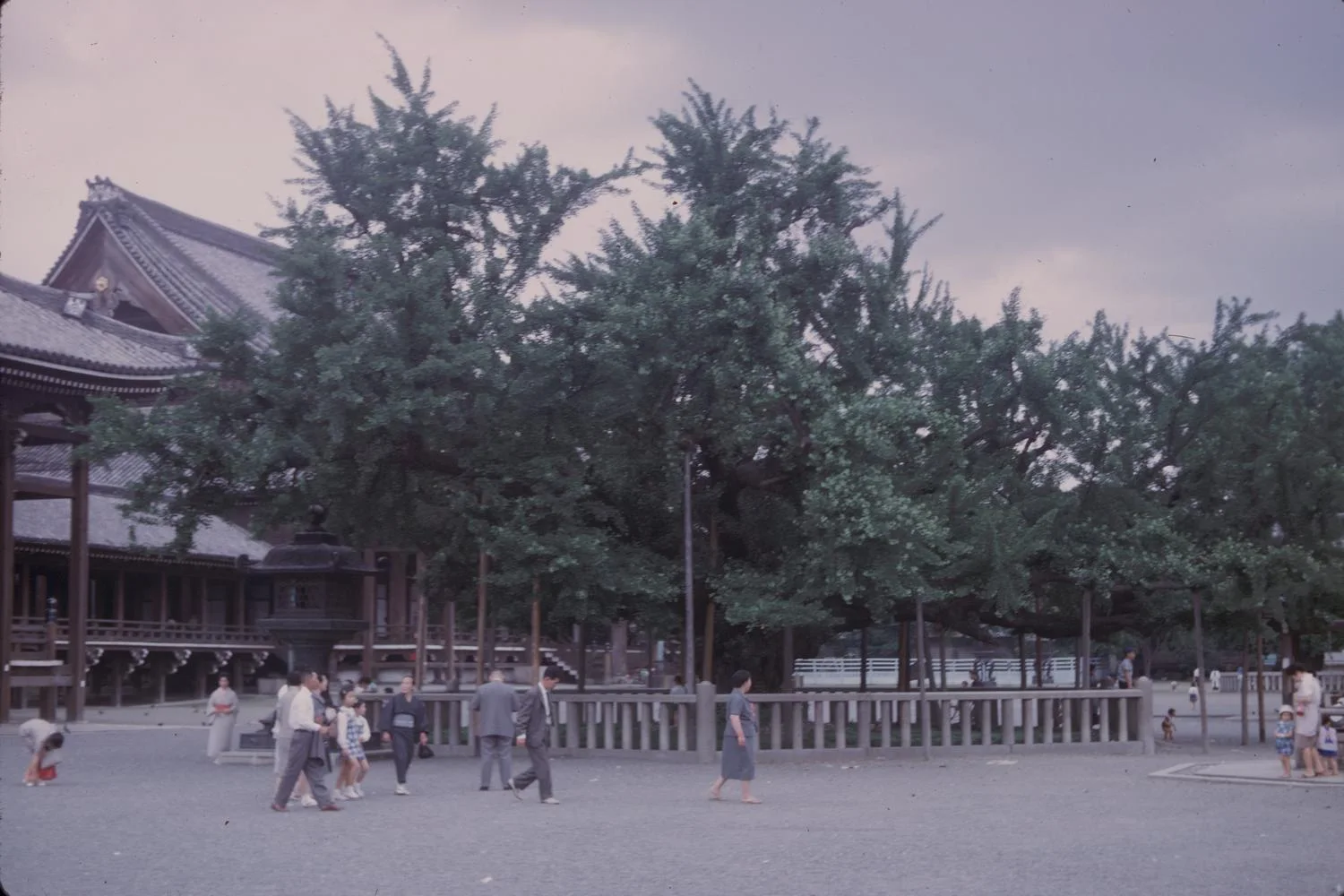
From Kyoto Station, leave by the Karasuma Exit, walk west to Horikawa-dōri, and head north to Nishi Hongan-ji; the temple's access map puts the walk at around 15 minutes. Set your map app to Nishi Hongan-ji Goei-dō Gate and turn in through the large wooden gate facing Horikawa-dōri. Entering here takes you straight to the ginkgo first; if you also want to see the ornate Karamon Gate, loop around the south perimeter afterwards. The open gravel expanse before the main halls is known as the Shirasu, and as soon as you step onto it you will spot the low, horizontally spreading crown.
"Upside-down ginkgo" translates the Japanese nickname Sakasa-ichō. Temple records describe the tree as roughly 400 years old, and Kyoto City designates it a Natural Monument because its thick boughs spread out low to the ground and angle upwards like roots upturned towards the sky. Step a few paces back directly in front of the tree to take in the trunk height against the width of its span, then shift diagonally to either side to see how the heavy limbs overlap in tiers — some skimming the courtyard floor, others lifting behind them. The temple grounds also hold a second large ginkgo near Amida-dō Hall, so when checking foliage photos beforehand, confirm whether you are looking at the designated tree outside Goei-dō Hall or its neighbour.
Nishi Hongan-ji is generally open from 05:30 to 17:00, and standard entry to the courtyard and both main halls is free. Allow about 30 minutes solely for the tree, or longer if you plan to climb the steps onto the wooden verandas of Goei-dō and Amida-dō Halls. On the Shirasu courtyard, the temple operates Ochaso, a combined rest pavilion and visitor information point. If you set out early before breakfast cafés open, it makes sense to visit the courtyard first and eat afterwards back towards Kyoto Station or along Shichijō-dōri. Wide as the Shirasu is, the steps and hall entrances remain busy with worshippers, so step to the side of the square when stopping for photographs.
If your schedule forces a choice between morning and afternoon, check the temple's Shirasu livestream during daylight hours to gauge weather and overall canopy colour. Compare the live feed with recent dated photos you have saved — looking first at whether the outer branch tips still hold dense foliage, then at the ground beneath. When the fixed camera only catches one edge of the crown, a recent close-up photo is far more reliable for judging leaf drop on the near side.
Late autumn also brings major annual services. On 22 and 23 November 2026, Nishi Hongan-ji holds its Zenkoku Monto Sōtsuitō Hōyō memorial service, which alters dharma-talk timings and interior hall circulation. Check the temple's monthly calendar if you want to attend a service; if you are only here for the ginkgoes, keep this visit to a brief stop for the courtyard tree, the gate, and nearby lanes, and save the interior halls for a quieter morning. Walking east towards Hanayamachō-dōri brings you smoothly across the same north-station neighbourhood to Higashi Hongan-ji.
Higashi Hongan-ji's avenue by the lotus fountain outside the gate
At Higashi Hongan-ji, the main autumn spectacle stands outside Goei-dō Gate. Shimogyō Ward includes this line of ginkgoes flanking the lotus fountain among its Eight Scenic Views of Shimogyō. Walking north up Karasuma-dōri from Kyoto Station's Karasuma Exit brings you to the square near Karasuma-Shichijō; coming from Nishi Hongan-ji, walk east towards Karasuma-dōri and aim for Ohigashi-san Square or the Higashi Hongan-ji fountain. Because both Hongan-ji temples have a Goei-dō Hall and Gate, adding "Higashi Hongan-ji" in map searches and specifying the outer square or inner hall when meeting companions prevents confusion on arrival.
The plaza lies between the monumental gate and Karasuma-dōri. From beside the lotus fountain, you can frame the dark timber of Goei-dō Gate behind the yellow leaves in a single shot. Move along the edge of the basin to compress the row of trunks into layered depth. When crowds gather at the central crossing, walk past the main approach and look back from further along the square — the gate remains clearly in view with fewer passers-by crossing your frame. Once the canopies thin out, drop your gaze to the basin rim and paving borders, though municipal sweeping and street breezes clear fallen leaves faster here than under Kyoto Gyoen's trees.
According to Higashi Hongan-ji's late-October 2026 notice, winter hours from November to February run from 06:20 to 16:30. Because the lotus fountain and ginkgo avenue sit outside the enclosure, closing times mainly matter if you intend to enter the halls. Personal photography is permitted within the temple's guidelines, which prohibit flash, entering restricted areas, and photographing active services. For trees and architecture alone, the outer square gives you plenty of breathing room.
From 21 to 28 November 2026, Higashi Hongan-ji observes its annual Hōonkō memorial week, welcoming visitors free of charge with published schedules, seating layouts, and wheelchair access routes. If you plan to attend a morning service, build your timetable around it first and photograph the outer ginkgoes afterwards. When ceremony crowds spill across the plaza, keep your stop outside brief and save unhurried foliage watching for Nishi Hongan-ji or Kyoto Gyoen in the afternoon.
With an extra hour north of Kyoto Station, walk across to Shōsei-en Garden
If you finish both temples early and still want red and yellow autumn colour close to Kyoto Station, cross Karasuma-dōri from Higashi Hongan-ji's Goei-dō Gate and walk east to Shōsei-en. Maintained separately by Higashi Hongan-ji with its own perimeter wall, the garden admits visitors through its West Gate reception. Head first towards the central pond, Ingetsu-chi, then wander the paths according to the day's foliage. The temple's botanical guide lists both ginkgo and maple trees on the grounds; even if the street avenue outside has thinned, Shōsei-en's pond banks, bridges, and overhanging branches offer a calmer composition, leaving big avenues for Kyoto Gyoen or Horikawa-dōri.
From November to February, Shōsei-en opens from 09:00 to 16:00, with last admission at 15:30. Entry requires a garden maintenance contribution of ¥700 or more for adults and ¥300 or more for junior high and high school students; primary-school children and younger enter free. Visitors follow the outdoor circuit around bridges and waterside paths. Handheld photography and video are allowed, while tripods and selfie sticks are prohibited, and only water for hydration may be consumed inside — finish any street snacks before passing the gate.
Shōsei-en slots neatly into a half-day north of Kyoto Station. In the morning, you can see Nishi Hongan-ji and Higashi Hongan-ji's outer avenue, enter Shōsei-en after 09:00, and return to the station for luggage. If your train arrives close to 15:00, walk straight east to beat Shōsei-en's 15:30 cutoff, then double back to Karasuma-dōri for Higashi Hongan-ji's illuminated exterior avenue — bearing in mind Nishi Hongan-ji closes its gates at 17:00 and is better left for the following morning.
Entering southern Kyoto Gyoen from Marutamachi: start north of Kan'innomiya-tei
Board the municipal Karasuma underground line from Kyoto, Gojō, or Shijō Station and alight at Marutamachi for the south half of Kyoto Gyoen. The Ministry of the Environment lists Exit 1 as the nearest exit for Kan'innomiya-tei and Shūsui-tei; if you need the lift, use Exit 5, which adds a short walk above ground. Follow Marutamachi-dōri into the park through Ainomachi-guchi Gate and orient yourself by Kan'innomiya-tei. Note that the foliage report's entry "north of Kan'innomiya-tei north gate" refers to the ginkgo avenue running along the park path just outside the northern wall of the residence grounds; if you wish to see the indoor exhibits, step inside the exhibition hall as well.
From there, walk north towards Kenrei-mon Gate on the south facade of Kyoto Imperial Palace and look along the Ōmiya-koji path for the large ginkgo at Gyōkadō-ato. The site sits inside the park along the public walking trails, mixing tall ginkgoes with neighbouring autumn trees. Where the path opens up, you can frame foliage still clinging to outer boughs together with fallen leaves on the ground. Search specifically for "Gyōkadō-ato" in your phone navigation — entering only "Kyoto Gyoen" usually drops a pin in the middle of a vast park with multiple gates.
For a self-contained loop, follow the Ministry of the Environment's roughly one-hour southern walking course: enter via Ainomachi-guchi, pass Kan'innomiya-tei, Kujō-ike Pond, and Shūsui-tei, continue towards Kenrei-mon and Gyōkadō-ato, then return past the plum and peach groves to the gate. That timing covers outdoor walking only, excluding exhibitions or lingering for light. If you have just 45 to 50 minutes, pick whichever looks stronger that day between the avenue north of Kan'innomiya-tei and Gyōkadō-ato, saving Kujō-ike Pond for your walk back to Marutamachi Station.
Mondays catch many visitors off guard. While Kyoto Gyoen's outdoor paths open free every day, the Kan'innomiya-tei Exhibition Hall closes on Mondays (unless Monday is a national holiday) and over the New Year period; on open days, last entry is 16:00 and closing is 16:30. Shūsui-tei tea pavilion normally opens Thursday to Saturday, closing at 15:30 with admission of ¥300 for high-school age and older. If you are strictly out for ginkgoes, treat both buildings as visual landmarks along your route; if you want tea overlooking Kujō-ike Pond, put that at the start of the afternoon.
Northern Kyoto Gyoen from Imadegawa Station: aim for Ichijō-tei
On the northern side of Kyoto Gyoen, make Ichijō-tei your first stop. Leave the Karasuma line at Imadegawa Station via Exit 3 and walk along Imadegawa-dōri to enter through Imadegawa-gomon Gate. Locate Ichijō-tei on the Ministry of the Environment's autumn foliage map, using Inui-gomon Gate and the Konoe-tei Rest House as nearby landmarks. When the National Gardens Association also reports Nakayama-tei at peak colour, continue slightly east across the northern lawns. Both Nakayama-tei and Gyōkadō-ato end in "-ato" (historic residence site), one north and one south, so pin the exact spot before boarding the train rather than searching at the exit.
If you arrive in the afternoon, a compact northern loop centred on Ichijō-tei is plenty. Take in the canopies along the path towards Konoe-tei first, then decide based on remaining daylight whether to cross towards Nakayama-tei. Families travelling with children can set aside time at the northern Children's Park, while Konoe-tei Rest House and the Nakadachiuri Rest House further west provide toilets and seating. Nakadachiuri also offers dining and free indoor rest space, saving a detour back out to the eastern avenues if you want a meal before leaving the park.
To cover both north and south on foot, enter at Imadegawa, see Ichijō-tei, then walk south past Kenrei-mon Gate, Gyōkadō-ato, and the north side of Kan'innomiya-tei to leave from Marutamachi Station. The reverse order works just as well — particularly if you visit Shūsui-tei in the morning and plan to continue to Horikawa-Imadegawa afterwards. Measuring the distance between Ichijō-tei and Gyōkadō-ato rather than pinning "Kyoto Gyoen" gives a realistic sense of the walk; if time allows only one end of the park, pick the matching underground station and save the other half for another day.
Two shrines across Karasuma-dōri on the west side of the park
If your Kyoto Gyoen walk covers only the southern section, leave through Shimodachiuri-gomon Gate before returning to Marutamachi Station and cross Karasuma-dōri to Sugawarain Tenmangū Shrine. Kamigyō Ward lists the shrine's ginkgo as a valued local landmark tree, with city records noting a height of around 21.5 metres. Once across the street, look at how the old tree rises beside the torii gate — the compact courtyard makes its crown appear even taller. Opening hours run from 06:00 to 17:00, so anyone lingering inside Kan'innomiya-tei until late afternoon should check the clock before crossing the road.
Walk north up Karasuma-dōri from Sugawarain Tenmangū and opposite Hamaguri-gomon Gate stands Goō Shrine. The shrine notes six centuries-old ginkgoes inside its precincts, including a great tree north of the Seihōden Hall listed on Kamigyō Ward's heritage register. Looking up beside the sanctuary buildings, branches stretch across the eaves against the shrine roofs. The guardian wild boar statues at the entrance make an easy meeting point inside the torii gate when photographing with companions. The grounds open from 06:00 to 21:00, though the amulet and goshuin stamp counter closes at 16:30.
For a short western circuit, visit Gyōkadō-ato inside Kyoto Gyoen, exit on the west side to see one of the two shrines, and follow Karasuma-dōri back to Marutamachi. If your plan already pairs northern Kyoto Gyoen with Horikawa-Imadegawa, save both shrines — which lie south of Imadegawa-dōri — for another day or attach them to a Marutamachi-based route so you avoid walking the same stretch of Karasuma-dōri twice at dusk.
A Nishijin walk from the Horikawa avenue to Ekō-ji Temple
Both Nishi Hongan-ji and the Horikawa-dōri ginkgo avenue share the name Horikawa on city maps, yet one sits just north of Kyoto Station while the other lies north-west of Kyoto Gyoen. Kamigyō Ward's registered avenue occupies the central median of Horikawa-dōri between Imadegawa-dōri and Shimei-dōri. If you saw Nishi Hongan-ji in the morning, save this stretch of Horikawa for after northern Kyoto Gyoen or a Nishijin stroll: leave the north end of the park, walk west along Imadegawa-dōri to Horikawa-Imadegawa, look north down the canopy line from the crossroads, and decide how far up the avenue to go.
You do not need to walk the full avenue to appreciate it. Right around Horikawa-Imadegawa, the row of trees already reads cleanly along the carriageway, with passing traffic and shopfronts framing the view. Choose whichever pavement gives the most unbroken run of crowns, then compare the opposite side at the next crossing. Cross only at pedestrian crossings if you want a view back across the street, and photograph golden leaves blanketing the central median safely from either footpath.
Treat Horikawa-dōri as an adaptable backup rather than a mandatory checkpoint. If individual trees inside Kyoto Gyoen have thinned while the street avenue still holds colour, add extra blocks west from Imadegawa. If both are shedding fast, trade the avenue walk for Nishijin's backstreets and catch a bus or train back from Horikawa-Imadegawa; if you already saw the avenue outside Higashi Hongan-ji and care less for roadside trees, finishing after Kyoto Gyoen makes for a cleaner afternoon.
Continue further west along Imadegawa-dōri to find the towering ginkgo at Ekō-ji, featured in the cover photograph. From the Imadegawa-Jōfukuji city bus stop, walk south down Jōfukuji-dōri; the Nichiren-shū temple directory gives the address as 562-5 Sasayachō 1-chōme, Kamigyō Ward. Search "Ekō-ji Kyoto Nishijin" rather than nearby Jōfuku-ji across the street, which has a similar name. Ekō-ji's ginkgo tapers upward into a tall cone, so you spot the golden tip well before reaching the trunk and fallen leaves inside the courtyard. Between Horikawa's long boulevard line and this quiet residential temple, give each a short stop, keeping to open pathways and stepping aside at the gate for worshippers and vehicles.
Only half a day? The two-temple walk from Kyoto Station is enough
First-time visitors arriving on the Shinkansen with half a day to spare should take Kyoto Station's Karasuma Exit, head west to Nishi Hongan-ji first, continue east to Higashi Hongan-ji, and drop back down Karasuma-dōri to the station. Nishi Hongan-ji's open courtyard rewards an early start, and the walk between the two temples stays on flat neighbourhood streets with no need to go back underground. Setting out around 08:30 lets you view the courtyard tree, step inside one main hall, and stroll past Higashi Hongan-ji's gate in plenty of time to collect bags, visit Shōsei-en, or stop for brunch around Gojō after 10:00. Block out generous chunks of time rather than counting mere minutes for quick snaps.
Anyone staying north of Gojō or checking out near Shijō the next morning can reverse the order and start at Higashi Hongan-ji. With one temple along Karasuma-dōri and the other on Horikawa-dōri, start at whichever tree sits closest to your hotel before cutting across the blocks between the two avenues. Kyoto Station has both a Karasuma side and a Hachijō side, with both Hongan-ji temples on the north side; guests based near the Hachijō Exit can cut straight through the station concourse, leave luggage on the north side, and walk directly out.
Fitting in a quick finale before leaving Kyoto is often easiest if you skip the loop and visit only Higashi Hongan-ji's outer plaza. Work backwards from when you need to retrieve stored bags near the Karasuma Exit, walk up to the fountain avenue, and return straight down the same street. Allow at least 90 minutes if you plan to include Nishi Hongan-ji as well, factoring in time to locate lockers, retrieve cases, and reach your ticket gate. If you need a meal before boarding, eat inside the station complex rather than crossing Karasuma-Shichijō twice.
On 21–23, 28, and 29 November 2026, a temporary baggage storage and delivery counter operates in front of Hotel Granvia Kyoto on the station plaza from 09:00 to 20:00 — turn right out of the JR Central Gate, or take the underground North Gate and Porta Exit B4 up to street level. Arriving visitors staying in central Kyoto that night can arrange same-day city hotel delivery before 14:00 under the city's hands-free service and walk both temples unencumbered. Day-trippers should opt for temporary storage with a firm pickup margin; in early December, use Kyoto City's baggage service map to locate permanent counters instead.
With a full day, link north of Kyoto Station and Kyoto Gyoen on the Karasuma line
To combine ancient courtyard trees, temple avenues, and sweeping parkland in one day, devote the morning to Nishi and Higashi Hongan-ji. After lunch, ride the Karasuma underground line from Kyoto or Gojō Station to Marutamachi to see the avenue north of Kan'innomiya-tei followed by Gyōkadō-ato — or stay on board to Imadegawa if Ichijō-tei is having the better week. Eat or pick up water before entering the park, or use the indoor rest houses for a midday pause. If morning sightseeing takes more out of your legs than planned, limit Kyoto Gyoen to one end and linger over coffee along Imadegawa-dōri afterwards.
When linking both districts, pay per ride unless your evening adds more legs. Visitors staying near Shijō might ride to Gojō in the morning, up to Marutamachi after lunch, and back to Shijō for dinner, whereas anyone walking from Kyoto Station up to Gojō only needs two underground trips all day. Tally any evening buses before choosing a pass; if you are combining this with Higashiyama or northern Kyoto on other days, compare pass options and express transfers in Kyoto subway, bus passes and express sightseeing routes.
Day-trippers returning to Osaka can let their homebound train dictate where they finish inside Kyoto Gyoen. Both Marutamachi and Imadegawa give direct Karasuma line connections back to Kyoto Station for JR or Kintetsu services. For the Hankyu Kyoto Line, ride down to Shijō underground station and walk through the concourse link to Hankyu Karasuma Station. Keeping to the Karasuma underground axis before a timed evening train is far more predictable than waiting for a city bus stuck in autumn traffic.
Want Japanese maples on the same day? Switch trees inside Kyoto Gyoen
Seeing both red maples and yellow ginkgoes in a single afternoon is far easier inside southern Kyoto Gyoen than rushing between mountain temples. In the 17 November 2026 park bulletin, maples at Takatsukasa-tei and Shūsui-tei had reached peak colour alongside the large ginkgo at Gyōkadō-ato. Frame yellow and red leaves together around Gyōkadō-ato, or separate the two by visiting maples around Kujō-ike Pond, Takatsukasa-tei, and outside Sentō Imperial Palace. Checking the same official bulletin lets you connect adjacent spots where both colours overlap.
If you are staying in Higashiyama or visiting the Okazaki museum district in the morning, limit the afternoon to either Kyoto Gyoen or the two station temples rather than squeezing in both. From Keihan Jingū-Marutamachi Station, a straight walk west along Marutamachi-dōri brings you to the southern edge of Kyoto Gyoen, from which you can exit via Marutamachi or Imadegawa underground stations. Anyone bound for Nishiyama or Arashiyama should leave the Kyoto Station ginkgoes for another morning, as crossing from the western hills to Kamigyō Ward wastes prime afternoon light on transfers. You can use Kyoto autumn foliage zones and transit planning to pair mountain temples with whichever side of town you stay on.
If you arrive in early December to find one ginkgo site already bare, pivot to whichever section of Kyoto Gyoen or temple garden still shows foliage in that week's photos. Nishi Hongan-ji remains rewarding even after leaf drop, when the bare horizontal limbs and timber supports clearly reveal why the tree earned its "upside-down" name. If full golden avenues are the sole goal, confirm dense canopy photos online before setting out — otherwise switch after lunch to a route combining historic architecture and late-turning maples.
Evening back near Kyoto Station: add Tō-ji's five-storey pagoda illumination
After a day of ginkgoes, swap yellow canopies for illuminated maples and Kyoto's tallest wooden pagoda by walking south-west from Kyoto Station or riding one stop on the Kintetsu line to Tōji Station. Officially named Kyōōgokoku-ji, Tō-ji sits within easy reach of the station's south side. Returning from Kyoto Gyoen by Karasuma underground gives you time for dinner around Kyoto Station before heading to Tō-ji, avoiding a cross-city detour to Higashiyama. If your daytime temple walk wraps up early, linger over dinner near the Hachijō Exit until evening gates open.
Tō-ji's autumn 2026 announcement schedules its foliage illumination and special evening opening of the Kondō and Kōdō Halls from 31 October to 13 December, from 18:00 to 21:30 (last admission 21:00). Admission is ¥1,000 for adults and high-school students, and ¥500 for junior-high students and younger. Note that the special opening of the pagoda's ground floor runs only during daytime hours on a separate ticket. Making the illumination your final stop lets you admire reflections in the garden pond and visit both great halls before heading back to the station; if an evening breeze ripples the water after rain, step back onto the path and look up at the illuminated spire through the trees.
Anyone hoping to enter the pagoda's ground floor and stay for the illumination on the same day should trim Kyoto Gyoen to its southern loop and return south early. Daytime ground-floor admission closes at 16:30, leaving a clear break for dinner before evening ticketing opens. Visitors who spent the day at the two Hongan-ji temples need not come down twice — just anchor your return at Kintetsu Tōji Station or Kyoto Station's Hachijō Exit before heading out so the walk home is effortless.
Travelling with a pushchair or at a gentle pace: pick stations with lifts first
Near Kyoto Station, focusing solely on Higashi Hongan-ji's outer ginkgo avenue keeps walking to flat paving along Karasuma-dōri and the plaza, right next to transit. At Nishi Hongan-ji, older travellers can decide on the spot whether to climb onto the hall verandas, as the courtyard tree itself sits on level ground. When coordinating group photos, agree on a clear landmark such as "outside Goei-dō Gate beside the fountain" rather than "under the ginkgoes". During Higashi Hongan-ji's Hōonkō week, lift and ramp routes into the main hall are signed for wheelchair users alongside designated priority seating.
Kyoto Gyoen is flat overall, though its broad gravel carriageways increase resistance for pushchairs and wheelchairs. Use the lift at Imadegawa Station Exit 3 for the northern park and Marutamachi Station Exit 5 for the southern half. The Ministry of the Environment publishes an accessibility map showing smoother stone pathways and accessible toilets; if crossing from north to south, follow the step-free route linking Inui-gomon Gate and Ainomachi-guchi Gate and make short detours to nearby trees. Pin accessible toilets and rest houses before starting so lunch or rest breaks do not wait until you reach the far side.
Wheelchairs can be borrowed inside Kyoto Gyoen at the Nakadachiuri Rest House, Konoe-tei Rest House, and Kan'innomiya-tei Exhibition Hall. Borrow and return from the same side of the park if you only have around an hour. Families pacing small children can combine the northern Children's Park with Ichijō-tei, while visitors seeking a quiet, unhurried autumn stroll with elderly relatives will find the southern entrance towards Kan'innomiya-tei and Kujō-ike Pond easy to turn around at any point.
Where to stand for canopies, avenues, and fallen leaves
At Nishi Hongan-ji, start on a standard 1x wide lens and step back until the gravel courtyard fills the lower edge of your frame — showing how close the boughs dip towards the ground is what gives the tree its scale. If foot traffic cuts through a straight-on shot, shift outside the stone balustrade to place the dark eaves of the hall behind the yellow foliage. Once you have the overall shape, switch to a 2x or tighter lens along one horizontal bough to bring out branch texture and leaf colour.
At Higashi Hongan-ji, take a wide establishing shot on the plaza showing both Goei-dō Gate and the lotus fountain before walking along one side of the basin to line up the row of trunks. When the trees change unevenly, anchor your foreground with two or three clusters of matching yellow leading towards the distant gate. On bright overcast days, angle the camera slightly downwards towards the trunks, stone kerbs, and dark timber doors to avoid washed-out white skies; in crisp sunlight, step slightly off to the side of the crown so backlit leaves pop against shaded woodwork.
In Kyoto Gyoen, pair tree trunks with the carpet of leaves below. After rain clears, wet ginkgo leaves reflect light strongly, so plant both feet on dry gravel beside the path before shooting. On windy days, save time by zooming in on a few fan-shaped leaves caught against a trunk base or stone kerb rather than waiting for gusts to settle on open paths. Personal photography is welcome across Kyoto Gyoen as long as walkways stay clear for pedestrians; as daylight fades around 16:00, photograph your main target tree first before heading towards the gate.
A few useful answers
Should I visit Kyoto's ginkgo spots in late November or early December?
If you are aiming for full yellow canopies, prioritise a weekday morning or afternoon in late November. By 17 November 2026, four ginkgo sites in Kyoto Gyoen were already listed at peak colour. For early December visits, check the latest tree reports for Kyoto Gyoen or the two Hongan-ji temples, and expect fallen leaves and dramatic bare branches on the oldest specimens.
With only an hour near Kyoto Station, where is the best place to see ginkgoes?
Leave Kyoto Station via the Karasuma Exit and walk north along Karasuma-dōri to Higashi Hongan-ji. View the ginkgo avenue beside the lotus fountain outside Goei-dō Gate, then walk back the same way. If your priority is the ancient upside-down ginkgo, head straight to Nishi Hongan-ji instead and enter through its Goei-dō Gate.
Do I need a reservation for Kyoto Imperial Palace just to see the ginkgoes in Kyoto Gyoen?
No. Walking the public paths of Kyoto Gyoen National Garden is free and requires no booking. Separate entry arrangements apply only if you wish to tour the Kyoto Imperial Palace or Sentō Imperial Palace grounds themselves.
Should I enter Kyoto Gyoen from Imadegawa or Marutamachi Station?
Enter from Imadegawa Station for the northern sites around Ichijō-tei and Nakayama-tei. Start from Marutamachi Station for the southern route covering the avenue north of Kan'innomiya-tei and Gyōkadō-ato. With enough time to cross the park, you can enter at one station and leave from the other.
Are the ginkgoes at Nishi Hongan-ji and Higashi Hongan-ji free to see?
Yes. Nishi Hongan-ji's upside-down ginkgo stands in the freely accessible courtyard before Goei-dō Hall, and Higashi Hongan-ji's avenue lines the public square and lotus fountain outside the temple gate. Only the nearby Shōsei-en Garden, which has its own entrance, requests a garden maintenance contribution.
Official information and references
Sources used in this guide.
- National Gardens Association Kyoto Gyoen — 17 November 2026 ginkgo and maple foliage report
- Ministry of the Environment Kyoto Gyoen — 13 November 2026 yellow-leaf bulletin and autumn colour map
- Kyoto City Official Travel Guide — Kyoto Gyoen typical autumn viewing season
- Nishi Hongan-ji — Grounds and architecture (Goei-dō Hall ginkgo and precinct map)
- Nishi Hongan-ji — November 2026 calendar (gate hours and memorial services)
- Nishi Hongan-ji — Visitor facilities (Ochaso rest pavilion and services)
- Nishi Hongan-ji — Official autumn visitor leaflet (walking route from Kyoto Station)
- Shimogyō Ward Office, Kyoto City — Higashi Hongan-ji gate-front ginkgo avenue
- Higashi Hongan-ji — Winter 2026 gate opening and closing hours notice
- Higashi Hongan-ji — 2026 Hōonkō memorial service schedule and seating guide
- Higashi Hongan-ji — Personal photography guidelines
- Shōsei-en Garden — Visitor guide (hours, maintenance contribution, photography rules)
- Shōsei-en Garden — Botanical guide to garden trees and plants
- Ministry of the Environment Kyoto Gyoen — Access and underground exits
- Ministry of the Environment Kyoto Gyoen — Park entry and facility hours
- Ministry of the Environment Kyoto Gyoen — Southern walking route map
- Ministry of the Environment Kyoto Gyoen — Universal design and wheelchair loan locations
- Kamigyō Ward Office, Kyoto City — Horikawa-dōri ginkgo avenue location
- Tō-ji Temple — Autumn 2026 special opening (foliage illumination and five-storey pagoda ground floor)
- Nishi Hongan-ji — Shirasu courtyard live camera
- Kamigyō Ward Office, Kyoto City — Sugawarain Tenmangū Shrine ginkgo listing
- Sugawarain Tenmangū Shrine — Visitor and worship hours
- Goō Shrine — Heritage ginkgoes in the shrine precincts
- Goō Shrine — Worship hours and goshuin counter schedule
- Kyoto City Hands-Free Travel — Autumn 2026 temporary Kyoto Station baggage counter
- Kyoto City Official Travel Guide — Nishi Hongan-ji ginkgo profile and access
- Nichiren-shū Temple Directory — Ekō-ji Temple address in Kamigyō Ward
- Japan Railway Construction, Transport and Technology Agency — Giant tree survey covering Ekō-ji ginkgo
- Kyoto Municipal Transportation Bureau — Imadegawa-Jōfukuji bus stop timetable
- Cover photography by Goat Tree Designs