When do Kyoto's ginkgos turn gold? Walk from Kyoto Station to Nishi Honganji's upside-down ginkgo and Higashi Honganji's avenue, then ride the subway to Kyoto Gyoen. Includes 2026 tree conditions, north and south Gyoen gates, and a Nishijin walk along Horikawa-dori and Eko-ji Temple.
- Region & Focus
- KyotoFall foliage
- Reading Scope
- 24 min read · 14 chapters · 5 Q&As
- Official Verification
- 30 official sources checkedUpdated November 22, 2026
- Key Topics
- SeasonsItinerariesKyoto, Osaka & Kansai
Chapter Route Map (tap any stop)
- Are leaves still on the trees in late November? Know which tree you are checking
- Nishi Honganji's upside-down ginkgo stands in front of Goeido Hall
- Walk outside Higashi Honganji's gates to see the lotus fountain avenue
- Add an extra hour north of the station for Shosei-en Garden
- Enter southern Kyoto Gyoen from Marutamachi for Kaninnomiya-tei-ato
- Enter northern Kyoto Gyoen from Imadegawa for Ichijo-tei-ato
- Two shrines along Karasuma-dori west of the park add bonus ginkgos
- Walk Nishijin from Horikawa's ginkgo median to Eko-ji Temple
- With only half a day, walking the two temples from Kyoto Station is enough
- With a full day, connect Kyoto Station North and Kyoto Gyoen on the Karasuma Line
- Want autumn maples the same day? Switch trees inside Kyoto Gyoen
- End the evening near Kyoto Station with To-ji's five-story pagoda illumination
- For strollers or slower paces, pick stations with elevators and nearby trees
- Where to stand for canopies, avenues, and fallen leaves
- Quick Q&A
Starting from Kyoto Station, half a day covers two distinct ginkgo settings. Begin in front of Goeido Hall at Nishi Honganji to see its low, wide-spreading giant ginkgo, then walk east to Higashi Honganji for the row of trees flanking the lotus fountain outside the gate. In the afternoon, ride the Karasuma Line to Kyoto Gyoen and choose your entrance based on tree conditions around Ichijo-tei-ato, Geikado-ato, and the north side of Kaninnomiya-tei-ato. On November 17, 2026, the National Parks Association listed four ginkgo sites inside Kyoto Gyoen at peak color. Before slotting urban yellow foliage into a late-November or early-December trip, decide whether you want full canopies or leaf carpets, then order your stops using updates for each site.
Are leaves still on the trees in late November? Know which tree you are checking
If you are still booking hotels, pencil ginkgos into your city days between mid-November and early December and keep one half-day block swappable. Kyoto City's autumn foliage guide lists Kyoto Gyoen's typical viewing window from mid-November through early December, a span that covers multiple species across the park. Once your dates are locked, narrow your checks to the specific temple or road segment you care about, whether that is the upside-down ginkgo outside Goeido Hall or the yellow row lining Higashi Honganji's outer plaza.
The 2026 season shows how quickly conditions shift. On November 13, 2026, the Ministry of the Environment reported that the giant ginkgo at Ichijo-tei-ato had turned yellow; by November 17, the National Parks Association listed the ginkgos at Ichijo-tei-ato, Geikado-ato, Nakayama-tei-ato, and outside the north gate of Kaninnomiya-tei-ato as peak color. Maples at Takatsukasa-tei-ato and Shisui-tei hit peak the same day, while maples west of Sento Imperial Palace were nearly ready. Because red and yellow overlap by mid-November, anyone arriving in early December should rely on later association updates and dated photos.
In Japanese foliage trackers, look specifically for icho (ginkgo) or koyo (yellow leaves), since general momiji dayori listings bundle different tree species together. When a status reads irozuki hajime (starting to turn), open the photo: one side of a canopy often turns yellow while the other stays green. Migoro marks peak canopy color, and rakuyo hajime (beginning to shed) means you should look below the crown to see how many leaves remain on the branches and whether a carpet has formed along the path. When a directory shows one uniform color icon across a district, trust dated on-site updates that name the exact tree.
Check the surrounding ground in fallen-leaf photos, too. At Nishi Honganji, a stone fence rings the trunk, so yellow leaves often gather inside the enclosure. Higashi Honganji's avenue sits along a daily pedestrian corridor where wind pushes leaves to one edge of the plaza. Inside Kyoto Gyoen, another tree down the same path may still hold its color. After overnight wind and rain, start at a spot close to your hotel at daybreak and decide from there whether to take the subway to the next stop.
| What you want to see | Where to go | Where to start |
|---|---|---|
| Ancient low branches reaching across a temple courtyard | Nishi Honganji | Goeido Gate on the Horikawa-dori side, toward the Goeido Hall plaza |
| A long row of ginkgos outside a temple gate | Higashi Honganji | Lotus fountain and plaza on the Karasuma-dori side |
| Yellow canopies alongside autumn maples | Kyoto Gyoen South | Marutamachi Subway Station, toward Ainoma-chiguchi Gate and the north side of Kaninnomiya-tei-ato |
| Two veteran trees along the park's north edge | Kyoto Gyoen North | Imadegawa Subway Station, toward Ichijo-tei-ato and Nakayama-tei-ato |
| A median-lined ginkgo avenue down a major street | Horikawa-dori | Horikawa-Imadegawa intersection, looking north toward Shimei-dori |
| A tall golden crown rising behind earthen temple walls | Eko-ji Temple | Imadegawa-Jofukuji city bus stop, walking south along Jofukuji-dori |
When do Kyoto's ginkgos turn gold? Walk from Kyoto Station to Nishi Honganji's upside-down ginkgo and Higashi Honganji's avenue, then ride the subway to Kyoto Gyoen. Includes 2026 tree conditions, north and south Gyoen gates, and a Nishijin walk along Horikawa-dori and Eko-ji Temple.
Nishi Honganji's upside-down ginkgo stands in front of Goeido Hall
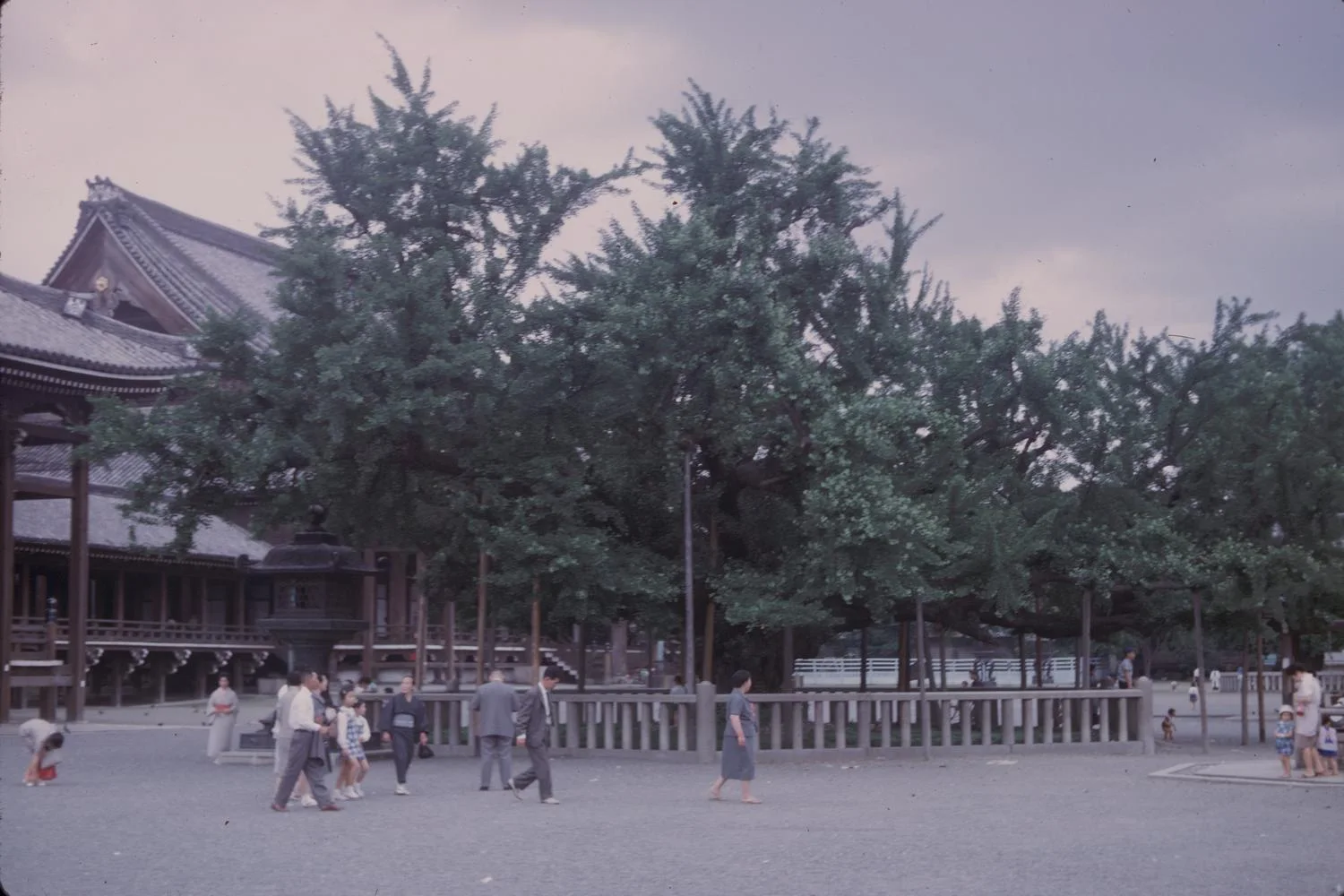
Leave Kyoto Station via the Karasuma Exit, walk west to Horikawa-dori, and head north to Nishi Honganji. The temple's access map puts the walk from the station at about 15 minutes. Set your navigation to Nishi Honganji Goeido Gate or Honganji Goeido Hall and enter through the gate facing Horikawa-dori. Go in through Goeido Gate if the ginkgo is your priority, then swing around the south side later if you want to see the Karamon Gate. Step onto the shirasu, the wide gravel courtyard in front of the main halls, and you will immediately spot the low, horizontally spreading crown.
Its nickname translates the Japanese sakasa icho, or upside-down ginkgo. Nishi Honganji notes that the tree is roughly 400 years old and designated a Kyoto City Natural Monument; municipal records describe thick limbs spreading outward and angling upward from low on the trunk, resembling upturned roots. Step back in front of the tree to take in its low height and wide span, then move to a diagonal angle to see the layered limbs, some hovering near the gravel and others lifting behind them. Temple maps also mark another large ginkgo on the grounds, so verify before you go whether a reference photo shows the designated tree before Goeido Hall or the one near Amidado Hall.
Nishi Honganji's normal gate hours are 5:30 to 17:00, and general entry to both main halls and the courtyard is free. Budget roughly 30 minutes just to see the tree, or add extra time to climb onto the wooden verandas of Goeido Hall and Amidado Hall. The courtyard includes the O-chasho rest pavilion for visitor services and seating. If you arrive early before breakfast spots open, tour the courtyard first and head north of the station or toward Shichijo-dori afterward to eat. Although the gravel yard is broad, the stairs and entrances to both halls stay busy with worshippers, so step toward the edge of the courtyard before stopping for photos.
When you have to pick between morning and afternoon, check the temple's live camera of the shirasu courtyard during daylight hours to gauge weather and overall canopy color. Compare the feed against recent dated photos: look first at whether the outer branch tips still hold foliage, then check the gravel below. If the webcam only catches one edge of the crown, zooming in on a recent courtyard photo gives a clearer read on ground-level leaf drop.
Late autumn brings major temple services. In 2026, Nishi Honganji scheduled its National Followers General Memorial Service on November 22 and 23, with adjusted sermon schedules and hall traffic flow. Check the temple's monthly calendar if you plan to attend a Dharma talk; if you are only here for the ginkgo, keep your visit to the courtyard tree, the gate, and the surrounding streets, and save the hall interiors for a quieter morning. Leaving via the Hanayacho-dori side puts you in the same station-north block as Higashi Honganji, an easy walk east.
Walk outside Higashi Honganji's gates to see the lotus fountain avenue
Higashi Honganji's main foliage display sits right outside Goeido Gate. Kyoto's Shimogyo Ward includes the ginkgo rows flanking the lotus fountain among its Eight Views of Shimogyo. From Kyoto Station's Karasuma Exit, walk north along Karasuma-dori toward Karasuma-Shichijo until the temple and its forecourt come into view. Coming from Nishi Honganji, walk east toward Karasuma-dori and look for Ohigashi-san Hiroba or Higashi Honganji Fountain. Because both Honganji temples have a Goeido Hall, include Higashi Honganji in map searches and clarify whether you are meeting in the outer plaza or inside the hall.
The plaza sits between the temple gates and Karasuma-dori. From beside the fountain, you can frame the dark timber of Goeido Gate together with the yellow foliage. Move along the edge of the basin to line up the trunks in depth so the trees overlap from foreground to background. When crowds build around the main approach, walk past the central entrance and shoot back from the side of the plaza, which still frames the gate while avoiding pedestrians walking up from the station. Once the canopies thin, look down along the fountain rim and paving joints—wind and sweeping can clear the main plaza quickly, so compare recent photos from Kyoto Gyoen if you want an unbroken carpet of fallen leaves.
According to Higashi Honganji's late-October 2026 notice, winter gate hours from November through February run 6:20 to 16:30. Because the lotus fountain stands outside the walls, only visitors heading inside the halls need to watch closing time. Casual personal photography is allowed under the temple's shooting rules, which prohibit flash, filming during services, and entering restricted areas. If you only want the trees and the gate, you have plenty of flexibility outdoors.
From November 21 to 28, 2026, Higashi Honganji holds its annual Ho-onko memorial service. General admission remains free, with schedules, seating, and wheelchair routes posted on the service page. If you plan to join a session inside, time your morning around the liturgy and look at the trees outside afterward. During peak service hours and heavy foot traffic in the forecourt, keep plaza stops brief and save slower viewing for Nishi Honganji or an afternoon in Kyoto Gyoen.
Add an extra hour north of the station for Shosei-en Garden
If you finish both temples early and still want red and yellow foliage near Kyoto Station, exit Higashi Honganji's Goeido Gate, cross Karasuma-dori, and walk east to Shosei-en. It is Higashi Honganji's detached garden with its own entrance; enter through the west gate to reach the reception desk. Head first toward the central Ingetsu-chi Pond, then loop along the garden paths based on where foliage looks best that day. Temple plant guides list ginkgo alongside maples inside the grounds. Even when the street-side avenue has thinned, Shosei-en's pond banks, overhanging branches, and bridges offer a quieter composition, while long unbroken ginkgo rows are better left for Kyoto Gyoen or Horikawa-dori.
From November through February, Shosei-en opens 9:00 to 16:00, with last admission at 15:30. Entry requires a garden maintenance donation of at least ¥700 for adults and ¥300 for junior high and high school students; elementary school students and younger enter free. Stick to the outdoor paths for pond and bridge views. Handheld photography and video are permitted, but tripods and selfie sticks are banned, and only drinking water is allowed inside—finish any snacks outside before entering.
Shosei-en fits neatly into a half-day north of Kyoto Station. For example, see Nishi Honganji and Higashi Honganji's avenue first, enter Shosei-en after 9:00, and return to the station to collect your bags. If you arrive near 15:00, walk east from the station first to make the 15:30 cutoff, then loop back to Karasuma-dori to see Higashi Honganji's forecourt. Keep in mind that Nishi Honganji closes at 17:00, so save a thorough visit there for the next morning if you are cutting it close.
Enter southern Kyoto Gyoen from Marutamachi for Kaninnomiya-tei-ato
Take the municipal Karasuma Subway Line from Kyoto, Gojo, or Shijo stations and get off at Marutamachi for the southern end of Kyoto Gyoen. The Ministry of the Environment lists Exit 1 as the closest exit for Kaninnomiya-tei-ato and Shisui-tei. Take Exit 5 if you need an elevator, which adds a slightly longer street walk. Walk along Marutamachi-dori to enter the park at Ainoma-chiguchi Gate and use Kaninnomiya-tei-ato as your first landmark. Association updates label the spot as north of the Kaninnomiya-tei-ato North Gate, referring to the ginkgo row lining the path just north of the residence; step into the exhibition hall afterward if you want to see the interior displays.
Continue north toward Kenrei-mon Gate on the south side of the Imperial Palace and look along the Omiya Path for the ginkgo at Geikado-ato. Geikado-ato sits inside Kyoto Gyoen along the park footpaths. This pocket combines large ginkgos with other autumn trees, and when leaves linger on the outer branches and the ground below, the opening along the path frames both together. Search directly for Geikado-ato in your maps app—searching only for Kyoto Gyoen drops a pin in the middle of the grounds even though the park has multiple perimeter gates.
To make a loop, follow the Ministry of the Environment's roughly one-hour southern walking course. It enters via Ainoma-chiguchi, passes Kaninnomiya-tei-ato, Kujo-ike Pond, and Shisui-tei, heads toward Kenrei-mon and Geikado-ato, and loops past the plum and peach groves back to the gate. That estimate covers outdoor walking only, without indoor stops or long photo waits. If you only have 45 to 50 minutes in the south half, pick whichever of Kaninnomiya-tei-ato or Geikado-ato looks better that day and stop by Kujo-ike Pond on your walk back to Marutamachi Station.
Watch out for Monday closures. While Kyoto Gyoen's park paths are free and open daily, the Kaninnomiya-tei-ato Exhibition Hall closes on Mondays unless Monday is a national holiday, as well as over the year-end and New Year break; normal last entry is 16:00 and closing is 16:30. Shisui-tei generally opens Thursday through Saturday until 15:30 and charges ¥300 for high school students and up. If you only care about the outdoor ginkgos, treat both buildings as landmarks; if you want to view Kujo-ike Pond from inside the teahouse, put it in the first half of your schedule.
Enter northern Kyoto Gyoen from Imadegawa for Ichijo-tei-ato
Start the northern section at Ichijo-tei-ato. Exit the Karasuma Line at Imadegawa Station Exit 3 and walk south along Karasuma-dori toward Imadegawa-Gomon Gate to enter the park. Check Ichijo-tei-ato on the Ministry of the Environment's autumn map, then orient yourself using Inui-Gomon Gate and the Konoe-tei-ato Rest Area. If association reports also list Nakayama-tei-ato at peak color, continue toward the northeastern side of the park. Both Nakayama-tei-ato and Geikado-ato carry the "-ato" (former residence) suffix—one in the north and one in the south—so save the pin for the specific tree you want before leaving the subway.
If you reach the north end in the afternoon, stick to a compact loop from Ichijo-tei-ato. View the canopies along the path toward Konoe-tei-ato first, then decide based on daylight whether to walk over to Nakayama-tei-ato. Families with kids can tack on time at the nearby children's playground, while anyone needing restrooms or seating can aim for the Konoe-tei-ato Rest Area or head west to the Nakadachiuri Rest Area. Nakadachiuri has dining and free indoor seating, saving you a detour back out to the east side if you want a meal before leaving the park.
To cover both ends, enter at Imadegawa, see Ichijo-tei-ato, walk south past Kenrei-mon, Geikado-ato, and the north side of Kaninnomiya-tei-ato, and catch the subway at Marutamachi. The reverse direction works equally well—especially if you visit Shisui-tei in the morning and plan to continue to Horikawa-Imadegawa in the afternoon, entering at Marutamachi and exiting at the northern gates. Mapping the walk from Ichijo-tei-ato to Geikado-ato gives a truer sense of the distance than pinning Kyoto Gyoen as a whole. If you only have time for one end, pick the matching station and leave the other half for another day.
Two shrines along Karasuma-dori west of the park add bonus ginkgos
If you only tour southern Kyoto Gyoen, exit through Shimodachiuri-Gomon Gate before heading back to Marutamachi and cross Karasuma-dori to Sugawarain Tenmangu Shrine. Kamigyo Ward lists the small shrine's ginkgo as a locally treasured tree, measuring roughly 21.5 meters tall in city records. Once across the street, notice how the tight precinct sets the torii gate right against the old trunk, making the crown look even taller overhead. Shrine grounds are open 6:00 to 17:00, so anyone finishing at the Kaninnomiya-tei-ato exhibition hall late in the afternoon should check the clock before crossing over.
Walk north up Karasuma-dori from Sugawarain Tenmangu to reach Goou Shrine directly opposite Hamaguri-Gomon Gate. The shrine notes six centuries-old ginkgos on its grounds, with the giant tree north of Seihoden Hall also included on Kamigyo Ward's heritage list. Looking up beside the main hall, branches reach over the shrine eaves in clean contrast with the dark roofs. The guardian boars at the entrance make an easy meeting point inside the torii when traveling in a group. Grounds stay open from 6:00 to 21:00, though the stamp and amulet office closes at 16:30.
For a short loop in this area, walk to Geikado-ato inside Kyoto Gyoen, exit via a western gate to visit one of the shrines, and follow Karasuma-dori south to Marutamachi. If your plan focuses on northern Kyoto Gyoen and Horikawa-dori, save both shrines—which lie south of Imadegawa-dori—for another day or combine them with your Marutamachi visit. That protects your morning hours at the two Honganji temples near Kyoto Station and keeps you from walking the same stretch of Karasuma-dori twice at dusk.
Walk Nishijin from Horikawa's ginkgo median to Eko-ji Temple
Both Nishi Honganji and the Horikawa-dori ginkgo avenue show "Horikawa" on maps, yet one sits north of Kyoto Station and the other northwest of Kyoto Gyoen. Kamigyo Ward's listed ginkgo avenue runs down the central median of Horikawa-dori between Imadegawa-dori and Shimei-dori. If you visited Nishi Honganji in the morning, pair this stretch of Horikawa-dori with northern Kyoto Gyoen or a Nishijin walk. Exit the north end of the park, walk west along Imadegawa-dori to Horikawa-Imadegawa, and look north at the tree line from the intersection before deciding how far to stroll.
You do not need to walk the whole avenue to enjoy it. Around Horikawa-Imadegawa, you can already see the trees marching down the boulevard, with passing traffic and storefronts framing the shot. Follow whichever sidewalk offers the fuller canopy line, then cross at a signal to compare the opposite view. Always use marked crosswalks to shoot across the street; when the central median fills with fallen yellow leaves, both sidewalks give clean angles without stepping near traffic.
Treat Horikawa-dori as a flexible backup rather than a fixed obligation. If single specimen trees in Kyoto Gyoen have already thinned while Horikawa's row still holds color, walk farther west from Imadegawa. If leaves are dropping everywhere, trade the long boulevard detour for a stroll through Nishijin's backstreets and catch transit back from Horikawa-Imadegawa. And if you already saw the avenue outside Higashi Honganji and are lukewarm on roadside views, wrapping up after Kyoto Gyoen makes plenty of sense.
Continue west along Imadegawa-dori to visit the giant ginkgo at Eko-ji Temple featured in the cover photo. From the Imadegawa-Jofukuji city bus stop, walk south down Jofukuji-dori; the Nichiren Shu directory lists the address as 562-5 Sasaya-cho 1-chome, Kamigyo-ku. Search for Eko-ji Kyoto Nishijin in maps—another temple with a similar name, Jofuku-ji, stands just across the street in the same neighborhood. Eko-ji's crown tapers upward into a tall spire visible from blocks away, while its trunk and fallen leaves appear once you step close. Pairing the long boulevard line of Horikawa with this quiet residential temple works well; use open walkways at Eko-ji and step aside at the gate so worshippers and vehicles can pass.
With only half a day, walking the two temples from Kyoto Station is enough
For first-time visitors arriving on the Shinkansen, step out of Kyoto Station's Karasuma Exit, head west to Nishi Honganji, continue east to Higashi Honganji, and walk back down Karasuma-dori to the station. Nishi Honganji's wide courtyard works smoothly early in the morning, and walking between the two temples at street level avoids transferring back through the station. Starting around 8:30 lets you see the courtyard ginkgo, step inside one hall, and stroll Higashi Honganji's outer plaza while still getting back to the station, heading into Shosei-en, or grabbing brunch around Gojo after 10:00. Plan in loose time blocks rather than treating hall visits and walks like quick five-minute photo stops.
If you are staying north of Gojo or checking out around Shijo the next morning, flip the order and start at Higashi Honganji. With one site on Karasuma-dori and the other on Horikawa-dori, visit whichever trees are closest to your hotel first and cut across the block between the two avenues. Kyoto Station has both a Karasuma Exit and a Hachijo Exit, while both Honganji temples sit on the north side—if your hotel is on the Hachijo side, walk through the station to store your luggage before heading up Karasuma-dori or Horikawa-dori.
If you are squeezing in one last stop before leaving Kyoto, sticking solely to Higashi Honganji's outer plaza is often the easiest option. Count backward from the time you need to retrieve bags at the Karasuma side, walk up to the plaza for a loop, and return the same way. Give yourself at least 90 minutes if you want to include Nishi Honganji, factoring in locker hunting, baggage pickup, and ticket gates. Eating inside the station before boarding avoids another round-trip crossing at Karasuma-Shichijo.
On November 21–23, 28, and 29, 2026, a temporary baggage storage and delivery counter operates outside Hotel Granvia Kyoto on the station forecourt from 9:00 to 20:00. Turn right out of the JR Central Gate, or take the subway North Gate to Porta Exit B4 to reach the plaza. If you arrive in the morning and are staying within Kyoto City that night, check the official hands-free service notice to arrange same-day city delivery before 14:00, then walk both temples light. Day-trippers can use temporary storage and build pickup time into the return walk; in early December, check Kyoto's hands-free baggage map for permanent counters.
With a full day, connect Kyoto Station North and Kyoto Gyoen on the Karasuma Line
To combine ancient courtyard trees, street rows, and park scenery, visit Nishi Honganji and Higashi Honganji in the morning. After lunch, ride the Karasuma Subway Line from Kyoto or Gojo stations to Marutamachi to see the ginkgos north of Kaninnomiya-tei-ato and at Geikado-ato. If Ichijo-tei-ato looks stronger that day, ride straight to Imadegawa and start from the north end instead. Eat lunch or pick up water before entering Kyoto Gyoen, or use the park rest areas for a midday break. If your morning walk already ran longer than planned, stick to one end of the park and decide afterward whether to stop for coffee along Imadegawa-dori.
When pairing both districts, pay per ride rather than assuming you need a pass. Guests staying near Shijo might take the subway to Gojo in the morning, ride to Marutamachi after lunch, and return to Shijo for dinner, while someone walking straight from Kyoto Station to Gojo might only ride the subway twice all day. Tally your evening transit before buying a day ticket; if you are adding Higashiyama or northern Kyoto later, Kyoto Subway and Bus Passes & Sightseeing Express Routes compares pass options and transfers.
Day-trippers returning to Osaka can let their train line dictate where the Gyoen walk ends. For JR or Kintetsu trains from Kyoto Station, both Marutamachi and Imadegawa connect straight back down the Karasuma Line. For the Hankyu Kyoto Line, ride the subway to Shijo Station and use the underground walkway to Hankyu Karasuma Station. When catching a reserved evening train, stick near the Karasuma Line rather than relying on city buses that stall in autumn traffic.
Want autumn maples the same day? Switch trees inside Kyoto Gyoen
To see red and yellow foliage in a single afternoon without bouncing between distant hillside temples, stay in southern Kyoto Gyoen. In the November 17, 2026 park update, maples at Takatsukasa-tei-ato and Shisui-tei were already at peak color while Geikado-ato's great ginkgo was in prime view. Shoot from Geikado-ato when you want yellow ginkgos and red maples in one frame, or separate the two by visiting Kujo-ike Pond, Takatsukasa-tei-ato, or the outer edge of Sento Imperial Palace for maples. Pick adjacent spots from the same official update where recent photos show both colors still holding, then link them on foot.
If you are staying in Higashiyama or sightseeing around Okazaki in the morning, choose either Kyoto Gyoen or the Kyoto Station temples for the afternoon rather than both. Walking west along Marutamachi-dori from Keihan Jingu-Marutamachi Station brings you straight to the south side of Kyoto Gyoen, with easy Karasuma Line access afterward from Marutamachi or Imadegawa stations. Travelers heading to Nishiyama or Arashiyama during the day should save the trees near Kyoto Station for the following morning, since crossing from the western hills to Kamigyo Ward in the same afternoon eats up prime daylight in transfers. Use Kyoto Autumn Foliage Zones and Transit Planning to match mountain temples to your hotel side of town.
If you arrive in early December to find one ginkgo site bare, pivot to whichever section of Kyoto Gyoen or temple garden still holds color in that week's photos. Nishi Honganji remains worth a stop even after leaf drop, since bare branches reveal the heavy limbs, wooden supports, and the structure behind the "upside-down ginkgo" name. If your goal is a thick yellow avenue, check fresh photos for intact canopies first—otherwise shift your afternoon toward architecture and late-season maples.
End the evening near Kyoto Station with To-ji's five-story pagoda illumination
After a day of ginkgo viewing, switch to illuminated maples and temple architecture south of Kyoto Station by walking or taking the Kintetsu Line one stop to To-ji Station. Officially named Kyo-o-gokoku-ji, To-ji sits southwest of the station. If you are still at Kyoto Gyoen in the afternoon, ride the Karasuma Line back to Kyoto Station for dinner and walk down to To-ji afterward without detouring through Higashiyama. If you finish the station-north temples early, wait near the station until evening gates open and head out from the Hachijo Exit.
To-ji's autumn 2026 schedule runs special evening illumination and night openings of the Kondo and Kodo halls from October 31 to December 13, 18:00 to 21:30 (last admission 21:00). Admission is ¥1,000 for adults and high school students and ¥500 for junior high school students and younger. Daytime admission also opens the first level of the five-story pagoda, which requires visiting during daytime hours. Making the night illumination your final stop lets you see pond reflections, the Kondo Hall, and the Kodo Hall before heading straight back to the station; after rain or wind ripples the pond, look up from the walkway to frame the pagoda against the trees.
To combine daytime entry into the pagoda's first level with the evening illumination on the same day, limit Kyoto Gyoen to the southern loop after lunch and head to To-ji early. Daytime pagoda entry closes to new visitors at 16:30 and uses a separate ticket from the night session, leaving an easy dinner gap in between. Visitors who spent the day at the two Honganji temples can skip the afternoon pagoda trip and arrive only for the night lighting, setting Kintetsu To-ji Station or Kyoto Station's Hachijo Exit as their route home.
For strollers or slower paces, pick stations with elevators and nearby trees
Near Kyoto Station, focusing on Higashi Honganji's outer avenue keeps walking flat along Karasuma-dori and the plaza, making it easy to return early if anyone gets tired. Older visitors at Nishi Honganji can enjoy the giant ginkgo right in the ground-level courtyard without climbing the hall steps unless they feel up to it. For group photos, pick a concrete landmark such as "outside Goeido Gate by the fountain" rather than "under the ginkgo tree." During Higashi Honganji's Ho-onko service, wheelchair users have elevator and ramp access into the hall plus designated priority seating.
Although Kyoto Gyoen is flat, coarse gravel on the main paths adds push resistance for strollers. Use the elevator at Imadegawa Station Exit 3 for the northern park and the elevator at Marutamachi Station Exit 5 for the southern park. The Ministry of the Environment publishes a map showing paved accessible paths and multi-purpose restrooms across the grounds; if walking north to south, follow the barrier-free path between Inui-Gomon and Ainoma-chiguchi and make short side detours to specific trees. Pin restrooms and rest houses in advance so nobody has to cross the entire park before lunch.
Wheelchairs can be borrowed inside Kyoto Gyoen at the Nakadachiuri Rest Area, Konoe-tei-ato Rest Area, and Kaninnomiya-tei-ato Exhibition Hall. Try to return wheelchairs at the same side of the park you exit, especially on a one-hour visit. With young children in the north, pair time at the children's playground with a quick look at Ichijo-tei-ato; with older relatives in the south, enter at Marutamachi and turn back around Kaninnomiya-tei-ato and Kujo-ike Pond.
Where to stand for canopies, avenues, and fallen leaves
At Nishi Honganji, step back with your phone's 1x lens so the courtyard gravel fills the bottom edge of the frame, showing just how low the heavy limbs hover above the ground. When crowds walk across your straight-on shot, shift outside the stone fence to frame the yellow foliage against the dark eaves of the temple roof. Once the overall shape works, switch to 2x or step closer to isolate one horizontal branch so both its form and remaining leaf color stand out.
At Higashi Honganji, shoot a wide plaza view including the gate and lotus fountain first, then walk along the basin to line up one row of trunks. If trees along the avenue are changing at uneven speeds, place the brightest yellow trees in the foreground and use the distant gate as an anchor. On bright overcast days, tilt down toward the trunks, stone railings, and timber gate to crop out flat white skies. In direct sun, move slightly to the side of the canopy so backlit leaves pop against deeper shadows.
For fallen-leaf shots in Kyoto Gyoen, frame the tree trunk together with the ground beneath it. After rain, wet leaves glare brightly—check your footing on the park edge and stand on dry gravel before shooting. On breezy days, look for fan-shaped leaves banked against a trunk base or stone curb rather than chasing swirling leaves down an open path. Kyoto Gyoen allows casual personal photography as long as walkways stay clear for pedestrians; as light fades around 16:00, prioritize your key trees before heading back toward the gate.
A few useful answers
Should I visit Kyoto's ginkgos in late November or early December?
If you want full canopies of yellow leaves, aim for a weekday during the last third of November. On November 17, 2026, four ginkgo spots inside Kyoto Gyoen had already reached peak color. In early December, check recent updates for Kyoto Gyoen or the two Honganji temples to catch fallen-leaf carpets and bare old-growth branch silhouettes.
Where should I see ginkgos near Kyoto Station if I only have one hour?
Head north out of Kyoto Station's Karasuma Exit to Higashi Honganji, view the ginkgo avenue beside the lotus fountain outside the Goeido Gate, and walk back the same way. If your top priority is the upside-down ginkgo, go straight to Nishi Honganji and enter through the Goeido Gate instead.
Do I need a Kyoto Imperial Palace reservation to see the ginkgos in Kyoto Gyoen?
No. The ginkgo walk follows Kyoto Gyoen's public park paths, which are free to enter without reservations. Kyoto Imperial Palace and Sento Imperial Palace each have their own admission rules if you also plan to tour the palace buildings or inner gardens.
Should I enter Kyoto Gyoen from Imadegawa Station or Marutamachi Station?
Enter from Imadegawa Station for the northern spots at Ichijo-tei-ato and Nakayama-tei-ato. Enter from Marutamachi Station for the southern avenue north of Kaninnomiya-tei-ato Gate and Geikado-ato. If you have time to walk the full park, enter at one station and exit at the other.
Are Nishi Honganji's giant ginkgo and Higashi Honganji's ginkgo avenue free to visit?
Yes. Nishi Honganji's upside-down ginkgo stands in the open courtyard before Goeido Hall in the free worship area, and Higashi Honganji's ginkgo avenue lines the outer plaza and lotus fountain outside the gates. Nearby Shosei-en Garden has a separate entrance and requests a garden maintenance donation.
Official information and references
Sources used in this guide.
- National Parks Association Kyoto Gyoen (November 17, 2026 Ginkgo and Maple Observation)
- Ministry of the Environment Kyoto Gyoen (November 13, 2026 Yellow Foliage Update and Autumn Color Map)
- Kyoto City Official Travel Guide (Typical Viewing Season for Kyoto Gyoen)
- Nishi Honganji Grounds and Architecture (Great Ginkgo in Front of Goeido Hall and Precinct Map)
- Nishi Honganji November 2026 Schedule (Gate Hours and Memorial Services)
- Nishi Honganji Visitor Facilities (O-chasho Rest Pavilion and General Services)
- Nishi Honganji Official Autumn Worship Brochure (Walking Route from Kyoto Station)
- Kyoto City Shimogyo Ward Office (Ginkgo Avenue Outside Higashi Honganji)
- Higashi Honganji 2026 Winter Gate Hours Notice
- Higashi Honganji 2026 Ho-onko Memorial Service (Schedule and Worship Seating)
- Higashi Honganji Personal Photography Guidelines
- Shosei-en Garden Visitor Guide (Hours, Maintenance Donation, Photography Rules)
- Shosei-en Garden Flora
- Ministry of the Environment Kyoto Gyoen Access and Subway Exits
- Ministry of the Environment Kyoto Gyoen Entry and Facility Hours
- Ministry of the Environment Kyoto Gyoen Southern Walking Route
- Ministry of the Environment Kyoto Gyoen Universal Design and Wheelchair Rentals
- Kyoto City Kamigyo Ward Office (Horikawa-dori Ginkgo Avenue Location)
- To-ji Temple 2026 Autumn Special Opening (Autumn Illumination and Five-Story Pagoda First Level)
- Nishi Honganji Shirasu Courtyard Live Camera
- Kyoto City Kamigyo Ward Office (Sugawarain Tenmangu Ginkgo Location)
- Sugawarain Tenmangu Shrine Visitor Information
- Goou Shrine Precinct Great Ginkgos
- Goou Shrine Worship and Stamp Office Hours
- Kyoto City Hands-Free Baggage Storage and Delivery Service (Autumn 2026 Temporary Counter at Kyoto Station)
- Kyoto City Official Travel Guide (Nishi Honganji Ginkgo Form and Access)
- Nichiren Shu Temple Directory (Eko-ji Temple Address)
- Japan Railway Construction, Transport and Technology Agency (Giant Tree Survey for Eko-ji Ginkgo)
- Kyoto City Bus (Imadegawa-Jofukuji Bus Stop)
- Cover Photo by Goat Tree Designs