Compare Shinmeikan, Yamamizuki and Okunoyu from the bus stop and village slopes. Explore named room types, cave baths, riverside pools, private baths and meals, with overnight routes and day-trip choices from Fukuoka or Kumamoto.
- Region & Focus
- KyushuAccommodation
- Reading Scope
- 31 min read · 18 chapters · 5 Q&As
- Official Verification
- 21 official sources checkedUpdated 7 November 2026
- Key Topics
- Hot springsWhere to stayItineraries
Chapter Route Map (tap any stop)
- Choose between an afternoon in the village and time in the valley
- Treat the bus stop, Kaze-no-Ya and Marusuzu Bridge as three separate places
- Deal with luggage before your bath walk
- A short village circuit: downhill from Kaze-no-Ya, across the bridge to Shinmeikan and back
- Shinmeikan: cave baths, village life and six- or eight-mat rooms
- Shinmeikan day-bath reception closes at 14:30; private baths have a separate fee
- Yamamizuki rooms: beds, an indoor bath and a river view are separate choices
- Yamamizuki riverside and private baths: find the right reception
- Staying at Yamamizuki: settle into the valley and dine at the inn
- Okunoyu new building: twin beds plus futons, with no shower beside the room's open-air bath
- Okunoyu main building and private baths: compare locations to reduce movement
- Okunoyu dinner: choose between the inn's kaiseki and a restaurant transfer
- Compare individual bath fees first, and choose one valley inn
- One night in the village: explore after arrival, then walk again after breakfast
- One night in the valley: lunch and village first, then stay at the inn
- Fukuoka day trips have a short window; Kumamoto's early bus allows two baths
- Save Yuakari for an overnight stay, around dinner and transfers
- Compare only what you will use, then match the budget to your booking
- Quick Q&A
For a walk through the village in a yukata, start with a centrally located inn such as Shinmeikan. For riverside open-air baths and an evening with dinner and breakfast included, compare Yamamizuki and Okunoyu. Put in-room baths, private-use baths, restaurants and transfers on one timetable to see which stay suits your evening.
Choose between an afternoon in the village and time in the valley
For a first visit with time to walk around in a yukata and buy snacks, an inn within the hot-spring village is convenient. If you want riverside open-air baths and a slow evening between your room and the restaurant, stay in the valley. The difference is how many journeys you make. Visiting two village baths in the afternoon, walking into the hills towards evening, then returning for night views turns a rest day into repeated transfers.
Start with three inns. Shinmeikan offers a village location, cave baths and Japanese-style rooms. Yama Mizuki (山みず木, referred to here as Yamamizuki) suits a stay focused on wooded river views and time at the inn. Okunoyu has a main building, a new building with in-room open-air baths, and several shared baths; its room and dining-plan differences deserve close attention. If you are also considering Sanga, see its section in the Kumamoto, Aso and Kurokawa route as another reference for accommodation outside the village centre.
For one night, choose one bath at another inn plus the baths at your own accommodation, adding a second outside bath only if time allows. Once inns open their facilities to staying guests in the afternoon, dinner, changing clothes and rest soon fill the remaining hours. Book the room and dinner you want first, then choose a bath at another inn from those open when you arrive. This makes it easier to preserve an unhurried evening.
| Inn | Starting point for room comparisons | Bathing and travel details |
|---|---|---|
| Shinmeikan | Six- or eight-tatami Japanese-style room | Village and cave baths; last day-bath reception 14:30 |
| Yamamizuki | TB twin beds; 花水 twin beds and indoor bath; type C stream-facing indoor bath | Upstream valley; day reception at Inoya; book bus-stop collection |
| Okunoyu | Main-building river-side two-room Japanese-Western room; new-building twin beds and open-air bath | Futons added for three or more guests; no shower by room open-air bath; free Kurokawa bus-stop transfer |
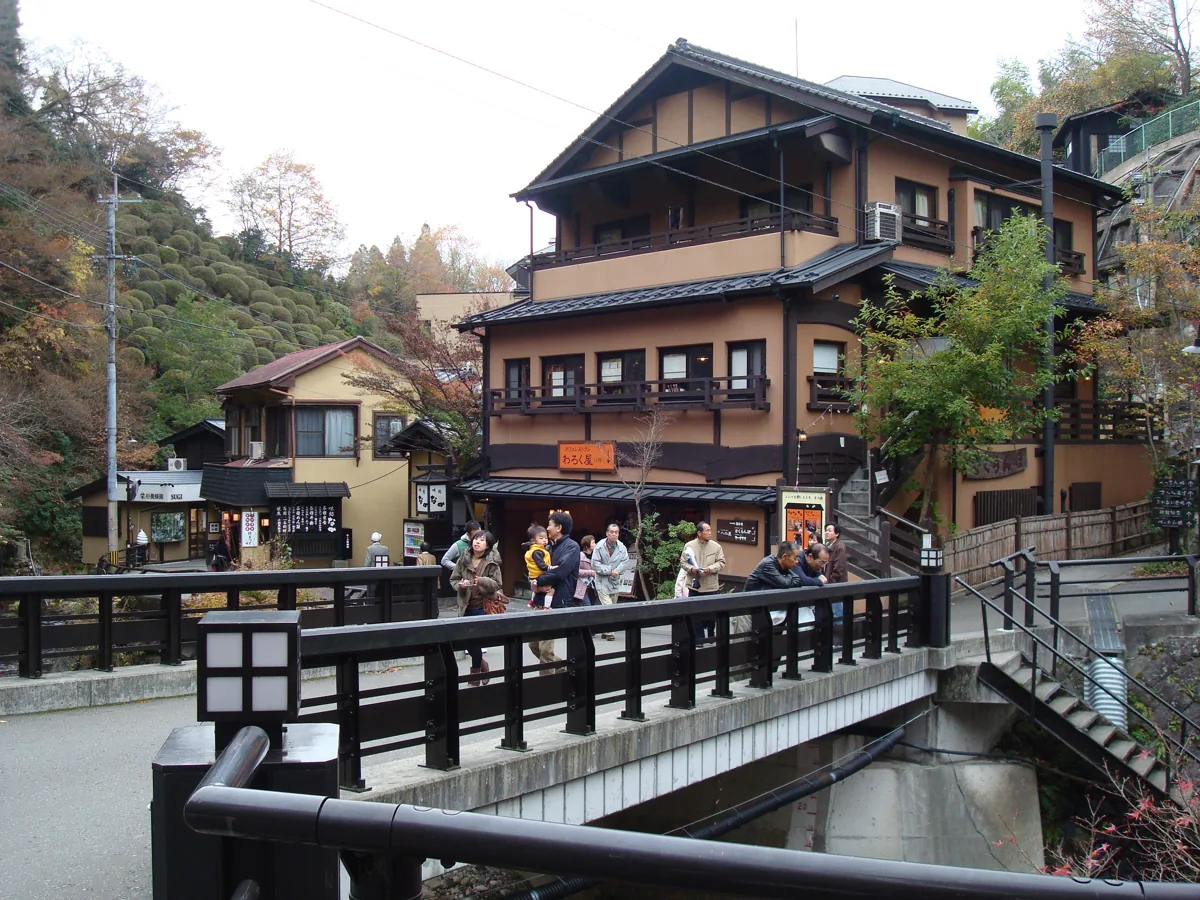
Compare Shinmeikan, Yamamizuki and Okunoyu from the bus stop and village slopes. Explore named room types, cave baths, riverside pools, private baths and meals, with overnight routes and day-trip choices from Fukuoka or Kumamoto.
Treat the bus stop, Kaze-no-Ya and Marusuzu Bridge as three separate places
Kurokawa Onsen bus stop is outside the hot-spring village. The Kaze-no-Ya tourist information office (風の舎) is within the streets, and Marusuzu Bridge is lower down by the river. The inn association FAQ gives about 600 metres and ten minutes on foot from the stop to the office, with a slope along the way. Ten minutes explains their relative positions. With luggage, rain, unfamiliar streets or older companions, allow 20–30 minutes to get off, find your way and deal with bags.
Walk down from the bus stop towards the village entrance, using Kaze-no-Ya and Fureai Square as your first landmarks. Continue down Igo-zaka to Kawabata-dori and Marusuzu Bridge. The official village map places Kaze-no-Ya, Shinmeikan and Marusuzu Bridge in the same central circuit. Yamamizuki lies further upstream in the valley; Okunoyu is on an upstream branch. Calling all of them one walkable area overlooks the climb back up from the river.
Returning uphill along the same route is easiest to judge. Leave more than ten minutes before departure: you still need to collect luggage, find the stop for the correct direction and wait. Aim to finish village activities 30 minutes before the bus, earlier with large bags. If your inn transfer is arranged, use the agreed meeting point instead of carrying bags downhill and back to the bus stop.
Deal with luggage before your bath walk
Day visitors can organise luggage after getting off the bus. The association FAQ lists coin lockers beside the tourist information office and behind the petrol station. Small lockers cost ¥100 and large ones ¥500, accepting only ¥100 coins. Large lockers are listed as 44 cm wide, 128 cm high and 60 cm deep. The information office does not take luggage, so arriving at Kaze-no-Ya does not mean someone can store an entire group's bags.
If you have a large case and the lockers are full, shorten the day-trip route until you have found a workable storage arrangement. Small valuables lockers inside bathhouses hold wallets and personal items; they do not replace village luggage lockers. Before getting off the bus, take out your changing bag, towel, coins and onward ticket to avoid opening a large case at the bathhouse.
Overnight guests have a simpler option. Ask about storage before check-in and after checkout, collection points and times when arranging your transfer. If the inn can meet the bus and take your bags back first, use that service. If you want to explore first, agree on collection at Kaze-no-Ya or the bus stop, making clear where people and luggage will meet. A single delivery to a valley inn avoids another journey for a forgotten item.
A short village circuit: downhill from Kaze-no-Ya, across the bridge to Shinmeikan and back
At Kaze-no-Ya, first read the day's bathing information and choose a bath still accepting visitors, then head towards the river. The official guide identifies Igo-zaka to Shimo-Kawabata-dori as the main strolling streets. Their shops, slopes and bridges make a better first route than trying to tick off every inn. Descend Igo-zaka, continue through Kawabata-dori and Marusuzu Bridge to the Shinmeikan side, then return after bathing for a snack before going back to Kaze-no-Ya or the bus stop.
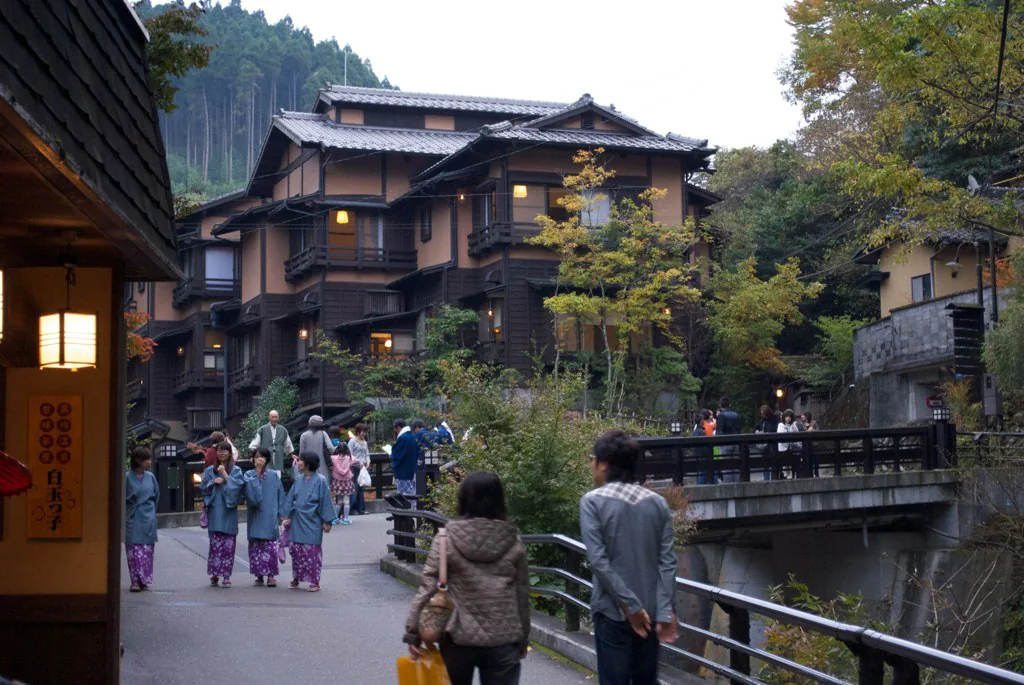
Allow about two hours for this example circuit: 30 minutes for finding your way and street views, about an hour for one bath including changing, and the rest for a snack and rest. If you want longer in shops or companions need more changing time, drop a second bath. Take bridge photographs from a position that leaves the passage clear. Vehicles, guests and delivery staff use these narrow streets too.
With a wheelchair or pushchair, revise the approach and transfer first. The association FAQ states that Betchin-zaka and Igo-zaka are steep and should be avoided by wheelchair users. Kaze-no-Ya has one loan wheelchair, first come, first served, with no reservations. If a companion needs a wheelchair throughout, start with an accessible inn entrance and indoor route, then add a short usable street section. Parking high up and pushing all the way downhill creates a harder return.
Shinmeikan: cave baths, village life and six- or eight-mat rooms
The Shinmeikan room page lists six- and eight-tatami Japanese-style rooms. The eight-mat description highlights the stream outside the window. The inn suits travellers directing their budget and attention towards baths and village walks. If you need Western beds, compare Yamamizuki's TB or 花水 rooms, or Okunoyu's new-building Japanese-Western rooms. Six and eight mats describe room types. Enter everyone in your party and each child's bedding needs on the booking form to check occupancy.
Shinmeikan's distinctive baths are its caves. The official page separates the men's Ana-buro from the women's Dokutsu-buro, alongside the riverside Iwato open-air bath. Choose the named bath you can use, then decide between an overnight stay and a day visit. Cave spaces, lighting and movement differ from open riverside pools. Companions who dislike narrow or dim settings can use different baths and meet outside.
The dining page places dinner in a dining room with an irori hearth. If hearth-side dining and an evening village walk are your priorities, leave out one visit to another inn's baths on arrival day, allowing time to change, return to your room and sit down on time. Tell the inn your bus arrival time when booking. Its access page lists collection from Kurokawa Onsen bus stop. Even within the central village, arranging this is useful with several bags.
Shinmeikan day-bath reception closes at 14:30; private baths have a separate fee
The Shinmeikan bath page lists day bathing from 10:30 to 15:00, last reception at 14:30, for ¥500 per visit. The first direct bus from Fukuoka arrives at 12:29, leaving time to get off, store luggage, walk to the inn and take one bath. An arrival at 14:14 is too late to fit storage, finding your way and changing comfortably before reception closes. If arriving later in the afternoon, use the cave bath after check-in or choose the next day's day-bathing hours.
For exclusive use together, compare the Kajika-no-Yu family bath (かじかの湯). Day use is 12:00–15:00, last reception 14:30, at ¥1,500 for 40 minutes. This is a separate charge from the ordinary ¥500 bath. Ask directly about your party size and available times, and put the confirmed reservation on your schedule. The bathing pass alone does not give access to this private arrangement.
Overnight guests have longer hours: Iwato and the two cave baths are listed for 06:30–22:00, and the indoor bath for 15:00–10:00 the following day. The private open-air Kaze-no-Yu takes reservations from 15:30, with separate men's and women's periods in the morning. An overnight stay gives access to different baths under the inn's arrangements after day visitors leave. Choose dinner and private-bath times at check-in before deciding on an outing, leaving gaps between evening activities.
Yamamizuki rooms: beds, an indoor bath and a river view are separate choices
The Yamamizuki room chart separates these choices clearly. Types A and B are both ten-tatami Japanese-style rooms; type A explicitly has no stream view. Type C has an indoor bath, faces the stream and includes a wooden deck. Type G also has an indoor bath but faces the courtyard. If you are paying for a river view from the room, start with C. If your priority is a quiet bath of your own, consider G. Separating an indoor bath from a stream-facing location shows what a price difference buys.

For beds, start with TB: a six-tatami room plus a twin bedroom. For twin beds and an indoor bath, the 花水 room has an eight-tatami room plus twin bedroom. The larger 風月 room includes a ten-tatami room, a Western-style room, a twin bedroom and an indoor bath. The 華林 and 翠竹 rooms are listed with a double bed; 翠竹 has an indoor bath. If two people each need a bed, choosing a room explicitly marked Twin is more useful than selecting Japanese-Western style alone.
Choose sleeping arrangements before the view. For two adults who value twin beds and are happy with shared baths, TB is worth comparing. For families or three-person parties, enter the third person's sleeping place, meals and age in the relevant plan so the inn can match the room. Guests with an in-room bath can still use the inn's other baths. Schedule the riverside bath you most want to see once, then leave time to rest in your room rather than rush through every pool.
Yamamizuki riverside and private baths: find the right reception
The Yamamizuki hot-spring page lists the men's open-air Yukoku-no-Yu and women's Mori-no-Yu. Ordinary day bathing runs 10:00–15:00 at ¥600 per visit, with reception at Inoya (井野家). Going first to the inn's room reception adds an unnecessary detour. Mark Inoya on your map to find the correct entrance. It also serves drinks, light meals and desserts, making a meeting point for companions outside the baths.
The settings differ on each side. The men's Masurao indoor bath connects with Yukoku's open-air bath. Women reach Mori-no-Yu along a wooded riverside path, with a women's indoor bath and Fujin-no-Yu (風人の湯) also available. Choose this day bath to spend time with flowing water, woodland and an open-air pool. Put cameras and phones away before entering: the official rules prohibit taking them into the bathing areas. Enjoy the river from the bath, and take photographs in public areas where permitted.
The private Saotome bath (さおと女) is separately listed at ¥2,000 for 50 minutes. Overnight guest hours are 15:00–21:00, with last reception at 20:00. The day-use private-bath column lists 10:00–21:00, last reception at 20:00, from ¥2,000. If private bathing together is your main reason for the trip, ask about available sessions and the total price before arranging transport. Ordinary open-air day bathing ends at 15:00. The separate private-bath timetable allows other plans, according to your confirmed booking.
Staying at Yamamizuki: settle into the valley and dine at the inn
The Yamamizuki access page offers collection from Kurokawa Onsen bus stop; give your arrival time when booking. The official village map places it about 2 km from the inn association office. A day visit from the central village needs separate return-transport time. The association FAQ recommends taxis for day visitors to baths outside the centre, and inn transfers for staying guests. Treating those two kilometres as a brief shopping stroll makes a two-bath itinerary much longer.
A convenient stay finishes lunch and a short village walk first, takes the agreed transfer to the inn, then uses Yamamizuki's facilities. If arrival is already near afternoon check-in, go straight to the inn and leave the village until the next day. The dining page says breakfast and dinner are served in the semi-private Hanahenpen (花片片) dining room. It suits travellers who want to take their time over a meal together. A dinner-and-breakfast booking gives the evening to the inn.
For staying guests, the indoor bath is listed for 15:00–10:00 the following day. Open-air baths including Mori-no-Yu are listed for 15:00–22:00 and 06:00–10:00 the next morning. Separate an afternoon riverside soak from a morning bath, and decide on another after dinner according to how you feel and your routine. Record your actual dinner sitting time in your confirmation details and end outings early enough. Assess the free time around dinner before adding a return trip to the village.
Okunoyu new building: twin beds plus futons, with no shower beside the room's open-air bath
The Okunoyu new-building Japanese-Western room combines an eight-tatami Japanese room with a ten-tatami-sized Western room. It accommodates two to five people and has twin beds, a terrace and an in-room open-air bath. With three or more guests, additional people sleep on futons on the tatami. This makes the family's sleeping arrangement clear: older relatives can use beds and younger people futons. If everyone needs a bed, choose an arrangement with enough beds.
There is no shower beside the room's open-air bath, so include washing facilities in your bathing plan. If you have children, need to wash hair first or want to wash without leaving the room, state the full requirement when booking and choose a suitable room. You can use the private open-air bath for a short soak before or after dinner, then wash in the inn's large bath rather than fit everything into one session.
The access limits are specific too. A ramp reaches the new-building room entrance, but wheelchairs cannot be used inside the room. If a companion needs wheelchair access indoors, transfers or bathroom access, describe the necessary movements before selecting a room the inn can accommodate. If you simply want less outdoor walking, the room's position relative to facilities matters as much as its size. Beds and ramps each solve part of the stay; reaching the restaurant and baths matters too.
Okunoyu main building and private baths: compare locations to reduce movement
The main-building room page describes rooms close to the large and open-air baths, with mountain- or river-facing options. The river-side two-room Japanese-Western type has an eight-tatami room and ten-tatami-sized Western room, accommodating two to six guests. Japanese-Western rooms have twin beds, with futons added for three or more people. Compare the main building if easy access to the large bath matters more than using an in-room open-air bath all evening. Standard river-side options also include Japanese-style or Japanese-Western rooms, so select the bedding arrangement you need.
Ajisai-no-Yu, Momiji-no-Yu and Take-no-Yu are private-use baths for overnight guests only. The official site lists hours of 15:00–23:00 and 07:00–09:30 the following day. These give guests in ordinary rooms another way to bathe together. Ask at check-in how use and order work that day, then fit dinner around them. If a companion can only use a private bath, settle the arrangement when booking. An in-room bath removes one layer of on-site scheduling.
Okunoyu also has mixed open-air, river and cave baths, which become women-only from 20:00 to 22:00. A separate women-only open-air bath is available too. Women staying at the inn can use that evening window for the riverside baths; men use other permitted baths during the same period. If you want different bathing settings within one inn, there is plenty of choice here. Leave out a visit to another inn's baths that afternoon.
Okunoyu dinner: choose between the inn's kaiseki and a restaurant transfer
The current Okunoyu dining page lists both country-style kaiseki and Au Kurokawa restaurant options. In-house meals are served at tables and chairs in the main building's dining area, with breakfast starting at 08:00 or 08:30. Au Kurokawa involves an inn transfer to a restaurant. Listed choices include Japanese restaurant 翔隆, French KAZANE, Kumamoto pork specialist Tonkou (豚皇), and Aka (褐), a restaurant specialising in Kumamoto Akaushi beef. Check the dinner venue in your plan to know whether you will stay within the inn or have another journey and a reserved restaurant sitting.
Families should distinguish the meals carefully. In-house kaiseki provides children's meals from preschool to primary-school age; a child wanting the adult meal must be booked as an adult. Au Kurokawa states that it has no children's meals and serves the same meal as adults. Each restaurant plan determines its rules and allergy arrangements. Resolve early dining, different portions and dietary restrictions when choosing the plan. A room sleeping five does not settle the table's needs.
The in-house dining page also states that vegetarian meals, reduced-salt meals and adjustments for food dislikes are unavailable. Stock, seasonings or trace allergens that are difficult to remove cannot all be accommodated. If these are essential conditions for your stay, choose accommodation with a clear suitable meal arrangement. The inn changed booking systems on 3 August 2026. Bookings made on or before 2 August 2026 must be viewed, changed or cancelled through the old system. Use the official migration notice to find the original booking.
Compare individual bath fees first, and choose one valley inn
Ordinary adult day bathing at Shinmeikan and Yamamizuki totals ¥1,100. Shinmeikan plus Okunoyu totals ¥1,200. Both are below the ¥1,500 adult bathing pass, and avoid a detour for a third use. If you already intend a third bath or a product redemption, include the pass in the comparison. Read the official pass rules and choose according to what you will use.
Yamamizuki and Okunoyu both lie upstream but have separate entrances and reception points. Using both and returning to the village adds journeys and changes of clothes. For a day trip, choose one village bath plus one valley bath. For an overnight stay, choose one bath at another inn plus the baths at your own inn. Inoya at Yamamizuki can be a meeting point for a companion who does not bathe. If everyone mainly wants a village walk and tea, choose a central bath and save the valley for a future stay.
Okunoyu lists day reception from 08:30 to 14:00, with departure by 15:00, at ¥700 for adults. It closes on some Mondays and Fridays. Non-staying visitors driving there use the dedicated bath-tour parking area; parking within the grounds is for overnight guests. Its 14:00 reception cutoff and Shinmeikan's 14:30 cutoff determine the order if you want both: start with the earlier-closing one, and read the day's bathing information before leaving. If one is temporarily closed, choose another bath rather than make waiting outside part of the itinerary.
One night in the village: explore after arrival, then walk again after breakfast
For example, the current Sanko timetable gives a 09:53 departure from Hakata Bus Terminal and 12:29 arrival in Kurokawa. If staying at Shinmeikan, use your agreed transfer or luggage arrangement, have lunch and a short walk, then visit its baths after check-in rather than during the day-bathing session, whose last admission is at 14:30. To visit another inn's bath, choose one still accepting visitors and allow enough time to return. An early arrival leaves afternoon time for a bath at another inn; a road delay is a reason to go straight to your accommodation.
If your plan allows check-in at 15:00 and dinner at 18:00, reserve 15:00–17:00 for the room, inn baths and rest. After 17:00, change and return to your room before dinner. These are example planning times; replace both with those on your booking. For a short walk after dinner, stay on familiar riverside streets and use the inn's return arrangements and bath hours to decide when to finish.
Have breakfast before checkout the next day, and shop during the period for which luggage storage has been agreed. For a 14:00 bus to Fukuoka, aim to finish and collect bags by 13:20, then start towards the stop at about 13:30. A distant bath after noon can squeeze this allowance. Choose the 11:00 service for an earlier city return, reducing the morning to breakfast, packing and a direct transfer. Both versions preserve the full previous evening.
One night in the valley: lunch and village first, then stay at the inn
For Yamamizuki or Okunoyu, put Kaze-no-Ya, Marusuzu Bridge and lunch before check-in, with an afternoon transfer from an agreed meeting point. A 12:29 arrival gives until about 14:30 for village activities before the confirmed pickup. Shorten post-lunch shopping if you want a central bath too. With a 14:14 arrival, go straight to the inn and leave the walk until the next day.
At Yamamizuki, start with the riverside open-air bath after check-in, eat at Hanahenpen, then use an indoor or in-room bath the next morning. At Okunoyu, new-building guests can begin with their room's open-air bath; others can ask about private-use baths. Follow the chosen in-house or Au Kurokawa dinner plan. If dinner includes an outside restaurant transfer, leave out another village journey afterwards. Each version keeps one main afternoon activity, leaving room for weather or a slightly late pickup.
Choose a departure after breakfast the next day. Between Okunoyu's 08:00 breakfast and a 10:00 Fukuoka-bound bus, you still need to pack, pay and transfer. For a slower meal, take the 11:00 or 14:00 and arrange luggage after leaving the inn. Kumamoto-bound travellers can also take an afternoon bus and use the post-checkout hours in the village. Taking an earlier bus can sacrifice the breakfast and rest you wanted, only to leave you waiting for a city room.
Fukuoka day trips have a short window; Kumamoto's early bus allows two baths
The first bus from Fukuoka arrives at 12:29, while the last bus back leaves at 14:00. That is 91 minutes. After getting off, walking the slopes both ways and waiting, it suits one bath near the village or a short walk. For a Shinmeikan bath, prepare to leave the pool and change by 13:15 before walking back. Lunch, the whole village and a valley open-air bath will not fit. Stay overnight to retain the later afternoon and evening.
Kumamoto offers a fuller day. The current Kyushu Odan Bus timetable lists departure from Kumamoto Station at 07:23, arrival in Kurokawa at 10:15, and a return option leaving at 15:25 and reaching Kumamoto Station at 18:03. Use 10:15–11:00 for luggage and entering the village, take a bath around 11:00, then have lunch and walk. To add a valley bath, arrange a taxi in advance, use the second bath within its pre-14:00 reception window, and start returning to the stop after 14:30. This two-bath plan needs a defined return journey. If no taxi is available, stay in the village.
A 16:25 return is another option, but it does not support a plan to leave the inn towards evening. Dinner and winter illuminations later in the day call for an overnight stay. The Fukuoka route uses reserved seats; departures from Kurokawa must be booked by 19:00 the previous day. Book the return before the trip so bathing can fit around your actual seat and service. If the timetable changes for your travel date, choose services again from the operator's current page.
Save Yuakari for an overnight stay, around dinner and transfers
As of 27 October 2026, the official Yuakari page still listed the previous season, 20 December 2025 to 31 March 2026. For the following winter, choose suitable accommodation first and place the lights before or after dinner once the new season is announced. Your inn's location determines the night walk: village guests can make a short stroll, while valley guests need return travel and available transfer hours in the plan.
The previous season included locations from Marusuzu Bridge to Kawabata-dori, with spherical bamboo lanterns along the water and streets. Walk the area in daylight to learn the route and choose a short section suited to your group. This avoids finding a long unfamiliar route at night. If dinner is late, ask about time to go out before it. For an after-dinner outing, settle transfer and return arrangements before deciding the walk's length.
An overnight hot-spring visit works outside winter too, with most time given to baths, the room and meals. In rain, reduce street walking and rest more inside. Winter drivers should follow the inn's access instructions for snow tyres or chains and use passable roads. Wear shoes suited to slopes for bath visits. After changing into a yukata, keep your own coat and shoes for a long walk or night outing.
A Yuakari film published by the Kurokawa Onsen Ryokan Association in 2018, showing bamboo lanterns and winter night streets.
Compare only what you will use, then match the budget to your booking
For two adults, ordinary day bathing at Shinmeikan alone totals ¥1,000. If both visit Shinmeikan and Yamamizuki, the total is ¥2,200. Two adult bathing passes cost ¥3,000. These compare bathing only; add luggage storage, lunch and any valley transport. List private-bath charges separately with the accepted party size and time. You can then judge whether paying more for an in-room bath is worthwhile.
Compare accommodation for the same date and full party: Shinmeikan's Japanese-style room with dinner and breakfast, Yamamizuki TB or 花水, and Okunoyu main-building or new-building open-air-bath rooms. Record total price, sleeping places, dinner venue and cancellation deadline for each. Date-specific prices reflect weekends, holidays and child combinations better than multiplying a weekday per-person starting price for two sharing into another date's family budget. Include the arriving bus, number of bags and return journey in the same transfer enquiry.
Save the Japanese room name, meal plan, every guest, private-bath access arrangements and the actual link for changing or cancelling. If transport changes, first contact the inn about that evening's dinner and transfer, then amend through the original booking channel. Each inn charges according to the booked terms. For a first ryokan stay, read the check-in, dining and bath preparation guide before departure and explain the practical arrangements to your companions, leaving arrival time for the stay itself.
A few useful answers
Do day visitors to Kurokawa Onsen have to buy a bathing pass?
Compare individual fees for your chosen baths. Shinmeikan costs ¥500 and Yamamizuki ¥600, totalling ¥1,100. The adult pass costs ¥1,500; include it in the comparison if you plan a third bath or a product redemption.
Which rooms combine beds with an in-room bath?
Compare Yamamizuki’s 花水 room, with twin beds and an indoor bath, or a Japanese-Western room in Okunoyu’s new building. Okunoyu adds futons for three or more guests, and its room open-air bath has no shower.
Can I visit two Kurokawa baths on a day trip from Fukuoka?
The current first arrival is 12:29 and last return 14:00, leaving only 91 minutes. Choose one central bath or a short walk. Stay overnight for the full village and a valley bath.
Can Kaze-no-Ya store luggage?
The information office does not take luggage. Coin lockers are beside it and behind the petrol station: ¥100 for small lockers, ¥500 for large, accepting only ¥100 coins. Staying guests can arrange storage and transfers with their booked inn.
Had the late-2026 Yuakari dates been announced?
The official event page read on 27 October 2026 still listed the previous season, 20 December 2025 to 31 March 2026. Plan the next winter’s illuminations from the new announcement; compare rooms and dinner arrangements first.
Official information and references
Sources used in this guide.
- Kurokawa Onsen | FAQ: walking, luggage, wheelchairs and transfers
- Kurokawa Onsen | Village and inn map
- Shinmeikan | Six- and eight-tatami rooms
- Shinmeikan | Baths, day use and private baths
- Shinmeikan | Meals and hearth dining room
- Shinmeikan | Bus-stop collection
- Yamamizuki | Named room types and bath chart
- Yamamizuki | Baths, day reception and private use
- Yamamizuki | Hanahenpen dining
- Yamamizuki | Transfers and access
- Okunoyu | New-building Japanese-Western rooms, sleeping places and ramp
- Okunoyu | Main-building room types and sleeping places
- Okunoyu | Baths and day use
- Okunoyu | In-house dining and Au Kurokawa plans
- Okunoyu | Free transfers and winter roads
- Okunoyu | August 2026 booking-system migration
- Kurokawa Onsen | Bathing pass
- Sanko Bus | Current Fukuoka route timetable
- Sanko Bus | Fukuoka route booking deadline
- Sanko Bus | Current Kyushu Odan Bus timetable
- Kurokawa Onsen | Official Yuakari event page