Plan a visit from Arita or Kami-Arita Station, with the Kyushu Ceramic Museum, Uchiyama kiln walls, Sueyama Shrine, pottery activities and Arita Será. Includes food, transport and opening conditions.
- Region & Focus
- KyushuAttractions
- Reading Scope
- 32 min read · 14 chapters · 4 Q&As
- Official Verification
- 23 official sources checkedUpdated 22 November 2026
- Key Topics
- ItinerariesFoodKyushu
Chapter Route Map (tap any stop)
- Choose two priorities: making ceramics, old streets or shopping
- Understand Arita and Imari before entering the museum
- An hour in the galleries: follow two threads
- From porcelain stone to blue-and-white decoration: work inside a kiln
- Lunch served on ceramics: near Arita Station or in Uchiyama
- From Arita Station to the Kyushu Ceramic Museum
- Enter Uchiyama: old merchants' buildings in a ceramics town
- Three ways to look at ceramics in Uchiyama
- Uchiyama is more than one wall
- Sueyama Shrine: porcelain on an architectural scale
- Activities and workshops: book the time, then plan around it
- Buying tableware: Uchiyama and Arita Será
- Plan a day or half a day
- Fares, buses and event days
- Quick Q&A
Choose what you want to take home from Arita: a better understanding of ceramics, or a box of bowls and plates for your table. For the first, start at the Kyushu Ceramic Museum, then walk through Uchiyama to see old shops, kiln walls and Sueyama Shrine. For shopping, allow more time for the specialist shops at Arita Será. You can combine both routes, but Arita Será is about 2 km from Arita Station and lies off the main Uchiyama walking route. A taxi makes the day easier if you buy large items or someone in your group cannot walk far.
Choose two priorities: making ceramics, old streets or shopping
If you arrive by train, distinguish Arita Station from Kami-Arita Station. Arita Station serves the Kyushu Ceramic Museum and the more distant shopping area. Kami-Arita Station is near eastern Uchiyama, so you can enter or leave from the other end of the street. Check whether your outward and return trains stop at Kami-Arita when choosing a station. Special trains and stops during the spring pottery fair do not apply to ordinary days.
For a first visit, combine the Kyushu Ceramic Museum with Uchiyama. The museum displays ceramics from across Kyushu and different periods. Uchiyama puts shops, old warehouses, walls made with reused kiln materials and the shrine in their street setting. Seeing the objects before walking through town helps connect the names on museum labels with local life.
For a hands-on activity, book wheel throwing or painting at Rokuroza near Izumiyama. Your work needs firing and posting, so plan to receive it later as a souvenir. Do not plan to leave that evening with a freshly thrown bowl. To watch craftspeople making ceramics, choose a weekday visit to the Gen-emon Kiln workshop. Watching production and making something yourself are different activities.
If shopping is your main purpose, reserve a proper block of time for Arita Será. Its cluster of specialist ceramics shops lets you compare everyday tableware, gifts and craft pieces. In Uchiyama, shopping fits between stretches of old streets. Decide whether you want rice bowls, plates or gifts before choosing shops. You do not need to visit every part of both areas.
Plan a visit from Arita or Kami-Arita Station, with the Kyushu Ceramic Museum, Uchiyama kiln walls, Sueyama Shrine, pottery activities and Arita Será. Includes food, transport and opening conditions.
Understand Arita and Imari before entering the museum
Arriving at Arita Station and finding labels saying Old Imari reflects the same history of production and shipping. The tourism association explains that Arita began making porcelain in the early 17th century after Korean potters, including Ri Sanpei, found porcelain stone at Izumiyama. The wares shipped from Imari and were also called Imari ware. Early Imari generally means Arita porcelain from the start of production in the 1610s to about 1650. These names help you read labels, but changes in shape and decoration are more rewarding to observe than dates to memorise.
Early pieces mainly used blue-and-white underglaze decoration. Overglaze enamelling appeared in Arita in the 1640s, adding colours on top of the glaze. Find two pieces you like in the museum: one mainly blue and white, the other with several colours. Compare their lines, the area covered by patterns and the use of undecorated space. Then read the dates and vessel types on the labels. This gives you a starting point for choosing pieces in the shops.
Do not call every multicoloured piece Kakiemon. The name refers to a specific history and kiln, and exhibition labels distinguish works and styles. For an unfamiliar term, read the museum's account of the date, place of production and technique. In a shop, ask about the maker and series of a piece you like. For everyday tableware, start with how it feels in your hand and a size you will use often. Ask before picking up display samples to compare their weight. Recording the diameter of your usual plates on your phone also helps you judge whether new ones will stack at home.
An hour in the galleries: follow two threads
The Kyushu Ceramic Museum's official floor plan lists Gallery 1 for Arita ware history, Gallery 2 for the Shibata Collection, Gallery 3 for old Kyushu ceramics and Gallery 4 for contemporary Kyushu ceramics. With one hour, start with the background in Gallery 1, then look at Edo-period pieces in Gallery 2. Add the others if time allows. Displays and exhibition periods change, so read the current information at the entrance. If your group has different interests, agree to meet in a particular gallery or rest area. Each person can choose a favourite piece and take the others to see it.
Akihiko and Yuko Shibata donated 10,311 pieces of Arita porcelain, tracing changes in vessels through the Edo period. A museum announcement in March 2026 said Gallery 2 would display about 1,000 pieces from the collection, with about 800 replaced, for a planned period of about one year. Follow changes within one type of vessel rather than scanning everything. Choose several plates and compare rim shapes, central motifs and empty space, then read the dates and techniques on nearby labels.
If your companions know little of the history, each person can find a bowl they would use, a plate they would give as a present and a piece they would only display in a cabinet. Explaining the choices draws attention to rims, patterns and sizes. Keen cooks can also look for displays about dining. Imagine how much decoration a sauce in a small dish or a main course on a large plate would cover.
Outside the galleries, the mechanical musical clock provides a pause. Families can see it before entering, or stop after part of the exhibition, to reduce the need to hurry children along. If lunch in Uchiyama comes next, decide on leaving whether to eat near Arita Station or continue to the district. Do not let finishing every gallery push lunch beyond a restaurant's last orders.
From porcelain stone to blue-and-white decoration: work inside a kiln
Arita ware traditionally divides work among different craftspeople. Raw material becomes a table bowl through forming, biscuit firing, underglaze painting, glazing and high-temperature firing. Some pieces then receive overglaze decoration and another firing. When you see an expensive plate in a shop, ask about its decoration and production as well as its size and use. The processes help explain how it differs from an everyday plate.
Blue-and-white sometsuke decoration uses gosu pigment to paint blue designs on the body. The glaze looks like a white liquid when applied and temporarily hides the painting. High-temperature firing turns it into a clear, glassy layer, revealing the design. The tourism association explains that sometsuke pieces decorated only with gosu can be finished after firing at about 1,300°C. Look at line thickness and washes on blue-and-white plates, then compare how patterns fit different shapes.
Overglaze decoration adds red, green, yellow, gold and other colours to the glaze after the high-temperature firing, followed by firing in an overglaze kiln. The tourism association calls overglaze work on white porcelain aka-e, and overglaze work added to blue-and-white porcelain somenishiki. These terms help with labels, but read the description of each shop's actual pieces. Colour alone does not establish age, and a printed everyday plate is not a hand-painted work.
The activities also differ. Wheel throwing lets your hands determine the outline of a vessel. Painting puts the time into brushwork and patterns. Choose throwing to make your own bowl shape, or painting if you prefer drawing to spending time forming a vessel. Materials, firing and completion depend on the workshop's package. Ask about fees and delivery when booking. If your return time is fixed, make the workshop's meeting time the first fixed point in your day.
ARITA EPISODE 1 (1616–), selected by the Arita Tourism Association and published by SagaKouhouMovie, uses ceramics-making footage to show the division of work in workshops.
Lunch served on ceramics: near Arita Station or in Uchiyama
Gallery Arita brings ceramics from the display cabinet to the table. The tourism association describes about 2,500 coffee cups on display, with a choice of cup when ordering a hot drink. Meals include set menus based on godofu, and the restaurant also serves Arita-yaki Gozen. The official page lists 11:00–17:00, last orders at 16:30 and irregular closing days. At 3057 Honmachi Otsu, Arita, it fits the station or museum part of the day.
Godofu is a local soya-milk food. The tourism association describes mixing soya milk with kudzu and starch, stirring it over heat, then cooling it in a mould. Tofu no Takahashi says its own product uses Japanese-grown soya beans and potato starch. Recipes and serving styles vary by shop. For a savoury meal, look at the set menus; for a small portion, ask what is available that day. If buying some for your accommodation, ask how to store and eat it, and buy before your return journey. A lunchtime set meal lets you try it with side dishes and local tableware. Anyone with a soya allergy should avoid it; ask the shop about other ingredients too.
Gallery Maison de Arita is in Akaemachi. The tourism association lists ceramics displays and a tatami café space, open 10:00–19:00 and closed Tuesdays, Wednesdays and over New Year. It provides a seated stop during an Uchiyama walk. Upstairs seating is sometimes used for booked events. If a workshop booking anchors your day, choose lunch nearby to suit its time rather than forcing lunch between two museum visits.
Arita-yaki Gozen serves several dishes in Arita ware, with the menu set by each restaurant. Mention dietary requirements when booking lunch so the restaurant can tell you whether it can provide a suitable meal.
From Arita Station to the Kyushu Ceramic Museum
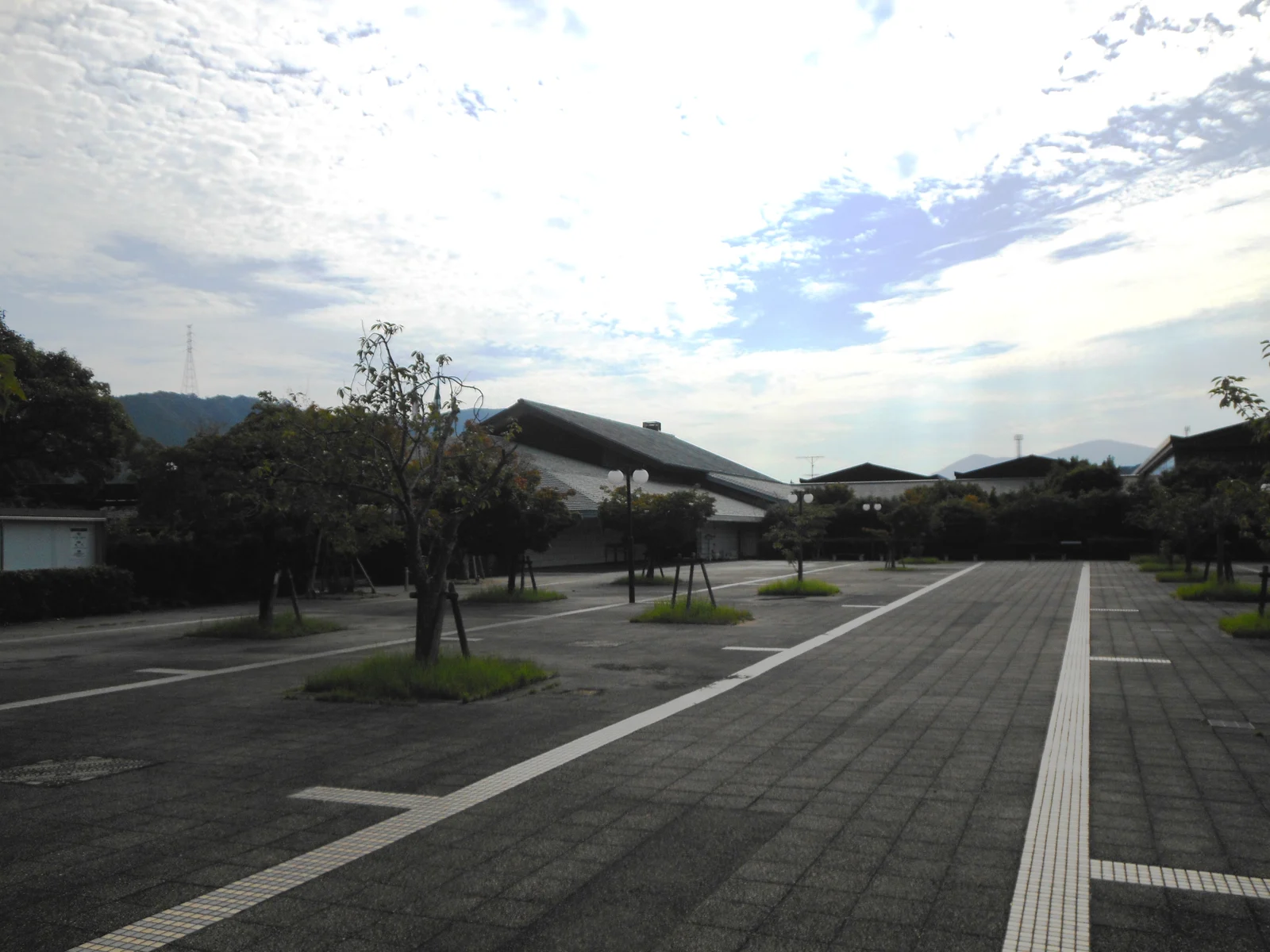
The Kyushu Ceramic Museum is about 12 minutes on foot from Arita Station, served by JR and Matsuura Railway, and works well as a first stop after arrival. Its collections include ceramics from Hizen and across Kyushu as well as contemporary work, giving first-time visitors a basis for comparison. Admission is free, though special exhibitions may charge. Official hours are 09:00–17:00, with last admission at 16:30. It closes on Mondays; if Monday is a national or other holiday, closure moves to the next weekday. It also closes over New Year.
Use three questions as you look: what was this vessel made for? What appeals to you about its pattern and shape? What size would you choose to use at home? You do not need to memorise every kiln name first. After the exhibition, you can tell shop staff that you want small bowls, blue-and-white pieces or plates with undecorated space, rather than guessing from scratch at the shelves.
The museum has an Arita ware mechanical musical clock made through collaboration between kilns. The tourism association says it moves to music every 30 minutes. With children, alternate the clock with the galleries. If there is a lot to see indoors, shorten the shopping walk to give the museum more time.
This museum and the Arita Ceramic Museum below have similar names, but different locations, collections and charges. The former is the prefectural Kyushu Ceramic Museum near Arita Station. The latter is a small museum in a former ceramics warehouse in Uchiyama. Enter the full name in navigation to reach the right one.
Enter Uchiyama: old merchants' buildings in a ceramics town
The Uchiyama preservation district extends about 2 km along the street, from the Iwayagawachi area towards Izumiyama. Shops and buildings from different periods line the way. Treat it as a street for stopping and looking, rather than trying to enter every shop. If you find a piece to buy, ask about other sizes and boxes before paying. Leave heavy purchases until later to make subsequent journeys easier. For gifts, consider the recipient's usual tableware as well as quantity and packaging. Small dishes fit easily with existing sets; larger plates need storage space at home.
Turn into the lanes with tonbai walls and look at their firebricks, old kiln furniture and pottery fragments. These walls differ from the neat shop fronts: they keep materials once used in firing within the town's everyday scenery. Keep residents' entrances clear and do not put your camera into private homes.
The Arita Ceramic Museum is in Odaru, in a ceramics warehouse built in 1874. Its collection centres on Meiji-period Arita ware. It also has the large blue-and-white dish depicting the craftspeople of Arita Sarayama, showing quarrying, crushing, forming and other tasks. Make this dish a focus before your walk. Look at its stages of work, then visit Izumiyama to picture where the material came from.
The museum opens 09:00–16:30. Admission is ¥120 for adults and free for high-school pupils and younger children. It closes on Mondays, or the following day if Monday is a national holiday. The official information lists exceptions for opening during the pottery fair and closure over New Year. It is about 20 minutes on foot from Kami-Arita Station or seven minutes by car from Arita Station. If you have time for one museum, choose the prefectural museum to compare Kyushu ceramics, or this one to combine a warehouse building with an Uchiyama walk.
Three ways to look at ceramics in Uchiyama
Near Kobira, add the Koransha Old Ceramics Exhibition Hall to your walk. The tourism association describes the Arita main shop, built in the Meiji period, with sales and displays downstairs and old ceramics and art upstairs. Upstairs admission is free. The page lists 09:00–17:00 and New Year closure. It suits visitors interested in one brand's development and in comparing exhibits with products sold today. See the upstairs pieces first, then return to the shop to compare patterns, uses and sizes.
The Arita Ceramic Museum focuses on the ceramics industry and its old warehouse building. It is smaller and close to the Uchiyama street, making a short stop to see the craftspeople dish before looking for kiln walls. The Kyushu Ceramic Museum covers a wider range of history and regional ceramics, and is a stronger main indoor visit in rain. There is no need to include all three. Choose the prefectural museum for historical works, the town museum for the street and industry, or Koransha for its brand's pieces.
Gen-emon Kiln takes you in another direction. The tourism association lists showroom hours of 08:00–17:00 on weekdays and 09:00–17:00 on weekends and national holidays, with New Year closure. Workshop and archive visits are listed for weekdays. It is in Maruo, so include transport there and back to the station. The showroom and workshop serve different purposes. If little time remains on arrival, choose the part that interests you most. Ask whether workshop visits are possible that day before replacing part of the Uchiyama walk. A weekend showroom visit does not include the weekday workshop visit by default.
Uchiyama is more than one wall
Most surviving townhouses in Uchiyama date from after the great fire of 1828. The street mixes late-Edo, Meiji, Taisho and Showa buildings. The tourism association says the main street was mainly occupied by merchants, while kiln owners and painters lived and worked in the back streets. Tonbai walls enclosed residences and workplaces there. Start with the shop fronts and façades, then enter the lanes behind to see different scales and materials.
The kiln walls are spread across more than one building. The association identifies several in the back streets between the large ginkgo at Izumiyama and the Arita Ceramic Museum in Odaru. Choose a stretch to explore rather than finding every wall on a map. For building uses and histories, the Arita Tourism Association offers town guides, with a two-hour route dedicated to learning about Arita porcelain and the kilns, and a one-and-a-half-hour walking route through the streets. Ask the association about meeting points, languages and fees when applying. For a first visit without researching each building yourself, a guide gives the street visit a clearer order.
Aritakan is a useful point for tourist information in the district. The tourism association provides walking maps showing streets, facilities and transport symbols. Mark the museums and booked activities you will visit, with time for lunch and the return journey. If your group splits up to shop, agree on an identifiable meeting point and time. Saying merely 'nearby' makes meeting again on a long street harder. For fragile items you like, note the shop, size and price. Decide after meeting whether to return together. Collecting purchases towards the end also saves carrying porcelain through the lanes.
Sueyama Shrine: porcelain on an architectural scale
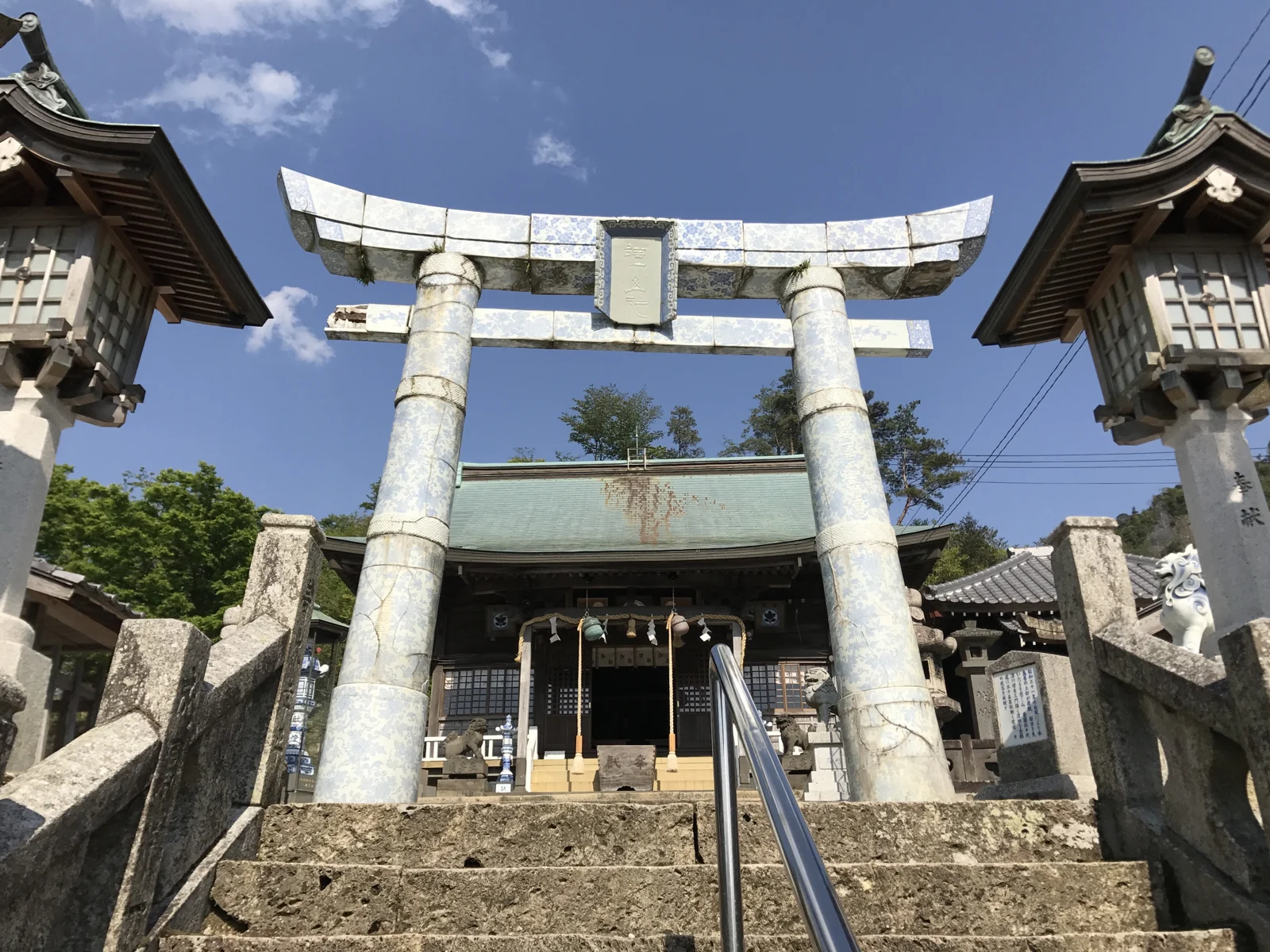
Parts of Sueyama Shrine's torii, guardian dogs and fence are made of porcelain. Their blue-and-white decoration shows Arita ware beyond the dining table. As you approach from the street, first look at the torii's proportions, then move closer to its patterns and surface. Follow the shrine's worship route and keep entrances clear when taking photographs.
The approach crosses a railway level crossing. Stay outside the white line when the alarm sounds and wait until the train has passed before crossing. With children, stop outside the crossing first so the group can pass together. Do not stop on the tracks for photographs.
To follow the raw material, continue towards Izumiyama Porcelain Stone Quarry. The tourism association links the stone found here with the origin of Arita porcelain. Walking from finished, coloured pieces back to their material source helps connect the production stages. Decide whether to add Izumiyama according to your energy and return train. Uchiyama and the shrine already make a half-day walk.
Activities and workshops: book the time, then plan around it
Rokuroza in Izumiyama offers wheel throwing and painting. The tourism association lists the forming activity at ¥1,360, or ¥2,040 for a package including trimming and firing. Painting prices depend on the item, and postage is extra. Firing and delivery take about two to three months, so ask about delivery destinations, charges and payment before booking. Listed hours are 10:00–15:00, closed Thursdays and over New Year, with reservations required. The booking number is 0955-41-1302. Ask the workshop for available arrival times, then place other visits around that slot. The association lists forming as taking no more than one hour, with a limit of two fired pieces. Larger families should state how many people will take part and which activities they want, so waiting at the workshop is not mistaken for free shopping time.
To watch production without making something yourself, consider Gen-emon Kiln. The tourism association describes weekday visits to the workshop and Old Imari archive, where the workshop shows traditional hand production. On a weekday trip, place it earlier in the day. On weekends, focus on collections, streets and choosing ceramics. Ask the kiln about the day's arrangements if you have a specific visit in mind.
With children, let them choose either the activity or museum as the main event, keeping the other flexible. Posted work needs firing first. If they want something to take away that day, choose a small finished item after the activity. Ask staff to help package it before paying, and put fragile pieces in a supportive bag.
Buying tableware: Uchiyama and Arita Será
In Uchiyama, shopping alternates with looking at the street. It suits visitors who want to take in buildings and enter shops as they find them. If you have a brand in mind, locate the right branch first. One business may have shops in both Uchiyama and Arita Será, with different stock and displays. Shobido Honten, for example, describes its Nakanohara shop as mainly an outlet, while its Arita Será shop has more stock and gift choices. The latter makes it easier to buy a coordinated gift set in one place.
Arita Será's official usual hours are 10:00–17:00, with some shops differing. It is about 2 km or six minutes by car from Arita Station. The site includes dining and accommodation, and officially lists 800 parking spaces and accessible toilets. Drivers can visit before leaving Arita. Rail travellers can arrange a return taxi before shopping, rather than looking for transport while carrying porcelain.
Bring your home habits into the shop. Can you lift the rice bowl with one hand? Will the plate fit in your cupboard? Are enough matching pieces available for a gift set? For use in a microwave, dishwasher or oven, ask about that specific product. Gold decoration and different glazes mean appearance alone cannot establish heat resistance.
Before paying, ask for packaging suitable for carrying and about delivery, overseas shipping and breakage procedures. Keep receipts separate from the goods, and protect heavy plates and bowls with a hard shell. To walk without carrying purchases, photograph the product name, size and shop name, then return at the end.
Plan a day or half a day
A day without a car: walk from Arita Station to the Kyushu Ceramic Museum in the morning, then continue to Uchiyama. Have lunch in the district and spend the afternoon at the Arita Ceramic Museum, kiln-wall lanes and Sueyama Shrine. Leave from the station that best suits that day's trains. For more shopping, shorten Uchiyama, take a vehicle to Arita Será, then leave from Arita Station. Fit the exhibition and lunch around your arrival train.
A day by car: start at the Kyushu Ceramic Museum, then visit Izumiyama or your booked workshop. Park at an Uchiyama tourist car park and link the museum, kiln walls and shrine on foot. Finish with shopping at Arita Será. The tourism association lists parking at the museum, Sueyama Shrine and other sites; event arrangements may differ. A car carries your purchases, but parking once and walking works better than moving it for each small stop.
Half a day: choose either the prefectural museum plus part of Uchiyama, or Uchiyama plus Sueyama Shrine. The first starts with the collections; the second leaves more time for the townscape. If shopping is your main purpose, go straight to Arita Será and allow time for transport back to the station.
Monday or rain: both museums usually close on Mondays, with their own rules for holiday closures moving to another day. Focus instead on open shops, Arita Será and booked activities. In rain, shorten the Uchiyama lanes and spend more time in open shops and museums. Use the organisers' and facilities' notices for major events or special closures.
Fares, buses and event days
The official tourism page for Arita's community bus lists single fares of ¥200 for adults and ¥100 for primary-school children, and day passes of ¥500 and ¥250 respectively. Fixed service suspensions are listed for 28 April–6 May, the Sarayama Festival date and 1–3 January. Check the stop, direction and services for your day before relying on a bus. If missing one would jeopardise your return train, a taxi is a direct fallback. The association lists Arita Taxi, 0955-42-3131, and Saihi Kamenoi Taxi, 0955-43-3000. When booking, give the museum or other pickup location, passenger and luggage counts, and the time you need to return to the station. Mention space requirements if you have bought a large box of ceramics.
Bicycle hire gives visitors without a car another option. The association lists hire from 09:00–17:00, starting at ¥500. Some rental points have suspended service during the spring pottery fair. If buying lots of porcelain or travelling with children, basket capacity and protection for fragile items affect the choice. You can walk first and decide about large purchases later.
The return point affects where your walk ends. The tourism association's bicycle hire rules allow ordinary bicycles to be returned to KILN ARITA Tourist Information Centre, Aritakan or Harada Liquor Shop at Kami-Arita Station. Harada closes on Sundays. Electric-assist bicycles are hired at KILN ARITA for ¥1,000 per use, plus a ¥1,000 deposit refunded on return, and must go back to the original rental point. For a one-way route, choose your departure station around the ordinary-bike return points. For electric assistance, plan to reach KILN ARITA before 17:00. Rental use is restricted to Arita town.
The spring pottery fair and autumn events change crowd levels, temporary transport and shop displays. If an event is your purpose, use that year's organiser announcement for dates and transport. For quieter displays or workshop visits, choose an ordinary day. Weekday and weekend opening and visit conditions differ. Put your priority activity in its confirmed opening period, then fit the rest around it.
A few useful answers
Which station should I get off at when visiting Arita?
Use Arita Station for the Kyushu Ceramic Museum, which is about 12 minutes away on foot. Kami-Arita Station is handy for starting at the eastern end of Uchiyama’s old streets. Check that both your outward and return trains stop there.
What can I see in half a day in Uchiyama and at Sueyama Shrine?
Walk along Uchiyama’s main street and turn into the back lanes to see the tonbai walls, built with firebricks and fragments of pottery. Carry on to Sueyama Shrine to see the porcelain details on the torii gate and guardian statues.
Do I need to book Arita’s pottery workshop, and when will my piece be sent?
Call 0955-41-1302 to book a session on the potter’s wheel or to paint a piece at Rokuroza in Izumiyama. Firing and postage take about two to three months, with postage charged separately.
Where can I buy crockery in Arita?
Try Arita Será for everyday crockery and gifts from several specialist ceramics shops. It’s about 2 km from Arita Station, or six minutes by car. The usual opening hours are 10 am to 5 pm, though some shops keep different hours.
Official information and references
Sources used in this guide.
- History of Arita ware
- Arita ware production process
- Arita Ceramic Museum
- Walking in Uchiyama
- Sueyama Shrine
- Koransha Old Ceramics Exhibition Hall
- Gen-emon Kiln
- Rokuroza
- Gallery Arita
- Gallery Maison de Arita
- Arita Será
- Shobido frequently asked questions
- Transport in Arita
- Tourist guides
- Local food in Arita
- Tofu shop
- Kiln walls
- Kyushu Ceramic Museum: Arita Tourism Association
- Saga Prefecture: 2026 Shibata Collection display change
- Saga Prefecture: old Kyushu ceramics and contemporary ceramics galleries
- Saga cultural property record: 10,311 pieces in the Shibata Collection
- Kyushu Ceramic Museum official floor plan
- Arita Tourism Association bicycle hire rules