Travel from Hakata via Hainuzuka to Yame Fukushima. Visit Yokomachi Machiya Exchange Centre and Sakaiya, have lunch at SoL, then make and collect paper at the washi museum. Includes reservation options at Ushijima Tea.
- Region & Focus
- Yame and the Fukushima district
- Reading Scope
- 36 min read · 20 chapters · 4 Q&As
- Official Verification
- 19 official sources checkedUpdated 22 November 2026
- Key Topics
- ItinerariesFoodKyushu
Chapter Route Map (tap any stop)
- Choose a day for the buildings and lunch together
- Hakata via Hainuzuka: connect both ends of the bus journey with trains
- After Fukushima, make a circuit through the eastern townhouses
- Behind the white walls, an earthen passage reveals merchant life
- Curved roads and waterways retain the castle town’s framework
- Yokomachi Machiya Exchange Centre: read the district, then choose your tea
- How the public townhouses survived
- Sakaiya: Yakusugi cedar and rosewood in a detached reception room
- SoL beside Fukushima bus stop: lunch within the walking area
- Traditional Crafts Centre: paper alongside altars, lanterns and everyday objects
- Handmade washi: work before the fibres reach the vat
- Kozo’s season and the difference between white and unbleached paper
- October 2026 prices: choose the work and collection time together
- Book a two-hour guide for architecture and crafts
- Buying Yame tea: distinguish origin from production method
- Tea utensils bring altar-makers’ lacquer and maki-e to the table
- Another day centred on tea: Ushijima’s factories and five-tea tasting
- Before the factory: season, walking ability and on-site rules
- Turn the times into a usable Fukushima day
- Daytime budget and the return journey
- Quick Q&A
A day in Yame Fukushima can lead from a brewing merchant’s earthen passage to Sakaiya’s detached reception room, back to lunch near Fukushima bus stop, then into making your own postcards from kozo fibres. White-walled townhouses, a paper workshop and local tea each offer details worth pausing over. Travel from Hakata via Hainuzuka and a bus, saving the tea gardens and factory for another day centred on tea.
Choose a day for the buildings and lunch together
An ordinary Tuesday is the easiest fit for two public townhouses, handmade paper and lunch. The Exchange Centre and Sakaiya normally close on Mondays, moving the closure to the following day when Monday is a Japanese holiday. The paper museum opens when Monday is a national or other holiday. SoL closes on Thursdays and two Wednesdays each month, and serves no Friday lunch. The same street route works on Saturdays and Sundays; choose trains from that day’s timetable.
See the white-walled district in the morning and start paper-making around 14:00, leaving time for craft displays after drying and collection. Both townhouses open at 10:00; the paper museum opens at 9:00. Early arrivals can walk the streets or go first to the Traditional Crafts Centre area. Normal visits to the Exchange Centre and Sakaiya are free. Spending is mainly on food, transport and the work you choose to make.
Travel from Hakata via Hainuzuka to Yame Fukushima. Visit Yokomachi Machiya Exchange Centre and Sakaiya, have lunch at SoL, then make and collect paper at the washi museum. Includes reservation options at Ushijima Tea.
Hakata via Hainuzuka: connect both ends of the bus journey with trains
From Hakata, take the JR Kagoshima Main Line to Hainuzuka, then Horikawa Bus’s Haya Line to Fukushima. JR’s official site lists southbound local and rapid trains under the direction for Kurume and Omuta. Check the stopping pattern includes Hainuzuka. A direct rapid avoids an intermediate change, and an early start leaves more room before the bus.
For example, JR’s official timetable for Tuesday 10 November 2026 has a rapid leaving Hakata at 7:52 and reaching Hainuzuka at 8:44. Connect with the 9:31 bus, arriving at Fukushima at 9:52. The 47-minute interval allows time to leave the station, locate the stop and wait. This suits a morning visit to townhouses opening at 10:00. The bus mark “ユ” means via Youme Town Yame and Kamenoko.
The official Haya Line timetable bears a printed revision date of 1 October 2024. The 9:31–9:52 service appears in all three versions: weekdays, Saturdays, and Sundays or Japanese national holidays. For the return, Fukushima 16:37 to Hainuzuka 16:59 is also the same across all three. Arrange paper collection before 16:00 to leave the final half hour for walking back to the stop.
The JR return example for the same 10 November leaves Hainuzuka at 17:13 and reaches Hakata at 18:26. The 16:59 bus arrival gives a 14-minute change. JR lists northbound departures from Hainuzuka under Kurume, Hakata, Kokura and Moji. For another date, use the JR date selector and compare the bus’s day category. Fix the Fukushima bus times first, then fit the rail journeys around them in both directions.
For about half an hour longer, the next Haya Line bus runs Fukushima 17:09 to Hainuzuka 17:31 on weekdays and Saturdays, or 17:10–17:32 on Sundays and national holidays. Move the Hakata train connection later too. On Sundays and national holidays, returning via Hainuzuka is the most direct approach. The Kurume Line’s Sunday-and-holiday table has no afternoon service starting directly from Fukushima; other rows begin at intermediate stops such as Yarimizu or the Medical Centre.
After Fukushima, make a circuit through the eastern townhouses
Inset Map 1 in the city tourism booklet places Fukushima bus stop north of the district, the Exchange Centre among streets to the south, Sakaiya further west, and the Traditional Crafts Centre and paper museum on the southern edge. Horikawa and Nishitetsu each have Fukushima stops. SoL’s official one-minute walk starts at the Nishitetsu stop. For Hainuzuka, find Horikawa Bus and the correct boarding position for that direction.
Official walking times from Fukushima are about 10 minutes to the Exchange Centre and 12 minutes to Sakaiya. Start at the Exchange Centre in the morning, then follow white-walled streets by Fukushima Hachimangu towards Sakaiya. The tourism association’s eastern townscape route joins Sakaiya, Hachimangu, the Exchange Centre, former county office and Railway Park into about an hour’s guided walking area. Independently, allow longer in the two houses and use the morning until 11:45.
Allow half an hour between the houses for walking and looking, then 20 minutes from Sakaiya back towards the bus stops. These allowances include streets, crossings and finding entrances. The official 10 and 12 minutes each refer to one stop-to-building journey.
After lunch, head south through the Exchange Centre and Sakaiya area to the group containing the Traditional Crafts Centre and Tokimeki. Allow 35 minutes including the walk and registration. Return north from the crafts centre through the district, leaving at 16:00 and reaching Horikawa’s Fukushima stop before 16:30.
Behind the white walls, an earthen passage reveals merchant life
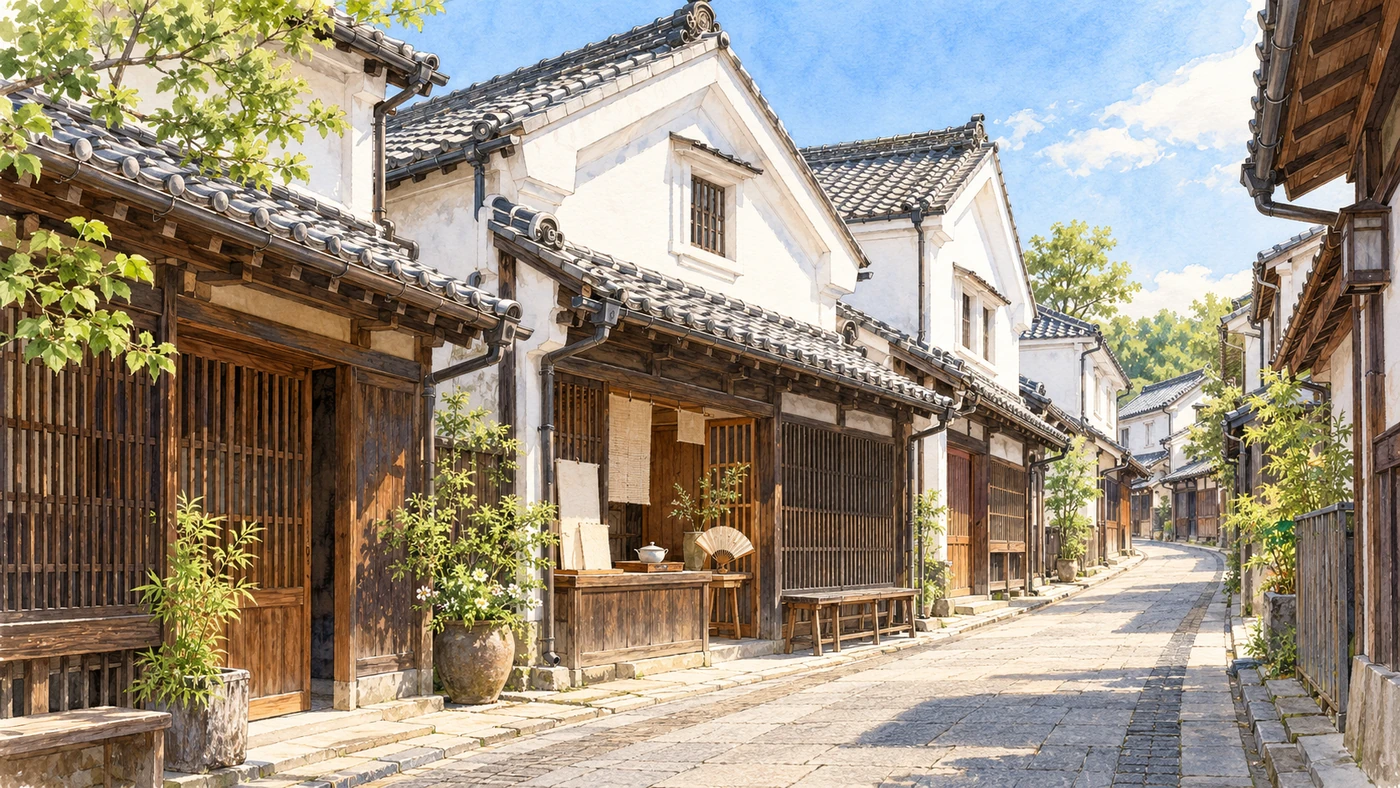
The city calls Fukushima’s basic townhouse form igura: earthen-storehouse construction combining a gable-end entrance, hip-and-gable roof and plastered walls. Repeated Edo-period fires preceded these buildings, which developed from the late Edo into the Meiji period. From the street, first identify the roof facing the road, then the upper walls and eaves. The white houses need not all look like the same shell.
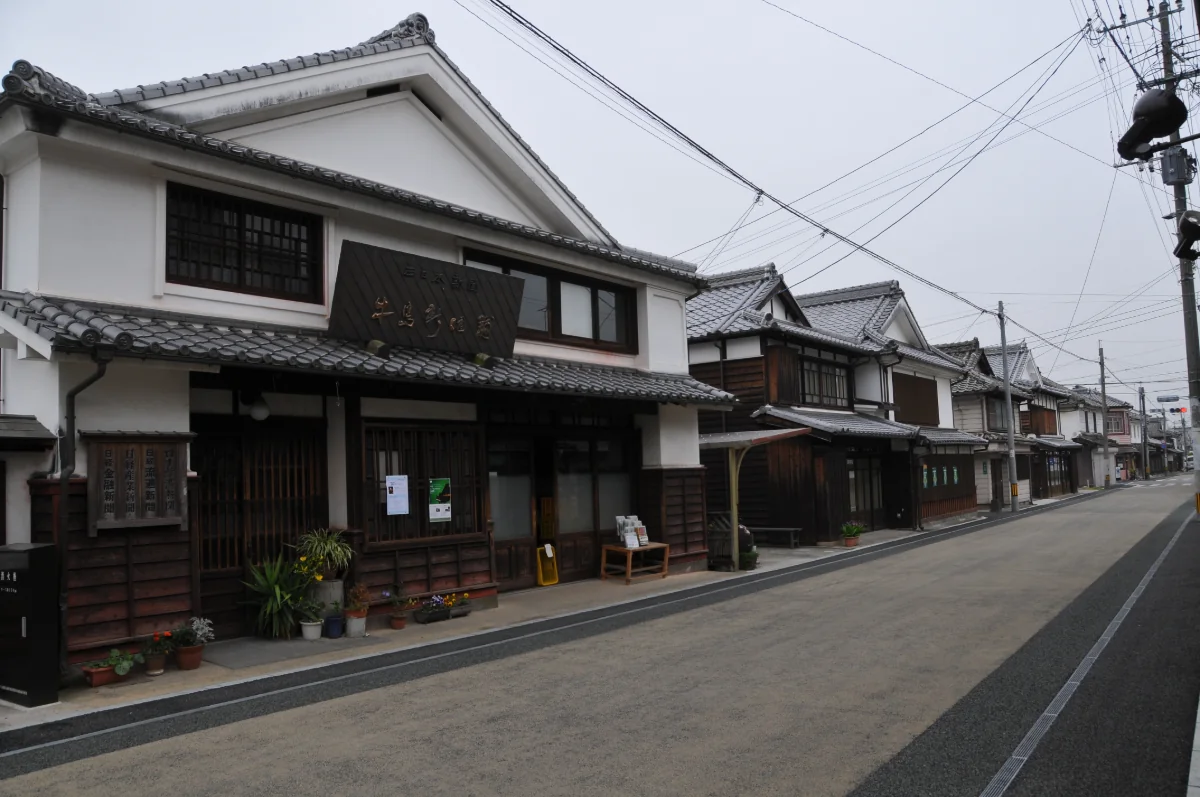
Narrow fronts extend into long plots. A typical ground floor has three or four rooms in a row, with an earthen passage running beside them from front to rear. A courtyard faces the reception room; a corridor beside it links toilet and bath, with kitchen, detached reception room and storage further back. Reading the plan explains how street trading, family life and receiving guests occupied different positions.
Some townhouses from the late Edo to early Meiji periods retain double-height spaces used for moving goods. Look up, then compare that height with the frontage width. Merchant needs shaped both horizontal passages and vertical space. In public buildings, ask how goods moved and where guests sat as you read the panels. The house becomes more than a front-elevation photograph.
Roads changed the houses too. Widening in the mid-Meiji and early Showa periods cut back road-facing eaves and altered ground-floor fronts. More original features survive upstairs. If shopfront and upper storey differ, pause to compare them rather than hurrying to the next house. The street’s changes are visible there.
Curved roads and waterways retain the castle town’s framework
Fukushima’s white-walled district began as the town below Fukushima Castle. Merchant land between the approach road and castle moat was divided into long narrow plots. After the castle was abolished in 1620, Fukushima continued as Yame’s transport and economic centre. Read long plots, bending streets and waterways left by the moat together to place the buildings within their original street conditions.
Later transport shifted activity elsewhere. From the Meiji period, the national road, horse tramway from Hainuzuka and electric tramway towards Kurume made Dobashi a gateway. As motor roads and ring routes developed, commerce gradually moved outwards, leaving many traditional townhouses along the old road. After seeing merchant interiors, compare the street’s scale with modern main roads.
Yokomachi Machiya Exchange Centre: read the district, then choose your tea
Yokomachi Machiya Exchange Centre is at 94 Motomachi, Yame. It opens 10:00–17:00, with historical information, rest space and details of local activities and shops. It is about 10 minutes on foot from Fukushima bus stop. Normal closure is Monday, moving to the following day when it is a Japanese holiday, plus 28 December–4 January. It makes a useful first indoor stop in the district.
The Yame tea café’s susuricha uses a lidded bowl for slowly brewing and sipping drops of tea. At the end, the leaves are eaten with vinegar and soy sauce. Drinking the infusion is followed by a separate step of eating the leaves.
How the public townhouses survived
Sakaiya’s public access is directly linked to local preservation. The Kinoshita residence was donated to the city in 1988, restored and opened in 1992. A major typhoon in 1991 damaged townhouses and led to demolitions, drawing residents’ attention to the threat of losing the street one building at a time. Later preservation had to deal with roofs, walls and woodwork while finding new uses for vacant houses.
The Exchange Centre opened in May 1997, and Fukushima was selected as an Important Preservation District for Groups of Traditional Buildings in May 2002. Today, the result extends beyond rows of façades. Public buildings let you read plans and construction details, while houses still used as shops or homes remain part of the street. Concentrate interior visits on public buildings and enter businesses only within the areas each opens to customers.
Sakaiya: Yakusugi cedar and rosewood in a detached reception room
The Kinoshita family brewed sake from the Edo period under the business name Sakaiya. Its detached reception room, completed in 1908, received and accommodated distinguished guests. City-listed details include a transom made from a single Yakusugi cedar board and a rosewood alcove frame. Look first at the transom above, then down towards the base of the tokonoma alcove. The positions of these components explain the guest room’s arrangement.
Sakaiya is at 184 Motomachi, about 12 minutes on foot from Fukushima bus stop, and opens free of charge from 10:00 to 17:00. Closures match the Exchange Centre: normally Mondays, the deferred day after a holiday Monday, and 28 December–4 January. Reading the district at the Exchange Centre before examining one specific reception room at Sakaiya is an easy sequence to follow.
For ordinary brief photography, avoid occupying rooms or gardens or obstructing others. Call ahead for coming-of-age or pre-wedding shoots. A facility-use application is needed when occupying space. Ordinary visitors viewing woodwork and gardens can enter during public hours without treating a private-use process as a general admission requirement.
SoL beside Fukushima bus stop: lunch within the walking area
Bar & Kitchen SoL is at 425-11 Motomura, Yame. The operator lists it as one minute on foot from Nishitetsu’s Fukushima stop. It serves Spanish food, with lunch 11:30–14:30 and last orders at 13:30. On Thursdays the two townhouses remain open but SoL closes. Friday evening service does not include lunch. It also closes on two Wednesdays each month, making Tuesday, Saturday or Sunday easier for this lunch plan.
The Simple Lunch costs ¥1,650 including tax, with the day’s salad, homemade soup, baguette and paella. For a drink and dessert too, the ¥2,200 SoL Lunch adds two tapas, a choice of paella, the day’s dessert and a drink. The ¥2,860 SoL Special Lunch adds beef skirt steak and replaces dessert with Basque cheesecake.
The restaurant blends rice from Yame and Imari with Spanish seasonings for paella, and uses vegetables, rice and meat from the Yame area. Paella is cooked to order, so choose your main dish when seated. Allow an hour for lunch before walking to the crafts centre.
The separate lunch menu also lists seafood paella at ¥1,210, chicken and mushroom at ¥1,155, squid ink at ¥1,265 and cheese at ¥1,375, all including tax. Reservations: 0943-24-8941.
Traditional Crafts Centre: paper alongside altars, lanterns and everyday objects
Before the paper museum, see Buddhist altars and lanterns at the Traditional Crafts Centre. The tourism association’s indoor route groups Yame Fukushima altars, Yame lanterns, a lantern-figure model, the paper museum and stone lanterns. The figure model is in the folk museum; the golden tea room is visited only when open. This order puts paper beside woodwork, coatings and metal decoration.
The city’s crafts account lists lacquer finishing, maki-e decoration and metal fittings among Yame altar techniques. Wood, metal and surface decoration involve separate work before assembly. The same lacquer and maki-e methods can produce tea utensils, accessories and interior decorations. Look first for material joins, then surface patterns, beyond the overall golden appearance.
Yame lanterns use local handmade paper painted with flowers, birds and landscapes. The booklet shows both hanging and stand-mounted forms. Lighting uses paper’s translucency, light weight and capacity to take shape. When making paper yourself, recall how lantern surfaces carry lines. Paper is a material with thickness, fibres and light effects as well as a writing surface.
The city booklet also lists bamboo baskets, strainers and household goods. Compare fine bamboo containers with paper fans and tea saucers to see how use changes a material’s form. Return to the displays while your paper dries, or choose something useful in the sales area.
Handmade washi: work before the fibres reach the vat
The Yame Handmade Washi Museum is attached to the Traditional Crafts Centre. Alongside demonstrations, visitors can make postcards, bookmarks and fans. The process explanation divides paper-making into preparation, sheet forming and drying, with preparation taking the most time. Before a short workshop, see where the fibres come from so lifting a wet sheet connects with earlier work.
Yame washi mainly uses kozo, locally called kago, taking white inner-bark fibres beneath the dark outer bark. The museum describes soaking, scraping away outer skin and scars, cooking in an alkaline liquid, then repeatedly washing out lye and impurities. Scraping and washing may seem remote from finished paper, but they determine whether clean, even fibres can remain in the vat.
Beating loosens fibre bundles into individual fibres, followed by further dispersal in a machine. The museum specifically explains that this does not crush the raw material to pulp. Follow the change from bundles to dispersed fibres during the demonstration. Once they enter the vat, you can connect the arm movements with the preparation that came before.
Traditional methods add mucilage extracted from tororo-aoi roots to help disperse fibres. The museum explicitly states that it buys a chemical paste with a similar molecular structure. In the workshop, watch the bamboo screen and frame lift a layer of material, then distribute it evenly through movement. Observe material and tools separately, rather than concentrating entirely on final decoration.
Wet sheets are stacked into a paper bed, gradually pressed to remove water, separated, attached to drying boards and finally checked against the light for flaws and thickness. This is the full process shown in the craft explanation. In a visitor workshop, staff dry and finish your design, so collection comes after a further wait.
Kozo’s season and the difference between white and unbleached paper
The museum’s raw-material account begins in winter. Kozo’s current-year branches are cut after leaf fall, when growth has stopped, and useful bark fibres are removed. The half hour visitors spend at the vat uses material already prepared through many steps. Read the scraping, cooking and washing diagrams before looking at the pulp beside the table to understand the work needed before fibres disperse evenly.
The process distinguishes bleached and unbleached methods. White paper is treated and washed after lye removal; unbleached paper skips the relevant step. Both then have remaining impurities picked out before beating. When choosing paper, compare colour, fibres and thickness. Whiteness and surface cleanliness are different observations, and adding a final decoration does not erase the material’s preparation.
October 2026 prices: choose the work and collection time together
New workshop prices apply from 1 October 2026. Four postcards, ten business cards, one square shikishi board or two narrow tanzaku strips each cost ¥1,000. Four postcards are easier to share with friends than one large piece; shikishi or tanzaku leave a single writing space. Decide how you will use the result before choosing.
Two postcards plus four bookmarks, or eight bookmarks, each cost ¥1,200. One regular fan costs ¥1,500; one oval koban-style fan costs ¥2,000. Postcards suit posting or gifts, bookmarks fit easily into a book, and fans need space where they will not be crushed. Each price is for one workshop option, and companions can choose different items.
Listed working time is 30 minutes for 1–12 people and one hour for 24, plus 30–40 minutes for drying and finishing. For a small group, work and drying total about 60–70 minutes, with extra time for registration and movement. Groups of five or more must book through Yame Traditional Crafts Centre on 0943-22-3131. Give the full group size.
Workshop registration runs 9:00–16:00; the building closes at 17:00. With the listed small-group timings of 30 minutes working and 30–40 drying, a 14:00 start gives an estimated collection at 15:00–15:10, plus registration and any on-site wait. The museum suggests seeing other facilities or browsing Tokimeki while waiting. Collect within the same complex, then start walking to Fukushima stop at 16:00.
The museum is at 2-123-2 Motomachi. It closes on Mondays, opening when Monday is a Japanese national or other holiday, and from 29 December to 3 January. The two townhouses begin their year-end closure on 28 December, one day earlier. For a New Year trip including both types of visit, avoid the overlapping closure dates.
Book a two-hour guide for architecture and crafts
The Yame City Sightseeing Guides Association offers a roughly 120-minute Traditional Crafts Centre and eastern townscape route. It begins with craft displays, then visits Sakaiya, Fukushima Hachimangu, the former geisha registry site and Exchange Centre, continuing to the former county office and Railway Park. For town stories alone, choose the roughly 60-minute eastern route. A separate western route focuses on artisan streets.
The tourism association’s plan published in June 2022 lists ¥1,500 per group per hour for up to ten people. For 11 or more, the group rate is ¥100 per person per hour. Meet at the crafts centre’s main entrance and agree a start between 10:00 and 15:00. Apply at least five days ahead on 0943-22-3131. This pays for guiding; paper-making is charged separately by workshop option.
To replace the independent morning walk with a guide, tell the contact about both townhouses and lunch, then agree meeting and finishing points and time at each stop. Request Chinese or another language when applying. The original route ends at Railway Park in the south, while lunch is beside Fukushima stop to the north, so include that transfer.
Buying Yame tea: distinguish origin from production method
Yame Dento Hon Gyokuro has a defined set of production features. The agriculture ministry’s registration lists overhead shading with natural materials, naturally grown bushes and hand picking. The bushes keep their natural form, straw or similar materials shade them before harvest, and new shoots are picked. The name refers to specific cultivation and harvesting methods, so start with the product name on the package.
Yame Dento Hon Gyokuro became Japan’s GI number 5 on 22 December 2015. The GI account places its tea gardens in hill and mountain areas of Yame and surrounding municipalities. Factories first turn fresh leaves into aracha, or crude tea, then refine appearance and aroma into finished tea for sale. Even within Yame-grown tea, you can distinguish tea type, cultivation and processing stage.
The straw and sumaki covering the frames also depend on local making and supply. In the GI account, sumaki is a loosely woven natural cover of straw, reeds or similar materials. The growing equipment itself relies on the region’s craft work and facilities.
Tea utensils bring altar-makers’ lacquer and maki-e to the table
Fukuoka’s tourism association introduces Maruya Sabo at 154 Motomachi, Yame, offering a matcha experience at tables in an earthen-floor space. Its described sequence begins with a bowl made by the host, followed by making a second bowl yourself. Table seating lets people unaccustomed to kneeling participate on chairs. Observe the first preparation, then use the tea scoop and whisk yourself for a different view of each bowl.
The same account identifies the utensils precisely. The natsume holding matcha uses Yame altar-makers’ lacquer and maki-e techniques; bowls come from Yame’s Kazami kiln, with scoops and trays made by local craftspeople. Read these objects alongside the merchant buildings you have seen. Craft then has concrete uses in serving tea, holding it and receiving guests.
Another day centred on tea: Ushijima’s factories and five-tea tasting
For tea processing, Ushijima Tea accepts public factory-tour reservations. Meet at the Yame main shop, 405-4 Tsue, Yame. The basic route visits the first factory, second factory and tea garden before returning to the shop. It lasts about 60–70 minutes and includes one tea tasting and a gift. For groups of fewer than ten, the tax-inclusive fee is ¥700 per person of junior high school age or above. This is a separate tour product, booked apart from accommodation packages.
The shortened route takes about 30–40 minutes, omitting the first factory while retaining the finishing factory, garden and shop tasting. The same small-group fee of ¥700 applies from junior high school age. The difference is content and walking time. If you want to follow crude tea into finished products, the basic route retains both factories for comparison.
The five-tea route adds five Yame teas back at the shop after the basic tour. Total time is about 90–100 minutes, for two to five people, at ¥4,400 including tax per person of junior high school age or above. The shop selects the teas; matcha is excluded. Book basic and shortened tours at least one week ahead, and the five-tea route at least two weeks ahead. Choose what your companions want to do before arranging other buildings.
Normal factory-tour periods are 11 January–20 June and 1 October–20 December, starting at 10:00 or 14:00 on weekdays, with one group per session. Additional weekends or holidays may be available during the new-tea season. Request a reservation through the official factory page’s enquiry form. The shop replies by telephone or email on acceptance. Fix the session in your itinerary after receiving that reply.
Ushijima Tea’s official Japanese-language factory introduction, to accompany the reservation options for a separate day.
Before the factory: season, walking ability and on-site rules
The first factory handles sencha raw material. The second covers finishing, packing, tea bags and powder processing. Outside the new-tea season, visitors normally see stopped machinery in the first factory. The shop places new-tea production from mid-April to around Golden Week. Seeing the machinery’s layout and seeing freshly picked leaves being processed require different date choices.
Ushijima’s first factory processes sencha, not tencha. Leaves from its own gardens go first to a partner tencha factory, then return for grinding. The powder room is viewed through glass, has no stone mill, and machinery may be stopped. If your aim is stone-milled matcha, this tour has different content. For sencha’s initial processing, finishing and packing, the two factories let you compare the work.
All movement between factories and garden is on foot, with no seated rest point along the way. The factories have several level changes, and pushchairs, walking frames and similar aids cannot enter. The upstairs powder-processing area in the second factory requires stairs. With children or slower-walking relatives, use these conditions to decide on the shortened route rather than relying only on minutes.
Bring and wear your own mask in the finishing factory, change into slippers, wear a simple cap and clean your clothing. As a rule, do not carry hand-held items into work areas. Tours normally run in rain or snow; bring rain gear and clothing suited to the temperature. The shop decides on cancellation during thunderstorms or typhoons. Do not drink alcohol before the visit. Arriving more than 30 minutes after the start is treated as cancellation.
During the factory shutdown from 21 June to 30 September, a separate five-tea tasting takes place at the main shop counter. It lasts about 30–40 minutes for two to five people, at ¥3,850 including tax per person of junior high school age or above. Apply by telephone at least two weeks ahead. This version stays in the shop without factory or garden walking and also excludes matcha. It suits those avoiding heat or mainly wanting to compare teas.
The factory meeting point is 405-4 Tsue. Give it a separate day centred on the booked session, with time to arrive early, change shoes and organise belongings.
Turn the times into a usable Fukushima day
Using the 10 November train example, leave Hakata at 7:52, reach Hainuzuka at 8:44, take the 9:31 bus and arrive at Fukushima at 9:52. Walk about 10 minutes to begin at the Exchange Centre. Read its district introduction from 10:10 to 10:45, allow half an hour for streets by Hachimangu, then see Sakaiya from 11:15 to 11:45. Return north to SoL near Fukushima stop for lunch at 12:15, comfortably before last orders at 13:30.
Leave at 13:15, head south and register near the crafts centre at 13:50 for paper-making at 14:00. A small group works for about 30 minutes, then sees craft displays or browses Tokimeki before collecting around 15:00–15:10. After 15:10, allow time for more crafts, rest and packing your work. Start for the stop at 16:00, take the 16:37 bus to Hainuzuka at 16:59, then the 17:13 train to Hakata at 18:26.
In rain, retain both townhouse interiors but shorten photography stops between them. Afternoon paper-making, displays and Tokimeki share the southern complex. If lunch runs late, skip the extra streets and go straight to the crafts centre. A 14:00 workshop still leaves more time for making, drying and returning to the stop than arriving near the 16:00 registration deadline.
Daytime budget and the return journey
The Haya Line’s published fare table revised on 1 October 2019 gives ¥350 at the Hainuzuka–Fukushima intersection, so use ¥700 return on that table’s basis. Four postcards cost ¥1,000 and SoL’s Simple Lunch ¥1,650, totalling ¥3,350 for the three items. With the ¥2,200 SoL Lunch, the total is ¥3,900. Add JR travel from Hakata, tea, other shopping and optional guiding separately.
A few useful answers
How do I get from Hakata to Yame Fukushima by public transport?
Take the JR Kagoshima Main Line from Hakata to Hainuzuka, then change to a Horikawa bus on the Haya Line and get off at Fukushima. For the return via Hainuzuka, choose a bus first and find a connecting JR train to Hakata.
Which day of the week is best for visiting Yame Fukushima?
An ordinary Tuesday works for both townhouses, lunch at SoL and papermaking. Yokomachi Machiya Exchange Centre and Sakaiya close on Mondays, or the following day if Monday is a Japanese public holiday. SoL closes on Thursdays and two Wednesdays a month, and serves no lunch on Fridays.
How long does papermaking at the Yame Washi Museum take, and should I book?
For 1 to 12 people, making the paper takes about 30 minutes, with another 30 to 40 minutes for drying before collection. Groups of five or more must book. From 1 October 2026, making four postcards costs ¥1,000.
How far in advance should I book an Ushijima Tea factory tour?
Book the standard or short tour at least a week in advance. The five-tea tasting needs at least two weeks’ notice, is for 2 to 5 people and lasts about 90 to 100 minutes including the factory tour. Use the online enquiry form for a reply by phone or email.
Official information and references
Sources used in this guide.
- Yame City: Yokomachi Machiya Exchange Centre
- Yame City: former Kinoshita residence (Sakaiya)
- Yame Traditional Crafts Centre: handmade washi museum and October 2026 prices
- Ushijima Tea: factory tour routes and reservation rules
- Yame City: Fukushima townscape history and preservation
- Yame Fukushima Tourism Association: Yame tea café
- Yame City: Sakaiya facility use and photography
- Ministry of Agriculture, Forestry and Fisheries: GI number 5, Yame Dento Hon Gyokuro
- Japan Geographical Indication Council: Yame Dento Hon Gyokuro
- Fukuoka Tourism Association: matcha experience with original Yame utensils
- Yame Traditional Crafts Centre: handmade washi process
- Horikawa Bus: Haya Line timetable
- Horikawa Bus: Haya Line fares
- Horikawa Bus: Kurume Line timetable
- SoL: lunch menu, hours and access
- Yame City: official tourism booklet (crafts, district maps and access)
- Yame Fukushima Tourism Association: guide routes and applications
- JR Kyushu: Hakata–Hainuzuka trains on 10 November 2026
- JR Kyushu: Hainuzuka–Hakata trains on 10 November 2026