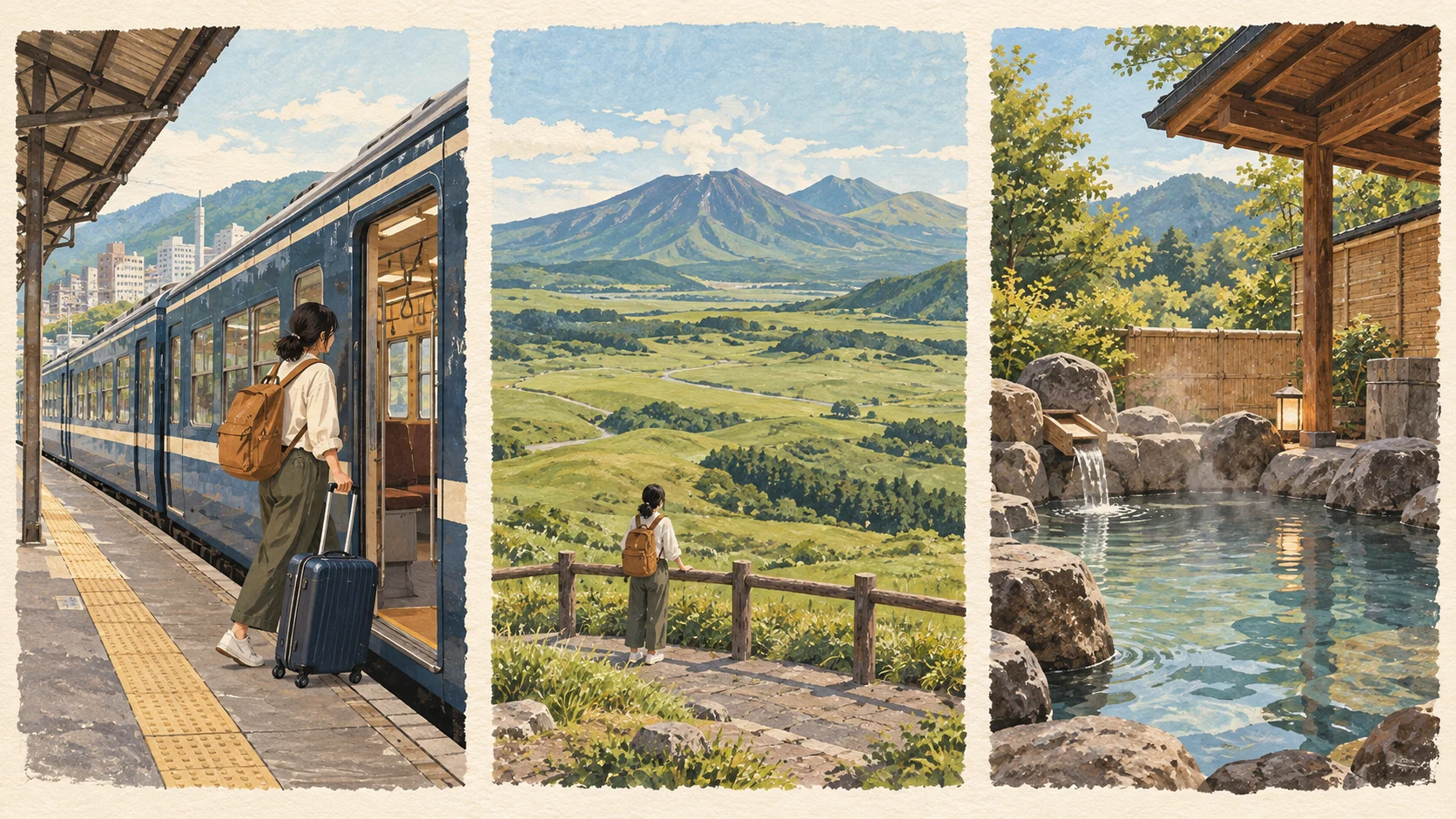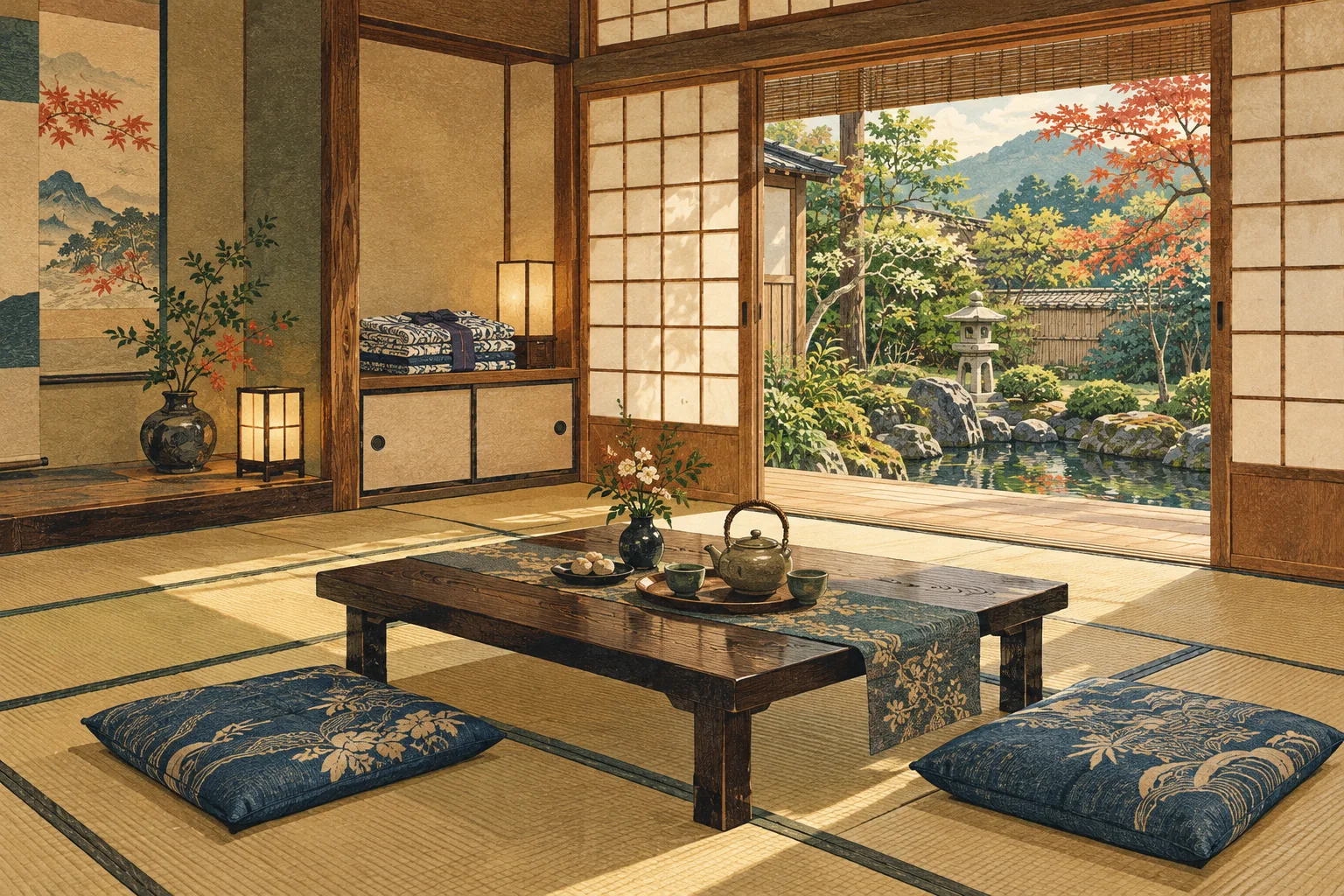
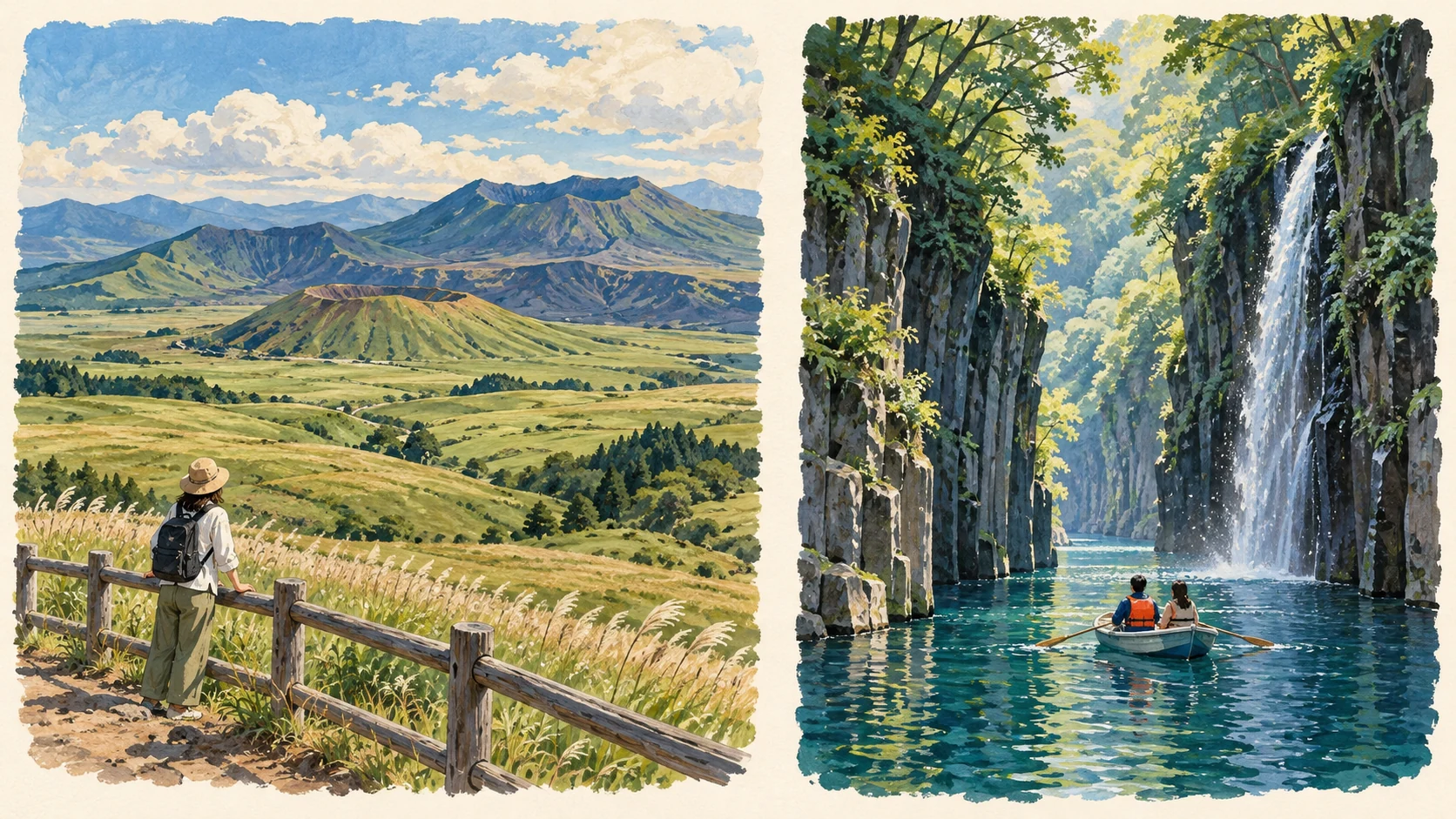
Decide where to stay each night before deciding how far to travel. Kumamoto Castle, Aso’s grasslands, Kurokawa Onsen and Takachiho each deserve proper time. This guide separates public-transport and driving plans, linking current crater restrictions, last buses and boat cancellation rules with named accommodation, meals and two-to-four-day itineraries.
Choose city, grasslands, hot springs or gorge: what two to four days can fit
Kumamoto Castle, Aso and Kurokawa Onsen are in Kumamoto Prefecture; Takachiho Gorge is in Takachiho Town, Miyazaki Prefecture. They may look like one continuous route, but each works to a different rhythm. The castle and restaurants suit a city day; Aso depends on weather and mountain transport; Kurokawa rewards an afternoon ryokan arrival, dinner and bathing; Takachiho revolves around boat slots and the return bus. With only two days, choose Kumamoto plus either Aso or Takachiho. Three days can include a night in Kurokawa or Takachiho. To attempt all four, start with at least a four-day driving plan and accept that restrictions may require dropping stops.
Without a car, use Kumamoto as a luggage base and plan Aso and an overnight Takachiho visit separately, with Kurokawa as an alternative. Driving adds flexibility over stops; it does not remove mountain roads, parking, sunset or ryokan dinner deadlines. If still choosing the wider Kyushu route, use the Kyushu seasons and route overview to decide between northern Kyushu, the mountains and southern Kyushu, then add one of this guide’s day plans.
- For the castle and food: stay in central Kumamoto and keep a full city day.
- For grasslands: make Aso a mountain day that does not depend on crater access.
- For a hot-spring ryokan: stay at least one night in Kurokawa and treat dinner as the arrival deadline.
- For boating and kagura: stay in Takachiho and reserve the boat, room and performance separately.
October 2026 checks: the crater is closed; the castle and gorge have separate notices
As of 22 October 2026, the Aso volcano crater restriction notice shows Volcanic Alert Level 2, prohibiting entry within about one kilometre of the crater. The mountain plaza became accessible again on 2 September; that does not mean crater visits resumed. The Aso day below centres on Kusasenri and areas permitted at the time. Old photographs, outdated shuttle schedules or a plan to “see when we get there” are no basis for entering a restricted zone.
Kumamoto Castle is still being restored, but official notices describe current special access and autumn evening opening. An earlier temporary closure notice is not grounds to say the entire castle cannot be visited. Takachiho’s boat page updates river levels, operations and same-day tickets daily; its parking information may also show individual lots unavailable. Different authorities control these three places. Open each relevant notice the previous evening and again on the day, rather than letting a general forecast of fine Kyushu weather stand in for every check.
Arriving in Kumamoto: distinguish the station, airport and city centre
Kumamoto Station is useful for Shinkansen and Hohi Main Line connections; Sakuramachi Bus Terminal serves long-distance buses; Torichosuji, Shimotori and Shinshigai are convenient for city dining. “Kumamoto” in a hotel name does not put its entrance beside Kumamoto Station. Mark the next morning’s actual boarding point before choosing a room. For an early train to Aso, a station-area stay simplifies departure. For Takachiho-go, boarding at Sakuramachi can avoid an unnecessary journey back to the station.
The Airport Liner between Kumamoto Airport and Higo-Ozu Station began charging on 1 July 2026; its regular fare is ¥200 per person. The official FAQ adds that infants and young children not requiring a seat are included in their caregiver’s fare. Discard older claims that the entire shuttle is free. This leg only reaches the railway station; check onward Hohi Main Line trains to Aso separately. With large luggage, a late flight or little connection time, consider staying in Kumamoto before continuing. If collecting a car and going straight into the mountains, include rental paperwork, vehicle checks, supplies and nightfall in day one.
Choosing a base: one fewer luggage move can matter more than another attraction
Several nights in Kumamoto suit travellers whose plans remain flexible, who want restaurant choices or who will move the Aso day according to the weather. Aso Station, Uchinomaki and Minamiaso are different lodging areas. Aso Station connects with the mountain bus; Uchinomaki suits local meals and hot springs; Minamiaso and Takamori are on another side, with their own onward route to Takachiho. Ask the property for the exact pickup station, booking deadline and arrival service. “Aso pickup” does not mean collection from any station.
Kurokawa suits a stay centred on the ryokan itself, while a Takachiho overnight divides the gorge and kagura between afternoon, evening and the following morning. A couple may accept frequent hotel changes; with children or older relatives, reduce luggage handling and stair-heavy routes. Compare room prices for the same date, party, bedding and meals. Before comparing a low per-person rate with a city hotel’s per-room price, establish whether it assumes two sharing, includes tax and bathing tax, and gives children their own beds.
Kumamoto Castle: restoration-era access is different from a park stroll
Kumamoto Castle’s visitor information lists standard individual admission at ¥800 for high-school students and older, ¥300 for elementary- and junior-high-school students, and free for preschool children. Normal hours from September through the following June are 9:00–17:00, with last admission at 16:00 and last entry to the keep at 16:30; July and August have longer hours. The castle closes on 29 December and may close in severe weather. These are baseline conditions; check newer notices for event extensions and current restrictions.
Allow time for exhibits and restoration work, rather than simply climbing to the highest floor for a photograph. The official special-opening introduction follows the keep’s displays from the Kato and Hosokawa eras through modern history and earthquake restoration. A restored keep does not mean every stone wall, turret and former route has reopened. From Kumamoto Station, board a Line A city tram bound for Kengunmachi at Kumamoto-ekimae and get off at Kumamotojo Shiyakusho-mae, the stop for the castle and City Hall. Then follow the castle’s visitor map, walking along 長塀通り on the castle’s south side toward the bridge 行幸橋 and up the slope 行幸坂 to the South Entrance for the special public opening. The tram stop is not the entrance to the paid area, so allow separate time for walking and admission. This route uses the South Entrance, in line with the weekday rule that entry and exit are through that entrance only. Both South and North Entrances may be used on Saturdays, Sundays and public holidays, but construction can still close the North Entrance; recheck official access information and current notices before leaving. This walking route is assembled from the official map and has not been verified as accessible throughout. With a pushchair or limited mobility, still check slopes, construction areas and available assistance; do not assume a flat shopping-street walk.
A Kumamoto city day: castle in the morning, Josaien and a proper meal afterward
Visit Kumamoto Castle in the morning, when you have more energy for queues, exhibits and walking. Eat at Josaien or in the city centre around midday, then explore Shimotori or Kamitori or take a café break. This is a planning suggestion, not a joint admission package or a route guaranteed to take two hours. If restoration details interest you, shorten shopping time. If your companions have less interest in history, keep the exterior views and one main display.
Autumn 2026 has a specific exception: the extended-opening notice for 2 October–1 November gives hours of 9:00–21:00, last admission at 20:00, with tickets still required for the paid area. This provides an option after a later arrival, but does not imply year-round evening access. If you have booked a kaiseki dinner, check its last seating and meal period first. An evening castle visit before an early mountain departure also calls for sleep; you need not use every extended hour.
What to eat in Kumamoto: spread horse-meat dishes, ramen and taipien across meals
For horse-meat cuisine, compare Suganoya Ginza-dori, on the second floor of Daiwa Roynet Hotel Kumamoto Ginza-dori PREMIER in Shimotori 1-chome. Official lunch hours are 11:30–14:30, with last admission at 13:45, but arrivals after 13:30 can order only à la carte. Dinner is 17:00–22:00, with the final kaiseki order accepted at 19:30. Closing at ten does not mean a complete set dinner can start at nine. The listed seasonal sushi kaiseki is ¥8,800 including tax; menus change seasonally. With a smaller budget, inspect lunch or à-la-carte choices before arriving and discovering the difference in cost.
For Kumamoto ramen, Keika’s main branch in Hanabatacho can fit lunch or dinner after the castle. The operator distinguishes Monday–Thursday, 11:00–24:00; Friday–Saturday, until 1:00 the next day; and Sundays and holidays, only until 16:30. Last orders are ten minutes before each closing time. Sunday arrivals in particular should not assume weekday late-night hours. For another meal, try Kourantei’s taipien, comparing its glass-noodle soup with ramen. Raw horse meat, raw egg and lightly cooked meat may not suit every companion’s needs or preferences. State unacceptable ingredients and cooking levels when reserving, without assuming the restaurant can replace everything at short notice.
Tonkatsu, akaushi beef bowls and snacks: choose by location
Katsuretsutei Shinshigai’s main branch is at 8-18 Shinshigai. Official hours are 11:00–21:30, last orders 21:00, with a holiday closure from 31 December–2 January. It fits meals around Sakuramachi and Shinshigai. If staying near the station, compare the AMU PLAZA Kumamoto branch separately; the branches’ hours are not interchangeable. Opening hours do not promise no queue. When a castle visit, meal and long-distance bus share a day, leave an alternative nearby if you cannot wait.
Reserve an Aso akaushi beef bowl for a genuine Uchinomaki stop. Imakin Shokudo, introduced by Michi-no-Eki Aso, is in the Uchinomaki Onsen area, separate from Aso Station and Kusasenri. Squeezing it into a mountain-bus connection can let one meal dictate the afternoon. Plan it on a Uchinomaki overnight, or choose somewhere serving food along the actual route; do not assume every restaurant offers the same items or cooking level. Josaien and the station market suit smaller snacks from several shops, subject to each shop’s hours and food-storage requirements.
Stays in Kumamoto and Aso: choosing between the castle area, city centre and station
KKR Hotel Kumamoto’s Deluxe Twin Castle View gives a concrete comparison: 31 square metres, capacity for three, an extra bed for the third guest and listed bed width of 120 centimetres. It is a castle-area option, not a hotel above Kumamoto Station. Early train departures still require a journey to the station. Book the actual room name for a castle view; promotional photographs do not show the direction of every room.
The room page says children from infancy through Japanese primary school can share existing bedding free, with meals charged separately. Breakfast is free for preschool children and ¥1,100 for children of Japanese primary-school age. Free bed-sharing does not add a bed or expand a three-person room into accommodation for an unrestricted family size. Give the hotel the adult count, every child’s age, separate bedding needs and meals together, and obtain confirmation that the arrangement is accepted. Cancellation and payment depend on the selected offer; a room introduction cannot guarantee identical terms across sales channels.
To combine dinner and walks around Shimotori and Shinshigai in one city day, compare REF Kumamoto by VESSEL HOTELS, which is actually inside the Shinshigai arcade. Its Standard Twin is 16.7–18.0 square metres, accommodates one or two adults and has two 120-centimetre-wide beds, with the bath and toilet in one bathroom. The official access page gives a walk of about one minute from Karashimacho and an address of Shinshigai 7-2. The entrance is inside the arcade, so vehicles cannot drive up to the door. This suits a stay focused on the dining district, but an early train still requires a trip to Kumamoto Station. The free bed-sharing service for children aged 18 and under includes 18-year-olds and applies only when they share existing beds in the same room as their parents or grandparents. A child needing a separate bed is charged the adult rate; a twin room for one adult and one child is also charged for two adults. The website sets no separate limit on the number of children sharing beds, but still requires checking the bed count, widths and actual arrangement; it does not add beds. Breakfast is free for bed-sharing children aged zero to five; from age six it costs extra and is not included in the booked room rate.
If the following morning is mainly about taking the Shinkansen or Hohi Line, compare THE BLOSSOM KUMAMOTO beside Kumamoto Station. Its Deluxe Twin is 30–33 square metres, accommodates up to three guests and lists the main beds as 120 × 200 centimetres. The third guest uses a sofa bed; the room has a bathroom with a washing area and a washlet toilet, so capacity for three does not mean three regular beds. The official arrival route starts at the station’s Shirakawa Exit, the east exit: head to the separate hotel entrance at the far right of the AMU PLAZA building’s ground floor on your right, then take the lift to reception on level 9. This is different from the shopping centre’s regular entrance. All rooms are non-smoking, with usual check-in at 15:00 and check-out at 11:00. Confirm breakfast inclusion, children’s bed-sharing eligibility and cancellation deadlines for the actual guest count, dates and offer booked; do not apply KKR’s or REF’s terms.
Near Aso Station, compare the South Wing “リニューアルスタンダードツイン” at KAMENOI HOTEL ASO PARK RESORT: 25.9 square metres, two semi-double beds and sofa beds added for three or four guests, with a maximum of four. The bath and toilet are in one bathroom; this is not a room with four standard beds. This is an Aso Station-area base, distinct from Uchinomaki or Minamiaso. The official access page lists a walk of about 15 minutes from JR Aso Station or a free shuttle taking about five minutes, with a reservation required. The hotel FAQ requires booking no later than the day before: confirm with the hotel and check both outward and return departures on the access page, rather than expecting a shuttle after getting off the train. Usual check-in is 15:00 and check-out 10:00. For dinner-inclusive offers, check in by 19:30; breakfast-only and room-only offers allow check-in until 23:00, subject to the particular offer’s terms. If staying out in the mountains until evening, first choose an offer compatible with your return and dinner. The FAQ also requires bedding for children of Japanese primary-school age and older; preschool children may be booked with or without bedding. Contact the hotel before booking if you want to exceed the room’s capacity. Enter children’s ages and meals accurately, and do not infer free bed-sharing from the stated occupancy. Whether breakfast is included depends on the offer, not the room name.
Aso crater: check alert level, volcanic gas and personal eligibility separately
The first condition for a crater visit is that the area is open. Current Level 2 restrictions exclude entry within about one kilometre of the crater, so do not plan a paid crater shuttle or walk into that zone. Even if the alert level later falls, gas concentrations, wind direction and weather can close particular areas immediately. A lower alert level is not permission for everyone to enter at any time. If staff on the mountain direct you to leave or reroute, follow them rather than waiting for the photograph you wanted.
The managing authority’s mountain-visit precautions explicitly prohibit crater visits by people with asthma, bronchial disease, heart disease or who feel unwell. If a companion falls within these restrictions, choose grassland or city activities in advance. A mask, a shorter visit or accompanying friends does not cancel the official prohibition. Kusasenri, the museum and other viewpoints have their own access conditions. Choose alternatives among places reachable that day, rather than taking an arbitrary mountain road because the crater is closed.
Aso without a car: secure the return before deciding how long to stay at Kusasenri
From Kumamoto, check JR Kyushu’s current operations and timetable, then connect at Aso Station with the Aso mountain bus. These are separate services; do not assume the bus will wait for a delayed train. The public transport timetable hosted by Aso City lists a 9:40 departure from Aso Station reaching Kusasenri at 10:06. It can anchor a morning mountain plan, provided your train allows adequate transfer time.
For the main return plan, consider Kusasenri at 15:45, arriving at Aso Station at 16:13. The listed last service leaves Kusasenri at 16:35 and reaches the station at 17:03. These are the municipal timetable’s entries as of the checking date; disruption, full buses and road delays remain possible, and no particular onward train connection is guaranteed. Keep the last bus as a fallback and recheck the stop and service information after lunch. Adding a Uchinomaki meal or Kurokawa overnight means recalculating the whole connection, not deciding spontaneously after Kusasenri.
Driving around Aso and a day that does not depend on the crater
A car lets you adjust stops between Kusasenri, viewpoints and accommodation, but keep one main landscape as the focus. In clear weather, do outdoor activities first and leave lunch and indoor rest for later. In dense fog or strong wind, shorten exposed outdoor time and use an indoor display confirmed open, or move the Kumamoto city day forward. Navigation estimates cover driving; parking queues, walking after arrival and photographs need additional time.
Daikanbo and Kusasenri do not share the same bus route, so a car-free traveller should not copy a driving checklist. If hiring transport for both, confirm whether the vehicle waits, cancellation terms and the final drop-off. In winter, city temperatures do not establish mountain-road conditions. Ask the rental company about tyres and viable routes before collecting the car; change plans if a road closes. Hiring a car is not an obligation to drive into the mountains. For onward travel to Kurokawa or Takachiho, work backward from the accommodation’s latest arrival time.
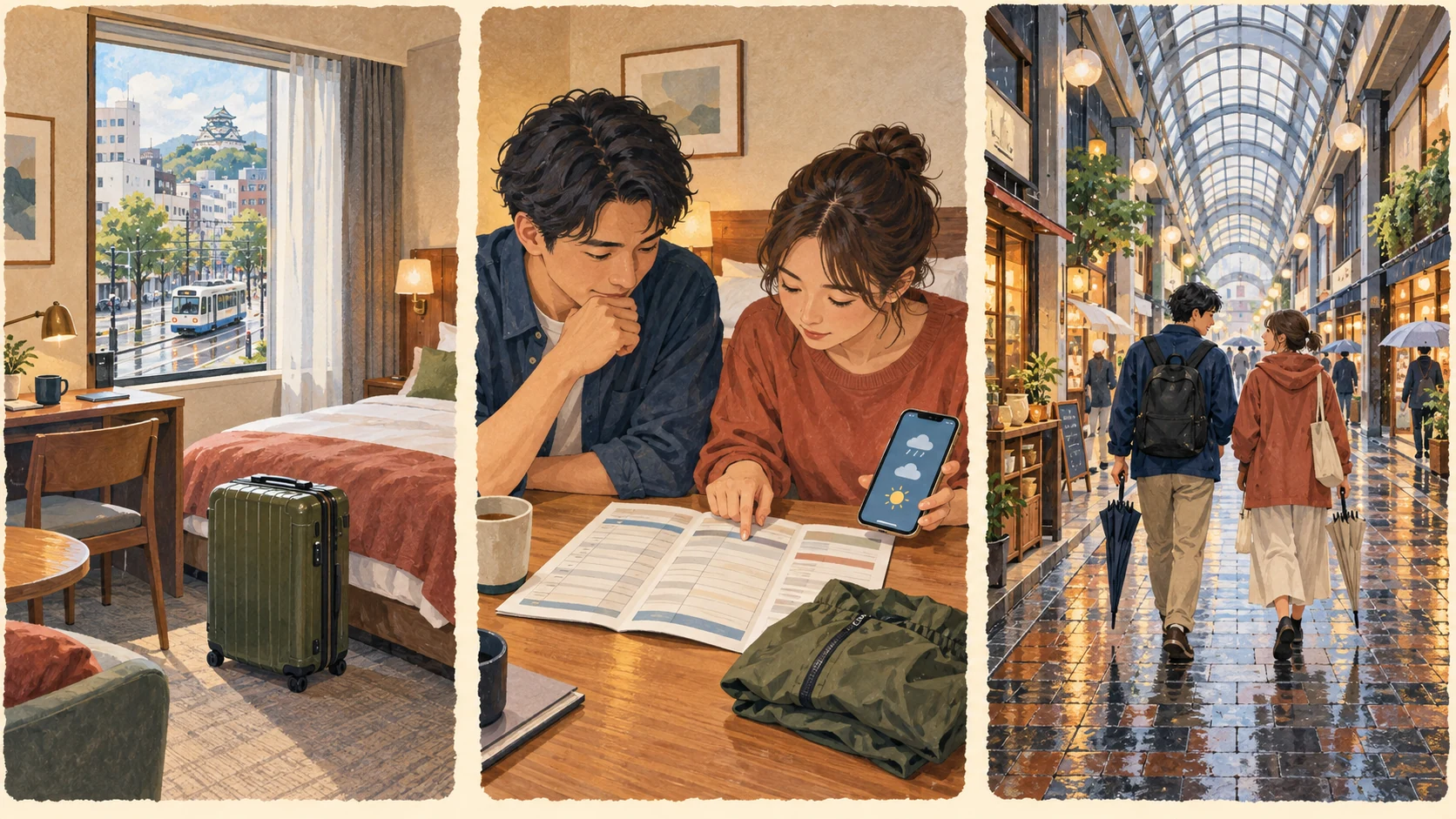
Kurokawa’s bathing pass buys three uses, not unlimited admission
The Kurokawa Onsen bathing pass costs ¥1,500 per adult and allows a choice of three outdoor baths at participating ryokan; one of those three uses can instead be exchanged for designated food, drink or souvenirs. It is valid for six months from purchase and cannot be shared: each person needs a pass. The ¥700 child version covers ages three through the sixth year of Japanese primary school and has its own redemption options. Do not apply the adult product list to the child pass.
The website gives general bath-hopping hours of 8:30–21:00, but maintenance, ryokan arrangements and capacity limits affect individual reception times. Buying a pass in the afternoon does not guarantee access to your preferred three baths. Check that day’s available facilities with the ryokan association or the properties before deciding whether the pass is worthwhile; for one bath, compare single-entry day-use prices. The pass does not include every family bath, in-room bath or hotel facility. Photography is generally prohibited in bathing areas. Take group pictures in public streets instead of bringing a phone into the baths for photographs.
A Kurokawa overnight example: choose Ryokan Sanga’s room and dinner together
The Ryokan Sanga room page helps compare a meaningful difference: whether the room has its own bath. Standard Japanese rooms in the main, west and east buildings measure eight to twelve-and-a-half tatami mats. The east building’s “Ho-no-ki” (朴の木) has two eight-mat Japanese rooms and an outdoor bath; the detached “Nemu-no-ki” (ねむの木) has a ten-mat room plus a bedroom, with cut-stone and outdoor baths. Several baths at the property do not mean every room has a private bath. If you need beds, fewer stairs or bathing inside the room, specify a room type and ask the ryokan to confirm the route to it.
The Sanga cuisine page describes meals in “Kigi no Tsudoi” (木々の集い): breakfast 8:00–9:00, with a dinner start of 18:00, 18:30 or 19:00 selected at check-in. The displayed kaiseki menu is a seasonal example, not a promise of identical dishes on your night. With dinner and breakfast included, treat afternoon arrival as part of the trip. Adding a late Takachiho boat ride can compromise the ryokan dinner that mattered most. Check children’s meals, dietary needs, bathing tax and cancellation against your own package, rather than carrying over another property’s rules.
Kurokawa access and current roadworks: arrange the ryokan transfer beforehand
The official Kurokawa access guide lists the Kyushu Odan Bus from the Kumamoto direction and highway buses from Fukuoka; other combinations may require changes through Aso or Minamioguni. Kurokawa has no JR station at which you can simply step off a train. A rail pass does not automatically solve the final journey. Confirm dates, seat reservations and return services, then ask which stop the ryokan collects from. Transfers may require booking; do not wait beside a road for an unarranged free shuttle.
There is a specific current issue for Sanga. Its 19 October road notice says water-pipe works will fully close a road in Tanoharu from 8:00 to 17:00, 2 November 2026–26 February 2027, except Saturdays and Sundays. From the Oguni direction, follow National Route 442 toward Senomoto, enter Kurokawa’s onsen streets and continue past Kaze-no-ya to the ryokan, using the official detour map. Do not follow a navigation shortcut into the closure. This concerns one road and specified dates, not closure of the whole onsen area.
Kumamoto to Takachiho: a day return is possible, but four hours are not four free stops
The currently valid Miyazaki Kotsu Takachiho-go timetable lists departures from Kumamoto Station at 9:11 and Sakuramachi at 9:22, arriving in Takachiho at 12:34. The return leaves at 16:57 and reaches Kumamoto Station at 19:58. A new timetable from 1 November has been published with these same endpoint times, but some stops and fares change; choose the table for your travel date. Grey-shaded services are marked suspended until further notice. The afternoon Kumamoto departure and morning Takachiho return in those shaded columns are not available alternatives.
The interval from 12:34 to 16:57 looks like four hours twenty-three minutes, but includes transport between the bus centre and gorge, lunch, check-in, sightseeing and waiting for the return bus. A boat slot immediately after bus arrival leaves no margin for congestion. A day visitor can concentrate on the gorge and Takachiho Shrine; add an overnight for Amanoiwato or evening kagura. Book the return seat separately from the hotel and do not rely on finding transport at the last moment. If buses are cancelled or roads blocked, contact accommodation and activities; providers do not all refund automatically together.
Booking a Takachiho boat: confirm the date, group and card before choosing a slot
The tourism association’s boat page normally opens online bookings at 9:00 Japan time fourteen days before a ride and closes them at 9:00 two days before. Payment is by credit card in advance; telephone bookings and waiting lists are unavailable. Weekends and holidays in October 2026, every day in November, and December weekends, holidays and 28–31 December are listed as reservation-only dates. Once online spaces sell out, no same-day tickets are sold for those dates. Even ordinary dates do not guarantee walk-up availability; read the day’s notice.
The official booking portal requires a credit card supporting 3D Secure authentication and payment within fifteen minutes of selecting a slot. Afterward, verify the reservation number on screen and the confirmation email. A card notification alone does not prove a successful reservation; check an uncertain result before making a duplicate booking. Normal capacity is three per boat, rising to four only if the party includes a preschool child. Four adults cannot share one boat. Each reservation is for one boat; follow the system’s process for multiple boats and ensure each has an eligible person able to take responsibility for rowing.
Boat costs and cancellation: rain, high-water closure and changing your own plans differ
Each boat rental is thirty minutes. The official October 2026 calendar lists ¥4,100 or ¥5,100 depending on the date, rather than a single daily rate; overrun costs ¥1,000 per ten minutes. Budget from your chosen date’s display, not another traveller’s weekday screenshot. The rower must be at least junior-high-school age. Do not change rowers, stand, drink alcohol or smoke aboard, and wear the life jacket as instructed. Pets and large luggage are not permitted. Keep out of the area where the waterfall lands; photography must not replace attention to rowing.
The official reservation terms separate the outcomes clearly. Cancellation is free before 9:00 two days before the ride, then costs 100%. Dates and times cannot be amended directly: cancel and rebook; contact the operator to change participant numbers. Ordinary rain without increased river levels may leave boats operating, so a last-minute guest cancellation for rain still follows the fee rules. If disaster or a safety inspection forces closure, the operator notifies customers and processes refunds. Do not cancel yourself merely after seeing a rain forecast and assume the operator-closure refund will apply.
Gorge paths, check-in and parking: a boat ticket does not reserve a parking space
Takachiho Gorge is worth seeing from land even without a boat, but path access and boat operations require separate checks. The association’s October 2026 shuttle notice says part of the footpath is under construction, requiring a detour along the road. Wear suitable walking shoes, watch for vehicles and obey closures. Do not imagine the roughly one-kilometre path as an entirely level, accessible walkway. Boat customers first check in inside No. 1 Oshioi Parking Lot, then continue to the boarding point. Parking the car or reaching the gorge is not completed check-in.
The official parking and seasonal shuttle notice lists No. 1 and No. 2 parking at ¥1,000 each, No. 3 Ohashi at ¥800 and No. 4 Oshikata at ¥500. There are no dedicated boat-rental parking spaces and parking cannot be reserved. No. 5 Taguchino appears as free in the general list, but its live status on 22 October showed it unavailable, so do not treat it as a guaranteed saving. Allow extra walking time from distant lots. The specified-date shuttle does not operate daily and takes cash; check your date before choosing where to park.
Takachiho kagura: the one-hour public performance fits an overnight stay
The official Takachiho kagura guide lists four representative dances at Takachiho Shrine’s Kagura Hall from 20:00 to 21:00, costing ¥1,000 per person, free for children of Japanese primary-school age and younger. Reserved customers can check in from 19:00; same-day ticket reception starts at 19:30. Capacity is limited, so reserve instead of leaving the decision until after dinner. The hall has tatami seating and does not rent chairs. You may bring a cushion or chair that will not inconvenience others; ask ahead about mobility needs.
This public presentation has different participation arrangements from the traditional all-night kagura offered by local communities. The site lists no performances on 31 December and 1 January; 22–23 November normally follow the current kagura festival arrangements. It is not a year-round, every-night guarantee. The Takachiho-go bus back to Kumamoto has already left in the afternoon, so you cannot take that service after a 21:00 finish. A complete kagura evening needs a Takachiho bed, earlier dinner and a confirmed walk or pickup after the show. Online kagura bookings incur a cancellation fee as soon as booking is complete: 10% from booking through two days before, 50% the previous day and 100% on the day. Contact the tourism association to cancel or change dates; changes still depend on spaces. These rules differ from the boat’s free-cancellation deadline.
A named Takachiho stay: check Japanese-room occupancy, children and cancellation together
Hotel Takachiho, at 1037-4 Mitai, offers an eight-tatami Japanese room of 28 square metres for two to three people, a ten-tatami room of 32 square metres for two to four, and a 62-square-metre Japanese-Western special room for two to five. Guests lay out their own bedding in Japanese rooms. If an older companion finds floor-level sleeping difficult, compare rooms with beds rather than choosing solely by floor area. Standard check-in is 15:00 and checkout 10:00, unless the selected package specifies otherwise.
The hotel FAQ permits one child of Japanese primary-school age or younger per adult to share existing bedding free, without bedding, amenities or meals; junior-high-school students pay as adults. Its general cancellation guidance gives 20% three to two days before, 50% from the previous day through arrival day, and 100% for a no-show without contact. Confirm the actual offer and booking channel; do not substitute the boat’s cancellation rules. Staying in Takachiho does not mean the hotel secures boat space: its site explicitly directs reservations to the tourism association and says the hotel does not accept them.
The hotel homepage’s exterior-renovation notice gives a planned work period from 4 January to the end of December 2027. Noise and vibration may occur, while scaffolding and protective sheeting will obstruct views. For a 2027 stay, check the effect on your date and room before deciding whether it suits companions seeking quiet or a window view. These are construction impacts, not an announcement that the entire hotel is closed.
Amanoiwato and Amanoyasukawara: allow another half-day after an overnight
Amanoiwato Shrine and Takachiho Gorge are not in one walkable neighbourhood. The tourism association’s FAQ says town buses are infrequent and serve limited destinations. Check outward and return services together; if using a taxi, arrange the return rather than assuming an empty vehicle will appear. Overnight visitors can put the shrine the following morning and return to the bus centre in the afternoon. On a Kumamoto day return, choose between the gorge and the Amanoiwato branch.
The official Amanoyasukawara introduction describes a roughly ten-minute walk from Amanoiwato Shrine’s West Sanctuary along the Iwato River, with no toilets at the site. This is a one-way walking indication; add the return, worship and rest. After rain or changes in river conditions, follow local access rules. Visit respectfully as a place of worship: do not cross restrictions, move others’ offerings or block the approach for photographs. If a companion cannot manage the riverside path, remain within the safely reachable shrine area.
Two or three days without a car: choose Aso or Takachiho as the main branch
For a two-day, one-night city-and-grasslands trip, arrive in Kumamoto on day one, leave luggage, visit the castle, eat in the city and stay overnight. On day two, match trains and buses for Aso, lunch and a walk at Kusasenri, then take the planned afternoon return. If flying out that day, work backward from airport check-in; Aso and the airport sharing a prefecture does not make the journey short. If time is insufficient, use a city half-day and save Aso for another trip.
For three days and two nights centred on the city and gorge, spend day one on Kumamoto’s castle and food. Take Takachiho-go on day two, visit the gorge or your reserved boat in the afternoon, then have dinner, watch kagura and stay in Takachiho. On day three, choose an Amanoiwato half-day or another gorge walk according to transport, then return to Kumamoto in the afternoon. To replace the second night with Kurokawa, change the entire branch to hot springs: take an available bus from Kumamoto or Aso and return the next day. Do not force both a Takachiho night and a Kurokawa night into a three-day car-free itinerary.
Four days by car: retain a mountain day you can adjust
A four-day, three-night framework can use one night each in Kumamoto, Kurokawa and Takachiho. Day one covers the castle and city. On day two, collect the car and choose Kusasenri or other currently accessible Aso scenery, then continue to Kurokawa in the afternoon. After breakfast on day three, travel to Takachiho, focus on the gorge that afternoon and watch kagura at night. On day four, choose Amanoiwato or go directly back to Kumamoto according to departure time. Every road segment and reservation needs checking; this framework cannot fit every flight automatically.
Day three is the vulnerable point. Kurokawa breakfast, checkout, mountain driving, lunch and boat check-in all take time. Do not book an early boat and force everyone in the car to rush. If Aso weather is poor and the Kurokawa reservation cannot move, drop mountain sightseeing and arrive at the ryokan early. If Takachiho boats close, retain safely accessible land visits and kagura. If changing hotels every night still feels tiring, omit either Kurokawa or Takachiho instead of cutting every stop shorter.
Budget by person, boat and room to avoid underestimating
For two adults, a limited activity calculation is ¥1,600 for two standard Kumamoto Castle tickets, ¥3,000 for two adult Kurokawa passes, ¥2,000 for two kagura admissions and ¥4,100 or ¥5,100 for one thirty-minute boat: ¥10,700 or ¥11,700 in total. This covers only those four activities, excluding accommodation, meals, transport, parking, car-hire insurance and other admission. It is not a four-day trip budget. Two people can split one boat’s cost; do not multiply a per-boat price again as though it were per person.
Use three accommodation columns: city hotel per-room cost, meal-inclusive ryokan per-person cost, and extra charges for children or beds. If dinner is included in a dinner-and-breakfast package, do not budget another restaurant feast for the same meal. For a room-only stay, find a dinner option before nightfall. Cancellation belongs to each booking separately: a refund for a boat rental after operator closure does not remove cancellation fees for cars, tickets or ryokan. Useful contingency money can cover a necessary detour or unexpected transport, rather than leaving every category with no margin.
Check in the right order so a change affects only the necessary part
Confirm arrival and departure points and the number of nights, then choose the main bases. Book accommodation, long-distance transport and timed activities before filling spare gaps with restaurants and minor stops. Save the Aso restrictions page, Takachiho boat status, return buses, ryokan telephone numbers and cancellation deadlines in notes accessible offline. For a first ryokan stay, read the guide to rooms, meals and bathing with your companions so dinner and bedding arrangements do not come as a surprise.
The previous evening, check whether the route works: volcanic and road access, boat operations and transport services. On the day, check execution: meeting point, reception time, parking and return. An old timetable does not replace a current notice, and completing a checklist does not justify a route unsuitable for a companion. Preserve time to see the castle, stop in the grasslands, enjoy a meal and return to an arranged room. Other sights can adapt to weather and energy.
A few useful answers
Can all four places fit into a single day?
It is not a sensible standard itinerary. Transport, activity check-in and ryokan dinners each impose time limits. With two days, choose the city plus one branch; even four days by car require choices.
Can I visit the Aso crater now?
As of 22 October 2026, the official notice shows Volcanic Alert Level 2 and prohibits entry within roughly one kilometre of the crater. Access to the mountain plaza does not mean the crater is open. Recheck the managing authority’s notice before departure.
Should I still visit Aso when the crater is closed?
Depending on that day’s access and weather, you can choose Kusasenri, viewpoints or indoor displays. In thick fog, strong wind or transport disruption, staying in Kumamoto is a complete backup plan.
Can I make a day trip from Kumamoto to Takachiho?
The currently valid timetable shows departure from Kumamoto Station at 9:11, arrival in Takachiho at 12:34 and the return departure at 16:57. Include local transport and check-in time. To watch kagura at 20:00, plan to stay overnight.
When can I book a boat at Takachiho Gorge?
Normally at 9:00 Japan time fourteen days before the ride, closing at 9:00 two days before. Payment is by credit card in advance. Busy dates may have no same-day tickets, and telephone bookings and waiting lists are not accepted.
Will rain entitle me to a Takachiho boat refund?
Boats may operate in rain if river levels have not risen. Cancelling yourself after 9:00 two days before the ride normally incurs a 100% fee. If the operator closes for a disaster or safety inspection, it notifies customers and handles refunds. These are different cases.
Can four people share one Takachiho rowing boat?
Normal capacity is three. Up to four are allowed only when the group includes a preschool child; four adults need separate boats. The person rowing must be at least junior-high-school age.
Can we share a Kurokawa bathing pass as a family?
No: each person needs their own. The adult pass costs ¥1,500 for three uses. The ¥700 child pass is for ages three through the sixth year of Japanese primary school. Check each bath’s admission hours separately.
Does a Kurokawa dinner-and-breakfast stay require an early arrival?
Yes. At Ryokan Sanga, for example, dinner starts at 18:00, 18:30 or 19:00. At other ryokan, confirm the latest arrival and meal times too.
Is the shuttle from Kumamoto Airport to Higo-Ozu Station still free?
Since 1 July 2026, Airport Liner’s regular fare has been ¥200 per person. Infants and young children who do not need a seat are included in the accompanying caregiver’s fare. Rail travel beyond the station is separate.
Check with the source
Schedules, availability and rules can change. These official sources are the place to confirm details before you book.
- Kumamoto Castle | visiting information and admission
- Kumamoto Castle | special opening and exhibits
- Kumamoto Castle | extended autumn 2026 opening hours
- Aso Volcano Disaster Prevention Council | current restrictions
- Aso volcano | crater eligibility and safety restrictions
- Aso City | public transport map and timetables
- JR Kyushu | service information
- Airport Liner | fares and operations
- Suganoya Ginza-dori | meal periods and menus
- Keika Ramen | Kumamoto branches
- Kourantei | taipien
- Katsuretsutei | branch information
- Michi-no-Eki Aso | Imakin Shokudo
- KKR Hotel Kumamoto | Deluxe Twin Castle View
- Kurokawa Onsen | bathing pass
- Kurokawa Onsen | access
- Ryokan Sanga | rooms
- Ryokan Sanga | cuisine and meal times
- Ryokan Sanga | roadworks from November 2026
- Miyazaki Kotsu | Takachiho-go timetable and fares
- Takachiho Town Tourism Association | boats, parking and current calendar
- Official Takachiho boat reservations | payment and cancellation terms
- Takachiho Town Tourism Association | 2026 seasonal shuttle and footpath works
- Takachiho Town Tourism Association | kagura times and reservations
- Hotel Takachiho | room types and occupancy
- Hotel Takachiho | children and cancellation rules
- Takachiho Town Tourism Association | getting around FAQ
- Takachiho Town Tourism Association | Amanoyasukawara
- Airport Liner | fares, infants and travel FAQ
- Hotel Takachiho | exterior renovation notice
- REF Kumamoto: Standard Twin, occupancy and bathroom
- REF Kumamoto: Shinshigai location and access from Karashimacho
- Vessel Hotels: bed-sharing for children aged 18 and under and children’s breakfast rules
- THE BLOSSOM KUMAMOTO: Deluxe Twin and room facilities
- THE BLOSSOM KUMAMOTO: route from Kumamoto Station’s Shirakawa Exit to the hotel entrance
- KAMENOI HOTEL ASO PARK RESORT: named South Wing twin room, occupancy and bathroom
- KAMENOI HOTEL ASO PARK RESORT: walk from JR Aso Station and shuttle departures in both directions
- KAMENOI HOTEL ASO PARK RESORT: FAQ on check-in deadlines, children’s bedding and shuttle reservations
- Kumamoto City Transportation Bureau: tram Lines A and B, routes and stop map
- Kumamoto Castle: official access information and site location