Compare Shinmeikan, Yamamizuki, and Okunoyu from the bus stop and village slopes. Match named room types, cave baths, riverside outdoor baths, private bathing, and meals with an overnight stay or a day trip from Fukuoka or Kumamoto.
- Region & Focus
- KyushuHotels and stays
- Reading Scope
- 31 min read · 18 chapters · 5 Q&As
- Official Verification
- 21 official sources checkedUpdated November 7, 2026
- Key Topics
- Hot springsWhere to stayItineraries
Chapter Route Map (tap any stop)
- Decide whether to spend the afternoon in the village or the valley
- Treat the bus stop, Kaze-no-ya, and Marusuzu Bridge as three separate places
- Store luggage before starting your bath walk
- A short village loop: down from Kaze-no-ya, across the bridge to Shinmeikan, and back
- Shinmeikan: cave baths and village life, with six- or eight-mat rooms
- Shinmeikan day visits: last admission at 14:30, with private baths priced separately
- Yamamizuki rooms: choose beds, an indoor bath, and a river view separately
- Yamamizuki’s riverside and private baths: use the correct reception point
- Staying at Yamamizuki: after heading into the valley, keep dinner at the ryokan
- Okunoyu’s new building: twin beds plus futons, and an outdoor bath without a shower
- Okunoyu’s main building and private baths: compare locations within the property
- Okunoyu dinner: choose between an in-house kaiseki meal and restaurant transfers
- Compare individual bath fees first, and choose one valley bath
- Two days based in the village: arrive at midday, then walk again after breakfast
- Two days in the valley: visit the village before check-in, then stay at the ryokan
- Fukuoka day trips have a short window; an early Kumamoto bus allows two baths
- Plan Yuakari for an overnight stay, around dinner and transfers
- Compare only what you will use, then check the actual reservation
- Quick Q&A
For a stroll through the village in a yukata, start with a centrally located ryokan such as Shinmeikan. For riverside outdoor bathing and a night with dinner and breakfast, compare Yamamizuki or Okunoyu. Put in-room baths, reservable private baths, restaurants, and pickups on the same schedule to see which stay suits your evening.
Decide whether to spend the afternoon in the village or the valley
For a first visit with time to change into a yukata, walk the streets, and buy snacks, a ryokan in the hot spring village is convenient. For riverside outdoor baths and an unhurried evening between your room and the restaurant, choose the valley. The difference is how often you travel between them. Visiting two village baths, heading into the hills at dusk, then returning after dinner for the night scenery divides a restful day into several journeys.
Three ryokan can narrow the choice. Shinmeikan centers on its village location, cave baths, and Japanese-style rooms. Yamamizuki, written 山みず木 in Japanese, suits a stay focused on forest, river views, and time on the property. Okunoyu has a main building, a newer building with rooms offering outdoor baths, and a range of shared baths, so its room and meal-plan differences deserve close attention. If you are also considering Sanga, see its section in the Kumamoto, Aso, and Kurokawa itinerary as another reference for a stay outside the village center.
For one night, plan one bath at another ryokan plus the baths at your own ryokan. Add a second bath at another ryokan only if time allows. Once guest facilities open in the afternoon, dinner, changing clothes, and resting quickly use the remaining hours. Book the room and dinner you want first, then choose baths at other ryokan from what is open when you arrive. That makes it easier to keep a full evening for your stay.
| Ryokan | Room comparison starting point | Bathing and access |
|---|---|---|
| Shinmeikan | Six- or eight-mat Japanese room | Village location and cave baths; last day admission 14:30 |
| Yamamizuki | TB twin; 花水 twin with indoor bath; Type C with stream-facing indoor bath | Upstream valley; day-use reception at Inoya; book bus-stop pickup |
| Okunoyu | Main-building river-side two-room Japanese-Western room; new-building twin with in-room outdoor bath | Futons for guests beyond the first two; no shower at room outdoor bath; free Kurokawa bus-stop transfers |
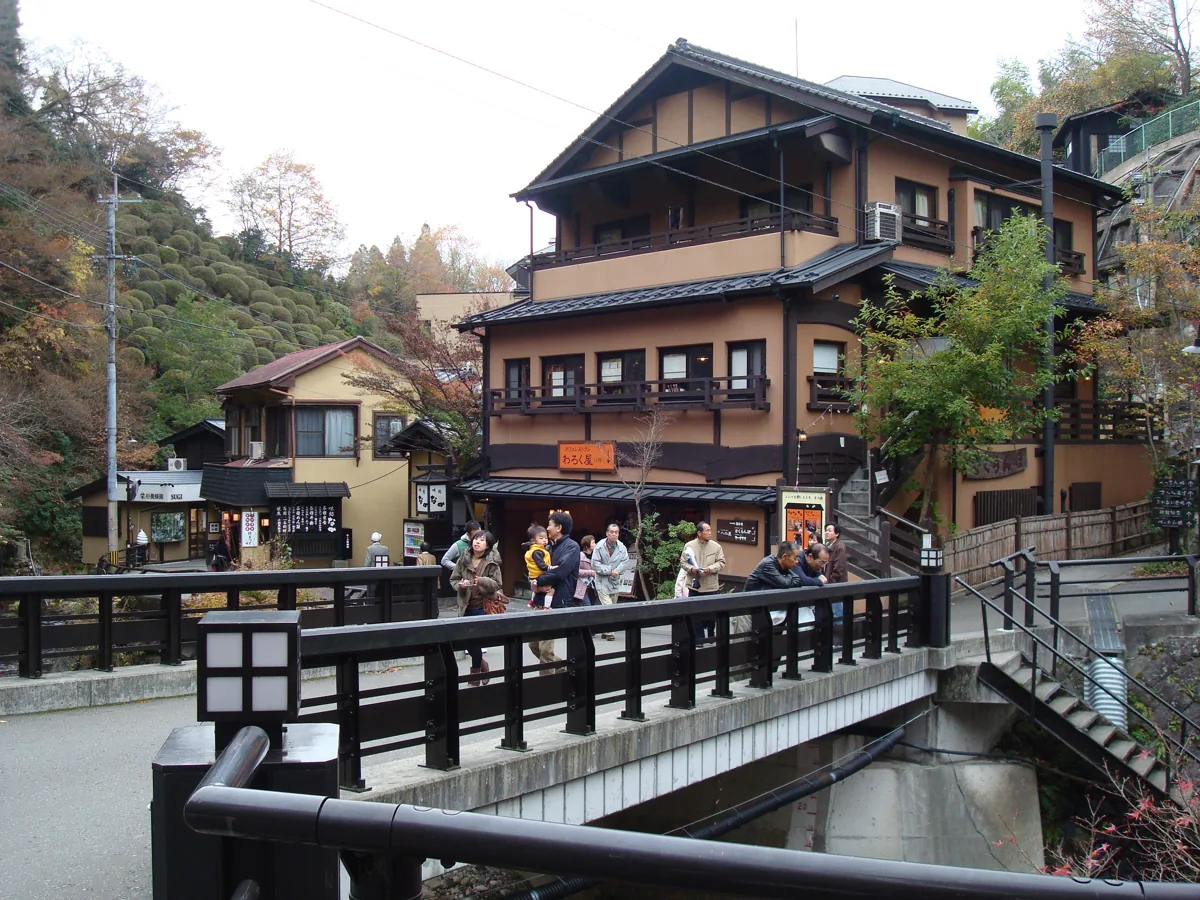
Compare Shinmeikan, Yamamizuki, and Okunoyu from the bus stop and village slopes. Match named room types, cave baths, riverside outdoor baths, private bathing, and meals with an overnight stay or a day trip from Fukuoka or Kumamoto.
Treat the bus stop, Kaze-no-ya, and Marusuzu Bridge as three separate places
Kurokawa Onsen’s bus stop is outside the village. The Kaze-no-ya tourist information center is within the streets, and Marusuzu Bridge is lower down beside the river. The ryokan association FAQ puts the bus stop about 600 meters, or a ten-minute walk, from the information center, with a slope on the way. Use ten minutes to understand the distance. With rolling luggage, rain, or older companions, allow 20–30 minutes to get off, find the route, and store bags.
Walk down from the bus stop toward Kaze-no-ya and Fureai Square, then follow Igozaka down to Kawabata-dori and Marusuzu Bridge. The official village map places Kaze-no-ya, Shinmeikan, and Marusuzu Bridge within the same old-street loop. Yamamizuki is farther upstream in the valley, while Okunoyu lies on a branch toward the upper river. Labeling all of them as one walkable Kurokawa area overlooks the climb from the river back to higher ground.
For the return, following the same uphill route to the bus stop is easiest to judge. Leave the riverside more than ten minutes before departure: you still need to collect luggage, find the stop for the correct direction, and wait to board. Aim to finish village activities 30 minutes before the bus, earlier with large bags. Overnight guests with a booked pickup should use the agreed meeting point instead of taking luggage downhill and back up again.
Store luggage before starting your bath walk
Day visitors can deal with luggage immediately after getting off the bus. The association FAQ lists coin lockers beside the information center and behind the gas station. Small lockers cost ¥100 and large lockers ¥500; both take only ¥100 coins. Large lockers are listed as 44 centimeters wide, 128 centimeters high, and 60 centimeters deep. The information center does not hold luggage, so going to Kaze-no-ya does not mean someone will store bags for the whole group.
If you have a large suitcase and the lockers are full, shorten the day-trip plan until you have found an actual storage arrangement. Small valuables lockers inside bath facilities are for wallets and personal items; they do not replace the village luggage lockers. Before getting off the bus, take out your change of clothes, towel, coins, and onward ticket so you do not need to search a large suitcase at the bathhouse.
For overnight guests, ask about luggage storage before check-in and after checkout when booking the pickup. Confirm where and when to collect it. If the ryokan can meet you at the bus stop and take bags to the property, use that arrangement. If you want to explore first, agree on a pickup at Kaze-no-ya or the bus stop and clarify how you and your bags will meet again. For a valley ryokan, taking everything to the property in one trip avoids retracing the route for a forgotten item.
A short village loop: down from Kaze-no-ya, across the bridge to Shinmeikan, and back
At Kaze-no-ya, check the day’s bath-opening information and choose a facility still accepting day visitors before heading down to the river. The official introduction identifies Igozaka through Shimo-Kawabata-dori as a main walking area. Its shops, slopes, and bridge make a better first-visit route than checking off every ryokan. Walk down Igozaka to Kawabata-dori and Marusuzu Bridge, continue to the Shinmeikan side, then return to the village for food after bathing. Finish at Kaze-no-ya or the bus stop.
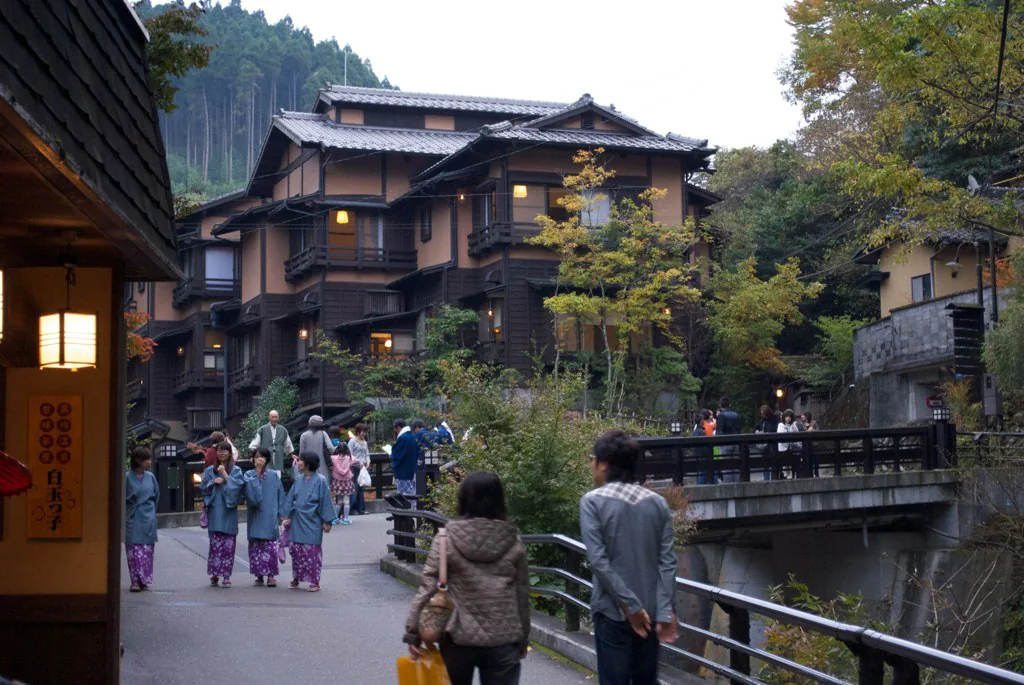
As a sample schedule, allow about two hours: 30 minutes for finding your way and viewing the streets, around an hour at one bath including changing, and the rest for snacks and a break. If you want to browse slowly or companions need longer to change, drop the second bath. Photograph the bridge from a position that leaves the passage clear. Vehicles, guests, and delivery staff also use these narrow streets.
With a wheelchair or stroller, adjust access and pickups first. The association FAQ specifically says Betchinzaka and Igozaka are steep and should be avoided by wheelchair users. Kaze-no-ya has one loan wheelchair, available first come, first served without reservations. If someone needs a wheelchair throughout, first identify a reachable ryokan entrance and indoor route, then add a short accessible street section. Starting high up and pushing downhill creates a harder return.
Shinmeikan: cave baths and village life, with six- or eight-mat rooms
The Shinmeikan room page lists Japanese-style rooms of six or eight tatami mats. The eight-mat room description highlights stream views from the window. This suits travelers who want to focus their budget and attention on the ryokan baths and village walks. If you need Western-style beds, compare Yamamizuki’s TB or 花水 rooms, or the Japanese-Western rooms in Okunoyu’s new building. Six and eight mats identify room types. Enter the full guest count and each child’s bedding needs together when booking.
Shinmeikan’s distinctive feature is its caves. The official site separates the men’s Ana-buro from the women’s Dokutsu-buro, with the Iwato outdoor bath beside the river as another option. To try a cave bath, identify the bath available to you, then choose an overnight stay or day visit. Cave space, lighting, and movement differ from an open riverside bath. Companions who dislike confined or darker places can use another bath and meet outside afterward.
The dining page places dinner in a dining room with an irori hearth. If hearth dining and an evening village walk are your priorities, visit fewer baths at other ryokan on arrival day and leave time to change, return to your room, and sit down on time. Bus travelers can provide their arrival time when booking. The ryokan’s access page lists pickup from Kurokawa Onsen bus stop. Even with a village stay, arranging it helps when you have substantial luggage.
Shinmeikan day visits: last admission at 14:30, with private baths priced separately
The Shinmeikan bath page lists day bathing from 10:30 to 15:00, last admission at 14:30, for ¥500. If you arrive at 12:29 on the first direct bus from Fukuoka, there is still time to get off, store bags, and walk to the ryokan for one bath. A 14:14 arrival does not leave enough margin to squeeze luggage storage, navigation, and changing before the deadline. For a later arrival, use the cave bath after checking in or choose a day-bathing slot the next day.
For private use together, compare the Kajika-no-yu family bath. Day use runs from noon to 15:00, with last admission at 14:30, and costs ¥1,500 for 40 minutes. This is a separate charge from the ordinary ¥500 bath. Ask directly about your group size and available times, then put the confirmed reservation on your schedule. A bath-hopping pass alone does not book this private-bath product.
Overnight guests have longer hours. The Iwato, Dokutsu, and Ana baths run from 6:30 to 22:00; the indoor bath runs from 15:00 to 10:00 the next morning. The Kaze-no-yu private outdoor bath takes reservations from 15:30, with separate men’s and women’s periods in the morning. This is an advantage of staying: after day visitors leave, you can use different baths under the ryokan’s arrangements. Set dinner and private-bath times at check-in before deciding whether to go out, leaving space between each activity.
Yamamizuki rooms: choose beds, an indoor bath, and a river view separately
The Yamamizuki room chart separates these choices clearly. Types A and B are both ten-mat Japanese rooms; Type A explicitly has no stream view. Type C has an indoor bath, faces the stream, and includes a wooden deck. Type G also has an indoor bath but faces the courtyard. If seeing the river from your room is the main use of your budget, start with Type C. If you mainly want your own quiet bath, Type G is another option. Separating an indoor bath from a stream-facing location shows what a price difference buys.

For beds, start with TB: a six-mat Japanese room plus a twin bedroom. For both twin beds and an indoor bath, look at 花水, with an eight-mat room and twin bedroom. The larger Fugetsu has a ten-mat Japanese room, a Western-style room, a twin bedroom, and an indoor bath. Karin and Suichiku list a double bed; Suichiku includes an indoor bath. If two people each need a bed, selecting a room explicitly labeled Twin is more useful than choosing any Japanese-Western room.
Choose sleeping arrangements first, then the view. For two adults who value twin beds and are happy using shared baths, TB is worth comparing. For families or three guests, enter the third person’s actual sleeping arrangement, meals, and age in the relevant plan so the ryokan can match them to the room. Guests with an in-room bath can also use the ryokan baths. Choose one riverside bath you most want to see, then rest in your room, rather than rushing through every pool.
Yamamizuki’s riverside and private baths: use the correct reception point
The Yamamizuki bath page lists the men’s outdoor Yukoku-no-yu and women’s outdoor Mori-no-yu. Day use is 10:00–15:00 for ¥600, with bath-hopping reception at Inoya. Going first to the accommodation desk in the ryokan lobby adds a detour. Mark Inoya on your map to find the correct entrance. It also serves drinks, light meals, and desserts, so companions can use it as a meeting point outside the baths.
The settings differ on the two sides. The men’s Masurao indoor bath connects with the Yukoku outdoor bath. Women reach Mori-no-yu along a wooded riverside path and also have an indoor bath and Fujin-no-yu. Choose this day visit for time with the river, trees, and outdoor bathing. Put cameras and phones away before entering; the official rules prohibit bringing them into the baths. Take permitted photos in public areas and enjoy the river scenery while bathing.
The private Saotome bath is listed separately at ¥2,000 for 50 minutes. Overnight guest hours are 15:00–21:00, with last admission at 20:00. The day-use private-bath listing gives 10:00–21:00, last admission 20:00, from ¥2,000. If private bathing together is the reason for your trip, ask about available slots and the total price first, then arrange transport around them. Ordinary day use of the outdoor baths ends at 15:00. The separate private-bath timetable supports a different plan when that specific product is confirmed.
Staying at Yamamizuki: after heading into the valley, keep dinner at the ryokan
The Yamamizuki access page offers pickup from Kurokawa Onsen bus stop; give your bus arrival time when booking. The official village map places it about two kilometers from the ryokan association. Day visitors coming from the village need to count round-trip transport separately. The association FAQ recommends taxis for day visits to baths away from the center and ryokan pickups for overnight guests. Treating those two kilometers as a short village stroll makes a two-bath day much longer.
A smoother stay has lunch and a short village walk first, then a booked pickup to the property, followed by time at Yamamizuki. If arrival is already close to afternoon check-in, go directly to the ryokan and leave the village for the next day. The dining page says dinner and breakfast are served in semi-private spaces at Hanahenpen. This suits companions who want to take their time over a meal. When booking dinner and breakfast, leave the evening for the property.
Guest indoor baths are open from 15:00 to 10:00 the next day. Outdoor baths, including Mori-no-yu, list 15:00–22:00 and 6:00–10:00 the following morning. Separate an afternoon riverside bath from a morning soak, and decide after dinner whether another bath fits your energy and routine. Write your actual dinner seating time in your confirmation details and finish outings early enough. Review that window before deciding whether a return trip to the village is worth the travel.
Okunoyu’s new building: twin beds plus futons, and an outdoor bath without a shower
The Japanese-Western rooms in Okunoyu’s new building combine an eight-mat Japanese area and a ten-mat Western area. They accommodate two to five guests and have twin beds, a terrace, and a private outdoor bath. With three or more guests, additional people sleep on futons on the tatami. This gives families a clear sleeping arrangement to assess: older guests can use the beds while younger companions use futons. If everyone needs a bed, choose an arrangement with enough actual beds.
There is no shower beside the in-room outdoor bath, so include washing facilities in your plan. If you have children, need to wash your hair first, or want to wash without leaving the room, state the full bathing requirement when booking and choose a room that meets it. You can use the private outdoor bath for a short soak before or after dinner and wash at the ryokan’s large communal bath, instead of trying to do everything in one session.
Accessibility also has a specific limit: the new-building ramp allows a wheelchair to reach the room entrance, but wheelchairs cannot be used inside the room. If a companion needs a wheelchair indoors, help transferring, or bathroom access, explain those essential movements before choosing an accommodating room. If you simply want less outdoor walking, the room’s actual position relative to facilities matters more than floor area alone. Beds and ramps each solve one part of the route; the evening also includes reaching the restaurant and baths.
Okunoyu’s main building and private baths: compare locations within the property
The main-building room page describes rooms close to the large communal and outdoor baths, with mountain-side and river-side options. The river-side, two-room Japanese-Western type has an eight-mat Japanese area and ten-mat Western area and accommodates two to six guests. Japanese-Western rooms have twin beds, with futons added for three or more people. If easy access to the large bath matters more than spending the evening in an in-room outdoor bath, include the main building in your comparison. River-side room options also include Japanese-only and Japanese-Western rooms, so select the bedding configuration you need.
The Ajisai-no-yu, Momiji-no-yu, and Take-no-yu private baths are reserved for overnight guests. The official site lists hours of 15:00–23:00 and 7:00–9:30 the following morning. These give guests in ordinary rooms another way to bathe together. Ask about the day’s use procedure and order at check-in, then fit dinner around them. If a companion will only use private baths, settle the available arrangements when booking. A room with its own bath reduces the scheduling needed on arrival.
Okunoyu also has mixed-gender outdoor, river, and cave baths that become women-only from 20:00 to 22:00. A separate women-only outdoor bath is available as well. Women who want the riverside bath can use that window after dinner, while men choose another permitted bath during those hours. For different settings within one property, there are already several options here, so you can visit one fewer bath at another ryokan that afternoon.
Okunoyu dinner: choose between an in-house kaiseki meal and restaurant transfers
The current Okunoyu dining page lists both countryside-style kaiseki and Au Kurokawa restaurant options. In-house meals use table-and-chair seating in the main-building dining room. Breakfast can start at 8:00 or 8:30. Au Kurokawa involves a ryokan transfer to the restaurant; the page lists Japanese restaurant Shoryu, French restaurant KAZANE, Kumamoto pork specialist Tonkou, and Akaushi beef specialist Aka. Check the selected dinner venue when booking to know whether the evening stays on the property or includes a drive and a reserved restaurant seating.
Families should distinguish the meals carefully. In-house kaiseki lists children’s meals for preschool and elementary-age children. To have the adult meal, book the child as an adult. Au Kurokawa says it has no children’s meals and serves the same meal as adults. Restaurant rules and allergy arrangements depend on each restaurant plan. If a child needs an early meal, different portions, or dietary adjustments, resolve these while choosing the plan. A room that sleeps five does not settle the dinner arrangements for all five.
The in-house dining page also states that vegetarian meals, reduced-salt meals, and changes for food preferences are unavailable. Stock, seasonings, or trace allergens that are difficult to remove cannot be fully accommodated. If these needs determine whether you can stay, choose accommodation with an established suitable meal arrangement. The ryokan changed booking systems on August 3, 2026. Reservations made on or before August 2, 2026 must be viewed, changed, or canceled through the old portal. Use the official migration notice to find that original booking.
Compare individual bath fees first, and choose one valley bath
For ordinary day use at Shinmeikan and Yamamizuki, the adult total is ¥1,100. Shinmeikan plus Okunoyu costs ¥1,200. Both are below the ¥1,500 adult bath-hopping pass and avoid a detour for a third use. If you already intend to take a third bath or redeem a product, include the pass in the same comparison. Read the full terms on the official pass page and choose based on what you will actually use.
Yamamizuki and Okunoyu are both upstream, but each has its own entrance and reception. Bathing at both before returning to the village adds journeys and changes of clothes. For a day trip, choose one village bath plus one valley bath. For an overnight stay, choose one bath at another ryokan plus your own ryokan’s baths. At Yamamizuki, Inoya can be a meeting point for companions who do not bathe. If everyone simply wants a walk and tea together, use a village bath and save the valley for a future stay.
Okunoyu lists day admission from 8:30 to 14:00, with exit by 15:00, at ¥700 per adult. It has irregular closures on Mondays and Fridays. Day visitors driving must use the designated bath-hopping parking lot; parking within the grounds is for overnight guests. Its 14:00 admission cutoff and Shinmeikan’s 14:30 cutoff determine the order. If visiting both, prioritize the earlier deadline and check the day’s bath-opening information before setting out. If one closes unexpectedly, choose another bath instead of spending the visit waiting outside.
Two days based in the village: arrive at midday, then walk again after breakfast
For a departure from Hakata, the current Sanko timetable lists a 9:53 departure from Hakata Bus Terminal, arriving at Kurokawa at 12:29. At Shinmeikan, use your agreed pickup or storage arrangement, have lunch and a short walk, and save its bath for after check-in instead of using the day-bathing slot before 14:30. If you want another ryokan’s bath, choose one still admitting visitors and leave enough time to return. An early arrival leaves room for a bath at another ryokan; a road delay is a reason to go straight to your accommodation.
As an example, if your plan allows check-in at 15:00 and dinner is at 18:00, leave 15:00–17:00 for the room, baths, and rest. After 17:00, change, return to the room, and get ready for dinner. Replace both example times with those on your own booking. For a short walk after dinner, stay with familiar riverside paths and streets. Use your ryokan’s return arrangements and bath hours to decide when to finish.
The next morning, eat breakfast before checking out and fit shopping into a confirmed luggage-storage window. For the 14:00 bus back to Fukuoka, aim to finish by 13:20, collect bags, and start toward the bus stop around 13:30. A distant bath after noon can squeeze this margin. For an earlier return to the city, choose 11:00 and keep the morning to breakfast, packing, and a direct transfer. Either version preserves the previous evening.
Two days in the valley: visit the village before check-in, then stay at the ryokan
For Yamamizuki or Okunoyu, combine Kaze-no-ya, Marusuzu Bridge, and lunch into one outing before check-in, then book an afternoon transfer from an agreed meeting point. After a 12:29 arrival, allow until about 14:30 for the village and use the pickup time confirmed by the ryokan. To add a village bath, shorten shopping after lunch. With a 14:14 arrival, go straight to the property and leave the village walk for the next day.
At Yamamizuki, start with the riverside outdoor bath after check-in, have dinner at Hanahenpen, then choose an indoor or in-room bath the next morning. At Okunoyu, new-building guests can use their room’s outdoor bath first; others can ask about private baths before dinner under their chosen in-house or Au Kurokawa plan. If dinner includes a restaurant transfer, keep village travel after the meal to a minimum. Each version leaves one main afternoon activity, with room for weather or a delayed pickup.
Choose a departure after breakfast the next day. At Okunoyu, an 8:00 breakfast still leaves packing, payment, and a transfer before the 10:00 bus to Fukuoka. For an unhurried meal, choose 11:00 or 14:00 and arrange post-checkout luggage storage in advance. Travelers returning to Kumamoto can also use an afternoon bus and spend the time after checkout in the village. Do not lose the breakfast and rest you wanted just to take an early bus, only to wait for a room again in the city.
Fukuoka day trips have a short window; an early Kumamoto bus allows two baths
The first Fukuoka bus arrives at 12:29, and the last return leaves at 14:00. That is a 91-minute window before getting off, walking both ways on slopes, and waiting to board. It suits one bath near the village or a short walk. For Shinmeikan, be ready to leave the water and change by 13:15, then head back uphill. Lunch, a full village visit, and valley outdoor bathing do not fit. To have the later afternoon and evening, stay one night.
A Kumamoto day trip gives more daylight. The current Kyushu Odan Bus timetable lists a 7:23 departure from Kumamoto Station arriving at Kurokawa at 10:15, with a return option at 15:25 arriving at Kumamoto Station at 18:03. Use 10:15–11:00 for bags and entering the village, bathe around 11:00, then have lunch and walk. For a valley bath too, arrange a taxi in advance and put the second visit before its 14:00 admission cutoff, starting back toward the bus stop after 14:30. This two-bath version needs clear transport in both directions. If a taxi is unavailable, stay in the village.
The 16:25 return is another option, but it does not support a plan to leave a ryokan in the early evening. Dinner and winter illuminations occur later, so an overnight stay gives the full window. The Fukuoka route uses reserved seats, and departures from Kurokawa must be booked by 19:00 the previous day. Reserve your return before the trip so bathing fits a known seat and service. If the timetable changes for your date, select buses from the operator’s current page.
Plan Yuakari for an overnight stay, around dinner and transfers
As of October 27, 2026, the official Yuakari page still listed the previous season, December 20, 2025–March 31, 2026. For the next winter, choose a suitable overnight stay first, then fit the lights before or after dinner when the new season is announced. The location determines the distance at night: village guests can take a short walk, while valley guests need to include travel both ways and the available pickup hours.
The previous season included areas from Marusuzu Bridge to Kawabata-dori, with bamboo ball lanterns beside the water and through the streets. For a nighttime riverside walk, learn the route by day and choose a short stretch that suits your companions. That avoids finding a long route in the dark. If dinner is late, ask about time to go out beforehand. If going afterward, settle both the pickup and return method before deciding how far to walk.
An overnight onsen stay also works outside winter, with the main time devoted to baths, your room, and meals. In rain, shorten street walks and rest more at the ryokan. For winter driving, follow the property’s access information, prepare snow tires or chains, and use passable roads. Wear shoes suited to slopes for bath hopping. Even after changing into a yukata, keep your own jacket and shoes for a longer or nighttime walk.
A Yuakari video released by the Kurokawa Onsen Ryokan Association in 2018, showing bamboo lanterns and the village streets on winter nights.
Compare only what you will use, then check the actual reservation
For two adults using only Shinmeikan’s ordinary bath, bathing costs ¥1,000 total. If both use Shinmeikan and Yamamizuki, the total is ¥2,200. Two adult bath-hopping passes cost ¥3,000. These figures cover bathing only; add lockers, lunch, and any valley transport. List private-bath fees separately with the confirmed guest capacity and time slot, then compare them with the premium for an in-room bath.
Compare stays for the same date and complete guest count: Shinmeikan with a Japanese room, dinner, and breakfast; Yamamizuki’s TB or 花水; and Okunoyu’s main building or a new-building room with an outdoor bath. Record the total price, sleeping arrangements, dinner venue, and cancellation deadline. Date-specific searches reflect weekends, holidays, and children’s combinations better than a generic nightly figure. A weekday starting rate per person for two sharing cannot simply be multiplied into a family budget for another date. In the same inquiry for a pickup, include your arriving bus, number of bags, and return journey.
Keep the Japanese room name, meal plan, all guests, private-bath arrangements, and the actual portal for changes or cancellations. If transport changes, contact the ryokan about that evening’s dinner and pickup first, then amend the booking through its original channel. Charges follow the booked terms. For a first ryokan stay, read the guide to check-in, meals, and bath preparation before departure and explain the practical arrangements to companions, leaving your time on arrival for the stay itself.
A few useful answers
Do I need a bath-hopping pass for a Kurokawa Onsen day trip?
Compare individual fees for the baths you will use. Shinmeikan is ¥500 and Yamamizuki ¥600, totaling ¥1,100. The adult pass costs ¥1,500. Include it in the comparison if you plan a third bath or a product redemption.
Which rooms should I compare for beds and an in-room bath?
Start with Yamamizuki’s 花水 room, with twin beds and an indoor bath, or a Japanese-Western room in Okunoyu’s new building. At Okunoyu, guests beyond the first two use futons, and the in-room outdoor bath has no shower.
Can I visit two baths on a day trip from Fukuoka?
The current first arrival is 12:29 and the last return leaves at 14:00, a window of only 91 minutes. Choose one village bath or a short walk. For the full village and a valley bath, stay overnight.
Can Kaze-no-ya store my luggage?
The information center does not hold luggage. Coin lockers are beside it and behind the gas station: ¥100 for a small locker or ¥500 for a large one, using ¥100 coins only. Overnight guests can arrange storage and pickups with their ryokan.
Have the late-2026 Yuakari dates been announced?
The official event page read on October 27, 2026 still showed the previous season, December 20, 2025–March 31, 2026. Plan the next winter’s illumination visit around its new announcement; compare rooms and dinner arrangements first.
Official information and references
Sources used in this guide.
- Kurokawa Onsen | FAQ: walking, lockers, wheelchairs, and pickups
- Kurokawa Onsen | Village and ryokan map
- Shinmeikan | Six- and eight-mat rooms
- Shinmeikan | Baths, day use, and private baths
- Shinmeikan | Meals and hearth dining
- Shinmeikan | Bus-stop pickup
- Yamamizuki | Named room types and bath chart
- Yamamizuki | Baths, day-use reception, and private baths
- Yamamizuki | Dining at Hanahenpen
- Yamamizuki | Pickups and property access
- Okunoyu | New-building Japanese-Western rooms, bedding, and ramps
- Okunoyu | Main-building room types and bedding
- Okunoyu | Baths and day bathing
- Okunoyu | In-house meals and Au Kurokawa plans
- Okunoyu | Free transfers and winter roads
- Okunoyu | August 2026 booking-system migration
- Kurokawa Onsen | Bath-hopping pass
- Sanko Bus | Current Fukuoka route timetable
- Sanko Bus | Fukuoka route booking deadlines
- Sanko Bus | Current Kyushu Odan Bus timetable
- Kurokawa Onsen | Official Yuakari event page