Compare Fukuichi, Chigira Jinsentei, Kishigon, Kokuya, Oyado Tamaki, Hotel Kogure, Hotel Tenbo and Kanoya by spring source, baths and entrances, with Shibukawa transfers, luggage delivery, half-board stays, private baths and winter logistics.
- Region & Focus
- KantoAccommodation
- Reading Scope
- 22 min read · 10 chapters · 7 Q&As
- Official Verification
- 44 official sources checkedUpdated 22 November 2026
- Key Topics
- Where to stayRyokanHot springs
Chapter Route Map (tap any stop)
- Choosing where to stay in Ikaho: check your departure route first
- Pick Kogane-no-Yu or Shirogane-no-Yu first, then check which bath has it
- Kogane-no-Yu ryokan along the Stone Steps suit different bathing routines
- How to choose between Fukuichi, Oyado Tamaki and Hotel Tenbo for both springs
- Even when a ryokan has parking, check where everyone steps out
- Getting to Ikaho from Tokyo: match your ticket to your ryokan's stop
- Forward bags before climbing the hill, and plan your check-out pick-up point
- Compare half-board rates on equal terms by pairing room and dinner together
- Keep your first evening flexible for rain, ice or early dusk
- Staying one night, two nights or continuing to Kusatsu
- Quick Q&A
If you want to drop your bags the moment you step off the bus on your first trip to Ikaho, start with Oyado Tamaki right by the entrance to the Stone Steps. If you would rather stay along the steps themselves and slip into Kogane-no-Yu before turning in, compare Chigira Jinsentei and Kishigon Ryokan. Fukuichi sits near the upper stretch and feeds both the Golden and Silver springs into its indoor baths. Travelling with a pushchair or anyone with limited mobility? Mark the bus stop, main lobby entrance and bath locations on a map first: Ishidan Street climbs 365 steps, so two properties that look one street apart on a flat map can mean a steep haul with suitcases.
Choosing where to stay in Ikaho: check your departure route first
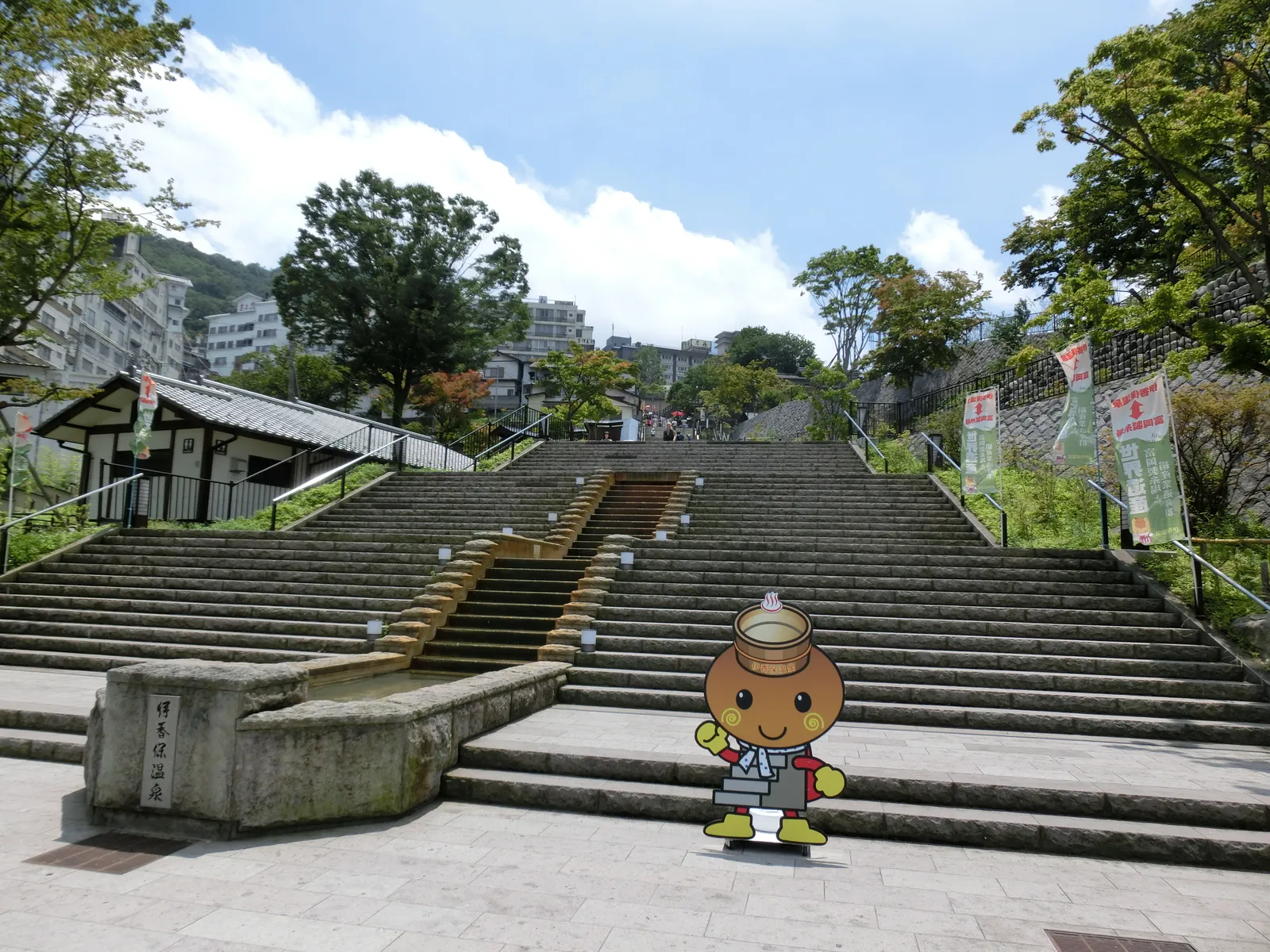
Ishidan Street climbs from the bottom entrance all the way up to Ikaho Shrine. Shops, footbaths and ryokan line the staircase, which makes a pleasant stroll when travelling light, yet on arrival you need the doorway where check-in actually happens. Before booking, locate the road-side main entrance on a map and cross-check the property's access notes, as several ryokan also keep a separate steps-side entrance for pedestrians. Those two doors serve completely different purposes: arriving with wheeled luggage at the staircase side often means facing stone flights or the wrong wing, forcing a detour back onto the road and up another hill.
If you are arriving by expressway bus for a single night, Oyado Tamaki at the foot of the steps is straightforward to plan around. Its official site estimates roughly a 1-minute walk from the Ikaho Ishidangai expressway bus stop. Roll large suitcases through the road-side main entrance, as the property notes that the steps-side approach crosses stairs and a courtyard. On local route buses from Shibukawa, Tamaki directs guests to alight at Ikaho Onsen, about a 5-minute walk away; overnight guests arriving at either stop can also call the ryokan for a shuttle pick-up. Families with young children can have one adult ring ahead while everyone else waits together at the stop.
For stepping straight out into the shops and street life, Chigira Jinsentei and Kishigon Ryokan sit directly along the Stone Steps. Chigira Jinsentei lists both Ikaho Onsen and Ishidangaiguchi as route-bus stops, each around 5 minutes on foot from the ryokan. Kishigon sits right beside the steps next to the free Kishigon Tatsu-no-Yu footbath, making it easy to wander a few landings after dinner and nip back to your room for an extra layer. By contrast, if every outing involves folding and carrying a pushchair, taking transport straight to a road-accessible lobby and keeping evening walks near the bottom entrance is far less tiring.
Fukuichi's Senjukan wing connects to the upper section of the steps; Fukuichi's neighbourhood guide places the property around step 285, with Ikaho Shrine near step 365. That makes it a natural base if you prefer starting walks from the top. When arriving by local bus from town, Fukuichi lists Ikaho Onsen or Ikaho Harunaguchi as the stops for its shuttle pick-up, while drivers can search for Fukuichi Car Park. Picturing where you step off in the evening, which door you carry bags through, and where you board the next morning tells you far more than straight-line distance on a map.
| Ryokan | Location and access | Spring sources | Key booking note |
|---|---|---|---|
| Oyado Tamaki | Beside the Stone Steps entrance, with a road-side main lobby | Kogane-no-Yu & Shirogane-no-Yu | Two private baths allow you to pick the spring source |
| Chigira Jinsentei | Directly along the Stone Steps | Kogane-no-Yu | Four complimentary private baths, used on a first-come basis |
| Kishigon Ryokan | Along the Stone Steps, beside Tatsu-no-Yu footbath | Kogane-no-Yu | Matazaemon-no-Yu runs on gender rotation during renovations |
| Kokuya | Side lane near the Stone Steps | Kogane-no-Yu | Designated bus-stop pick-up; select rooms feature Kogane-no-Yu baths |
| Fukuichi | Upper Stone Steps, with road-side parking | Kogane-no-Yu & Shirogane-no-Yu | Two large baths in the Manyokan wing serve both springs |
| Hotel Kogure | Outside the Stone Steps, with on-site parking | Kogane-no-Yu | Wheelchair-accessible private bath Iyashi-no-Yu |
| Hotel Tenbo | Near Miharashishita, with local town buses to the Stone Steps | Kogane-no-Yu & Shirogane-no-Yu | Wide choice of bath styles and dining plans; pick dinner first for families |
| Kanoya | Towards Yumoto, connected to its car park by a private incline cable car | Shirogane-no-Yu | Annex suites include private Shirogane-no-Yu baths |
Compare Fukuichi, Chigira Jinsentei, Kishigon, Kokuya, Oyado Tamaki, Hotel Kogure, Hotel Tenbo and Kanoya by spring source, baths and entrances, with Shibukawa transfers, luggage delivery, half-board stays, private baths and winter logistics.
Pick Kogane-no-Yu or Shirogane-no-Yu first, then check which bath has it
Kogane-no-Yu (the Golden Spring) is a sulphate spring that emerges clear and oxidises to a rusty brown on contact with air. Shirogane-no-Yu (the Silver Spring) is a clear metasilicic acid water. If this is your first night in Ikaho and you want to compare both waters without trekking between two separate public bathhouses, staying at a dual-spring ryokan such as Fukuichi, Oyado Tamaki or Hotel Tenbo is much simpler. Both Ishidan-no-Yu and Ikaho Rotenburo use Kogane-no-Yu exclusively, so guests booked into a Silver Spring ryokan can visit one of those public baths before check-in to try both springs in a single evening.
Treat any mention of free-flowing source water (gensen kakenagashi) as a detail about a specific tub rather than the entire property. At Fukuichi's Manyokan wing, both Fuku-no-Yu and Ichi-no-Yu offer Golden and Silver waters, yet the ryokan labels water supply and heating bath by bath, alongside distinct private baths for different needs. On any ryokan website, open the onsen section first to confirm which tubs hold the spring you want, then switch to the rooms section and match the exact room name. At Kokuya, for example, open-air bath rooms draw Kogane-no-Yu, whereas the semi-open-air bath in the room named Otowa uses heated tap water even though both listings show photos of a tub.
A private in-room bath lets you soak on your own schedule without dressing for the walk to the communal bathhouse. Still, if you only want one shared session with family, pairing a standard room with a booked private bath often works out better value. Complimentary and paid private baths each have clear strengths: Chigira Jinsentei's four private baths require no reservation, so if they are busy before dinner you can easily try again early the next morning. Paid slots at Oyado Tamaki or Hotel Kogure run to fixed times, which helps when coordinating who showers first or accompanies elderly relatives before dinner. When a booking page lists both a private bath plan and an open-air-bath room, check whether you are paying for a single timed slot or round-the-clock private access.
Oyado Tamaki sets out its bath schedule plainly on its website. Hashibami-no-Yu holds both Golden and Silver waters, while Tamaibuki-no-Yu holds Shirogane-no-Yu, and the two communal bathhouses swap between men and women at 20:00 JST. On the timetable checked in November 2026, men use Hashibami-no-Yu in the afternoon and women enter after 20:00 JST. If everyone in your group wants to experience Kogane-no-Yu, one person can soak before dinner and another before breakfast the next morning, or you can split between an in-room bath and the communal hall on the same day without leaving the property for the rusty-brown water.
Kogane-no-Yu ryokan along the Stone Steps suit different bathing routines
At Chigira Jinsentei, the Jin-no-Yu communal bath reaches roughly 1 metre deep. Anyone who prefers shallower water, needs a handrail, or is travelling with young children should compare the private baths and in-room tubs first. The four complimentary private baths operate from 15:00 to 09:30 JST the following morning on a vacant-entry basis. To avoid rushing before breakfast, check where the private baths sit shortly after arrival and pick a quieter evening hour. For bathing in your room, the website specifies that all rooms in the Tsuru-no-I annex have semi-open-air baths, alongside rooms 155, 156 and 157 in the main building. Architecture enthusiasts can also ask at reception to see the letter written by novelist Tokutomi Roka to an earlier proprietor behind the front desk.
Kishigon Ryokan works well when you treat the bath as the reward at the end of a walk. Coming back along the steps, you can pause at the public footbath outside the front door before heading inside to the panoramic bath or detached bathhouse. If you are booking primarily for a specific private bath, write its name and preferred window into your reservation notes early. Staying right on the main staircase also makes it effortless to slip on a yukata and stroll the middle landings. Drivers are instructed to head first to Car Park No. 4 opposite Ikaho Elementary School (address: Ikaho 321-1), where the ryokan provides a shuttle transfer.
Anyone planning a stay at Kishigon should check the current bath schedule. The ryokan has announced renovations to its Matazaemon-no-Yu communal bath continuing through 31 January 2027, during which the bath operates on alternating men's and women's hours while Gonzaemon-no-Yu and Rokuzaemon-no-Yu remain open as normal. Additional demolition work is scheduled for 24 and 25 November 2026 between 10:00 and 15:00 JST. If checking in on those dates, plan lunch or a walk up the Stone Steps first and enter the building after 15:00 JST.
Kokuya sits down a lane branching off the main road, giving it a road-side main entrance with free on-site parking. Drivers should enter the entrance coordinates published on Kokuya's access page (36.497165, 138.918563) rather than relying on the street address, which can route satnavs to the rear door. Guests taking Kan-etsu Kotsu buses from Shibukawa alight at Ikaho Onsen. Kokuya also notes a pick-up arrangement for guests arriving on the 14:42 JST expressway bus at Ikaho Ishidangai who call upon arrival; late arrivals are better off approaching via the road side or taking a taxi to the front door.
All three of these properties serve Kogane-no-Yu, so price differences largely come down to bath facilities and room types. For a bath overlooking the changing sky, Kokuya offers a private panoramic open-air bath for overnight guests at ¥2,200 for 50 minutes between 15:00 JST and midnight, bookable by phone from 10:30 to 18:30 JST. Because it has no showers or washing area, wash beforehand in your room or a bathhouse that has washing stations. Note also that Kokuya does not permit infants still in nappies in the communal baths, so compare private-bath and in-room-bath options before booking with toddlers.
How to choose between Fukuichi, Oyado Tamaki and Hotel Tenbo for both springs
Fukuichi suits travellers spending their first evening at the upper end of Ishidan Street. Stepping out of the Senjukan wing's steps-side exit puts you straight onto the higher shops and the path to the shrine. When planning routes between both springs, the communal baths and breakfast, pay close attention to which wing your room is in. Both communal baths in the Manyokan wing carry Kogane-no-Yu and Shirogane-no-Yu, whereas guests staying in other wings must walk through indoor corridors to reach them—booking directly in Manyokan is easier for older relatives who tire quickly. Fukuichi also announced in 2026 that its Kogane-no-Yu private bath Fuwari was suspended due to earthquake-related equipment damage, a notice still standing when checked in November, so plan around the open communal baths or compare Oyado Tamaki if a private Golden Spring bath is essential.
Oyado Tamaki separates its two paid private baths clearly by spring and setting. The indoor stone bath Koharubiyori uses free-flowing Kogane-no-Yu at ¥3,300 for 50 minutes, while the open-air Akari uses circulated Shirogane-no-Yu at ¥2,200 for 50 minutes and is capped at two or three guests. Indoor bathing is much easier if you dislike cold draughts or need to dry and dress young children, whereas an in-room Shirogane-no-Yu bath lets you enjoy open-air soaking in chilly weather at your own pace. Tamaki also differentiates its tattoo policy by facility: tattooed guests may use the paid private baths or rooms with private baths, and small tattoos completely covered by a patch are permitted in the communal baths.
Hotel Tenbo stands near Miharashishita, around 5 minutes on foot along the hotel's marked path from the Kan-etsu Kotsu bus stop. Its FAQ estimates roughly a 20-minute walk to the Stone Steps, though during the day you can hop on the local town bus from Nashinokizaka outside the hotel to Kayu—listed by the hotel at around 6 minutes and ¥200 one way. Doing the Stone Steps with the family in the morning and returning in the afternoon for baths and dinner saves far more energy than forcing an uphill walk after dark. On site, Tenbo has the Tenbare grand bath and an underground rock bath; the underground bath rotates between men and women, so fit that slot into your schedule as soon as you receive the daily timetable at check-in.
Families choosing Hotel Tenbo should match the meal plan to their children's routine before worrying about bedding or tubs. Tenbo offers buffet plans alongside kaiseki courses, so check both adult and child meal options carefully to ensure everyone eats in the same dining hall. According to the hotel FAQ, children not yet toilet-trained cannot enter the communal bath pools; consider requesting a baby bath or booking a private bath instead. Adults wanting to try both the indoor rock bath and open-air pools can simply take turns while the children rest, rather than keeping the whole group waiting outside one bathhouse.
Even when a ryokan has parking, check where everyone steps out
Hotel Kogure sits away from the main Stone Steps, making it a strong pick for guests who plan to spend most of their stay unwinding indoors. The hotel lists roughly 300 free parking spaces and invites guests to check at reception before parking on arrival. Approaches to the communal baths involve escalators or stairs, so wheelchair users can turn to the step-free private bath Iyashi-no-Yu, which features a wheelchair-accessible toilet and free-flowing Kogane-no-Yu water at ¥3,300 for 60 minutes for up to four guests (booked by phone). If someone in your party needs transfer assistance, check bath photos or call ahead to ask about rim height and grab-rail placement before deciding how many helpers are needed and how many slots to reserve.
When travelling across generations with a motorised wheelchair, elderly relatives and young children, trace every threshold between the room and the bathhouse. Chigira Jinsentei can set out an entrance ramp and lends wheelchairs and shower chairs, though its rooms and baths span multiple floors. Before confirming a reservation, tell the ryokan directly how many steps a guest can manage, whether a wheelchair folds, and whether bedside transfer space is needed—simply asking if there is a lift rarely covers the bathroom doorway or how many carers can turn inside once the door shuts. Families booking two separate rooms should also ask where the rooms sit relative to each other to cut down late-night trips down the corridor.
Towards Yumoto, Keifuryu no Yado Kanoya links its dedicated car park to the main building via its own short incline cable car. Drivers are advised to search first for the Tokutomi Roka Memorial Museum of Literature and continue roughly 400 metres further to reach the private car park before riding the cable car down to reception. Note that this is entirely separate from the municipal Ikaho Ropeway, which climbs from Hototogisu Station to Miharashi Station. Kanoya suits guests arriving by car who want a quiet woodland setting, and the Sora-no-Niwa annex pages match specific room names to Shirogane-no-Yu private baths and views. Anyone bringing a pushchair or needing step-free routes should ask in advance whether a wheelchair fits inside the incline car and what thresholds lie between its lower station and the guest rooms.
Getting to Ikaho from Tokyo: match your ticket to your ryokan's stop
From Tokyo Station, take the Joetsu or Hokuriku Shinkansen to Takasaki, change to a local train stopping at Shibukawa, and board a Kan-etsu Kotsu bus outside Shibukawa Station. Chigira Jinsentei's access guide puts actual riding times at roughly 50 minutes to Takasaki, 25 minutes to Shibukawa and 30 minutes up to Ikaho—1 hour 45 minutes on board before counting transfer waits and navigating stations with bags. From Ueno or Omiya, the all-reserved Kusatsu-Shima Limited Express runs directly to Shibukawa to meet the bus. Look up the bus departure first and plan your rail connection backwards from a comfortable transfer window rather than picking a train out of Tokyo at random.
Kan-etsu Kotsu buses to Ikaho generally depart Shibukawa Station from Stand 3. Guests bound for Hotel Tenbo get off at Miharashishita, while those heading to the foot of the Stone Steps need a service running through to Ishidangaiguchi, as some buses terminate and turn around at Ikaho Onsen. Because one timetable mixes seasonal runs and different termini, locate your target stop first and trace straight up that column to find the Shibukawa departure time. An adult one-way fare from Shibukawa to Ikaho Onsen is ¥750, so for an overnight trip spanning two calendar days, paying two single fares is more accurate than buying a one-day pass. Day-trippers can weigh up the Ikaho Line 1-day free pass introduced from April 2026 at ¥1,100 for adults and ¥550 for children across the designated Kan-etsu Kotsu zone.
JR Bus Kanto's Joshu Yumeguri and Tokyo Yumeguri expressway coaches from Shinjuku Expressway Bus Terminal or Tokyo Station cut out both rail changes in favour of a single boarding. Pick Ikaho Ishidangai on the booking screen if staying near the bottom of the steps, or Ikaho Onsen (Miharashishita) for Hotel Tenbo, as each ryokan's access page specifies. Watch the stop list carefully when booking, because certain expressway departures bypass Ikaho altogether. Under JR Bus fare revisions taking effect from 1 December 2026, standard one-way fares between Tokyo or Shinjuku and both Ikaho stops range from ¥2,800 to ¥3,400 across pricing tiers S to C (or ¥3,600 bought on board), with separate rates for online discounts and promotional seats; check outbound and return legs individually if your trip straddles 1 December.
If you have booked a half-board stay with a fixed dinner check-in time, take an earlier expressway coach that leaves ample margin before the latest dining cut-off. Snow forecasts and holiday return traffic can eat into schedules, and extra cushion gives you time to hand over bags, select a yukata or call for a shuttle. For tight evening flights or long-distance Shinkansen connections on the return leg, routing back down to Shibukawa by bus or taxi and catching the train is usually more predictable, provided you factor in the road descent to Shibukawa. Anyone bringing more than one large suitcase, a pushchair or oversized gear should check the coach operator's luggage policy before booking and pack an overnight pouch separately so you are not repacking on the pavement at the bus stop.
Forward bags before climbing the hill, and plan your check-out pick-up point
If you change trains at Shibukawa and want to explore Ishidan Street straight away, drop your suitcases at Shibukawa Ekimae Plaza / Shibukawa Local Products Centre on the station forecourt for same-day delivery to your ryokan. Tourism association guidance lists acceptance hours from 09:00 to 14:00 JST (closed New Year's Day) at ¥500 per bag up to 25 kg, with delivery to the ryokan front desk around 16:30 JST. Keep the ryokan's Japanese name, your booking name and its telephone number handy for the counter form, and keep passports, cash, cards and a small change of clothes or bathing essentials in a daypack for arrival.
Arriving after 14:00 JST, it is far smoother to head to your ryokan's road-side entrance or take a taxi than to haul cases towards a staircase door. Be careful not to lump together Shibukawa Station, the hot-spring town bus stops and a ryokan's own car park when asking about shuttles: many properties only pick up from the latter two. Hotel Tenbo's FAQ notes that the stretch from Shibukawa Station requires a bus or taxi; Oyado Tamaki sends a car after you call from its two designated stops; and Kokuya lists specific expressway bus arrivals eligible for pick-up on its access page. If your coach changes at short notice, save the new stop name and arrival time on your phone before boarding so you can read them straight out when you ring.
On departure morning, check whether your ryokan will hold your bags until your planned pick-up hour. If you intend to walk down from Ikaho Shrine and board your bus at the bottom of the Stone Steps, verify that returning to the ryokan for suitcases will not force you to climb the hill a second time. Guests checking out near the top do better collecting bags first, walking down via the road, and having lunch or waiting for the bus near the entrance; anyone leaving luggage at the ryokan should walk out to their furthest sightseeing point first, double back to collect bags, and head straight to the departure stop before deciding if there is time for one last footbath.
Compare half-board rates on equal terms by pairing room and dinner together
Enter the exact adult headcount and children's ages whenever comparing rates. Set a two-guest half-board stay in a standard room against a one-night room-with-bath plan for the same two guests, then check whether any price gap is quoted per person or per room—many Japanese booking pages display a single-adult rate, requiring you to add extra adults and children. Solo travellers will notice some room categories only open for two or more guests on peak dates, so search for one guest directly and compare within available rooms. Run the same room across a weekday and a Saturday to see the real difference for your chosen dinner plan; on dates when only upgraded suites remain, pricing a standard room the next night alongside the transport cost often beats chasing minor coupon discounts.
On a first ryokan stay, anchor the afternoon around your set dinner time. Arrive early enough to check in, confirm your dining slot and fit in a soak beforehand. If you are leaving Tokyo in the evening, book bed-and-breakfast or room-only and eat in Takasaki, Shibukawa or before departure so arrival night is simply check-in and a bath. Even when a ryokan advertises an on-site restaurant, verify whether it only cooks for specific meal plans: on Kokuya's dining page, for example, the head-chef kaiseki course is restricted to open-air-bath room bookings, so check eligibility carefully if choosing a standard room.
Where food allergies apply, send full dietary details before booking and stick to properties that cater for that meal style. List exact allergens, whether dashi stock and shared cookware must also be avoided, the number of affected guests and any children's ages. When only one or two people need kitchen adjustments, ask upfront whether children's meals can be modified or outside food brought in, rather than assuming a buffet solves everything. For older travellers uncomfortable sitting on tatami, compare dining venue, seating type and main course side by side—and if a booking engine states a private dining room (koshitsu-shoku), ask whether it has tables and chairs or floor seating.
Small fixed add-ons quickly change how rooms rank on value. Comparing two ryokan with identical dinner terms for two adults, add the full cost of any paid private bath onto a standard-room quote: one 50-minute session in Oyado Tamaki's Koharubiyori adds ¥3,300, matching the ¥3,300 for a 60-minute session in Hotel Kogure's Iyashi-no-Yu, and larger groups must check per-bath capacity limits. Before paying, review bathing tax, child extra-bed fees, cancellation cut-off dates and accepted payment methods so every property sits in one like-for-like total.
Keep your first evening flexible for rain, ice or early dusk
In summer rain, favour a ryokan where half a day indoors feels effortless—Hotel Tenbo offers communal baths, an underground rock bath, a footbath and lounge spaces, while Hotel Kogure works well around booked private-bath slots. If you arrive early around the lower Stone Steps, the municipal Ishidan-no-Yu provides indoor bathing; November 2026 city guidance lists hours of 10:00 to 20:00 JST (last entry 19:30 JST) at ¥800 for adults, ¥400 for primary school pupils and free for pre-schoolers, closing on the second and fourth Tuesdays of each month (or the following day when falling on a public holiday). On a closed Tuesday, save your soak for check-in or walk up to the source area for Ikaho Rotenburo if the sky clears.
Ikaho Rotenburo sits behind Kajika Bridge at the spring source, charging ¥600 for adults; it opens at 09:00 JST from April to September and 10:00 JST from October to March, closing at 18:00 JST (last entry 17:30 JST), and closes on the first and third Thursdays (staying open on public holidays and throughout August). Because it has no washing area, guests staying near the top of the steps can combine a gentle afternoon walk with a quick soak and wash back in their room before dinner. In heavy rain or icy road conditions, stick to your ryokan's own baths and leave the steps for daylight. Traffic around Kajika Bridge's autumn illuminations follows seasonal event controls—in 2026 running from 27 October to 15 November—so on illumination weekends, booking near the upper steps and checking in early lets you walk there before or after dinner.
For mountain views via the municipal Ikaho Ropeway, alight at Ikaho Bus Terminal and walk roughly 5 minutes to Hototogisu Station for the 4-minute ride up to Miharashi Station. City figures list operating hours of 09:00 to 17:00 JST (last ascent 16:45 JST) at ¥830 for an adult return; the ropeway climbs directly to Uenoyama Park without passing the ryokan along Ishidan Street, so push it to a clear morning on rainy days and stay inside the town bathhouses instead. Art lovers heading down towards Shibukawa Station can pair Ikaho Green Bokujo with Hara Museum ARC, though note the museum's winter closure from 12 January 2027 to mid-March, when a leisurely ryokan breakfast and the lower Stone Steps make an easier winter morning.
Winter drivers should follow Gunma Prefecture road advisories by fitting winter tyres or carrying snow chains and allowing generous extra time on climbs, passing places and car parks after snowfall. When anyone in your group is unsteady on their feet, door-step car access matters far more than shaving a minute off the walk to the Stone Steps. If you plan an evening stroll after dinner, walk your return road and doorways in daylight first: wet granite edges, shaded slopes and black ice are hard to spot at night, so save long flights of steps for daytime, wear grippy soles, and stop at the first well-lit landing if conditions turn slick.
Staying one night, two nights or continuing to Kusatsu
For a one-night first visit, arrive in the afternoon and hand bags straight to your ryokan or the station delivery desk. Climbing Ishidan Street after lunch, start with either Ishidan-no-Yu or Ikaho Shrine depending on energy—Fukuichi guests can step straight back indoors from the upper steps, whereas those staying near the entrance should allow time for the walk back down and leave Kajika Bridge for the next morning. If you want both springs in a rotating bathhouse on site, schedule the swapping bath before breakfast. Save hot-spring manju sweets, luggage sorting or a side trip to Mizusawa until after check-out, leaving a one-bus buffer before your departure home so you are not watching the clock from the tub.
Two consecutive nights work best if you want half a day outside the onsen town. On your middle day, catch a Gunma Bus towards Mizusawa and Mizusawa Kannon for udon noodles before returning to soak, or check the separate Gunma Bus timetable for Lake Haruna before deciding where to base yourself. Travellers hoping to board an expressway coach straight after check-out are well served by Oyado Tamaki by the entrance or Hotel Tenbo near Miharashishita, both sitting by designated stops. When both nights include dinner, ask the ryokan in advance about second-night menus and dining venues, and leave plenty of time to return from the lake before evening service.
If you are pairing Ikaho with Kusatsu, one night in each town keeps the pace relaxed. Under JR Bus fares effective from 1 December 2026, onboard tickets from either Ikaho Onsen or Ikaho Ishidangai to Kusatsu Onsen Bus Terminal cost ¥1,300—pick a departure serving those stops. By rail, ride Kan-etsu Kotsu back down to Shibukawa, take the Agatsuma Line to Naganohara-Kusatsuguchi and transfer to a JR Bus into Kusatsu; match the train and bus times before deciding where to stop for lunch after check-out, as missing an Agatsuma Line connection can mean a wait longer than the bus ride down from Ikaho. For ryokan choices and bathing plans onward, see our guide to staying in Kusatsu Onsen; if your main goal is simply comparing Kogane-no-Yu and Shirogane-no-Yu, one unhurried night in Ikaho covers it before heading back to Takasaki.
A few useful answers
Should first-time visitors stay at the top or the entrance of Ikaho's Stone Steps?
If you want to drop your bags right off the expressway bus, look at Oyado Tamaki near the entrance. For early-morning strolls to Ikaho Shrine and Kajika Bridge, Fukuichi sits at the upper end of the steps. Chigira Jinsentei and Kishigon lie along the steps themselves, making it easy to pop back to your room after exploring the middle section.
Which ryokan offer both Kogane-no-Yu and Shirogane-no-Yu on site?
Fukuichi, Oyado Tamaki and Hotel Tenbo all draw from both springs. At Oyado Tamaki, Hashibami-no-Yu has both waters and the two large communal baths swap genders at 20:00 JST. When booking a single private bath, check the bath name to select your preferred spring.
Which ryokan are best for bathing together as a family?
Chigira Jinsentei has four complimentary private baths available without reservation whenever vacant after check-in. If you prefer a guaranteed slot, look at Oyado Tamaki's spring-specific private baths, Kokuya's Kogane-no-Yu open-air bath with views, or Hotel Kogure's step-free, wheelchair-accessible Iyashi-no-Yu.
Can I pay to have luggage forwarded from Shibukawa Station to my Ikaho ryokan?
Yes. Shibukawa Ekimae Plaza / Shibukawa Local Products Centre outside Shibukawa Station accepts bags between 09:00 and 14:00 JST for ¥500 per item (up to 25 kg), delivering to your ryokan around 16:30 JST. The service is closed on New Year's Day.
Which expressway bus stop from Shinjuku is closest to the Stone Steps entrance?
Select the Ikaho Ishidangai stop. If you are staying at Hotel Tenbo, select Ikaho Onsen (Miharashishita) instead. Local Kan-etsu Kotsu buses from Shibukawa Station use different stop names from the expressway buses.
Do both public bathhouses in Ikaho feature both Golden and Silver spring waters?
No. Both the municipal Ishidan-no-Yu and Ikaho Rotenburo use Kogane-no-Yu water. To soak in Shirogane-no-Yu, stay at a ryokan fed by the Silver Spring or book one of the dual-spring properties.
How many days do I need to combine one night in Ikaho with one night in Kusatsu?
Allow three days and two nights for one night in each town. Direct JR buses connect Ikaho and Kusatsu, or you can return to Shibukawa for the Agatsuma Line to Naganohara-Kusatsuguchi and transfer to a bus there.
Official information and references
Sources used in this guide.
- Shibukawa Ikaho Onsen Tourism Association: Ishidan Street, Footbaths and Kajika Bridge
- Shibukawa Ikaho Onsen Tourism Association: Kogane-no-Yu and Shirogane-no-Yu Water Profiles
- Shibukawa Ikaho Onsen Tourism Association: Spring Sources by Ryokan
- Fukuichi: Guest Rooms and Senjukan Wing
- Fukuichi: Stone Steps Access and Surroundings
- Fukuichi: Access and Car Park Information
- Fukuichi: Dual-Spring Baths on Site
- Fukuichi: Temporary Suspension of Private Bath Fuwari
- Chigira Jinsentei: Kogane-no-Yu and Private Baths
- Chigira Jinsentei: Entrances and Access
- Chigira Jinsentei: Facilities and Accessibility Equipment
- Chigira Jinsentei: In-House Displays and Private Bath Facilities
- Ikaho Onsen Ryokan Cooperative: Kishigon Ryokan
- Kishigon Ryokan: Parking and Shuttle Service
- Kishigon Ryokan: Communal Bath Renovation and Gender Rotation
- Kishigon Ryokan: November 2026 Demolition Work Hours
- Kokuya: Access and Designated Road Entrance
- Kokuya: Private Panoramic Open-Air Bath
- Kokuya: Guest Rooms and Baths
- Kokuya: Kaiseki Dining and Plan Conditions
- Oyado Tamaki: Communal and Private Baths
- Oyado Tamaki: Bus-Stop Pick-Up and Two Entrances
- Oyado Tamaki: Guest Rooms with Private Shirogane-no-Yu Baths
- Hotel Kogure: Layout, Parking and Wheelchair Access
- Hotel Kogure: Private Panoramic Bath
- Hotel Tenbo: Dual Springs, Baths and Meal Plans
- Hotel Tenbo: Buses, Family Stays and Bath FAQ
- Relo Hotels & Resorts: Hotel Tenbo and Shibukawa Station Stand 3
- Kanoya: Private Incline Cable Car and Driver Entrance
- Kanoya: Guest Rooms and Shirogane-no-Yu
- JR East: Kusatsu-Shima Limited Express Stops and Reserved Seating
- JR East: Takasaki Station Shinkansen and Local Timetables
- Ikaho Onsen Ryokan Cooperative: Shibukawa–Ikaho Bus Stops and Fares
- Kan-etsu Kotsu: Ikaho Line 1-Day Pass and 2026 Fares
- JR Bus Kanto: Joshu and Tokyo Yumeguri Services and Tickets
- JR Bus Kanto: Fare Revision Effective 1 December 2026
- Shibukawa Ikaho Onsen Tourism Association: Station-to-Ryokan Luggage Delivery
- Shibukawa City: Ishidan-no-Yu Opening Hours, Fares and Closures
- Shibukawa Ikaho Onsen Tourism Association: Ikaho Rotenburo
- Shibukawa Ikaho Onsen Tourism Association: Kajika Bridge 2026 Autumn Illuminations
- Shibukawa City: Ikaho Ropeway Hours and Fares
- Hara Museum ARC: Exhibition Schedule and 2027 Winter Closure
- Gunma Prefecture: Winter Roads and Snow Driving Guidance
- Shibukawa Ikaho Onsen Tourism Association: Bus Routes and Access Directory