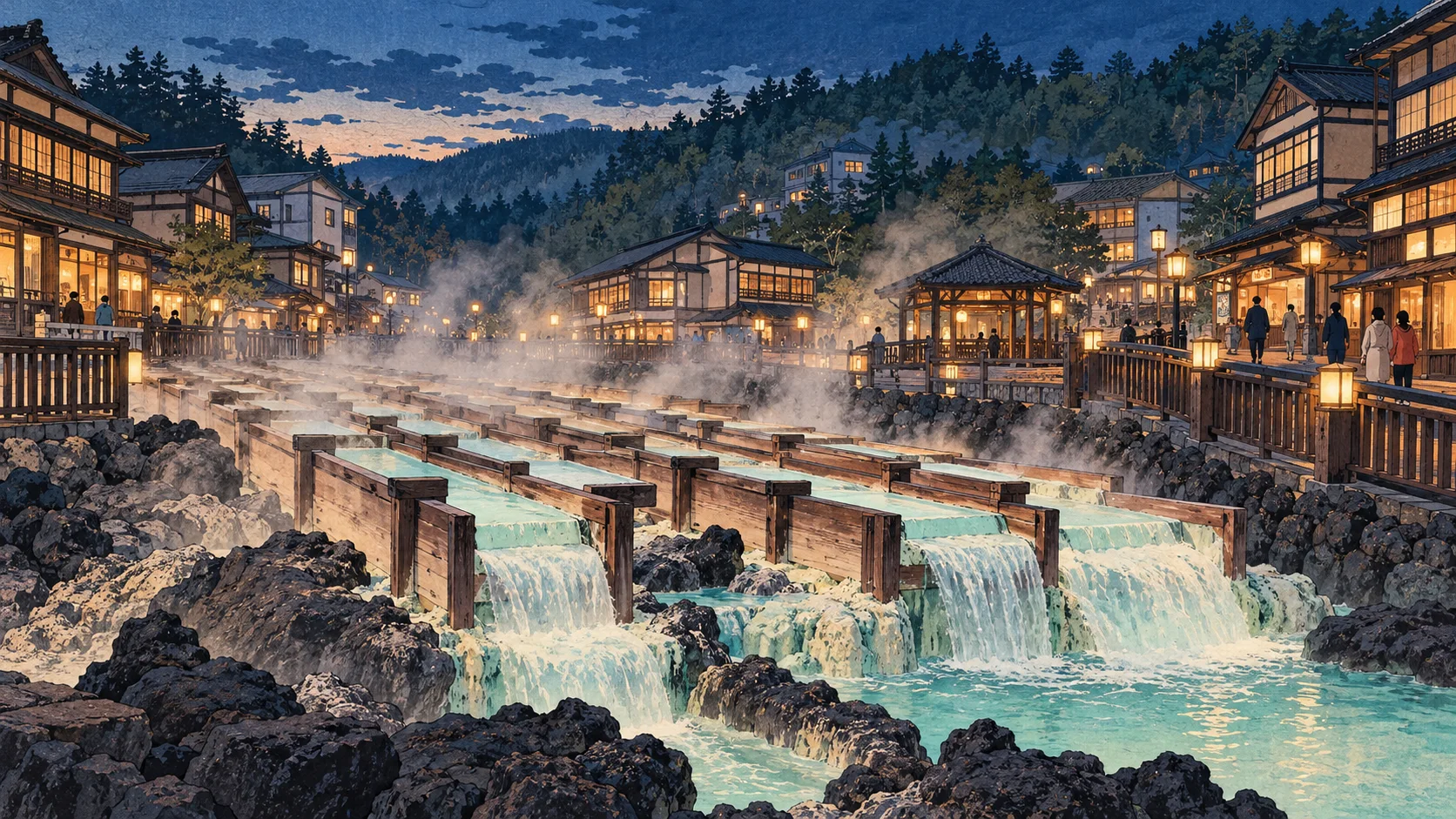
Choose the evening you want: Yubatake views, an in-room bath, or a forest base. Then connect beds, ryokan dinner, pick-up, and public-bath costs into a workable two-day Kusatsu stay.
Where to stay in Kusatsu Onsen: start with the evening you want
Picture your first evening in Kusatsu. Would you rather walk around Yubatake after dinner, soak in your room, or settle the children early in a little more space? Those priorities point to different places to stay. Write down what matters most before comparing views, in-room baths, and shuttles. It is easier to avoid the disappointment of a good hotel that does not suit the people on this particular trip.
Rooms deserve careful comparison because conditions can differ substantially within the same ryokan. Ichii has Yubatake-facing and mountain-facing categories; Boun has rooms with their own hot-spring baths as well as ordinary Japanese rooms; Hotel Village offers Western, split-level, and Japanese-Western rooms. This guide explains the choices through named categories. A hotel’s star rating does not establish that every room has a night view, a private onsen, or an easy route with luggage.
All amounts are in yen, using official information available on 21 October 2026. Room and meal allowances that are only budgeting assumptions are identified separately. Availability, menus, and transport operation still need checking for your travel date. If you are planning your first overnight stay in Japan, read the guide to ryokan meals, room types, and bathing terms before comparing packages for your own night.
Set your destination to Kusatsu Onsen in Gunma, not simply Kusatsu Station
This Kusatsu Onsen is in Kusatsu Town, Agatsuma District, Gunma Prefecture. A common arrival point is Kusatsu Onsen Bus Terminal, with rail journeys often connecting through Naganohara-Kusatsuguchi. Use the full place name and hotel address when buying tickets, checking a map, or arranging a car. Searching only for “Kusatsu Station” can mix up places with the same name, stations, and the hot-spring town, leaving you to discover later that your accommodation is nowhere within walking distance.
When adding a Gunma onsen to a Tokyo trip, allow for the entire journey. After the train there may still be a bus, waiting, arrival at the ryokan, and luggage storage. Counting only the rail leg often leaves less of the afternoon than expected. Ichii’s rail, bus, and arrival directions help explain the transfers; verify departures with the operators rather than treating the total time on a hotel diagram as a promise.
For one night, consider coming straight to Kusatsu from your previous city, forwarding or reducing large bags, and leaving the following day. If you also want a Tokyo morning, shopping in Karuizawa that afternoon, and a ryokan dinner, work backwards from the latest acceptable arrival time. The plan depends on which part you are willing to remove, not simply on the places looking close together on a map.
From Tokyo: train plus local bus, or a direct highway bus
From Tokyo, compare rail to Naganohara-Kusatsuguchi followed by a JR bus with a highway bus to Kusatsu Onsen Bus Terminal. The first divides the journey into two legs; the second reduces transfers but remains exposed to traffic. Start with your departure point, luggage, and seating needs, comparing both outward and return journeys. A cheaper individual leg may not fit the route your family actually needs.
The current JR route page between Naganohara-Kusatsuguchi and Kusatsu Onsen distinguishes weekdays, weekends, holidays, and some services operating only during specified periods. The regular route cannot be reserved: boarding follows the queue, and you may be unable to board once all seats are taken. Fares are paid when getting off, and transport IC cards are accepted with exceptions on some extra buses. Find the stop and queue after leaving the train; a rail seat does not reserve the connecting bus.
If dinner is included at your ryokan, ask for the latest acceptable arrival before choosing a service with a margin. If booking without dinner, arrange a place to eat, luggage storage, and check-in hours together. Use the route-based comparison of Japanese rail tickets and passes to assess a pass. JR branding on the vehicle does not mean every bus product is included free of charge.
The 2026 direct-to-hotel trial is separate from the regular bus route
The direct hotel bus trial announced by JR Bus has its own dates and hotel stops. The official period is 7 June–31 October 2026, from Naganohara-Kusatsuguchi through Kusatsu Onsen Bus Terminal to selected hotels. It is useful when your date and accommodation match. It is not evidence of a year-round service continuing from November, or of a stop outside every ryokan.
The trial timetable and fare PDF lists 780 between the station and terminal, 300 between the terminal and specified hotels, and 1,000 between the station and specified hotels. Comparing the adult one-way fares in this table, separate legs cost 780 + 300 = 1,080, while the direct fare of 1,000 is 80 less. This compares only that route’s published fare structure. It does not mean every hotel shuttle costs 300; check each property’s complimentary guest transfer separately.
The same trial table says reservations are not accepted, seating capacity limits boarding, and Japan Rail Pass and JR East Pass are excluded. Those conditions belong to this trial, not automatically to every regular route. If using it, save the valid dates, the stop order for your hotel, and the return departure. Before leaving, check the operating notices for buses towards Kusatsu; an old screenshot is no substitute for that day’s update.
Karuizawa to Kusatsu: check the seasonal timetable, not just the distance
Continuing to Kusatsu can make sense if you are already staying in Karuizawa. If starting in Tokyo, compare the whole journey rather than detouring just to add another place name. The Kusakaru Kotsu route and seasonal timetable index separates 20 April–31 October 2026 from the table starting 1 November. Autumn and winter travellers need the matching version, rather than carrying summer-autumn departures into a winter plan.
Kusakaru says local-bus boarding follows the queue; a full bus may mean waiting for the next one. It also warns that road delays affect Shinkansen connections. With large bags, check luggage rules, your alighting stop, and the hotel pick-up. If flying after leaving Kusatsu, allow separate margins for the mountain bus and the train. Holding a ticket does not make a connection of only a few minutes reliable.
For a Karuizawa–Kusatsu day trip, limit the plan to one main activity, such as a public bath and a Yubatake walk. Shopping, a ryokan dinner, and several baths fit more comfortably with a night away. If companions dislike changing transport, remove a city and arrive at a calmer pace. That preserves more rest than making every connection depend on a perfect last-minute transfer.
Yubatake, a nearby hillside, or the forest: choose your base
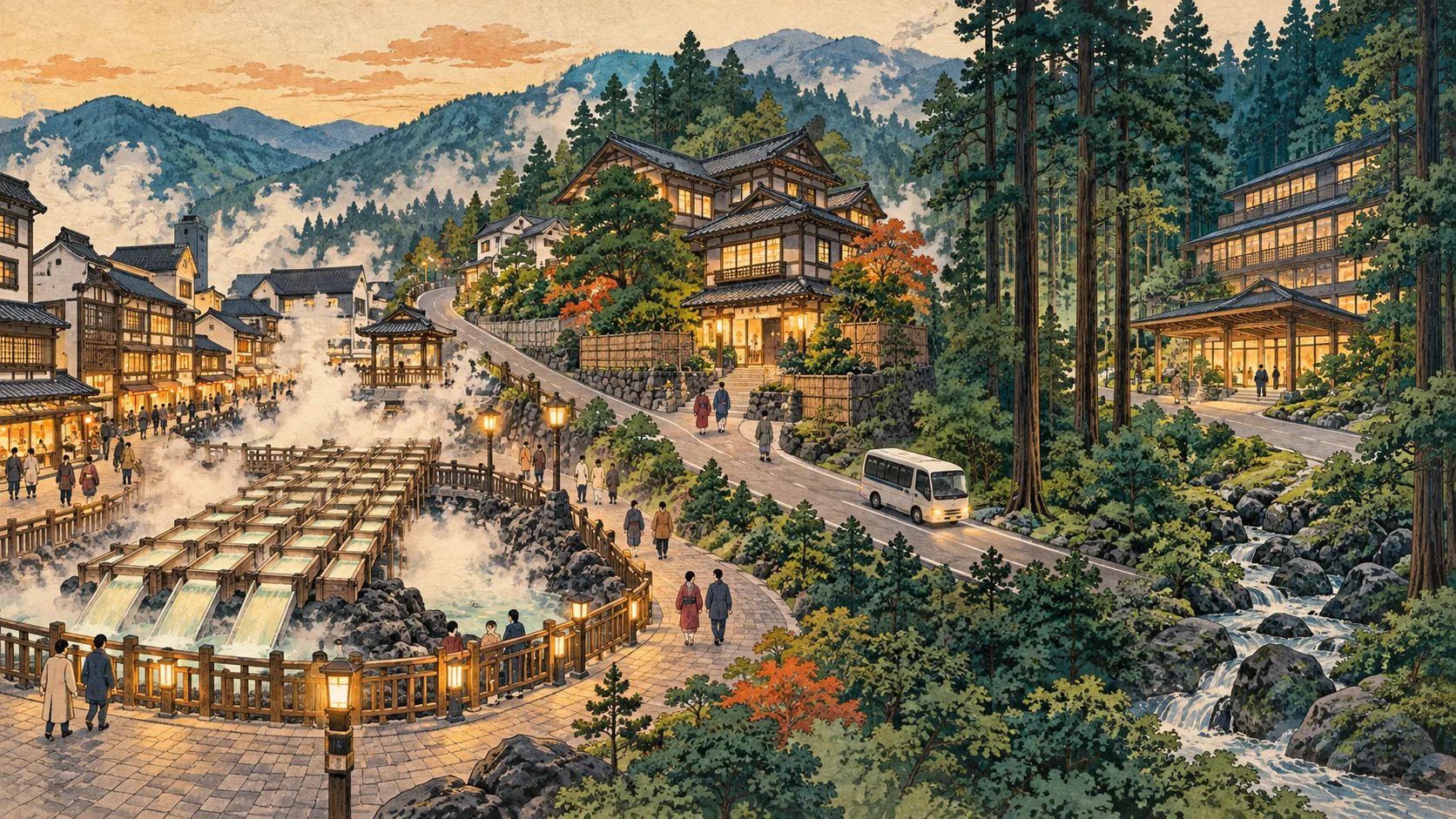
A Yubatake location suits repeated outings after dinner and another early-morning walk. A ryokan on a nearby rise may combine walking access with more tucked-away rooms. A forest hotel suits more time on the property and larger room categories. These are differences in movement, not guarantees about noise, views, or service in every room. A room’s orientation, floor, and building can matter more than its map distance.
Include the route from your room door to the communal bath. Not every central hotel room is beside the bath, and a forest hotel does not necessarily require pulling a suitcase the entire way yourself. The table narrows the choice to three concrete directions before the room-by-room details. If you use a wheelchair, need fewer steps, or return to the room often, send the complete route to the hotel for confirmation. One entrance photograph cannot establish access throughout a property.
If a Yubatake view is not especially important, put the supplement towards something you value more: an in-room bath, the two meals, or more suitable beds. If the purpose of the trip is to watch the town at night from your room, the reservation must identify the view category clearly. A useful Kusatsu accommodation recommendation first answers what you want to do at the hotel, before deciding which name offers the best value.
| Priority | What to compare | Before booking |
|---|---|---|
| Repeated Yubatake walks after dinner | Ichii’s specified Yubatake-facing rooms | Views are not guaranteed outside the 23 view rooms; the communal bath involves movement between buildings |
| In-room bathing and nearby walks | Boun’s specified indoor- or outdoor-bath rooms | Separate ordinary Japanese rooms from onsen-equipped categories; check hills and pick-up |
| More time on the property and several sleeping places | Hotel Village Western, maisonette, or Wing Japanese-Western rooms | Standard beds, extras, or futons; the shuttle now goes to the terminal |
Store your bags and save the pick-up number and meeting point
Luggage directly changes how arrival day works. Plan station to terminal, terminal to hotel, and collection after check-out as separate stages. Even a short map distance can take longer with hills, rain, snow, or tired companions. At booking, ask whether bags can be stored before check-in and after check-out, whether there is a charge, and the final collection time. Use the answer to decide where to walk that afternoon.
Ichii’s terminal walking and pick-up conditions give an approximately five-minute walk, or a telephone request for collection after arrival, with possible waiting when busy. Boun’s terminal pick-up FAQ likewise asks guests to call after reaching the terminal. Neither means a vehicle will necessarily be available as you step off the bus. Have the booking name, stay date, terminal floor, and party size ready; confirm special space or equipment needs beforehand.
For departure, coordinate stored bags with your bus. Ask where to collect them, then work back through packing, check-out, reaching the meeting point, and waiting. If the transfer goes only to the terminal, ticket purchase or queuing may still follow. Leaving the hotel door is not the same time as the long-distance bus departure. In poor weather, reducing repeated trips to retrieve things is usually more helpful than squeezing in another small attraction.
Two days and one night: keep the first afternoon for arrival and dinner
A workable two-day Kusatsu plan starts with arrival, stored luggage, and getting to know the Yubatake surroundings. Check in within the ryokan’s hours, then leave a pause for bathing or rest. After dinner, return to Yubatake if weather and energy allow. On day two, have breakfast, choose one public bath or a short neighbourhood walk, collect your bags, and leave. This is a suggested sequence, not a timetable everyone must follow.
Decide on dinner when booking. For a meal-inclusive package, confirm the starting time, restaurant or in-room service, children’s meals, food restrictions, and what happens if you are late. Until the property confirms, avoiding one ingredient does not mean you can freely swap dishes that evening. Without dinner included, find a suitable place open that day and keep a simple backup. Going out to eat does not guarantee a table whenever you want one.
With just one night, you usually do not need all three public baths. If the hotel already provides a suitable bath, select the public bath that interests you most and leave time for changing, drying hair, and resting. Sitting in your room with tea is also part of the trip. A schedule filled only with travel and paid activities can miss the evening and early morning that staying overnight actually adds.
Ichii’s Yubatake view belongs to 23 specified rooms
The Ichii rooms officially classified as Yubatake-facing total 23: three Executive Rooms and 20 standard Japanese rooms of ten tatami mats. Check that category if you want to see Yubatake from your room. The hotel being beside it does not turn mountain-facing or unspecified-view rooms into view rooms. If a booking page promises only a “Japanese room,” ask about the orientation before deciding whether to accept it.
The Yubatake-facing standard Japanese rooms are on Levels 4–7 (4F–7F) of the main building, with ten tatami mats and occupancy of two to four. Either two or four adults fit the stated capacity, but usable space after bedding is laid out and room for suitcases will differ. Include ages, separate bedding needs, bed-sharing numbers, and large bags in your enquiry. “Up to four” does not arrange everyone’s sleeping position for you.
The benefit is being able to return to your own room whenever you want the view. If you intend to spend the whole evening outside, you may not need to pay extra for that same outlook. Rates change with the date and package, so price your actual night. The official film introduces the building and surroundings, while current room details, meals, and stay conditions still come from the formal category page and your booking.
Executive Room: two beds, a shower, and the route to the communal bath
The bed description for Ichii’s Yubatake-facing Executive Room identifies rooms 801–803 on Level 8 (8F) of the main building, for two to four guests. There are two double beds, each 140 cm wide; the third and fourth guests use futons in the Japanese area. “Two double beds” describes the furniture, not a separate bed for each of four people. If an older relative needs a bed or children need separate sleeping spaces, confirm the allocation before booking instead of adjusting it on arrival.
The bathroom and communal-bath route for this view category list a shower booth and no bathtub. Reaching the annex bath requires two lifts and a connecting passage; the hotel gives a walking estimate of three to four minutes. You may repeat that route to change clothes or help a companion. A spacious room photo does not establish an in-room onsen, and lifts do not remove every other movement requirement along the way.
The mountain-facing Executive Room’s equipment and orientation page separately lists rooms 804–806 and expressly says Yubatake cannot be seen. These also have a shower but no bathtub. Similar Executive names do not mean identical views, so save the complete name and orientation when comparing prices. Mountain-facing may be worth considering for room comfort and beds; if the aim is Yubatake at night, the categories are different products.
Ichii in winter: check the announced maintenance closure first
Ichii’s December 2026 maintenance announcement lists closure on 14–18 December, including suspension of telephone, email, and other enquiries during that period. Stays from 19 December can still be newly booked through the official website. If those nights show no availability, do not immediately assume ordinary sold-out demand. Establish that the hotel is operating before discussing the room and dinner. Read the latest notices for other dates too.
To assess dinner at Kusatsu’s Hotel Ichii, check the meal package you will actually book. Food in a promotional video, an old stay report, or someone else’s in-room dining experience does not establish what your booking includes. Check meal count, venue, child charges, and the arrival deadline. If a late arrival may affect dinner, confirm the procedure with both the booking channel and the ryokan, keeping the written reply and cancellation deadline.
The closure notice also separates changes through websites, agencies, and direct contact: the booking source affects where to complete the process. A pause in replies does not automatically waive cancellation fees, and a social-media message does not prove the booking has been cancelled. Use the original channel and save the notification time and result. That is more practical for the guest than memorising a generic percentage scale.
Boun’s new main building: the named room with an indoor hot-spring bath
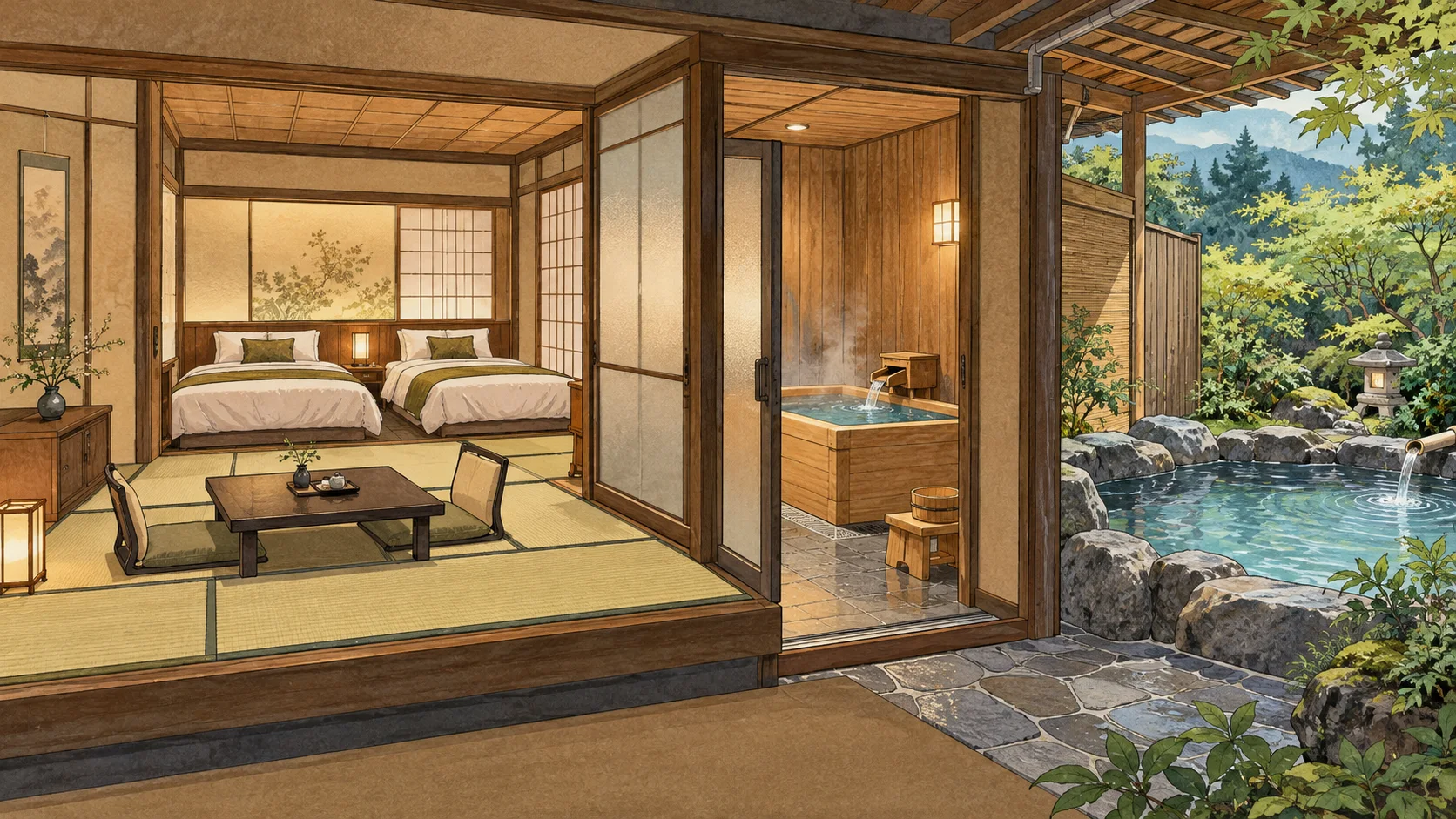
Boun’s current room-equipment page lists the main-building Japanese-Western room with an indoor onsen, opened 6 January 2025. It includes an eight-tatami Japanese area, living space, two semidouble beds, and an indoor bath with natural continuously flowing hot-spring water. If bathing in your room matters, ask for this complete category and your actual package. The indoor onsen belongs to this category; do not assume that rooms in other buildings or older Japanese categories include one too.
An indoor bath and an outdoor bath offer different experiences. The first is less directly exposed to outdoor rain and wind; the second brings you closer to the garden and air. Both still require checking tub size, changes in level at the entrance, and how companions will use it. If family members want to take turns soaking without walking back to a communal bath each time, an in-room bath may help more than simply enlarging the bedroom. You still need to weigh the extra price.
This is an accommodation comparison based on official equipment descriptions, not a rating after a personal stay. Ask directly about child restrictions or equipment details that the website does not specify. If someone needs bathing assistance or a particular bed height, send those requirements for a reply. Establishing that you can use the room before comparing attractive views makes a Boun booking much more specific.
Boun Unshoan: distinguish the outdoor-bath room from ordinary Japanese rooms
The Unshoan Japanese room at Boun with a private outdoor bath lists a 12.5-tatami room plus a six-tatami hiroen, a wide window-side area. Its equipment includes an outdoor bath with natural free-flowing water from the Sainokawara source, a wooden terrace, and a shower room. The hiroen extends the room near the windows; it is not automatically another bedroom where extra beds may be added. Confirm occupancy and bedding for the specific room category instead of adding tatami figures to invent a capacity.
The other room-equipment lists on the same page include ordinary Unshoan Japanese rooms, twins, and Japanese-Western rooms, plus a main-building ten-tatami Japanese room. That last category lists a toilet and washbasin, so photographs of the outdoor-bath category cannot be applied to it. When comparing Boun across booking platforms, put hotel, building, full room name, and bath type on one line before the meal-inclusive total. A cheaper-looking room may simply have different facilities.
Boun’s FAQ on communal baths and separately reservable bathing says there is no separate private-use bath. That is different from a bath belonging to a specified guest room. If you want an independently reserved bath without booking a bath-equipped room, look for another suitable option. Booking an in-room bath also does not authorise unregistered visitors to use it. Obtain the property’s explicit agreement for extra people or different usage.
Boun’s location and check-in times help place the walk around dinner
Boun’s check-in and walking FAQ lists check-in at 14:00 and check-out at 10:00, with roughly three to four minutes on foot to Yubatake and the Sainokawara Park entrance. Another access page says about five minutes. The ryokan also describes its position on a rise near the centre. Treat these as general estimates, allowing separately for luggage and the uphill return. It may suit an after-dinner walk; if slopes are a concern, ask about terminal pick-up and the last part of the route.
For pick-up, call after reaching the terminal; overnight guests also have free parking. Drivers should use Boun’s arrival and parking directions, rather than entering a pedestrian strolling route as a driving shortcut. Before leaving, ask how long parking or bag storage can continue. Parking included with a stay does not automatically permit leaving the car all day after check-out for sightseeing.
Whether dinner at Boun suits you still depends on the meals, format, and acceptable service conditions in your package. If the family values sitting down together, ask about child seating, food, and starting time in the same enquiry. If someone arrives late, check whether separate arrivals are possible. Do not leave mountain-road travel without a time margin to meet a dinner time that has not yet been verified.
Hotel Village Western rooms and duplexes: four guests do not mean four standard beds
The Hotel Village Tower Western-room specifications list rooms of 24–37 m², sleeping three to four, with sofa or extra beds from the third guest onward. Standard beds measure 120 × 200 cm; the sofa or extra bed measures 100 × 200 cm. Allocate everyone’s sleeping place before deciding whether it fits. Maximum occupancy does not promise a conventional bed of the same size for each guest.
The Tower maisonette’s two-floor layout accommodates three to five. The lower floor is 23–33 m² and the upper floor 13 m², with sofa beds or futons possible for the third guest onward. Added together, the floor areas range from 36 to 46 m², but movement between floors remains. With toddlers, frequent night waking, or difficulty on stairs, ask about the staircase and bed positions before choosing the layout.
These two categories have unit-bath facilities with a bathtub and shower, which does not establish that the water in the room is natural onsen water. Ask separately what is included for washing in the room, the hotel’s hot-spring baths, and leisure facilities. Pool access, activity tickets, and special bundles depend on your package. Even a large hotel with many facilities needs free intervals in the day if you are to use the things that attracted you.
Hotel Village’s Japanese-Western rooms: match the details to your family
The Wing Japanese-Western room layout lists 46–52 m², a six- to eight-tatami Japanese area, and occupancy of four to five. Futons are used from the third guest onward; beds measure 110 × 195 cm. This layout can separate bed sleepers from futon sleepers, but actual usable space, luggage, and bedding numbers still need checking. A party of five cannot freely add a sixth, and children sharing a bed are not automatically free.
Break a family booking into sleeping, meals, and getting around. Confirm bed-sharing, bedding, and child-meal charges for each age, then ask about distances to the restaurant, onsen, and shuttle stop. The Wing’s child-equipment loan list includes pushchairs, bed guards, and child toilet seats, plus a paid cot. Being listed does not guarantee stock every night. If an item matters, ask the hotel to confirm the quantity and applicable room categories beforehand.
If some people want to go out while others remain on the property, this sort of base allows separate activities, but agree on meeting and communication first. Recreation facilities do not make every charge inclusive or every activity suitable for every age. Mark included items, extras, and reservations beside your own package. Then you can judge which services you will actually use in return for the accommodation premium.
Village’s shuttle now runs to the bus terminal, including for evening outings
Hotel Village’s 23 September 2026 shuttle-change announcement says the service is temporarily running all day between the hotel and Kusatsu Onsen Bus Terminal to reduce crowds and congestion around Yubatake. Even if the timetable still has a “Yubatake service” heading, read the change note with it. Heading out after dinner does not mean the shuttle will drop you directly beside Yubatake.
Village’s shuttle times and meeting instructions give an approximately five-minute drive, stopping near the level-1 terminal taxi area. Guests arriving at the terminal after 17:00 must contact the hotel. Weather, traffic, and festivals can change the time or stop; when capacity is exceeded, the shuttle makes repeat trips. These are waiting arrangements, not a promise of immediate boarding at any hour. Check before choosing a late arrival.
Before going out at night, photograph that day’s return meeting point and note the final shuttle. Walking to Yubatake, returning to the terminal, waiting, and reaching the room are all part of the outing. If the children are tired or rain or snow arrives, shorten the walk. If you expect several daily trips to the centre, compare these movements with the price difference for a Yubatake-side stay, not only the room’s square metres.
Three public baths: compare individual admission with the pass you will use
Kusatsu’s three baths are Ohtakinoyu, Gozanoyu, and Sainokawara Rotenburo. Current single-entry prices are respectively 1,200, 900, and 800 for adults, and 600, 450, and 400 for children. The official child category is age three through Japanese primary school. The operator’s combined admission and pass comparison also lists the totals. Visiting all three costs 1,200 + 900 + 800 = 2,900 for an adult and 600 + 450 + 400 = 1,450 for a child. Compare the pass against that actual plan rather than buying for a possible use.
The current Santo Meguri Tegata conditions list 2,100 for adults and 1,050 for children, one admission per bath, with no expiry date but with the child age restriction retained. Compared with three single entries, savings are 800 for an adult and 400 for a child. If you only have time for Sainokawara, adult admission at 800 is 1,300 less than the 2,100 pass. No expiry does not mean unlimited returns to one bath or permanent child eligibility as the holder grows older.
For Gozanoyu and Ohtakinoyu only, adult entries total 900 + 1,200 = 2,100, exactly the adult pass price. Choose based on whether a third visit will actually happen, rather than rushing between baths to create an impression of savings. The operator also says old passes purchased by 31 August 2025 can continue to be used without paying the difference. An old internet price is not today’s new-purchase price; existing holders should follow their own ticket conditions.
| Bath or ticket | Adult | Child | Main conditions |
|---|---|---|---|
| Ohtakinoyu | 1,200 | 600 | The private hot-spring bath needs a separate reservation and payment; admission is additional |
| Gozanoyu | 900 | 450 | The 2,000-per-hour private room is a resting space |
| Sainokawara Rotenburo | 800 | 400 | No washing area, hairdryer, or towel rental |
| Santo Meguri Tegata | 2,100 | 1,050 | One entry per bath; no expiry, but the child age limit still applies |
Ohtakinoyu’s private bath: add individual admission to the 2,000 fee
Ohtakinoyu’s charges and private-bath booking information give general hours of 9:00–21:00, last admission 20:00. The private Shakunage hot-spring bath runs 9:00–19:00, with last reception at 18:00, by reservation, for 2,000 an hour plus admission. It is a specific option to ask about when looking for a private onsen in Kusatsu, but availability at the time you need still requires confirmation.
Using the admission, private-bath, and towel price list, a published-charge example for two adults without a pass or discount is 1,200 × 2 admission plus 2,000 for one private hour: 4,400. If each rents a 250 towel set, add 500 to reach 4,900. This adds the identified items; it is not an all-inclusive 2,000 for two. The time slot still needs a reservation. Check any other required charges and payment methods against the on-site or booking details.
Ohtakinoyu’s equipment and re-entry FAQ lists communal and outdoor baths, awase-yu for moving through different-temperature baths, a cold pool, and a sauna. Ordinarily, leaving and entering again requires another admission charge. Arrange the private session, indoor rest, and an outside meal before leaving, rather than discovering the need for another ticket afterward. The official parking rules also prohibit using this lot for sightseeing unrelated to bathing.
Gozanoyu’s private room is a relaxation room, not a private bath
The Gozanoyu admission, relaxation-room, and yukata rental page lists 900 for adults and 450 for children; hours are 7:00–21:00 April–November and 8:00–21:00 December–March, with final admission at 20:30. Bathers can use the shared large hall, while a separate 12-tatami private room costs 2,000 an hour. That rents a place to rest; it does not create an exclusively available hot-spring tub. Be careful when reading translated product names.
If one companion wants to rest while another bathes, ask whether the room fits the party and intended use, then add admission and rental together. The same 2,000 figure may appear for Ohtakinoyu’s private bath, but the service is different. Do not compare clipped prices alone. First decide whether you want to bathe together in one tub or have a separate room to rest afterward, so the product comparison answers the right question.
Gozanoyu’s equipment and use FAQ also lists showers with shampoo and washing products. Towels are not rented: bring your own or buy at the current price. If you are unsure whether hotel towels may be taken out, ask your accommodation rather than treating room supplies as freely portable. A small bag separating dry clothes and wet towels avoids more backtracking than searching for things only after your bath.
Sainokawara Rotenburo: outdoor scenery with simpler facilities
The seasonal opening times for Sainokawara Rotenburo list adult admission at 800 and child admission at 400, with hours of 7:00–20:00 April–November and 9:00–20:00 December–March. Last admission is 19:30. If planning a bath before breakfast on day two, winter opening at 9:00 directly affects check-out and luggage collection. Do not book an impossible return bus while picturing the summer opening time of 7:00.
The Sainokawara facilities FAQ describes outdoor baths only, with no washing area, hairdryer, relaxation room, or towel rental, and no barrier-free provision. If you like a broad open-air setting, it can be the purpose of a visit. If you need a full hair-washing routine, indoor rest, or particular access equipment, judge the fit first. A large bath in a photograph does not mean the supporting facilities are equally extensive.
The official walking and equipment answers give roughly 12 minutes from Yubatake and six from Tenguyama No. 1 parking as estimates. Add changing shoes, changing clothes, soaking, and walking back: this is not a five-minute stop in passing. In winter or rain, choose a more convenient time. If you have concerns about health or skin conditions, seek appropriate professional advice; attractive scenery is no reason to make a companion stay longer than comfortable.
Tattoos, children, and bathing together: use the three baths' own rules
For the tattoo policy at Kusatsu’s three baths, read the operator’s answer about tattooed visitors. It says these three facilities do not specifically refuse admission or bathing to people with tattoos, while asking everyone to observe bathing etiquette. This covers those three operations, not every Kusatsu ryokan, pool, or bath in another city. If using your hotel’s communal bath, check that property’s current rules instead of inferring a shared policy from the location.
Gozanoyu’s guidance on children with guardians says preschool children may accompany a guardian into the bath for the opposite sex. Decide who accompanies each child using the local rule and the child’s actual age. If the family needs a single independent tub together, ask a private-bath operator about capacity and reservable slots. Being below the adult ticket category does not remove supervision, hygiene, or usage requirements.
Before travelling, organise towels, changing supplies, and the conditions you need to ask about; once there, follow staff and signs. Do not bring a phone or camera to photograph other bathers, or rush simply to check off all three places. A recommendation should follow the equipment you want and the time left. If you have already soaked enough at the ryokan, skipping one public bath may make for a more comfortable stay.
A yukata walk around Yubatake: Gozanoyu’s separate outdoor rental
Gozanoyu’s yukata rental for going out currently lists 2,500 for three hours, with reception 9:00–17:00 throughout the year. It includes a yukata, bamboo basket, geta sandals, bathing, and a luggage-storage locker. It differs from the 300 indoor yukata item and is not automatically included in ordinary 900 admission. For a walk and photographs, ask about sizes, return time, and that day’s availability before adding the service.
Ask how changing, bathing, and going out fit together. Reception ending at 17:00 does not mean you can wear the outfit until late at night without checking the rules. Rain, slippery surfaces, and slopes also call for considering your footwear and walking needs. If your ryokan already provides a yukata that can be worn outside, ask what area is allowed before comparing a second rental. Clothing with the same name does not necessarily carry the same permission to use it.
The video below is the Gozanoyu yukata-walk promotional film published by Kusatsu’s official three-bath channel, introducing the activity’s atmosphere and setting. It is earlier promotional material; today’s prices, sizes, services, and weather-related availability still come from the current product page and on-site confirmation. Use it to decide whether the activity interests you, rather than treating every object in the footage as a guaranteed inclusion.
Kusatsu in winter: check the road section, seasonal bus, and hotel closure separately
Winter onsen scenes are appealing, but access begins with the specific road section. Gunma’s 2026–2027 winter road-closure table lists roughly 17.9 km of the Shiga-Kusatsu road, between Tenguyama Gate and Shibutoge at the Nagano boundary. Closure is scheduled for 11 November 2026 at 13:00, with reopening 21 April 2027 at 10:00. This is a designated highland section, not simultaneous closure of the whole town or every approach road.
For winter driving, establish the routes permitted by operators and road authorities, vehicle requirements, and equipment before planning the arrival. A seasonal shortcut on a navigation app may not apply that day. For buses, check the winter version, operation notices, and final pick-up again. Ichii’s 14–18 December closure and Village’s changed shuttle stop also have their own reasons and periods. “Normal winter operation” cannot summarise all of them.
Make the stay a little more forgiving: arrive in daylight, store bags, shorten after-dark walks to suit the surface and your energy, and leave time to change into dry clothes afterward. Snow is not present every night, and an image checked today cannot promise the same scene on your stay. If the main purpose is bathing, choose a room you enjoy spending time in rather than tying the trip’s success to snowfall.
Kusatsu’s bathing tax is not always 150: check the calculation basis
Kusatsu Town’s bathing-tax rates and FAQ list 150 per person per night when the basic accommodation charge exceeds 6,000, and 100 when it is 6,000 or below. On school trips, students in the upper-secondary school category used in Japan pay 50; day-use resting visits are another 50 category. Children through Japanese primary school and students in the lower-secondary school category used in Japan on school trips are among those exempt. A child in the lower-secondary school category used in Japan on an ordinary family trip cannot claim the school-trip exemption merely by still attending school. Exemption does not make rooms, meals, or admission free.
The town’s definition of the basic accommodation charge follows the amount shown in accommodation terms or their equivalent. If those terms include food and drink with the room, the combined charge is used, excluding consumption tax. Simply dividing a booking platform’s final tax-inclusive total by the number of people may not establish whether 100 or 150 applies. Ask the property to itemise amounts already paid and payable on-site, including on prepaid bookings, to avoid omissions or double counting.
For several baths on a day visit, the town’s answer on visiting multiple facilities says each facility’s bathing use is taxed separately. Whether the displayed admission price already includes the relevant tax still requires checking that product’s payment details. This guide uses the three-bath websites' published admission prices without automatically adding another 50 to every ticket as a final amount due. If the breakdown is unclear, ask the collector rather than applying another ryokan’s tax to every product in town.
| Category | Tax | Important detail |
|---|---|---|
| Basic accommodation charge above 6,000 | 150 per person per night | Use the combined basis if the terms include food and drink in accommodation |
| Basic accommodation charge 6,000 or below | 100 per person per night | Do not arbitrarily split a platform’s tax-inclusive total |
| Day-use rest / student in the upper-secondary school category used in Japan on a school trip | 50 per person | Separate applicable categories; check whether the displayed price already includes tax |
| Children through Japanese primary school / students in the lower-secondary school category used in Japan on school trips | Exempt | Tax exemption does not make rooms, meals, or admission free |
One-night budget for two adults: assumed room rates and checkable bath charges
Suppose two adults share a room for one night with two meals, costing 36,000 in total, and the booking charges a separate 150 bathing tax per person. Add Sainokawara adult admission at 800 × 2, a 3,000 lunch allowance, and 1,000 for snacks and drinks: 36,000 + 300 + 1,600 + 3,000 + 1,000 = 41,900. The room and food amounts are self-selected planning assumptions, not a hotel offer available on that date. Transport to and from Kusatsu is not yet included.
If switching to two adult Ohtakinoyu entries plus one private hour, replace the public-bath item of 1,600 with 4,400. This example rises by 2,800 to 44,700; renting two 250 towel sets adds 500 for 45,200. If the accommodation booking already includes bathing tax, do not add the 300 again. If removing a meal from the package, restore a budget for dinner elsewhere. The point is to substitute your own conditions and recalculate, not declare one option always cheaper.
For children or larger groups, list transport, accommodation category, bedding, and meals for each person instead of multiplying the couple’s total. Room occupancy, child tickets, and tax ages apply separately and may not coincide. Use the itemised Japan travel budgeting method to separate committed spending from removable activities. To save money, first remove extras you do not value rather than deleting the last shuttle or a necessary meal from the sheet.
Only a day, rain, or snow: keep the plan in a small area
A Kusatsu day trip can work, but first establish the time actually left between outward and return transport. Consider Yubatake plus one public bath, including allowances for food and luggage. If only a short afternoon remains, do not add forest-hotel facilities needing repeated transfers or several baths. The last bus is a departure condition, not a reminder to start finding your bags just before it leaves.
In rain, replace a long outdoor walk with an indoor bath you want to use or rest at your accommodation. Without a stay, you cannot simply use a ryokan lobby and facilities as free shelter. For a resting room, check Gozanoyu or another explicitly available space in advance, including admission and rental charges. Sainokawara has only outdoor bathing; rain does not produce an indoor alternative there.
For solo bookings, select the correct party size in the official product and see which rooms and meals are offered. A room listed for two to four does not become bookable for one by dividing a two-person price in half. If suitable accommodation or a return trip cannot be secured that day, change dates, choose a workable category, or retain a short day-trip version. Do not accept unverified conditions just to fit an existing itinerary.
Cancellation belongs to your package, not a generic policy table
Alongside rooms and meals, save the date cancellation fees start, the local time, payment method, and change channel when comparing Kusatsu stays. The same property can have different conditions by date, advance-purchase package, or agency product. General terms or an older trip report cannot replace what you accepted when booking. A change in party size may also affect category or cost, so check whether amendments are permitted first.
For special meals, pick-up, room orientation, or loan equipment, separate a request submitted from the hotel’s confirmation that it can provide it. A wish in booking notes does not necessarily reserve a service. Keep the reply with your package once confirmed. If a platform and the official website use different room names, ask using the full equipment description and photographs rather than assuming two similar translated words identify the same accommodation.
Before departure, recheck hotel announcements, roads, and bus status, making decisions before cancellation charges increase where necessary. If unexpectedly delayed, contact the booking channel and keep the times. A missed call or unread message is not agreement to a refund. Clear communication records cannot guarantee waived fees, but they establish what was booked and when particular requests were made.
Fit Kusatsu into the Japan trip and keep only workable choices
The decision order can be straightforward: establish your overnight date and arrival route, choose the priority among a Yubatake view, in-room bath, and forest base, then confirm sleeping arrangements, meals, shuttle, and cancellation. Public baths and walks come afterward. Let each companion retain one most-anticipated activity and trim the rest to fit the time. This is easier to carry out than adding two complete wish lists together.
This guide covers accommodation in Kusatsu, Gunma, and a short nearby itinerary. It does not cover every Japanese onsen or all Kanto travel. For multiple cities before or after Kusatsu, use the first-trip Japan guide to days and accommodation bases to redistribute nights. For seasonal differences, consult the comparison of Japan’s seasons and winter travel choices. Give Kusatsu a night that can actually provide rest rather than only another tick on the route map.
Before booking, read the complete room category, arrival time, dinner, and post-check-out luggage arrangements once more. Before travelling, recheck seasonal routes, closures, and that day’s operation; on arrival, confirm the pick-up point. Once these are clear, leave some gaps for a walk or a return to the room. A useful overnight result is accommodation, bathing, and transport that connect, not trying every recommended hotel or completing every bath.
A few useful answers
For a first Kusatsu stay, should I choose Yubatake or a forest hotel?
Compare the centre for repeated Yubatake walks, specified bath-equipped rooms for in-room soaking, and a forest base for more time on the property. Check the building, actual sleeping places, and transfers rather than deciding by hotel name alone.
Does every Ichii room overlook Yubatake?
No. The official Yubatake-facing category totals 23 rooms: three Executive and 20 standard Japanese rooms. Mountain-facing Executive rooms expressly have no Yubatake view. Confirm the complete view category in your booking.
Does Ichii’s Executive Room have a private onsen?
The category page used here lists a shower and no bathtub, so it is not an in-room onsen. From a Yubatake-facing room to the annex communal bath, the route uses two lifts and a connecting passage, estimated at three to four minutes.
Can I book a bath-equipped Boun room if it has no reservable private bath?
Compare the specified categories. The FAQ refers to no separate reservable private bath; the equipment page separately lists in-room baths in the new main-building Japanese-Western category and the Unshoan Japanese room with an outdoor bath.
Does Hotel Village’s shuttle currently go directly to Yubatake?
The 23 September 2026 notice says it temporarily runs all day to Kusatsu Onsen Bus Terminal instead. Plan walking, waiting, and the return at night using that change. Contact the hotel if reaching the terminal after 17:00.
Does the 2026 direct-to-hotel JR bus operate year-round?
The trial table lists 7 June–31 October 2026, with specified hotels and departures, without an assumed extension. Its JR Pass exclusion belongs to this trial; other routes need separate checking.
Is the Kusatsu three-bath pass always cheaper?
No. Three adult single entries total 2,900 versus a 2,100 pass. Sainokawara alone costs 800 and is cheaper; Ohtakinoyu plus Gozanoyu totals the same 2,100. Calculate the baths you will actually visit.
Is Ohtakinoyu’s private bath only 2,000 for two adults?
No. The private hour is 2,000 with admission separate. Two adult admissions at 1,200 each bring the identified total to 4,400. Check towels, extras, and reservable times separately.
Is Gozanoyu’s 2,000 private room a private onsen?
No. It is a 12-tatami relaxation room for 2,000 an hour, a different product from Ohtakinoyu’s private bath. Decide whether you need a room to rest or independent bathing.
Do the three baths accept tattooed visitors?
The official FAQ says these three do not specifically refuse tattooed guests entry or bathing, and asks for proper etiquette. The rule does not automatically cover all Kusatsu ryokans or other facilities.
Is every road into Kusatsu closed in winter?
No. Gunma lists specified sections, such as the Shiga-Kusatsu road from Tenguyama Gate to Shibutoge, scheduled to close 11 November 2026 at 13:00 until 21 April 2027 at 10:00. Check other routes, buses, and daily conditions separately.
Is the bathing tax always 150 at Kusatsu ryokans?
No. The town lists 150 or 100 per person per night according to the basic accommodation charge, plus day-use and school-trip categories and exemptions. The basis follows accommodation terms and excludes consumption tax. Check paid and on-site amounts to avoid adding the charge twice.
Check with the source
Schedules, availability and rules can change. These official sources are the place to confirm details before you book.
- Ichii | Access and terminal pick-up
- JR Bus Kanto | Regular Naganohara-Kusatsuguchi–Kusatsu Onsen route
- JR Bus Kanto | 2026 direct trial to selected hotels
- JR Bus Kanto | 2026 hotel-bus trial timetable and fare PDF
- JR Bus Kanto | Kusatsu operating notices
- Kusakaru Kotsu | 2026–2027 Kusatsu seasonal timetables
- Ichii | 23 Yubatake-facing rooms and equipment
- Ichii | Mountain-facing rooms and shower facilities
- Ichii | 14–18 December 2026 maintenance closure
- Boun | Main-building and Unshoan room categories
- Boun | Check-in, pick-up, and communal-bath FAQ
- Boun | Access information
- Hotel Village | Tower Western rooms
- Hotel Village | Tower maisonettes
- Hotel Village | Wing Japanese-Western rooms
- Hotel Village | 23 September 2026 shuttle-stop change
- Hotel Village | Shuttle departures and meeting points
- Kusatsu three baths | Pass prices, ages, and conditions
- Ohtakinoyu | Hours, admission, and private-bath charges
- Ohtakinoyu | Equipment, parking, and re-entry FAQ
- Gozanoyu | Admission, relaxation rooms, and outdoor yukata
- Gozanoyu | Towels, showers, and bathing FAQ
- Sainokawara Rotenburo | Seasonal hours and prices
- Sainokawara Rotenburo | Equipment, children, and tattoos
- Gunma Prefecture | Specified 2026–2027 winter road closures
- Kusatsu Town | Bathing-tax rates, exemptions, and calculation basis