Ikaho Onsen centres on a 400-year-old, 365-step granite staircase and two distinct thermal springs: iron-rich Kogane no Yu and gentle Shirogane no Yu. Day-trippers can soak in both municipal Ishidan no Yu (¥800) and free-flowing Ikaho Rotenburo (¥600, home to the town's only drinking spring), just 30 minutes by bus from JR Shibukawa Station.
- Region & Focus
- KantoSide trips
- Reading Scope
- 13 min read · 6 chapters · 4 Q&As
- Official Verification
- 10 official sources checkedUpdated 20 November 2026
- Key Topics
- Hot springsItinerariesTokyo & Kanto
Chapter Route Map (tap any stop)
The spine of any visit to Ikaho Onsen is its 365-step Stone Steps Street (Ishidan-gai). First laid out over 400 years ago in 1576 (Tensho 4), the granite staircase seen today underwent a five-year reconstruction starting in 1980 before being extended northwards in 2010 to reach 365 steps—a symbolic wish for the spa town to prosper all 365 days of the year. Ikaho is blessed with two contrasting thermal waters: iron-rich Kogane no Yu (Golden Spring), which turns russet brown on contact with air, and colourless, silky Shirogane no Yu (Silver Spring). Day-trippers without an overnight ryokan booking can still experience the town's essence at two public bathhouses: municipal Ishidan no Yu (¥800) and the tourist association's Ikaho Rotenburo (¥600), which offers free-flowing Kogane no Yu and the town's sole onsen drinking tap. Just a 30-minute Kan-etsu Kotsu bus ride uphill from JR Shibukawa Station, Ikaho makes a well-paced day out combining the steps with both baths.
Stone Steps Street: How to Tackle All 365 Steps
Before climbing Ikaho's Stone Steps Street, it helps to know its origins. This 365-step granite staircase dates back to 1576 (Tensho 4), was rebuilt over five years from 1980 (Showa 55), and reached 365 steps in 2010 when a northern extension, hot-spring cascade, and plaza were added to echo the wish for year-round bustle. Unlike purely scenic stairways elsewhere, Ikaho's steps are a living high street: the broad landings serve as resting spots while opening directly onto ryokan entrances and souvenir shops. Although visitors lugging suitcases up the steps are a familiar sight, heavy bags can be handed over to ryokan shuttles or the hands-free luggage service outside Shibukawa Station, saving your legs for the stroll.
Along the 365 steps, four landmarks stand out. Just above the midpoint, the Yudaki cascade channels steaming spring water down a stone trough, forming the street's unmistakable visual centrepiece. Near the top by Yumoto, four Komaguchi sluices divide the hot source water among individual inns—a working relic of the historic water-allocation system. Set into the steps are twelve zodiac plaques (eto-ishi), reflecting the Edo-period crest tradition of the twelve founding innkeeper families (Oya Juniken), turning the walk into a hunt for your birth-year sign. Halfway up, a stone tablet bears the poem 'Ikaho no Machi' by poet Akiko Yosano; paired with sites linked to Meiji author Roka Tokutomi, who set his celebrated novel 'Hototogisu' in Ikaho, literary travellers can easily stitch these stops into a short walking route.
Whether you climb up or stroll down depends entirely on where you alight. Riding the Kan-etsu Kotsu bus to the Ikaho Onsen terminus drops you near the top end (Yumoto side), letting you wander downhill—far easier on older relatives, larger groups, or anyone carrying bags. Conversely, starting at the lower municipal Ishidan no Yu or planning to finish at the upper open-air bath means tackling the 365 steps upwards while pausing at shops along the way. Broad landings break up the gradient, and a leisurely stroll with snack stops takes roughly 30 to 45 minutes; while there is no official route duration, allow at least half an hour so you do not rush past the mid-street poem stone, cascade, and independent shops.
Traditional ryokan, gift shops, and retro shateki cork-gun shooting galleries line the steps, and Ikaho is also the birthplace of Japan's onsen manju—its signature yunohana manju steamed buns were once presented to the Imperial Household. Buying a piping-hot bun during the day to eat as you wander is half the charm. For completely empty photographs of the granite steps, head out around 7:00 am before shopkeepers open their shutters.
Commercial life wakes up after 10:00 am, as souvenir stalls, snack counters, and shooting galleries slide open their wooden doors and fresh batches of onsen manju emerge around midday. Early morning reveals noren curtains, timber rooflines, and drifting steam; by afternoon, the street hums like a market. Most ryokan along the steps run pick-up shuttles from the bus stop—simply tell them which stop you are arriving at when booking, and most properties will meet you at the Ikaho Onsen stop so you avoid hauling luggage up the stairs.
If you are visiting with children and worry they might flag halfway up, turn the four official highlights—the poem stone, Yudaki cascade, zodiac plaques, and Komaguchi sluices—into a mini scavenger hunt. Walking upwards, spot Akiko Yosano's poem halfway up, climb a few steps further to the steaming Yudaki, keep your eyes down to tick off the twelve zodiac plaques, and finish by inspecting the four Komaguchi channels at Yumoto, splitting the climb neatly between landings. At dusk, when the lanterns flicker on, Showa-era air-gun shooting galleries light up; for a few hundred yen, adults and children alike can join in. Steam, granite steps, shateki stalls, and hot manju together capture Ikaho's unmistakable atmosphere.
Read the town's official chronology and the street unfolds like a living history book. In 1576 (Tensho 4), a year after the Battle of Nagashino, Takeda Katsuyori ordered Sanada Masayuki to build a recuperation settlement here, laying the groundwork for the stone steps. In 1590 (Tensho 18), the spa quarter shifted from Yumoto to its present site, and in 1743 (Kanpo 3) the layout of the twelve founding inns and twelve zodiac signs took shape. The tourist association's open-air bath opened in 1950 (Showa 25), the steps reached 365 in 2010, and Fo Guang Shan Hossui-ji Temple was completed in 2016. Looking further back, nine of the 25 Kozuke Province poems in Japan's oldest anthology, the 'Man'yoshu', mention Ikaho, while official hot-spring lore traces its origins roughly 1,900 years back to Emperor Suinin's reign and volcanic activity on Mount Haruna's Futatsudake.
Literature runs just as deep through the stone steps. Roka Tokutomi visited Ikaho in 1898 (Meiji 31), subsequently publishing 'Hototogisu', and returned in 1927 (Showa 2) to spend his final days here. Linking Tokutomi's landmarks with Akiko Yosano's carved verse turns historical dates on wayside plaques into a tangible sense of place.
If you are torn between a day trip and an overnight stay, the deciding factor is the contrast between the night-time street and the morning bath. Busy shops draw a lively crowd by day, yet once they close after dark, only ryokan lanterns and wisps of rising steam remain—a starker shift than in many Japanese spa towns. Photographing the illuminated steps and cascade steam at night rarely requires jostling for space, and tripods are generally fine provided you keep ryokan entrances clear.
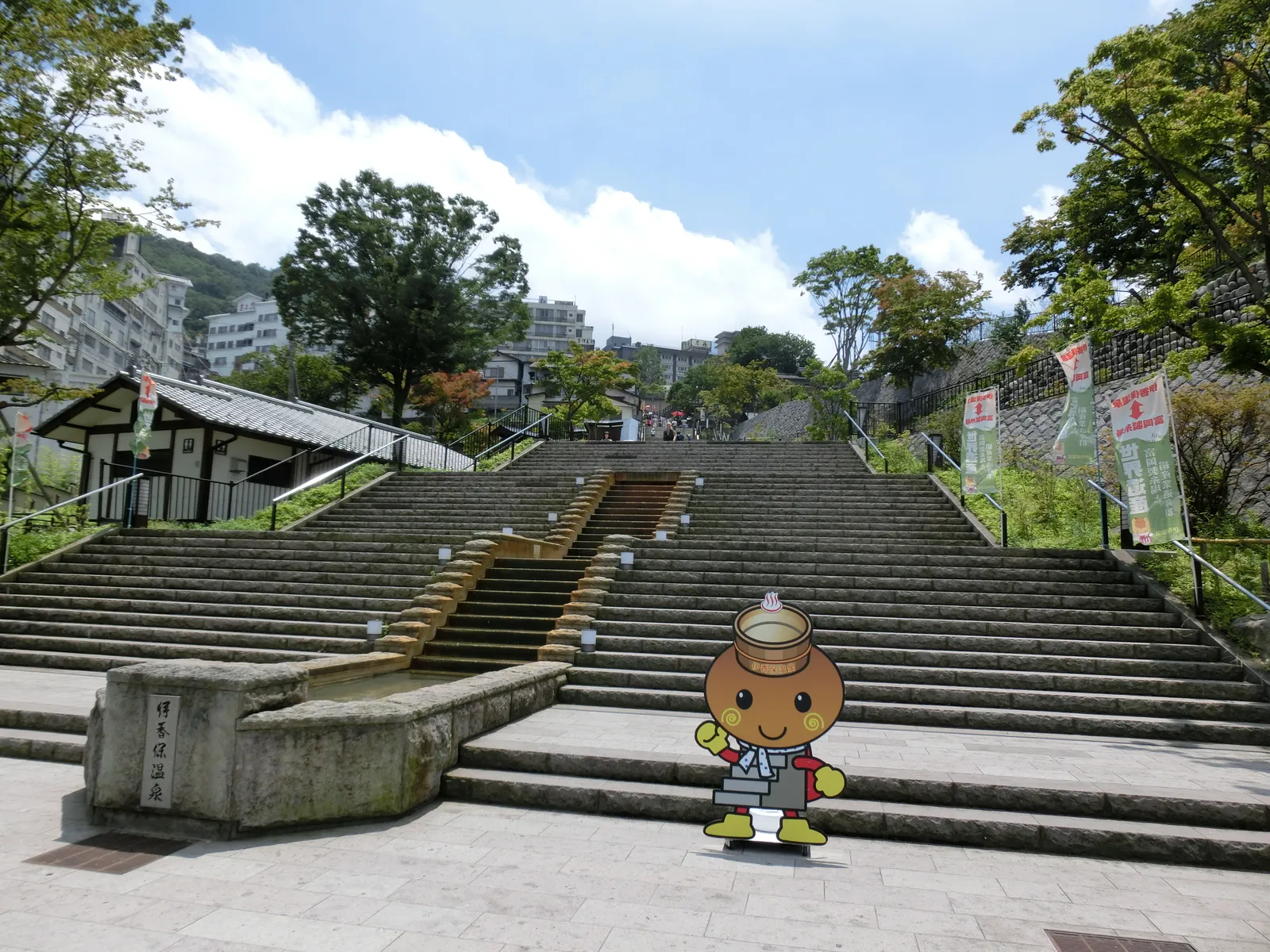
Ikaho Onsen centres on a 400-year-old, 365-step granite staircase and two distinct thermal springs: iron-rich Kogane no Yu and gentle Shirogane no Yu. Day-trippers can soak in both municipal Ishidan no Yu (¥800) and free-flowing Ikaho Rotenburo (¥600, home to the town's only drinking spring), just 30 minutes by bus from JR Shibukawa Station.
Gold and Silver Springs: Two Waters, Two Experiences
Ikaho draws from two completely different thermal sources. The first, Kogane no Yu (Golden Spring), is an iron-rich sulphate spring—officially classified by Shibukawa City as a calcium-sodium sulphate, bicarbonate, and chloride spring. It emerges crystal clear and oxidises into a deep russet brown upon meeting the air, warming the body from the core and traditionally recommended for poor circulation and recovery from injuries. The second, Shirogane no Yu (Silver Spring), is a colourless, transparent cold mineral spring containing metasilicic acid, prized for easing fatigue and general wellbeing. Gentle and non-irritating, it is officially recommended for older guests and those recuperating from illness. Meanwhile, Ikaho's famed Edo-period epithet 'Kodakara no Yu' (fertility spring) specifically refers to the source around the Yumoto open-air bath.
Match the spring to whoever is travelling with you. For Ikaho's signature russet soak and thorough warmth on a crisp day, head straight for Kogane no Yu. If you are travelling with elderly parents, recovering from an illness, or simply want a long, mild soak, colourless and odourless Shirogane no Yu puts far less strain on the body. Day visitors can soak in Kogane no Yu at both Ikaho Rotenburo and municipal Ishidan no Yu, whereas Shirogane no Yu is mostly piped into individual ryokan—check a hotel's official website for its spring label before booking a day-use plan. As for pacing, Kogane no Yu runs hot with a pronounced metallic tang, so avoid entering straight after alcohol or on an empty stomach; Shirogane no Yu is heated cold mineral water and feels gentler, yet you still need to hydrate well after a long soak.
Ikaho Rotenburo also holds a town-wide exclusive: the Kogane no Yu drinking tap. One sip of fresh water straight from the source delivers an unmistakable iron tang that immediately explains where the russet colour comes from; a slight astringency on the first sip is completely normal. Drinking thermal water comes with volume limits and health precautions, so stick to a few small sips as posted on site rather than gulping it down like tap water. Note also that the open-air bath is strictly for soaking and has no indoor washing stations, so shower beforehand at your ryokan or at Ishidan no Yu.
In the water, the two springs feel worlds apart. Steaming Kogane no Yu in an open-air pool carries a robust mineral scent and holds heat remarkably well—in winter, you will still feel glowing on the walk back to your room. Shirogane no Yu feels light and velvety, letting you linger through several rounds without overheating, making it ideal for onsen newcomers. If you plan to try both in one day, warm up gently in Shirogane no Yu first before stepping into intense Kogane no Yu; if you do it in reverse, keep each dip in the Golden Spring short and take breaks between rounds.
The 'Kodakara no Yu' tradition centres around the Yumoto open-air bath, and the town continues to preserve that Edo-era heritage today. At ¥600 a ticket, gaining free-flowing russet Kogane no Yu, historic Kodakara no Yu surroundings, and Ikaho's only drinking spring makes it exceptional value among Kanto hot springs.
When browsing Ikaho ryokan websites, check the room or bath pages first for the Kogane no Yu and Shirogane no Yu designations. Larger properties often pipe in both springs across separate pools, removing the guesswork so you can sample both in a single stay. If older relatives or convalescing guests are in your party, prioritise inns featuring Shirogane no Yu—comfort matters far more than chasing the famous brown water. Filter by spring type first before comparing rates, location, and meals so you do not arrive only to miss the water you came for. Day-trippers, by contrast, can pay ¥1,400 across Ishidan no Yu and Ikaho Rotenburo for a full Kogane no Yu experience, whereas sampling Shirogane no Yu without staying overnight requires finding a ryokan that sells day-use bath access.
The white steam drifting up through the pavements along Stone Steps Street comes from the network of channels feeding water downhill from Yumoto and the Komaguchi sluices, alongside the Yudaki cascade displaying the spring's heat. Because thermal water constantly trickles over stone surfaces, sections of the steps stay perpetually damp and can develop thin black ice on winter mornings. Pack footwear with proper tread rather than smooth-soled fashion shoes.
Two Public Bathhouses: Prices, Hours, and Closing Days
Near the foot of Stone Steps Street sits municipal Ishidan no Yu, open 10:00 to 20:00 (last entry 19:30). Admission is ¥800 for adults and ¥400 for children, disabled visitors, and seniors, with discounted rates for Shibukawa residents; it closes on the second and fourth Tuesdays of each month (deferred to Wednesday if a Tuesday falls on a public holiday). Ticket machines at the entrance take cash as well as Suica, PayPay, and other e-payments. Named after the staircase itself, the bathhouse lines its pools with repurposed granite slabs salvaged during the steps' renovation, and offers full indoor washing stations alongside a spacious main bath—ideal as a first stop to wash off the journey or for families with young children.
At the far top of the steps in Yumoto lies Ikaho Rotenburo, run directly by the tourist association. Supplied by free-flowing Kogane no Yu, admission is ¥600 for adults and ¥300 for primary-school children and younger. Opening hours run 10:00 to 18:00 from October to March, and from 9:00 between April and September, with last entry strictly at 17:30 all year. It closes on the first and third Thursdays of each month (open as usual on public holidays, and open daily throughout August). Small face towels (¥400) and bath towels (¥1,200) are sold on site, so you can turn up empty-handed. Drivers can use the free Kajika Bridge car park (roughly 20 spaces) a five-minute walk away. Opened in 1950, it remains Ikaho's flagship bathhouse.
Kogane no Yu Kan, once regularly included in three-bath circuits, is currently closed indefinitely—the tourist association's official spring page lists a temporary closure notice, so leave it out of your itinerary and focus on Ishidan no Yu and Ikaho Rotenburo. Fortunately, the two public bathhouses stagger their regular closing days: Ishidan no Yu closes on the second and fourth Tuesdays (or the following Wednesday on public holidays), while Ikaho Rotenburo closes on the first and third Thursdays (open on holidays and all August). Whichever day you travel up the mountain, at least one public bathhouse is always open, and an overnight stay almost guarantees access to both—just check the calendar for a single-bath closure before setting out.
To fit both bathhouses into a single day, follow a clear order: start at fully equipped Ishidan no Yu to wash thoroughly and enjoy your first soak, stroll up Stone Steps Street towards Yumoto, and finish at Ikaho Rotenburo—which lacks washing stations—purely for the free-flowing Kogane no Yu open-air soak and a taste at the drinking spring. This keeps your route strictly one-way without backtracking and avoids the awkwardness of having nowhere to wash your hair at the open-air bath.
Timing your visit transforms the experience. Ishidan no Yu opens at 10:00 and Ikaho Rotenburo opens at 9:00 or 10:00 depending on the season; the quietest windows are the first hour after opening and the final hour before closing, whereas weekend afternoons draw peak tour-group and day-trip crowds. Keep a close eye on last-entry cut-offs (19:30 at Ishidan no Yu, 17:30 at Ikaho Rotenburo) and work backwards to catch your bus down to Shibukawa Station.
Packing is straightforward: both bathhouses welcome your own towels, or you can buy a face towel for ¥400 or bath towel for ¥1,200 on site as a usable souvenir. Ishidan no Yu functions like a classic municipal sento with complete washing amenities, whereas Ikaho Rotenburo strips things back to pure open-air bathing and the drinking tap; anyone with long hair or needing full toiletries and hairdryers should handle washing at Ishidan no Yu or back at their ryokan.
Seen side by side, the two bathhouses reflect the twin sides of Ikaho's bathing culture: Ishidan no Yu, with its resident discount and everyday utility, serves as the locals' bath, while Ikaho Rotenburo—steeped in Kodakara no Yu lore with its drinking tap—stands as the classic destination spring. Combined entry comes to just ¥1,400 for both in one day. Crisp winter air paired with rising russet-pool steam feels unbeatable, while earlier 9:00 am openings from April to September let summer visitors slip into the water during the cool of the morning.
Getting There and Luggage: Travelling Without a Car
Travelling from Tokyo without a car, the standard route is by Shinkansen or JR conventional line to Shibukawa Station, then changing to the Kan-etsu Kotsu bus bound for Ikaho Onsen (about 30 minutes), or taking the Gunma Bus uphill from Takasaki Station (about 1 hour 10 minutes). For a no-transfer option, board the direct Joshu Yumeguri express highway bus from Shinjuku (via Shibukawa Station). Total journey time is roughly an hour-plus by rail and bus via Shibukawa, or around two hours door-to-door on the Shinjuku express bus—little separates them, so choose between frequent train departures and avoiding luggage transfers. International visitors can also buy the Shibukawa-Ikaho Area Pass (¥1,500 adults, ¥750 children) at the Shibukawa Regional Products Centre for unlimited local bus rides within the zone. Bear in mind the pass is sold inside the products centre rather than at the station ticket barriers, so allow a few spare minutes when changing; financially it pays off only after three or more bus rides in a day, so paying single cash fares is simpler for a straightforward return trip from Shibukawa Station.
Ikaho operates a remarkably handy hands-free luggage service (tebura kanko) for car-free travellers: right at the Shibukawa Station forecourt, you can check suitcases up to 25 kg for ¥500 per bag straight to participating Ikaho ryokan. You can travel light up the mountain, browse the steps, and soak before finding your bags waiting at check-in; day-trippers can equally leave bags at the station area and tackle all 365 steps unencumbered. If you want bags sent back down to the station on departure, ask your ryokan reception at check-in whether they participate in the return service.
When catching buses uphill or downhill, watch two distinct stop names closely. The Kan-etsu Kotsu trunk line terminates at Ikaho Onsen stop near the upper end of Stone Steps Street, about an 18-minute walk from Ikaho Rotenburo. By contrast, Ikaho Onsen Town Bus Route 1 stops at Yumoto, just a three-minute walk from the high-altitude open-air bath. Trunk-line buses run frequently while Town Bus Route 1 runs less often, so check Route 1 timetables in advance. To combine Stone Steps Street with the open-air bath without doubling back, alight at Ikaho Onsen and stroll downhill, or walk one-way from the upper street out through Yumoto so you only tackle the 365-step slope once.
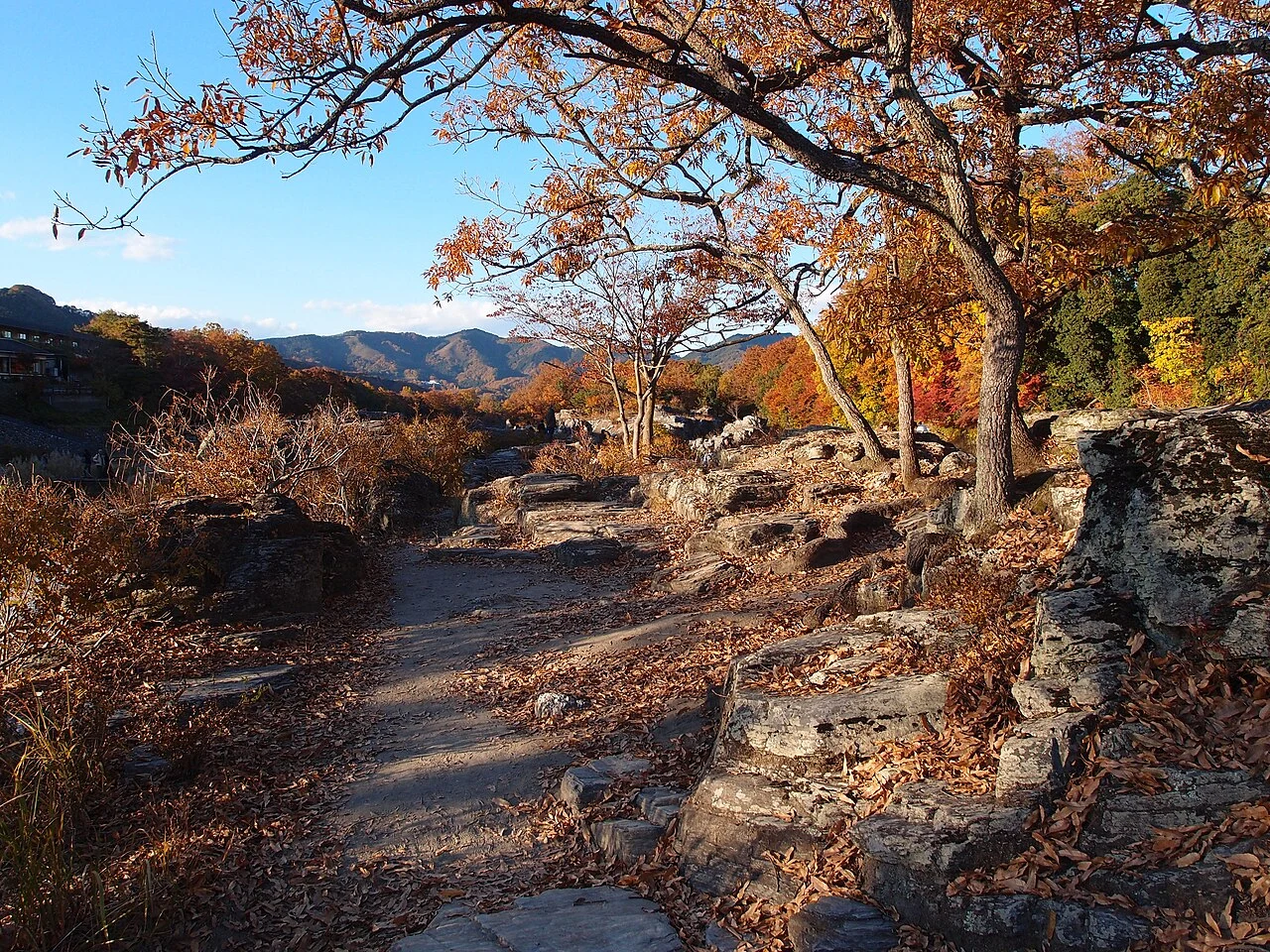
About a five-minute walk from the Ikaho Rotenburo car park near Yumoto lies Kajika Bridge, a seasonal highlight worth adding. This vermilion arched bridge turns into one of Gunma's celebrated autumn-foliage spots from late October to mid-November, and glows with fresh green maple leaves from mid-May to mid-June. Visiting in spring or autumn, always pair Kajika Bridge with your soak at Ikaho Rotenburo.
Winter (December to March) brings the most atmospheric soaking, yet Ikaho's mountainside location means snow can delay or thin out bus services. Build generous buffers into winter transfers and check Kan-etsu Kotsu and local bus advisories on the morning of travel; drivers must ensure vehicles are fitted with snow tyres and winter gear. Picking between the three car-free routes comes down to starting point and bags: travel straight from Shinjuku with light luggage on the Joshu Yumeguri highway bus; ride the Shinkansen from Tokyo or Ueno to JR Shibukawa Station if you want the 30-minute bus plus the ¥500 station-to-ryokan bag delivery; or take the 70-minute Gunma Bus straight from Takasaki Station if you are already exploring the Takasaki area.
Fitting Ikaho into a Wider Gunma Itinerary
Ikaho pairs effortlessly with fellow Gunma spa town Kusatsu Onsen for a two-onsen trip; there is no direct bus between them, so all connections route through JR Shibukawa Station. Our guide to Kusatsu Onsen stays covers accommodation and how to weigh Tokyo-area hot-spring choices—read alongside this guide, you have a complete Gunma twin-spa plan. Rather than cramming both major towns into one day, give yourself two days and one night: on day one, drop your bags at Shibukawa Station for ¥500 delivery to your Ikaho ryokan, walk Stone Steps Street light, soak in both springs, and stay overnight; on day two, take a morning bath or ride the Ikaho Ropeway before heading back down to Shibukawa Station and continuing north following the Kusatsu stays transport section. Keep in mind Shibukawa's luggage delivery only serves Ikaho properties, so you will carry your own bags onwards to Kusatsu.
When booking an overnight stay in Ikaho, narrow down hotels using just two criteria: spring source—Kogane no Yu, Shirogane no Yu, or a property piping both—and location—along Stone Steps Street for easy snacking and browsing, higher up in quiet Yumoto near the springhead, or around Ikaho Rotenburo with its Kodakara no Yu heritage. Lock in those two decisions before comparing prices and dining plans, and choosing a room becomes far quicker.
Two seasonal windows stand out above the rest: late October to mid-November for autumn colours around Kajika Bridge, and mid-May to mid-June for bright spring foliage across the same valley. Outside those weeks, Stone Steps Street and both public bathhouses operate smoothly year-round, with only the scenery around Kajika Bridge shifting through the seasons.
Mount Haruna's Futatsudake peak behind the spa town is the geothermal engine feeding Ikaho. Drivers can easily combine the town with Lake Haruna or Haruna Shrine on the same day, using the free Kajika Bridge car park (around 20 spaces, five minutes on foot from Ikaho Rotenburo and the bridge)—just verify snow tyres are fitted during the December-to-March snow season. Non-drivers have plenty to fill a day too: operating since 1962, the Ikaho Ropeway climbs straight from Hototogisu Station to sweeping mountain views on clear days, and combining trunk buses, Town Bus Route 1, and Shibukawa Station's ¥500 bag delivery makes a car-free trip seamless; simply check the ropeway website on the morning for wind or snow suspensions.
Tick off six quick checks before you travel and all that remains is strolling and soaking: align your dates with Ishidan no Yu's closures (second and fourth Tuesdays) and Ikaho Rotenburo's closures (first and third Thursdays); decide whether to alight at Ikaho Onsen or Yumoto stop to avoid backtracking; use the ¥500 hands-free bag service at Shibukawa Station; choose Kogane no Yu or Shirogane no Yu based on your party's health and hotel labels; add Kajika Bridge to your Yumoto walk in spring or autumn; and check whether Kogane no Yu Kan has announced a reopening before heading out light.
Two Ways to Structure Your Ikaho Trip
For a streamlined day trip from Tokyo, catch an early train to Shibukawa and bus uphill in time for Ishidan no Yu's 10:00 am opening to wash and take your first soak. At 11:00 am, wander up all 365 steps of Stone Steps Street taking in the poem tablet, Yudaki cascade, zodiac plaques, and Komaguchi sluices, before stopping for a 12:30 pm street lunch with hot yunohana manju. Around 2:00 pm, ride the bus up to Yumoto for free-flowing Kogane no Yu and a sip at the drinking tap inside Ikaho Rotenburo, leaving by 4:30 pm to catch a 5:00 pm bus down to Shibukawa for the Shinkansen back to Tokyo. Combined bath entry is ¥1,400 (plus ¥400 for a small towel or ¥1,200 for a bath towel if needed), wrapping up 400 years of spa history in a single day. To cover both the steps and Yumoto in one day without retracing your route, either alight at Ikaho Onsen stop to walk downhill and catch Route 1 from Yumoto, or soak at Ishidan no Yu at the foot first and climb up to Ikaho Rotenburo.
For an unhurried two-day, one-night stay focused on night streets and morning baths, reach Shibukawa before noon on day one, pay ¥500 to send heavy luggage ahead to your ryokan, and spend the afternoon strolling Stone Steps Street and soaking at Ishidan no Yu. Check in by dusk for your ryokan's dinner-and-breakfast plan and in-house Gold or Silver Spring baths, then slip on a coat after dark to wander the hushed, lantern-lit steps and shooting galleries. On day two, arrive at Ikaho Rotenburo when it opens at 10:00 am (9:00 am from April to September) for a morning soak—winter's crisp air against steaming russet water is unforgettable—then check out, walk over to Kajika Bridge for autumn leaves or spring greenery, and head back to Shibukawa in the afternoon.
Families with young children should dial the pace down another notch. Build the afternoon around retro shateki shooting games, hunting for zodiac plaques along the steps, and warm steamed manju, pausing on the wide landings for snacks every few flights. For bathing, stick to Ishidan no Yu with its indoor pools and full washing stations rather than Ikaho Rotenburo, which lacks showers and makes washing toddlers awkward. Be sure to use the hands-free luggage drop at Shibukawa Station so your hands stay free on buses and stairs, letting everyone enjoy the town at ease.
A few useful answers
Can I bathe in Ikaho's hot springs without staying overnight?
Yes. Municipal Ishidan no Yu costs ¥800 for adults (open 10:00-20:00, closed second and fourth Tuesdays), while the tourist association's Ikaho Rotenburo costs ¥600 for adults (free-flowing Kogane no Yu; open 10:00-18:00 October-March and from 9:00 April-September; closed first and third Thursdays, open daily in August). Kogane no Yu Kan is currently temporarily closed—check official association notices for any reopening date.
What is the difference between Kogane no Yu and Shirogane no Yu?
Kogane no Yu (Gold Spring) is an iron-rich sulphate spring that emerges clear before turning russet brown in air, designed to warm the body deeply from the core. Shirogane no Yu (Silver Spring) is a clear, gentle cold mineral spring containing metasilicic acid, well suited to fatigue recovery, older guests, and convalescents. Both Ikaho Rotenburo and Ishidan no Yu feature Kogane no Yu, while Shirogane no Yu is primarily piped into individual ryokan—check each property's spring listing when booking.
How long does it take to climb Stone Steps Street?
An unhurried stroll up all 365 granite steps—including browsing shops and pausing on the frequent landings—takes roughly 30 to 45 minutes, though there is no official fixed duration. The Yudaki cascade and plaza sit near the middle, giving plenty of spots to rest; walking downhill from the Yumoto top end takes the least effort, so your choice of bus stop sets your direction.
How do I get to Ikaho Onsen from Tokyo?
Take a Shinkansen or JR train to Shibukawa Station and transfer to the Kan-etsu Kotsu bus bound for Ikaho Onsen (about 30 minutes), or catch the direct Joshu Yumeguri express highway bus from Shinjuku. International visitors can buy the Shibukawa-Ikaho Area Pass (¥1,500 adults) at the Shibukawa Regional Products Centre, and bags under 25 kg can be sent from the Shibukawa Station forecourt directly to Ikaho accommodation for ¥500 per piece.
Official information and references
Sources used in this guide.
- Shibukawa Ikaho Onsen Tourism Association | Homepage (Overview of Gold and Silver Springs)
- Tourism Association | Stone Steps Street (365 Steps, Yudaki Cascade, and Zodiac Plaques)
- Tourism Association | Spring Qualities and Benefits (Kogane no Yu and Shirogane no Yu)
- Tourism Association | Ikaho Rotenburo (Free-Flowing Kogane no Yu, Drinking Tap, and Fees)
- Tourism Association | Day-Trip Hot Springs Directory and Kogane no Yu Kan Closure Notice
- Tourism Association | Ikaho Chronology (1576 Steps Origins, 1950 Rotenburo, 2010 365-Step Completion)
- Shibukawa City | Stone Steps Street (Tensho 4 Origins and Setting of Hototogisu)
- Shibukawa City | Spring Classification (Chemical Composition of Kogane no Yu and Shirogane no Yu)
- Shibukawa City | Ishidan no Yu (Opening Hours, Closing Days, and Admission Fees)
- Shibukawa City | Ikaho Rotenburo Access, Hands-Free Luggage Service, and Area Pass