Compare hotels around JR Ashikaga, Tobu Ashikagashi and Oyama stations, weighing late-night Shinkansen connections, breakfast, parking, communal baths and Toyokan half-board stays after the Ashikaga Flower Park illuminations.
- Region & Focus
- Ashikaga
- Reading Scope
- 18 min read · 10 chapters · 8 Q&As
- Official Verification
- 36 official sources checkedUpdated 22 November 2026
- Key Topics
- Where to stayBookingRail travel
Chapter Route Map (tap any stop)
- Start with the station you can reach at night
- Why the 22:50 train to Oyama misses Tokyo
- Two hotels at the JR Ashikaga North Exit
- New Miyako Main Building and Annex at Tobu Ashikagashi
- Walkable and driving options around Oyama
- Reserve Toyokan's half-board stay for nights you can arrive before dinner
- Booking sequence for winter illuminations and spring wisteria
- Compare total trip cost with dinner, children and luggage included
- First stops next morning and wet-weather backups
- Test your hotel booking against three real itineraries
- Quick Q&A
If it is your first visit to Ashikaga for the illuminations and you also want to see Ashikaga School the next morning, stay near the North Exit of JR Ashikaga Station. It is one stop back into town from the flower park, putting the historic sights within walking distance after breakfast. If your onward journey heads back towards Asakusa or Kita-Senju, the main building and annex beside Tobu Ashikagashi Station make for a smoother departure. Oyama Station suits travellers saving the Shinkansen for the following morning. Anyone hoping to return to Tokyo the same night should note that under the December 2026 timetable, the 22:50 last train from Ashikaga Flower Park Station only gets you as far as Oyama, after the final Tokyo-bound bullet train has already departed.
Start with the station you can reach at night
Two separate railway networks connect Ashikaga with Tokyo. JR trains run from Tokyo, Ueno or Shinjuku to Oyama, where you change onto the Ryomo Line. Tobu Railway's limited express Ryomo runs directly from Asakusa or Kita-Senju to Ashikagashi Station on the south bank of the Watarase River. JR Ashikaga Station and the historic town centre sit on the north bank. Because there is no shared transfer concourse between the two stations, always check which railway a 'station-front' hotel faces so you know whether you will be crossing the river after dropping your bags.
If you plan to explore the town first and head out for the illuminations towards dusk, JR Ashikaga Station is the easiest base. Ashikaga Flower Park Station is the very next stop towards Oyama, taking roughly six to seven minutes by train, and you simply ride back in the Kiryu or Takasaki direction afterwards. From the station exit, it is about a three-minute walk to the park's designated entrance. The neighbouring stop further towards Oyama is Tomita Station, so make sure the train and station signs clearly read Ashikaga Flower Park.
When your next morning begins on the Tobu network, staying beside Ashikagashi Station saves one luggage haul. Even so, you will need to factor the river into your evening return, as the park's access guide explicitly states there is no direct shuttle bus to Tobu Ashikagashi Station. Most visitors take the JR train back to JR Ashikaga Station and cross the Watarase River to their hotel. If you are coming straight from the Tobu network without stopping in central Ashikaga first, change at Tatebayashi onto the Tobu Sano Line and transfer at Sano to the JR Ryomo Line. The convenience of staying by the Tobu station mainly pays off at arrival and check-out.
Once you move the Shinkansen ride to the next morning, Oyama becomes a very practical overnight stop. This works especially well if you are travelling up from Tokyo or Omiya during the day and have a longer rail leg early the following morning: drop your bags at an Oyama hotel and head out to the park with just a daypack. Bear in mind that if you want to visit Ashikaga's historic sights the next day, you will have to ride back out to Ashikaga and return along the same line. A single night's choice makes a noticeable difference to your usable morning hours.
| Where you stay | Getting back from the flower park | Best-suited itinerary |
|---|---|---|
| JR Ashikaga Station | JR Ryomo Line towards Kiryu or Takasaki | Visiting Ashikaga School and Bannaji Temple next morning, or departing by JR |
| Tobu Ashikagashi Station | Take JR back to JR Ashikaga, then walk or take a taxi across the river | Using Tobu limited express services to and from Asakusa or Kita-Senju on both days |
| JR Oyama Station | JR Ryomo Line towards Oyama | Heading straight back to sleep after the lights, then catching the Shinkansen or Utsunomiya Line next morning |
Compare hotels around JR Ashikaga, Tobu Ashikagashi and Oyama stations, weighing late-night Shinkansen connections, breakfast, parking, communal baths and Toyokan half-board stays after the Ashikaga Flower Park illuminations.
Why the 22:50 train to Oyama misses Tokyo
Under the December 2026 JR Ryomo Line timetable, the last local train leaving Ashikaga Flower Park Station towards Oyama departs at 22:50 on both weekdays and weekends/public holidays, arriving at Oyama at 23:23. By then, the final Tokyo-bound Shinkansen has already left Oyama at 22:39, and even the last Utsunomiya Line train to Omiya departs at 23:08. That 22:50 service only works if you are staying in Oyama or along the Ryomo Line; anyone with a hotel room waiting in Tokyo needs to catch an earlier departure.
On the same timetable, the 21:45 train from Ashikaga Flower Park reaches Oyama at 22:27, leaving 12 minutes to connect onto the 22:39 Yamabiko Shinkansen to Tokyo. Buy or collect your tickets before setting off and follow the Shinkansen Transfer Gate signs straight off the platform. If you are travelling with a pushchair, bulky suitcases, or still need to use a reserved-seat ticket machine, take the 20:58 train instead: it arrives at Oyama at 21:42, giving a comfortable 23-minute buffer before the 22:05 Tokyo Shinkansen.
Local trains can also save you the Shinkansen limited express surcharge. Based on the December timetable, after the 21:45 Ryomo Line train pulls into Oyama, there is still a local Utsunomiya Line service to Ueno at 22:47 on weekdays and 22:46 on weekends and public holidays. Reaching Tokyo Station, Asakusa or other neighbourhoods from Ueno adds another leg on top of that. Check your door-to-door arrival time for that evening before deciding whether the slower ride is worth the saving; if you have an early booking next morning or your group has to split up across different lines back in Tokyo, sleeping in Oyama is usually far less stressful than chasing the last train.
The park's standard evening closing times are 20:30 on weekdays and 21:00 on weekends and public holidays, extended by 30 minutes from 7 November to 3 January, with further plans to stay open until 21:30 daily from 24 to 30 December. When closing at 21:30 meets a 21:45 Oyama-bound train, you only have 15 minutes to walk the garden paths, clear the exit and queue through the station gates. If 21:45 is your hard cut-off for getting back to Tokyo, you will need to start leaving the park earlier; staying locally makes far more sense if you want to linger until closing.
Heading back to JR Ashikaga Station gives you more breathing room. On the December weekday and holiday timetables, after the 21:22 and 22:06 westbound local trains towards Kiryu and Takasaki, there are still Kiryu-bound services at 22:55 and 23:45 that stop at Ashikaga first. Those westbound departures let anyone staying in central Ashikaga enjoy the displays a little longer. If your hotel is on the Tobu side, simply budget for the river crossing after stepping off the JR train, and consider eating before entering the park on late nights when town restaurants have already closed.
Travellers based in Chiba or Saitama can also look at the seasonal limited express Kirakira Ashikaga Illumi. JR East has announced services for 12 and 19 December 2026 as well as 14 February 2027, with the return train leaving Ashikaga Flower Park at 20:05 and calling at Omiya, Minami-Urawa and Shin-Matsudo before terminating at Nishi-Funabashi. All seats are reserved and go on sale at 10:00 JST one month before travel; Ashikaga Flower Park Station does not sell limited express tickets and cannot issue paper tickets booked online. If you use it for a day trip, time your arrival around dusk and eat dinner early so you are not forced to choose between queueing for food and seeing the lights.
Two hotels at the JR Ashikaga North Exit
Toyoko Inn Tochigi Ashikaga-eki Kita-guchi sits just a one-minute walk from the JR North Exit. It is the shortest stroll off the Ryomo Line and lets you repack your bags calmly before checking out. Check-in is at 15:00 and check-out at 10:00, with a complimentary buffet breakfast served from 6:30 to 9:00—much easier to rely on before an early train than waiting for shops in the old town to open. Parking is first-come, first-served at ¥700 per night across 30 mechanical spaces and 20 flat bays. If you already know your hire car model, check the official mechanical-bay limits of 1.85 m width and 2.0 m height before booking.
Hotel Route-Inn Ashikaga Ekimae stands around 400 metres—roughly a five-minute walk—from JR Ashikaga Station, placing it neatly along the route into the historic district. Check-in and check-out are likewise 15:00 and 10:00, with complimentary breakfast from 6:45 to 9:00. Its artificial hot-spring communal bath opens from 15:00 to 02:00 and again from 05:00 to 10:00, making it far easier to enjoy a late soak after the illuminations than catching dinner on site. The in-house restaurant Hanahanatei opens from 18:00 to 22:00 with last orders at 21:30, and closes on Sundays and public holidays.
If you are driving an SUV or tall people carrier, read Route-Inn's 'free parking' note alongside the height restriction. Only 39 bays are flat outdoor spaces; the other 60 are in a parking tower capped at 1.55 m high, which also excludes cars with certain exterior fittings or roof racks. The hotel notes that flat bays often fill up after 20:00. If your car exceeds the tower limit and you plan to arrive after the illuminations, consider checking in and parking early before taking the Ryomo Line out to the park, or pick a hotel with purely surface parking. Should the flat bays be full on arrival, speak to reception first, as staff may direct you to a tourist car park five to six minutes' walk away.
If you switch to a Tobu limited express the next morning, Route-Inn runs a pre-booked morning shuttle to Tobu Ashikagashi Station. Departures run every 30 minutes from 7:00 until 9:00, which helps if you want to lock in a seat before choosing your train. Travellers who plan to have breakfast and tour Ashikaga School first before boarding at Tobu will simply walk over after collecting their stored luggage. Staying between the two stations lets you decide which line to leave on after breakfast, whereas the early shuttle is strictly for heading straight out.
Route-Inn publishes clear co-sleeping rates for younger children: ¥2,000 for primary-school children and free for preschoolers. Bed-sharing keeps costs down for a quick one-night stay with an early start, though comfort still matters. If restless sleepers, two large open suitcases or a preference for separate beds would crowd one room, compare the combined rate for two rooms against the four-person Japanese-style rooms near Ashikagashi Station rather than sorting purely by the lowest headline price.
New Miyako Main Building and Annex at Tobu Ashikagashi
The Ryomo limited express from Tobu Asakusa reaches Ashikagashi in roughly 70 to 75 minutes. Tobu's access guide lists the adult one-way base fare at ¥990, plus ¥1,050 for a standard Ryomo limited express supplement, making ¥2,040 in total. Certain Revaty Ryomo services carry different supplement fares, so verify the exact price when selecting your train. Tobu reserved seats go on sale at 9:00 JST one month prior to travel, and boarding at Kita-Senju is usually just as straightforward—worth comparing if you are staying on the eastern side of Tokyo.
Hotel New Miyako Ashikaga Honkan (Main Building) sits directly beside Ashikagashi Station—listed officially as a zero-minute walk—with around 50 free flat parking spaces. The Annex (Bekkan) is roughly a three-minute walk from the north exit along the road parallel to the Watarase River, identifiable by its brick ground-floor facade. Save both the exact building name (Honkan or Bekkan) and street address in your booking notes: both share the same station name, and turning up at the wrong building in the rain with suitcases means backtracking down the road.
The Main Building offers two 36-square-metre Japanese-style rooms that each sleep up to four guests. If you prefer Western beds, look for its single 36-square-metre Family Twin room—also sleeping up to four—with views towards the Watarase River. When travelling with older relatives, weigh tatami futons against easier bed height and bathroom layout. For groups of four determined to share one room, these specific room types sell out faster than standard rooms and often dictate which dates remain available. The Annex takes a simpler business-hotel approach with a free light breakfast and 24-hour front desk, letting light packers put the price difference towards limited express tickets or dinner.
To enjoy an unhurried breakfast in the Main Building, head to the upper-floor restaurant, open from 7:00 to 9:30 with last entry at 9:00; if your booking includes breakfast, it is worth leaving that morning window open. Lunch and dinner in the restaurant require advance group bookings of at least 10 people, with dinner reserved three days ahead. Couples returning late from the illuminations should eat before entering the flower park or ask the Main Building desk for a local dining map showing kitchens still open.
Reconstruction work around Nakahashi Bridge is still under way. The city has opened the historic three-arch bridge deck for pedestrians and cyclists, while drivers must follow signed detours across the river. Leaving from New Miyako's Annex, you can stroll up onto the bridge towards Ashikaga School and continue into the old town. In wet weather or with a pushchair, save a separate north-bank hotel or landmark pin on your phone map so both walking routes and taxi drop-offs stay unambiguous.
Walkable and driving options around Oyama
Super Hotel Oyama sits on the West Exit side, officially a five-minute walk from JR Oyama Station, with 15:00 check-in and 10:00 check-out. Bear in mind that the 22:50 last train only reaches Oyama at 23:23 and Super Hotel's final check-in cut-off is 24:00, leaving little margin after walking from the platform. Checking in earlier on your way through Oyama is far simpler so you can walk straight up to your room at night. Free breakfast runs 6:30 to 8:30 Monday to Saturday and until 9:00 on Sundays and public holidays; if you have an early train out of Oyama, factor in the walk from your room to the ticket barriers rather than relying solely on the five-minute station estimate.
The natural hot-spring bath Izuru no Yu operates on alternating gender slots in a single bathing hall: women from 20:00 to 22:50 and 07:00 to 09:50 next morning, and men from 15:00 to 19:50 and 23:00 to 06:50. Taking the 21:45 Ryomo Line train puts you at Oyama at 22:27, meaning women aiming for the late evening slot really need to have checked in and dropped bags earlier in the afternoon. Men returning on that same train only wait until 23:00. Families sharing a trip can split up—women before bedtime, men after 23:00—though anyone returning on the 22:50 train leaves the women's soak for the next morning.
Oyama Grand Hotel in Jintori, Oyama City, is listed as a five-minute drive from Oyama Station and offers 300 parking spaces. It makes sense if you are driving yourself or have family picking you up. Rail travellers comparing it against station-side hotels should add the late-night taxi fare from the station, the return fare with luggage next morning, and the wait time for a morning pick-up before deciding whether the room rate actually works out cheaper.
From Tokyo, the Tohoku Shinkansen reaches Oyama in around 40 minutes, while slower Utsunomiya Line trains run straight up from Ueno and Omiya depending on where you are starting from. With older travellers or heavy suitcases, spot the West Exit and Shinkansen Transfer Gate as soon as you arrive: exit the barriers if you are heading to your hotel, or stay inside the paid zone to board the Ryomo Line for the flower park. If your next morning involves a northbound Shinkansen connection from Omiya, double-check that your chosen train actually stops at Oyama and matches both train name and departure station.
Reserve Toyokan's half-board stay for nights you can arrive before dinner
Jizo no Yu Toyokan sits in Hajika-cho on the western side of Ashikaga, dating back to the late Meiji era. It is around five minutes by taxi from JR Omata Station or 20 minutes from Tobu Ashikagashi Station, appealing to travellers who want tatami rooms, dinner and an open-air bath wrapped into one evening. If you book a half-board (two meals) stay, confirm the final meal arrival cut-off before planning your flower park visit, and do not pair it with staying in the park until 21:30. A smoother split is dining at the ryokan on night one and sightseeing or seeing the blooms after checking out next morning; if winter night illuminations are your main goal, spend illumination night at a station-side hotel and save the ryokan for another night.
Check-in begins at 16:00 and check-out is at 10:00, with overnight guests able to use the baths straight through until 9:00 the next morning. When weighing a half-board ryokan rate against city hotels, add the cost of dinner and breakfast back into the city option for a fair comparison. In spring, if you plan to queue for the earliest morning park opening, you might miss ryokan breakfast altogether—making a town hotel a better fit the night before. Day-use bathing followed by an evening illumination visit pairs far more easily with a hire car so you are not detouring back out to Hajika-cho the next day.
Travellers without a car can use Toyokan's shuttle from Omata Station. The ryokan asks guests to contact them directly no later than the day before check-in with their train arrival time and party size so a pick-up can be arranged. That transfer only covers check-in and check-out; getting to and from Ashikaga Flower Park still depends on Ryomo Line schedules. If your real priority is simply a hot bath after the illuminations and an easy walk from the station to your door at night, Route-Inn in central Ashikaga or Super Hotel in Oyama removes an extra transfer and makes meal timing much simpler.
Drivers can set satnav for Toyokan and the Ota-Kiryu Interchange, with 40 standard parking bays available at the ryokan. On busy weekends when you visit the flower park first, remember to allow time to walk back to your car and drive out to Hajika-cho. The park's free temporary overflow car parks spread out away from the main gate, so note your exact parking zone before entering—relying purely on the entrance pin will skew your drive-time estimate back to dinner. Treat the ryokan's meal time as a hard deadline and arrive early for the lights, or save the garden for daylight the following morning.
Booking sequence for winter illuminations and spring wisteria
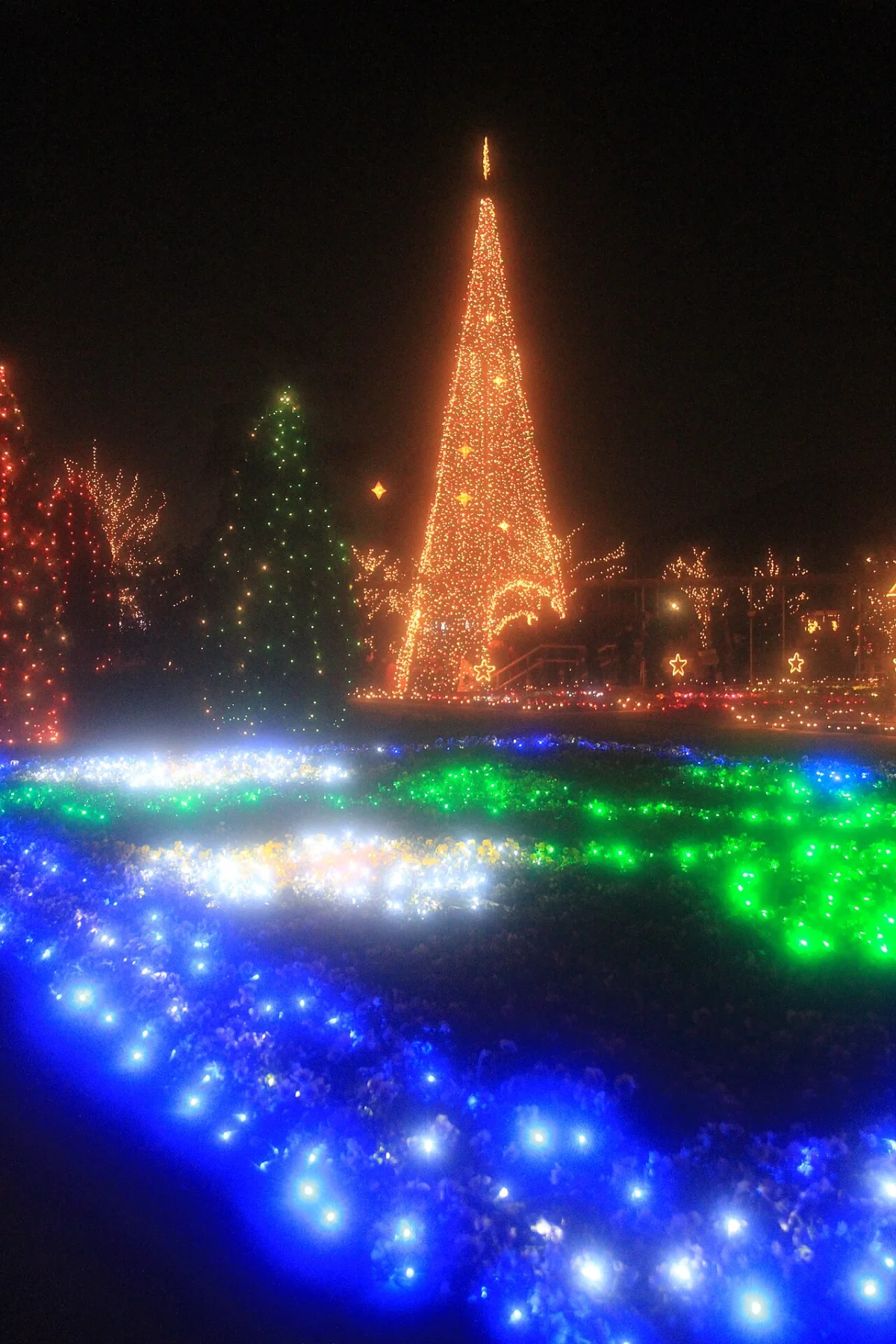
The 25th Flower Fantasy illumination season runs from 17 October 2026 to 14 February 2027, closed on 31 December. Evening admission starts at 15:30 at ¥1,500 for adults and ¥800 for children (aged four through primary school). Daytime and evening sessions are ticketed separately, so visitors inside during the day must buy an evening ticket to stay after dusk. Lights switch on around 16:30 from 7 November to 3 January and around 17:00 on other dates; if you want both daytime blooms and evening displays, the afternoon changeover gap is an ideal window to check into your hotel or grab an early meal in town.
Holiday closures overlap awkwardly between Christmas and New Year. While the flower park plans to stay open until 21:30 daily from 24 to 30 December, Ashikaga School closes from 29 to 31 December. Guests arriving on 28 December who want to see the school should fit it in that afternoon, whereas 29 December arrivals can focus on Bannaji Temple instead. Anyone arriving on the evening of 31 December can sleep near whichever station suits their departure and visit the flower park on 1 January.
Spring's Great Wisteria Festival combines daytime and illuminated evening viewing on a single entry. The 2026 season ran from 11 April to 20 May, with night lighting from 15 April onwards; daytime ticket holders could remain inside without clearing the park, while separate evening admission began at 17:30. Adult daytime tickets ranged from ¥1,200 to ¥2,300 (children ¥600 to ¥1,200) depending on peak bloom, and from 18 April to 6 May 2026 gates opened as early as 7:00—perfect for guests staying overnight in Ashikaga or Oyama to catch an early train. Use those dates as a rough benchmark for early mornings and room demand, and plug in the 2027 opening and lighting times once officially announced.
If you are booking an overnight stay around a specific wisteria variety, pick your flower first. The park notes that Great Wisteria and purple wisteria typically peak from late April to early May, white wisteria in early May, and pale pink wisteria slightly earlier. If your spring dates are flexible, book a cancellable room rate first and lock in your early train once the park's daily bloom photos confirm peak colour. When tied to a single public-holiday weekend, secure the twin rooms, Japanese-style rooms or adjoining rooms you actually need straight away; if central Ashikaga sells out, widening your search to Oyama usually beats refreshing one full hotel page all week.
Align room bookings with each rail company's ticket release calendar. Route-Inn, for instance, opens online bookings up to eight months ahead, with deposit and cancellation deadlines tied to the specific rate plan you choose. In winter, if your dates are flexible and you travel on a weekday, catching an earlier train back to your hotel shifts the decision away from 'which hotel still has a room' to 'whose breakfast hours and communal bath schedule match your evening'.
Compare total trip cost with dinner, children and luggage included
Always switch booking search filters to your exact headcount before comparing nightly rates. A twin room may display a per-room figure alongside per-person pricing at the top of search results. Add dinner, parking fees and return train fares to build a true comparison: staying by JR Ashikaga puts the park one stop away, whereas staying in Oyama and doubling back into Ashikaga the next morning adds an extra return rail ticket. The same applies to drivers—when room rates sit within a few hundred yen of each other, weigh Toyoko Inn's ¥700 parking fee against the fuel and hassle saved by being beside the station.
If you already hold two consecutive nights in Tokyo, moving your Ashikaga trip earlier in the afternoon avoids paying for a separate country hotel altogether. Conversely, if you are coming from Tokyo on day one and heading onwards to Utsunomiya the next morning, shifting that single night from Tokyo to Oyama becomes a straight trade between two hotel rates plus one less late-night rail leg. When travelling with older relatives, mapping that door-to-door flow reflects real fatigue far better than staring at the last Ryomo Line departure time alone.
Eating dinner early pays off twice: families with young children dodge post-closing restaurant queues, and photographers do not lose prime dusk viewing hours waiting for a table. Once dinner slips past 20:30, staying close to JR Ashikaga preserves precious sleep if you plan an early morning walk around the historic quarter. A few minutes on the Ryomo Line train are effortless; it is standing on cold platforms, changing lines and walking across the river bridge that stretches an evening out.
Leave large suitcases at your hotel before visiting the park. Lockers sit beside the main gate shop in limited sizes and numbers, and wheeling luggage through crowded illumination paths is awkward. The park loans free manual wheelchairs on a first-come, first-served basis, offers no pushchair rentals, and prohibits pull wagons, camping trolleys and wagon-style strollers inside. Rail travellers bringing a standard folding pushchair should pick less rushed train connections, and anyone switching to a taxi should save the hotel's address and Japanese name on their phone so saying 'Ashikaga Station' does not send them to the wrong side of the river.
When family members arrive at different times or via separate railway lines on the same day, agree on a clear indoor meeting point. Tobu Ashikagashi Station houses the Ashi-Navi tourist information centre alongside coin lockers, lifts and baby-changing facilities, making it comfortable for early arrivals to wait. If your itinerary begins on the JR side, meet at the JR North Exit instead; whoever arrives in a hurry can go straight to the pre-booked hotel while the other tracks down the exact building name, avoiding an unnecessary river crossing.
First stops next morning and wet-weather backups
Staying on the JR Ashikaga side puts you at the gates of Ashikaga School right when it opens at 9:00. Official access times are around 10 minutes on foot from JR Ashikaga Station or 15 minutes from Tobu Ashikagashi Station. Admission is ¥480 for adults, ¥240 for senior high school students, ¥120 for primary and junior high students from outside the city, and free for preschoolers. Last entry is 16:30 from April to September and 16:00 from October to March. Scheduled closures in fiscal 2026 fall on 16 December, 29–31 December, 20 January 2027, 17 February 2027 and 17 March 2027—cross those off your booking calendar straight away if the school is your main reason to stay overnight.
Thatched-roof restoration on the Hojo main hall is scheduled through 25 March 2027, closing interior access to the Hojo and certain paths fronting the South Garden while the rest of the grounds stay open. To watch the Analects animation normally screened inside the Hojo, head to the history exhibition area at Ashikaga Machinaka Yugakukan in Tori 1-chome, a five-minute walk from JR Ashikaga Station. Entry is free from 9:00 to 17:00 (generally closed on the third Wednesday of each month plus the New Year period). On a rainy morning, stepping inside after seeing the school gate and Confucius shrine saves trekking across town before collecting your bags.
Bannaji Temple makes a natural second stop. Follow the stone-paved approach across the small moat bridge through the main gate to the National Treasure main hall, then continue on to the Taiheikikan visitor centre for tourist information and indoor seating (open 9:00 to 17:00, closed 29–31 December). Save longer town walks for dry mornings when energy is high; wearing the waterproof jacket from the night before and shoes with decent grip makes wet cobblestones far easier to manage than juggling umbrellas and rolling suitcases. If your hotel holds bags after check-out, leaving them behind for a hands-free stroll is the cleanest route.
Because the flower park's illuminations and garden paths are mostly outdoors, staying overnight gives you flexibility in light rain to swap indoor town halls with garden hours—especially in spring, when single-ticket re-entry to dusk lets you wait out a passing shower. In winter, if you only plan to cover the headline light zones, decide on an earlier Ryomo Line return before leaving your room rather than shivering outdoors until closing. Check our Ashikaga Flower Park illumination guide for layout zones, and pair bag pick-up with the Ashikaga School and Bannaji walking route.
Test your hotel booking against three real itineraries
For an illuminations-plus-school trip, book one night at the JR Ashikaga North Exit. After afternoon check-in, check the Ryomo Line departure board, allow walking time back to the station, and prioritise your must-see light zones first. If dining at Route-Inn's restaurant, catch a return train ahead of the 21:30 last-order cut-off, or eat before entering the park on Sundays and public holidays. Next morning, leave your bags with reception at check-out, wander the historic quarter through lunch without rushing back to the room, and take the JR train back to Oyama with time for a midday meal before boarding your Shinkansen.
If you only want the illuminations between two travel legs and are heading north next morning, base yourself at Oyama. Drop luggage at your hotel first, ride out to the park light-handed, and take the Ryomo Line straight back to the same station at night. If your onward northbound Shinkansen skips Oyama, catch the Utsunomiya Line to connect at Omiya or Utsunomiya with plenty of transfer margin. Women hoping to use Super Hotel's hot-spring bath can either catch an earlier evening train or take the 7:00 morning slot before a post-breakfast Shinkansen.
Travelling with children or older relatives from Asakusa? Book an earlier Ryomo limited express, check bags into New Miyako's Main Building, and plan your evening river crossing while everyone still has energy in their legs. If your group splits up inside the flower park, agree to regroup near the park entrance towards the station before walking up to the platform together rather than waiting for every photo along the trails. Book your return Tobu reserved seats together in advance so you can walk straight from breakfast and check-out onto the train next morning.
A few useful answers
Where is the easiest place to stay for a first-time visit to the Ashikaga illuminations?
Choose JR Ashikaga Station's North Exit if you want to walk to Ashikaga School and Bannaji Temple next morning. Pick Tobu Ashikagashi Station if travelling both ways by Tobu limited express, or Oyama Station if your priority is catching a morning Shinkansen.
Can I take the 22:50 Ryomo Line train and get back to Tokyo the same night?
Under the December 2026 timetable, the 22:50 departure from Ashikaga Flower Park arrives at Oyama at 23:23—after both the 22:39 final Tokyo-bound Shinkansen and the 23:08 final Utsunomiya Line train to Omiya. To catch a Tokyo Shinkansen at Oyama, aim for the 21:45 or 20:58 train instead.
Is there a shuttle bus from Tobu Ashikagashi Station to Ashikaga Flower Park?
The flower park currently states there is no direct shuttle bus on this route. From Tobu Ashikagashi Station, cross the Watarase River to JR Ashikaga Station and ride the Ryomo Line one stop.
How do I tell the two Route-Inn hotels in Ashikaga apart?
Hotel Route-Inn Ashikaga Ekimae is in Tori 1-chome, roughly a five-minute walk from JR Ashikaga Station. Hotel Route-Inn Dai-ni Ashikaga sits in Horikomecho along National Route 50, listed by the hotel as an eight-minute drive from JR Ashikaga Station and better suited to drivers.
Do hotels in central Ashikaga have rooms for four people?
Hotel New Miyako Ashikaga Honkan (Main Building) has four-person Japanese-style tatami rooms as well as a Family Twin room for up to four. If everyone prefers separate beds, compare the price and layout of booking two twin rooms.
Can I still use the hot spring in Oyama after returning from the illuminations?
At Super Hotel Oyama, men's late bathing runs from 23:00, while women's evening access ends at 22:50. Women returning on the last 22:50 train can use the morning slot from 7:00 to 9:50 instead.
Can I visit the illuminations until closing time and eat dinner at Toyokan afterwards?
Half-board bookings at Toyokan require arriving in time for the ryokan's set dinner service. If you plan to stay at the flower park until 21:30, book a town hotel for illumination night and save Toyokan for another evening.
Do winter illumination and spring wisteria tickets let you stay from daytime into the evening?
The winter illumination season splits daytime and evening admission, so staying into the night requires a separate evening ticket. During the 2026 spring Great Wisteria Festival, the park did not clear visitors before evening lighting, allowing daytime ticket holders to stay after dark.
Official information and references
Sources used in this guide.
- Ashikaga Flower Park | 2026–27 Flower Fantasy Illuminations
- Ashikaga Flower Park | 20 November Illumination Notice and Christmas Extended Hours
- Ashikaga Flower Park | Access and Parking
- Ashikaga Flower Park | Admission and Locker FAQs
- Ashikaga Flower Park | 2026 Great Wisteria Festival Official Archive
- JR East | Ashikaga Flower Park Station Ryomo Line Timetable
- JR East | Oyama Station Shinkansen and Utsunomiya Line Timetables
- JR East | Oyama Station Shinkansen Transfers and Facilities
- JR East | 2026–27 Kirakira Ashikaga Illumi Seasonal Limited Express
- Tobu Railway | Asakusa to Ashikagashi Access and Fares
- Tobu Railway | Limited Express Ticket Purchase and Refunds
- Toyoko Inn | Tochigi Ashikaga-eki Kita-guchi
- Route-Inn | Ashikaga Ekimae Overview, Baths and Stay Policies
- Route-Inn | Ashikaga Ekimae Parking and Shuttle Reservation
- Route-Inn | Ashikaga Ekimae Breakfast and Restaurant Hours
- Route-Inn | Dai-ni Ashikaga Access and Parking
- Hotel New Miyako Ashikaga Main Building | Station Access and Parking
- Hotel New Miyako Ashikaga Main Building | Guest Rooms
- Hotel New Miyako Ashikaga Main Building | Breakfast and Dining
- Hotel New Miyako Ashikaga Annex | Access and Facilities
- Super Hotel Oyama | Izuru no Yu Hot Spring and Breakfast Hours
- Oyama Grand Hotel | Access Information
- Toyokan | Omata Station Shuttle Service Notice
- Toyokan | Guest Bathing and Check-in Hours
- City of Ashikaga | Historic Ashikaga School Admission, Hours and Restoration
- City of Ashikaga | FY2026 Ashikaga School Closure Dates
- City of Ashikaga | Ashikaga Machinaka Yugakukan
- Ashikaga Tourism Association | Ashikaga School Access and Restoration Viewing
- Ashikaga Tourism Association | Bannaji Temple
- Ashikaga Tourism Association | Taiheikikan Hours and Closure Dates
- City of Ashikaga | Nakahashi Three-Arch Pedestrian and Cycle Walkway
- City of Ashikaga | Vehicle Detour Information During Nakahashi Reconstruction
- Tobu Railway | Ashikagashi Station Facilities and Map
- Super Hotel | Check-in Cut-off and Stay FAQs
- Toyokan | Jizo no Yu Hot Spring and Ryokan History
- Ashikaga Tourism Association | Ashi-Navi Tourist Information Centre at Tobu Ashikagashi Station